
BY JEMMA FOSTER
ECOMANCY: A Garden of Forking Paths
HANGAR Lisbon
Exhibition April 2026
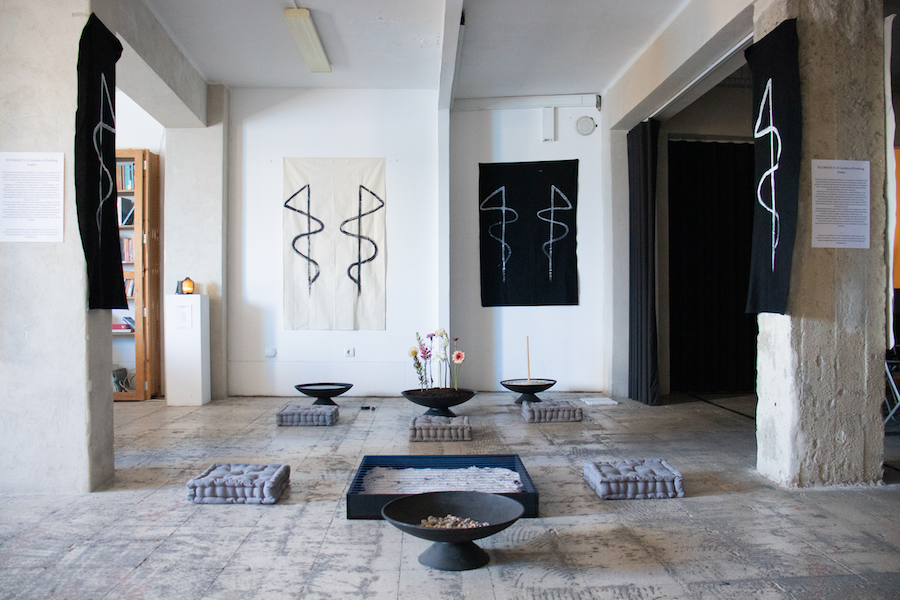
Drawing inspiration from Jorge Luis Borges’ short story The Garden of Forking Paths, this interactive installation unfolded through a series of embodied and elemental divinatory practices exploring ecology, nonlinear time, and memory. The term Ecomancy was chosen to foreground ecology as a study of relationship: a way of sensing through attunement and exchange. Visitors were invited to move through the garden as a living field of encounter, where meaning emerged through sensorial experience rather than fixed interpretation.
Rooted in ancient practices of earth divination, the work traced a series of elemental modalities: hydromancy (water), pyromancy (fire), floromancy (air), and lithomancy (earth). These systems were approached not as symbolic frameworks alone, but as embodied practices of attention and relation.
Through guided rituals of ecological time-sensing and collective acts of divination, pathways diverged and converged through a branching system of possible readings. At intervals, participants held the question:
As we remember, what is being formed?
The opening included an immersive evening of interactive performance and ritual screening exploring our relationship to the more-than-human through deep time.
We began with an embodied deep listening practice cultivating sensory awareness and psychometry with a guided stone meditation. This then evolved into a collective act of dreaming together with an open-eyed meditation and screening of a short film, 'Dreaming with Stones'.
Participants were then invited to create a temporary sigil stone sculpture as a means of attuning to the emerging field of the group, before being guided through a liminal ritual with the elements of air, fire, water and earth. In a collective act of lithomancy, the geomantic figure Caput Draconis emerged. An archetype associated with beginnings, emergence, thresholds, and creative acts: a reflection of the shared field of the group created through our collective remembering and becoming.
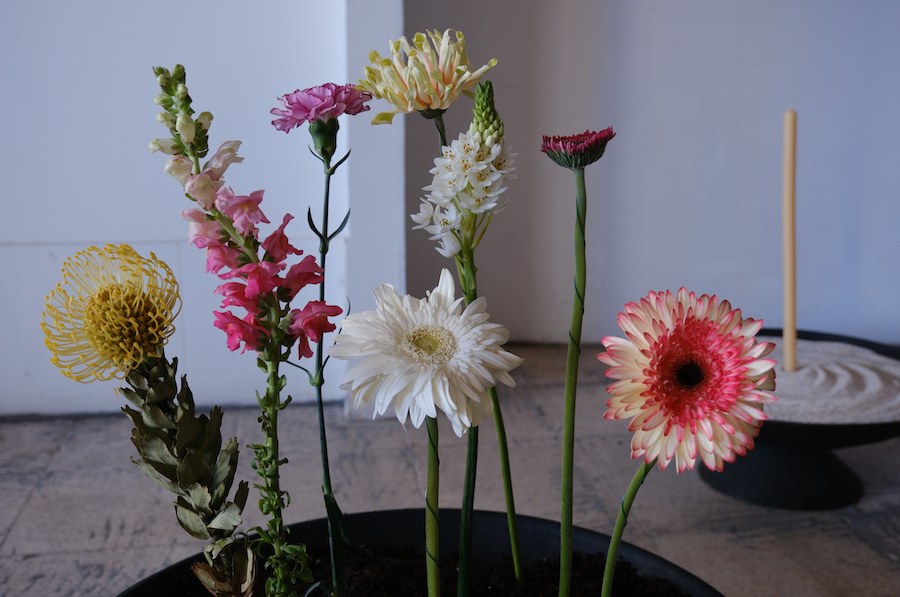
The evening concluded with a Floromancy Dinner, allowing divinatory practices to unfold at embodied intervals through practices of attention, where each botanical ingredient was randomly distributed or selected, carrying a symbolic message, each plate casting an oracle.
INTERVIEW with Jemma Foster, by CUP students Alyse Kaweng Fan, Roxana-Andreea David, and Anika Borko.
- In general, how did the exhibition unfold for you and what did you feel from the participants in response?
I was interested in creating conditions where participants could move beyond spectatorship and enter into slower rhythms of perception. The interactive rituals and performance elements created a temporary ecology composed of human and more-than-human fields of shared attention and listening as a way of sensing relationships, and perception as a subtle form of exchange.
Initially, people arrived curious about the conceptual frameworks, attempting to understand the work through interpretation. Through collective acts of remembering and sensing, there was a gradual yet noticeable movement from analytical thinking towards a more embodied mode of attention. Through shared breathing and multisensory encounters involving touch, scent and sound, conversations shifted from explanation towards stillness and relationship. I wanted the experience to be deeply personal to the individual, which was reflected in the varied responses participants had, and how they each intuited the feelings and emotions that arose from these interactions. The work positions the body as an antenna, dialing into the subtle channels of awareness through which the more-than-human world communicates. Through this process, the space transformed over the course of the exhibition into a shared field of co-creation.
- The title of the installation is related to Borges’s short story The Garden of Forking Paths. You’ve mentioned that you consider time as a “a living labyrinth of simultaneous possibilities encountered through reflection, attunement to deep time, relational remembering and entangled ecological futures”, could your advise us on how to stay more attuned to our presence even if the web of time can be sometimes bifurcating.
Our relationship with time is inherently subjective and in flux. Two people may take part in exactly the same activity for the same fixed duration, yet their experience of that time and whether it feels expansive, compressed, slow or accelerated, can be entirely different. We spend much of our lives inhabiting projections into the future or interpretations of the past, whereas the body is continually returning us to immediate experience, and it is through the body that we attune to our presence.
What I find compelling in The Garden of Forking Paths is not only the idea of multiple timelines, but the suggestion that uncertainty is not necessarily something to be resolved. Borges's labyrinth proposes a world composed of branching and overlapping realities that cannot be understood from a singular perspective. We often try to move through life by reducing complexity and searching for singular pathways or definitive answers, but ecological systems rarely operate in this way. Forests, weather systems, fungal networks and planetary processes all unfold through layered relationships and continual adaptation.
The key to greater presence is not to try and understand it, but to see the body as the vehicle through which all realities can be navigated. When you become deeply immersed in a physical activity there can be a temporary dissolution of chronological time and a heightened sense of presence. Being absolutely present is to experience a sense of timelessness. I enter this state when I am sculpting stone because I need to be fully attentive, not only to avoid injury, but also to remain in continual dialogue with the stone itself and understand the form that wishes to emerge. Even small acts of embodied attention help to anchor us into the present moment.
- The plot of Borges’ story has a reference to the Chinese classical novel Dream of the Red Chamber, which is also called The Story of Stones in Chinese. Would this also be something in relation to Lithomancy as sensory-based clairvoyance with the interaction of stones?
In Dream of the Red Chamber, there is a sentient stone that acts as the narrator. This relates to lithomancy as it also speaks to the possibility that matter itself becomes a site of memory, imagination and encounter. Stones are carriers of deep time, emerging through geological processes unfolding over durations that vastly exceed human scales of experience. When we explored this together during the guided deep time visualisation in the Lithomancy performance, there was a sensation that multiple scales of time had temporarily folded together. In our hands, we held something that existed before us and will continue long after us. Lithomancy is less about seeing into the future and more about entering more deeply into it. The stone becomes a threshold, a meeting point between embodied time, geological time, memory and imagination.
- Participants take a stone home with them to continue the practice of dreaming, sensory awareness and empathic connection. What is your expectation of this and is there any recommendation that you could share with us to continue with this practice?
The stones were distributed as vessels of memory to be encountered less as symbolic objects and more as presences participating within shared worlds. The invitation for the audience was to carry the stone with them, to be reminded of its presence through touch, to dream with it by placing it under a pillow, and eventually return it to the land. Its presence alone can interrupt habitual rhythms and introduce another temporal register into domestic space. This practice is about attunement to the land and an alignment to deep time, which is something that can be exercised by giving attention to stones, plants or bodies of water. Go for a walk when there is no fixed timeframe or destination – how much can you slow down your movements? What do you notice? What can you hear? Take a moment to stop and focus your attention on a single point – a patch of moss, an inch of bark – and observe the fractal nature of its patterning, where do you see these patterns mirrored in your own body?
- Would you see the reflection on memory through your ritual practice be a transtemporal method to reconnect with our organic and primeval world? On the other hand, would you see any possibility that our past memory would shape our ways of meaning-making and thinking in the future?
Yes I consider ritual as an act of remembrance. Ritual processes are technologies developed across generations for transmitting ecological awareness, emotional knowledge and collective experience. Ritual acts enhance presence and perception, and form bridges to wider fields of connection and communication. Just as memory, both personal and ancestral, shapes our future because it is the lens through which we look out, our imagined futures also reshape our understanding of the past. This becomes especially important when thinking about ecological futures. The Aymara people of the Andes see the past as being in front of them, with their backs to the future. Standing in the present day, the path of the past is etched into the landscape with all the actions and experiences that have led us to where we are now. These tracks are our signposts, our breadcrumbs to help us find our way. By engaging with the wisdom and ritual practices of our ancestors and early alchemists, we look towards our past in order to inform our future and establish a framework for reclaiming a sacred relationship to nature and, in doing so, ourselves.
- Your work of soundscapes engages with ecosystems shaped by climate change and monoculture. What differences have you observed between biodiverse environments and monocultures?
In A Tale of Two Seeds: Sound and Silence in Latin America’s Andean Plains, a sound study I was involved in as Semantica, and in collaboration with Atractor, we demonstrated exactly this. The biodiverse landscapes were orchestral, full of life and complex. Insects, birds, water systems, plant movement, wind patterns and microbial processes all contribute to a dynamic field of interaction. In contrast, monoculture crops are eerily silent, absent of wildlife. Sound is a form of ecological storytelling and a way of listening more deeply and in doing so, being more present with the land. Sound can reveal ecological conditions long before they become visible. Acoustic environments reveal patterns of migration, adaptation, disturbance and resilience. There is also an emotional dimension to this. When species disappear we do not simply lose individual organisms; we lose relationships and forms of communication that have evolved over vast periods of time. Entire sonic worlds disappear. The response we had from audiences was visceral, hearing the change in landscape due to aggressive agricultural methods has a far deeper effect on an individual than just reading about it in the news, because it enters into the body; you feel it in your bones. I consider the role of sound in my practice as a form of ecological intimacy.
- How do the concepts of ecofeminism and ecological ritual thinking shape your creative works? Would you see ecofeminism and ecological ritual logic be a key theme for your future works?
Ecofeminism informs my practice in that it critiques systems built upon separation, hierarchy and extraction. I am interested in it as a relational ethic centred on care and reciprocity. It offers a way of thinking beyond structures that position humans as separate from nature and instead proposes that we emerge through relationships with one another and with the wider living world.
Many dominant cultural systems tend to organise life through binaries, but I am interested in practices that soften these distinctions and create spaces where relationships become more fluid and reciprocal, shifting our relationship with nature away from extraction and towards active participation and co-creation. Rather than imagining ourselves as autonomous individuals existing separately from ecological systems, kinship becomes a way of recognising that we are embedded within larger networks of mutual dependence. I see my work as a deepening of these processes as I continue to collaborate with the land in a responsive and reciprocal manner.
- By moving beyond anthropocentric and hierarchical structures, your work opens a different relational space through ritual. Do you see this as opening a way of imagining alternative modes of coexistence?
Yes, very much so. Ritual for me is a form of embodied knowledge and a way of learning through direct sensory experience. Rituals create temporary structures that allow different relationships to emerge and be physically experienced. Within ritual spaces there can be a suspension of familiar assumptions and hierarchies, that allow us to rehearse alternative ways of being together. These are not necessarily solutions, but propositions or invitations that can signpost ways of reorientation. Temporary ecologies where people can experience themselves differently and encounter the world through another set of relations.
Many contemporary ecological narratives are framed around inevitability, collapse or loss. While these realities are important to acknowledge, imagination also plays a critical role because the futures we become capable of imagining influence the futures we become capable of creating. I think ritual becomes interesting because it creates temporary conditions where different temporalities can briefly coexist. Personal memory, ancestral memory, geological time and speculative futures can momentarily occupy the same space. Through ritual we are able to enter forms of relation that sit outside of linear understandings of time and instead move towards being part of a larger living system of memory and becoming.When we see all life as sacred, every act becomes a ritual.
ECOMANCY: A Garden of Forking Paths
HANGAR Lisbon
Exhibition April 2026
Drawing inspiration from Jorge Luis Borges’ short story The Garden of Forking Paths, this interactive installation unfolded through a series of embodied and elemental divinatory practices exploring ecology, nonlinear time, and memory. The term Ecomancy was chosen to foreground ecology as a study of relationship: a way of sensing through attunement and exchange. Visitors were invited to move through the garden as a living field of encounter, where meaning emerged through sensorial experience rather than fixed interpretation.
Rooted in ancient practices of earth divination, the work traced a series of elemental modalities: hydromancy (water), pyromancy (fire), floromancy (air), and lithomancy (earth). These systems were approached not as symbolic frameworks alone, but as embodied practices of attention and relation.
Through guided rituals of ecological time-sensing and collective acts of divination, pathways diverged and converged through a branching system of possible readings. At intervals, participants held the question:
As we remember, what is being formed?
The opening included an immersive evening of interactive performance and ritual screening exploring our relationship to the more-than-human through deep time.
We began with an embodied deep listening practice cultivating sensory awareness and psychometry with a guided stone meditation. This then evolved into a collective act of dreaming together with an open-eyed meditation and screening of a short film, 'Dreaming with Stones'.
Participants were then invited to create a temporary sigil stone sculpture as a means of attuning to the emerging field of the group, before being guided through a liminal ritual with the elements of air, fire, water and earth. In a collective act of lithomancy, the geomantic figure Caput Draconis emerged. An archetype associated with beginnings, emergence, thresholds, and creative acts: a reflection of the shared field of the group created through our collective remembering and becoming.
The evening concluded with a Floromancy Dinner, allowing divinatory practices to unfold at embodied intervals through practices of attention, where each botanical ingredient was randomly distributed or selected, carrying a symbolic message, each plate casting an oracle.
INTERVIEW with Jemma Foster, by CUP students Alyse Kaweng Fan, Roxana-Andreea David, and Anika Borko.
- In general, how did the exhibition unfold for you and what did you feel from the participants in response?
I was interested in creating conditions where participants could move beyond spectatorship and enter into slower rhythms of perception. The interactive rituals and performance elements created a temporary ecology composed of human and more-than-human fields of shared attention and listening as a way of sensing relationships, and perception as a subtle form of exchange.
Initially, people arrived curious about the conceptual frameworks, attempting to understand the work through interpretation. Through collective acts of remembering and sensing, there was a gradual yet noticeable movement from analytical thinking towards a more embodied mode of attention. Through shared breathing and multisensory encounters involving touch, scent and sound, conversations shifted from explanation towards stillness and relationship. I wanted the experience to be deeply personal to the individual, which was reflected in the varied responses participants had, and how they each intuited the feelings and emotions that arose from these interactions. The work positions the body as an antenna, dialing into the subtle channels of awareness through which the more-than-human world communicates. Through this process, the space transformed over the course of the exhibition into a shared field of co-creation.
- The title of the installation is related to Borges’s short story The Garden of Forking Paths. You’ve mentioned that you consider time as a “a living labyrinth of simultaneous possibilities encountered through reflection, attunement to deep time, relational remembering and entangled ecological futures”, could your advise us on how to stay more attuned to our presence even if the web of time can be sometimes bifurcating.
Our relationship with time is inherently subjective and in flux. Two people may take part in exactly the same activity for the same fixed duration, yet their experience of that time and whether it feels expansive, compressed, slow or accelerated, can be entirely different. We spend much of our lives inhabiting projections into the future or interpretations of the past, whereas the body is continually returning us to immediate experience, and it is through the body that we attune to our presence.
What I find compelling in The Garden of Forking Paths is not only the idea of multiple timelines, but the suggestion that uncertainty is not necessarily something to be resolved. Borges's labyrinth proposes a world composed of branching and overlapping realities that cannot be understood from a singular perspective. We often try to move through life by reducing complexity and searching for singular pathways or definitive answers, but ecological systems rarely operate in this way. Forests, weather systems, fungal networks and planetary processes all unfold through layered relationships and continual adaptation.
The key to greater presence is not to try and understand it, but to see the body as the vehicle through which all realities can be navigated. When you become deeply immersed in a physical activity there can be a temporary dissolution of chronological time and a heightened sense of presence. Being absolutely present is to experience a sense of timelessness. I enter this state when I am sculpting stone because I need to be fully attentive, not only to avoid injury, but also to remain in continual dialogue with the stone itself and understand the form that wishes to emerge. Even small acts of embodied attention help to anchor us into the present moment.
- The plot of Borges’ story has a reference to the Chinese classical novel Dream of the Red Chamber, which is also called The Story of Stones in Chinese. Would this also be something in relation to Lithomancy as sensory-based clairvoyance with the interaction of stones?
In Dream of the Red Chamber, there is a sentient stone that acts as the narrator. This relates to lithomancy as it also speaks to the possibility that matter itself becomes a site of memory, imagination and encounter. Stones are carriers of deep time, emerging through geological processes unfolding over durations that vastly exceed human scales of experience. When we explored this together during the guided deep time visualisation in the Lithomancy performance, there was a sensation that multiple scales of time had temporarily folded together. In our hands, we held something that existed before us and will continue long after us. Lithomancy is less about seeing into the future and more about entering more deeply into it. The stone becomes a threshold, a meeting point between embodied time, geological time, memory and imagination.
- Participants take a stone home with them to continue the practice of dreaming, sensory awareness and empathic connection. What is your expectation of this and is there any recommendation that you could share with us to continue with this practice?
The stones were distributed as vessels of memory to be encountered less as symbolic objects and more as presences participating within shared worlds. The invitation for the audience was to carry the stone with them, to be reminded of its presence through touch, to dream with it by placing it under a pillow, and eventually return it to the land. Its presence alone can interrupt habitual rhythms and introduce another temporal register into domestic space. This practice is about attunement to the land and an alignment to deep time, which is something that can be exercised by giving attention to stones, plants or bodies of water. Go for a walk when there is no fixed timeframe or destination – how much can you slow down your movements? What do you notice? What can you hear? Take a moment to stop and focus your attention on a single point – a patch of moss, an inch of bark – and observe the fractal nature of its patterning, where do you see these patterns mirrored in your own body?
- Would you see the reflection on memory through your ritual practice be a transtemporal method to reconnect with our organic and primeval world? On the other hand, would you see any possibility that our past memory would shape our ways of meaning-making and thinking in the future?
Yes I consider ritual as an act of remembrance. Ritual processes are technologies developed across generations for transmitting ecological awareness, emotional knowledge and collective experience. Ritual acts enhance presence and perception, and form bridges to wider fields of connection and communication. Just as memory, both personal and ancestral, shapes our future because it is the lens through which we look out, our imagined futures also reshape our understanding of the past. This becomes especially important when thinking about ecological futures. The Aymara people of the Andes see the past as being in front of them, with their backs to the future. Standing in the present day, the path of the past is etched into the landscape with all the actions and experiences that have led us to where we are now. These tracks are our signposts, our breadcrumbs to help us find our way. By engaging with the wisdom and ritual practices of our ancestors and early alchemists, we look towards our past in order to inform our future and establish a framework for reclaiming a sacred relationship to nature and, in doing so, ourselves.
- Your work of soundscapes engages with ecosystems shaped by climate change and monoculture. What differences have you observed between biodiverse environments and monocultures?
In A Tale of Two Seeds: Sound and Silence in Latin America’s Andean Plains, a sound study I was involved in as Semantica, and in collaboration with Atractor, we demonstrated exactly this. The biodiverse landscapes were orchestral, full of life and complex. Insects, birds, water systems, plant movement, wind patterns and microbial processes all contribute to a dynamic field of interaction. In contrast, monoculture crops are eerily silent, absent of wildlife. Sound is a form of ecological storytelling and a way of listening more deeply and in doing so, being more present with the land. Sound can reveal ecological conditions long before they become visible. Acoustic environments reveal patterns of migration, adaptation, disturbance and resilience. There is also an emotional dimension to this. When species disappear we do not simply lose individual organisms; we lose relationships and forms of communication that have evolved over vast periods of time. Entire sonic worlds disappear. The response we had from audiences was visceral, hearing the change in landscape due to aggressive agricultural methods has a far deeper effect on an individual than just reading about it in the news, because it enters into the body; you feel it in your bones. I consider the role of sound in my practice as a form of ecological intimacy.
- How do the concepts of ecofeminism and ecological ritual thinking shape your creative works? Would you see ecofeminism and ecological ritual logic be a key theme for your future works?
Ecofeminism informs my practice in that it critiques systems built upon separation, hierarchy and extraction. I am interested in it as a relational ethic centred on care and reciprocity. It offers a way of thinking beyond structures that position humans as separate from nature and instead proposes that we emerge through relationships with one another and with the wider living world.
Many dominant cultural systems tend to organise life through binaries, but I am interested in practices that soften these distinctions and create spaces where relationships become more fluid and reciprocal, shifting our relationship with nature away from extraction and towards active participation and co-creation. Rather than imagining ourselves as autonomous individuals existing separately from ecological systems, kinship becomes a way of recognising that we are embedded within larger networks of mutual dependence. I see my work as a deepening of these processes as I continue to collaborate with the land in a responsive and reciprocal manner.
- By moving beyond anthropocentric and hierarchical structures, your work opens a different relational space through ritual. Do you see this as opening a way of imagining alternative modes of coexistence?
Yes, very much so. Ritual for me is a form of embodied knowledge and a way of learning through direct sensory experience. Rituals create temporary structures that allow different relationships to emerge and be physically experienced. Within ritual spaces there can be a suspension of familiar assumptions and hierarchies, that allow us to rehearse alternative ways of being together. These are not necessarily solutions, but propositions or invitations that can signpost ways of reorientation. Temporary ecologies where people can experience themselves differently and encounter the world through another set of relations.
Many contemporary ecological narratives are framed around inevitability, collapse or loss. While these realities are important to acknowledge, imagination also plays a critical role because the futures we become capable of imagining influence the futures we become capable of creating. I think ritual becomes interesting because it creates temporary conditions where different temporalities can briefly coexist. Personal memory, ancestral memory, geological time and speculative futures can momentarily occupy the same space. Through ritual we are able to enter forms of relation that sit outside of linear understandings of time and instead move towards being part of a larger living system of memory and becoming.When we see all life as sacred, every act becomes a ritual.
Jemma Foster is an interdiscipinary artist, writer and creative consultant. Her work researches human and more-than human imagination, at the intersection of art, technology and embodiment. Rooted in the healing arts, her practice draws from alchemy, geomancy and social dreaming, to create bio-therapeutic soundscapes, immersive installations and guided rituals for interspecies communication. Jemma is the founder and director of creative consultancy, experience design studio and mixed-media publishing house Wild Alchemy Lab. She is half of artist duo Semantica, whose practice incorporates sound, film, generative art and sculptural works to examine ways of sensing and co-creating with more-than-human worlds.


BY JEMMA FOSTER
ECOMANCY: A Garden of Forking Paths
HANGAR Lisbon
Exhibition April 2026
Drawing inspiration from Jorge Luis Borges’ short story The Garden of Forking Paths, this interactive installation unfolded through a series of embodied and elemental divinatory practices exploring ecology, nonlinear time, and memory. The term Ecomancy was chosen to foreground ecology as a study of relationship: a way of sensing through attunement and exchange. Visitors were invited to move through the garden as a living field of encounter, where meaning emerged through sensorial experience rather than fixed interpretation.
Rooted in ancient practices of earth divination, the work traced a series of elemental modalities: hydromancy (water), pyromancy (fire), floromancy (air), and lithomancy (earth). These systems were approached not as symbolic frameworks alone, but as embodied practices of attention and relation.
Through guided rituals of ecological time-sensing and collective acts of divination, pathways diverged and converged through a branching system of possible readings. At intervals, participants held the question:
As we remember, what is being formed?
The opening included an immersive evening of interactive performance and ritual screening exploring our relationship to the more-than-human through deep time.
We began with an embodied deep listening practice cultivating sensory awareness and psychometry with a guided stone meditation. This then evolved into a collective act of dreaming together with an open-eyed meditation and screening of a short film, 'Dreaming with Stones'.
Participants were then invited to create a temporary sigil stone sculpture as a means of attuning to the emerging field of the group, before being guided through a liminal ritual with the elements of air, fire, water and earth. In a collective act of lithomancy, the geomantic figure Caput Draconis emerged. An archetype associated with beginnings, emergence, thresholds, and creative acts: a reflection of the shared field of the group created through our collective remembering and becoming.
The evening concluded with a Floromancy Dinner, allowing divinatory practices to unfold at embodied intervals through practices of attention, where each botanical ingredient was randomly distributed or selected, carrying a symbolic message, each plate casting an oracle.
INTERVIEW with Jemma Foster, by CUP students Alyse Kaweng Fan, Roxana-Andreea David, and Anika Borko.
- In general, how did the exhibition unfold for you and what did you feel from the participants in response?
I was interested in creating conditions where participants could move beyond spectatorship and enter into slower rhythms of perception. The interactive rituals and performance elements created a temporary ecology composed of human and more-than-human fields of shared attention and listening as a way of sensing relationships, and perception as a subtle form of exchange.
Initially, people arrived curious about the conceptual frameworks, attempting to understand the work through interpretation. Through collective acts of remembering and sensing, there was a gradual yet noticeable movement from analytical thinking towards a more embodied mode of attention. Through shared breathing and multisensory encounters involving touch, scent and sound, conversations shifted from explanation towards stillness and relationship. I wanted the experience to be deeply personal to the individual, which was reflected in the varied responses participants had, and how they each intuited the feelings and emotions that arose from these interactions. The work positions the body as an antenna, dialing into the subtle channels of awareness through which the more-than-human world communicates. Through this process, the space transformed over the course of the exhibition into a shared field of co-creation.
- The title of the installation is related to Borges’s short story The Garden of Forking Paths. You’ve mentioned that you consider time as a “a living labyrinth of simultaneous possibilities encountered through reflection, attunement to deep time, relational remembering and entangled ecological futures”, could your advise us on how to stay more attuned to our presence even if the web of time can be sometimes bifurcating.
Our relationship with time is inherently subjective and in flux. Two people may take part in exactly the same activity for the same fixed duration, yet their experience of that time and whether it feels expansive, compressed, slow or accelerated, can be entirely different. We spend much of our lives inhabiting projections into the future or interpretations of the past, whereas the body is continually returning us to immediate experience, and it is through the body that we attune to our presence.
What I find compelling in The Garden of Forking Paths is not only the idea of multiple timelines, but the suggestion that uncertainty is not necessarily something to be resolved. Borges's labyrinth proposes a world composed of branching and overlapping realities that cannot be understood from a singular perspective. We often try to move through life by reducing complexity and searching for singular pathways or definitive answers, but ecological systems rarely operate in this way. Forests, weather systems, fungal networks and planetary processes all unfold through layered relationships and continual adaptation.
The key to greater presence is not to try and understand it, but to see the body as the vehicle through which all realities can be navigated. When you become deeply immersed in a physical activity there can be a temporary dissolution of chronological time and a heightened sense of presence. Being absolutely present is to experience a sense of timelessness. I enter this state when I am sculpting stone because I need to be fully attentive, not only to avoid injury, but also to remain in continual dialogue with the stone itself and understand the form that wishes to emerge. Even small acts of embodied attention help to anchor us into the present moment.
- The plot of Borges’ story has a reference to the Chinese classical novel Dream of the Red Chamber, which is also called The Story of Stones in Chinese. Would this also be something in relation to Lithomancy as sensory-based clairvoyance with the interaction of stones?
In Dream of the Red Chamber, there is a sentient stone that acts as the narrator. This relates to lithomancy as it also speaks to the possibility that matter itself becomes a site of memory, imagination and encounter. Stones are carriers of deep time, emerging through geological processes unfolding over durations that vastly exceed human scales of experience. When we explored this together during the guided deep time visualisation in the Lithomancy performance, there was a sensation that multiple scales of time had temporarily folded together. In our hands, we held something that existed before us and will continue long after us. Lithomancy is less about seeing into the future and more about entering more deeply into it. The stone becomes a threshold, a meeting point between embodied time, geological time, memory and imagination.
- Participants take a stone home with them to continue the practice of dreaming, sensory awareness and empathic connection. What is your expectation of this and is there any recommendation that you could share with us to continue with this practice?
The stones were distributed as vessels of memory to be encountered less as symbolic objects and more as presences participating within shared worlds. The invitation for the audience was to carry the stone with them, to be reminded of its presence through touch, to dream with it by placing it under a pillow, and eventually return it to the land. Its presence alone can interrupt habitual rhythms and introduce another temporal register into domestic space. This practice is about attunement to the land and an alignment to deep time, which is something that can be exercised by giving attention to stones, plants or bodies of water. Go for a walk when there is no fixed timeframe or destination – how much can you slow down your movements? What do you notice? What can you hear? Take a moment to stop and focus your attention on a single point – a patch of moss, an inch of bark – and observe the fractal nature of its patterning, where do you see these patterns mirrored in your own body?
- Would you see the reflection on memory through your ritual practice be a transtemporal method to reconnect with our organic and primeval world? On the other hand, would you see any possibility that our past memory would shape our ways of meaning-making and thinking in the future?
Yes I consider ritual as an act of remembrance. Ritual processes are technologies developed across generations for transmitting ecological awareness, emotional knowledge and collective experience. Ritual acts enhance presence and perception, and form bridges to wider fields of connection and communication. Just as memory, both personal and ancestral, shapes our future because it is the lens through which we look out, our imagined futures also reshape our understanding of the past. This becomes especially important when thinking about ecological futures. The Aymara people of the Andes see the past as being in front of them, with their backs to the future. Standing in the present day, the path of the past is etched into the landscape with all the actions and experiences that have led us to where we are now. These tracks are our signposts, our breadcrumbs to help us find our way. By engaging with the wisdom and ritual practices of our ancestors and early alchemists, we look towards our past in order to inform our future and establish a framework for reclaiming a sacred relationship to nature and, in doing so, ourselves.
- Your work of soundscapes engages with ecosystems shaped by climate change and monoculture. What differences have you observed between biodiverse environments and monocultures?
In A Tale of Two Seeds: Sound and Silence in Latin America’s Andean Plains, a sound study I was involved in as Semantica, and in collaboration with Atractor, we demonstrated exactly this. The biodiverse landscapes were orchestral, full of life and complex. Insects, birds, water systems, plant movement, wind patterns and microbial processes all contribute to a dynamic field of interaction. In contrast, monoculture crops are eerily silent, absent of wildlife. Sound is a form of ecological storytelling and a way of listening more deeply and in doing so, being more present with the land. Sound can reveal ecological conditions long before they become visible. Acoustic environments reveal patterns of migration, adaptation, disturbance and resilience. There is also an emotional dimension to this. When species disappear we do not simply lose individual organisms; we lose relationships and forms of communication that have evolved over vast periods of time. Entire sonic worlds disappear. The response we had from audiences was visceral, hearing the change in landscape due to aggressive agricultural methods has a far deeper effect on an individual than just reading about it in the news, because it enters into the body; you feel it in your bones. I consider the role of sound in my practice as a form of ecological intimacy.
- How do the concepts of ecofeminism and ecological ritual thinking shape your creative works? Would you see ecofeminism and ecological ritual logic be a key theme for your future works?
Ecofeminism informs my practice in that it critiques systems built upon separation, hierarchy and extraction. I am interested in it as a relational ethic centred on care and reciprocity. It offers a way of thinking beyond structures that position humans as separate from nature and instead proposes that we emerge through relationships with one another and with the wider living world.
Many dominant cultural systems tend to organise life through binaries, but I am interested in practices that soften these distinctions and create spaces where relationships become more fluid and reciprocal, shifting our relationship with nature away from extraction and towards active participation and co-creation. Rather than imagining ourselves as autonomous individuals existing separately from ecological systems, kinship becomes a way of recognising that we are embedded within larger networks of mutual dependence. I see my work as a deepening of these processes as I continue to collaborate with the land in a responsive and reciprocal manner.
- By moving beyond anthropocentric and hierarchical structures, your work opens a different relational space through ritual. Do you see this as opening a way of imagining alternative modes of coexistence?
Yes, very much so. Ritual for me is a form of embodied knowledge and a way of learning through direct sensory experience. Rituals create temporary structures that allow different relationships to emerge and be physically experienced. Within ritual spaces there can be a suspension of familiar assumptions and hierarchies, that allow us to rehearse alternative ways of being together. These are not necessarily solutions, but propositions or invitations that can signpost ways of reorientation. Temporary ecologies where people can experience themselves differently and encounter the world through another set of relations.
Many contemporary ecological narratives are framed around inevitability, collapse or loss. While these realities are important to acknowledge, imagination also plays a critical role because the futures we become capable of imagining influence the futures we become capable of creating. I think ritual becomes interesting because it creates temporary conditions where different temporalities can briefly coexist. Personal memory, ancestral memory, geological time and speculative futures can momentarily occupy the same space. Through ritual we are able to enter forms of relation that sit outside of linear understandings of time and instead move towards being part of a larger living system of memory and becoming.When we see all life as sacred, every act becomes a ritual.
ECOMANCY: A Garden of Forking Paths
HANGAR Lisbon
Exhibition April 2026
Drawing inspiration from Jorge Luis Borges’ short story The Garden of Forking Paths, this interactive installation unfolded through a series of embodied and elemental divinatory practices exploring ecology, nonlinear time, and memory. The term Ecomancy was chosen to foreground ecology as a study of relationship: a way of sensing through attunement and exchange. Visitors were invited to move through the garden as a living field of encounter, where meaning emerged through sensorial experience rather than fixed interpretation.
Rooted in ancient practices of earth divination, the work traced a series of elemental modalities: hydromancy (water), pyromancy (fire), floromancy (air), and lithomancy (earth). These systems were approached not as symbolic frameworks alone, but as embodied practices of attention and relation.
Through guided rituals of ecological time-sensing and collective acts of divination, pathways diverged and converged through a branching system of possible readings. At intervals, participants held the question:
As we remember, what is being formed?
The opening included an immersive evening of interactive performance and ritual screening exploring our relationship to the more-than-human through deep time.
We began with an embodied deep listening practice cultivating sensory awareness and psychometry with a guided stone meditation. This then evolved into a collective act of dreaming together with an open-eyed meditation and screening of a short film, 'Dreaming with Stones'.
Participants were then invited to create a temporary sigil stone sculpture as a means of attuning to the emerging field of the group, before being guided through a liminal ritual with the elements of air, fire, water and earth. In a collective act of lithomancy, the geomantic figure Caput Draconis emerged. An archetype associated with beginnings, emergence, thresholds, and creative acts: a reflection of the shared field of the group created through our collective remembering and becoming.
The evening concluded with a Floromancy Dinner, allowing divinatory practices to unfold at embodied intervals through practices of attention, where each botanical ingredient was randomly distributed or selected, carrying a symbolic message, each plate casting an oracle.
INTERVIEW with Jemma Foster, by CUP students Alyse Kaweng Fan, Roxana-Andreea David, and Anika Borko.
- In general, how did the exhibition unfold for you and what did you feel from the participants in response?
I was interested in creating conditions where participants could move beyond spectatorship and enter into slower rhythms of perception. The interactive rituals and performance elements created a temporary ecology composed of human and more-than-human fields of shared attention and listening as a way of sensing relationships, and perception as a subtle form of exchange.
Initially, people arrived curious about the conceptual frameworks, attempting to understand the work through interpretation. Through collective acts of remembering and sensing, there was a gradual yet noticeable movement from analytical thinking towards a more embodied mode of attention. Through shared breathing and multisensory encounters involving touch, scent and sound, conversations shifted from explanation towards stillness and relationship. I wanted the experience to be deeply personal to the individual, which was reflected in the varied responses participants had, and how they each intuited the feelings and emotions that arose from these interactions. The work positions the body as an antenna, dialing into the subtle channels of awareness through which the more-than-human world communicates. Through this process, the space transformed over the course of the exhibition into a shared field of co-creation.
- The title of the installation is related to Borges’s short story The Garden of Forking Paths. You’ve mentioned that you consider time as a “a living labyrinth of simultaneous possibilities encountered through reflection, attunement to deep time, relational remembering and entangled ecological futures”, could your advise us on how to stay more attuned to our presence even if the web of time can be sometimes bifurcating.
Our relationship with time is inherently subjective and in flux. Two people may take part in exactly the same activity for the same fixed duration, yet their experience of that time and whether it feels expansive, compressed, slow or accelerated, can be entirely different. We spend much of our lives inhabiting projections into the future or interpretations of the past, whereas the body is continually returning us to immediate experience, and it is through the body that we attune to our presence.
What I find compelling in The Garden of Forking Paths is not only the idea of multiple timelines, but the suggestion that uncertainty is not necessarily something to be resolved. Borges's labyrinth proposes a world composed of branching and overlapping realities that cannot be understood from a singular perspective. We often try to move through life by reducing complexity and searching for singular pathways or definitive answers, but ecological systems rarely operate in this way. Forests, weather systems, fungal networks and planetary processes all unfold through layered relationships and continual adaptation.
The key to greater presence is not to try and understand it, but to see the body as the vehicle through which all realities can be navigated. When you become deeply immersed in a physical activity there can be a temporary dissolution of chronological time and a heightened sense of presence. Being absolutely present is to experience a sense of timelessness. I enter this state when I am sculpting stone because I need to be fully attentive, not only to avoid injury, but also to remain in continual dialogue with the stone itself and understand the form that wishes to emerge. Even small acts of embodied attention help to anchor us into the present moment.
- The plot of Borges’ story has a reference to the Chinese classical novel Dream of the Red Chamber, which is also called The Story of Stones in Chinese. Would this also be something in relation to Lithomancy as sensory-based clairvoyance with the interaction of stones?
In Dream of the Red Chamber, there is a sentient stone that acts as the narrator. This relates to lithomancy as it also speaks to the possibility that matter itself becomes a site of memory, imagination and encounter. Stones are carriers of deep time, emerging through geological processes unfolding over durations that vastly exceed human scales of experience. When we explored this together during the guided deep time visualisation in the Lithomancy performance, there was a sensation that multiple scales of time had temporarily folded together. In our hands, we held something that existed before us and will continue long after us. Lithomancy is less about seeing into the future and more about entering more deeply into it. The stone becomes a threshold, a meeting point between embodied time, geological time, memory and imagination.
- Participants take a stone home with them to continue the practice of dreaming, sensory awareness and empathic connection. What is your expectation of this and is there any recommendation that you could share with us to continue with this practice?
The stones were distributed as vessels of memory to be encountered less as symbolic objects and more as presences participating within shared worlds. The invitation for the audience was to carry the stone with them, to be reminded of its presence through touch, to dream with it by placing it under a pillow, and eventually return it to the land. Its presence alone can interrupt habitual rhythms and introduce another temporal register into domestic space. This practice is about attunement to the land and an alignment to deep time, which is something that can be exercised by giving attention to stones, plants or bodies of water. Go for a walk when there is no fixed timeframe or destination – how much can you slow down your movements? What do you notice? What can you hear? Take a moment to stop and focus your attention on a single point – a patch of moss, an inch of bark – and observe the fractal nature of its patterning, where do you see these patterns mirrored in your own body?
- Would you see the reflection on memory through your ritual practice be a transtemporal method to reconnect with our organic and primeval world? On the other hand, would you see any possibility that our past memory would shape our ways of meaning-making and thinking in the future?
Yes I consider ritual as an act of remembrance. Ritual processes are technologies developed across generations for transmitting ecological awareness, emotional knowledge and collective experience. Ritual acts enhance presence and perception, and form bridges to wider fields of connection and communication. Just as memory, both personal and ancestral, shapes our future because it is the lens through which we look out, our imagined futures also reshape our understanding of the past. This becomes especially important when thinking about ecological futures. The Aymara people of the Andes see the past as being in front of them, with their backs to the future. Standing in the present day, the path of the past is etched into the landscape with all the actions and experiences that have led us to where we are now. These tracks are our signposts, our breadcrumbs to help us find our way. By engaging with the wisdom and ritual practices of our ancestors and early alchemists, we look towards our past in order to inform our future and establish a framework for reclaiming a sacred relationship to nature and, in doing so, ourselves.
- Your work of soundscapes engages with ecosystems shaped by climate change and monoculture. What differences have you observed between biodiverse environments and monocultures?
In A Tale of Two Seeds: Sound and Silence in Latin America’s Andean Plains, a sound study I was involved in as Semantica, and in collaboration with Atractor, we demonstrated exactly this. The biodiverse landscapes were orchestral, full of life and complex. Insects, birds, water systems, plant movement, wind patterns and microbial processes all contribute to a dynamic field of interaction. In contrast, monoculture crops are eerily silent, absent of wildlife. Sound is a form of ecological storytelling and a way of listening more deeply and in doing so, being more present with the land. Sound can reveal ecological conditions long before they become visible. Acoustic environments reveal patterns of migration, adaptation, disturbance and resilience. There is also an emotional dimension to this. When species disappear we do not simply lose individual organisms; we lose relationships and forms of communication that have evolved over vast periods of time. Entire sonic worlds disappear. The response we had from audiences was visceral, hearing the change in landscape due to aggressive agricultural methods has a far deeper effect on an individual than just reading about it in the news, because it enters into the body; you feel it in your bones. I consider the role of sound in my practice as a form of ecological intimacy.
- How do the concepts of ecofeminism and ecological ritual thinking shape your creative works? Would you see ecofeminism and ecological ritual logic be a key theme for your future works?
Ecofeminism informs my practice in that it critiques systems built upon separation, hierarchy and extraction. I am interested in it as a relational ethic centred on care and reciprocity. It offers a way of thinking beyond structures that position humans as separate from nature and instead proposes that we emerge through relationships with one another and with the wider living world.
Many dominant cultural systems tend to organise life through binaries, but I am interested in practices that soften these distinctions and create spaces where relationships become more fluid and reciprocal, shifting our relationship with nature away from extraction and towards active participation and co-creation. Rather than imagining ourselves as autonomous individuals existing separately from ecological systems, kinship becomes a way of recognising that we are embedded within larger networks of mutual dependence. I see my work as a deepening of these processes as I continue to collaborate with the land in a responsive and reciprocal manner.
- By moving beyond anthropocentric and hierarchical structures, your work opens a different relational space through ritual. Do you see this as opening a way of imagining alternative modes of coexistence?
Yes, very much so. Ritual for me is a form of embodied knowledge and a way of learning through direct sensory experience. Rituals create temporary structures that allow different relationships to emerge and be physically experienced. Within ritual spaces there can be a suspension of familiar assumptions and hierarchies, that allow us to rehearse alternative ways of being together. These are not necessarily solutions, but propositions or invitations that can signpost ways of reorientation. Temporary ecologies where people can experience themselves differently and encounter the world through another set of relations.
Many contemporary ecological narratives are framed around inevitability, collapse or loss. While these realities are important to acknowledge, imagination also plays a critical role because the futures we become capable of imagining influence the futures we become capable of creating. I think ritual becomes interesting because it creates temporary conditions where different temporalities can briefly coexist. Personal memory, ancestral memory, geological time and speculative futures can momentarily occupy the same space. Through ritual we are able to enter forms of relation that sit outside of linear understandings of time and instead move towards being part of a larger living system of memory and becoming.When we see all life as sacred, every act becomes a ritual.
Jemma Foster is an interdiscipinary artist, writer and creative consultant. Her work researches human and more-than human imagination, at the intersection of art, technology and embodiment. Rooted in the healing arts, her practice draws from alchemy, geomancy and social dreaming, to create bio-therapeutic soundscapes, immersive installations and guided rituals for interspecies communication. Jemma is the founder and director of creative consultancy, experience design studio and mixed-media publishing house Wild Alchemy Lab. She is half of artist duo Semantica, whose practice incorporates sound, film, generative art and sculptural works to examine ways of sensing and co-creating with more-than-human worlds.
BY JEMMA FOSTER
ECOMANCY: A Garden of Forking Paths
HANGAR Lisbon
Exhibition April 2026
Drawing inspiration from Jorge Luis Borges’ short story The Garden of Forking Paths, this interactive installation unfolded through a series of embodied and elemental divinatory practices exploring ecology, nonlinear time, and memory. The term Ecomancy was chosen to foreground ecology as a study of relationship: a way of sensing through attunement and exchange. Visitors were invited to move through the garden as a living field of encounter, where meaning emerged through sensorial experience rather than fixed interpretation.
Rooted in ancient practices of earth divination, the work traced a series of elemental modalities: hydromancy (water), pyromancy (fire), floromancy (air), and lithomancy (earth). These systems were approached not as symbolic frameworks alone, but as embodied practices of attention and relation.
Through guided rituals of ecological time-sensing and collective acts of divination, pathways diverged and converged through a branching system of possible readings. At intervals, participants held the question:
As we remember, what is being formed?
The opening included an immersive evening of interactive performance and ritual screening exploring our relationship to the more-than-human through deep time.
We began with an embodied deep listening practice cultivating sensory awareness and psychometry with a guided stone meditation. This then evolved into a collective act of dreaming together with an open-eyed meditation and screening of a short film, 'Dreaming with Stones'.
Participants were then invited to create a temporary sigil stone sculpture as a means of attuning to the emerging field of the group, before being guided through a liminal ritual with the elements of air, fire, water and earth. In a collective act of lithomancy, the geomantic figure Caput Draconis emerged. An archetype associated with beginnings, emergence, thresholds, and creative acts: a reflection of the shared field of the group created through our collective remembering and becoming.
The evening concluded with a Floromancy Dinner, allowing divinatory practices to unfold at embodied intervals through practices of attention, where each botanical ingredient was randomly distributed or selected, carrying a symbolic message, each plate casting an oracle.
INTERVIEW with Jemma Foster, by CUP students Alyse Kaweng Fan, Roxana-Andreea David, and Anika Borko.
- In general, how did the exhibition unfold for you and what did you feel from the participants in response?
I was interested in creating conditions where participants could move beyond spectatorship and enter into slower rhythms of perception. The interactive rituals and performance elements created a temporary ecology composed of human and more-than-human fields of shared attention and listening as a way of sensing relationships, and perception as a subtle form of exchange.
Initially, people arrived curious about the conceptual frameworks, attempting to understand the work through interpretation. Through collective acts of remembering and sensing, there was a gradual yet noticeable movement from analytical thinking towards a more embodied mode of attention. Through shared breathing and multisensory encounters involving touch, scent and sound, conversations shifted from explanation towards stillness and relationship. I wanted the experience to be deeply personal to the individual, which was reflected in the varied responses participants had, and how they each intuited the feelings and emotions that arose from these interactions. The work positions the body as an antenna, dialing into the subtle channels of awareness through which the more-than-human world communicates. Through this process, the space transformed over the course of the exhibition into a shared field of co-creation.
- The title of the installation is related to Borges’s short story The Garden of Forking Paths. You’ve mentioned that you consider time as a “a living labyrinth of simultaneous possibilities encountered through reflection, attunement to deep time, relational remembering and entangled ecological futures”, could your advise us on how to stay more attuned to our presence even if the web of time can be sometimes bifurcating.
Our relationship with time is inherently subjective and in flux. Two people may take part in exactly the same activity for the same fixed duration, yet their experience of that time and whether it feels expansive, compressed, slow or accelerated, can be entirely different. We spend much of our lives inhabiting projections into the future or interpretations of the past, whereas the body is continually returning us to immediate experience, and it is through the body that we attune to our presence.
What I find compelling in The Garden of Forking Paths is not only the idea of multiple timelines, but the suggestion that uncertainty is not necessarily something to be resolved. Borges's labyrinth proposes a world composed of branching and overlapping realities that cannot be understood from a singular perspective. We often try to move through life by reducing complexity and searching for singular pathways or definitive answers, but ecological systems rarely operate in this way. Forests, weather systems, fungal networks and planetary processes all unfold through layered relationships and continual adaptation.
The key to greater presence is not to try and understand it, but to see the body as the vehicle through which all realities can be navigated. When you become deeply immersed in a physical activity there can be a temporary dissolution of chronological time and a heightened sense of presence. Being absolutely present is to experience a sense of timelessness. I enter this state when I am sculpting stone because I need to be fully attentive, not only to avoid injury, but also to remain in continual dialogue with the stone itself and understand the form that wishes to emerge. Even small acts of embodied attention help to anchor us into the present moment.
- The plot of Borges’ story has a reference to the Chinese classical novel Dream of the Red Chamber, which is also called The Story of Stones in Chinese. Would this also be something in relation to Lithomancy as sensory-based clairvoyance with the interaction of stones?
In Dream of the Red Chamber, there is a sentient stone that acts as the narrator. This relates to lithomancy as it also speaks to the possibility that matter itself becomes a site of memory, imagination and encounter. Stones are carriers of deep time, emerging through geological processes unfolding over durations that vastly exceed human scales of experience. When we explored this together during the guided deep time visualisation in the Lithomancy performance, there was a sensation that multiple scales of time had temporarily folded together. In our hands, we held something that existed before us and will continue long after us. Lithomancy is less about seeing into the future and more about entering more deeply into it. The stone becomes a threshold, a meeting point between embodied time, geological time, memory and imagination.
- Participants take a stone home with them to continue the practice of dreaming, sensory awareness and empathic connection. What is your expectation of this and is there any recommendation that you could share with us to continue with this practice?
The stones were distributed as vessels of memory to be encountered less as symbolic objects and more as presences participating within shared worlds. The invitation for the audience was to carry the stone with them, to be reminded of its presence through touch, to dream with it by placing it under a pillow, and eventually return it to the land. Its presence alone can interrupt habitual rhythms and introduce another temporal register into domestic space. This practice is about attunement to the land and an alignment to deep time, which is something that can be exercised by giving attention to stones, plants or bodies of water. Go for a walk when there is no fixed timeframe or destination – how much can you slow down your movements? What do you notice? What can you hear? Take a moment to stop and focus your attention on a single point – a patch of moss, an inch of bark – and observe the fractal nature of its patterning, where do you see these patterns mirrored in your own body?
- Would you see the reflection on memory through your ritual practice be a transtemporal method to reconnect with our organic and primeval world? On the other hand, would you see any possibility that our past memory would shape our ways of meaning-making and thinking in the future?
Yes I consider ritual as an act of remembrance. Ritual processes are technologies developed across generations for transmitting ecological awareness, emotional knowledge and collective experience. Ritual acts enhance presence and perception, and form bridges to wider fields of connection and communication. Just as memory, both personal and ancestral, shapes our future because it is the lens through which we look out, our imagined futures also reshape our understanding of the past. This becomes especially important when thinking about ecological futures. The Aymara people of the Andes see the past as being in front of them, with their backs to the future. Standing in the present day, the path of the past is etched into the landscape with all the actions and experiences that have led us to where we are now. These tracks are our signposts, our breadcrumbs to help us find our way. By engaging with the wisdom and ritual practices of our ancestors and early alchemists, we look towards our past in order to inform our future and establish a framework for reclaiming a sacred relationship to nature and, in doing so, ourselves.
- Your work of soundscapes engages with ecosystems shaped by climate change and monoculture. What differences have you observed between biodiverse environments and monocultures?
In A Tale of Two Seeds: Sound and Silence in Latin America’s Andean Plains, a sound study I was involved in as Semantica, and in collaboration with Atractor, we demonstrated exactly this. The biodiverse landscapes were orchestral, full of life and complex. Insects, birds, water systems, plant movement, wind patterns and microbial processes all contribute to a dynamic field of interaction. In contrast, monoculture crops are eerily silent, absent of wildlife. Sound is a form of ecological storytelling and a way of listening more deeply and in doing so, being more present with the land. Sound can reveal ecological conditions long before they become visible. Acoustic environments reveal patterns of migration, adaptation, disturbance and resilience. There is also an emotional dimension to this. When species disappear we do not simply lose individual organisms; we lose relationships and forms of communication that have evolved over vast periods of time. Entire sonic worlds disappear. The response we had from audiences was visceral, hearing the change in landscape due to aggressive agricultural methods has a far deeper effect on an individual than just reading about it in the news, because it enters into the body; you feel it in your bones. I consider the role of sound in my practice as a form of ecological intimacy.
- How do the concepts of ecofeminism and ecological ritual thinking shape your creative works? Would you see ecofeminism and ecological ritual logic be a key theme for your future works?
Ecofeminism informs my practice in that it critiques systems built upon separation, hierarchy and extraction. I am interested in it as a relational ethic centred on care and reciprocity. It offers a way of thinking beyond structures that position humans as separate from nature and instead proposes that we emerge through relationships with one another and with the wider living world.
Many dominant cultural systems tend to organise life through binaries, but I am interested in practices that soften these distinctions and create spaces where relationships become more fluid and reciprocal, shifting our relationship with nature away from extraction and towards active participation and co-creation. Rather than imagining ourselves as autonomous individuals existing separately from ecological systems, kinship becomes a way of recognising that we are embedded within larger networks of mutual dependence. I see my work as a deepening of these processes as I continue to collaborate with the land in a responsive and reciprocal manner.
- By moving beyond anthropocentric and hierarchical structures, your work opens a different relational space through ritual. Do you see this as opening a way of imagining alternative modes of coexistence?
Yes, very much so. Ritual for me is a form of embodied knowledge and a way of learning through direct sensory experience. Rituals create temporary structures that allow different relationships to emerge and be physically experienced. Within ritual spaces there can be a suspension of familiar assumptions and hierarchies, that allow us to rehearse alternative ways of being together. These are not necessarily solutions, but propositions or invitations that can signpost ways of reorientation. Temporary ecologies where people can experience themselves differently and encounter the world through another set of relations.
Many contemporary ecological narratives are framed around inevitability, collapse or loss. While these realities are important to acknowledge, imagination also plays a critical role because the futures we become capable of imagining influence the futures we become capable of creating. I think ritual becomes interesting because it creates temporary conditions where different temporalities can briefly coexist. Personal memory, ancestral memory, geological time and speculative futures can momentarily occupy the same space. Through ritual we are able to enter forms of relation that sit outside of linear understandings of time and instead move towards being part of a larger living system of memory and becoming.When we see all life as sacred, every act becomes a ritual.
ECOMANCY: A Garden of Forking Paths
HANGAR Lisbon
Exhibition April 2026
Drawing inspiration from Jorge Luis Borges’ short story The Garden of Forking Paths, this interactive installation unfolded through a series of embodied and elemental divinatory practices exploring ecology, nonlinear time, and memory. The term Ecomancy was chosen to foreground ecology as a study of relationship: a way of sensing through attunement and exchange. Visitors were invited to move through the garden as a living field of encounter, where meaning emerged through sensorial experience rather than fixed interpretation.
Rooted in ancient practices of earth divination, the work traced a series of elemental modalities: hydromancy (water), pyromancy (fire), floromancy (air), and lithomancy (earth). These systems were approached not as symbolic frameworks alone, but as embodied practices of attention and relation.
Through guided rituals of ecological time-sensing and collective acts of divination, pathways diverged and converged through a branching system of possible readings. At intervals, participants held the question:
As we remember, what is being formed?
The opening included an immersive evening of interactive performance and ritual screening exploring our relationship to the more-than-human through deep time.
We began with an embodied deep listening practice cultivating sensory awareness and psychometry with a guided stone meditation. This then evolved into a collective act of dreaming together with an open-eyed meditation and screening of a short film, 'Dreaming with Stones'.
Participants were then invited to create a temporary sigil stone sculpture as a means of attuning to the emerging field of the group, before being guided through a liminal ritual with the elements of air, fire, water and earth. In a collective act of lithomancy, the geomantic figure Caput Draconis emerged. An archetype associated with beginnings, emergence, thresholds, and creative acts: a reflection of the shared field of the group created through our collective remembering and becoming.
The evening concluded with a Floromancy Dinner, allowing divinatory practices to unfold at embodied intervals through practices of attention, where each botanical ingredient was randomly distributed or selected, carrying a symbolic message, each plate casting an oracle.
INTERVIEW with Jemma Foster, by CUP students Alyse Kaweng Fan, Roxana-Andreea David, and Anika Borko.
- In general, how did the exhibition unfold for you and what did you feel from the participants in response?
I was interested in creating conditions where participants could move beyond spectatorship and enter into slower rhythms of perception. The interactive rituals and performance elements created a temporary ecology composed of human and more-than-human fields of shared attention and listening as a way of sensing relationships, and perception as a subtle form of exchange.
Initially, people arrived curious about the conceptual frameworks, attempting to understand the work through interpretation. Through collective acts of remembering and sensing, there was a gradual yet noticeable movement from analytical thinking towards a more embodied mode of attention. Through shared breathing and multisensory encounters involving touch, scent and sound, conversations shifted from explanation towards stillness and relationship. I wanted the experience to be deeply personal to the individual, which was reflected in the varied responses participants had, and how they each intuited the feelings and emotions that arose from these interactions. The work positions the body as an antenna, dialing into the subtle channels of awareness through which the more-than-human world communicates. Through this process, the space transformed over the course of the exhibition into a shared field of co-creation.
- The title of the installation is related to Borges’s short story The Garden of Forking Paths. You’ve mentioned that you consider time as a “a living labyrinth of simultaneous possibilities encountered through reflection, attunement to deep time, relational remembering and entangled ecological futures”, could your advise us on how to stay more attuned to our presence even if the web of time can be sometimes bifurcating.
Our relationship with time is inherently subjective and in flux. Two people may take part in exactly the same activity for the same fixed duration, yet their experience of that time and whether it feels expansive, compressed, slow or accelerated, can be entirely different. We spend much of our lives inhabiting projections into the future or interpretations of the past, whereas the body is continually returning us to immediate experience, and it is through the body that we attune to our presence.
What I find compelling in The Garden of Forking Paths is not only the idea of multiple timelines, but the suggestion that uncertainty is not necessarily something to be resolved. Borges's labyrinth proposes a world composed of branching and overlapping realities that cannot be understood from a singular perspective. We often try to move through life by reducing complexity and searching for singular pathways or definitive answers, but ecological systems rarely operate in this way. Forests, weather systems, fungal networks and planetary processes all unfold through layered relationships and continual adaptation.
The key to greater presence is not to try and understand it, but to see the body as the vehicle through which all realities can be navigated. When you become deeply immersed in a physical activity there can be a temporary dissolution of chronological time and a heightened sense of presence. Being absolutely present is to experience a sense of timelessness. I enter this state when I am sculpting stone because I need to be fully attentive, not only to avoid injury, but also to remain in continual dialogue with the stone itself and understand the form that wishes to emerge. Even small acts of embodied attention help to anchor us into the present moment.
- The plot of Borges’ story has a reference to the Chinese classical novel Dream of the Red Chamber, which is also called The Story of Stones in Chinese. Would this also be something in relation to Lithomancy as sensory-based clairvoyance with the interaction of stones?
In Dream of the Red Chamber, there is a sentient stone that acts as the narrator. This relates to lithomancy as it also speaks to the possibility that matter itself becomes a site of memory, imagination and encounter. Stones are carriers of deep time, emerging through geological processes unfolding over durations that vastly exceed human scales of experience. When we explored this together during the guided deep time visualisation in the Lithomancy performance, there was a sensation that multiple scales of time had temporarily folded together. In our hands, we held something that existed before us and will continue long after us. Lithomancy is less about seeing into the future and more about entering more deeply into it. The stone becomes a threshold, a meeting point between embodied time, geological time, memory and imagination.
- Participants take a stone home with them to continue the practice of dreaming, sensory awareness and empathic connection. What is your expectation of this and is there any recommendation that you could share with us to continue with this practice?
The stones were distributed as vessels of memory to be encountered less as symbolic objects and more as presences participating within shared worlds. The invitation for the audience was to carry the stone with them, to be reminded of its presence through touch, to dream with it by placing it under a pillow, and eventually return it to the land. Its presence alone can interrupt habitual rhythms and introduce another temporal register into domestic space. This practice is about attunement to the land and an alignment to deep time, which is something that can be exercised by giving attention to stones, plants or bodies of water. Go for a walk when there is no fixed timeframe or destination – how much can you slow down your movements? What do you notice? What can you hear? Take a moment to stop and focus your attention on a single point – a patch of moss, an inch of bark – and observe the fractal nature of its patterning, where do you see these patterns mirrored in your own body?
- Would you see the reflection on memory through your ritual practice be a transtemporal method to reconnect with our organic and primeval world? On the other hand, would you see any possibility that our past memory would shape our ways of meaning-making and thinking in the future?
Yes I consider ritual as an act of remembrance. Ritual processes are technologies developed across generations for transmitting ecological awareness, emotional knowledge and collective experience. Ritual acts enhance presence and perception, and form bridges to wider fields of connection and communication. Just as memory, both personal and ancestral, shapes our future because it is the lens through which we look out, our imagined futures also reshape our understanding of the past. This becomes especially important when thinking about ecological futures. The Aymara people of the Andes see the past as being in front of them, with their backs to the future. Standing in the present day, the path of the past is etched into the landscape with all the actions and experiences that have led us to where we are now. These tracks are our signposts, our breadcrumbs to help us find our way. By engaging with the wisdom and ritual practices of our ancestors and early alchemists, we look towards our past in order to inform our future and establish a framework for reclaiming a sacred relationship to nature and, in doing so, ourselves.
- Your work of soundscapes engages with ecosystems shaped by climate change and monoculture. What differences have you observed between biodiverse environments and monocultures?
In A Tale of Two Seeds: Sound and Silence in Latin America’s Andean Plains, a sound study I was involved in as Semantica, and in collaboration with Atractor, we demonstrated exactly this. The biodiverse landscapes were orchestral, full of life and complex. Insects, birds, water systems, plant movement, wind patterns and microbial processes all contribute to a dynamic field of interaction. In contrast, monoculture crops are eerily silent, absent of wildlife. Sound is a form of ecological storytelling and a way of listening more deeply and in doing so, being more present with the land. Sound can reveal ecological conditions long before they become visible. Acoustic environments reveal patterns of migration, adaptation, disturbance and resilience. There is also an emotional dimension to this. When species disappear we do not simply lose individual organisms; we lose relationships and forms of communication that have evolved over vast periods of time. Entire sonic worlds disappear. The response we had from audiences was visceral, hearing the change in landscape due to aggressive agricultural methods has a far deeper effect on an individual than just reading about it in the news, because it enters into the body; you feel it in your bones. I consider the role of sound in my practice as a form of ecological intimacy.
- How do the concepts of ecofeminism and ecological ritual thinking shape your creative works? Would you see ecofeminism and ecological ritual logic be a key theme for your future works?
Ecofeminism informs my practice in that it critiques systems built upon separation, hierarchy and extraction. I am interested in it as a relational ethic centred on care and reciprocity. It offers a way of thinking beyond structures that position humans as separate from nature and instead proposes that we emerge through relationships with one another and with the wider living world.
Many dominant cultural systems tend to organise life through binaries, but I am interested in practices that soften these distinctions and create spaces where relationships become more fluid and reciprocal, shifting our relationship with nature away from extraction and towards active participation and co-creation. Rather than imagining ourselves as autonomous individuals existing separately from ecological systems, kinship becomes a way of recognising that we are embedded within larger networks of mutual dependence. I see my work as a deepening of these processes as I continue to collaborate with the land in a responsive and reciprocal manner.
- By moving beyond anthropocentric and hierarchical structures, your work opens a different relational space through ritual. Do you see this as opening a way of imagining alternative modes of coexistence?
Yes, very much so. Ritual for me is a form of embodied knowledge and a way of learning through direct sensory experience. Rituals create temporary structures that allow different relationships to emerge and be physically experienced. Within ritual spaces there can be a suspension of familiar assumptions and hierarchies, that allow us to rehearse alternative ways of being together. These are not necessarily solutions, but propositions or invitations that can signpost ways of reorientation. Temporary ecologies where people can experience themselves differently and encounter the world through another set of relations.
Many contemporary ecological narratives are framed around inevitability, collapse or loss. While these realities are important to acknowledge, imagination also plays a critical role because the futures we become capable of imagining influence the futures we become capable of creating. I think ritual becomes interesting because it creates temporary conditions where different temporalities can briefly coexist. Personal memory, ancestral memory, geological time and speculative futures can momentarily occupy the same space. Through ritual we are able to enter forms of relation that sit outside of linear understandings of time and instead move towards being part of a larger living system of memory and becoming.When we see all life as sacred, every act becomes a ritual.
Jemma Foster is an interdiscipinary artist, writer and creative consultant. Her work researches human and more-than human imagination, at the intersection of art, technology and embodiment. Rooted in the healing arts, her practice draws from alchemy, geomancy and social dreaming, to create bio-therapeutic soundscapes, immersive installations and guided rituals for interspecies communication. Jemma is the founder and director of creative consultancy, experience design studio and mixed-media publishing house Wild Alchemy Lab. She is half of artist duo Semantica, whose practice incorporates sound, film, generative art and sculptural works to examine ways of sensing and co-creating with more-than-human worlds.
BY JEMMA FOSTER
ECOMANCY: A Garden of Forking Paths
HANGAR Lisbon
Exhibition April 2026
Drawing inspiration from Jorge Luis Borges’ short story The Garden of Forking Paths, this interactive installation unfolded through a series of embodied and elemental divinatory practices exploring ecology, nonlinear time, and memory. The term Ecomancy was chosen to foreground ecology as a study of relationship: a way of sensing through attunement and exchange. Visitors were invited to move through the garden as a living field of encounter, where meaning emerged through sensorial experience rather than fixed interpretation.
Rooted in ancient practices of earth divination, the work traced a series of elemental modalities: hydromancy (water), pyromancy (fire), floromancy (air), and lithomancy (earth). These systems were approached not as symbolic frameworks alone, but as embodied practices of attention and relation.
Through guided rituals of ecological time-sensing and collective acts of divination, pathways diverged and converged through a branching system of possible readings. At intervals, participants held the question:
As we remember, what is being formed?
The opening included an immersive evening of interactive performance and ritual screening exploring our relationship to the more-than-human through deep time.
We began with an embodied deep listening practice cultivating sensory awareness and psychometry with a guided stone meditation. This then evolved into a collective act of dreaming together with an open-eyed meditation and screening of a short film, 'Dreaming with Stones'.
Participants were then invited to create a temporary sigil stone sculpture as a means of attuning to the emerging field of the group, before being guided through a liminal ritual with the elements of air, fire, water and earth. In a collective act of lithomancy, the geomantic figure Caput Draconis emerged. An archetype associated with beginnings, emergence, thresholds, and creative acts: a reflection of the shared field of the group created through our collective remembering and becoming.
The evening concluded with a Floromancy Dinner, allowing divinatory practices to unfold at embodied intervals through practices of attention, where each botanical ingredient was randomly distributed or selected, carrying a symbolic message, each plate casting an oracle.
INTERVIEW with Jemma Foster, by CUP students Alyse Kaweng Fan, Roxana-Andreea David, and Anika Borko.
- In general, how did the exhibition unfold for you and what did you feel from the participants in response?
I was interested in creating conditions where participants could move beyond spectatorship and enter into slower rhythms of perception. The interactive rituals and performance elements created a temporary ecology composed of human and more-than-human fields of shared attention and listening as a way of sensing relationships, and perception as a subtle form of exchange.
Initially, people arrived curious about the conceptual frameworks, attempting to understand the work through interpretation. Through collective acts of remembering and sensing, there was a gradual yet noticeable movement from analytical thinking towards a more embodied mode of attention. Through shared breathing and multisensory encounters involving touch, scent and sound, conversations shifted from explanation towards stillness and relationship. I wanted the experience to be deeply personal to the individual, which was reflected in the varied responses participants had, and how they each intuited the feelings and emotions that arose from these interactions. The work positions the body as an antenna, dialing into the subtle channels of awareness through which the more-than-human world communicates. Through this process, the space transformed over the course of the exhibition into a shared field of co-creation.
- The title of the installation is related to Borges’s short story The Garden of Forking Paths. You’ve mentioned that you consider time as a “a living labyrinth of simultaneous possibilities encountered through reflection, attunement to deep time, relational remembering and entangled ecological futures”, could your advise us on how to stay more attuned to our presence even if the web of time can be sometimes bifurcating.
Our relationship with time is inherently subjective and in flux. Two people may take part in exactly the same activity for the same fixed duration, yet their experience of that time and whether it feels expansive, compressed, slow or accelerated, can be entirely different. We spend much of our lives inhabiting projections into the future or interpretations of the past, whereas the body is continually returning us to immediate experience, and it is through the body that we attune to our presence.
What I find compelling in The Garden of Forking Paths is not only the idea of multiple timelines, but the suggestion that uncertainty is not necessarily something to be resolved. Borges's labyrinth proposes a world composed of branching and overlapping realities that cannot be understood from a singular perspective. We often try to move through life by reducing complexity and searching for singular pathways or definitive answers, but ecological systems rarely operate in this way. Forests, weather systems, fungal networks and planetary processes all unfold through layered relationships and continual adaptation.
The key to greater presence is not to try and understand it, but to see the body as the vehicle through which all realities can be navigated. When you become deeply immersed in a physical activity there can be a temporary dissolution of chronological time and a heightened sense of presence. Being absolutely present is to experience a sense of timelessness. I enter this state when I am sculpting stone because I need to be fully attentive, not only to avoid injury, but also to remain in continual dialogue with the stone itself and understand the form that wishes to emerge. Even small acts of embodied attention help to anchor us into the present moment.
- The plot of Borges’ story has a reference to the Chinese classical novel Dream of the Red Chamber, which is also called The Story of Stones in Chinese. Would this also be something in relation to Lithomancy as sensory-based clairvoyance with the interaction of stones?
In Dream of the Red Chamber, there is a sentient stone that acts as the narrator. This relates to lithomancy as it also speaks to the possibility that matter itself becomes a site of memory, imagination and encounter. Stones are carriers of deep time, emerging through geological processes unfolding over durations that vastly exceed human scales of experience. When we explored this together during the guided deep time visualisation in the Lithomancy performance, there was a sensation that multiple scales of time had temporarily folded together. In our hands, we held something that existed before us and will continue long after us. Lithomancy is less about seeing into the future and more about entering more deeply into it. The stone becomes a threshold, a meeting point between embodied time, geological time, memory and imagination.
- Participants take a stone home with them to continue the practice of dreaming, sensory awareness and empathic connection. What is your expectation of this and is there any recommendation that you could share with us to continue with this practice?
The stones were distributed as vessels of memory to be encountered less as symbolic objects and more as presences participating within shared worlds. The invitation for the audience was to carry the stone with them, to be reminded of its presence through touch, to dream with it by placing it under a pillow, and eventually return it to the land. Its presence alone can interrupt habitual rhythms and introduce another temporal register into domestic space. This practice is about attunement to the land and an alignment to deep time, which is something that can be exercised by giving attention to stones, plants or bodies of water. Go for a walk when there is no fixed timeframe or destination – how much can you slow down your movements? What do you notice? What can you hear? Take a moment to stop and focus your attention on a single point – a patch of moss, an inch of bark – and observe the fractal nature of its patterning, where do you see these patterns mirrored in your own body?
- Would you see the reflection on memory through your ritual practice be a transtemporal method to reconnect with our organic and primeval world? On the other hand, would you see any possibility that our past memory would shape our ways of meaning-making and thinking in the future?
Yes I consider ritual as an act of remembrance. Ritual processes are technologies developed across generations for transmitting ecological awareness, emotional knowledge and collective experience. Ritual acts enhance presence and perception, and form bridges to wider fields of connection and communication. Just as memory, both personal and ancestral, shapes our future because it is the lens through which we look out, our imagined futures also reshape our understanding of the past. This becomes especially important when thinking about ecological futures. The Aymara people of the Andes see the past as being in front of them, with their backs to the future. Standing in the present day, the path of the past is etched into the landscape with all the actions and experiences that have led us to where we are now. These tracks are our signposts, our breadcrumbs to help us find our way. By engaging with the wisdom and ritual practices of our ancestors and early alchemists, we look towards our past in order to inform our future and establish a framework for reclaiming a sacred relationship to nature and, in doing so, ourselves.
- Your work of soundscapes engages with ecosystems shaped by climate change and monoculture. What differences have you observed between biodiverse environments and monocultures?
In A Tale of Two Seeds: Sound and Silence in Latin America’s Andean Plains, a sound study I was involved in as Semantica, and in collaboration with Atractor, we demonstrated exactly this. The biodiverse landscapes were orchestral, full of life and complex. Insects, birds, water systems, plant movement, wind patterns and microbial processes all contribute to a dynamic field of interaction. In contrast, monoculture crops are eerily silent, absent of wildlife. Sound is a form of ecological storytelling and a way of listening more deeply and in doing so, being more present with the land. Sound can reveal ecological conditions long before they become visible. Acoustic environments reveal patterns of migration, adaptation, disturbance and resilience. There is also an emotional dimension to this. When species disappear we do not simply lose individual organisms; we lose relationships and forms of communication that have evolved over vast periods of time. Entire sonic worlds disappear. The response we had from audiences was visceral, hearing the change in landscape due to aggressive agricultural methods has a far deeper effect on an individual than just reading about it in the news, because it enters into the body; you feel it in your bones. I consider the role of sound in my practice as a form of ecological intimacy.
- How do the concepts of ecofeminism and ecological ritual thinking shape your creative works? Would you see ecofeminism and ecological ritual logic be a key theme for your future works?
Ecofeminism informs my practice in that it critiques systems built upon separation, hierarchy and extraction. I am interested in it as a relational ethic centred on care and reciprocity. It offers a way of thinking beyond structures that position humans as separate from nature and instead proposes that we emerge through relationships with one another and with the wider living world.
Many dominant cultural systems tend to organise life through binaries, but I am interested in practices that soften these distinctions and create spaces where relationships become more fluid and reciprocal, shifting our relationship with nature away from extraction and towards active participation and co-creation. Rather than imagining ourselves as autonomous individuals existing separately from ecological systems, kinship becomes a way of recognising that we are embedded within larger networks of mutual dependence. I see my work as a deepening of these processes as I continue to collaborate with the land in a responsive and reciprocal manner.
- By moving beyond anthropocentric and hierarchical structures, your work opens a different relational space through ritual. Do you see this as opening a way of imagining alternative modes of coexistence?
Yes, very much so. Ritual for me is a form of embodied knowledge and a way of learning through direct sensory experience. Rituals create temporary structures that allow different relationships to emerge and be physically experienced. Within ritual spaces there can be a suspension of familiar assumptions and hierarchies, that allow us to rehearse alternative ways of being together. These are not necessarily solutions, but propositions or invitations that can signpost ways of reorientation. Temporary ecologies where people can experience themselves differently and encounter the world through another set of relations.
Many contemporary ecological narratives are framed around inevitability, collapse or loss. While these realities are important to acknowledge, imagination also plays a critical role because the futures we become capable of imagining influence the futures we become capable of creating. I think ritual becomes interesting because it creates temporary conditions where different temporalities can briefly coexist. Personal memory, ancestral memory, geological time and speculative futures can momentarily occupy the same space. Through ritual we are able to enter forms of relation that sit outside of linear understandings of time and instead move towards being part of a larger living system of memory and becoming.When we see all life as sacred, every act becomes a ritual.
ECOMANCY: A Garden of Forking Paths
HANGAR Lisbon
Exhibition April 2026
Drawing inspiration from Jorge Luis Borges’ short story The Garden of Forking Paths, this interactive installation unfolded through a series of embodied and elemental divinatory practices exploring ecology, nonlinear time, and memory. The term Ecomancy was chosen to foreground ecology as a study of relationship: a way of sensing through attunement and exchange. Visitors were invited to move through the garden as a living field of encounter, where meaning emerged through sensorial experience rather than fixed interpretation.
Rooted in ancient practices of earth divination, the work traced a series of elemental modalities: hydromancy (water), pyromancy (fire), floromancy (air), and lithomancy (earth). These systems were approached not as symbolic frameworks alone, but as embodied practices of attention and relation.
Through guided rituals of ecological time-sensing and collective acts of divination, pathways diverged and converged through a branching system of possible readings. At intervals, participants held the question:
As we remember, what is being formed?
The opening included an immersive evening of interactive performance and ritual screening exploring our relationship to the more-than-human through deep time.
We began with an embodied deep listening practice cultivating sensory awareness and psychometry with a guided stone meditation. This then evolved into a collective act of dreaming together with an open-eyed meditation and screening of a short film, 'Dreaming with Stones'.
Participants were then invited to create a temporary sigil stone sculpture as a means of attuning to the emerging field of the group, before being guided through a liminal ritual with the elements of air, fire, water and earth. In a collective act of lithomancy, the geomantic figure Caput Draconis emerged. An archetype associated with beginnings, emergence, thresholds, and creative acts: a reflection of the shared field of the group created through our collective remembering and becoming.
The evening concluded with a Floromancy Dinner, allowing divinatory practices to unfold at embodied intervals through practices of attention, where each botanical ingredient was randomly distributed or selected, carrying a symbolic message, each plate casting an oracle.
INTERVIEW with Jemma Foster, by CUP students Alyse Kaweng Fan, Roxana-Andreea David, and Anika Borko.
- In general, how did the exhibition unfold for you and what did you feel from the participants in response?
I was interested in creating conditions where participants could move beyond spectatorship and enter into slower rhythms of perception. The interactive rituals and performance elements created a temporary ecology composed of human and more-than-human fields of shared attention and listening as a way of sensing relationships, and perception as a subtle form of exchange.
Initially, people arrived curious about the conceptual frameworks, attempting to understand the work through interpretation. Through collective acts of remembering and sensing, there was a gradual yet noticeable movement from analytical thinking towards a more embodied mode of attention. Through shared breathing and multisensory encounters involving touch, scent and sound, conversations shifted from explanation towards stillness and relationship. I wanted the experience to be deeply personal to the individual, which was reflected in the varied responses participants had, and how they each intuited the feelings and emotions that arose from these interactions. The work positions the body as an antenna, dialing into the subtle channels of awareness through which the more-than-human world communicates. Through this process, the space transformed over the course of the exhibition into a shared field of co-creation.
- The title of the installation is related to Borges’s short story The Garden of Forking Paths. You’ve mentioned that you consider time as a “a living labyrinth of simultaneous possibilities encountered through reflection, attunement to deep time, relational remembering and entangled ecological futures”, could your advise us on how to stay more attuned to our presence even if the web of time can be sometimes bifurcating.
Our relationship with time is inherently subjective and in flux. Two people may take part in exactly the same activity for the same fixed duration, yet their experience of that time and whether it feels expansive, compressed, slow or accelerated, can be entirely different. We spend much of our lives inhabiting projections into the future or interpretations of the past, whereas the body is continually returning us to immediate experience, and it is through the body that we attune to our presence.
What I find compelling in The Garden of Forking Paths is not only the idea of multiple timelines, but the suggestion that uncertainty is not necessarily something to be resolved. Borges's labyrinth proposes a world composed of branching and overlapping realities that cannot be understood from a singular perspective. We often try to move through life by reducing complexity and searching for singular pathways or definitive answers, but ecological systems rarely operate in this way. Forests, weather systems, fungal networks and planetary processes all unfold through layered relationships and continual adaptation.
The key to greater presence is not to try and understand it, but to see the body as the vehicle through which all realities can be navigated. When you become deeply immersed in a physical activity there can be a temporary dissolution of chronological time and a heightened sense of presence. Being absolutely present is to experience a sense of timelessness. I enter this state when I am sculpting stone because I need to be fully attentive, not only to avoid injury, but also to remain in continual dialogue with the stone itself and understand the form that wishes to emerge. Even small acts of embodied attention help to anchor us into the present moment.
- The plot of Borges’ story has a reference to the Chinese classical novel Dream of the Red Chamber, which is also called The Story of Stones in Chinese. Would this also be something in relation to Lithomancy as sensory-based clairvoyance with the interaction of stones?
In Dream of the Red Chamber, there is a sentient stone that acts as the narrator. This relates to lithomancy as it also speaks to the possibility that matter itself becomes a site of memory, imagination and encounter. Stones are carriers of deep time, emerging through geological processes unfolding over durations that vastly exceed human scales of experience. When we explored this together during the guided deep time visualisation in the Lithomancy performance, there was a sensation that multiple scales of time had temporarily folded together. In our hands, we held something that existed before us and will continue long after us. Lithomancy is less about seeing into the future and more about entering more deeply into it. The stone becomes a threshold, a meeting point between embodied time, geological time, memory and imagination.
- Participants take a stone home with them to continue the practice of dreaming, sensory awareness and empathic connection. What is your expectation of this and is there any recommendation that you could share with us to continue with this practice?
The stones were distributed as vessels of memory to be encountered less as symbolic objects and more as presences participating within shared worlds. The invitation for the audience was to carry the stone with them, to be reminded of its presence through touch, to dream with it by placing it under a pillow, and eventually return it to the land. Its presence alone can interrupt habitual rhythms and introduce another temporal register into domestic space. This practice is about attunement to the land and an alignment to deep time, which is something that can be exercised by giving attention to stones, plants or bodies of water. Go for a walk when there is no fixed timeframe or destination – how much can you slow down your movements? What do you notice? What can you hear? Take a moment to stop and focus your attention on a single point – a patch of moss, an inch of bark – and observe the fractal nature of its patterning, where do you see these patterns mirrored in your own body?
- Would you see the reflection on memory through your ritual practice be a transtemporal method to reconnect with our organic and primeval world? On the other hand, would you see any possibility that our past memory would shape our ways of meaning-making and thinking in the future?
Yes I consider ritual as an act of remembrance. Ritual processes are technologies developed across generations for transmitting ecological awareness, emotional knowledge and collective experience. Ritual acts enhance presence and perception, and form bridges to wider fields of connection and communication. Just as memory, both personal and ancestral, shapes our future because it is the lens through which we look out, our imagined futures also reshape our understanding of the past. This becomes especially important when thinking about ecological futures. The Aymara people of the Andes see the past as being in front of them, with their backs to the future. Standing in the present day, the path of the past is etched into the landscape with all the actions and experiences that have led us to where we are now. These tracks are our signposts, our breadcrumbs to help us find our way. By engaging with the wisdom and ritual practices of our ancestors and early alchemists, we look towards our past in order to inform our future and establish a framework for reclaiming a sacred relationship to nature and, in doing so, ourselves.
- Your work of soundscapes engages with ecosystems shaped by climate change and monoculture. What differences have you observed between biodiverse environments and monocultures?
In A Tale of Two Seeds: Sound and Silence in Latin America’s Andean Plains, a sound study I was involved in as Semantica, and in collaboration with Atractor, we demonstrated exactly this. The biodiverse landscapes were orchestral, full of life and complex. Insects, birds, water systems, plant movement, wind patterns and microbial processes all contribute to a dynamic field of interaction. In contrast, monoculture crops are eerily silent, absent of wildlife. Sound is a form of ecological storytelling and a way of listening more deeply and in doing so, being more present with the land. Sound can reveal ecological conditions long before they become visible. Acoustic environments reveal patterns of migration, adaptation, disturbance and resilience. There is also an emotional dimension to this. When species disappear we do not simply lose individual organisms; we lose relationships and forms of communication that have evolved over vast periods of time. Entire sonic worlds disappear. The response we had from audiences was visceral, hearing the change in landscape due to aggressive agricultural methods has a far deeper effect on an individual than just reading about it in the news, because it enters into the body; you feel it in your bones. I consider the role of sound in my practice as a form of ecological intimacy.
- How do the concepts of ecofeminism and ecological ritual thinking shape your creative works? Would you see ecofeminism and ecological ritual logic be a key theme for your future works?
Ecofeminism informs my practice in that it critiques systems built upon separation, hierarchy and extraction. I am interested in it as a relational ethic centred on care and reciprocity. It offers a way of thinking beyond structures that position humans as separate from nature and instead proposes that we emerge through relationships with one another and with the wider living world.
Many dominant cultural systems tend to organise life through binaries, but I am interested in practices that soften these distinctions and create spaces where relationships become more fluid and reciprocal, shifting our relationship with nature away from extraction and towards active participation and co-creation. Rather than imagining ourselves as autonomous individuals existing separately from ecological systems, kinship becomes a way of recognising that we are embedded within larger networks of mutual dependence. I see my work as a deepening of these processes as I continue to collaborate with the land in a responsive and reciprocal manner.
- By moving beyond anthropocentric and hierarchical structures, your work opens a different relational space through ritual. Do you see this as opening a way of imagining alternative modes of coexistence?
Yes, very much so. Ritual for me is a form of embodied knowledge and a way of learning through direct sensory experience. Rituals create temporary structures that allow different relationships to emerge and be physically experienced. Within ritual spaces there can be a suspension of familiar assumptions and hierarchies, that allow us to rehearse alternative ways of being together. These are not necessarily solutions, but propositions or invitations that can signpost ways of reorientation. Temporary ecologies where people can experience themselves differently and encounter the world through another set of relations.
Many contemporary ecological narratives are framed around inevitability, collapse or loss. While these realities are important to acknowledge, imagination also plays a critical role because the futures we become capable of imagining influence the futures we become capable of creating. I think ritual becomes interesting because it creates temporary conditions where different temporalities can briefly coexist. Personal memory, ancestral memory, geological time and speculative futures can momentarily occupy the same space. Through ritual we are able to enter forms of relation that sit outside of linear understandings of time and instead move towards being part of a larger living system of memory and becoming.When we see all life as sacred, every act becomes a ritual.
Jemma Foster is an interdiscipinary artist, writer and creative consultant. Her work researches human and more-than human imagination, at the intersection of art, technology and embodiment. Rooted in the healing arts, her practice draws from alchemy, geomancy and social dreaming, to create bio-therapeutic soundscapes, immersive installations and guided rituals for interspecies communication. Jemma is the founder and director of creative consultancy, experience design studio and mixed-media publishing house Wild Alchemy Lab. She is half of artist duo Semantica, whose practice incorporates sound, film, generative art and sculptural works to examine ways of sensing and co-creating with more-than-human worlds.