
BY SEANACEY PIERCE
Ikebana is an esoteric Japanese practice that can be traced back to a group of 15th century Kyoto monks making floral offerings in a small hut by a pond in their temple grounds. Today, it is also a contemporary art created by practitioners worldwide using plant materials as a medium to create sculpture. As a meditative practice, it allows us to connect with the natural world, pay tribute to the seasons, and harness the enchanting power of air and empty space using the lines and shapes of plants.
IKEBANA PRACTICE
1 CHOOSE A CONTAINER
If you do not have access to a traditional shallow container called a suiban, wide containers such as fruit bowls or serving dishes can make beautiful vessels for ikebana. For this style, it’s useful to have a metal kenzan (also known as a “flower frog”) to keep the stems stable. Please do not use floral foam: it gets mushy, clouds the water with microplastic particles and can only be used once before being thrown away. Investing in a kenzan and taking good care of it will allow you to enjoy decades of use.
Ikebana can also be arranged in tall vases, earthen jars, glass containers, etc. When arranging, be mindful of the interaction of the branches and flowers with the vase, especially making sure that the stems are cleanly arranged at the mouth of the vase (or if they can’t be, camouflage them using a strategically placed flower or leafy stem). When using a glass vase, make sure the stems in the water look good too, as they are a visible part of the arrangement.
2 GATHER MATERIALS AND TOOLS
Using a flower shop is fine – there are even flower shops in Japan that specialise in ikebana materials – but shops often carry flowers with stems that have been bred for straightness and uniformity. Going into your own yard, foraging along roadsides or asking a neighbour to use branches that they’ve pruned – this is the best way to gather materials that will make for interesting arrangements. It is also possible to use fruit, vegetables and inorganic materials from around your house as part of an arrangement. Specialty hanabasami flower scissors are the best and most versatile method for cutting stems for ikebana, but you can also use gardening shears or strong kitchen scissors. Make sure that the cutting tool you use is giving you clean cuts; stems that are smashed or frayed will not stay as securely in the kenzan.
3 THINK ABOUT PLACEMENT
It’s best to place the vase or container in the place where you plan to display your work and create the arrangement there on the spot. This will allow you to see how the light and space are interacting with your materials as you arrange them.
4 IDENTIFY LINES AND SHAPES
Choose 1 to 3 branches or long stems that have interesting lines. You may need to trim off some leaves or smaller subordinate stems to bring out the lines. Put the branches in first and make sure that they are securely fixed in the needles of the kenzan, or well balanced in the vase. The traditional way is to incorporate one high element, one middle element and one low element, but feel free to experiment and see what looks good to you, and how the lines and space are best highlighted by the materials. You may also choose to forgo lines altogether and focus on the shape of the flowers or leaves themselves, particularly when working with a unique vase, as you can think of your arrangement as an extension of the vase itself and create interesting shapes and textures.
5 ADD FLOWERS AND LEAFY STEMS
After you have placed the lines, you can think of them as the foundation or frame for your arrangement. Additional flowers can be used to enhance them, but shouldn’t compete with them. Flowers and leaves can also be used to camouflage places where the branches rest on the lip of the vase, creating the effect that the arrangement is effortlessly floating out from the vase.
6 DISPLAY
Clean the area around the arrangement. Check and refresh the water each day, remove or adjust elements as flowers wilt and enjoy the small changes as you observe the arrangement at different times of day.
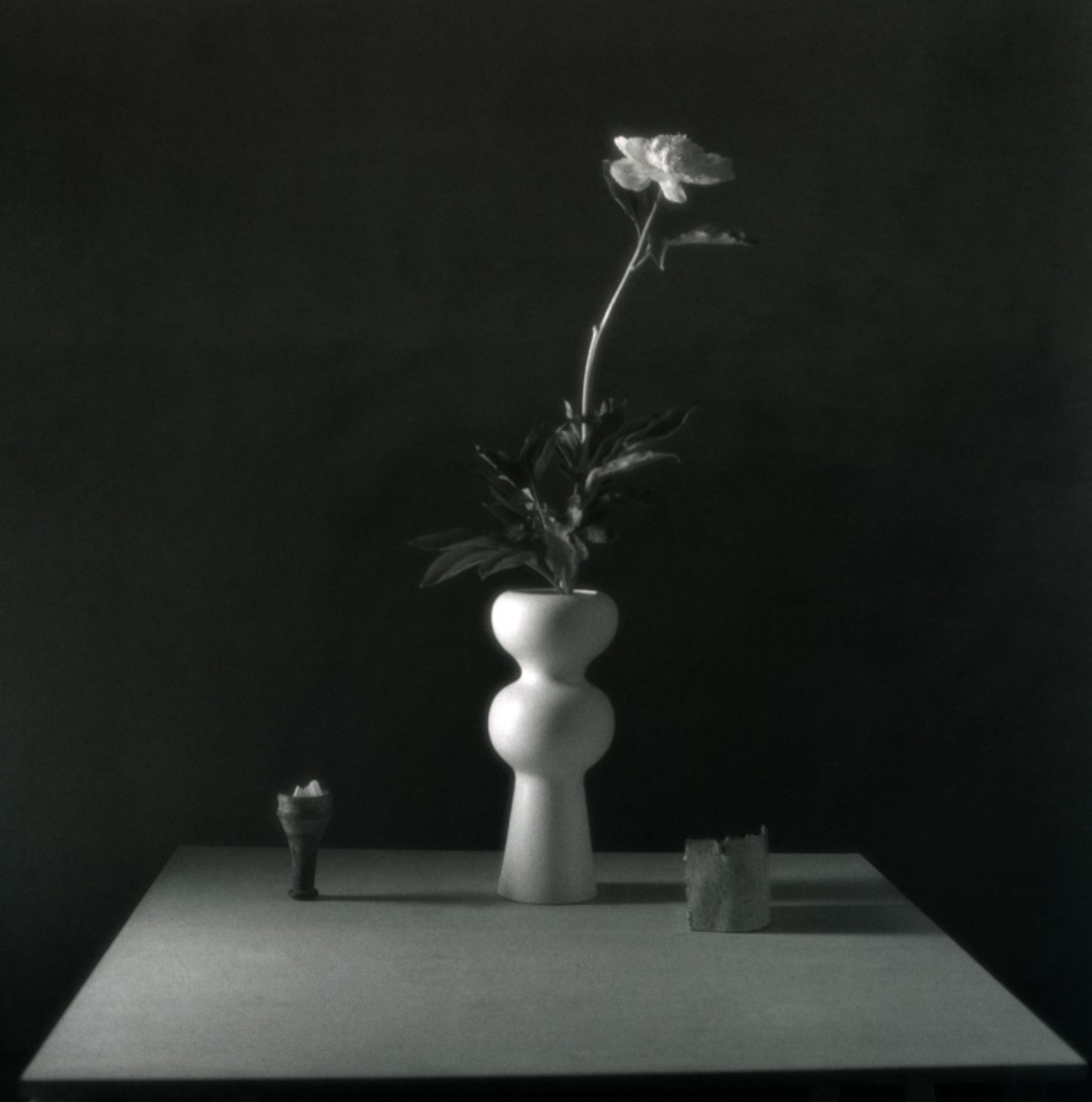
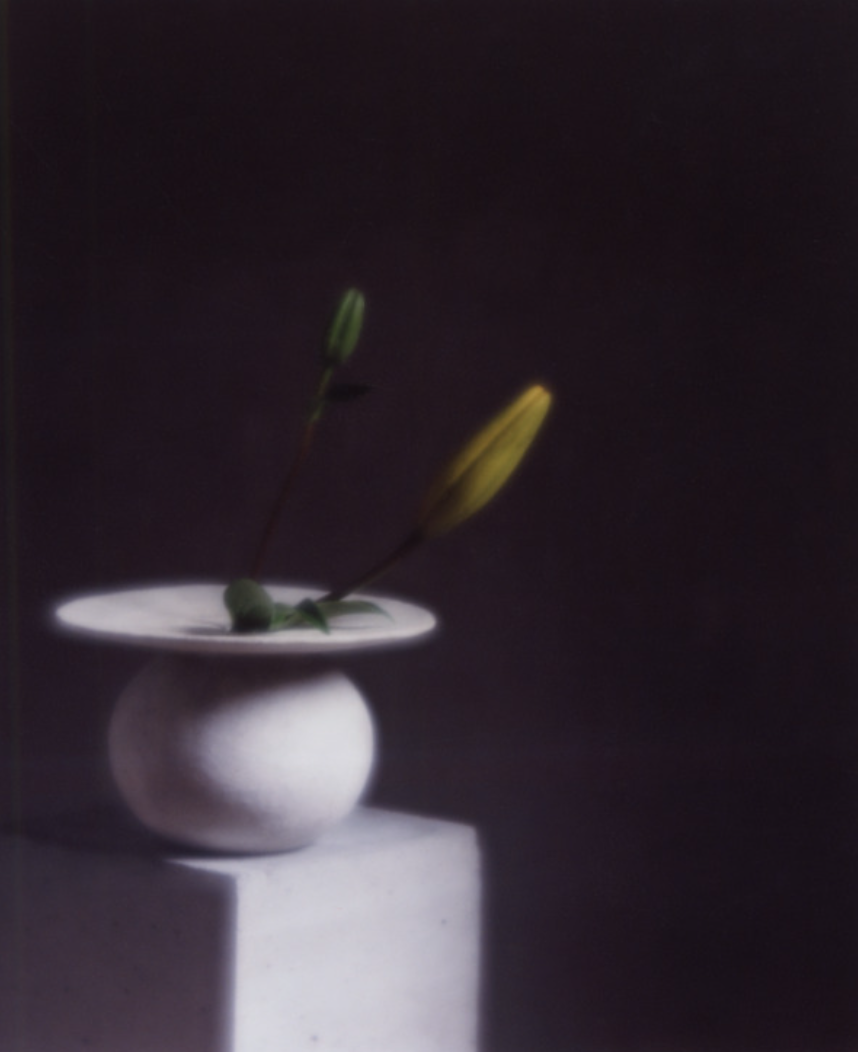
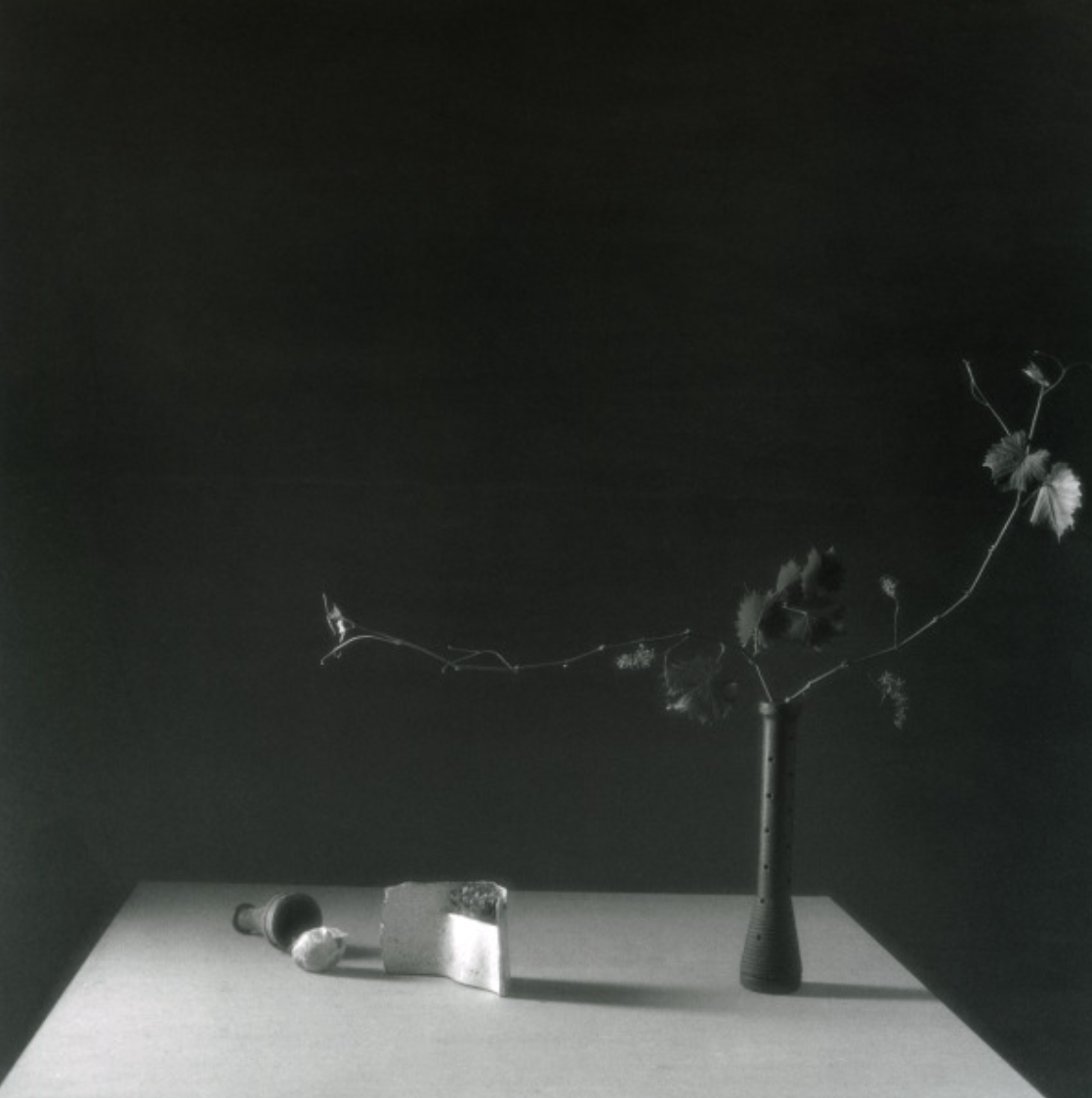
IMAGE CREDITS: Ikebana by Seanacey Pierce, film photographs by by Nozomi Matsumoto of Studio Ausgang in Kyoto.
Ikebana is an esoteric Japanese practice that can be traced back to a group of 15th century Kyoto monks making floral offerings in a small hut by a pond in their temple grounds. Today, it is also a contemporary art created by practitioners worldwide using plant materials as a medium to create sculpture. As a meditative practice, it allows us to connect with the natural world, pay tribute to the seasons, and harness the enchanting power of air and empty space using the lines and shapes of plants.
IKEBANA PRACTICE
1 CHOOSE A CONTAINER
If you do not have access to a traditional shallow container called a suiban, wide containers such as fruit bowls or serving dishes can make beautiful vessels for ikebana. For this style, it’s useful to have a metal kenzan (also known as a “flower frog”) to keep the stems stable. Please do not use floral foam: it gets mushy, clouds the water with microplastic particles and can only be used once before being thrown away. Investing in a kenzan and taking good care of it will allow you to enjoy decades of use.
Ikebana can also be arranged in tall vases, earthen jars, glass containers, etc. When arranging, be mindful of the interaction of the branches and flowers with the vase, especially making sure that the stems are cleanly arranged at the mouth of the vase (or if they can’t be, camouflage them using a strategically placed flower or leafy stem). When using a glass vase, make sure the stems in the water look good too, as they are a visible part of the arrangement.
2 GATHER MATERIALS AND TOOLS
Using a flower shop is fine – there are even flower shops in Japan that specialise in ikebana materials – but shops often carry flowers with stems that have been bred for straightness and uniformity. Going into your own yard, foraging along roadsides or asking a neighbour to use branches that they’ve pruned – this is the best way to gather materials that will make for interesting arrangements. It is also possible to use fruit, vegetables and inorganic materials from around your house as part of an arrangement. Specialty hanabasami flower scissors are the best and most versatile method for cutting stems for ikebana, but you can also use gardening shears or strong kitchen scissors. Make sure that the cutting tool you use is giving you clean cuts; stems that are smashed or frayed will not stay as securely in the kenzan.
3 THINK ABOUT PLACEMENT
It’s best to place the vase or container in the place where you plan to display your work and create the arrangement there on the spot. This will allow you to see how the light and space are interacting with your materials as you arrange them.
4 IDENTIFY LINES AND SHAPES
Choose 1 to 3 branches or long stems that have interesting lines. You may need to trim off some leaves or smaller subordinate stems to bring out the lines. Put the branches in first and make sure that they are securely fixed in the needles of the kenzan, or well balanced in the vase. The traditional way is to incorporate one high element, one middle element and one low element, but feel free to experiment and see what looks good to you, and how the lines and space are best highlighted by the materials. You may also choose to forgo lines altogether and focus on the shape of the flowers or leaves themselves, particularly when working with a unique vase, as you can think of your arrangement as an extension of the vase itself and create interesting shapes and textures.
5 ADD FLOWERS AND LEAFY STEMS
After you have placed the lines, you can think of them as the foundation or frame for your arrangement. Additional flowers can be used to enhance them, but shouldn’t compete with them. Flowers and leaves can also be used to camouflage places where the branches rest on the lip of the vase, creating the effect that the arrangement is effortlessly floating out from the vase.
6 DISPLAY
Clean the area around the arrangement. Check and refresh the water each day, remove or adjust elements as flowers wilt and enjoy the small changes as you observe the arrangement at different times of day.
IMAGE CREDITS: Ikebana by Seanacey Pierce, film photographs by by Nozomi Matsumoto of Studio Ausgang in Kyoto.
Based in Kyoto, Seanacey Yabe and her husband are the owners and caretakers of Kinse Ryokan. She began practicing Sogetsu style ikebana in 2008 and received permission to teach ikebana in 2014. In 2019 she received the First Rank Somu Teacher’s Diploma. In addition to teaching workshops at Kinse, she does custom floral work and is pursuing her own project creating “Foraged Ikebana.”
The Sogetsu school of ikebana is grounded in traditional Japanese aesthetics while also proposing that ikebana can be done "anytime, anywhere, using any materials." This gives students the chance, no matter where they are, to see the natural materials and seasons around them with new eyes, opening the way for truly unique and interesting compositions. For more information, please visit http://www.sogetsu.or.jp/e/
BY SEANACEY PIERCE
Ikebana is an esoteric Japanese practice that can be traced back to a group of 15th century Kyoto monks making floral offerings in a small hut by a pond in their temple grounds. Today, it is also a contemporary art created by practitioners worldwide using plant materials as a medium to create sculpture. As a meditative practice, it allows us to connect with the natural world, pay tribute to the seasons, and harness the enchanting power of air and empty space using the lines and shapes of plants.
IKEBANA PRACTICE
1 CHOOSE A CONTAINER
If you do not have access to a traditional shallow container called a suiban, wide containers such as fruit bowls or serving dishes can make beautiful vessels for ikebana. For this style, it’s useful to have a metal kenzan (also known as a “flower frog”) to keep the stems stable. Please do not use floral foam: it gets mushy, clouds the water with microplastic particles and can only be used once before being thrown away. Investing in a kenzan and taking good care of it will allow you to enjoy decades of use.
Ikebana can also be arranged in tall vases, earthen jars, glass containers, etc. When arranging, be mindful of the interaction of the branches and flowers with the vase, especially making sure that the stems are cleanly arranged at the mouth of the vase (or if they can’t be, camouflage them using a strategically placed flower or leafy stem). When using a glass vase, make sure the stems in the water look good too, as they are a visible part of the arrangement.
2 GATHER MATERIALS AND TOOLS
Using a flower shop is fine – there are even flower shops in Japan that specialise in ikebana materials – but shops often carry flowers with stems that have been bred for straightness and uniformity. Going into your own yard, foraging along roadsides or asking a neighbour to use branches that they’ve pruned – this is the best way to gather materials that will make for interesting arrangements. It is also possible to use fruit, vegetables and inorganic materials from around your house as part of an arrangement. Specialty hanabasami flower scissors are the best and most versatile method for cutting stems for ikebana, but you can also use gardening shears or strong kitchen scissors. Make sure that the cutting tool you use is giving you clean cuts; stems that are smashed or frayed will not stay as securely in the kenzan.
3 THINK ABOUT PLACEMENT
It’s best to place the vase or container in the place where you plan to display your work and create the arrangement there on the spot. This will allow you to see how the light and space are interacting with your materials as you arrange them.
4 IDENTIFY LINES AND SHAPES
Choose 1 to 3 branches or long stems that have interesting lines. You may need to trim off some leaves or smaller subordinate stems to bring out the lines. Put the branches in first and make sure that they are securely fixed in the needles of the kenzan, or well balanced in the vase. The traditional way is to incorporate one high element, one middle element and one low element, but feel free to experiment and see what looks good to you, and how the lines and space are best highlighted by the materials. You may also choose to forgo lines altogether and focus on the shape of the flowers or leaves themselves, particularly when working with a unique vase, as you can think of your arrangement as an extension of the vase itself and create interesting shapes and textures.
5 ADD FLOWERS AND LEAFY STEMS
After you have placed the lines, you can think of them as the foundation or frame for your arrangement. Additional flowers can be used to enhance them, but shouldn’t compete with them. Flowers and leaves can also be used to camouflage places where the branches rest on the lip of the vase, creating the effect that the arrangement is effortlessly floating out from the vase.
6 DISPLAY
Clean the area around the arrangement. Check and refresh the water each day, remove or adjust elements as flowers wilt and enjoy the small changes as you observe the arrangement at different times of day.
IMAGE CREDITS: Ikebana by Seanacey Pierce, film photographs by by Nozomi Matsumoto of Studio Ausgang in Kyoto.
Ikebana is an esoteric Japanese practice that can be traced back to a group of 15th century Kyoto monks making floral offerings in a small hut by a pond in their temple grounds. Today, it is also a contemporary art created by practitioners worldwide using plant materials as a medium to create sculpture. As a meditative practice, it allows us to connect with the natural world, pay tribute to the seasons, and harness the enchanting power of air and empty space using the lines and shapes of plants.
IKEBANA PRACTICE
1 CHOOSE A CONTAINER
If you do not have access to a traditional shallow container called a suiban, wide containers such as fruit bowls or serving dishes can make beautiful vessels for ikebana. For this style, it’s useful to have a metal kenzan (also known as a “flower frog”) to keep the stems stable. Please do not use floral foam: it gets mushy, clouds the water with microplastic particles and can only be used once before being thrown away. Investing in a kenzan and taking good care of it will allow you to enjoy decades of use.
Ikebana can also be arranged in tall vases, earthen jars, glass containers, etc. When arranging, be mindful of the interaction of the branches and flowers with the vase, especially making sure that the stems are cleanly arranged at the mouth of the vase (or if they can’t be, camouflage them using a strategically placed flower or leafy stem). When using a glass vase, make sure the stems in the water look good too, as they are a visible part of the arrangement.
2 GATHER MATERIALS AND TOOLS
Using a flower shop is fine – there are even flower shops in Japan that specialise in ikebana materials – but shops often carry flowers with stems that have been bred for straightness and uniformity. Going into your own yard, foraging along roadsides or asking a neighbour to use branches that they’ve pruned – this is the best way to gather materials that will make for interesting arrangements. It is also possible to use fruit, vegetables and inorganic materials from around your house as part of an arrangement. Specialty hanabasami flower scissors are the best and most versatile method for cutting stems for ikebana, but you can also use gardening shears or strong kitchen scissors. Make sure that the cutting tool you use is giving you clean cuts; stems that are smashed or frayed will not stay as securely in the kenzan.
3 THINK ABOUT PLACEMENT
It’s best to place the vase or container in the place where you plan to display your work and create the arrangement there on the spot. This will allow you to see how the light and space are interacting with your materials as you arrange them.
4 IDENTIFY LINES AND SHAPES
Choose 1 to 3 branches or long stems that have interesting lines. You may need to trim off some leaves or smaller subordinate stems to bring out the lines. Put the branches in first and make sure that they are securely fixed in the needles of the kenzan, or well balanced in the vase. The traditional way is to incorporate one high element, one middle element and one low element, but feel free to experiment and see what looks good to you, and how the lines and space are best highlighted by the materials. You may also choose to forgo lines altogether and focus on the shape of the flowers or leaves themselves, particularly when working with a unique vase, as you can think of your arrangement as an extension of the vase itself and create interesting shapes and textures.
5 ADD FLOWERS AND LEAFY STEMS
After you have placed the lines, you can think of them as the foundation or frame for your arrangement. Additional flowers can be used to enhance them, but shouldn’t compete with them. Flowers and leaves can also be used to camouflage places where the branches rest on the lip of the vase, creating the effect that the arrangement is effortlessly floating out from the vase.
6 DISPLAY
Clean the area around the arrangement. Check and refresh the water each day, remove or adjust elements as flowers wilt and enjoy the small changes as you observe the arrangement at different times of day.
IMAGE CREDITS: Ikebana by Seanacey Pierce, film photographs by by Nozomi Matsumoto of Studio Ausgang in Kyoto.
Based in Kyoto, Seanacey Yabe and her husband are the owners and caretakers of Kinse Ryokan. She began practicing Sogetsu style ikebana in 2008 and received permission to teach ikebana in 2014. In 2019 she received the First Rank Somu Teacher’s Diploma. In addition to teaching workshops at Kinse, she does custom floral work and is pursuing her own project creating “Foraged Ikebana.”
The Sogetsu school of ikebana is grounded in traditional Japanese aesthetics while also proposing that ikebana can be done "anytime, anywhere, using any materials." This gives students the chance, no matter where they are, to see the natural materials and seasons around them with new eyes, opening the way for truly unique and interesting compositions. For more information, please visit http://www.sogetsu.or.jp/e/
BY SEANACEY PIERCE
Ikebana is an esoteric Japanese practice that can be traced back to a group of 15th century Kyoto monks making floral offerings in a small hut by a pond in their temple grounds. Today, it is also a contemporary art created by practitioners worldwide using plant materials as a medium to create sculpture. As a meditative practice, it allows us to connect with the natural world, pay tribute to the seasons, and harness the enchanting power of air and empty space using the lines and shapes of plants.
IKEBANA PRACTICE
1 CHOOSE A CONTAINER
If you do not have access to a traditional shallow container called a suiban, wide containers such as fruit bowls or serving dishes can make beautiful vessels for ikebana. For this style, it’s useful to have a metal kenzan (also known as a “flower frog”) to keep the stems stable. Please do not use floral foam: it gets mushy, clouds the water with microplastic particles and can only be used once before being thrown away. Investing in a kenzan and taking good care of it will allow you to enjoy decades of use.
Ikebana can also be arranged in tall vases, earthen jars, glass containers, etc. When arranging, be mindful of the interaction of the branches and flowers with the vase, especially making sure that the stems are cleanly arranged at the mouth of the vase (or if they can’t be, camouflage them using a strategically placed flower or leafy stem). When using a glass vase, make sure the stems in the water look good too, as they are a visible part of the arrangement.
2 GATHER MATERIALS AND TOOLS
Using a flower shop is fine – there are even flower shops in Japan that specialise in ikebana materials – but shops often carry flowers with stems that have been bred for straightness and uniformity. Going into your own yard, foraging along roadsides or asking a neighbour to use branches that they’ve pruned – this is the best way to gather materials that will make for interesting arrangements. It is also possible to use fruit, vegetables and inorganic materials from around your house as part of an arrangement. Specialty hanabasami flower scissors are the best and most versatile method for cutting stems for ikebana, but you can also use gardening shears or strong kitchen scissors. Make sure that the cutting tool you use is giving you clean cuts; stems that are smashed or frayed will not stay as securely in the kenzan.
3 THINK ABOUT PLACEMENT
It’s best to place the vase or container in the place where you plan to display your work and create the arrangement there on the spot. This will allow you to see how the light and space are interacting with your materials as you arrange them.
4 IDENTIFY LINES AND SHAPES
Choose 1 to 3 branches or long stems that have interesting lines. You may need to trim off some leaves or smaller subordinate stems to bring out the lines. Put the branches in first and make sure that they are securely fixed in the needles of the kenzan, or well balanced in the vase. The traditional way is to incorporate one high element, one middle element and one low element, but feel free to experiment and see what looks good to you, and how the lines and space are best highlighted by the materials. You may also choose to forgo lines altogether and focus on the shape of the flowers or leaves themselves, particularly when working with a unique vase, as you can think of your arrangement as an extension of the vase itself and create interesting shapes and textures.
5 ADD FLOWERS AND LEAFY STEMS
After you have placed the lines, you can think of them as the foundation or frame for your arrangement. Additional flowers can be used to enhance them, but shouldn’t compete with them. Flowers and leaves can also be used to camouflage places where the branches rest on the lip of the vase, creating the effect that the arrangement is effortlessly floating out from the vase.
6 DISPLAY
Clean the area around the arrangement. Check and refresh the water each day, remove or adjust elements as flowers wilt and enjoy the small changes as you observe the arrangement at different times of day.
IMAGE CREDITS: Ikebana by Seanacey Pierce, film photographs by by Nozomi Matsumoto of Studio Ausgang in Kyoto.
Ikebana is an esoteric Japanese practice that can be traced back to a group of 15th century Kyoto monks making floral offerings in a small hut by a pond in their temple grounds. Today, it is also a contemporary art created by practitioners worldwide using plant materials as a medium to create sculpture. As a meditative practice, it allows us to connect with the natural world, pay tribute to the seasons, and harness the enchanting power of air and empty space using the lines and shapes of plants.
IKEBANA PRACTICE
1 CHOOSE A CONTAINER
If you do not have access to a traditional shallow container called a suiban, wide containers such as fruit bowls or serving dishes can make beautiful vessels for ikebana. For this style, it’s useful to have a metal kenzan (also known as a “flower frog”) to keep the stems stable. Please do not use floral foam: it gets mushy, clouds the water with microplastic particles and can only be used once before being thrown away. Investing in a kenzan and taking good care of it will allow you to enjoy decades of use.
Ikebana can also be arranged in tall vases, earthen jars, glass containers, etc. When arranging, be mindful of the interaction of the branches and flowers with the vase, especially making sure that the stems are cleanly arranged at the mouth of the vase (or if they can’t be, camouflage them using a strategically placed flower or leafy stem). When using a glass vase, make sure the stems in the water look good too, as they are a visible part of the arrangement.
2 GATHER MATERIALS AND TOOLS
Using a flower shop is fine – there are even flower shops in Japan that specialise in ikebana materials – but shops often carry flowers with stems that have been bred for straightness and uniformity. Going into your own yard, foraging along roadsides or asking a neighbour to use branches that they’ve pruned – this is the best way to gather materials that will make for interesting arrangements. It is also possible to use fruit, vegetables and inorganic materials from around your house as part of an arrangement. Specialty hanabasami flower scissors are the best and most versatile method for cutting stems for ikebana, but you can also use gardening shears or strong kitchen scissors. Make sure that the cutting tool you use is giving you clean cuts; stems that are smashed or frayed will not stay as securely in the kenzan.
3 THINK ABOUT PLACEMENT
It’s best to place the vase or container in the place where you plan to display your work and create the arrangement there on the spot. This will allow you to see how the light and space are interacting with your materials as you arrange them.
4 IDENTIFY LINES AND SHAPES
Choose 1 to 3 branches or long stems that have interesting lines. You may need to trim off some leaves or smaller subordinate stems to bring out the lines. Put the branches in first and make sure that they are securely fixed in the needles of the kenzan, or well balanced in the vase. The traditional way is to incorporate one high element, one middle element and one low element, but feel free to experiment and see what looks good to you, and how the lines and space are best highlighted by the materials. You may also choose to forgo lines altogether and focus on the shape of the flowers or leaves themselves, particularly when working with a unique vase, as you can think of your arrangement as an extension of the vase itself and create interesting shapes and textures.
5 ADD FLOWERS AND LEAFY STEMS
After you have placed the lines, you can think of them as the foundation or frame for your arrangement. Additional flowers can be used to enhance them, but shouldn’t compete with them. Flowers and leaves can also be used to camouflage places where the branches rest on the lip of the vase, creating the effect that the arrangement is effortlessly floating out from the vase.
6 DISPLAY
Clean the area around the arrangement. Check and refresh the water each day, remove or adjust elements as flowers wilt and enjoy the small changes as you observe the arrangement at different times of day.
IMAGE CREDITS: Ikebana by Seanacey Pierce, film photographs by by Nozomi Matsumoto of Studio Ausgang in Kyoto.
Based in Kyoto, Seanacey Yabe and her husband are the owners and caretakers of Kinse Ryokan. She began practicing Sogetsu style ikebana in 2008 and received permission to teach ikebana in 2014. In 2019 she received the First Rank Somu Teacher’s Diploma. In addition to teaching workshops at Kinse, she does custom floral work and is pursuing her own project creating “Foraged Ikebana.”
The Sogetsu school of ikebana is grounded in traditional Japanese aesthetics while also proposing that ikebana can be done "anytime, anywhere, using any materials." This gives students the chance, no matter where they are, to see the natural materials and seasons around them with new eyes, opening the way for truly unique and interesting compositions. For more information, please visit http://www.sogetsu.or.jp/e/
BY SEANACEY PIERCE
Ikebana is an esoteric Japanese practice that can be traced back to a group of 15th century Kyoto monks making floral offerings in a small hut by a pond in their temple grounds. Today, it is also a contemporary art created by practitioners worldwide using plant materials as a medium to create sculpture. As a meditative practice, it allows us to connect with the natural world, pay tribute to the seasons, and harness the enchanting power of air and empty space using the lines and shapes of plants.
IKEBANA PRACTICE
1 CHOOSE A CONTAINER
If you do not have access to a traditional shallow container called a suiban, wide containers such as fruit bowls or serving dishes can make beautiful vessels for ikebana. For this style, it’s useful to have a metal kenzan (also known as a “flower frog”) to keep the stems stable. Please do not use floral foam: it gets mushy, clouds the water with microplastic particles and can only be used once before being thrown away. Investing in a kenzan and taking good care of it will allow you to enjoy decades of use.
Ikebana can also be arranged in tall vases, earthen jars, glass containers, etc. When arranging, be mindful of the interaction of the branches and flowers with the vase, especially making sure that the stems are cleanly arranged at the mouth of the vase (or if they can’t be, camouflage them using a strategically placed flower or leafy stem). When using a glass vase, make sure the stems in the water look good too, as they are a visible part of the arrangement.
2 GATHER MATERIALS AND TOOLS
Using a flower shop is fine – there are even flower shops in Japan that specialise in ikebana materials – but shops often carry flowers with stems that have been bred for straightness and uniformity. Going into your own yard, foraging along roadsides or asking a neighbour to use branches that they’ve pruned – this is the best way to gather materials that will make for interesting arrangements. It is also possible to use fruit, vegetables and inorganic materials from around your house as part of an arrangement. Specialty hanabasami flower scissors are the best and most versatile method for cutting stems for ikebana, but you can also use gardening shears or strong kitchen scissors. Make sure that the cutting tool you use is giving you clean cuts; stems that are smashed or frayed will not stay as securely in the kenzan.
3 THINK ABOUT PLACEMENT
It’s best to place the vase or container in the place where you plan to display your work and create the arrangement there on the spot. This will allow you to see how the light and space are interacting with your materials as you arrange them.
4 IDENTIFY LINES AND SHAPES
Choose 1 to 3 branches or long stems that have interesting lines. You may need to trim off some leaves or smaller subordinate stems to bring out the lines. Put the branches in first and make sure that they are securely fixed in the needles of the kenzan, or well balanced in the vase. The traditional way is to incorporate one high element, one middle element and one low element, but feel free to experiment and see what looks good to you, and how the lines and space are best highlighted by the materials. You may also choose to forgo lines altogether and focus on the shape of the flowers or leaves themselves, particularly when working with a unique vase, as you can think of your arrangement as an extension of the vase itself and create interesting shapes and textures.
5 ADD FLOWERS AND LEAFY STEMS
After you have placed the lines, you can think of them as the foundation or frame for your arrangement. Additional flowers can be used to enhance them, but shouldn’t compete with them. Flowers and leaves can also be used to camouflage places where the branches rest on the lip of the vase, creating the effect that the arrangement is effortlessly floating out from the vase.
6 DISPLAY
Clean the area around the arrangement. Check and refresh the water each day, remove or adjust elements as flowers wilt and enjoy the small changes as you observe the arrangement at different times of day.
IMAGE CREDITS: Ikebana by Seanacey Pierce, film photographs by by Nozomi Matsumoto of Studio Ausgang in Kyoto.
Ikebana is an esoteric Japanese practice that can be traced back to a group of 15th century Kyoto monks making floral offerings in a small hut by a pond in their temple grounds. Today, it is also a contemporary art created by practitioners worldwide using plant materials as a medium to create sculpture. As a meditative practice, it allows us to connect with the natural world, pay tribute to the seasons, and harness the enchanting power of air and empty space using the lines and shapes of plants.
IKEBANA PRACTICE
1 CHOOSE A CONTAINER
If you do not have access to a traditional shallow container called a suiban, wide containers such as fruit bowls or serving dishes can make beautiful vessels for ikebana. For this style, it’s useful to have a metal kenzan (also known as a “flower frog”) to keep the stems stable. Please do not use floral foam: it gets mushy, clouds the water with microplastic particles and can only be used once before being thrown away. Investing in a kenzan and taking good care of it will allow you to enjoy decades of use.
Ikebana can also be arranged in tall vases, earthen jars, glass containers, etc. When arranging, be mindful of the interaction of the branches and flowers with the vase, especially making sure that the stems are cleanly arranged at the mouth of the vase (or if they can’t be, camouflage them using a strategically placed flower or leafy stem). When using a glass vase, make sure the stems in the water look good too, as they are a visible part of the arrangement.
2 GATHER MATERIALS AND TOOLS
Using a flower shop is fine – there are even flower shops in Japan that specialise in ikebana materials – but shops often carry flowers with stems that have been bred for straightness and uniformity. Going into your own yard, foraging along roadsides or asking a neighbour to use branches that they’ve pruned – this is the best way to gather materials that will make for interesting arrangements. It is also possible to use fruit, vegetables and inorganic materials from around your house as part of an arrangement. Specialty hanabasami flower scissors are the best and most versatile method for cutting stems for ikebana, but you can also use gardening shears or strong kitchen scissors. Make sure that the cutting tool you use is giving you clean cuts; stems that are smashed or frayed will not stay as securely in the kenzan.
3 THINK ABOUT PLACEMENT
It’s best to place the vase or container in the place where you plan to display your work and create the arrangement there on the spot. This will allow you to see how the light and space are interacting with your materials as you arrange them.
4 IDENTIFY LINES AND SHAPES
Choose 1 to 3 branches or long stems that have interesting lines. You may need to trim off some leaves or smaller subordinate stems to bring out the lines. Put the branches in first and make sure that they are securely fixed in the needles of the kenzan, or well balanced in the vase. The traditional way is to incorporate one high element, one middle element and one low element, but feel free to experiment and see what looks good to you, and how the lines and space are best highlighted by the materials. You may also choose to forgo lines altogether and focus on the shape of the flowers or leaves themselves, particularly when working with a unique vase, as you can think of your arrangement as an extension of the vase itself and create interesting shapes and textures.
5 ADD FLOWERS AND LEAFY STEMS
After you have placed the lines, you can think of them as the foundation or frame for your arrangement. Additional flowers can be used to enhance them, but shouldn’t compete with them. Flowers and leaves can also be used to camouflage places where the branches rest on the lip of the vase, creating the effect that the arrangement is effortlessly floating out from the vase.
6 DISPLAY
Clean the area around the arrangement. Check and refresh the water each day, remove or adjust elements as flowers wilt and enjoy the small changes as you observe the arrangement at different times of day.
IMAGE CREDITS: Ikebana by Seanacey Pierce, film photographs by by Nozomi Matsumoto of Studio Ausgang in Kyoto.
Based in Kyoto, Seanacey Yabe and her husband are the owners and caretakers of Kinse Ryokan. She began practicing Sogetsu style ikebana in 2008 and received permission to teach ikebana in 2014. In 2019 she received the First Rank Somu Teacher’s Diploma. In addition to teaching workshops at Kinse, she does custom floral work and is pursuing her own project creating “Foraged Ikebana.”
The Sogetsu school of ikebana is grounded in traditional Japanese aesthetics while also proposing that ikebana can be done "anytime, anywhere, using any materials." This gives students the chance, no matter where they are, to see the natural materials and seasons around them with new eyes, opening the way for truly unique and interesting compositions. For more information, please visit http://www.sogetsu.or.jp/e/