
INTERVIEW WITH JULIE FREEMAN
WAL - Your work brings together visual art, data, and emerging technologies, with sound increasingly moving to the foreground in recent years. Was there a moment when sound shifted from something you composed to something you began to think with, spatially, physically, or somatically?
JF - In 2005, I created The Lake, which used hydrophones (underwater microphones), custom software and advanced technology to track electronically tagged fish and translate their movement into an audio-visual experience.
I designed the installation part of the artwork in a nine metre high, three metre wide steel cylinder, a recycled steel silo I fitted with a door so you could go inside it. The animation played on a circular projection screen, and the sounds almost fell down on you from speakers hidden behind it.
I wanted this really immersive environment in a circular space because it was lake-like – but a surprising result was that the steel cylinder acted as a huge resonator and the sound experience was palpable. We installed a rubber floor to get the acoustics right, and slightly dampen the vibrations as they were so intense.
That was the first time I realised how powerful low frequencies can be to the experience of an immersive artwork. From that moment on, all my installations, including my data-driven soundscapes, include low-level frequency layers.
WAL - Sound here really feels like something that is entered rather than listened to. What was the evolution from The Lake installation to creating vibroacoustic furniture as Sonaforms? What does touch allow us to understand about sound that listening alone cannot?
JF - In 2023, I was commissioned by Modern Art Oxford to create a piece called Another Present. It came about in the post-COVID era; I’d spent so much time on my own and hadn’t hugged anyone for probably over a year, touch became an unconscious driver. I wanted to create work that could be held.
The commission was for a sound art piece, but the other exhibiting artists were making physical installations, one of which had video. I felt strongly that I didn’t want my sonic work to dominate theirs.
So, I started to work on localising the sound and came up with embedding it into figurative tactile objects people could touch, hug, and lean on.
I remember the moment it clicked: I was a bit hungover in a cafe after a private view, and realised I needed to enmesh sound and sculpture together.
WAL - You wouldn’t have been alone in feeling that need for touch, what was the response from the audience processing their own trauma from isolation?
JF - We had some amazing responses. There was one woman in particular who just didn’t want to let go. She kept coming back to the gallery. It seemed that people spent a lot more time with the Sonaforms than they would with a non-physical sonic artwork. Listening repeatedly as they felt the vibrations.
When artwork engages multiple senses, people tend to linger and listen more deeply - it’s intimate. In addition, Sonaforms are a completely new way of listening for most people, so it's a novel experience.
WAL - You’ve played peoples’ heartbeats live through the Sonaforms, including your own. How do people respond to the intimacy of that connection?
JF - It’s a really moving experience for some people, depending where they are at in their life and what particular mental state they're in. There was one person who just cried – he was surprised by the connection and also joyful. Other people couldn’t listen to someone else’s heart beat, it felt too intimate.
Any experience that is sensorially immersive and activates your whole body, has the potential to be moving. The Sonaforms are really tactile and invite you to move, so they've got this kind of playful, almost performative quality..
WAL - It’s an interesting sort of sympathetic resonance that happens between machine and human, where the body is responding to the frequencies, recalibrating, resisting, resonating, causing these micro-movements of adjustment and realignment. The body becomes an interface.
JF - Yes, an interface, that's beautiful. And it's exactly that. I had a meeting in my studio once and the four of us were sitting on different Sonaforms. Throughout the meeting, we ended up moving around, and at one point, someone had their feet up in the air – practically upside down. We ended up in quite strange positions at times, but it felt natural. I wish I'd recorded it, because it was a kind of weird performance.
WAL - Do you see haptic sound as a way of bypassing cognition and speaking directly to the nervous system?
JF - It depends. Some people are more sensitive than others. Our nervous system receives information in multiple ways, various senses - sometimes it’s unexpected, sometimes more familiar - and how we process this information is different for everyone. I wonder if, when people feel anxious or dysregulated, low frequencies through the body reduce those feelings, or reduce the way we are cognitively hijacked by them, and allow other thoughts and feelings to flow. I don’t know if it’s giving (an extra sensory experience) or taking (removing a heightened feeling), but from my experience something definitely shifts. It’s about change.
WAL - Yes, if the resonant frequencies meet dissonance within the body and then automatically respond by bringing it into resonance. Going back to the sensation of a hug, when this entrainment happens between machine/object and person, the exchange is without the messy emotional interaction of two distinct human energetic fields merging, which might be more accessible for someone who finds that level of emotional information overwhelming.
JF - With the Sonaforms your body can receive touch without taking on another person’s emotion, yes. Like the soft rollers used in special education – they give the sensation of a squeeze or a hug without the need for human touch. It’s really important if it’s not wanted, if there’s trauma for instance.
WAL - You’ve mentioned before this idea that if you can touch sound, you can hold onto it - and therefore let go. What did this mean for you personally?
JF - That was a central concept for Another Present. The title comes from understanding that the past is just another present that existed at another time. If you can hold on to the past, you can also let it go. One of the soundscapes I used in the show was composed from underwater recordings, taken from the river where my dad's ashes were scattered in Oxford.,
Thirty years after his passing, to listen to the underwater world in that same place, was a really personal process that felt very cathartic. When played through the wooden forms, the piece was something I could hold onto that felt close to him, but I could also let go.
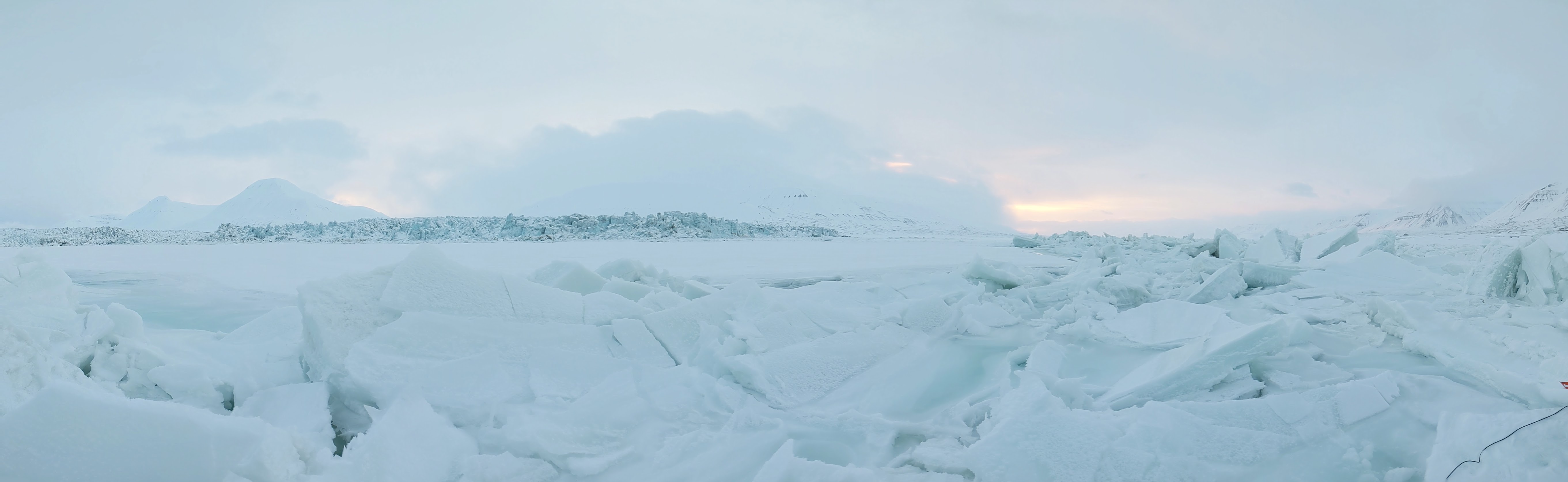
WAL - Is this experience of grief something that you considered in your current research project Glacial Lamentation, might the glacial Sonaform become a potential vehicle for ecological grief? In Svalbard, in the Arctic, environmental change is both visible and accelerated. How did being physically present there alter your sense of scale, time, and listening?
JF - On the trip, myself and a team of creatives and scientists entered ice caves inside the glaciers to record the ice melting, cracking, shifting and creaking, which I later played back through a glacier-shaped Sonaform. It’s such an extraordinary experience to be inside one, you know you’re contained within a moving glacier. You can only go inside ones that are really stable, and it’s not safe to go in the summer, but some glaciers can move around 30 metres a day. You can literally see the landscape moving.
So, there’s this strange sense of scale and time – and grief. I took the glacial recordings and Sonaform to the Svalbard Science Conference, where around 300 glaciologists attended. There was an overwhelming feeling of grief and sadness in the room. Some of the recordings have really low frequencies, which are great to hold on to through the sculpture.
In the future, I want a real-time data feed from various sensors and hydrophones at the glacier to a bunch of Sonaforms, so when you’re hugging the sculptures you’re feeling the live glacial movement. That would be hugely powerful because of the real-time connection.
We haven’t yet put real-time data through the Sonaforms, but I’m really excited because it will add greater depth. If we knew what you were feeling was being generated by another living thing, how would that change our relationship to the artwork; how would our bodies respond? My instinct is that it would be more electrifying and induce stronger empathy – like the live heartbeat moving people to tears.
WAL - I’ve seen this when we play the sound of depleted soil through bone transducers, and people can really feel the loss. As someone who also works with bioacoustics and nature-derived data, I’m acutely aware of what inevitably gets lost in translation. Your broader practice, including Data as Culture, and Translating Nature has consistently addressed questions of translation rather than representation. How do you navigate the inherent subjectivity of translating natural systems into sound?
JF - My PhD was about exactly this; the subjectivity of translating data into a creative tool. The word “translation” matters; it’s different each time it goes through the human process, like with book translation. An excellent translator understands the voice of the original author and creates a new version with the same poetry and cadence.
So with the glacier work, the live feed would be direct from the glacier, but I’d add other layers too – recordings from the same glacier shifting depending on environmental data, melt water, sunlight, temperature, humidity. The live feed would be the core, the “cheese in the sandwich” and everything else is to make it a richer experience.
WAL - Yes and experiencing nature through technology can be a primer to enhance the real-time experience, to bring a person closer to nature so that deep listening becomes a form of care. It’s not the end but a means to an end, a primer for deeper awareness and understanding, rather than a replacement.
JF - I like that. Rather than a tool for escapism, technology here becomes a grounding force that supports experience of the present. We spend a lot of time escaping on our phones, getting away from where we need to be. Deep listening is important – It asks you to stop, slow down, appreciate, take your time, sit with it.
WAL - In our hyper-digital environment, if we don't integrate our experience and it's like it never happened, it washes through us like water, which we’re seeing more of with digital worlds and attention deficit. We can't hold on to the experience. With vibroacoustics, the integration is happening in real time as you listen, because listening is embodied. As you say, by making sound physical, we can hold onto it.
JF - I like that idea that you need to integrate. There’s a coldness with screen-based technology. Even with big immersive pieces, beautiful as they are, you don’t get vibrations, you don’t get that physicality. I feel like we’re craving more connection, not just to escape into something immersive, but to come back to reality.
WAL - Are you working with any research partners to measure the physiological impacts of the Sonaforms?
JF - We’re about to start working with sound specialists to get precise audio measurements, but we don’t anticipate clinical trials or the Sonaforms becoming medical devices. We’ve got a user study coming up with an Ayurvedic practitioner at Turner Contemporary. She’ll read people’s pulse to assess their constitution (Vata, Pitta, Kapha) and then they’ll.have a Sonaform experience attuned to their reading. The practitioner will take secondary pulse readings afterwards and gather feedback. This is just a light experiment, we’re hoping to run future research projects with academic partners.
WAL - I’ve collected over a hundred tuning forks over the years and can testify for their physiological impact and healing potential, but these are all audible frequencies. When we worked together on Emergence for 113 Spring, and we first discussed your research, we talked about how some of the issues with sub-audible and very low frequencies being problematic because of their similarity to body organs.
JF - A 100! Wow.
When I put very low frequencies through the Sonaforms, like 10 and 15 hertz, it made me feel uncomfortable. I could hardly hear it, but I knew it wasn’t good for me. This range can make people feel sick. Our organs have resonant frequencies, liver and kidneys lower, lungs higher, and I’ve read that some resonate maybe between five and seven hertz. So when you get around those ranges you might do damage.
But higher frequencies can feel amazing. I was given a tuning fork recently - 128 hertz. I put it on my sternum and couldn’t get enough of it, that frequency is very impactful for my body. We had it in the studio for a while and Grace, our Studio Director, had to ask me to put it down in meetings as it was a distraction.
I’m pleased that there is a wider growing movement in medical research looking seriously at vibration and frequency, not just as metaphor, but as something that has measurable physiological impact. Positive impacts on Alzheimer's and other diseases are being researched and that is a brilliant way forward for the future of vibration.
.
WAL - Your work brings together visual art, data, and emerging technologies, with sound increasingly moving to the foreground in recent years. Was there a moment when sound shifted from something you composed to something you began to think with, spatially, physically, or somatically?
JF - In 2005, I created The Lake, which used hydrophones (underwater microphones), custom software and advanced technology to track electronically tagged fish and translate their movement into an audio-visual experience.
I designed the installation part of the artwork in a nine metre high, three metre wide steel cylinder, a recycled steel silo I fitted with a door so you could go inside it. The animation played on a circular projection screen, and the sounds almost fell down on you from speakers hidden behind it.
I wanted this really immersive environment in a circular space because it was lake-like – but a surprising result was that the steel cylinder acted as a huge resonator and the sound experience was palpable. We installed a rubber floor to get the acoustics right, and slightly dampen the vibrations as they were so intense.
That was the first time I realised how powerful low frequencies can be to the experience of an immersive artwork. From that moment on, all my installations, including my data-driven soundscapes, include low-level frequency layers.
WAL - Sound here really feels like something that is entered rather than listened to. What was the evolution from The Lake installation to creating vibroacoustic furniture as Sonaforms? What does touch allow us to understand about sound that listening alone cannot?
JF - In 2023, I was commissioned by Modern Art Oxford to create a piece called Another Present. It came about in the post-COVID era; I’d spent so much time on my own and hadn’t hugged anyone for probably over a year, touch became an unconscious driver. I wanted to create work that could be held.
The commission was for a sound art piece, but the other exhibiting artists were making physical installations, one of which had video. I felt strongly that I didn’t want my sonic work to dominate theirs.
So, I started to work on localising the sound and came up with embedding it into figurative tactile objects people could touch, hug, and lean on.
I remember the moment it clicked: I was a bit hungover in a cafe after a private view, and realised I needed to enmesh sound and sculpture together.
WAL - You wouldn’t have been alone in feeling that need for touch, what was the response from the audience processing their own trauma from isolation?
JF - We had some amazing responses. There was one woman in particular who just didn’t want to let go. She kept coming back to the gallery. It seemed that people spent a lot more time with the Sonaforms than they would with a non-physical sonic artwork. Listening repeatedly as they felt the vibrations.
When artwork engages multiple senses, people tend to linger and listen more deeply - it’s intimate. In addition, Sonaforms are a completely new way of listening for most people, so it's a novel experience.
WAL - You’ve played peoples’ heartbeats live through the Sonaforms, including your own. How do people respond to the intimacy of that connection?
JF - It’s a really moving experience for some people, depending where they are at in their life and what particular mental state they're in. There was one person who just cried – he was surprised by the connection and also joyful. Other people couldn’t listen to someone else’s heart beat, it felt too intimate.
Any experience that is sensorially immersive and activates your whole body, has the potential to be moving. The Sonaforms are really tactile and invite you to move, so they've got this kind of playful, almost performative quality..
WAL - It’s an interesting sort of sympathetic resonance that happens between machine and human, where the body is responding to the frequencies, recalibrating, resisting, resonating, causing these micro-movements of adjustment and realignment. The body becomes an interface.
JF - Yes, an interface, that's beautiful. And it's exactly that. I had a meeting in my studio once and the four of us were sitting on different Sonaforms. Throughout the meeting, we ended up moving around, and at one point, someone had their feet up in the air – practically upside down. We ended up in quite strange positions at times, but it felt natural. I wish I'd recorded it, because it was a kind of weird performance.
WAL - Do you see haptic sound as a way of bypassing cognition and speaking directly to the nervous system?
JF - It depends. Some people are more sensitive than others. Our nervous system receives information in multiple ways, various senses - sometimes it’s unexpected, sometimes more familiar - and how we process this information is different for everyone. I wonder if, when people feel anxious or dysregulated, low frequencies through the body reduce those feelings, or reduce the way we are cognitively hijacked by them, and allow other thoughts and feelings to flow. I don’t know if it’s giving (an extra sensory experience) or taking (removing a heightened feeling), but from my experience something definitely shifts. It’s about change.
WAL - Yes, if the resonant frequencies meet dissonance within the body and then automatically respond by bringing it into resonance. Going back to the sensation of a hug, when this entrainment happens between machine/object and person, the exchange is without the messy emotional interaction of two distinct human energetic fields merging, which might be more accessible for someone who finds that level of emotional information overwhelming.
JF - With the Sonaforms your body can receive touch without taking on another person’s emotion, yes. Like the soft rollers used in special education – they give the sensation of a squeeze or a hug without the need for human touch. It’s really important if it’s not wanted, if there’s trauma for instance.
WAL - You’ve mentioned before this idea that if you can touch sound, you can hold onto it - and therefore let go. What did this mean for you personally?
JF - That was a central concept for Another Present. The title comes from understanding that the past is just another present that existed at another time. If you can hold on to the past, you can also let it go. One of the soundscapes I used in the show was composed from underwater recordings, taken from the river where my dad's ashes were scattered in Oxford.,
Thirty years after his passing, to listen to the underwater world in that same place, was a really personal process that felt very cathartic. When played through the wooden forms, the piece was something I could hold onto that felt close to him, but I could also let go.
WAL - Is this experience of grief something that you considered in your current research project Glacial Lamentation, might the glacial Sonaform become a potential vehicle for ecological grief? In Svalbard, in the Arctic, environmental change is both visible and accelerated. How did being physically present there alter your sense of scale, time, and listening?
JF - On the trip, myself and a team of creatives and scientists entered ice caves inside the glaciers to record the ice melting, cracking, shifting and creaking, which I later played back through a glacier-shaped Sonaform. It’s such an extraordinary experience to be inside one, you know you’re contained within a moving glacier. You can only go inside ones that are really stable, and it’s not safe to go in the summer, but some glaciers can move around 30 metres a day. You can literally see the landscape moving.
So, there’s this strange sense of scale and time – and grief. I took the glacial recordings and Sonaform to the Svalbard Science Conference, where around 300 glaciologists attended. There was an overwhelming feeling of grief and sadness in the room. Some of the recordings have really low frequencies, which are great to hold on to through the sculpture.
In the future, I want a real-time data feed from various sensors and hydrophones at the glacier to a bunch of Sonaforms, so when you’re hugging the sculptures you’re feeling the live glacial movement. That would be hugely powerful because of the real-time connection.
We haven’t yet put real-time data through the Sonaforms, but I’m really excited because it will add greater depth. If we knew what you were feeling was being generated by another living thing, how would that change our relationship to the artwork; how would our bodies respond? My instinct is that it would be more electrifying and induce stronger empathy – like the live heartbeat moving people to tears.
WAL - I’ve seen this when we play the sound of depleted soil through bone transducers, and people can really feel the loss. As someone who also works with bioacoustics and nature-derived data, I’m acutely aware of what inevitably gets lost in translation. Your broader practice, including Data as Culture, and Translating Nature has consistently addressed questions of translation rather than representation. How do you navigate the inherent subjectivity of translating natural systems into sound?
JF - My PhD was about exactly this; the subjectivity of translating data into a creative tool. The word “translation” matters; it’s different each time it goes through the human process, like with book translation. An excellent translator understands the voice of the original author and creates a new version with the same poetry and cadence.
So with the glacier work, the live feed would be direct from the glacier, but I’d add other layers too – recordings from the same glacier shifting depending on environmental data, melt water, sunlight, temperature, humidity. The live feed would be the core, the “cheese in the sandwich” and everything else is to make it a richer experience.
WAL - Yes and experiencing nature through technology can be a primer to enhance the real-time experience, to bring a person closer to nature so that deep listening becomes a form of care. It’s not the end but a means to an end, a primer for deeper awareness and understanding, rather than a replacement.
JF - I like that. Rather than a tool for escapism, technology here becomes a grounding force that supports experience of the present. We spend a lot of time escaping on our phones, getting away from where we need to be. Deep listening is important – It asks you to stop, slow down, appreciate, take your time, sit with it.
WAL - In our hyper-digital environment, if we don't integrate our experience and it's like it never happened, it washes through us like water, which we’re seeing more of with digital worlds and attention deficit. We can't hold on to the experience. With vibroacoustics, the integration is happening in real time as you listen, because listening is embodied. As you say, by making sound physical, we can hold onto it.
JF - I like that idea that you need to integrate. There’s a coldness with screen-based technology. Even with big immersive pieces, beautiful as they are, you don’t get vibrations, you don’t get that physicality. I feel like we’re craving more connection, not just to escape into something immersive, but to come back to reality.
WAL - Are you working with any research partners to measure the physiological impacts of the Sonaforms?
JF - We’re about to start working with sound specialists to get precise audio measurements, but we don’t anticipate clinical trials or the Sonaforms becoming medical devices. We’ve got a user study coming up with an Ayurvedic practitioner at Turner Contemporary. She’ll read people’s pulse to assess their constitution (Vata, Pitta, Kapha) and then they’ll.have a Sonaform experience attuned to their reading. The practitioner will take secondary pulse readings afterwards and gather feedback. This is just a light experiment, we’re hoping to run future research projects with academic partners.
WAL - I’ve collected over a hundred tuning forks over the years and can testify for their physiological impact and healing potential, but these are all audible frequencies. When we worked together on Emergence for 113 Spring, and we first discussed your research, we talked about how some of the issues with sub-audible and very low frequencies being problematic because of their similarity to body organs.
JF - A 100! Wow.
When I put very low frequencies through the Sonaforms, like 10 and 15 hertz, it made me feel uncomfortable. I could hardly hear it, but I knew it wasn’t good for me. This range can make people feel sick. Our organs have resonant frequencies, liver and kidneys lower, lungs higher, and I’ve read that some resonate maybe between five and seven hertz. So when you get around those ranges you might do damage.
But higher frequencies can feel amazing. I was given a tuning fork recently - 128 hertz. I put it on my sternum and couldn’t get enough of it, that frequency is very impactful for my body. We had it in the studio for a while and Grace, our Studio Director, had to ask me to put it down in meetings as it was a distraction.
I’m pleased that there is a wider growing movement in medical research looking seriously at vibration and frequency, not just as metaphor, but as something that has measurable physiological impact. Positive impacts on Alzheimer's and other diseases are being researched and that is a brilliant way forward for the future of vibration.
.
Dr Julie Freeman is an artist whose work spans visual, audio and digital art forms and explores the relationship between science, nature and how humans interact with it. She is the founder of ShapedSound and created Sonaforms® to provide moments of transformation through multi-sensory experiences.

INTERVIEW WITH JULIE FREEMAN
WAL - Your work brings together visual art, data, and emerging technologies, with sound increasingly moving to the foreground in recent years. Was there a moment when sound shifted from something you composed to something you began to think with, spatially, physically, or somatically?
JF - In 2005, I created The Lake, which used hydrophones (underwater microphones), custom software and advanced technology to track electronically tagged fish and translate their movement into an audio-visual experience.
I designed the installation part of the artwork in a nine metre high, three metre wide steel cylinder, a recycled steel silo I fitted with a door so you could go inside it. The animation played on a circular projection screen, and the sounds almost fell down on you from speakers hidden behind it.
I wanted this really immersive environment in a circular space because it was lake-like – but a surprising result was that the steel cylinder acted as a huge resonator and the sound experience was palpable. We installed a rubber floor to get the acoustics right, and slightly dampen the vibrations as they were so intense.
That was the first time I realised how powerful low frequencies can be to the experience of an immersive artwork. From that moment on, all my installations, including my data-driven soundscapes, include low-level frequency layers.
WAL - Sound here really feels like something that is entered rather than listened to. What was the evolution from The Lake installation to creating vibroacoustic furniture as Sonaforms? What does touch allow us to understand about sound that listening alone cannot?
JF - In 2023, I was commissioned by Modern Art Oxford to create a piece called Another Present. It came about in the post-COVID era; I’d spent so much time on my own and hadn’t hugged anyone for probably over a year, touch became an unconscious driver. I wanted to create work that could be held.
The commission was for a sound art piece, but the other exhibiting artists were making physical installations, one of which had video. I felt strongly that I didn’t want my sonic work to dominate theirs.
So, I started to work on localising the sound and came up with embedding it into figurative tactile objects people could touch, hug, and lean on.
I remember the moment it clicked: I was a bit hungover in a cafe after a private view, and realised I needed to enmesh sound and sculpture together.
WAL - You wouldn’t have been alone in feeling that need for touch, what was the response from the audience processing their own trauma from isolation?
JF - We had some amazing responses. There was one woman in particular who just didn’t want to let go. She kept coming back to the gallery. It seemed that people spent a lot more time with the Sonaforms than they would with a non-physical sonic artwork. Listening repeatedly as they felt the vibrations.
When artwork engages multiple senses, people tend to linger and listen more deeply - it’s intimate. In addition, Sonaforms are a completely new way of listening for most people, so it's a novel experience.
WAL - You’ve played peoples’ heartbeats live through the Sonaforms, including your own. How do people respond to the intimacy of that connection?
JF - It’s a really moving experience for some people, depending where they are at in their life and what particular mental state they're in. There was one person who just cried – he was surprised by the connection and also joyful. Other people couldn’t listen to someone else’s heart beat, it felt too intimate.
Any experience that is sensorially immersive and activates your whole body, has the potential to be moving. The Sonaforms are really tactile and invite you to move, so they've got this kind of playful, almost performative quality..
WAL - It’s an interesting sort of sympathetic resonance that happens between machine and human, where the body is responding to the frequencies, recalibrating, resisting, resonating, causing these micro-movements of adjustment and realignment. The body becomes an interface.
JF - Yes, an interface, that's beautiful. And it's exactly that. I had a meeting in my studio once and the four of us were sitting on different Sonaforms. Throughout the meeting, we ended up moving around, and at one point, someone had their feet up in the air – practically upside down. We ended up in quite strange positions at times, but it felt natural. I wish I'd recorded it, because it was a kind of weird performance.
WAL - Do you see haptic sound as a way of bypassing cognition and speaking directly to the nervous system?
JF - It depends. Some people are more sensitive than others. Our nervous system receives information in multiple ways, various senses - sometimes it’s unexpected, sometimes more familiar - and how we process this information is different for everyone. I wonder if, when people feel anxious or dysregulated, low frequencies through the body reduce those feelings, or reduce the way we are cognitively hijacked by them, and allow other thoughts and feelings to flow. I don’t know if it’s giving (an extra sensory experience) or taking (removing a heightened feeling), but from my experience something definitely shifts. It’s about change.
WAL - Yes, if the resonant frequencies meet dissonance within the body and then automatically respond by bringing it into resonance. Going back to the sensation of a hug, when this entrainment happens between machine/object and person, the exchange is without the messy emotional interaction of two distinct human energetic fields merging, which might be more accessible for someone who finds that level of emotional information overwhelming.
JF - With the Sonaforms your body can receive touch without taking on another person’s emotion, yes. Like the soft rollers used in special education – they give the sensation of a squeeze or a hug without the need for human touch. It’s really important if it’s not wanted, if there’s trauma for instance.
WAL - You’ve mentioned before this idea that if you can touch sound, you can hold onto it - and therefore let go. What did this mean for you personally?
JF - That was a central concept for Another Present. The title comes from understanding that the past is just another present that existed at another time. If you can hold on to the past, you can also let it go. One of the soundscapes I used in the show was composed from underwater recordings, taken from the river where my dad's ashes were scattered in Oxford.,
Thirty years after his passing, to listen to the underwater world in that same place, was a really personal process that felt very cathartic. When played through the wooden forms, the piece was something I could hold onto that felt close to him, but I could also let go.
WAL - Is this experience of grief something that you considered in your current research project Glacial Lamentation, might the glacial Sonaform become a potential vehicle for ecological grief? In Svalbard, in the Arctic, environmental change is both visible and accelerated. How did being physically present there alter your sense of scale, time, and listening?
JF - On the trip, myself and a team of creatives and scientists entered ice caves inside the glaciers to record the ice melting, cracking, shifting and creaking, which I later played back through a glacier-shaped Sonaform. It’s such an extraordinary experience to be inside one, you know you’re contained within a moving glacier. You can only go inside ones that are really stable, and it’s not safe to go in the summer, but some glaciers can move around 30 metres a day. You can literally see the landscape moving.
So, there’s this strange sense of scale and time – and grief. I took the glacial recordings and Sonaform to the Svalbard Science Conference, where around 300 glaciologists attended. There was an overwhelming feeling of grief and sadness in the room. Some of the recordings have really low frequencies, which are great to hold on to through the sculpture.
In the future, I want a real-time data feed from various sensors and hydrophones at the glacier to a bunch of Sonaforms, so when you’re hugging the sculptures you’re feeling the live glacial movement. That would be hugely powerful because of the real-time connection.
We haven’t yet put real-time data through the Sonaforms, but I’m really excited because it will add greater depth. If we knew what you were feeling was being generated by another living thing, how would that change our relationship to the artwork; how would our bodies respond? My instinct is that it would be more electrifying and induce stronger empathy – like the live heartbeat moving people to tears.
WAL - I’ve seen this when we play the sound of depleted soil through bone transducers, and people can really feel the loss. As someone who also works with bioacoustics and nature-derived data, I’m acutely aware of what inevitably gets lost in translation. Your broader practice, including Data as Culture, and Translating Nature has consistently addressed questions of translation rather than representation. How do you navigate the inherent subjectivity of translating natural systems into sound?
JF - My PhD was about exactly this; the subjectivity of translating data into a creative tool. The word “translation” matters; it’s different each time it goes through the human process, like with book translation. An excellent translator understands the voice of the original author and creates a new version with the same poetry and cadence.
So with the glacier work, the live feed would be direct from the glacier, but I’d add other layers too – recordings from the same glacier shifting depending on environmental data, melt water, sunlight, temperature, humidity. The live feed would be the core, the “cheese in the sandwich” and everything else is to make it a richer experience.
WAL - Yes and experiencing nature through technology can be a primer to enhance the real-time experience, to bring a person closer to nature so that deep listening becomes a form of care. It’s not the end but a means to an end, a primer for deeper awareness and understanding, rather than a replacement.
JF - I like that. Rather than a tool for escapism, technology here becomes a grounding force that supports experience of the present. We spend a lot of time escaping on our phones, getting away from where we need to be. Deep listening is important – It asks you to stop, slow down, appreciate, take your time, sit with it.
WAL - In our hyper-digital environment, if we don't integrate our experience and it's like it never happened, it washes through us like water, which we’re seeing more of with digital worlds and attention deficit. We can't hold on to the experience. With vibroacoustics, the integration is happening in real time as you listen, because listening is embodied. As you say, by making sound physical, we can hold onto it.
JF - I like that idea that you need to integrate. There’s a coldness with screen-based technology. Even with big immersive pieces, beautiful as they are, you don’t get vibrations, you don’t get that physicality. I feel like we’re craving more connection, not just to escape into something immersive, but to come back to reality.
WAL - Are you working with any research partners to measure the physiological impacts of the Sonaforms?
JF - We’re about to start working with sound specialists to get precise audio measurements, but we don’t anticipate clinical trials or the Sonaforms becoming medical devices. We’ve got a user study coming up with an Ayurvedic practitioner at Turner Contemporary. She’ll read people’s pulse to assess their constitution (Vata, Pitta, Kapha) and then they’ll.have a Sonaform experience attuned to their reading. The practitioner will take secondary pulse readings afterwards and gather feedback. This is just a light experiment, we’re hoping to run future research projects with academic partners.
WAL - I’ve collected over a hundred tuning forks over the years and can testify for their physiological impact and healing potential, but these are all audible frequencies. When we worked together on Emergence for 113 Spring, and we first discussed your research, we talked about how some of the issues with sub-audible and very low frequencies being problematic because of their similarity to body organs.
JF - A 100! Wow.
When I put very low frequencies through the Sonaforms, like 10 and 15 hertz, it made me feel uncomfortable. I could hardly hear it, but I knew it wasn’t good for me. This range can make people feel sick. Our organs have resonant frequencies, liver and kidneys lower, lungs higher, and I’ve read that some resonate maybe between five and seven hertz. So when you get around those ranges you might do damage.
But higher frequencies can feel amazing. I was given a tuning fork recently - 128 hertz. I put it on my sternum and couldn’t get enough of it, that frequency is very impactful for my body. We had it in the studio for a while and Grace, our Studio Director, had to ask me to put it down in meetings as it was a distraction.
I’m pleased that there is a wider growing movement in medical research looking seriously at vibration and frequency, not just as metaphor, but as something that has measurable physiological impact. Positive impacts on Alzheimer's and other diseases are being researched and that is a brilliant way forward for the future of vibration.
.
WAL - Your work brings together visual art, data, and emerging technologies, with sound increasingly moving to the foreground in recent years. Was there a moment when sound shifted from something you composed to something you began to think with, spatially, physically, or somatically?
JF - In 2005, I created The Lake, which used hydrophones (underwater microphones), custom software and advanced technology to track electronically tagged fish and translate their movement into an audio-visual experience.
I designed the installation part of the artwork in a nine metre high, three metre wide steel cylinder, a recycled steel silo I fitted with a door so you could go inside it. The animation played on a circular projection screen, and the sounds almost fell down on you from speakers hidden behind it.
I wanted this really immersive environment in a circular space because it was lake-like – but a surprising result was that the steel cylinder acted as a huge resonator and the sound experience was palpable. We installed a rubber floor to get the acoustics right, and slightly dampen the vibrations as they were so intense.
That was the first time I realised how powerful low frequencies can be to the experience of an immersive artwork. From that moment on, all my installations, including my data-driven soundscapes, include low-level frequency layers.
WAL - Sound here really feels like something that is entered rather than listened to. What was the evolution from The Lake installation to creating vibroacoustic furniture as Sonaforms? What does touch allow us to understand about sound that listening alone cannot?
JF - In 2023, I was commissioned by Modern Art Oxford to create a piece called Another Present. It came about in the post-COVID era; I’d spent so much time on my own and hadn’t hugged anyone for probably over a year, touch became an unconscious driver. I wanted to create work that could be held.
The commission was for a sound art piece, but the other exhibiting artists were making physical installations, one of which had video. I felt strongly that I didn’t want my sonic work to dominate theirs.
So, I started to work on localising the sound and came up with embedding it into figurative tactile objects people could touch, hug, and lean on.
I remember the moment it clicked: I was a bit hungover in a cafe after a private view, and realised I needed to enmesh sound and sculpture together.
WAL - You wouldn’t have been alone in feeling that need for touch, what was the response from the audience processing their own trauma from isolation?
JF - We had some amazing responses. There was one woman in particular who just didn’t want to let go. She kept coming back to the gallery. It seemed that people spent a lot more time with the Sonaforms than they would with a non-physical sonic artwork. Listening repeatedly as they felt the vibrations.
When artwork engages multiple senses, people tend to linger and listen more deeply - it’s intimate. In addition, Sonaforms are a completely new way of listening for most people, so it's a novel experience.
WAL - You’ve played peoples’ heartbeats live through the Sonaforms, including your own. How do people respond to the intimacy of that connection?
JF - It’s a really moving experience for some people, depending where they are at in their life and what particular mental state they're in. There was one person who just cried – he was surprised by the connection and also joyful. Other people couldn’t listen to someone else’s heart beat, it felt too intimate.
Any experience that is sensorially immersive and activates your whole body, has the potential to be moving. The Sonaforms are really tactile and invite you to move, so they've got this kind of playful, almost performative quality..
WAL - It’s an interesting sort of sympathetic resonance that happens between machine and human, where the body is responding to the frequencies, recalibrating, resisting, resonating, causing these micro-movements of adjustment and realignment. The body becomes an interface.
JF - Yes, an interface, that's beautiful. And it's exactly that. I had a meeting in my studio once and the four of us were sitting on different Sonaforms. Throughout the meeting, we ended up moving around, and at one point, someone had their feet up in the air – practically upside down. We ended up in quite strange positions at times, but it felt natural. I wish I'd recorded it, because it was a kind of weird performance.
WAL - Do you see haptic sound as a way of bypassing cognition and speaking directly to the nervous system?
JF - It depends. Some people are more sensitive than others. Our nervous system receives information in multiple ways, various senses - sometimes it’s unexpected, sometimes more familiar - and how we process this information is different for everyone. I wonder if, when people feel anxious or dysregulated, low frequencies through the body reduce those feelings, or reduce the way we are cognitively hijacked by them, and allow other thoughts and feelings to flow. I don’t know if it’s giving (an extra sensory experience) or taking (removing a heightened feeling), but from my experience something definitely shifts. It’s about change.
WAL - Yes, if the resonant frequencies meet dissonance within the body and then automatically respond by bringing it into resonance. Going back to the sensation of a hug, when this entrainment happens between machine/object and person, the exchange is without the messy emotional interaction of two distinct human energetic fields merging, which might be more accessible for someone who finds that level of emotional information overwhelming.
JF - With the Sonaforms your body can receive touch without taking on another person’s emotion, yes. Like the soft rollers used in special education – they give the sensation of a squeeze or a hug without the need for human touch. It’s really important if it’s not wanted, if there’s trauma for instance.
WAL - You’ve mentioned before this idea that if you can touch sound, you can hold onto it - and therefore let go. What did this mean for you personally?
JF - That was a central concept for Another Present. The title comes from understanding that the past is just another present that existed at another time. If you can hold on to the past, you can also let it go. One of the soundscapes I used in the show was composed from underwater recordings, taken from the river where my dad's ashes were scattered in Oxford.,
Thirty years after his passing, to listen to the underwater world in that same place, was a really personal process that felt very cathartic. When played through the wooden forms, the piece was something I could hold onto that felt close to him, but I could also let go.
WAL - Is this experience of grief something that you considered in your current research project Glacial Lamentation, might the glacial Sonaform become a potential vehicle for ecological grief? In Svalbard, in the Arctic, environmental change is both visible and accelerated. How did being physically present there alter your sense of scale, time, and listening?
JF - On the trip, myself and a team of creatives and scientists entered ice caves inside the glaciers to record the ice melting, cracking, shifting and creaking, which I later played back through a glacier-shaped Sonaform. It’s such an extraordinary experience to be inside one, you know you’re contained within a moving glacier. You can only go inside ones that are really stable, and it’s not safe to go in the summer, but some glaciers can move around 30 metres a day. You can literally see the landscape moving.
So, there’s this strange sense of scale and time – and grief. I took the glacial recordings and Sonaform to the Svalbard Science Conference, where around 300 glaciologists attended. There was an overwhelming feeling of grief and sadness in the room. Some of the recordings have really low frequencies, which are great to hold on to through the sculpture.
In the future, I want a real-time data feed from various sensors and hydrophones at the glacier to a bunch of Sonaforms, so when you’re hugging the sculptures you’re feeling the live glacial movement. That would be hugely powerful because of the real-time connection.
We haven’t yet put real-time data through the Sonaforms, but I’m really excited because it will add greater depth. If we knew what you were feeling was being generated by another living thing, how would that change our relationship to the artwork; how would our bodies respond? My instinct is that it would be more electrifying and induce stronger empathy – like the live heartbeat moving people to tears.
WAL - I’ve seen this when we play the sound of depleted soil through bone transducers, and people can really feel the loss. As someone who also works with bioacoustics and nature-derived data, I’m acutely aware of what inevitably gets lost in translation. Your broader practice, including Data as Culture, and Translating Nature has consistently addressed questions of translation rather than representation. How do you navigate the inherent subjectivity of translating natural systems into sound?
JF - My PhD was about exactly this; the subjectivity of translating data into a creative tool. The word “translation” matters; it’s different each time it goes through the human process, like with book translation. An excellent translator understands the voice of the original author and creates a new version with the same poetry and cadence.
So with the glacier work, the live feed would be direct from the glacier, but I’d add other layers too – recordings from the same glacier shifting depending on environmental data, melt water, sunlight, temperature, humidity. The live feed would be the core, the “cheese in the sandwich” and everything else is to make it a richer experience.
WAL - Yes and experiencing nature through technology can be a primer to enhance the real-time experience, to bring a person closer to nature so that deep listening becomes a form of care. It’s not the end but a means to an end, a primer for deeper awareness and understanding, rather than a replacement.
JF - I like that. Rather than a tool for escapism, technology here becomes a grounding force that supports experience of the present. We spend a lot of time escaping on our phones, getting away from where we need to be. Deep listening is important – It asks you to stop, slow down, appreciate, take your time, sit with it.
WAL - In our hyper-digital environment, if we don't integrate our experience and it's like it never happened, it washes through us like water, which we’re seeing more of with digital worlds and attention deficit. We can't hold on to the experience. With vibroacoustics, the integration is happening in real time as you listen, because listening is embodied. As you say, by making sound physical, we can hold onto it.
JF - I like that idea that you need to integrate. There’s a coldness with screen-based technology. Even with big immersive pieces, beautiful as they are, you don’t get vibrations, you don’t get that physicality. I feel like we’re craving more connection, not just to escape into something immersive, but to come back to reality.
WAL - Are you working with any research partners to measure the physiological impacts of the Sonaforms?
JF - We’re about to start working with sound specialists to get precise audio measurements, but we don’t anticipate clinical trials or the Sonaforms becoming medical devices. We’ve got a user study coming up with an Ayurvedic practitioner at Turner Contemporary. She’ll read people’s pulse to assess their constitution (Vata, Pitta, Kapha) and then they’ll.have a Sonaform experience attuned to their reading. The practitioner will take secondary pulse readings afterwards and gather feedback. This is just a light experiment, we’re hoping to run future research projects with academic partners.
WAL - I’ve collected over a hundred tuning forks over the years and can testify for their physiological impact and healing potential, but these are all audible frequencies. When we worked together on Emergence for 113 Spring, and we first discussed your research, we talked about how some of the issues with sub-audible and very low frequencies being problematic because of their similarity to body organs.
JF - A 100! Wow.
When I put very low frequencies through the Sonaforms, like 10 and 15 hertz, it made me feel uncomfortable. I could hardly hear it, but I knew it wasn’t good for me. This range can make people feel sick. Our organs have resonant frequencies, liver and kidneys lower, lungs higher, and I’ve read that some resonate maybe between five and seven hertz. So when you get around those ranges you might do damage.
But higher frequencies can feel amazing. I was given a tuning fork recently - 128 hertz. I put it on my sternum and couldn’t get enough of it, that frequency is very impactful for my body. We had it in the studio for a while and Grace, our Studio Director, had to ask me to put it down in meetings as it was a distraction.
I’m pleased that there is a wider growing movement in medical research looking seriously at vibration and frequency, not just as metaphor, but as something that has measurable physiological impact. Positive impacts on Alzheimer's and other diseases are being researched and that is a brilliant way forward for the future of vibration.
.
Dr Julie Freeman is an artist whose work spans visual, audio and digital art forms and explores the relationship between science, nature and how humans interact with it. She is the founder of ShapedSound and created Sonaforms® to provide moments of transformation through multi-sensory experiences.
INTERVIEW WITH JULIE FREEMAN
WAL - Your work brings together visual art, data, and emerging technologies, with sound increasingly moving to the foreground in recent years. Was there a moment when sound shifted from something you composed to something you began to think with, spatially, physically, or somatically?
JF - In 2005, I created The Lake, which used hydrophones (underwater microphones), custom software and advanced technology to track electronically tagged fish and translate their movement into an audio-visual experience.
I designed the installation part of the artwork in a nine metre high, three metre wide steel cylinder, a recycled steel silo I fitted with a door so you could go inside it. The animation played on a circular projection screen, and the sounds almost fell down on you from speakers hidden behind it.
I wanted this really immersive environment in a circular space because it was lake-like – but a surprising result was that the steel cylinder acted as a huge resonator and the sound experience was palpable. We installed a rubber floor to get the acoustics right, and slightly dampen the vibrations as they were so intense.
That was the first time I realised how powerful low frequencies can be to the experience of an immersive artwork. From that moment on, all my installations, including my data-driven soundscapes, include low-level frequency layers.
WAL - Sound here really feels like something that is entered rather than listened to. What was the evolution from The Lake installation to creating vibroacoustic furniture as Sonaforms? What does touch allow us to understand about sound that listening alone cannot?
JF - In 2023, I was commissioned by Modern Art Oxford to create a piece called Another Present. It came about in the post-COVID era; I’d spent so much time on my own and hadn’t hugged anyone for probably over a year, touch became an unconscious driver. I wanted to create work that could be held.
The commission was for a sound art piece, but the other exhibiting artists were making physical installations, one of which had video. I felt strongly that I didn’t want my sonic work to dominate theirs.
So, I started to work on localising the sound and came up with embedding it into figurative tactile objects people could touch, hug, and lean on.
I remember the moment it clicked: I was a bit hungover in a cafe after a private view, and realised I needed to enmesh sound and sculpture together.
WAL - You wouldn’t have been alone in feeling that need for touch, what was the response from the audience processing their own trauma from isolation?
JF - We had some amazing responses. There was one woman in particular who just didn’t want to let go. She kept coming back to the gallery. It seemed that people spent a lot more time with the Sonaforms than they would with a non-physical sonic artwork. Listening repeatedly as they felt the vibrations.
When artwork engages multiple senses, people tend to linger and listen more deeply - it’s intimate. In addition, Sonaforms are a completely new way of listening for most people, so it's a novel experience.
WAL - You’ve played peoples’ heartbeats live through the Sonaforms, including your own. How do people respond to the intimacy of that connection?
JF - It’s a really moving experience for some people, depending where they are at in their life and what particular mental state they're in. There was one person who just cried – he was surprised by the connection and also joyful. Other people couldn’t listen to someone else’s heart beat, it felt too intimate.
Any experience that is sensorially immersive and activates your whole body, has the potential to be moving. The Sonaforms are really tactile and invite you to move, so they've got this kind of playful, almost performative quality..
WAL - It’s an interesting sort of sympathetic resonance that happens between machine and human, where the body is responding to the frequencies, recalibrating, resisting, resonating, causing these micro-movements of adjustment and realignment. The body becomes an interface.
JF - Yes, an interface, that's beautiful. And it's exactly that. I had a meeting in my studio once and the four of us were sitting on different Sonaforms. Throughout the meeting, we ended up moving around, and at one point, someone had their feet up in the air – practically upside down. We ended up in quite strange positions at times, but it felt natural. I wish I'd recorded it, because it was a kind of weird performance.
WAL - Do you see haptic sound as a way of bypassing cognition and speaking directly to the nervous system?
JF - It depends. Some people are more sensitive than others. Our nervous system receives information in multiple ways, various senses - sometimes it’s unexpected, sometimes more familiar - and how we process this information is different for everyone. I wonder if, when people feel anxious or dysregulated, low frequencies through the body reduce those feelings, or reduce the way we are cognitively hijacked by them, and allow other thoughts and feelings to flow. I don’t know if it’s giving (an extra sensory experience) or taking (removing a heightened feeling), but from my experience something definitely shifts. It’s about change.
WAL - Yes, if the resonant frequencies meet dissonance within the body and then automatically respond by bringing it into resonance. Going back to the sensation of a hug, when this entrainment happens between machine/object and person, the exchange is without the messy emotional interaction of two distinct human energetic fields merging, which might be more accessible for someone who finds that level of emotional information overwhelming.
JF - With the Sonaforms your body can receive touch without taking on another person’s emotion, yes. Like the soft rollers used in special education – they give the sensation of a squeeze or a hug without the need for human touch. It’s really important if it’s not wanted, if there’s trauma for instance.
WAL - You’ve mentioned before this idea that if you can touch sound, you can hold onto it - and therefore let go. What did this mean for you personally?
JF - That was a central concept for Another Present. The title comes from understanding that the past is just another present that existed at another time. If you can hold on to the past, you can also let it go. One of the soundscapes I used in the show was composed from underwater recordings, taken from the river where my dad's ashes were scattered in Oxford.,
Thirty years after his passing, to listen to the underwater world in that same place, was a really personal process that felt very cathartic. When played through the wooden forms, the piece was something I could hold onto that felt close to him, but I could also let go.
WAL - Is this experience of grief something that you considered in your current research project Glacial Lamentation, might the glacial Sonaform become a potential vehicle for ecological grief? In Svalbard, in the Arctic, environmental change is both visible and accelerated. How did being physically present there alter your sense of scale, time, and listening?
JF - On the trip, myself and a team of creatives and scientists entered ice caves inside the glaciers to record the ice melting, cracking, shifting and creaking, which I later played back through a glacier-shaped Sonaform. It’s such an extraordinary experience to be inside one, you know you’re contained within a moving glacier. You can only go inside ones that are really stable, and it’s not safe to go in the summer, but some glaciers can move around 30 metres a day. You can literally see the landscape moving.
So, there’s this strange sense of scale and time – and grief. I took the glacial recordings and Sonaform to the Svalbard Science Conference, where around 300 glaciologists attended. There was an overwhelming feeling of grief and sadness in the room. Some of the recordings have really low frequencies, which are great to hold on to through the sculpture.
In the future, I want a real-time data feed from various sensors and hydrophones at the glacier to a bunch of Sonaforms, so when you’re hugging the sculptures you’re feeling the live glacial movement. That would be hugely powerful because of the real-time connection.
We haven’t yet put real-time data through the Sonaforms, but I’m really excited because it will add greater depth. If we knew what you were feeling was being generated by another living thing, how would that change our relationship to the artwork; how would our bodies respond? My instinct is that it would be more electrifying and induce stronger empathy – like the live heartbeat moving people to tears.
WAL - I’ve seen this when we play the sound of depleted soil through bone transducers, and people can really feel the loss. As someone who also works with bioacoustics and nature-derived data, I’m acutely aware of what inevitably gets lost in translation. Your broader practice, including Data as Culture, and Translating Nature has consistently addressed questions of translation rather than representation. How do you navigate the inherent subjectivity of translating natural systems into sound?
JF - My PhD was about exactly this; the subjectivity of translating data into a creative tool. The word “translation” matters; it’s different each time it goes through the human process, like with book translation. An excellent translator understands the voice of the original author and creates a new version with the same poetry and cadence.
So with the glacier work, the live feed would be direct from the glacier, but I’d add other layers too – recordings from the same glacier shifting depending on environmental data, melt water, sunlight, temperature, humidity. The live feed would be the core, the “cheese in the sandwich” and everything else is to make it a richer experience.
WAL - Yes and experiencing nature through technology can be a primer to enhance the real-time experience, to bring a person closer to nature so that deep listening becomes a form of care. It’s not the end but a means to an end, a primer for deeper awareness and understanding, rather than a replacement.
JF - I like that. Rather than a tool for escapism, technology here becomes a grounding force that supports experience of the present. We spend a lot of time escaping on our phones, getting away from where we need to be. Deep listening is important – It asks you to stop, slow down, appreciate, take your time, sit with it.
WAL - In our hyper-digital environment, if we don't integrate our experience and it's like it never happened, it washes through us like water, which we’re seeing more of with digital worlds and attention deficit. We can't hold on to the experience. With vibroacoustics, the integration is happening in real time as you listen, because listening is embodied. As you say, by making sound physical, we can hold onto it.
JF - I like that idea that you need to integrate. There’s a coldness with screen-based technology. Even with big immersive pieces, beautiful as they are, you don’t get vibrations, you don’t get that physicality. I feel like we’re craving more connection, not just to escape into something immersive, but to come back to reality.
WAL - Are you working with any research partners to measure the physiological impacts of the Sonaforms?
JF - We’re about to start working with sound specialists to get precise audio measurements, but we don’t anticipate clinical trials or the Sonaforms becoming medical devices. We’ve got a user study coming up with an Ayurvedic practitioner at Turner Contemporary. She’ll read people’s pulse to assess their constitution (Vata, Pitta, Kapha) and then they’ll.have a Sonaform experience attuned to their reading. The practitioner will take secondary pulse readings afterwards and gather feedback. This is just a light experiment, we’re hoping to run future research projects with academic partners.
WAL - I’ve collected over a hundred tuning forks over the years and can testify for their physiological impact and healing potential, but these are all audible frequencies. When we worked together on Emergence for 113 Spring, and we first discussed your research, we talked about how some of the issues with sub-audible and very low frequencies being problematic because of their similarity to body organs.
JF - A 100! Wow.
When I put very low frequencies through the Sonaforms, like 10 and 15 hertz, it made me feel uncomfortable. I could hardly hear it, but I knew it wasn’t good for me. This range can make people feel sick. Our organs have resonant frequencies, liver and kidneys lower, lungs higher, and I’ve read that some resonate maybe between five and seven hertz. So when you get around those ranges you might do damage.
But higher frequencies can feel amazing. I was given a tuning fork recently - 128 hertz. I put it on my sternum and couldn’t get enough of it, that frequency is very impactful for my body. We had it in the studio for a while and Grace, our Studio Director, had to ask me to put it down in meetings as it was a distraction.
I’m pleased that there is a wider growing movement in medical research looking seriously at vibration and frequency, not just as metaphor, but as something that has measurable physiological impact. Positive impacts on Alzheimer's and other diseases are being researched and that is a brilliant way forward for the future of vibration.
.
WAL - Your work brings together visual art, data, and emerging technologies, with sound increasingly moving to the foreground in recent years. Was there a moment when sound shifted from something you composed to something you began to think with, spatially, physically, or somatically?
JF - In 2005, I created The Lake, which used hydrophones (underwater microphones), custom software and advanced technology to track electronically tagged fish and translate their movement into an audio-visual experience.
I designed the installation part of the artwork in a nine metre high, three metre wide steel cylinder, a recycled steel silo I fitted with a door so you could go inside it. The animation played on a circular projection screen, and the sounds almost fell down on you from speakers hidden behind it.
I wanted this really immersive environment in a circular space because it was lake-like – but a surprising result was that the steel cylinder acted as a huge resonator and the sound experience was palpable. We installed a rubber floor to get the acoustics right, and slightly dampen the vibrations as they were so intense.
That was the first time I realised how powerful low frequencies can be to the experience of an immersive artwork. From that moment on, all my installations, including my data-driven soundscapes, include low-level frequency layers.
WAL - Sound here really feels like something that is entered rather than listened to. What was the evolution from The Lake installation to creating vibroacoustic furniture as Sonaforms? What does touch allow us to understand about sound that listening alone cannot?
JF - In 2023, I was commissioned by Modern Art Oxford to create a piece called Another Present. It came about in the post-COVID era; I’d spent so much time on my own and hadn’t hugged anyone for probably over a year, touch became an unconscious driver. I wanted to create work that could be held.
The commission was for a sound art piece, but the other exhibiting artists were making physical installations, one of which had video. I felt strongly that I didn’t want my sonic work to dominate theirs.
So, I started to work on localising the sound and came up with embedding it into figurative tactile objects people could touch, hug, and lean on.
I remember the moment it clicked: I was a bit hungover in a cafe after a private view, and realised I needed to enmesh sound and sculpture together.
WAL - You wouldn’t have been alone in feeling that need for touch, what was the response from the audience processing their own trauma from isolation?
JF - We had some amazing responses. There was one woman in particular who just didn’t want to let go. She kept coming back to the gallery. It seemed that people spent a lot more time with the Sonaforms than they would with a non-physical sonic artwork. Listening repeatedly as they felt the vibrations.
When artwork engages multiple senses, people tend to linger and listen more deeply - it’s intimate. In addition, Sonaforms are a completely new way of listening for most people, so it's a novel experience.
WAL - You’ve played peoples’ heartbeats live through the Sonaforms, including your own. How do people respond to the intimacy of that connection?
JF - It’s a really moving experience for some people, depending where they are at in their life and what particular mental state they're in. There was one person who just cried – he was surprised by the connection and also joyful. Other people couldn’t listen to someone else’s heart beat, it felt too intimate.
Any experience that is sensorially immersive and activates your whole body, has the potential to be moving. The Sonaforms are really tactile and invite you to move, so they've got this kind of playful, almost performative quality..
WAL - It’s an interesting sort of sympathetic resonance that happens between machine and human, where the body is responding to the frequencies, recalibrating, resisting, resonating, causing these micro-movements of adjustment and realignment. The body becomes an interface.
JF - Yes, an interface, that's beautiful. And it's exactly that. I had a meeting in my studio once and the four of us were sitting on different Sonaforms. Throughout the meeting, we ended up moving around, and at one point, someone had their feet up in the air – practically upside down. We ended up in quite strange positions at times, but it felt natural. I wish I'd recorded it, because it was a kind of weird performance.
WAL - Do you see haptic sound as a way of bypassing cognition and speaking directly to the nervous system?
JF - It depends. Some people are more sensitive than others. Our nervous system receives information in multiple ways, various senses - sometimes it’s unexpected, sometimes more familiar - and how we process this information is different for everyone. I wonder if, when people feel anxious or dysregulated, low frequencies through the body reduce those feelings, or reduce the way we are cognitively hijacked by them, and allow other thoughts and feelings to flow. I don’t know if it’s giving (an extra sensory experience) or taking (removing a heightened feeling), but from my experience something definitely shifts. It’s about change.
WAL - Yes, if the resonant frequencies meet dissonance within the body and then automatically respond by bringing it into resonance. Going back to the sensation of a hug, when this entrainment happens between machine/object and person, the exchange is without the messy emotional interaction of two distinct human energetic fields merging, which might be more accessible for someone who finds that level of emotional information overwhelming.
JF - With the Sonaforms your body can receive touch without taking on another person’s emotion, yes. Like the soft rollers used in special education – they give the sensation of a squeeze or a hug without the need for human touch. It’s really important if it’s not wanted, if there’s trauma for instance.
WAL - You’ve mentioned before this idea that if you can touch sound, you can hold onto it - and therefore let go. What did this mean for you personally?
JF - That was a central concept for Another Present. The title comes from understanding that the past is just another present that existed at another time. If you can hold on to the past, you can also let it go. One of the soundscapes I used in the show was composed from underwater recordings, taken from the river where my dad's ashes were scattered in Oxford.,
Thirty years after his passing, to listen to the underwater world in that same place, was a really personal process that felt very cathartic. When played through the wooden forms, the piece was something I could hold onto that felt close to him, but I could also let go.
WAL - Is this experience of grief something that you considered in your current research project Glacial Lamentation, might the glacial Sonaform become a potential vehicle for ecological grief? In Svalbard, in the Arctic, environmental change is both visible and accelerated. How did being physically present there alter your sense of scale, time, and listening?
JF - On the trip, myself and a team of creatives and scientists entered ice caves inside the glaciers to record the ice melting, cracking, shifting and creaking, which I later played back through a glacier-shaped Sonaform. It’s such an extraordinary experience to be inside one, you know you’re contained within a moving glacier. You can only go inside ones that are really stable, and it’s not safe to go in the summer, but some glaciers can move around 30 metres a day. You can literally see the landscape moving.
So, there’s this strange sense of scale and time – and grief. I took the glacial recordings and Sonaform to the Svalbard Science Conference, where around 300 glaciologists attended. There was an overwhelming feeling of grief and sadness in the room. Some of the recordings have really low frequencies, which are great to hold on to through the sculpture.
In the future, I want a real-time data feed from various sensors and hydrophones at the glacier to a bunch of Sonaforms, so when you’re hugging the sculptures you’re feeling the live glacial movement. That would be hugely powerful because of the real-time connection.
We haven’t yet put real-time data through the Sonaforms, but I’m really excited because it will add greater depth. If we knew what you were feeling was being generated by another living thing, how would that change our relationship to the artwork; how would our bodies respond? My instinct is that it would be more electrifying and induce stronger empathy – like the live heartbeat moving people to tears.
WAL - I’ve seen this when we play the sound of depleted soil through bone transducers, and people can really feel the loss. As someone who also works with bioacoustics and nature-derived data, I’m acutely aware of what inevitably gets lost in translation. Your broader practice, including Data as Culture, and Translating Nature has consistently addressed questions of translation rather than representation. How do you navigate the inherent subjectivity of translating natural systems into sound?
JF - My PhD was about exactly this; the subjectivity of translating data into a creative tool. The word “translation” matters; it’s different each time it goes through the human process, like with book translation. An excellent translator understands the voice of the original author and creates a new version with the same poetry and cadence.
So with the glacier work, the live feed would be direct from the glacier, but I’d add other layers too – recordings from the same glacier shifting depending on environmental data, melt water, sunlight, temperature, humidity. The live feed would be the core, the “cheese in the sandwich” and everything else is to make it a richer experience.
WAL - Yes and experiencing nature through technology can be a primer to enhance the real-time experience, to bring a person closer to nature so that deep listening becomes a form of care. It’s not the end but a means to an end, a primer for deeper awareness and understanding, rather than a replacement.
JF - I like that. Rather than a tool for escapism, technology here becomes a grounding force that supports experience of the present. We spend a lot of time escaping on our phones, getting away from where we need to be. Deep listening is important – It asks you to stop, slow down, appreciate, take your time, sit with it.
WAL - In our hyper-digital environment, if we don't integrate our experience and it's like it never happened, it washes through us like water, which we’re seeing more of with digital worlds and attention deficit. We can't hold on to the experience. With vibroacoustics, the integration is happening in real time as you listen, because listening is embodied. As you say, by making sound physical, we can hold onto it.
JF - I like that idea that you need to integrate. There’s a coldness with screen-based technology. Even with big immersive pieces, beautiful as they are, you don’t get vibrations, you don’t get that physicality. I feel like we’re craving more connection, not just to escape into something immersive, but to come back to reality.
WAL - Are you working with any research partners to measure the physiological impacts of the Sonaforms?
JF - We’re about to start working with sound specialists to get precise audio measurements, but we don’t anticipate clinical trials or the Sonaforms becoming medical devices. We’ve got a user study coming up with an Ayurvedic practitioner at Turner Contemporary. She’ll read people’s pulse to assess their constitution (Vata, Pitta, Kapha) and then they’ll.have a Sonaform experience attuned to their reading. The practitioner will take secondary pulse readings afterwards and gather feedback. This is just a light experiment, we’re hoping to run future research projects with academic partners.
WAL - I’ve collected over a hundred tuning forks over the years and can testify for their physiological impact and healing potential, but these are all audible frequencies. When we worked together on Emergence for 113 Spring, and we first discussed your research, we talked about how some of the issues with sub-audible and very low frequencies being problematic because of their similarity to body organs.
JF - A 100! Wow.
When I put very low frequencies through the Sonaforms, like 10 and 15 hertz, it made me feel uncomfortable. I could hardly hear it, but I knew it wasn’t good for me. This range can make people feel sick. Our organs have resonant frequencies, liver and kidneys lower, lungs higher, and I’ve read that some resonate maybe between five and seven hertz. So when you get around those ranges you might do damage.
But higher frequencies can feel amazing. I was given a tuning fork recently - 128 hertz. I put it on my sternum and couldn’t get enough of it, that frequency is very impactful for my body. We had it in the studio for a while and Grace, our Studio Director, had to ask me to put it down in meetings as it was a distraction.
I’m pleased that there is a wider growing movement in medical research looking seriously at vibration and frequency, not just as metaphor, but as something that has measurable physiological impact. Positive impacts on Alzheimer's and other diseases are being researched and that is a brilliant way forward for the future of vibration.
.
Dr Julie Freeman is an artist whose work spans visual, audio and digital art forms and explores the relationship between science, nature and how humans interact with it. She is the founder of ShapedSound and created Sonaforms® to provide moments of transformation through multi-sensory experiences.
INTERVIEW WITH JULIE FREEMAN
WAL - Your work brings together visual art, data, and emerging technologies, with sound increasingly moving to the foreground in recent years. Was there a moment when sound shifted from something you composed to something you began to think with, spatially, physically, or somatically?
JF - In 2005, I created The Lake, which used hydrophones (underwater microphones), custom software and advanced technology to track electronically tagged fish and translate their movement into an audio-visual experience.
I designed the installation part of the artwork in a nine metre high, three metre wide steel cylinder, a recycled steel silo I fitted with a door so you could go inside it. The animation played on a circular projection screen, and the sounds almost fell down on you from speakers hidden behind it.
I wanted this really immersive environment in a circular space because it was lake-like – but a surprising result was that the steel cylinder acted as a huge resonator and the sound experience was palpable. We installed a rubber floor to get the acoustics right, and slightly dampen the vibrations as they were so intense.
That was the first time I realised how powerful low frequencies can be to the experience of an immersive artwork. From that moment on, all my installations, including my data-driven soundscapes, include low-level frequency layers.
WAL - Sound here really feels like something that is entered rather than listened to. What was the evolution from The Lake installation to creating vibroacoustic furniture as Sonaforms? What does touch allow us to understand about sound that listening alone cannot?
JF - In 2023, I was commissioned by Modern Art Oxford to create a piece called Another Present. It came about in the post-COVID era; I’d spent so much time on my own and hadn’t hugged anyone for probably over a year, touch became an unconscious driver. I wanted to create work that could be held.
The commission was for a sound art piece, but the other exhibiting artists were making physical installations, one of which had video. I felt strongly that I didn’t want my sonic work to dominate theirs.
So, I started to work on localising the sound and came up with embedding it into figurative tactile objects people could touch, hug, and lean on.
I remember the moment it clicked: I was a bit hungover in a cafe after a private view, and realised I needed to enmesh sound and sculpture together.
WAL - You wouldn’t have been alone in feeling that need for touch, what was the response from the audience processing their own trauma from isolation?
JF - We had some amazing responses. There was one woman in particular who just didn’t want to let go. She kept coming back to the gallery. It seemed that people spent a lot more time with the Sonaforms than they would with a non-physical sonic artwork. Listening repeatedly as they felt the vibrations.
When artwork engages multiple senses, people tend to linger and listen more deeply - it’s intimate. In addition, Sonaforms are a completely new way of listening for most people, so it's a novel experience.
WAL - You’ve played peoples’ heartbeats live through the Sonaforms, including your own. How do people respond to the intimacy of that connection?
JF - It’s a really moving experience for some people, depending where they are at in their life and what particular mental state they're in. There was one person who just cried – he was surprised by the connection and also joyful. Other people couldn’t listen to someone else’s heart beat, it felt too intimate.
Any experience that is sensorially immersive and activates your whole body, has the potential to be moving. The Sonaforms are really tactile and invite you to move, so they've got this kind of playful, almost performative quality..
WAL - It’s an interesting sort of sympathetic resonance that happens between machine and human, where the body is responding to the frequencies, recalibrating, resisting, resonating, causing these micro-movements of adjustment and realignment. The body becomes an interface.
JF - Yes, an interface, that's beautiful. And it's exactly that. I had a meeting in my studio once and the four of us were sitting on different Sonaforms. Throughout the meeting, we ended up moving around, and at one point, someone had their feet up in the air – practically upside down. We ended up in quite strange positions at times, but it felt natural. I wish I'd recorded it, because it was a kind of weird performance.
WAL - Do you see haptic sound as a way of bypassing cognition and speaking directly to the nervous system?
JF - It depends. Some people are more sensitive than others. Our nervous system receives information in multiple ways, various senses - sometimes it’s unexpected, sometimes more familiar - and how we process this information is different for everyone. I wonder if, when people feel anxious or dysregulated, low frequencies through the body reduce those feelings, or reduce the way we are cognitively hijacked by them, and allow other thoughts and feelings to flow. I don’t know if it’s giving (an extra sensory experience) or taking (removing a heightened feeling), but from my experience something definitely shifts. It’s about change.
WAL - Yes, if the resonant frequencies meet dissonance within the body and then automatically respond by bringing it into resonance. Going back to the sensation of a hug, when this entrainment happens between machine/object and person, the exchange is without the messy emotional interaction of two distinct human energetic fields merging, which might be more accessible for someone who finds that level of emotional information overwhelming.
JF - With the Sonaforms your body can receive touch without taking on another person’s emotion, yes. Like the soft rollers used in special education – they give the sensation of a squeeze or a hug without the need for human touch. It’s really important if it’s not wanted, if there’s trauma for instance.
WAL - You’ve mentioned before this idea that if you can touch sound, you can hold onto it - and therefore let go. What did this mean for you personally?
JF - That was a central concept for Another Present. The title comes from understanding that the past is just another present that existed at another time. If you can hold on to the past, you can also let it go. One of the soundscapes I used in the show was composed from underwater recordings, taken from the river where my dad's ashes were scattered in Oxford.,
Thirty years after his passing, to listen to the underwater world in that same place, was a really personal process that felt very cathartic. When played through the wooden forms, the piece was something I could hold onto that felt close to him, but I could also let go.
WAL - Is this experience of grief something that you considered in your current research project Glacial Lamentation, might the glacial Sonaform become a potential vehicle for ecological grief? In Svalbard, in the Arctic, environmental change is both visible and accelerated. How did being physically present there alter your sense of scale, time, and listening?
JF - On the trip, myself and a team of creatives and scientists entered ice caves inside the glaciers to record the ice melting, cracking, shifting and creaking, which I later played back through a glacier-shaped Sonaform. It’s such an extraordinary experience to be inside one, you know you’re contained within a moving glacier. You can only go inside ones that are really stable, and it’s not safe to go in the summer, but some glaciers can move around 30 metres a day. You can literally see the landscape moving.
So, there’s this strange sense of scale and time – and grief. I took the glacial recordings and Sonaform to the Svalbard Science Conference, where around 300 glaciologists attended. There was an overwhelming feeling of grief and sadness in the room. Some of the recordings have really low frequencies, which are great to hold on to through the sculpture.
In the future, I want a real-time data feed from various sensors and hydrophones at the glacier to a bunch of Sonaforms, so when you’re hugging the sculptures you’re feeling the live glacial movement. That would be hugely powerful because of the real-time connection.
We haven’t yet put real-time data through the Sonaforms, but I’m really excited because it will add greater depth. If we knew what you were feeling was being generated by another living thing, how would that change our relationship to the artwork; how would our bodies respond? My instinct is that it would be more electrifying and induce stronger empathy – like the live heartbeat moving people to tears.
WAL - I’ve seen this when we play the sound of depleted soil through bone transducers, and people can really feel the loss. As someone who also works with bioacoustics and nature-derived data, I’m acutely aware of what inevitably gets lost in translation. Your broader practice, including Data as Culture, and Translating Nature has consistently addressed questions of translation rather than representation. How do you navigate the inherent subjectivity of translating natural systems into sound?
JF - My PhD was about exactly this; the subjectivity of translating data into a creative tool. The word “translation” matters; it’s different each time it goes through the human process, like with book translation. An excellent translator understands the voice of the original author and creates a new version with the same poetry and cadence.
So with the glacier work, the live feed would be direct from the glacier, but I’d add other layers too – recordings from the same glacier shifting depending on environmental data, melt water, sunlight, temperature, humidity. The live feed would be the core, the “cheese in the sandwich” and everything else is to make it a richer experience.
WAL - Yes and experiencing nature through technology can be a primer to enhance the real-time experience, to bring a person closer to nature so that deep listening becomes a form of care. It’s not the end but a means to an end, a primer for deeper awareness and understanding, rather than a replacement.
JF - I like that. Rather than a tool for escapism, technology here becomes a grounding force that supports experience of the present. We spend a lot of time escaping on our phones, getting away from where we need to be. Deep listening is important – It asks you to stop, slow down, appreciate, take your time, sit with it.
WAL - In our hyper-digital environment, if we don't integrate our experience and it's like it never happened, it washes through us like water, which we’re seeing more of with digital worlds and attention deficit. We can't hold on to the experience. With vibroacoustics, the integration is happening in real time as you listen, because listening is embodied. As you say, by making sound physical, we can hold onto it.
JF - I like that idea that you need to integrate. There’s a coldness with screen-based technology. Even with big immersive pieces, beautiful as they are, you don’t get vibrations, you don’t get that physicality. I feel like we’re craving more connection, not just to escape into something immersive, but to come back to reality.
WAL - Are you working with any research partners to measure the physiological impacts of the Sonaforms?
JF - We’re about to start working with sound specialists to get precise audio measurements, but we don’t anticipate clinical trials or the Sonaforms becoming medical devices. We’ve got a user study coming up with an Ayurvedic practitioner at Turner Contemporary. She’ll read people’s pulse to assess their constitution (Vata, Pitta, Kapha) and then they’ll.have a Sonaform experience attuned to their reading. The practitioner will take secondary pulse readings afterwards and gather feedback. This is just a light experiment, we’re hoping to run future research projects with academic partners.
WAL - I’ve collected over a hundred tuning forks over the years and can testify for their physiological impact and healing potential, but these are all audible frequencies. When we worked together on Emergence for 113 Spring, and we first discussed your research, we talked about how some of the issues with sub-audible and very low frequencies being problematic because of their similarity to body organs.
JF - A 100! Wow.
When I put very low frequencies through the Sonaforms, like 10 and 15 hertz, it made me feel uncomfortable. I could hardly hear it, but I knew it wasn’t good for me. This range can make people feel sick. Our organs have resonant frequencies, liver and kidneys lower, lungs higher, and I’ve read that some resonate maybe between five and seven hertz. So when you get around those ranges you might do damage.
But higher frequencies can feel amazing. I was given a tuning fork recently - 128 hertz. I put it on my sternum and couldn’t get enough of it, that frequency is very impactful for my body. We had it in the studio for a while and Grace, our Studio Director, had to ask me to put it down in meetings as it was a distraction.
I’m pleased that there is a wider growing movement in medical research looking seriously at vibration and frequency, not just as metaphor, but as something that has measurable physiological impact. Positive impacts on Alzheimer's and other diseases are being researched and that is a brilliant way forward for the future of vibration.
.
WAL - Your work brings together visual art, data, and emerging technologies, with sound increasingly moving to the foreground in recent years. Was there a moment when sound shifted from something you composed to something you began to think with, spatially, physically, or somatically?
JF - In 2005, I created The Lake, which used hydrophones (underwater microphones), custom software and advanced technology to track electronically tagged fish and translate their movement into an audio-visual experience.
I designed the installation part of the artwork in a nine metre high, three metre wide steel cylinder, a recycled steel silo I fitted with a door so you could go inside it. The animation played on a circular projection screen, and the sounds almost fell down on you from speakers hidden behind it.
I wanted this really immersive environment in a circular space because it was lake-like – but a surprising result was that the steel cylinder acted as a huge resonator and the sound experience was palpable. We installed a rubber floor to get the acoustics right, and slightly dampen the vibrations as they were so intense.
That was the first time I realised how powerful low frequencies can be to the experience of an immersive artwork. From that moment on, all my installations, including my data-driven soundscapes, include low-level frequency layers.
WAL - Sound here really feels like something that is entered rather than listened to. What was the evolution from The Lake installation to creating vibroacoustic furniture as Sonaforms? What does touch allow us to understand about sound that listening alone cannot?
JF - In 2023, I was commissioned by Modern Art Oxford to create a piece called Another Present. It came about in the post-COVID era; I’d spent so much time on my own and hadn’t hugged anyone for probably over a year, touch became an unconscious driver. I wanted to create work that could be held.
The commission was for a sound art piece, but the other exhibiting artists were making physical installations, one of which had video. I felt strongly that I didn’t want my sonic work to dominate theirs.
So, I started to work on localising the sound and came up with embedding it into figurative tactile objects people could touch, hug, and lean on.
I remember the moment it clicked: I was a bit hungover in a cafe after a private view, and realised I needed to enmesh sound and sculpture together.
WAL - You wouldn’t have been alone in feeling that need for touch, what was the response from the audience processing their own trauma from isolation?
JF - We had some amazing responses. There was one woman in particular who just didn’t want to let go. She kept coming back to the gallery. It seemed that people spent a lot more time with the Sonaforms than they would with a non-physical sonic artwork. Listening repeatedly as they felt the vibrations.
When artwork engages multiple senses, people tend to linger and listen more deeply - it’s intimate. In addition, Sonaforms are a completely new way of listening for most people, so it's a novel experience.
WAL - You’ve played peoples’ heartbeats live through the Sonaforms, including your own. How do people respond to the intimacy of that connection?
JF - It’s a really moving experience for some people, depending where they are at in their life and what particular mental state they're in. There was one person who just cried – he was surprised by the connection and also joyful. Other people couldn’t listen to someone else’s heart beat, it felt too intimate.
Any experience that is sensorially immersive and activates your whole body, has the potential to be moving. The Sonaforms are really tactile and invite you to move, so they've got this kind of playful, almost performative quality..
WAL - It’s an interesting sort of sympathetic resonance that happens between machine and human, where the body is responding to the frequencies, recalibrating, resisting, resonating, causing these micro-movements of adjustment and realignment. The body becomes an interface.
JF - Yes, an interface, that's beautiful. And it's exactly that. I had a meeting in my studio once and the four of us were sitting on different Sonaforms. Throughout the meeting, we ended up moving around, and at one point, someone had their feet up in the air – practically upside down. We ended up in quite strange positions at times, but it felt natural. I wish I'd recorded it, because it was a kind of weird performance.
WAL - Do you see haptic sound as a way of bypassing cognition and speaking directly to the nervous system?
JF - It depends. Some people are more sensitive than others. Our nervous system receives information in multiple ways, various senses - sometimes it’s unexpected, sometimes more familiar - and how we process this information is different for everyone. I wonder if, when people feel anxious or dysregulated, low frequencies through the body reduce those feelings, or reduce the way we are cognitively hijacked by them, and allow other thoughts and feelings to flow. I don’t know if it’s giving (an extra sensory experience) or taking (removing a heightened feeling), but from my experience something definitely shifts. It’s about change.
WAL - Yes, if the resonant frequencies meet dissonance within the body and then automatically respond by bringing it into resonance. Going back to the sensation of a hug, when this entrainment happens between machine/object and person, the exchange is without the messy emotional interaction of two distinct human energetic fields merging, which might be more accessible for someone who finds that level of emotional information overwhelming.
JF - With the Sonaforms your body can receive touch without taking on another person’s emotion, yes. Like the soft rollers used in special education – they give the sensation of a squeeze or a hug without the need for human touch. It’s really important if it’s not wanted, if there’s trauma for instance.
WAL - You’ve mentioned before this idea that if you can touch sound, you can hold onto it - and therefore let go. What did this mean for you personally?
JF - That was a central concept for Another Present. The title comes from understanding that the past is just another present that existed at another time. If you can hold on to the past, you can also let it go. One of the soundscapes I used in the show was composed from underwater recordings, taken from the river where my dad's ashes were scattered in Oxford.,
Thirty years after his passing, to listen to the underwater world in that same place, was a really personal process that felt very cathartic. When played through the wooden forms, the piece was something I could hold onto that felt close to him, but I could also let go.
WAL - Is this experience of grief something that you considered in your current research project Glacial Lamentation, might the glacial Sonaform become a potential vehicle for ecological grief? In Svalbard, in the Arctic, environmental change is both visible and accelerated. How did being physically present there alter your sense of scale, time, and listening?
JF - On the trip, myself and a team of creatives and scientists entered ice caves inside the glaciers to record the ice melting, cracking, shifting and creaking, which I later played back through a glacier-shaped Sonaform. It’s such an extraordinary experience to be inside one, you know you’re contained within a moving glacier. You can only go inside ones that are really stable, and it’s not safe to go in the summer, but some glaciers can move around 30 metres a day. You can literally see the landscape moving.
So, there’s this strange sense of scale and time – and grief. I took the glacial recordings and Sonaform to the Svalbard Science Conference, where around 300 glaciologists attended. There was an overwhelming feeling of grief and sadness in the room. Some of the recordings have really low frequencies, which are great to hold on to through the sculpture.
In the future, I want a real-time data feed from various sensors and hydrophones at the glacier to a bunch of Sonaforms, so when you’re hugging the sculptures you’re feeling the live glacial movement. That would be hugely powerful because of the real-time connection.
We haven’t yet put real-time data through the Sonaforms, but I’m really excited because it will add greater depth. If we knew what you were feeling was being generated by another living thing, how would that change our relationship to the artwork; how would our bodies respond? My instinct is that it would be more electrifying and induce stronger empathy – like the live heartbeat moving people to tears.
WAL - I’ve seen this when we play the sound of depleted soil through bone transducers, and people can really feel the loss. As someone who also works with bioacoustics and nature-derived data, I’m acutely aware of what inevitably gets lost in translation. Your broader practice, including Data as Culture, and Translating Nature has consistently addressed questions of translation rather than representation. How do you navigate the inherent subjectivity of translating natural systems into sound?
JF - My PhD was about exactly this; the subjectivity of translating data into a creative tool. The word “translation” matters; it’s different each time it goes through the human process, like with book translation. An excellent translator understands the voice of the original author and creates a new version with the same poetry and cadence.
So with the glacier work, the live feed would be direct from the glacier, but I’d add other layers too – recordings from the same glacier shifting depending on environmental data, melt water, sunlight, temperature, humidity. The live feed would be the core, the “cheese in the sandwich” and everything else is to make it a richer experience.
WAL - Yes and experiencing nature through technology can be a primer to enhance the real-time experience, to bring a person closer to nature so that deep listening becomes a form of care. It’s not the end but a means to an end, a primer for deeper awareness and understanding, rather than a replacement.
JF - I like that. Rather than a tool for escapism, technology here becomes a grounding force that supports experience of the present. We spend a lot of time escaping on our phones, getting away from where we need to be. Deep listening is important – It asks you to stop, slow down, appreciate, take your time, sit with it.
WAL - In our hyper-digital environment, if we don't integrate our experience and it's like it never happened, it washes through us like water, which we’re seeing more of with digital worlds and attention deficit. We can't hold on to the experience. With vibroacoustics, the integration is happening in real time as you listen, because listening is embodied. As you say, by making sound physical, we can hold onto it.
JF - I like that idea that you need to integrate. There’s a coldness with screen-based technology. Even with big immersive pieces, beautiful as they are, you don’t get vibrations, you don’t get that physicality. I feel like we’re craving more connection, not just to escape into something immersive, but to come back to reality.
WAL - Are you working with any research partners to measure the physiological impacts of the Sonaforms?
JF - We’re about to start working with sound specialists to get precise audio measurements, but we don’t anticipate clinical trials or the Sonaforms becoming medical devices. We’ve got a user study coming up with an Ayurvedic practitioner at Turner Contemporary. She’ll read people’s pulse to assess their constitution (Vata, Pitta, Kapha) and then they’ll.have a Sonaform experience attuned to their reading. The practitioner will take secondary pulse readings afterwards and gather feedback. This is just a light experiment, we’re hoping to run future research projects with academic partners.
WAL - I’ve collected over a hundred tuning forks over the years and can testify for their physiological impact and healing potential, but these are all audible frequencies. When we worked together on Emergence for 113 Spring, and we first discussed your research, we talked about how some of the issues with sub-audible and very low frequencies being problematic because of their similarity to body organs.
JF - A 100! Wow.
When I put very low frequencies through the Sonaforms, like 10 and 15 hertz, it made me feel uncomfortable. I could hardly hear it, but I knew it wasn’t good for me. This range can make people feel sick. Our organs have resonant frequencies, liver and kidneys lower, lungs higher, and I’ve read that some resonate maybe between five and seven hertz. So when you get around those ranges you might do damage.
But higher frequencies can feel amazing. I was given a tuning fork recently - 128 hertz. I put it on my sternum and couldn’t get enough of it, that frequency is very impactful for my body. We had it in the studio for a while and Grace, our Studio Director, had to ask me to put it down in meetings as it was a distraction.
I’m pleased that there is a wider growing movement in medical research looking seriously at vibration and frequency, not just as metaphor, but as something that has measurable physiological impact. Positive impacts on Alzheimer's and other diseases are being researched and that is a brilliant way forward for the future of vibration.
.
Dr Julie Freeman is an artist whose work spans visual, audio and digital art forms and explores the relationship between science, nature and how humans interact with it. She is the founder of ShapedSound and created Sonaforms® to provide moments of transformation through multi-sensory experiences.