BY DAVID ROTHENBURG
Do nightingales like making music with people? The most rigorous study of nightingale response to playbacks of their own species’ songs, conducted in Berlin in the 1970s by Henrike Hultsch and Dietmar Todt, discovered three ways a nightingale may respond to a strange new music in his midst. First, if he feels his territory is threatened, he will try to interrupt the unfamiliar sound—what the scientists called “jamming the signal”—thereby preventing any foreign message from coming through by getting in the way of it as much as possible. That’s the aggressive response. But he may respond differently. A male nightingale who is confident in his territory, who doesn’t consider you and your clarinet or iPad or voice or cello a threat, will listen to what you play, wait a moment, then respond with his own short song, and then pause again. If you give him some space, play a short phrase, and stop, the whole exchange is considered a friendly acknowledgment, with each musician trading ideas, leaving space for the next, accepting that we each have our place and our song.
Third, a nightingale who considers himself at the top of his game—the boss bird, the best singer in the whole park—will do whatever he wants, maybe interrupting, maybe leaving space, singing however long it pleases him, because you matter not in the least to him, convinced as he is of his greatness. He sings as if no one is there but himself.
We’ve all met musicians who fit into these three categories.
From a musical point of view, distinguishing between interruption and sharing could get quite blurry. What one person hears as jamming the signal could, to another, come across as just plain jamming, trying to make interesting music together. This is be- cause music is far from a simple sign. It depends on what one believes music, in either a human or an avian context, to be all about. Perhaps artistry and form constitute not just an advertisement of territory and skill, but an attempt to work together to create some- thing no one species could make on its own.
They may be challenging us, and deeming to impress. But they may also be enjoying themselves.
I never tire of that tale of the three ways nightingales respond to each other, it seems so achingly human. We humans are as prejudiced as any other species: when we find animals doing something like us, we think they’re smart! Uniquely animal kinds of intelligence, like the social cohesion of ant societies, impress us a lot less. And of course, music isn’t so much a matter of intelligence, but of feeling, emotion, aesthetic developments.
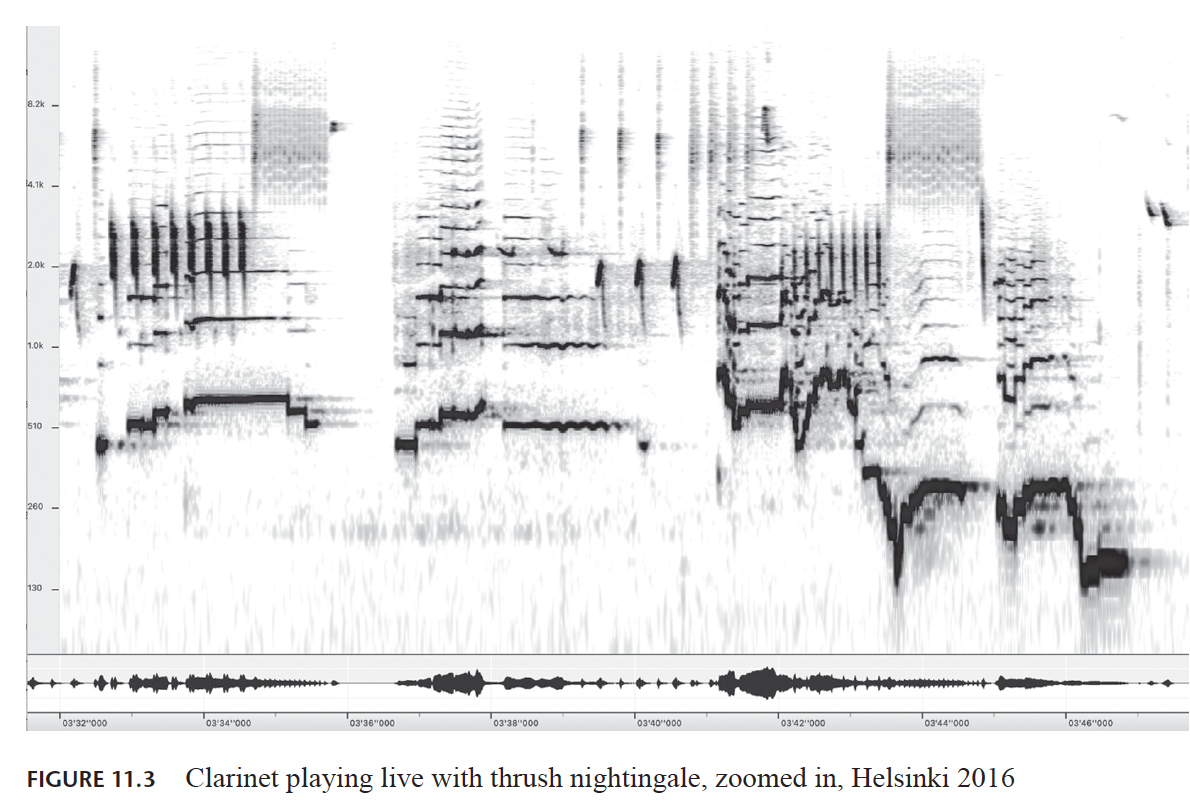
The nightingales certainly have that; they know some songs are better than others. We listen and listen, and still only dream of understanding what they know. As a transspecies performer, and someone fairly intuitive in my musical approach, the more I play live with these birds, the more I endeavor to fit in with them, as I felt in this one particular duet with a thrush nightingale in Helsinki, just before sunrise in June 2016, around 2.30 am, when at the time I felt fed up with the whole project. Night after night trying to do this on two hours sleep, in the far enough north where it’s hardly dark at all in the night. The bird doesn’t want to be seen but we can easily see him, so instead of hiding in place on a perch he darts around, always on the move, impossible to film but easy to engage with because he does not stop, going on for hours, until the sun is ready to come up and too many sedge warblers, blackbirds, and robins make noise. He sounds frustrated, I felt frustrated, because I had been doing this for too many nights and had no idea what it all meant.
But then when I listened back I smiled—I was playing beyond what I knew and towards what the bird knows. I had heard my own music changing. And it keeps changing up until this day.
Playing with individual bird musicians is like playing duets. Playing with several birds is like chamber music, or perhaps since so much improvisation is involved it’s closer to a jazz trio. With practice one learns the kinds of things the other musicians like to do, and we gain a sense of expectation, or anticipation. Still, even if one is prepared by experience, it’s the possibility for surprise that makes the whole thing valuable. As Wayne Shorter once said, “you cannot rehearse for the unknown.” Still, we rehearse and practice all the time.
The next step is to figure out how to play with a whole ensemble of birds, and the best time to do this is the dawn chorus. Amazingly, science has not figured out why it is that birds sing so much at dawn. Is it to early for them to eat? Does sound travel better then? Are they announcing to the world they are present, here, ready to live? All these explanations have been proposed.
Modern humans may be less used to getting up just before dawn, when the birds are most active, but almost everyone who manages to do it feels a sense of rightness to the experience, that this is an essential time to be listening, present, and ready to join in.
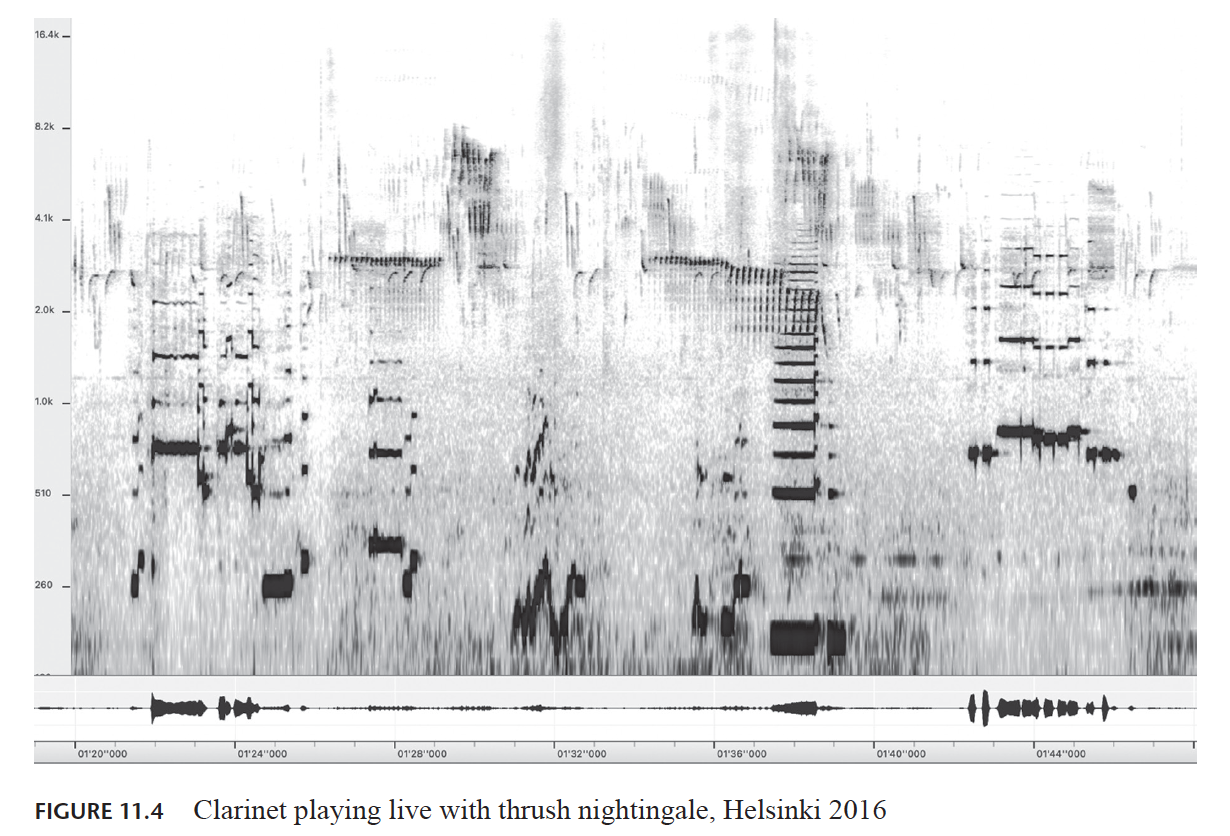
Echoing the patience of the great Estonian nature sound recordist Fred Jüssi, who listened to nightingales for ten years before feeling ready to commit their songs to his Nagra tape deck, I urge you to spend at least a few mornings just listening so as to find your place. Any careful listener will soon hear what ornithologists are just beginning to admit—that birds at dawn don’t only listen to their own species, but to all the sounds in their midst, be they natural or human. They are inspired by all possibilities of sound. If you want to join in, I recommend hearing yourself as one voice in a vast improvising orchestra, finding your place by listening much more than you play, hearing your moment as one among a vast array of rhythms and tones as this excerpt clearly shows:
It is this metaphor of one hue among many that gives me the greatest hope for humanity better understanding our place in nature. Our lifestyles, our structures, our culture can fit into the surrounding world without destroying it, and this will be essential for us to find solutions to the looming climate crisis. Everyone knows this, but it can be so hard to actually know what to do.
I wouldn’t say music or art can save the world, but it can put us into the mindset for the possibility of saving, by radically changing our whole worldview. Fitting into the natural world in a new way will require some adjustments, but it is absolutely something that our species has to try to do.
Music is not a language, not even a universal one. It is something beyond language, a form of communication that reaches from our world into the more-than-human world. It can connect us to nature, help humanity fit into the world surrounding us instead of beckoning us to destroy everything in our path. Music helps us find our place in the wider world.
“Birdsong,” writes poet Joan Retallack, “entered our words and left with migratory echoes insufficiently dispersed. We are not designed to perceive most of what surrounds us or to fully understand the rest.” This may be why science can never be complete and why we also need the poetic to resonate with the beauty nature presents to us. But she knows better than to take that easy tack: “There’s that conspicuous absence of real metaphor in nature. Sorry, I meant to say there’s that conspicuous absence of real nature in metaphor.”
Either way, we lose. So why even try? Retallack explains. In addition to pushing science towards beauty, to its edge, she has to have the hubris to imagine we can figure out the beauty in nature, and at the same time, even in this great time of crisis for humanity and the planet, we see that beauty still can matter. It might even make sense to celebrate work that experiments, that pushes our sense of what in possible, in art as well as science.
She speaks of something called a poethical wager. The moral weight of believing in poetry?
[We are] a highly decorative, lightweight species that might seem almost like a biological whim, but of course, we know [we have] a very active place in nature. And that any individual, for reasons entirely unknown qua qua qua, could shift some ecological pattern—in a way noticeable or not to us, the “observant species.” In other words, all one can do is take what is actually, in these terms, a very realistic, if improbable, chance that one’s contribution might be useful. So that’s it, the long and the short of it—my view of progressive action within a paradigm of chaos…. The poethical wager is just that we do our utmost to understand our contemporary position and then act on the chance that our work may be at least as effective as any other initial condition in the intertwining trajectories of pattern and chance. There’s no certainty. One could, as John Cage said, make matters worse. But to make this wager is at least to step out into the weather of our times.[1]
So what are we to do with all these animal aesthetics? They are not preferences designed for us. We can invent our own preferences, and decide the song of the starling is unpleasant, or the wattle dangling off a turkey’s neck to be red and unpleasant. That’s one way to look at it. But we can also use all of our knowledge, and sensitivity, to imagine how they might appreciate it.
We can easily get closer to the animal world, by thinking not of the relativity of beauty, but the fact that it is situated within different worlds.
The individual mockingbird does not have completely free choice as to what sounds she finds most pleasurable in what the male sings. Her preferences have evolved because that’s who she has developed to be. Humans may cause a lot of trouble, but we have one great aesthetic advantage: we can imagine what the world might look and sound like from another’s point of view.
I started by announcing this is what makes humans exceptional: we can step back and consider what is beautiful from another species’ point of view, even another person’s! With that ability we could potentially offer the greatest amount of care for our world of any living species on Earth.
We have this choice.
Life on Earth is more than misguided purpose. We are most decidedly not just in it for ourselves. That’s the other sense of human exception. We can step back from our own perspective, we may see what the world looks like from another species’ point of view.
Take this risk and the world becomes all the richer the moment you do.
[1] Joan Retallack, The Poethical Wager (Berkeley: University of California Press, 2003), p.45
Extract from Birdsong and The Transpecies Aesthetic, Chapter 11 of Transpecies Design, Design for a Posthumanist World, 2023, edited by Adrian Parr Zaretsky, Michael Zaretsky
Do nightingales like making music with people? The most rigorous study of nightingale response to playbacks of their own species’ songs, conducted in Berlin in the 1970s by Henrike Hultsch and Dietmar Todt, discovered three ways a nightingale may respond to a strange new music in his midst. First, if he feels his territory is threatened, he will try to interrupt the unfamiliar sound—what the scientists called “jamming the signal”—thereby preventing any foreign message from coming through by getting in the way of it as much as possible. That’s the aggressive response. But he may respond differently. A male nightingale who is confident in his territory, who doesn’t consider you and your clarinet or iPad or voice or cello a threat, will listen to what you play, wait a moment, then respond with his own short song, and then pause again. If you give him some space, play a short phrase, and stop, the whole exchange is considered a friendly acknowledgment, with each musician trading ideas, leaving space for the next, accepting that we each have our place and our song.
Third, a nightingale who considers himself at the top of his game—the boss bird, the best singer in the whole park—will do whatever he wants, maybe interrupting, maybe leaving space, singing however long it pleases him, because you matter not in the least to him, convinced as he is of his greatness. He sings as if no one is there but himself.
We’ve all met musicians who fit into these three categories.
From a musical point of view, distinguishing between interruption and sharing could get quite blurry. What one person hears as jamming the signal could, to another, come across as just plain jamming, trying to make interesting music together. This is be- cause music is far from a simple sign. It depends on what one believes music, in either a human or an avian context, to be all about. Perhaps artistry and form constitute not just an advertisement of territory and skill, but an attempt to work together to create some- thing no one species could make on its own.
They may be challenging us, and deeming to impress. But they may also be enjoying themselves.
I never tire of that tale of the three ways nightingales respond to each other, it seems so achingly human. We humans are as prejudiced as any other species: when we find animals doing something like us, we think they’re smart! Uniquely animal kinds of intelligence, like the social cohesion of ant societies, impress us a lot less. And of course, music isn’t so much a matter of intelligence, but of feeling, emotion, aesthetic developments.
The nightingales certainly have that; they know some songs are better than others. We listen and listen, and still only dream of understanding what they know. As a transspecies performer, and someone fairly intuitive in my musical approach, the more I play live with these birds, the more I endeavor to fit in with them, as I felt in this one particular duet with a thrush nightingale in Helsinki, just before sunrise in June 2016, around 2.30 am, when at the time I felt fed up with the whole project. Night after night trying to do this on two hours sleep, in the far enough north where it’s hardly dark at all in the night. The bird doesn’t want to be seen but we can easily see him, so instead of hiding in place on a perch he darts around, always on the move, impossible to film but easy to engage with because he does not stop, going on for hours, until the sun is ready to come up and too many sedge warblers, blackbirds, and robins make noise. He sounds frustrated, I felt frustrated, because I had been doing this for too many nights and had no idea what it all meant.
But then when I listened back I smiled—I was playing beyond what I knew and towards what the bird knows. I had heard my own music changing. And it keeps changing up until this day.
Playing with individual bird musicians is like playing duets. Playing with several birds is like chamber music, or perhaps since so much improvisation is involved it’s closer to a jazz trio. With practice one learns the kinds of things the other musicians like to do, and we gain a sense of expectation, or anticipation. Still, even if one is prepared by experience, it’s the possibility for surprise that makes the whole thing valuable. As Wayne Shorter once said, “you cannot rehearse for the unknown.” Still, we rehearse and practice all the time.
The next step is to figure out how to play with a whole ensemble of birds, and the best time to do this is the dawn chorus. Amazingly, science has not figured out why it is that birds sing so much at dawn. Is it to early for them to eat? Does sound travel better then? Are they announcing to the world they are present, here, ready to live? All these explanations have been proposed.
Modern humans may be less used to getting up just before dawn, when the birds are most active, but almost everyone who manages to do it feels a sense of rightness to the experience, that this is an essential time to be listening, present, and ready to join in.
Echoing the patience of the great Estonian nature sound recordist Fred Jüssi, who listened to nightingales for ten years before feeling ready to commit their songs to his Nagra tape deck, I urge you to spend at least a few mornings just listening so as to find your place. Any careful listener will soon hear what ornithologists are just beginning to admit—that birds at dawn don’t only listen to their own species, but to all the sounds in their midst, be they natural or human. They are inspired by all possibilities of sound. If you want to join in, I recommend hearing yourself as one voice in a vast improvising orchestra, finding your place by listening much more than you play, hearing your moment as one among a vast array of rhythms and tones as this excerpt clearly shows:
It is this metaphor of one hue among many that gives me the greatest hope for humanity better understanding our place in nature. Our lifestyles, our structures, our culture can fit into the surrounding world without destroying it, and this will be essential for us to find solutions to the looming climate crisis. Everyone knows this, but it can be so hard to actually know what to do.
I wouldn’t say music or art can save the world, but it can put us into the mindset for the possibility of saving, by radically changing our whole worldview. Fitting into the natural world in a new way will require some adjustments, but it is absolutely something that our species has to try to do.
Music is not a language, not even a universal one. It is something beyond language, a form of communication that reaches from our world into the more-than-human world. It can connect us to nature, help humanity fit into the world surrounding us instead of beckoning us to destroy everything in our path. Music helps us find our place in the wider world.
“Birdsong,” writes poet Joan Retallack, “entered our words and left with migratory echoes insufficiently dispersed. We are not designed to perceive most of what surrounds us or to fully understand the rest.” This may be why science can never be complete and why we also need the poetic to resonate with the beauty nature presents to us. But she knows better than to take that easy tack: “There’s that conspicuous absence of real metaphor in nature. Sorry, I meant to say there’s that conspicuous absence of real nature in metaphor.”
Either way, we lose. So why even try? Retallack explains. In addition to pushing science towards beauty, to its edge, she has to have the hubris to imagine we can figure out the beauty in nature, and at the same time, even in this great time of crisis for humanity and the planet, we see that beauty still can matter. It might even make sense to celebrate work that experiments, that pushes our sense of what in possible, in art as well as science.
She speaks of something called a poethical wager. The moral weight of believing in poetry?
[We are] a highly decorative, lightweight species that might seem almost like a biological whim, but of course, we know [we have] a very active place in nature. And that any individual, for reasons entirely unknown qua qua qua, could shift some ecological pattern—in a way noticeable or not to us, the “observant species.” In other words, all one can do is take what is actually, in these terms, a very realistic, if improbable, chance that one’s contribution might be useful. So that’s it, the long and the short of it—my view of progressive action within a paradigm of chaos…. The poethical wager is just that we do our utmost to understand our contemporary position and then act on the chance that our work may be at least as effective as any other initial condition in the intertwining trajectories of pattern and chance. There’s no certainty. One could, as John Cage said, make matters worse. But to make this wager is at least to step out into the weather of our times.[1]
So what are we to do with all these animal aesthetics? They are not preferences designed for us. We can invent our own preferences, and decide the song of the starling is unpleasant, or the wattle dangling off a turkey’s neck to be red and unpleasant. That’s one way to look at it. But we can also use all of our knowledge, and sensitivity, to imagine how they might appreciate it.
We can easily get closer to the animal world, by thinking not of the relativity of beauty, but the fact that it is situated within different worlds.
The individual mockingbird does not have completely free choice as to what sounds she finds most pleasurable in what the male sings. Her preferences have evolved because that’s who she has developed to be. Humans may cause a lot of trouble, but we have one great aesthetic advantage: we can imagine what the world might look and sound like from another’s point of view.
I started by announcing this is what makes humans exceptional: we can step back and consider what is beautiful from another species’ point of view, even another person’s! With that ability we could potentially offer the greatest amount of care for our world of any living species on Earth.
We have this choice.
Life on Earth is more than misguided purpose. We are most decidedly not just in it for ourselves. That’s the other sense of human exception. We can step back from our own perspective, we may see what the world looks like from another species’ point of view.
Take this risk and the world becomes all the richer the moment you do.
[1] Joan Retallack, The Poethical Wager (Berkeley: University of California Press, 2003), p.45
Extract from Birdsong and The Transpecies Aesthetic, Chapter 11 of Transpecies Design, Design for a Posthumanist World, 2023, edited by Adrian Parr Zaretsky, Michael Zaretsky
David Rothenberg is a writer, philosopher, ecologist, and musician, speaking out for nature in all aspects of his diverse work. He investigates the musicality of animals and the role of nature in philosophy, with a particular interest in understanding other species by making music with them. As a professor of philosophy and music at the New Jersey Institute of Technology, he “teaches engineers nonquantifiable things.” He is also an acclaimed composer and jazz clarinetist known for his integration of world music with improvisation and electronics.
BY DAVID ROTHENBURG
Do nightingales like making music with people? The most rigorous study of nightingale response to playbacks of their own species’ songs, conducted in Berlin in the 1970s by Henrike Hultsch and Dietmar Todt, discovered three ways a nightingale may respond to a strange new music in his midst. First, if he feels his territory is threatened, he will try to interrupt the unfamiliar sound—what the scientists called “jamming the signal”—thereby preventing any foreign message from coming through by getting in the way of it as much as possible. That’s the aggressive response. But he may respond differently. A male nightingale who is confident in his territory, who doesn’t consider you and your clarinet or iPad or voice or cello a threat, will listen to what you play, wait a moment, then respond with his own short song, and then pause again. If you give him some space, play a short phrase, and stop, the whole exchange is considered a friendly acknowledgment, with each musician trading ideas, leaving space for the next, accepting that we each have our place and our song.
Third, a nightingale who considers himself at the top of his game—the boss bird, the best singer in the whole park—will do whatever he wants, maybe interrupting, maybe leaving space, singing however long it pleases him, because you matter not in the least to him, convinced as he is of his greatness. He sings as if no one is there but himself.
We’ve all met musicians who fit into these three categories.
From a musical point of view, distinguishing between interruption and sharing could get quite blurry. What one person hears as jamming the signal could, to another, come across as just plain jamming, trying to make interesting music together. This is be- cause music is far from a simple sign. It depends on what one believes music, in either a human or an avian context, to be all about. Perhaps artistry and form constitute not just an advertisement of territory and skill, but an attempt to work together to create some- thing no one species could make on its own.
They may be challenging us, and deeming to impress. But they may also be enjoying themselves.
I never tire of that tale of the three ways nightingales respond to each other, it seems so achingly human. We humans are as prejudiced as any other species: when we find animals doing something like us, we think they’re smart! Uniquely animal kinds of intelligence, like the social cohesion of ant societies, impress us a lot less. And of course, music isn’t so much a matter of intelligence, but of feeling, emotion, aesthetic developments.
The nightingales certainly have that; they know some songs are better than others. We listen and listen, and still only dream of understanding what they know. As a transspecies performer, and someone fairly intuitive in my musical approach, the more I play live with these birds, the more I endeavor to fit in with them, as I felt in this one particular duet with a thrush nightingale in Helsinki, just before sunrise in June 2016, around 2.30 am, when at the time I felt fed up with the whole project. Night after night trying to do this on two hours sleep, in the far enough north where it’s hardly dark at all in the night. The bird doesn’t want to be seen but we can easily see him, so instead of hiding in place on a perch he darts around, always on the move, impossible to film but easy to engage with because he does not stop, going on for hours, until the sun is ready to come up and too many sedge warblers, blackbirds, and robins make noise. He sounds frustrated, I felt frustrated, because I had been doing this for too many nights and had no idea what it all meant.
But then when I listened back I smiled—I was playing beyond what I knew and towards what the bird knows. I had heard my own music changing. And it keeps changing up until this day.
Playing with individual bird musicians is like playing duets. Playing with several birds is like chamber music, or perhaps since so much improvisation is involved it’s closer to a jazz trio. With practice one learns the kinds of things the other musicians like to do, and we gain a sense of expectation, or anticipation. Still, even if one is prepared by experience, it’s the possibility for surprise that makes the whole thing valuable. As Wayne Shorter once said, “you cannot rehearse for the unknown.” Still, we rehearse and practice all the time.
The next step is to figure out how to play with a whole ensemble of birds, and the best time to do this is the dawn chorus. Amazingly, science has not figured out why it is that birds sing so much at dawn. Is it to early for them to eat? Does sound travel better then? Are they announcing to the world they are present, here, ready to live? All these explanations have been proposed.
Modern humans may be less used to getting up just before dawn, when the birds are most active, but almost everyone who manages to do it feels a sense of rightness to the experience, that this is an essential time to be listening, present, and ready to join in.
Echoing the patience of the great Estonian nature sound recordist Fred Jüssi, who listened to nightingales for ten years before feeling ready to commit their songs to his Nagra tape deck, I urge you to spend at least a few mornings just listening so as to find your place. Any careful listener will soon hear what ornithologists are just beginning to admit—that birds at dawn don’t only listen to their own species, but to all the sounds in their midst, be they natural or human. They are inspired by all possibilities of sound. If you want to join in, I recommend hearing yourself as one voice in a vast improvising orchestra, finding your place by listening much more than you play, hearing your moment as one among a vast array of rhythms and tones as this excerpt clearly shows:
It is this metaphor of one hue among many that gives me the greatest hope for humanity better understanding our place in nature. Our lifestyles, our structures, our culture can fit into the surrounding world without destroying it, and this will be essential for us to find solutions to the looming climate crisis. Everyone knows this, but it can be so hard to actually know what to do.
I wouldn’t say music or art can save the world, but it can put us into the mindset for the possibility of saving, by radically changing our whole worldview. Fitting into the natural world in a new way will require some adjustments, but it is absolutely something that our species has to try to do.
Music is not a language, not even a universal one. It is something beyond language, a form of communication that reaches from our world into the more-than-human world. It can connect us to nature, help humanity fit into the world surrounding us instead of beckoning us to destroy everything in our path. Music helps us find our place in the wider world.
“Birdsong,” writes poet Joan Retallack, “entered our words and left with migratory echoes insufficiently dispersed. We are not designed to perceive most of what surrounds us or to fully understand the rest.” This may be why science can never be complete and why we also need the poetic to resonate with the beauty nature presents to us. But she knows better than to take that easy tack: “There’s that conspicuous absence of real metaphor in nature. Sorry, I meant to say there’s that conspicuous absence of real nature in metaphor.”
Either way, we lose. So why even try? Retallack explains. In addition to pushing science towards beauty, to its edge, she has to have the hubris to imagine we can figure out the beauty in nature, and at the same time, even in this great time of crisis for humanity and the planet, we see that beauty still can matter. It might even make sense to celebrate work that experiments, that pushes our sense of what in possible, in art as well as science.
She speaks of something called a poethical wager. The moral weight of believing in poetry?
[We are] a highly decorative, lightweight species that might seem almost like a biological whim, but of course, we know [we have] a very active place in nature. And that any individual, for reasons entirely unknown qua qua qua, could shift some ecological pattern—in a way noticeable or not to us, the “observant species.” In other words, all one can do is take what is actually, in these terms, a very realistic, if improbable, chance that one’s contribution might be useful. So that’s it, the long and the short of it—my view of progressive action within a paradigm of chaos…. The poethical wager is just that we do our utmost to understand our contemporary position and then act on the chance that our work may be at least as effective as any other initial condition in the intertwining trajectories of pattern and chance. There’s no certainty. One could, as John Cage said, make matters worse. But to make this wager is at least to step out into the weather of our times.[1]
So what are we to do with all these animal aesthetics? They are not preferences designed for us. We can invent our own preferences, and decide the song of the starling is unpleasant, or the wattle dangling off a turkey’s neck to be red and unpleasant. That’s one way to look at it. But we can also use all of our knowledge, and sensitivity, to imagine how they might appreciate it.
We can easily get closer to the animal world, by thinking not of the relativity of beauty, but the fact that it is situated within different worlds.
The individual mockingbird does not have completely free choice as to what sounds she finds most pleasurable in what the male sings. Her preferences have evolved because that’s who she has developed to be. Humans may cause a lot of trouble, but we have one great aesthetic advantage: we can imagine what the world might look and sound like from another’s point of view.
I started by announcing this is what makes humans exceptional: we can step back and consider what is beautiful from another species’ point of view, even another person’s! With that ability we could potentially offer the greatest amount of care for our world of any living species on Earth.
We have this choice.
Life on Earth is more than misguided purpose. We are most decidedly not just in it for ourselves. That’s the other sense of human exception. We can step back from our own perspective, we may see what the world looks like from another species’ point of view.
Take this risk and the world becomes all the richer the moment you do.
[1] Joan Retallack, The Poethical Wager (Berkeley: University of California Press, 2003), p.45
Extract from Birdsong and The Transpecies Aesthetic, Chapter 11 of Transpecies Design, Design for a Posthumanist World, 2023, edited by Adrian Parr Zaretsky, Michael Zaretsky
Do nightingales like making music with people? The most rigorous study of nightingale response to playbacks of their own species’ songs, conducted in Berlin in the 1970s by Henrike Hultsch and Dietmar Todt, discovered three ways a nightingale may respond to a strange new music in his midst. First, if he feels his territory is threatened, he will try to interrupt the unfamiliar sound—what the scientists called “jamming the signal”—thereby preventing any foreign message from coming through by getting in the way of it as much as possible. That’s the aggressive response. But he may respond differently. A male nightingale who is confident in his territory, who doesn’t consider you and your clarinet or iPad or voice or cello a threat, will listen to what you play, wait a moment, then respond with his own short song, and then pause again. If you give him some space, play a short phrase, and stop, the whole exchange is considered a friendly acknowledgment, with each musician trading ideas, leaving space for the next, accepting that we each have our place and our song.
Third, a nightingale who considers himself at the top of his game—the boss bird, the best singer in the whole park—will do whatever he wants, maybe interrupting, maybe leaving space, singing however long it pleases him, because you matter not in the least to him, convinced as he is of his greatness. He sings as if no one is there but himself.
We’ve all met musicians who fit into these three categories.
From a musical point of view, distinguishing between interruption and sharing could get quite blurry. What one person hears as jamming the signal could, to another, come across as just plain jamming, trying to make interesting music together. This is be- cause music is far from a simple sign. It depends on what one believes music, in either a human or an avian context, to be all about. Perhaps artistry and form constitute not just an advertisement of territory and skill, but an attempt to work together to create some- thing no one species could make on its own.
They may be challenging us, and deeming to impress. But they may also be enjoying themselves.
I never tire of that tale of the three ways nightingales respond to each other, it seems so achingly human. We humans are as prejudiced as any other species: when we find animals doing something like us, we think they’re smart! Uniquely animal kinds of intelligence, like the social cohesion of ant societies, impress us a lot less. And of course, music isn’t so much a matter of intelligence, but of feeling, emotion, aesthetic developments.
The nightingales certainly have that; they know some songs are better than others. We listen and listen, and still only dream of understanding what they know. As a transspecies performer, and someone fairly intuitive in my musical approach, the more I play live with these birds, the more I endeavor to fit in with them, as I felt in this one particular duet with a thrush nightingale in Helsinki, just before sunrise in June 2016, around 2.30 am, when at the time I felt fed up with the whole project. Night after night trying to do this on two hours sleep, in the far enough north where it’s hardly dark at all in the night. The bird doesn’t want to be seen but we can easily see him, so instead of hiding in place on a perch he darts around, always on the move, impossible to film but easy to engage with because he does not stop, going on for hours, until the sun is ready to come up and too many sedge warblers, blackbirds, and robins make noise. He sounds frustrated, I felt frustrated, because I had been doing this for too many nights and had no idea what it all meant.
But then when I listened back I smiled—I was playing beyond what I knew and towards what the bird knows. I had heard my own music changing. And it keeps changing up until this day.
Playing with individual bird musicians is like playing duets. Playing with several birds is like chamber music, or perhaps since so much improvisation is involved it’s closer to a jazz trio. With practice one learns the kinds of things the other musicians like to do, and we gain a sense of expectation, or anticipation. Still, even if one is prepared by experience, it’s the possibility for surprise that makes the whole thing valuable. As Wayne Shorter once said, “you cannot rehearse for the unknown.” Still, we rehearse and practice all the time.
The next step is to figure out how to play with a whole ensemble of birds, and the best time to do this is the dawn chorus. Amazingly, science has not figured out why it is that birds sing so much at dawn. Is it to early for them to eat? Does sound travel better then? Are they announcing to the world they are present, here, ready to live? All these explanations have been proposed.
Modern humans may be less used to getting up just before dawn, when the birds are most active, but almost everyone who manages to do it feels a sense of rightness to the experience, that this is an essential time to be listening, present, and ready to join in.
Echoing the patience of the great Estonian nature sound recordist Fred Jüssi, who listened to nightingales for ten years before feeling ready to commit their songs to his Nagra tape deck, I urge you to spend at least a few mornings just listening so as to find your place. Any careful listener will soon hear what ornithologists are just beginning to admit—that birds at dawn don’t only listen to their own species, but to all the sounds in their midst, be they natural or human. They are inspired by all possibilities of sound. If you want to join in, I recommend hearing yourself as one voice in a vast improvising orchestra, finding your place by listening much more than you play, hearing your moment as one among a vast array of rhythms and tones as this excerpt clearly shows:
It is this metaphor of one hue among many that gives me the greatest hope for humanity better understanding our place in nature. Our lifestyles, our structures, our culture can fit into the surrounding world without destroying it, and this will be essential for us to find solutions to the looming climate crisis. Everyone knows this, but it can be so hard to actually know what to do.
I wouldn’t say music or art can save the world, but it can put us into the mindset for the possibility of saving, by radically changing our whole worldview. Fitting into the natural world in a new way will require some adjustments, but it is absolutely something that our species has to try to do.
Music is not a language, not even a universal one. It is something beyond language, a form of communication that reaches from our world into the more-than-human world. It can connect us to nature, help humanity fit into the world surrounding us instead of beckoning us to destroy everything in our path. Music helps us find our place in the wider world.
“Birdsong,” writes poet Joan Retallack, “entered our words and left with migratory echoes insufficiently dispersed. We are not designed to perceive most of what surrounds us or to fully understand the rest.” This may be why science can never be complete and why we also need the poetic to resonate with the beauty nature presents to us. But she knows better than to take that easy tack: “There’s that conspicuous absence of real metaphor in nature. Sorry, I meant to say there’s that conspicuous absence of real nature in metaphor.”
Either way, we lose. So why even try? Retallack explains. In addition to pushing science towards beauty, to its edge, she has to have the hubris to imagine we can figure out the beauty in nature, and at the same time, even in this great time of crisis for humanity and the planet, we see that beauty still can matter. It might even make sense to celebrate work that experiments, that pushes our sense of what in possible, in art as well as science.
She speaks of something called a poethical wager. The moral weight of believing in poetry?
[We are] a highly decorative, lightweight species that might seem almost like a biological whim, but of course, we know [we have] a very active place in nature. And that any individual, for reasons entirely unknown qua qua qua, could shift some ecological pattern—in a way noticeable or not to us, the “observant species.” In other words, all one can do is take what is actually, in these terms, a very realistic, if improbable, chance that one’s contribution might be useful. So that’s it, the long and the short of it—my view of progressive action within a paradigm of chaos…. The poethical wager is just that we do our utmost to understand our contemporary position and then act on the chance that our work may be at least as effective as any other initial condition in the intertwining trajectories of pattern and chance. There’s no certainty. One could, as John Cage said, make matters worse. But to make this wager is at least to step out into the weather of our times.[1]
So what are we to do with all these animal aesthetics? They are not preferences designed for us. We can invent our own preferences, and decide the song of the starling is unpleasant, or the wattle dangling off a turkey’s neck to be red and unpleasant. That’s one way to look at it. But we can also use all of our knowledge, and sensitivity, to imagine how they might appreciate it.
We can easily get closer to the animal world, by thinking not of the relativity of beauty, but the fact that it is situated within different worlds.
The individual mockingbird does not have completely free choice as to what sounds she finds most pleasurable in what the male sings. Her preferences have evolved because that’s who she has developed to be. Humans may cause a lot of trouble, but we have one great aesthetic advantage: we can imagine what the world might look and sound like from another’s point of view.
I started by announcing this is what makes humans exceptional: we can step back and consider what is beautiful from another species’ point of view, even another person’s! With that ability we could potentially offer the greatest amount of care for our world of any living species on Earth.
We have this choice.
Life on Earth is more than misguided purpose. We are most decidedly not just in it for ourselves. That’s the other sense of human exception. We can step back from our own perspective, we may see what the world looks like from another species’ point of view.
Take this risk and the world becomes all the richer the moment you do.
[1] Joan Retallack, The Poethical Wager (Berkeley: University of California Press, 2003), p.45
Extract from Birdsong and The Transpecies Aesthetic, Chapter 11 of Transpecies Design, Design for a Posthumanist World, 2023, edited by Adrian Parr Zaretsky, Michael Zaretsky
David Rothenberg is a writer, philosopher, ecologist, and musician, speaking out for nature in all aspects of his diverse work. He investigates the musicality of animals and the role of nature in philosophy, with a particular interest in understanding other species by making music with them. As a professor of philosophy and music at the New Jersey Institute of Technology, he “teaches engineers nonquantifiable things.” He is also an acclaimed composer and jazz clarinetist known for his integration of world music with improvisation and electronics.
BY DAVID ROTHENBURG
Do nightingales like making music with people? The most rigorous study of nightingale response to playbacks of their own species’ songs, conducted in Berlin in the 1970s by Henrike Hultsch and Dietmar Todt, discovered three ways a nightingale may respond to a strange new music in his midst. First, if he feels his territory is threatened, he will try to interrupt the unfamiliar sound—what the scientists called “jamming the signal”—thereby preventing any foreign message from coming through by getting in the way of it as much as possible. That’s the aggressive response. But he may respond differently. A male nightingale who is confident in his territory, who doesn’t consider you and your clarinet or iPad or voice or cello a threat, will listen to what you play, wait a moment, then respond with his own short song, and then pause again. If you give him some space, play a short phrase, and stop, the whole exchange is considered a friendly acknowledgment, with each musician trading ideas, leaving space for the next, accepting that we each have our place and our song.
Third, a nightingale who considers himself at the top of his game—the boss bird, the best singer in the whole park—will do whatever he wants, maybe interrupting, maybe leaving space, singing however long it pleases him, because you matter not in the least to him, convinced as he is of his greatness. He sings as if no one is there but himself.
We’ve all met musicians who fit into these three categories.
From a musical point of view, distinguishing between interruption and sharing could get quite blurry. What one person hears as jamming the signal could, to another, come across as just plain jamming, trying to make interesting music together. This is be- cause music is far from a simple sign. It depends on what one believes music, in either a human or an avian context, to be all about. Perhaps artistry and form constitute not just an advertisement of territory and skill, but an attempt to work together to create some- thing no one species could make on its own.
They may be challenging us, and deeming to impress. But they may also be enjoying themselves.
I never tire of that tale of the three ways nightingales respond to each other, it seems so achingly human. We humans are as prejudiced as any other species: when we find animals doing something like us, we think they’re smart! Uniquely animal kinds of intelligence, like the social cohesion of ant societies, impress us a lot less. And of course, music isn’t so much a matter of intelligence, but of feeling, emotion, aesthetic developments.
The nightingales certainly have that; they know some songs are better than others. We listen and listen, and still only dream of understanding what they know. As a transspecies performer, and someone fairly intuitive in my musical approach, the more I play live with these birds, the more I endeavor to fit in with them, as I felt in this one particular duet with a thrush nightingale in Helsinki, just before sunrise in June 2016, around 2.30 am, when at the time I felt fed up with the whole project. Night after night trying to do this on two hours sleep, in the far enough north where it’s hardly dark at all in the night. The bird doesn’t want to be seen but we can easily see him, so instead of hiding in place on a perch he darts around, always on the move, impossible to film but easy to engage with because he does not stop, going on for hours, until the sun is ready to come up and too many sedge warblers, blackbirds, and robins make noise. He sounds frustrated, I felt frustrated, because I had been doing this for too many nights and had no idea what it all meant.
But then when I listened back I smiled—I was playing beyond what I knew and towards what the bird knows. I had heard my own music changing. And it keeps changing up until this day.
Playing with individual bird musicians is like playing duets. Playing with several birds is like chamber music, or perhaps since so much improvisation is involved it’s closer to a jazz trio. With practice one learns the kinds of things the other musicians like to do, and we gain a sense of expectation, or anticipation. Still, even if one is prepared by experience, it’s the possibility for surprise that makes the whole thing valuable. As Wayne Shorter once said, “you cannot rehearse for the unknown.” Still, we rehearse and practice all the time.
The next step is to figure out how to play with a whole ensemble of birds, and the best time to do this is the dawn chorus. Amazingly, science has not figured out why it is that birds sing so much at dawn. Is it to early for them to eat? Does sound travel better then? Are they announcing to the world they are present, here, ready to live? All these explanations have been proposed.
Modern humans may be less used to getting up just before dawn, when the birds are most active, but almost everyone who manages to do it feels a sense of rightness to the experience, that this is an essential time to be listening, present, and ready to join in.
Echoing the patience of the great Estonian nature sound recordist Fred Jüssi, who listened to nightingales for ten years before feeling ready to commit their songs to his Nagra tape deck, I urge you to spend at least a few mornings just listening so as to find your place. Any careful listener will soon hear what ornithologists are just beginning to admit—that birds at dawn don’t only listen to their own species, but to all the sounds in their midst, be they natural or human. They are inspired by all possibilities of sound. If you want to join in, I recommend hearing yourself as one voice in a vast improvising orchestra, finding your place by listening much more than you play, hearing your moment as one among a vast array of rhythms and tones as this excerpt clearly shows:
It is this metaphor of one hue among many that gives me the greatest hope for humanity better understanding our place in nature. Our lifestyles, our structures, our culture can fit into the surrounding world without destroying it, and this will be essential for us to find solutions to the looming climate crisis. Everyone knows this, but it can be so hard to actually know what to do.
I wouldn’t say music or art can save the world, but it can put us into the mindset for the possibility of saving, by radically changing our whole worldview. Fitting into the natural world in a new way will require some adjustments, but it is absolutely something that our species has to try to do.
Music is not a language, not even a universal one. It is something beyond language, a form of communication that reaches from our world into the more-than-human world. It can connect us to nature, help humanity fit into the world surrounding us instead of beckoning us to destroy everything in our path. Music helps us find our place in the wider world.
“Birdsong,” writes poet Joan Retallack, “entered our words and left with migratory echoes insufficiently dispersed. We are not designed to perceive most of what surrounds us or to fully understand the rest.” This may be why science can never be complete and why we also need the poetic to resonate with the beauty nature presents to us. But she knows better than to take that easy tack: “There’s that conspicuous absence of real metaphor in nature. Sorry, I meant to say there’s that conspicuous absence of real nature in metaphor.”
Either way, we lose. So why even try? Retallack explains. In addition to pushing science towards beauty, to its edge, she has to have the hubris to imagine we can figure out the beauty in nature, and at the same time, even in this great time of crisis for humanity and the planet, we see that beauty still can matter. It might even make sense to celebrate work that experiments, that pushes our sense of what in possible, in art as well as science.
She speaks of something called a poethical wager. The moral weight of believing in poetry?
[We are] a highly decorative, lightweight species that might seem almost like a biological whim, but of course, we know [we have] a very active place in nature. And that any individual, for reasons entirely unknown qua qua qua, could shift some ecological pattern—in a way noticeable or not to us, the “observant species.” In other words, all one can do is take what is actually, in these terms, a very realistic, if improbable, chance that one’s contribution might be useful. So that’s it, the long and the short of it—my view of progressive action within a paradigm of chaos…. The poethical wager is just that we do our utmost to understand our contemporary position and then act on the chance that our work may be at least as effective as any other initial condition in the intertwining trajectories of pattern and chance. There’s no certainty. One could, as John Cage said, make matters worse. But to make this wager is at least to step out into the weather of our times.[1]
So what are we to do with all these animal aesthetics? They are not preferences designed for us. We can invent our own preferences, and decide the song of the starling is unpleasant, or the wattle dangling off a turkey’s neck to be red and unpleasant. That’s one way to look at it. But we can also use all of our knowledge, and sensitivity, to imagine how they might appreciate it.
We can easily get closer to the animal world, by thinking not of the relativity of beauty, but the fact that it is situated within different worlds.
The individual mockingbird does not have completely free choice as to what sounds she finds most pleasurable in what the male sings. Her preferences have evolved because that’s who she has developed to be. Humans may cause a lot of trouble, but we have one great aesthetic advantage: we can imagine what the world might look and sound like from another’s point of view.
I started by announcing this is what makes humans exceptional: we can step back and consider what is beautiful from another species’ point of view, even another person’s! With that ability we could potentially offer the greatest amount of care for our world of any living species on Earth.
We have this choice.
Life on Earth is more than misguided purpose. We are most decidedly not just in it for ourselves. That’s the other sense of human exception. We can step back from our own perspective, we may see what the world looks like from another species’ point of view.
Take this risk and the world becomes all the richer the moment you do.
[1] Joan Retallack, The Poethical Wager (Berkeley: University of California Press, 2003), p.45
Extract from Birdsong and The Transpecies Aesthetic, Chapter 11 of Transpecies Design, Design for a Posthumanist World, 2023, edited by Adrian Parr Zaretsky, Michael Zaretsky
Do nightingales like making music with people? The most rigorous study of nightingale response to playbacks of their own species’ songs, conducted in Berlin in the 1970s by Henrike Hultsch and Dietmar Todt, discovered three ways a nightingale may respond to a strange new music in his midst. First, if he feels his territory is threatened, he will try to interrupt the unfamiliar sound—what the scientists called “jamming the signal”—thereby preventing any foreign message from coming through by getting in the way of it as much as possible. That’s the aggressive response. But he may respond differently. A male nightingale who is confident in his territory, who doesn’t consider you and your clarinet or iPad or voice or cello a threat, will listen to what you play, wait a moment, then respond with his own short song, and then pause again. If you give him some space, play a short phrase, and stop, the whole exchange is considered a friendly acknowledgment, with each musician trading ideas, leaving space for the next, accepting that we each have our place and our song.
Third, a nightingale who considers himself at the top of his game—the boss bird, the best singer in the whole park—will do whatever he wants, maybe interrupting, maybe leaving space, singing however long it pleases him, because you matter not in the least to him, convinced as he is of his greatness. He sings as if no one is there but himself.
We’ve all met musicians who fit into these three categories.
From a musical point of view, distinguishing between interruption and sharing could get quite blurry. What one person hears as jamming the signal could, to another, come across as just plain jamming, trying to make interesting music together. This is be- cause music is far from a simple sign. It depends on what one believes music, in either a human or an avian context, to be all about. Perhaps artistry and form constitute not just an advertisement of territory and skill, but an attempt to work together to create some- thing no one species could make on its own.
They may be challenging us, and deeming to impress. But they may also be enjoying themselves.
I never tire of that tale of the three ways nightingales respond to each other, it seems so achingly human. We humans are as prejudiced as any other species: when we find animals doing something like us, we think they’re smart! Uniquely animal kinds of intelligence, like the social cohesion of ant societies, impress us a lot less. And of course, music isn’t so much a matter of intelligence, but of feeling, emotion, aesthetic developments.
The nightingales certainly have that; they know some songs are better than others. We listen and listen, and still only dream of understanding what they know. As a transspecies performer, and someone fairly intuitive in my musical approach, the more I play live with these birds, the more I endeavor to fit in with them, as I felt in this one particular duet with a thrush nightingale in Helsinki, just before sunrise in June 2016, around 2.30 am, when at the time I felt fed up with the whole project. Night after night trying to do this on two hours sleep, in the far enough north where it’s hardly dark at all in the night. The bird doesn’t want to be seen but we can easily see him, so instead of hiding in place on a perch he darts around, always on the move, impossible to film but easy to engage with because he does not stop, going on for hours, until the sun is ready to come up and too many sedge warblers, blackbirds, and robins make noise. He sounds frustrated, I felt frustrated, because I had been doing this for too many nights and had no idea what it all meant.
But then when I listened back I smiled—I was playing beyond what I knew and towards what the bird knows. I had heard my own music changing. And it keeps changing up until this day.
Playing with individual bird musicians is like playing duets. Playing with several birds is like chamber music, or perhaps since so much improvisation is involved it’s closer to a jazz trio. With practice one learns the kinds of things the other musicians like to do, and we gain a sense of expectation, or anticipation. Still, even if one is prepared by experience, it’s the possibility for surprise that makes the whole thing valuable. As Wayne Shorter once said, “you cannot rehearse for the unknown.” Still, we rehearse and practice all the time.
The next step is to figure out how to play with a whole ensemble of birds, and the best time to do this is the dawn chorus. Amazingly, science has not figured out why it is that birds sing so much at dawn. Is it to early for them to eat? Does sound travel better then? Are they announcing to the world they are present, here, ready to live? All these explanations have been proposed.
Modern humans may be less used to getting up just before dawn, when the birds are most active, but almost everyone who manages to do it feels a sense of rightness to the experience, that this is an essential time to be listening, present, and ready to join in.
Echoing the patience of the great Estonian nature sound recordist Fred Jüssi, who listened to nightingales for ten years before feeling ready to commit their songs to his Nagra tape deck, I urge you to spend at least a few mornings just listening so as to find your place. Any careful listener will soon hear what ornithologists are just beginning to admit—that birds at dawn don’t only listen to their own species, but to all the sounds in their midst, be they natural or human. They are inspired by all possibilities of sound. If you want to join in, I recommend hearing yourself as one voice in a vast improvising orchestra, finding your place by listening much more than you play, hearing your moment as one among a vast array of rhythms and tones as this excerpt clearly shows:
It is this metaphor of one hue among many that gives me the greatest hope for humanity better understanding our place in nature. Our lifestyles, our structures, our culture can fit into the surrounding world without destroying it, and this will be essential for us to find solutions to the looming climate crisis. Everyone knows this, but it can be so hard to actually know what to do.
I wouldn’t say music or art can save the world, but it can put us into the mindset for the possibility of saving, by radically changing our whole worldview. Fitting into the natural world in a new way will require some adjustments, but it is absolutely something that our species has to try to do.
Music is not a language, not even a universal one. It is something beyond language, a form of communication that reaches from our world into the more-than-human world. It can connect us to nature, help humanity fit into the world surrounding us instead of beckoning us to destroy everything in our path. Music helps us find our place in the wider world.
“Birdsong,” writes poet Joan Retallack, “entered our words and left with migratory echoes insufficiently dispersed. We are not designed to perceive most of what surrounds us or to fully understand the rest.” This may be why science can never be complete and why we also need the poetic to resonate with the beauty nature presents to us. But she knows better than to take that easy tack: “There’s that conspicuous absence of real metaphor in nature. Sorry, I meant to say there’s that conspicuous absence of real nature in metaphor.”
Either way, we lose. So why even try? Retallack explains. In addition to pushing science towards beauty, to its edge, she has to have the hubris to imagine we can figure out the beauty in nature, and at the same time, even in this great time of crisis for humanity and the planet, we see that beauty still can matter. It might even make sense to celebrate work that experiments, that pushes our sense of what in possible, in art as well as science.
She speaks of something called a poethical wager. The moral weight of believing in poetry?
[We are] a highly decorative, lightweight species that might seem almost like a biological whim, but of course, we know [we have] a very active place in nature. And that any individual, for reasons entirely unknown qua qua qua, could shift some ecological pattern—in a way noticeable or not to us, the “observant species.” In other words, all one can do is take what is actually, in these terms, a very realistic, if improbable, chance that one’s contribution might be useful. So that’s it, the long and the short of it—my view of progressive action within a paradigm of chaos…. The poethical wager is just that we do our utmost to understand our contemporary position and then act on the chance that our work may be at least as effective as any other initial condition in the intertwining trajectories of pattern and chance. There’s no certainty. One could, as John Cage said, make matters worse. But to make this wager is at least to step out into the weather of our times.[1]
So what are we to do with all these animal aesthetics? They are not preferences designed for us. We can invent our own preferences, and decide the song of the starling is unpleasant, or the wattle dangling off a turkey’s neck to be red and unpleasant. That’s one way to look at it. But we can also use all of our knowledge, and sensitivity, to imagine how they might appreciate it.
We can easily get closer to the animal world, by thinking not of the relativity of beauty, but the fact that it is situated within different worlds.
The individual mockingbird does not have completely free choice as to what sounds she finds most pleasurable in what the male sings. Her preferences have evolved because that’s who she has developed to be. Humans may cause a lot of trouble, but we have one great aesthetic advantage: we can imagine what the world might look and sound like from another’s point of view.
I started by announcing this is what makes humans exceptional: we can step back and consider what is beautiful from another species’ point of view, even another person’s! With that ability we could potentially offer the greatest amount of care for our world of any living species on Earth.
We have this choice.
Life on Earth is more than misguided purpose. We are most decidedly not just in it for ourselves. That’s the other sense of human exception. We can step back from our own perspective, we may see what the world looks like from another species’ point of view.
Take this risk and the world becomes all the richer the moment you do.
[1] Joan Retallack, The Poethical Wager (Berkeley: University of California Press, 2003), p.45
Extract from Birdsong and The Transpecies Aesthetic, Chapter 11 of Transpecies Design, Design for a Posthumanist World, 2023, edited by Adrian Parr Zaretsky, Michael Zaretsky
David Rothenberg is a writer, philosopher, ecologist, and musician, speaking out for nature in all aspects of his diverse work. He investigates the musicality of animals and the role of nature in philosophy, with a particular interest in understanding other species by making music with them. As a professor of philosophy and music at the New Jersey Institute of Technology, he “teaches engineers nonquantifiable things.” He is also an acclaimed composer and jazz clarinetist known for his integration of world music with improvisation and electronics.
BY DAVID ROTHENBURG
Do nightingales like making music with people? The most rigorous study of nightingale response to playbacks of their own species’ songs, conducted in Berlin in the 1970s by Henrike Hultsch and Dietmar Todt, discovered three ways a nightingale may respond to a strange new music in his midst. First, if he feels his territory is threatened, he will try to interrupt the unfamiliar sound—what the scientists called “jamming the signal”—thereby preventing any foreign message from coming through by getting in the way of it as much as possible. That’s the aggressive response. But he may respond differently. A male nightingale who is confident in his territory, who doesn’t consider you and your clarinet or iPad or voice or cello a threat, will listen to what you play, wait a moment, then respond with his own short song, and then pause again. If you give him some space, play a short phrase, and stop, the whole exchange is considered a friendly acknowledgment, with each musician trading ideas, leaving space for the next, accepting that we each have our place and our song.
Third, a nightingale who considers himself at the top of his game—the boss bird, the best singer in the whole park—will do whatever he wants, maybe interrupting, maybe leaving space, singing however long it pleases him, because you matter not in the least to him, convinced as he is of his greatness. He sings as if no one is there but himself.
We’ve all met musicians who fit into these three categories.
From a musical point of view, distinguishing between interruption and sharing could get quite blurry. What one person hears as jamming the signal could, to another, come across as just plain jamming, trying to make interesting music together. This is be- cause music is far from a simple sign. It depends on what one believes music, in either a human or an avian context, to be all about. Perhaps artistry and form constitute not just an advertisement of territory and skill, but an attempt to work together to create some- thing no one species could make on its own.
They may be challenging us, and deeming to impress. But they may also be enjoying themselves.
I never tire of that tale of the three ways nightingales respond to each other, it seems so achingly human. We humans are as prejudiced as any other species: when we find animals doing something like us, we think they’re smart! Uniquely animal kinds of intelligence, like the social cohesion of ant societies, impress us a lot less. And of course, music isn’t so much a matter of intelligence, but of feeling, emotion, aesthetic developments.
The nightingales certainly have that; they know some songs are better than others. We listen and listen, and still only dream of understanding what they know. As a transspecies performer, and someone fairly intuitive in my musical approach, the more I play live with these birds, the more I endeavor to fit in with them, as I felt in this one particular duet with a thrush nightingale in Helsinki, just before sunrise in June 2016, around 2.30 am, when at the time I felt fed up with the whole project. Night after night trying to do this on two hours sleep, in the far enough north where it’s hardly dark at all in the night. The bird doesn’t want to be seen but we can easily see him, so instead of hiding in place on a perch he darts around, always on the move, impossible to film but easy to engage with because he does not stop, going on for hours, until the sun is ready to come up and too many sedge warblers, blackbirds, and robins make noise. He sounds frustrated, I felt frustrated, because I had been doing this for too many nights and had no idea what it all meant.
But then when I listened back I smiled—I was playing beyond what I knew and towards what the bird knows. I had heard my own music changing. And it keeps changing up until this day.
Playing with individual bird musicians is like playing duets. Playing with several birds is like chamber music, or perhaps since so much improvisation is involved it’s closer to a jazz trio. With practice one learns the kinds of things the other musicians like to do, and we gain a sense of expectation, or anticipation. Still, even if one is prepared by experience, it’s the possibility for surprise that makes the whole thing valuable. As Wayne Shorter once said, “you cannot rehearse for the unknown.” Still, we rehearse and practice all the time.
The next step is to figure out how to play with a whole ensemble of birds, and the best time to do this is the dawn chorus. Amazingly, science has not figured out why it is that birds sing so much at dawn. Is it to early for them to eat? Does sound travel better then? Are they announcing to the world they are present, here, ready to live? All these explanations have been proposed.
Modern humans may be less used to getting up just before dawn, when the birds are most active, but almost everyone who manages to do it feels a sense of rightness to the experience, that this is an essential time to be listening, present, and ready to join in.
Echoing the patience of the great Estonian nature sound recordist Fred Jüssi, who listened to nightingales for ten years before feeling ready to commit their songs to his Nagra tape deck, I urge you to spend at least a few mornings just listening so as to find your place. Any careful listener will soon hear what ornithologists are just beginning to admit—that birds at dawn don’t only listen to their own species, but to all the sounds in their midst, be they natural or human. They are inspired by all possibilities of sound. If you want to join in, I recommend hearing yourself as one voice in a vast improvising orchestra, finding your place by listening much more than you play, hearing your moment as one among a vast array of rhythms and tones as this excerpt clearly shows:
It is this metaphor of one hue among many that gives me the greatest hope for humanity better understanding our place in nature. Our lifestyles, our structures, our culture can fit into the surrounding world without destroying it, and this will be essential for us to find solutions to the looming climate crisis. Everyone knows this, but it can be so hard to actually know what to do.
I wouldn’t say music or art can save the world, but it can put us into the mindset for the possibility of saving, by radically changing our whole worldview. Fitting into the natural world in a new way will require some adjustments, but it is absolutely something that our species has to try to do.
Music is not a language, not even a universal one. It is something beyond language, a form of communication that reaches from our world into the more-than-human world. It can connect us to nature, help humanity fit into the world surrounding us instead of beckoning us to destroy everything in our path. Music helps us find our place in the wider world.
“Birdsong,” writes poet Joan Retallack, “entered our words and left with migratory echoes insufficiently dispersed. We are not designed to perceive most of what surrounds us or to fully understand the rest.” This may be why science can never be complete and why we also need the poetic to resonate with the beauty nature presents to us. But she knows better than to take that easy tack: “There’s that conspicuous absence of real metaphor in nature. Sorry, I meant to say there’s that conspicuous absence of real nature in metaphor.”
Either way, we lose. So why even try? Retallack explains. In addition to pushing science towards beauty, to its edge, she has to have the hubris to imagine we can figure out the beauty in nature, and at the same time, even in this great time of crisis for humanity and the planet, we see that beauty still can matter. It might even make sense to celebrate work that experiments, that pushes our sense of what in possible, in art as well as science.
She speaks of something called a poethical wager. The moral weight of believing in poetry?
[We are] a highly decorative, lightweight species that might seem almost like a biological whim, but of course, we know [we have] a very active place in nature. And that any individual, for reasons entirely unknown qua qua qua, could shift some ecological pattern—in a way noticeable or not to us, the “observant species.” In other words, all one can do is take what is actually, in these terms, a very realistic, if improbable, chance that one’s contribution might be useful. So that’s it, the long and the short of it—my view of progressive action within a paradigm of chaos…. The poethical wager is just that we do our utmost to understand our contemporary position and then act on the chance that our work may be at least as effective as any other initial condition in the intertwining trajectories of pattern and chance. There’s no certainty. One could, as John Cage said, make matters worse. But to make this wager is at least to step out into the weather of our times.[1]
So what are we to do with all these animal aesthetics? They are not preferences designed for us. We can invent our own preferences, and decide the song of the starling is unpleasant, or the wattle dangling off a turkey’s neck to be red and unpleasant. That’s one way to look at it. But we can also use all of our knowledge, and sensitivity, to imagine how they might appreciate it.
We can easily get closer to the animal world, by thinking not of the relativity of beauty, but the fact that it is situated within different worlds.
The individual mockingbird does not have completely free choice as to what sounds she finds most pleasurable in what the male sings. Her preferences have evolved because that’s who she has developed to be. Humans may cause a lot of trouble, but we have one great aesthetic advantage: we can imagine what the world might look and sound like from another’s point of view.
I started by announcing this is what makes humans exceptional: we can step back and consider what is beautiful from another species’ point of view, even another person’s! With that ability we could potentially offer the greatest amount of care for our world of any living species on Earth.
We have this choice.
Life on Earth is more than misguided purpose. We are most decidedly not just in it for ourselves. That’s the other sense of human exception. We can step back from our own perspective, we may see what the world looks like from another species’ point of view.
Take this risk and the world becomes all the richer the moment you do.
[1] Joan Retallack, The Poethical Wager (Berkeley: University of California Press, 2003), p.45
Extract from Birdsong and The Transpecies Aesthetic, Chapter 11 of Transpecies Design, Design for a Posthumanist World, 2023, edited by Adrian Parr Zaretsky, Michael Zaretsky
Do nightingales like making music with people? The most rigorous study of nightingale response to playbacks of their own species’ songs, conducted in Berlin in the 1970s by Henrike Hultsch and Dietmar Todt, discovered three ways a nightingale may respond to a strange new music in his midst. First, if he feels his territory is threatened, he will try to interrupt the unfamiliar sound—what the scientists called “jamming the signal”—thereby preventing any foreign message from coming through by getting in the way of it as much as possible. That’s the aggressive response. But he may respond differently. A male nightingale who is confident in his territory, who doesn’t consider you and your clarinet or iPad or voice or cello a threat, will listen to what you play, wait a moment, then respond with his own short song, and then pause again. If you give him some space, play a short phrase, and stop, the whole exchange is considered a friendly acknowledgment, with each musician trading ideas, leaving space for the next, accepting that we each have our place and our song.
Third, a nightingale who considers himself at the top of his game—the boss bird, the best singer in the whole park—will do whatever he wants, maybe interrupting, maybe leaving space, singing however long it pleases him, because you matter not in the least to him, convinced as he is of his greatness. He sings as if no one is there but himself.
We’ve all met musicians who fit into these three categories.
From a musical point of view, distinguishing between interruption and sharing could get quite blurry. What one person hears as jamming the signal could, to another, come across as just plain jamming, trying to make interesting music together. This is be- cause music is far from a simple sign. It depends on what one believes music, in either a human or an avian context, to be all about. Perhaps artistry and form constitute not just an advertisement of territory and skill, but an attempt to work together to create some- thing no one species could make on its own.
They may be challenging us, and deeming to impress. But they may also be enjoying themselves.
I never tire of that tale of the three ways nightingales respond to each other, it seems so achingly human. We humans are as prejudiced as any other species: when we find animals doing something like us, we think they’re smart! Uniquely animal kinds of intelligence, like the social cohesion of ant societies, impress us a lot less. And of course, music isn’t so much a matter of intelligence, but of feeling, emotion, aesthetic developments.
The nightingales certainly have that; they know some songs are better than others. We listen and listen, and still only dream of understanding what they know. As a transspecies performer, and someone fairly intuitive in my musical approach, the more I play live with these birds, the more I endeavor to fit in with them, as I felt in this one particular duet with a thrush nightingale in Helsinki, just before sunrise in June 2016, around 2.30 am, when at the time I felt fed up with the whole project. Night after night trying to do this on two hours sleep, in the far enough north where it’s hardly dark at all in the night. The bird doesn’t want to be seen but we can easily see him, so instead of hiding in place on a perch he darts around, always on the move, impossible to film but easy to engage with because he does not stop, going on for hours, until the sun is ready to come up and too many sedge warblers, blackbirds, and robins make noise. He sounds frustrated, I felt frustrated, because I had been doing this for too many nights and had no idea what it all meant.
But then when I listened back I smiled—I was playing beyond what I knew and towards what the bird knows. I had heard my own music changing. And it keeps changing up until this day.
Playing with individual bird musicians is like playing duets. Playing with several birds is like chamber music, or perhaps since so much improvisation is involved it’s closer to a jazz trio. With practice one learns the kinds of things the other musicians like to do, and we gain a sense of expectation, or anticipation. Still, even if one is prepared by experience, it’s the possibility for surprise that makes the whole thing valuable. As Wayne Shorter once said, “you cannot rehearse for the unknown.” Still, we rehearse and practice all the time.
The next step is to figure out how to play with a whole ensemble of birds, and the best time to do this is the dawn chorus. Amazingly, science has not figured out why it is that birds sing so much at dawn. Is it to early for them to eat? Does sound travel better then? Are they announcing to the world they are present, here, ready to live? All these explanations have been proposed.
Modern humans may be less used to getting up just before dawn, when the birds are most active, but almost everyone who manages to do it feels a sense of rightness to the experience, that this is an essential time to be listening, present, and ready to join in.
Echoing the patience of the great Estonian nature sound recordist Fred Jüssi, who listened to nightingales for ten years before feeling ready to commit their songs to his Nagra tape deck, I urge you to spend at least a few mornings just listening so as to find your place. Any careful listener will soon hear what ornithologists are just beginning to admit—that birds at dawn don’t only listen to their own species, but to all the sounds in their midst, be they natural or human. They are inspired by all possibilities of sound. If you want to join in, I recommend hearing yourself as one voice in a vast improvising orchestra, finding your place by listening much more than you play, hearing your moment as one among a vast array of rhythms and tones as this excerpt clearly shows:
It is this metaphor of one hue among many that gives me the greatest hope for humanity better understanding our place in nature. Our lifestyles, our structures, our culture can fit into the surrounding world without destroying it, and this will be essential for us to find solutions to the looming climate crisis. Everyone knows this, but it can be so hard to actually know what to do.
I wouldn’t say music or art can save the world, but it can put us into the mindset for the possibility of saving, by radically changing our whole worldview. Fitting into the natural world in a new way will require some adjustments, but it is absolutely something that our species has to try to do.
Music is not a language, not even a universal one. It is something beyond language, a form of communication that reaches from our world into the more-than-human world. It can connect us to nature, help humanity fit into the world surrounding us instead of beckoning us to destroy everything in our path. Music helps us find our place in the wider world.
“Birdsong,” writes poet Joan Retallack, “entered our words and left with migratory echoes insufficiently dispersed. We are not designed to perceive most of what surrounds us or to fully understand the rest.” This may be why science can never be complete and why we also need the poetic to resonate with the beauty nature presents to us. But she knows better than to take that easy tack: “There’s that conspicuous absence of real metaphor in nature. Sorry, I meant to say there’s that conspicuous absence of real nature in metaphor.”
Either way, we lose. So why even try? Retallack explains. In addition to pushing science towards beauty, to its edge, she has to have the hubris to imagine we can figure out the beauty in nature, and at the same time, even in this great time of crisis for humanity and the planet, we see that beauty still can matter. It might even make sense to celebrate work that experiments, that pushes our sense of what in possible, in art as well as science.
She speaks of something called a poethical wager. The moral weight of believing in poetry?
[We are] a highly decorative, lightweight species that might seem almost like a biological whim, but of course, we know [we have] a very active place in nature. And that any individual, for reasons entirely unknown qua qua qua, could shift some ecological pattern—in a way noticeable or not to us, the “observant species.” In other words, all one can do is take what is actually, in these terms, a very realistic, if improbable, chance that one’s contribution might be useful. So that’s it, the long and the short of it—my view of progressive action within a paradigm of chaos…. The poethical wager is just that we do our utmost to understand our contemporary position and then act on the chance that our work may be at least as effective as any other initial condition in the intertwining trajectories of pattern and chance. There’s no certainty. One could, as John Cage said, make matters worse. But to make this wager is at least to step out into the weather of our times.[1]
So what are we to do with all these animal aesthetics? They are not preferences designed for us. We can invent our own preferences, and decide the song of the starling is unpleasant, or the wattle dangling off a turkey’s neck to be red and unpleasant. That’s one way to look at it. But we can also use all of our knowledge, and sensitivity, to imagine how they might appreciate it.
We can easily get closer to the animal world, by thinking not of the relativity of beauty, but the fact that it is situated within different worlds.
The individual mockingbird does not have completely free choice as to what sounds she finds most pleasurable in what the male sings. Her preferences have evolved because that’s who she has developed to be. Humans may cause a lot of trouble, but we have one great aesthetic advantage: we can imagine what the world might look and sound like from another’s point of view.
I started by announcing this is what makes humans exceptional: we can step back and consider what is beautiful from another species’ point of view, even another person’s! With that ability we could potentially offer the greatest amount of care for our world of any living species on Earth.
We have this choice.
Life on Earth is more than misguided purpose. We are most decidedly not just in it for ourselves. That’s the other sense of human exception. We can step back from our own perspective, we may see what the world looks like from another species’ point of view.
Take this risk and the world becomes all the richer the moment you do.
[1] Joan Retallack, The Poethical Wager (Berkeley: University of California Press, 2003), p.45
Extract from Birdsong and The Transpecies Aesthetic, Chapter 11 of Transpecies Design, Design for a Posthumanist World, 2023, edited by Adrian Parr Zaretsky, Michael Zaretsky
David Rothenberg is a writer, philosopher, ecologist, and musician, speaking out for nature in all aspects of his diverse work. He investigates the musicality of animals and the role of nature in philosophy, with a particular interest in understanding other species by making music with them. As a professor of philosophy and music at the New Jersey Institute of Technology, he “teaches engineers nonquantifiable things.” He is also an acclaimed composer and jazz clarinetist known for his integration of world music with improvisation and electronics.