BY FAM STUDIO
Awe, Blue and Healing
BLUE:
Childhood exposure to blue spaces – such as coasts, rivers and lakes – link to benefits of wellbeing that persist into adulthood, according to a study of 15,000 participants across 18 countries. While the benefits of green space have been long established, the benefits of blue space for wellbeing are now catching up and deepening our understanding of healing and connection to nature. (1) Among the findings of the study blue spaces were found to hold special sensorial qualities around light reflection, wave motion and sound.
Blue sounds, such as the ocean waves, rich in high frequency (inaudible) sound components, increase alpha waves and decrease beta waves in our brain- precursors to reduced anxiety and increased wellbeing. (2) Blue as a colour is known to promote a sense of calm. According to the University of Melbourne, the colour blue activates the anterior component of the hypothalamus that is in control of the parasympathetic nervous system, contracting blood vessels, and decreasing blood flow and heart rate.(3) And this sense of calm means that blue promotes creativity.(4)
“At Fam Studios in thinking about the emotional response that blue facilitates, we sought to more deeply immerse ourselves in designing for awe. Blue is not commonly found in nature other than the great expanses of ocean and sky, and so as a colour and a concept it triggers an openness to experiencing a sense of vastness or the ephemeral and thus the emotion of awe.”
AWE:
Recent research has shown that increasing the dosage of awe in our lives promotes greater wellbeing. Awe as an intrinsic emotion is universal, felt by all people across all cultures- an important lever for intergenerational, inter-cultural design that promotes equitable and inclusive access to healing and wellbeing.
Awe is the emotion we experience when we encounter something so vast that it does not fit within our existing mental models. The vast thing can be a vista, an idea, a sensory overload- a sensation that often comes with goosebumps.
Psychologically, what happens when we experience awe is revealing why we see the healing and wellbeing benefits.
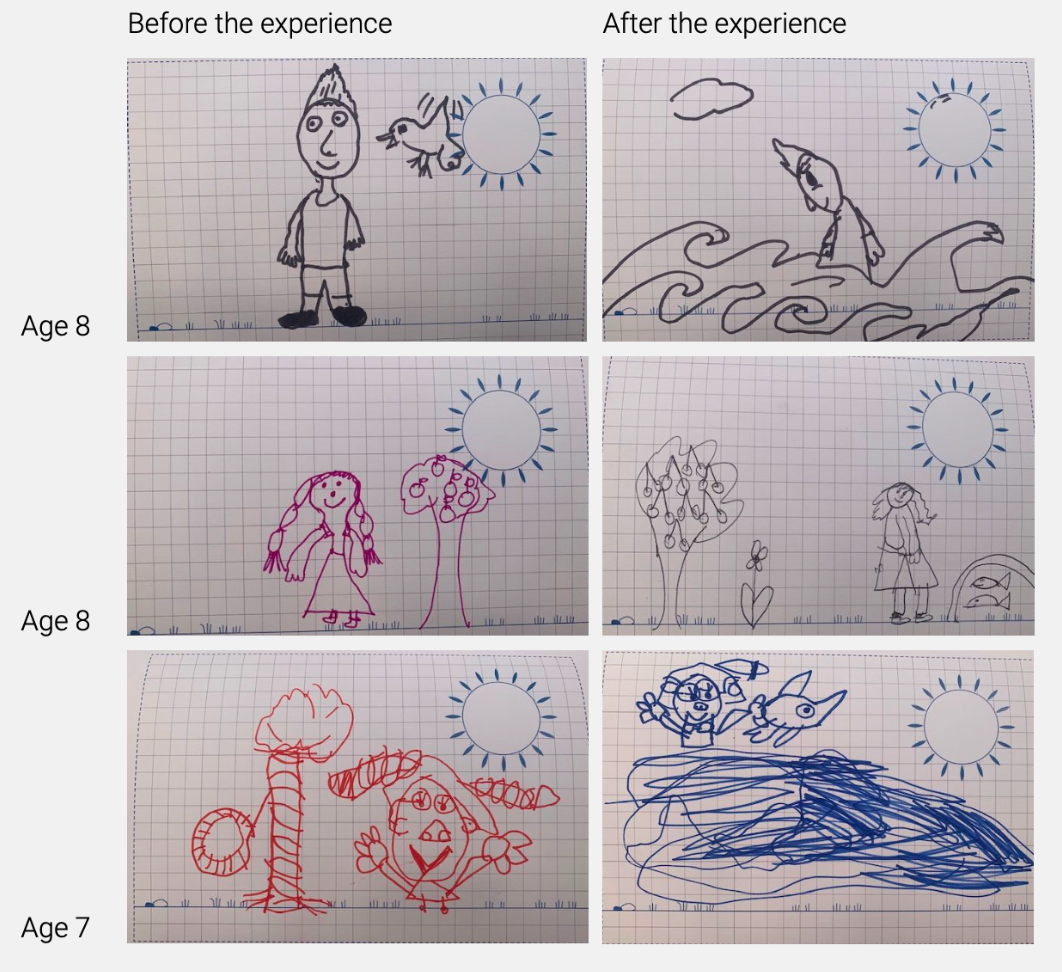
The children Fam Studios worked with show it best in their self portraits drawn before and after the experiences designed to invoke awe during the Venice Biennale:
The small self
Image: Age 7
- Reduction in the size of self portrait
Results:
- Awe diminishes the sense of self and shifts attention away from concerns
- Awe leads to pro-social and pro-environmental behaviours
The transcendent self
Image: Age 8
- Reduction in the size of self portrait
- The movement of self portrait from the center to the edge of frame
- The inclusion of more images of nature in the self portrait
- Taking on a more humble position in posture within the self portrait
Results
- Diminishing the sense of self and shifting attention away from concerns
- Transcending a self focused narrative and accepting complex and multinarrative truths
- Links to a sense of nature in self (as opposed to connection with nature) which is predictive of increased happiness
The wellbeing benefits of blue, awe and a sense of nature in self are at the cutting edge of research. Fam Studio is developing a toolkit called Awe in the Everyday for designers from different fields who look to design for children, young people and their families. The principles support children experiencing vastness and reframing mental models and can be used in art curation, architecture and urban planning, pedagogical or technology driven design practices. Below they are illustrated with Fam’s application in dance art experience design employed in Venice and Barcelona in 2022.
Awe, Blue and Healing: Fam Studio’s 5 principles for designing for Awe in the Everyday links the three concepts.
Fam Studios Pillars of Designing for Awe
- 1. Infinity
- Magnitude (physical or conceptual)- Fam used the ocean ecosystems as a concept and designed for large open spaces (akin to a school gym or large public space) to invoke infinity;
- Repetition- Fam designed space repeating patterns and used sound design to inculcate the repetition of ocean waves
- 2. Totality
Fam Studios used multisensory experience design for children:
- Hearing- the sounds of ocean waves
- Sight- the colour blue echoed in space and materials
- Touch- Enabling touch of blue materials- sand, ocean rock surfaces
- Vestibular- Enabling play with gravity, movement and balance through dance
- Proprioception- Learning where our body is, by moving through concepts of being small and of being big, moving fast and moving slow as children inhabit different ocean creatures.
- Interoceptive- Feeling what is happening inside our body by slowing breathing down. Reflecting on our feelings by engaging in a pre and post reflection exercise.
- 3. Silence or stillness
- Fam created pause for reflection on feelings and self portraiture, and designed sound and visual cues from the ocean to evoke calm
- 4. Threat and mystery
- Fam Studios used movement and working at the edge of comfort zones and embracing the unknowable quality of improvisation with strangers in dance- what shapes will we form, which rhythms will we co-create, which patterns will we weave?
- 5. Nature in self
- Extraction of natural materials and incorporation of biophilic forms and patterns is often used in design practice. Fam employed natural elements as part of the conceptual and multisensory design.
(1) https://www.theguardian.com/society/2022/oct/12/blue-spaces-benefit-children-later-life-study
Awe, Blue and Healing
BLUE:
Childhood exposure to blue spaces – such as coasts, rivers and lakes – link to benefits of wellbeing that persist into adulthood, according to a study of 15,000 participants across 18 countries. While the benefits of green space have been long established, the benefits of blue space for wellbeing are now catching up and deepening our understanding of healing and connection to nature. (1) Among the findings of the study blue spaces were found to hold special sensorial qualities around light reflection, wave motion and sound.
Blue sounds, such as the ocean waves, rich in high frequency (inaudible) sound components, increase alpha waves and decrease beta waves in our brain- precursors to reduced anxiety and increased wellbeing. (2) Blue as a colour is known to promote a sense of calm. According to the University of Melbourne, the colour blue activates the anterior component of the hypothalamus that is in control of the parasympathetic nervous system, contracting blood vessels, and decreasing blood flow and heart rate.(3) And this sense of calm means that blue promotes creativity.(4)
“At Fam Studios in thinking about the emotional response that blue facilitates, we sought to more deeply immerse ourselves in designing for awe. Blue is not commonly found in nature other than the great expanses of ocean and sky, and so as a colour and a concept it triggers an openness to experiencing a sense of vastness or the ephemeral and thus the emotion of awe.”
AWE:
Recent research has shown that increasing the dosage of awe in our lives promotes greater wellbeing. Awe as an intrinsic emotion is universal, felt by all people across all cultures- an important lever for intergenerational, inter-cultural design that promotes equitable and inclusive access to healing and wellbeing.
Awe is the emotion we experience when we encounter something so vast that it does not fit within our existing mental models. The vast thing can be a vista, an idea, a sensory overload- a sensation that often comes with goosebumps.
Psychologically, what happens when we experience awe is revealing why we see the healing and wellbeing benefits.
The children Fam Studios worked with show it best in their self portraits drawn before and after the experiences designed to invoke awe during the Venice Biennale:
The small self
Image: Age 7
- Reduction in the size of self portrait
Results:
- Awe diminishes the sense of self and shifts attention away from concerns
- Awe leads to pro-social and pro-environmental behaviours
The transcendent self
Image: Age 8
- Reduction in the size of self portrait
- The movement of self portrait from the center to the edge of frame
- The inclusion of more images of nature in the self portrait
- Taking on a more humble position in posture within the self portrait
Results
- Diminishing the sense of self and shifting attention away from concerns
- Transcending a self focused narrative and accepting complex and multinarrative truths
- Links to a sense of nature in self (as opposed to connection with nature) which is predictive of increased happiness
The wellbeing benefits of blue, awe and a sense of nature in self are at the cutting edge of research. Fam Studio is developing a toolkit called Awe in the Everyday for designers from different fields who look to design for children, young people and their families. The principles support children experiencing vastness and reframing mental models and can be used in art curation, architecture and urban planning, pedagogical or technology driven design practices. Below they are illustrated with Fam’s application in dance art experience design employed in Venice and Barcelona in 2022.
Awe, Blue and Healing: Fam Studio’s 5 principles for designing for Awe in the Everyday links the three concepts.
Fam Studios Pillars of Designing for Awe
- 1. Infinity
- Magnitude (physical or conceptual)- Fam used the ocean ecosystems as a concept and designed for large open spaces (akin to a school gym or large public space) to invoke infinity;
- Repetition- Fam designed space repeating patterns and used sound design to inculcate the repetition of ocean waves
- 2. Totality
Fam Studios used multisensory experience design for children:
- Hearing- the sounds of ocean waves
- Sight- the colour blue echoed in space and materials
- Touch- Enabling touch of blue materials- sand, ocean rock surfaces
- Vestibular- Enabling play with gravity, movement and balance through dance
- Proprioception- Learning where our body is, by moving through concepts of being small and of being big, moving fast and moving slow as children inhabit different ocean creatures.
- Interoceptive- Feeling what is happening inside our body by slowing breathing down. Reflecting on our feelings by engaging in a pre and post reflection exercise.
- 3. Silence or stillness
- Fam created pause for reflection on feelings and self portraiture, and designed sound and visual cues from the ocean to evoke calm
- 4. Threat and mystery
- Fam Studios used movement and working at the edge of comfort zones and embracing the unknowable quality of improvisation with strangers in dance- what shapes will we form, which rhythms will we co-create, which patterns will we weave?
- 5. Nature in self
- Extraction of natural materials and incorporation of biophilic forms and patterns is often used in design practice. Fam employed natural elements as part of the conceptual and multisensory design.
(1) https://www.theguardian.com/society/2022/oct/12/blue-spaces-benefit-children-later-life-study
FAM STUDIO is a research, strategy and design practice that helps families thrive. With expertise spanning early childhood to adolescence, we work across continents.
BY FAM STUDIO
Awe, Blue and Healing
BLUE:
Childhood exposure to blue spaces – such as coasts, rivers and lakes – link to benefits of wellbeing that persist into adulthood, according to a study of 15,000 participants across 18 countries. While the benefits of green space have been long established, the benefits of blue space for wellbeing are now catching up and deepening our understanding of healing and connection to nature. (1) Among the findings of the study blue spaces were found to hold special sensorial qualities around light reflection, wave motion and sound.
Blue sounds, such as the ocean waves, rich in high frequency (inaudible) sound components, increase alpha waves and decrease beta waves in our brain- precursors to reduced anxiety and increased wellbeing. (2) Blue as a colour is known to promote a sense of calm. According to the University of Melbourne, the colour blue activates the anterior component of the hypothalamus that is in control of the parasympathetic nervous system, contracting blood vessels, and decreasing blood flow and heart rate.(3) And this sense of calm means that blue promotes creativity.(4)
“At Fam Studios in thinking about the emotional response that blue facilitates, we sought to more deeply immerse ourselves in designing for awe. Blue is not commonly found in nature other than the great expanses of ocean and sky, and so as a colour and a concept it triggers an openness to experiencing a sense of vastness or the ephemeral and thus the emotion of awe.”
AWE:
Recent research has shown that increasing the dosage of awe in our lives promotes greater wellbeing. Awe as an intrinsic emotion is universal, felt by all people across all cultures- an important lever for intergenerational, inter-cultural design that promotes equitable and inclusive access to healing and wellbeing.
Awe is the emotion we experience when we encounter something so vast that it does not fit within our existing mental models. The vast thing can be a vista, an idea, a sensory overload- a sensation that often comes with goosebumps.
Psychologically, what happens when we experience awe is revealing why we see the healing and wellbeing benefits.
The children Fam Studios worked with show it best in their self portraits drawn before and after the experiences designed to invoke awe during the Venice Biennale:
The small self
Image: Age 7
- Reduction in the size of self portrait
Results:
- Awe diminishes the sense of self and shifts attention away from concerns
- Awe leads to pro-social and pro-environmental behaviours
The transcendent self
Image: Age 8
- Reduction in the size of self portrait
- The movement of self portrait from the center to the edge of frame
- The inclusion of more images of nature in the self portrait
- Taking on a more humble position in posture within the self portrait
Results
- Diminishing the sense of self and shifting attention away from concerns
- Transcending a self focused narrative and accepting complex and multinarrative truths
- Links to a sense of nature in self (as opposed to connection with nature) which is predictive of increased happiness
The wellbeing benefits of blue, awe and a sense of nature in self are at the cutting edge of research. Fam Studio is developing a toolkit called Awe in the Everyday for designers from different fields who look to design for children, young people and their families. The principles support children experiencing vastness and reframing mental models and can be used in art curation, architecture and urban planning, pedagogical or technology driven design practices. Below they are illustrated with Fam’s application in dance art experience design employed in Venice and Barcelona in 2022.
Awe, Blue and Healing: Fam Studio’s 5 principles for designing for Awe in the Everyday links the three concepts.
Fam Studios Pillars of Designing for Awe
- 1. Infinity
- Magnitude (physical or conceptual)- Fam used the ocean ecosystems as a concept and designed for large open spaces (akin to a school gym or large public space) to invoke infinity;
- Repetition- Fam designed space repeating patterns and used sound design to inculcate the repetition of ocean waves
- 2. Totality
Fam Studios used multisensory experience design for children:
- Hearing- the sounds of ocean waves
- Sight- the colour blue echoed in space and materials
- Touch- Enabling touch of blue materials- sand, ocean rock surfaces
- Vestibular- Enabling play with gravity, movement and balance through dance
- Proprioception- Learning where our body is, by moving through concepts of being small and of being big, moving fast and moving slow as children inhabit different ocean creatures.
- Interoceptive- Feeling what is happening inside our body by slowing breathing down. Reflecting on our feelings by engaging in a pre and post reflection exercise.
- 3. Silence or stillness
- Fam created pause for reflection on feelings and self portraiture, and designed sound and visual cues from the ocean to evoke calm
- 4. Threat and mystery
- Fam Studios used movement and working at the edge of comfort zones and embracing the unknowable quality of improvisation with strangers in dance- what shapes will we form, which rhythms will we co-create, which patterns will we weave?
- 5. Nature in self
- Extraction of natural materials and incorporation of biophilic forms and patterns is often used in design practice. Fam employed natural elements as part of the conceptual and multisensory design.
(1) https://www.theguardian.com/society/2022/oct/12/blue-spaces-benefit-children-later-life-study
Awe, Blue and Healing
BLUE:
Childhood exposure to blue spaces – such as coasts, rivers and lakes – link to benefits of wellbeing that persist into adulthood, according to a study of 15,000 participants across 18 countries. While the benefits of green space have been long established, the benefits of blue space for wellbeing are now catching up and deepening our understanding of healing and connection to nature. (1) Among the findings of the study blue spaces were found to hold special sensorial qualities around light reflection, wave motion and sound.
Blue sounds, such as the ocean waves, rich in high frequency (inaudible) sound components, increase alpha waves and decrease beta waves in our brain- precursors to reduced anxiety and increased wellbeing. (2) Blue as a colour is known to promote a sense of calm. According to the University of Melbourne, the colour blue activates the anterior component of the hypothalamus that is in control of the parasympathetic nervous system, contracting blood vessels, and decreasing blood flow and heart rate.(3) And this sense of calm means that blue promotes creativity.(4)
“At Fam Studios in thinking about the emotional response that blue facilitates, we sought to more deeply immerse ourselves in designing for awe. Blue is not commonly found in nature other than the great expanses of ocean and sky, and so as a colour and a concept it triggers an openness to experiencing a sense of vastness or the ephemeral and thus the emotion of awe.”
AWE:
Recent research has shown that increasing the dosage of awe in our lives promotes greater wellbeing. Awe as an intrinsic emotion is universal, felt by all people across all cultures- an important lever for intergenerational, inter-cultural design that promotes equitable and inclusive access to healing and wellbeing.
Awe is the emotion we experience when we encounter something so vast that it does not fit within our existing mental models. The vast thing can be a vista, an idea, a sensory overload- a sensation that often comes with goosebumps.
Psychologically, what happens when we experience awe is revealing why we see the healing and wellbeing benefits.
The children Fam Studios worked with show it best in their self portraits drawn before and after the experiences designed to invoke awe during the Venice Biennale:
The small self
Image: Age 7
- Reduction in the size of self portrait
Results:
- Awe diminishes the sense of self and shifts attention away from concerns
- Awe leads to pro-social and pro-environmental behaviours
The transcendent self
Image: Age 8
- Reduction in the size of self portrait
- The movement of self portrait from the center to the edge of frame
- The inclusion of more images of nature in the self portrait
- Taking on a more humble position in posture within the self portrait
Results
- Diminishing the sense of self and shifting attention away from concerns
- Transcending a self focused narrative and accepting complex and multinarrative truths
- Links to a sense of nature in self (as opposed to connection with nature) which is predictive of increased happiness
The wellbeing benefits of blue, awe and a sense of nature in self are at the cutting edge of research. Fam Studio is developing a toolkit called Awe in the Everyday for designers from different fields who look to design for children, young people and their families. The principles support children experiencing vastness and reframing mental models and can be used in art curation, architecture and urban planning, pedagogical or technology driven design practices. Below they are illustrated with Fam’s application in dance art experience design employed in Venice and Barcelona in 2022.
Awe, Blue and Healing: Fam Studio’s 5 principles for designing for Awe in the Everyday links the three concepts.
Fam Studios Pillars of Designing for Awe
- 1. Infinity
- Magnitude (physical or conceptual)- Fam used the ocean ecosystems as a concept and designed for large open spaces (akin to a school gym or large public space) to invoke infinity;
- Repetition- Fam designed space repeating patterns and used sound design to inculcate the repetition of ocean waves
- 2. Totality
Fam Studios used multisensory experience design for children:
- Hearing- the sounds of ocean waves
- Sight- the colour blue echoed in space and materials
- Touch- Enabling touch of blue materials- sand, ocean rock surfaces
- Vestibular- Enabling play with gravity, movement and balance through dance
- Proprioception- Learning where our body is, by moving through concepts of being small and of being big, moving fast and moving slow as children inhabit different ocean creatures.
- Interoceptive- Feeling what is happening inside our body by slowing breathing down. Reflecting on our feelings by engaging in a pre and post reflection exercise.
- 3. Silence or stillness
- Fam created pause for reflection on feelings and self portraiture, and designed sound and visual cues from the ocean to evoke calm
- 4. Threat and mystery
- Fam Studios used movement and working at the edge of comfort zones and embracing the unknowable quality of improvisation with strangers in dance- what shapes will we form, which rhythms will we co-create, which patterns will we weave?
- 5. Nature in self
- Extraction of natural materials and incorporation of biophilic forms and patterns is often used in design practice. Fam employed natural elements as part of the conceptual and multisensory design.
(1) https://www.theguardian.com/society/2022/oct/12/blue-spaces-benefit-children-later-life-study
FAM STUDIO is a research, strategy and design practice that helps families thrive. With expertise spanning early childhood to adolescence, we work across continents.
BY FAM STUDIO
Awe, Blue and Healing
BLUE:
Childhood exposure to blue spaces – such as coasts, rivers and lakes – link to benefits of wellbeing that persist into adulthood, according to a study of 15,000 participants across 18 countries. While the benefits of green space have been long established, the benefits of blue space for wellbeing are now catching up and deepening our understanding of healing and connection to nature. (1) Among the findings of the study blue spaces were found to hold special sensorial qualities around light reflection, wave motion and sound.
Blue sounds, such as the ocean waves, rich in high frequency (inaudible) sound components, increase alpha waves and decrease beta waves in our brain- precursors to reduced anxiety and increased wellbeing. (2) Blue as a colour is known to promote a sense of calm. According to the University of Melbourne, the colour blue activates the anterior component of the hypothalamus that is in control of the parasympathetic nervous system, contracting blood vessels, and decreasing blood flow and heart rate.(3) And this sense of calm means that blue promotes creativity.(4)
“At Fam Studios in thinking about the emotional response that blue facilitates, we sought to more deeply immerse ourselves in designing for awe. Blue is not commonly found in nature other than the great expanses of ocean and sky, and so as a colour and a concept it triggers an openness to experiencing a sense of vastness or the ephemeral and thus the emotion of awe.”
AWE:
Recent research has shown that increasing the dosage of awe in our lives promotes greater wellbeing. Awe as an intrinsic emotion is universal, felt by all people across all cultures- an important lever for intergenerational, inter-cultural design that promotes equitable and inclusive access to healing and wellbeing.
Awe is the emotion we experience when we encounter something so vast that it does not fit within our existing mental models. The vast thing can be a vista, an idea, a sensory overload- a sensation that often comes with goosebumps.
Psychologically, what happens when we experience awe is revealing why we see the healing and wellbeing benefits.
The children Fam Studios worked with show it best in their self portraits drawn before and after the experiences designed to invoke awe during the Venice Biennale:
The small self
Image: Age 7
- Reduction in the size of self portrait
Results:
- Awe diminishes the sense of self and shifts attention away from concerns
- Awe leads to pro-social and pro-environmental behaviours
The transcendent self
Image: Age 8
- Reduction in the size of self portrait
- The movement of self portrait from the center to the edge of frame
- The inclusion of more images of nature in the self portrait
- Taking on a more humble position in posture within the self portrait
Results
- Diminishing the sense of self and shifting attention away from concerns
- Transcending a self focused narrative and accepting complex and multinarrative truths
- Links to a sense of nature in self (as opposed to connection with nature) which is predictive of increased happiness
The wellbeing benefits of blue, awe and a sense of nature in self are at the cutting edge of research. Fam Studio is developing a toolkit called Awe in the Everyday for designers from different fields who look to design for children, young people and their families. The principles support children experiencing vastness and reframing mental models and can be used in art curation, architecture and urban planning, pedagogical or technology driven design practices. Below they are illustrated with Fam’s application in dance art experience design employed in Venice and Barcelona in 2022.
Awe, Blue and Healing: Fam Studio’s 5 principles for designing for Awe in the Everyday links the three concepts.
Fam Studios Pillars of Designing for Awe
- 1. Infinity
- Magnitude (physical or conceptual)- Fam used the ocean ecosystems as a concept and designed for large open spaces (akin to a school gym or large public space) to invoke infinity;
- Repetition- Fam designed space repeating patterns and used sound design to inculcate the repetition of ocean waves
- 2. Totality
Fam Studios used multisensory experience design for children:
- Hearing- the sounds of ocean waves
- Sight- the colour blue echoed in space and materials
- Touch- Enabling touch of blue materials- sand, ocean rock surfaces
- Vestibular- Enabling play with gravity, movement and balance through dance
- Proprioception- Learning where our body is, by moving through concepts of being small and of being big, moving fast and moving slow as children inhabit different ocean creatures.
- Interoceptive- Feeling what is happening inside our body by slowing breathing down. Reflecting on our feelings by engaging in a pre and post reflection exercise.
- 3. Silence or stillness
- Fam created pause for reflection on feelings and self portraiture, and designed sound and visual cues from the ocean to evoke calm
- 4. Threat and mystery
- Fam Studios used movement and working at the edge of comfort zones and embracing the unknowable quality of improvisation with strangers in dance- what shapes will we form, which rhythms will we co-create, which patterns will we weave?
- 5. Nature in self
- Extraction of natural materials and incorporation of biophilic forms and patterns is often used in design practice. Fam employed natural elements as part of the conceptual and multisensory design.
(1) https://www.theguardian.com/society/2022/oct/12/blue-spaces-benefit-children-later-life-study
Awe, Blue and Healing
BLUE:
Childhood exposure to blue spaces – such as coasts, rivers and lakes – link to benefits of wellbeing that persist into adulthood, according to a study of 15,000 participants across 18 countries. While the benefits of green space have been long established, the benefits of blue space for wellbeing are now catching up and deepening our understanding of healing and connection to nature. (1) Among the findings of the study blue spaces were found to hold special sensorial qualities around light reflection, wave motion and sound.
Blue sounds, such as the ocean waves, rich in high frequency (inaudible) sound components, increase alpha waves and decrease beta waves in our brain- precursors to reduced anxiety and increased wellbeing. (2) Blue as a colour is known to promote a sense of calm. According to the University of Melbourne, the colour blue activates the anterior component of the hypothalamus that is in control of the parasympathetic nervous system, contracting blood vessels, and decreasing blood flow and heart rate.(3) And this sense of calm means that blue promotes creativity.(4)
“At Fam Studios in thinking about the emotional response that blue facilitates, we sought to more deeply immerse ourselves in designing for awe. Blue is not commonly found in nature other than the great expanses of ocean and sky, and so as a colour and a concept it triggers an openness to experiencing a sense of vastness or the ephemeral and thus the emotion of awe.”
AWE:
Recent research has shown that increasing the dosage of awe in our lives promotes greater wellbeing. Awe as an intrinsic emotion is universal, felt by all people across all cultures- an important lever for intergenerational, inter-cultural design that promotes equitable and inclusive access to healing and wellbeing.
Awe is the emotion we experience when we encounter something so vast that it does not fit within our existing mental models. The vast thing can be a vista, an idea, a sensory overload- a sensation that often comes with goosebumps.
Psychologically, what happens when we experience awe is revealing why we see the healing and wellbeing benefits.
The children Fam Studios worked with show it best in their self portraits drawn before and after the experiences designed to invoke awe during the Venice Biennale:
The small self
Image: Age 7
- Reduction in the size of self portrait
Results:
- Awe diminishes the sense of self and shifts attention away from concerns
- Awe leads to pro-social and pro-environmental behaviours
The transcendent self
Image: Age 8
- Reduction in the size of self portrait
- The movement of self portrait from the center to the edge of frame
- The inclusion of more images of nature in the self portrait
- Taking on a more humble position in posture within the self portrait
Results
- Diminishing the sense of self and shifting attention away from concerns
- Transcending a self focused narrative and accepting complex and multinarrative truths
- Links to a sense of nature in self (as opposed to connection with nature) which is predictive of increased happiness
The wellbeing benefits of blue, awe and a sense of nature in self are at the cutting edge of research. Fam Studio is developing a toolkit called Awe in the Everyday for designers from different fields who look to design for children, young people and their families. The principles support children experiencing vastness and reframing mental models and can be used in art curation, architecture and urban planning, pedagogical or technology driven design practices. Below they are illustrated with Fam’s application in dance art experience design employed in Venice and Barcelona in 2022.
Awe, Blue and Healing: Fam Studio’s 5 principles for designing for Awe in the Everyday links the three concepts.
Fam Studios Pillars of Designing for Awe
- 1. Infinity
- Magnitude (physical or conceptual)- Fam used the ocean ecosystems as a concept and designed for large open spaces (akin to a school gym or large public space) to invoke infinity;
- Repetition- Fam designed space repeating patterns and used sound design to inculcate the repetition of ocean waves
- 2. Totality
Fam Studios used multisensory experience design for children:
- Hearing- the sounds of ocean waves
- Sight- the colour blue echoed in space and materials
- Touch- Enabling touch of blue materials- sand, ocean rock surfaces
- Vestibular- Enabling play with gravity, movement and balance through dance
- Proprioception- Learning where our body is, by moving through concepts of being small and of being big, moving fast and moving slow as children inhabit different ocean creatures.
- Interoceptive- Feeling what is happening inside our body by slowing breathing down. Reflecting on our feelings by engaging in a pre and post reflection exercise.
- 3. Silence or stillness
- Fam created pause for reflection on feelings and self portraiture, and designed sound and visual cues from the ocean to evoke calm
- 4. Threat and mystery
- Fam Studios used movement and working at the edge of comfort zones and embracing the unknowable quality of improvisation with strangers in dance- what shapes will we form, which rhythms will we co-create, which patterns will we weave?
- 5. Nature in self
- Extraction of natural materials and incorporation of biophilic forms and patterns is often used in design practice. Fam employed natural elements as part of the conceptual and multisensory design.
(1) https://www.theguardian.com/society/2022/oct/12/blue-spaces-benefit-children-later-life-study
FAM STUDIO is a research, strategy and design practice that helps families thrive. With expertise spanning early childhood to adolescence, we work across continents.
BY FAM STUDIO
Awe, Blue and Healing
BLUE:
Childhood exposure to blue spaces – such as coasts, rivers and lakes – link to benefits of wellbeing that persist into adulthood, according to a study of 15,000 participants across 18 countries. While the benefits of green space have been long established, the benefits of blue space for wellbeing are now catching up and deepening our understanding of healing and connection to nature. (1) Among the findings of the study blue spaces were found to hold special sensorial qualities around light reflection, wave motion and sound.
Blue sounds, such as the ocean waves, rich in high frequency (inaudible) sound components, increase alpha waves and decrease beta waves in our brain- precursors to reduced anxiety and increased wellbeing. (2) Blue as a colour is known to promote a sense of calm. According to the University of Melbourne, the colour blue activates the anterior component of the hypothalamus that is in control of the parasympathetic nervous system, contracting blood vessels, and decreasing blood flow and heart rate.(3) And this sense of calm means that blue promotes creativity.(4)
“At Fam Studios in thinking about the emotional response that blue facilitates, we sought to more deeply immerse ourselves in designing for awe. Blue is not commonly found in nature other than the great expanses of ocean and sky, and so as a colour and a concept it triggers an openness to experiencing a sense of vastness or the ephemeral and thus the emotion of awe.”
AWE:
Recent research has shown that increasing the dosage of awe in our lives promotes greater wellbeing. Awe as an intrinsic emotion is universal, felt by all people across all cultures- an important lever for intergenerational, inter-cultural design that promotes equitable and inclusive access to healing and wellbeing.
Awe is the emotion we experience when we encounter something so vast that it does not fit within our existing mental models. The vast thing can be a vista, an idea, a sensory overload- a sensation that often comes with goosebumps.
Psychologically, what happens when we experience awe is revealing why we see the healing and wellbeing benefits.
The children Fam Studios worked with show it best in their self portraits drawn before and after the experiences designed to invoke awe during the Venice Biennale:
The small self
Image: Age 7
- Reduction in the size of self portrait
Results:
- Awe diminishes the sense of self and shifts attention away from concerns
- Awe leads to pro-social and pro-environmental behaviours
The transcendent self
Image: Age 8
- Reduction in the size of self portrait
- The movement of self portrait from the center to the edge of frame
- The inclusion of more images of nature in the self portrait
- Taking on a more humble position in posture within the self portrait
Results
- Diminishing the sense of self and shifting attention away from concerns
- Transcending a self focused narrative and accepting complex and multinarrative truths
- Links to a sense of nature in self (as opposed to connection with nature) which is predictive of increased happiness
The wellbeing benefits of blue, awe and a sense of nature in self are at the cutting edge of research. Fam Studio is developing a toolkit called Awe in the Everyday for designers from different fields who look to design for children, young people and their families. The principles support children experiencing vastness and reframing mental models and can be used in art curation, architecture and urban planning, pedagogical or technology driven design practices. Below they are illustrated with Fam’s application in dance art experience design employed in Venice and Barcelona in 2022.
Awe, Blue and Healing: Fam Studio’s 5 principles for designing for Awe in the Everyday links the three concepts.
Fam Studios Pillars of Designing for Awe
- 1. Infinity
- Magnitude (physical or conceptual)- Fam used the ocean ecosystems as a concept and designed for large open spaces (akin to a school gym or large public space) to invoke infinity;
- Repetition- Fam designed space repeating patterns and used sound design to inculcate the repetition of ocean waves
- 2. Totality
Fam Studios used multisensory experience design for children:
- Hearing- the sounds of ocean waves
- Sight- the colour blue echoed in space and materials
- Touch- Enabling touch of blue materials- sand, ocean rock surfaces
- Vestibular- Enabling play with gravity, movement and balance through dance
- Proprioception- Learning where our body is, by moving through concepts of being small and of being big, moving fast and moving slow as children inhabit different ocean creatures.
- Interoceptive- Feeling what is happening inside our body by slowing breathing down. Reflecting on our feelings by engaging in a pre and post reflection exercise.
- 3. Silence or stillness
- Fam created pause for reflection on feelings and self portraiture, and designed sound and visual cues from the ocean to evoke calm
- 4. Threat and mystery
- Fam Studios used movement and working at the edge of comfort zones and embracing the unknowable quality of improvisation with strangers in dance- what shapes will we form, which rhythms will we co-create, which patterns will we weave?
- 5. Nature in self
- Extraction of natural materials and incorporation of biophilic forms and patterns is often used in design practice. Fam employed natural elements as part of the conceptual and multisensory design.
(1) https://www.theguardian.com/society/2022/oct/12/blue-spaces-benefit-children-later-life-study
Awe, Blue and Healing
BLUE:
Childhood exposure to blue spaces – such as coasts, rivers and lakes – link to benefits of wellbeing that persist into adulthood, according to a study of 15,000 participants across 18 countries. While the benefits of green space have been long established, the benefits of blue space for wellbeing are now catching up and deepening our understanding of healing and connection to nature. (1) Among the findings of the study blue spaces were found to hold special sensorial qualities around light reflection, wave motion and sound.
Blue sounds, such as the ocean waves, rich in high frequency (inaudible) sound components, increase alpha waves and decrease beta waves in our brain- precursors to reduced anxiety and increased wellbeing. (2) Blue as a colour is known to promote a sense of calm. According to the University of Melbourne, the colour blue activates the anterior component of the hypothalamus that is in control of the parasympathetic nervous system, contracting blood vessels, and decreasing blood flow and heart rate.(3) And this sense of calm means that blue promotes creativity.(4)
“At Fam Studios in thinking about the emotional response that blue facilitates, we sought to more deeply immerse ourselves in designing for awe. Blue is not commonly found in nature other than the great expanses of ocean and sky, and so as a colour and a concept it triggers an openness to experiencing a sense of vastness or the ephemeral and thus the emotion of awe.”
AWE:
Recent research has shown that increasing the dosage of awe in our lives promotes greater wellbeing. Awe as an intrinsic emotion is universal, felt by all people across all cultures- an important lever for intergenerational, inter-cultural design that promotes equitable and inclusive access to healing and wellbeing.
Awe is the emotion we experience when we encounter something so vast that it does not fit within our existing mental models. The vast thing can be a vista, an idea, a sensory overload- a sensation that often comes with goosebumps.
Psychologically, what happens when we experience awe is revealing why we see the healing and wellbeing benefits.
The children Fam Studios worked with show it best in their self portraits drawn before and after the experiences designed to invoke awe during the Venice Biennale:
The small self
Image: Age 7
- Reduction in the size of self portrait
Results:
- Awe diminishes the sense of self and shifts attention away from concerns
- Awe leads to pro-social and pro-environmental behaviours
The transcendent self
Image: Age 8
- Reduction in the size of self portrait
- The movement of self portrait from the center to the edge of frame
- The inclusion of more images of nature in the self portrait
- Taking on a more humble position in posture within the self portrait
Results
- Diminishing the sense of self and shifting attention away from concerns
- Transcending a self focused narrative and accepting complex and multinarrative truths
- Links to a sense of nature in self (as opposed to connection with nature) which is predictive of increased happiness
The wellbeing benefits of blue, awe and a sense of nature in self are at the cutting edge of research. Fam Studio is developing a toolkit called Awe in the Everyday for designers from different fields who look to design for children, young people and their families. The principles support children experiencing vastness and reframing mental models and can be used in art curation, architecture and urban planning, pedagogical or technology driven design practices. Below they are illustrated with Fam’s application in dance art experience design employed in Venice and Barcelona in 2022.
Awe, Blue and Healing: Fam Studio’s 5 principles for designing for Awe in the Everyday links the three concepts.
Fam Studios Pillars of Designing for Awe
- 1. Infinity
- Magnitude (physical or conceptual)- Fam used the ocean ecosystems as a concept and designed for large open spaces (akin to a school gym or large public space) to invoke infinity;
- Repetition- Fam designed space repeating patterns and used sound design to inculcate the repetition of ocean waves
- 2. Totality
Fam Studios used multisensory experience design for children:
- Hearing- the sounds of ocean waves
- Sight- the colour blue echoed in space and materials
- Touch- Enabling touch of blue materials- sand, ocean rock surfaces
- Vestibular- Enabling play with gravity, movement and balance through dance
- Proprioception- Learning where our body is, by moving through concepts of being small and of being big, moving fast and moving slow as children inhabit different ocean creatures.
- Interoceptive- Feeling what is happening inside our body by slowing breathing down. Reflecting on our feelings by engaging in a pre and post reflection exercise.
- 3. Silence or stillness
- Fam created pause for reflection on feelings and self portraiture, and designed sound and visual cues from the ocean to evoke calm
- 4. Threat and mystery
- Fam Studios used movement and working at the edge of comfort zones and embracing the unknowable quality of improvisation with strangers in dance- what shapes will we form, which rhythms will we co-create, which patterns will we weave?
- 5. Nature in self
- Extraction of natural materials and incorporation of biophilic forms and patterns is often used in design practice. Fam employed natural elements as part of the conceptual and multisensory design.
(1) https://www.theguardian.com/society/2022/oct/12/blue-spaces-benefit-children-later-life-study
FAM STUDIO is a research, strategy and design practice that helps families thrive. With expertise spanning early childhood to adolescence, we work across continents.