
BY MÓNICA DE MIRANDA
Earthworks invites audiences to reconsider the role of botanical spaces in shaping our environmental futures.
The project reflects the thinking of Achille Mbembe from his book Terrestrial Community (2023), which proposes a reflection in the era of environmental collapse, on the relationship between human beings and the group of beings that make up the symbiotic chain of life. Using African cosmovision’s in a counterpoint to Western philosophical scientism, the author offers us a holistic vision of the destiny of the Earth and of living beings, thus calling for the creation of a new planetary consciousness.
Earthworks is a program of diverse metaphysics and intersections of disciplines, theories and multiple artistic practices. It addresses a series of urgent issues, such as the extractive exploitation of natural resources and the resurgence of racism, and contrasts these places of oblivion and oppression with practices of imagination in a creation that points to a new future, a place of listening and participation, among artists, theorists, curators, communities and audiences.
The project develops as a magnetic field that creates a space that calls the spectator to the action of the work of art, a discursive space of learning. The installation reimagines botanical spaces as living, dynamic systems that transcend their colonial past. Inspired by Buckminster’s “Spaceship Earth,” this project challenges traditional uses of greenhouses and botanical gardens, reinterpreting them as arenas for ecological stewardship, cultural resilience, and decolonial engagement.
This project draws on diverse perspectives from leading thinkers, artists, and scholars to address themes of colonial legacies, ecological ethics, and the restoration of botanical spaces. By integrating historical critique, artistic interventions.
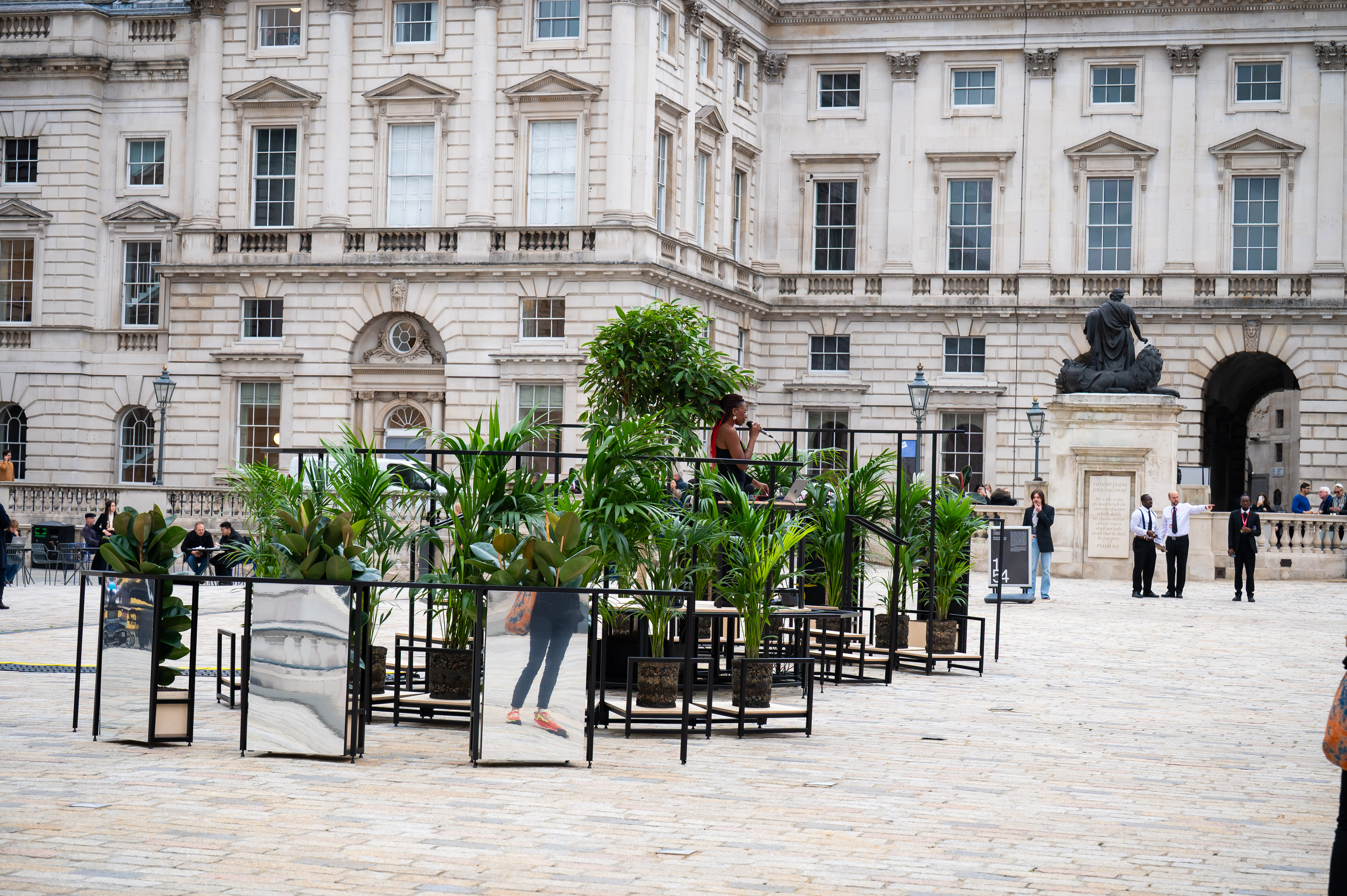
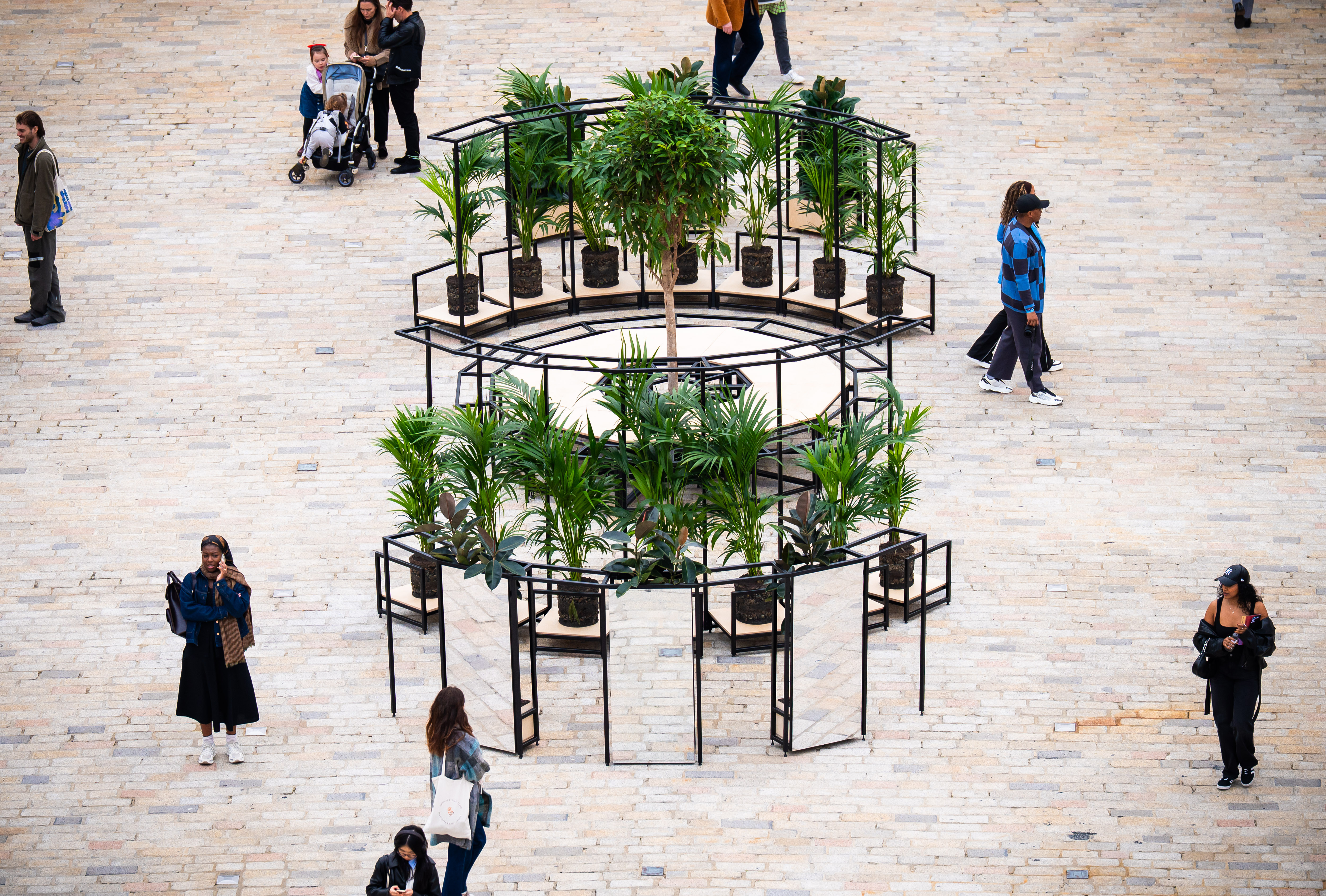
Earthworks was a public project developed for the courtyards of Somerset House. It consisted of a site-specific installation, encouraging public participation. The installation took the form of a pavilion, a vessel composed of organic elements such as earth, wood, and plants, and designed as an immersive environment that reflects the interconnected and self-sustaining ethos of the installation.
Earthworks invites audiences to reconsider the role of botanical spaces in shaping our environmental futures.
The project reflects the thinking of Achille Mbembe from his book Terrestrial Community (2023), which proposes a reflection in the era of environmental collapse, on the relationship between human beings and the group of beings that make up the symbiotic chain of life. Using African cosmovision’s in a counterpoint to Western philosophical scientism, the author offers us a holistic vision of the destiny of the Earth and of living beings, thus calling for the creation of a new planetary consciousness.
Earthworks is a program of diverse metaphysics and intersections of disciplines, theories and multiple artistic practices. It addresses a series of urgent issues, such as the extractive exploitation of natural resources and the resurgence of racism, and contrasts these places of oblivion and oppression with practices of imagination in a creation that points to a new future, a place of listening and participation, among artists, theorists, curators, communities and audiences.
The project develops as a magnetic field that creates a space that calls the spectator to the action of the work of art, a discursive space of learning. The installation reimagines botanical spaces as living, dynamic systems that transcend their colonial past. Inspired by Buckminster’s “Spaceship Earth,” this project challenges traditional uses of greenhouses and botanical gardens, reinterpreting them as arenas for ecological stewardship, cultural resilience, and decolonial engagement.
This project draws on diverse perspectives from leading thinkers, artists, and scholars to address themes of colonial legacies, ecological ethics, and the restoration of botanical spaces. By integrating historical critique, artistic interventions.
Earthworks was a public project developed for the courtyards of Somerset House. It consisted of a site-specific installation, encouraging public participation. The installation took the form of a pavilion, a vessel composed of organic elements such as earth, wood, and plants, and designed as an immersive environment that reflects the interconnected and self-sustaining ethos of the installation.
Mónica de Miranda is a Portuguese/Angolan visual artist, filmmaker and researcher whose interdisciplinary and research-based practice critically looks at the convergence of politics, gender, memory, space and history. Her work encompasses drawing, installation, photography, film and sound, on the boundaries between documentary and fiction. Mónica investigates strategies of resistance, geographies of affection, storytelling and ecologies of care.
She is the founder of Hangar (2014), an art and research centre in Lisbon. Hangar’s programmes provide spaces where artists, curators and researchers, mainly from the global south, can co-create and build social and creative networks to benefit their communities.
BY MÓNICA DE MIRANDA
Earthworks invites audiences to reconsider the role of botanical spaces in shaping our environmental futures.
The project reflects the thinking of Achille Mbembe from his book Terrestrial Community (2023), which proposes a reflection in the era of environmental collapse, on the relationship between human beings and the group of beings that make up the symbiotic chain of life. Using African cosmovision’s in a counterpoint to Western philosophical scientism, the author offers us a holistic vision of the destiny of the Earth and of living beings, thus calling for the creation of a new planetary consciousness.
Earthworks is a program of diverse metaphysics and intersections of disciplines, theories and multiple artistic practices. It addresses a series of urgent issues, such as the extractive exploitation of natural resources and the resurgence of racism, and contrasts these places of oblivion and oppression with practices of imagination in a creation that points to a new future, a place of listening and participation, among artists, theorists, curators, communities and audiences.
The project develops as a magnetic field that creates a space that calls the spectator to the action of the work of art, a discursive space of learning. The installation reimagines botanical spaces as living, dynamic systems that transcend their colonial past. Inspired by Buckminster’s “Spaceship Earth,” this project challenges traditional uses of greenhouses and botanical gardens, reinterpreting them as arenas for ecological stewardship, cultural resilience, and decolonial engagement.
This project draws on diverse perspectives from leading thinkers, artists, and scholars to address themes of colonial legacies, ecological ethics, and the restoration of botanical spaces. By integrating historical critique, artistic interventions.
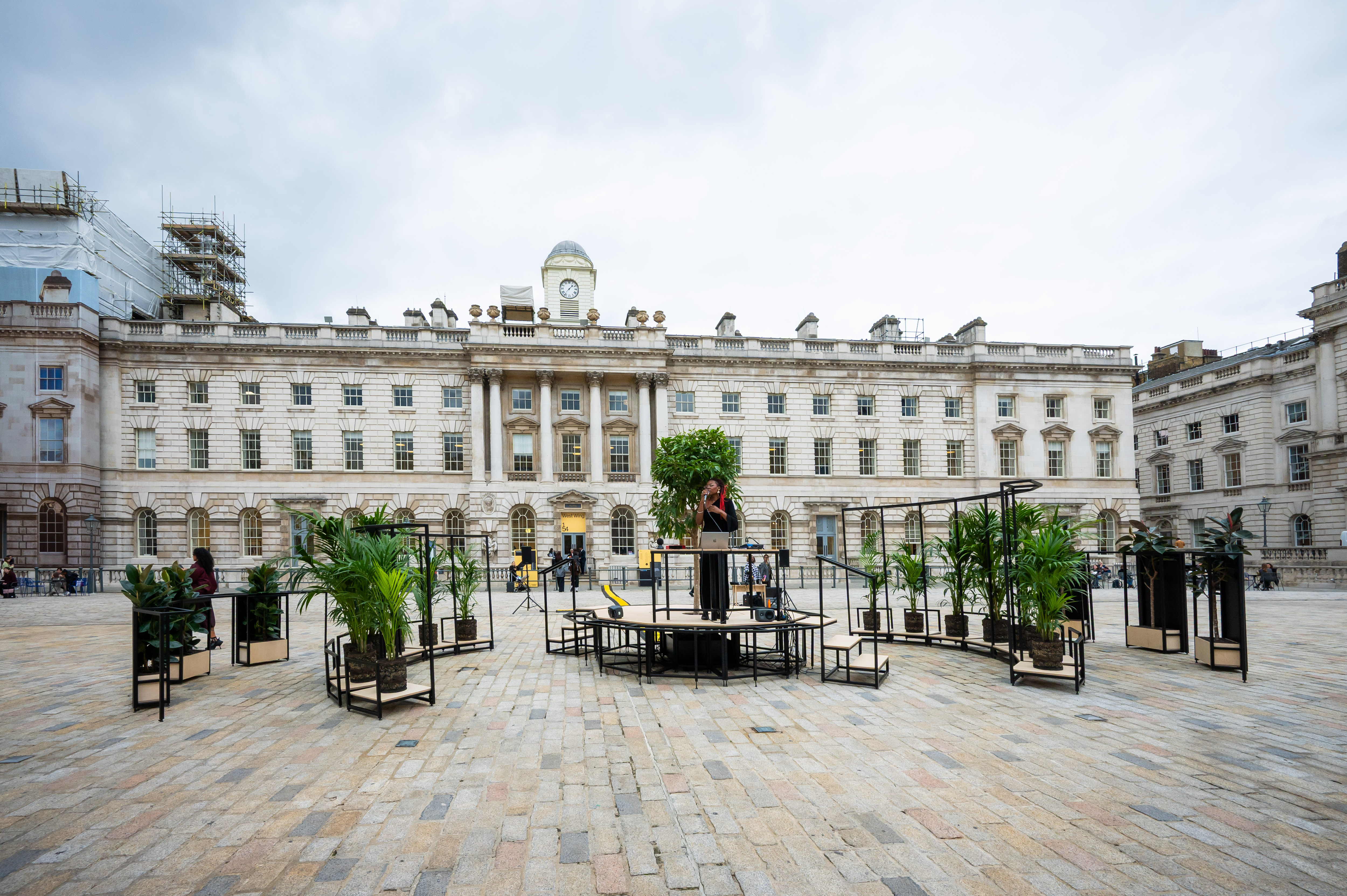
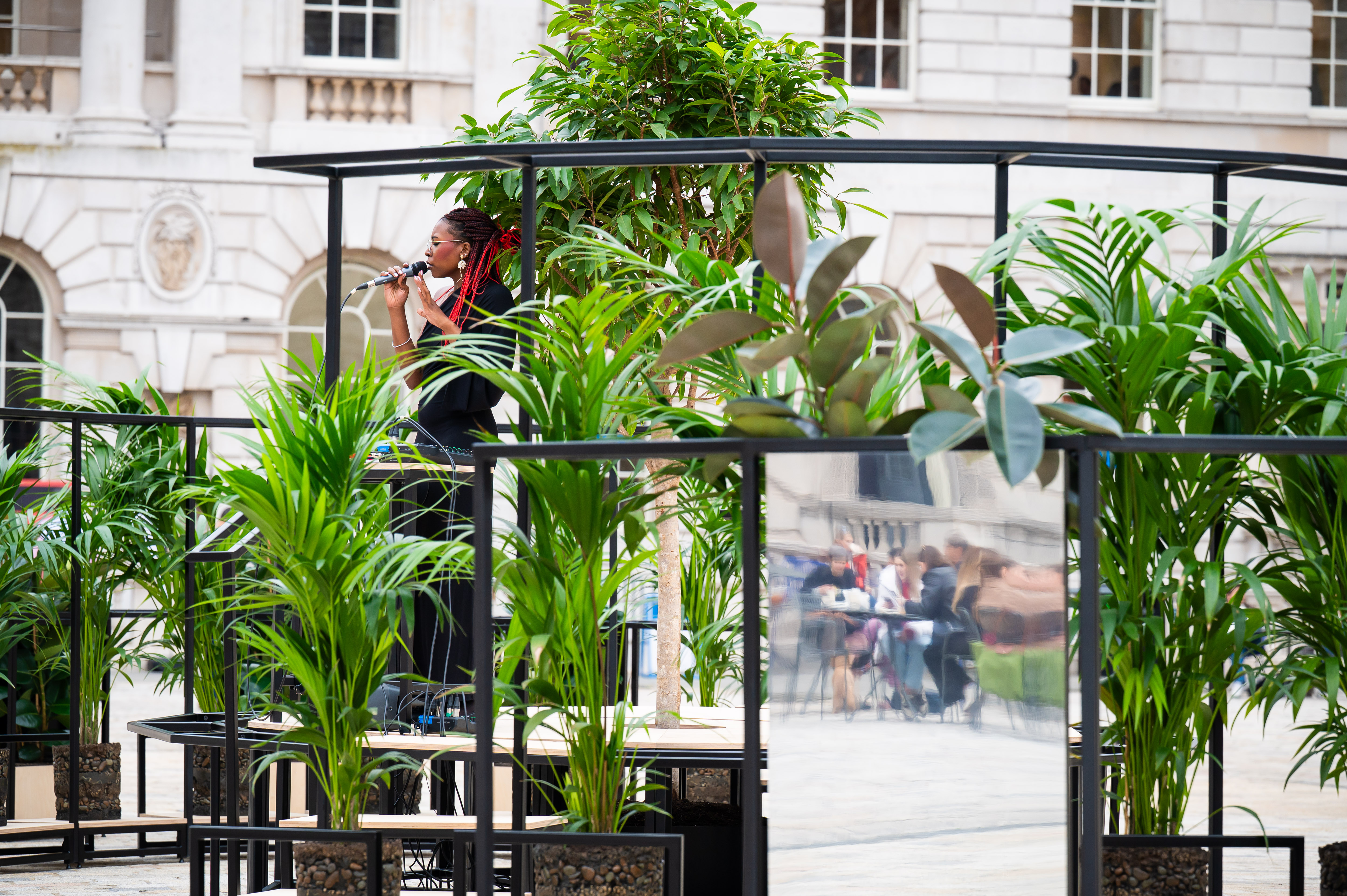
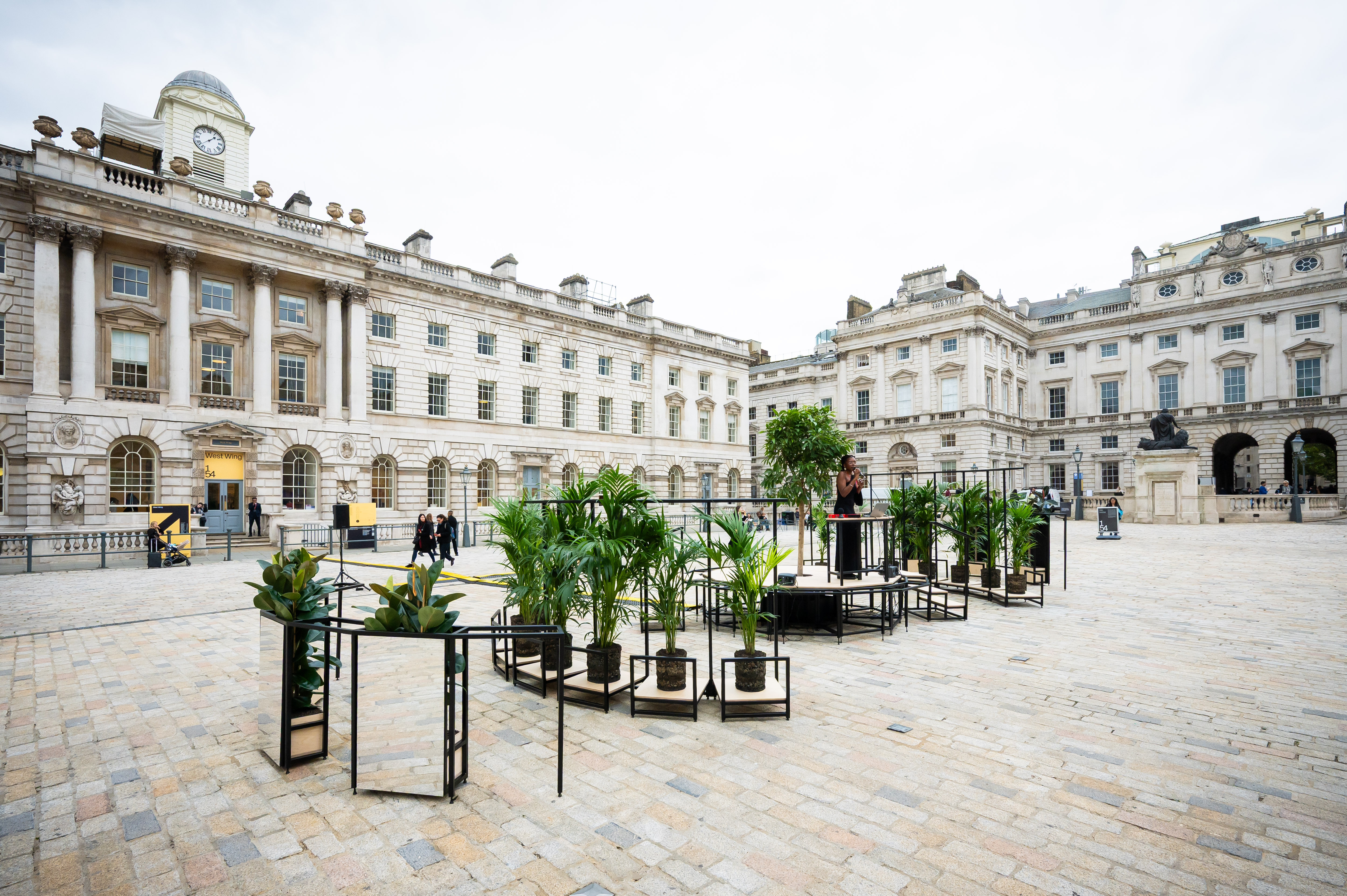
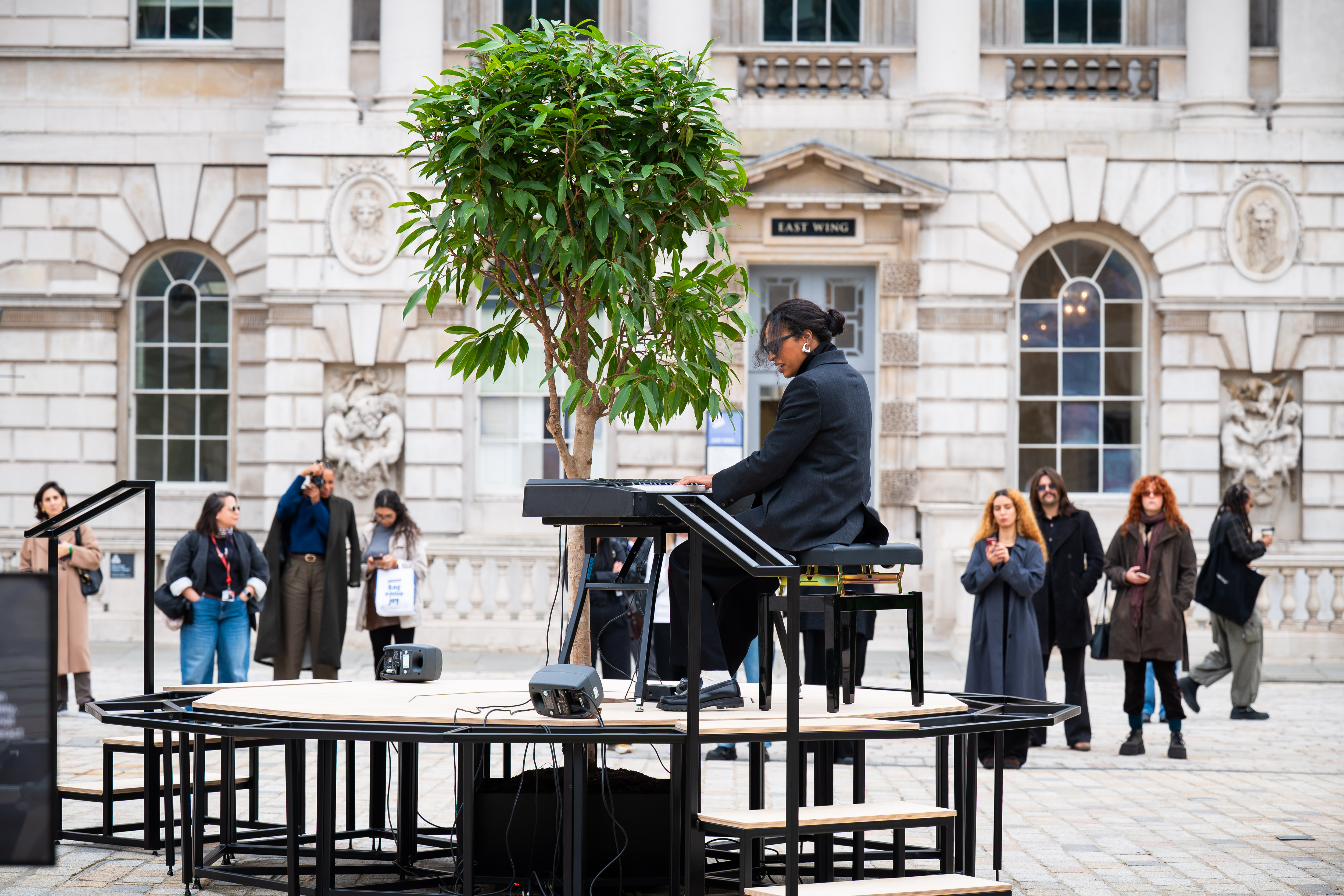
Earthworks was a public project developed for the courtyards of Somerset House. It consisted of a site-specific installation, encouraging public participation. The installation took the form of a pavilion, a vessel composed of organic elements such as earth, wood, and plants, and designed as an immersive environment that reflects the interconnected and self-sustaining ethos of the installation.
Earthworks invites audiences to reconsider the role of botanical spaces in shaping our environmental futures.
The project reflects the thinking of Achille Mbembe from his book Terrestrial Community (2023), which proposes a reflection in the era of environmental collapse, on the relationship between human beings and the group of beings that make up the symbiotic chain of life. Using African cosmovision’s in a counterpoint to Western philosophical scientism, the author offers us a holistic vision of the destiny of the Earth and of living beings, thus calling for the creation of a new planetary consciousness.
Earthworks is a program of diverse metaphysics and intersections of disciplines, theories and multiple artistic practices. It addresses a series of urgent issues, such as the extractive exploitation of natural resources and the resurgence of racism, and contrasts these places of oblivion and oppression with practices of imagination in a creation that points to a new future, a place of listening and participation, among artists, theorists, curators, communities and audiences.
The project develops as a magnetic field that creates a space that calls the spectator to the action of the work of art, a discursive space of learning. The installation reimagines botanical spaces as living, dynamic systems that transcend their colonial past. Inspired by Buckminster’s “Spaceship Earth,” this project challenges traditional uses of greenhouses and botanical gardens, reinterpreting them as arenas for ecological stewardship, cultural resilience, and decolonial engagement.
This project draws on diverse perspectives from leading thinkers, artists, and scholars to address themes of colonial legacies, ecological ethics, and the restoration of botanical spaces. By integrating historical critique, artistic interventions.
Earthworks was a public project developed for the courtyards of Somerset House. It consisted of a site-specific installation, encouraging public participation. The installation took the form of a pavilion, a vessel composed of organic elements such as earth, wood, and plants, and designed as an immersive environment that reflects the interconnected and self-sustaining ethos of the installation.
Mónica de Miranda is a Portuguese/Angolan visual artist, filmmaker and researcher whose interdisciplinary and research-based practice critically looks at the convergence of politics, gender, memory, space and history. Her work encompasses drawing, installation, photography, film and sound, on the boundaries between documentary and fiction. Mónica investigates strategies of resistance, geographies of affection, storytelling and ecologies of care.
She is the founder of Hangar (2014), an art and research centre in Lisbon. Hangar’s programmes provide spaces where artists, curators and researchers, mainly from the global south, can co-create and build social and creative networks to benefit their communities.
BY MÓNICA DE MIRANDA
Earthworks invites audiences to reconsider the role of botanical spaces in shaping our environmental futures.
The project reflects the thinking of Achille Mbembe from his book Terrestrial Community (2023), which proposes a reflection in the era of environmental collapse, on the relationship between human beings and the group of beings that make up the symbiotic chain of life. Using African cosmovision’s in a counterpoint to Western philosophical scientism, the author offers us a holistic vision of the destiny of the Earth and of living beings, thus calling for the creation of a new planetary consciousness.
Earthworks is a program of diverse metaphysics and intersections of disciplines, theories and multiple artistic practices. It addresses a series of urgent issues, such as the extractive exploitation of natural resources and the resurgence of racism, and contrasts these places of oblivion and oppression with practices of imagination in a creation that points to a new future, a place of listening and participation, among artists, theorists, curators, communities and audiences.
The project develops as a magnetic field that creates a space that calls the spectator to the action of the work of art, a discursive space of learning. The installation reimagines botanical spaces as living, dynamic systems that transcend their colonial past. Inspired by Buckminster’s “Spaceship Earth,” this project challenges traditional uses of greenhouses and botanical gardens, reinterpreting them as arenas for ecological stewardship, cultural resilience, and decolonial engagement.
This project draws on diverse perspectives from leading thinkers, artists, and scholars to address themes of colonial legacies, ecological ethics, and the restoration of botanical spaces. By integrating historical critique, artistic interventions.
Earthworks was a public project developed for the courtyards of Somerset House. It consisted of a site-specific installation, encouraging public participation. The installation took the form of a pavilion, a vessel composed of organic elements such as earth, wood, and plants, and designed as an immersive environment that reflects the interconnected and self-sustaining ethos of the installation.
Earthworks invites audiences to reconsider the role of botanical spaces in shaping our environmental futures.
The project reflects the thinking of Achille Mbembe from his book Terrestrial Community (2023), which proposes a reflection in the era of environmental collapse, on the relationship between human beings and the group of beings that make up the symbiotic chain of life. Using African cosmovision’s in a counterpoint to Western philosophical scientism, the author offers us a holistic vision of the destiny of the Earth and of living beings, thus calling for the creation of a new planetary consciousness.
Earthworks is a program of diverse metaphysics and intersections of disciplines, theories and multiple artistic practices. It addresses a series of urgent issues, such as the extractive exploitation of natural resources and the resurgence of racism, and contrasts these places of oblivion and oppression with practices of imagination in a creation that points to a new future, a place of listening and participation, among artists, theorists, curators, communities and audiences.
The project develops as a magnetic field that creates a space that calls the spectator to the action of the work of art, a discursive space of learning. The installation reimagines botanical spaces as living, dynamic systems that transcend their colonial past. Inspired by Buckminster’s “Spaceship Earth,” this project challenges traditional uses of greenhouses and botanical gardens, reinterpreting them as arenas for ecological stewardship, cultural resilience, and decolonial engagement.
This project draws on diverse perspectives from leading thinkers, artists, and scholars to address themes of colonial legacies, ecological ethics, and the restoration of botanical spaces. By integrating historical critique, artistic interventions.
Earthworks was a public project developed for the courtyards of Somerset House. It consisted of a site-specific installation, encouraging public participation. The installation took the form of a pavilion, a vessel composed of organic elements such as earth, wood, and plants, and designed as an immersive environment that reflects the interconnected and self-sustaining ethos of the installation.
Mónica de Miranda is a Portuguese/Angolan visual artist, filmmaker and researcher whose interdisciplinary and research-based practice critically looks at the convergence of politics, gender, memory, space and history. Her work encompasses drawing, installation, photography, film and sound, on the boundaries between documentary and fiction. Mónica investigates strategies of resistance, geographies of affection, storytelling and ecologies of care.
She is the founder of Hangar (2014), an art and research centre in Lisbon. Hangar’s programmes provide spaces where artists, curators and researchers, mainly from the global south, can co-create and build social and creative networks to benefit their communities.
BY MÓNICA DE MIRANDA
Earthworks invites audiences to reconsider the role of botanical spaces in shaping our environmental futures.
The project reflects the thinking of Achille Mbembe from his book Terrestrial Community (2023), which proposes a reflection in the era of environmental collapse, on the relationship between human beings and the group of beings that make up the symbiotic chain of life. Using African cosmovision’s in a counterpoint to Western philosophical scientism, the author offers us a holistic vision of the destiny of the Earth and of living beings, thus calling for the creation of a new planetary consciousness.
Earthworks is a program of diverse metaphysics and intersections of disciplines, theories and multiple artistic practices. It addresses a series of urgent issues, such as the extractive exploitation of natural resources and the resurgence of racism, and contrasts these places of oblivion and oppression with practices of imagination in a creation that points to a new future, a place of listening and participation, among artists, theorists, curators, communities and audiences.
The project develops as a magnetic field that creates a space that calls the spectator to the action of the work of art, a discursive space of learning. The installation reimagines botanical spaces as living, dynamic systems that transcend their colonial past. Inspired by Buckminster’s “Spaceship Earth,” this project challenges traditional uses of greenhouses and botanical gardens, reinterpreting them as arenas for ecological stewardship, cultural resilience, and decolonial engagement.
This project draws on diverse perspectives from leading thinkers, artists, and scholars to address themes of colonial legacies, ecological ethics, and the restoration of botanical spaces. By integrating historical critique, artistic interventions.
Earthworks was a public project developed for the courtyards of Somerset House. It consisted of a site-specific installation, encouraging public participation. The installation took the form of a pavilion, a vessel composed of organic elements such as earth, wood, and plants, and designed as an immersive environment that reflects the interconnected and self-sustaining ethos of the installation.
Earthworks invites audiences to reconsider the role of botanical spaces in shaping our environmental futures.
The project reflects the thinking of Achille Mbembe from his book Terrestrial Community (2023), which proposes a reflection in the era of environmental collapse, on the relationship between human beings and the group of beings that make up the symbiotic chain of life. Using African cosmovision’s in a counterpoint to Western philosophical scientism, the author offers us a holistic vision of the destiny of the Earth and of living beings, thus calling for the creation of a new planetary consciousness.
Earthworks is a program of diverse metaphysics and intersections of disciplines, theories and multiple artistic practices. It addresses a series of urgent issues, such as the extractive exploitation of natural resources and the resurgence of racism, and contrasts these places of oblivion and oppression with practices of imagination in a creation that points to a new future, a place of listening and participation, among artists, theorists, curators, communities and audiences.
The project develops as a magnetic field that creates a space that calls the spectator to the action of the work of art, a discursive space of learning. The installation reimagines botanical spaces as living, dynamic systems that transcend their colonial past. Inspired by Buckminster’s “Spaceship Earth,” this project challenges traditional uses of greenhouses and botanical gardens, reinterpreting them as arenas for ecological stewardship, cultural resilience, and decolonial engagement.
This project draws on diverse perspectives from leading thinkers, artists, and scholars to address themes of colonial legacies, ecological ethics, and the restoration of botanical spaces. By integrating historical critique, artistic interventions.
Earthworks was a public project developed for the courtyards of Somerset House. It consisted of a site-specific installation, encouraging public participation. The installation took the form of a pavilion, a vessel composed of organic elements such as earth, wood, and plants, and designed as an immersive environment that reflects the interconnected and self-sustaining ethos of the installation.
Mónica de Miranda is a Portuguese/Angolan visual artist, filmmaker and researcher whose interdisciplinary and research-based practice critically looks at the convergence of politics, gender, memory, space and history. Her work encompasses drawing, installation, photography, film and sound, on the boundaries between documentary and fiction. Mónica investigates strategies of resistance, geographies of affection, storytelling and ecologies of care.
She is the founder of Hangar (2014), an art and research centre in Lisbon. Hangar’s programmes provide spaces where artists, curators and researchers, mainly from the global south, can co-create and build social and creative networks to benefit their communities.