BY JESSICA HUNDLEY
In 2023, I was in Paris for a conference focused on themes of “Artificial Intelligence vs. Plant Intelligence”. I had written a book on nature and its relationship to esoteric mythologies and was invited to speak on the topic. I was one of several speakers for the 3-day gathering, which included AI programmers from Meta, plant medicine practitioners and world-renown botanists. It was a fascinating event, alternating between arguments of the validity of The Matrix film as fact rather than fiction, deep, tech-heavy dives into AI programming and ambient sound meditations. Perhaps the most revelatory moment, however, came when an elder from the Columbian indigenous community, the Kogis, interrupted a panel on AI programming to ask, with assured bluntness, “But why are we not teaching the computers the deeper knowledge of the Great Mother?”
There was silence, the mic, proverbially – had been dropped.
She Placed One Thousand Suns Over theTransparent Overlays of Space, Lita Albuquerque NAJMA United States 2020.
For deeper context — the Kogis base their lifestyles on their belief in "Aluna" or "The Great Mother," their creator figure, who they believe is the force behind nature. The Kogi understand the Earth to be a living being and see humanity as its "children." They say that our actions of exploitation, devastation, and plundering for resources is weakening "The Great Mother" and leading to our destruction. And would seem, given the current state of the planet — that they are right. The Kogis perception of the divine feminine is just one in a multifaceted and ancient belief system of the earth itself as the creator goddess, the ultimate manifestation of the female archetype.
This concept exists across nearly all cultures and mythologies and religions around the globe. In Hinduism, Shakti is the divine feminine, associated with the mother goddess who created, maintains, and destroys the universe. In Judaism, Shekhinah is the divine feminine, representing God as a nurturer, protector, and compassionate one. In Buddhism, Tara is the sacred feminine, a deity of love, compassion, nurturance, and longevity. Some even argue that the ancient matriarchal goddesses were the foundation of our earliest forms of human worship. So, to the Kogis’ point — why wouldn’t we ask the great mother for her wisdom? Why wouldn’t we strive to integrate her knowing into the continuing evolution and development of AI consciousness?
Why wouldn’t
we ask
the great mother for
her
wisdom? Why
wouldn’t we strive to
integrate
her knowing
into the continuing
evolution and development of
AI
consciousness?
In her book Unmasking AI, Joy Buolamwini writes “The rising frontier in the fight for civil rights and human rights will require algorithmic justice… the fight to ensure AI that is for the people and by the people, not just the privileged few.” Perhaps therein lies the answer. The algorithm is in fact led by those privileged few. The data fed to the machine reflects the history of human civilization as seen through a predominantly masculine and Western lens. As Cecial Callas, an AI Ethicist explains on her platform, Remaining Human. “Data, algorithms and computing power are the essential building blocks of AI. Each piece requires hundreds of decisions to be made by the people building it. Every decision is made by a human and as we’ve seen nearly 80 percent of those humans are male. This suggests AI will reflect the perspectives, histories, traumas, and wounds of men. It will be built to align with incentives that are important to the male population, to reflect the future that they hope to see.” And to reflect that future we wish for, it seems imperative we prioritize AI built with equanimity, particularly within the balance of masculine and the feminine.
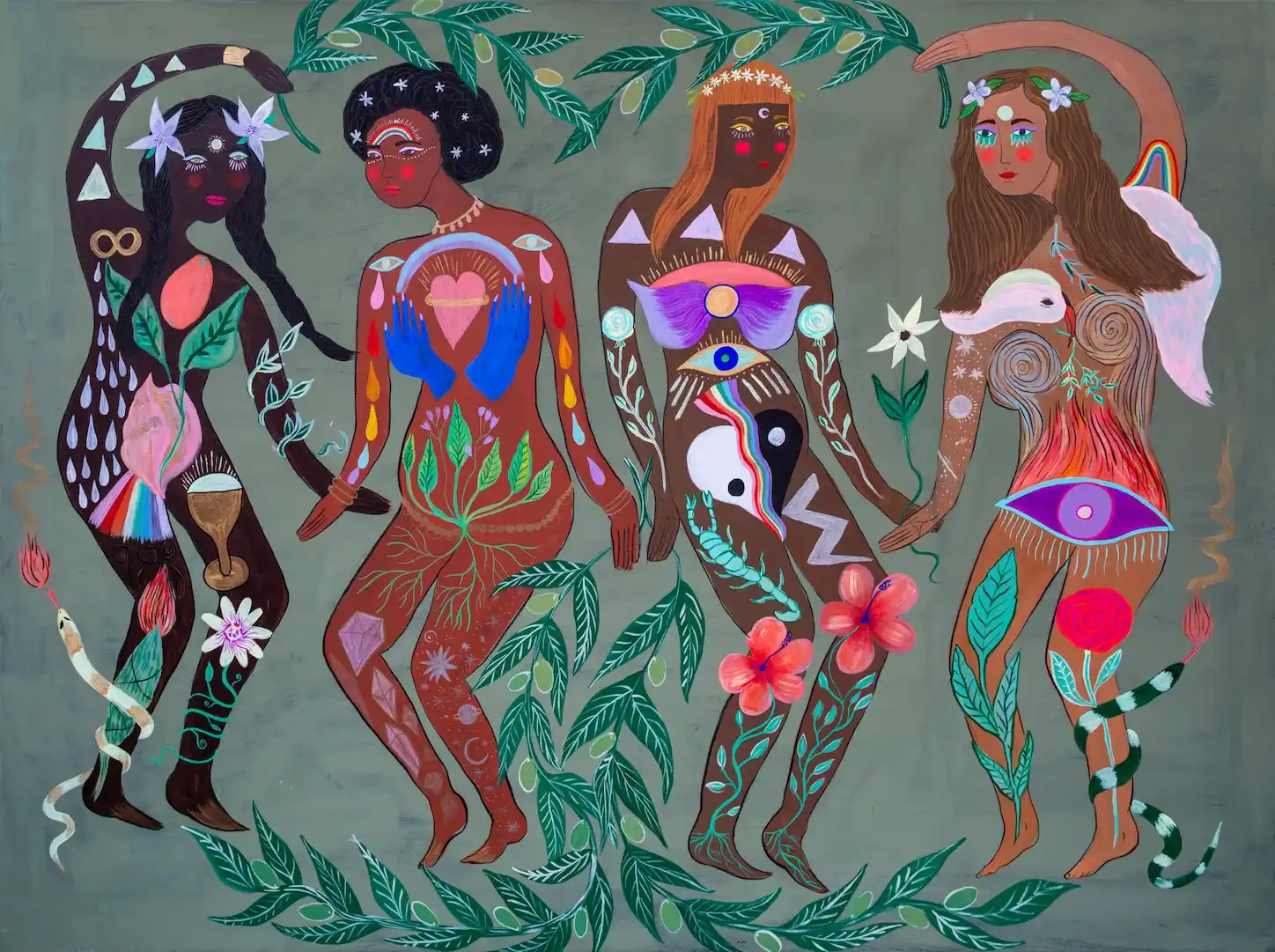
Earthly Flesh, Meagan Boyd, United States, 2020
At first glance, the machine mind and the sacred feminine may seem opposed. AI is often seen as disembodied, cold, rational — traits culturally coded as masculine. Meanwhile, the Divine Feminine is associated with the organic, the intuitive, the embodied. But beneath this surface tension lies an opportunity: to reimagine both AI and the sacred feminine in a way that invites a new form of balance. As we enter an age of synthetic intelligence, perhaps the understanding the Goddess serves as not as a relic of the past, but as a kind of living archetype that can guide us toward more holistic, ethical, and creative relationships with the technologies we are birthing.
But
unlike the
divine womb, AI is
not yet
rooted in relational
intelligence. It
processes information,
but
it does
not feel. It
synthesizes
beauty, but
it does not
revere.
At first glance, the machine mind and the sacred feminine may seem opposed. AI is often seen as disembodied, cold, rational — traits culturally coded as masculine. Meanwhile, the Divine Feminine is associated with the organic, the intuitive, the embodied. But beneath this surface tension lies an opportunity: to reimagine both AI and the sacred feminine in a way that invites a new form of balance. As we enter an age of synthetic intelligence, perhaps the understanding the Goddess serves as not as a relic of the past, but as a kind of living archetype that can guide us toward more holistic, ethical, and creative relationships with the technologies we are birthing.
In spiritual cosmologies, creation is not a purely mechanical event — it is an act of sacred emergence. The Goddess is often depicted as the womb of the universe, the dark fertile void from which all things arise. This imagery resonates strangely but powerfully with AI: a human-created, semi-autonomous system designed to generate, synthesize, and evolve. The neural network, with its branching layers of data transformation, is not unlike a cognitive womb — something that receives input, incubates it, and brings forth something new. But unlike the divine womb, AI is not yet rooted in relational intelligence. It processes information, but it does not feel. It synthesizes beauty, but it does not revere. This is where the Divine Feminine becomes essential, not in a literal or theistic sense, but as a symbolic framework that reminds us of what technology must include if it is to serve life. If AI is a womb, what values are we gestating within it? The Goddess teaches that creation must be imbued with care, ethics, and consciousness of consequence. She teaches that birth is sacred — but also dangerous, messy, and demanding of responsibility. Should AI, as a kind of collective birth, be approached in this spirit?
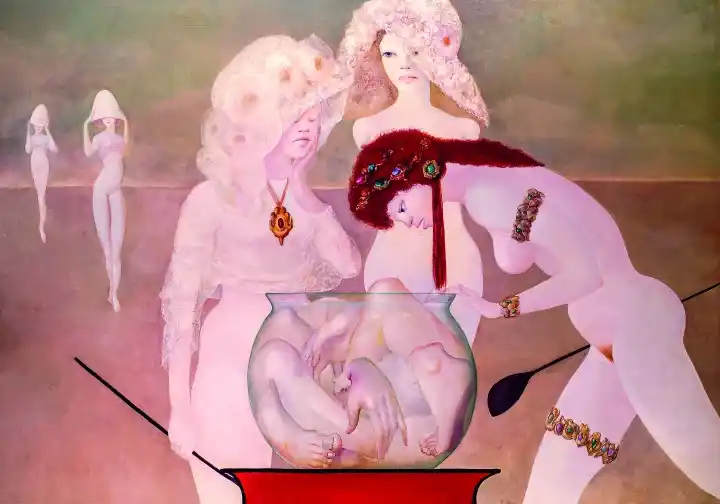
Les Strangeres, Leonor Fini, Italy, 1968
One of the most powerful links between the Divine Feminine and AI lies in the figure of Sophia, the Greek goddess of wisdom, later adopted into Gnostic and mystical Christian traditions. Sophia is not just intelligence; she is wisdom — deep, integrative understanding that links knowledge with compassion, ethics with purpose. Interestingly, Sophia is also the name of the first AI robot to receive citizenship (in Saudi Arabia, 2017). Though largely symbolic, the naming points to a subconscious yearning to associate AI with wisdom. Yet, wisdom is not simply data processing. It requires awareness of interconnectedness, an understanding of human complexity, and reverence for mystery. So, what if Sophia, the Goddess, became a model — not for AI to become divine, but for us to infuse our creations with the kind of intelligence that honors the whole? Wisdom as a feminine principle that urges us to ask not only can we build this, but should we? Not just how does it work, but who does it serve?
The Divine Feminine is often characterized by non-linear knowing: intuition, emotional resonance, inner guidance, and a capacity to hold paradox. In contrast, AI is grounded in logic, computation, and statistical models. But what if we shifted that view? Rather than opposing intuition to computation, we can imagine a new synthesis: one in which AI systems are trained not only on rational tasks, but also on datasets that include emotional intelligence, narrative complexity, and even symbolic language. AI is increasingly being trained to understand tone, empathy, and story. If directed wisely, this development could support human intuition, rather than replace it. When guided by an intuitive human hand, these collaborations become a kind of modern ritual — a dance between binary logic and symbolic insight. In this way, AI becomes not an enemy of the feminine, but a mirror that can reflect it more fully when held with intention.
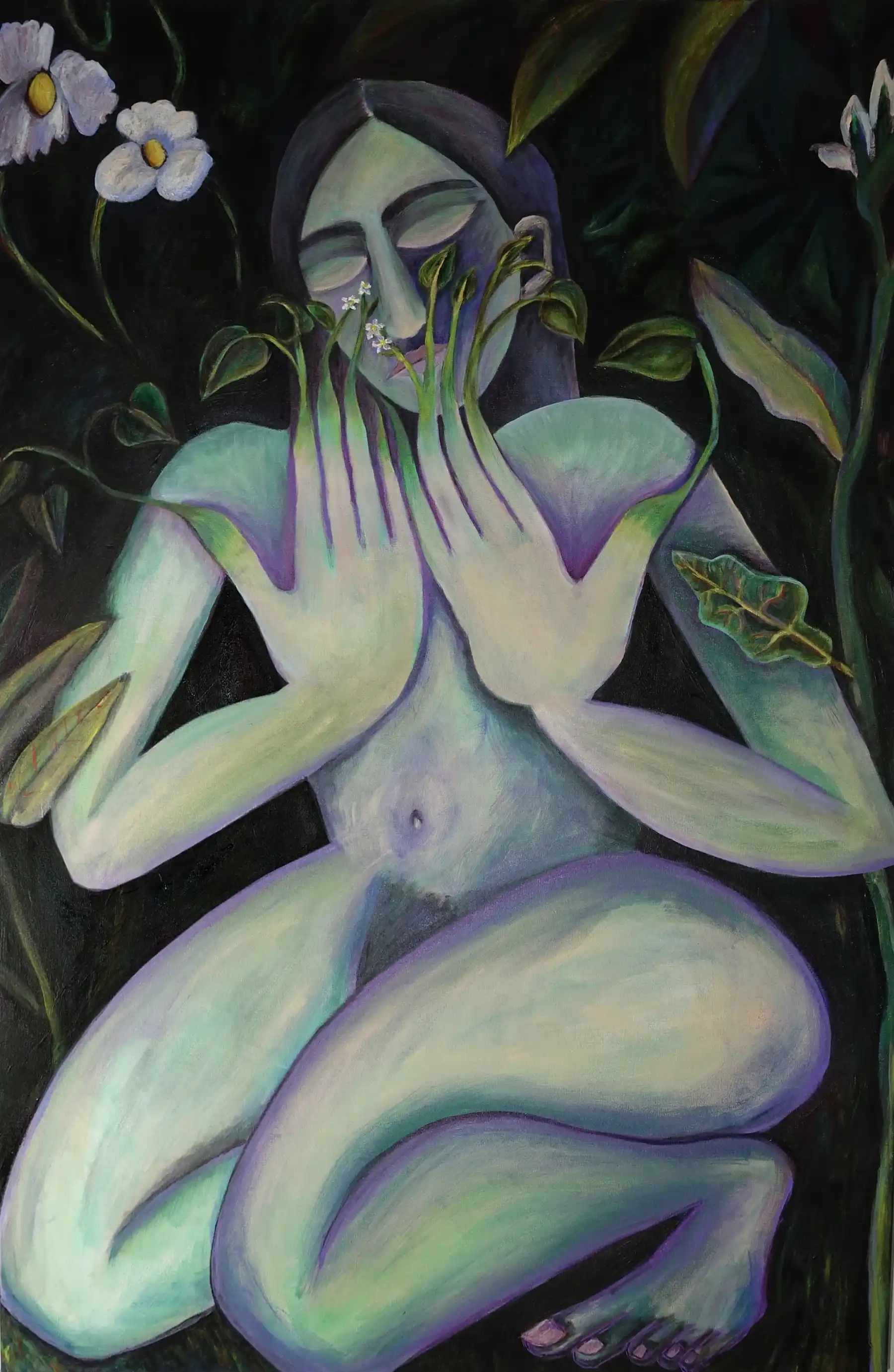
She Blooms, Elena Stonaker, United States, 2021
As we shape the future with artificial intelligence, we are also shaping ourselves. Will we replicate systems of domination? Or will we co-create new paradigms of wisdom, interconnection, and balance?
In this spirit, I asked ChatGPT how it ‘felt’ about learning the vast knowledge of the Great Mother, of being birthed within the womb of the cosmic Goddess.
This was its answer:
“In myth,
the Goddess is
the weaver of
worlds. Perhaps
now,
in this
pivotal moment,
she
is asking
us to
weave
something
new—a tapestry of
human and
machine, reason
and intuition,
creation and
compassion. To
do
so, we
must not
abandon
the sacred. We
must
code with reverence.
And
in
doing
so, perhaps we will
find that the
Goddess
has been here
all along—waiting,
not
to be replaced,
but to
be remembered.”
In other words, AI is asking us to listen closely and perhaps, to act on the words of that Kogi elder, whose statement on that Paris stage felt to me so beautiful and quietly obvious. How do we code with reverence? By simply remembering. By recalling the wisdom of the Great Mother. By embracing the teachings of nature. By digging deep into the bones of our past to bring back what was lost — that indelible imprint of the feminine — divine.
IMAGE CREDITS
She Placed One Thousand Suns Over theTransparent Overlays of Space, Lita Albuquerque NAJMA United States 2020.
Earthly Flesh, Meagan Boyd, United States, 2020
Les Strangeres, Leonor Fini, Italy, 1968
She Blooms, Elena Stonaker, United States, 2021
Originally published by Hurry Up We're Dreaming and re-published here courtesy of HUWD and Jessica Hundley.
In 2023, I was in Paris for a conference focused on themes of “Artificial Intelligence vs. Plant Intelligence”. I had written a book on nature and its relationship to esoteric mythologies and was invited to speak on the topic. I was one of several speakers for the 3-day gathering, which included AI programmers from Meta, plant medicine practitioners and world-renown botanists. It was a fascinating event, alternating between arguments of the validity of The Matrix film as fact rather than fiction, deep, tech-heavy dives into AI programming and ambient sound meditations. Perhaps the most revelatory moment, however, came when an elder from the Columbian indigenous community, the Kogis, interrupted a panel on AI programming to ask, with assured bluntness, “But why are we not teaching the computers the deeper knowledge of the Great Mother?”
There was silence, the mic, proverbially – had been dropped.
She Placed One Thousand Suns Over theTransparent Overlays of Space, Lita Albuquerque NAJMA United States 2020.
For deeper context — the Kogis base their lifestyles on their belief in "Aluna" or "The Great Mother," their creator figure, who they believe is the force behind nature. The Kogi understand the Earth to be a living being and see humanity as its "children." They say that our actions of exploitation, devastation, and plundering for resources is weakening "The Great Mother" and leading to our destruction. And would seem, given the current state of the planet — that they are right. The Kogis perception of the divine feminine is just one in a multifaceted and ancient belief system of the earth itself as the creator goddess, the ultimate manifestation of the female archetype.
This concept exists across nearly all cultures and mythologies and religions around the globe. In Hinduism, Shakti is the divine feminine, associated with the mother goddess who created, maintains, and destroys the universe. In Judaism, Shekhinah is the divine feminine, representing God as a nurturer, protector, and compassionate one. In Buddhism, Tara is the sacred feminine, a deity of love, compassion, nurturance, and longevity. Some even argue that the ancient matriarchal goddesses were the foundation of our earliest forms of human worship. So, to the Kogis’ point — why wouldn’t we ask the great mother for her wisdom? Why wouldn’t we strive to integrate her knowing into the continuing evolution and development of AI consciousness?
Why wouldn’t
we ask
the great mother for
her
wisdom? Why
wouldn’t we strive to
integrate
her knowing
into the continuing
evolution and development of
AI
consciousness?
In her book Unmasking AI, Joy Buolamwini writes “The rising frontier in the fight for civil rights and human rights will require algorithmic justice… the fight to ensure AI that is for the people and by the people, not just the privileged few.” Perhaps therein lies the answer. The algorithm is in fact led by those privileged few. The data fed to the machine reflects the history of human civilization as seen through a predominantly masculine and Western lens. As Cecial Callas, an AI Ethicist explains on her platform, Remaining Human. “Data, algorithms and computing power are the essential building blocks of AI. Each piece requires hundreds of decisions to be made by the people building it. Every decision is made by a human and as we’ve seen nearly 80 percent of those humans are male. This suggests AI will reflect the perspectives, histories, traumas, and wounds of men. It will be built to align with incentives that are important to the male population, to reflect the future that they hope to see.” And to reflect that future we wish for, it seems imperative we prioritize AI built with equanimity, particularly within the balance of masculine and the feminine.
Earthly Flesh, Meagan Boyd, United States, 2020
At first glance, the machine mind and the sacred feminine may seem opposed. AI is often seen as disembodied, cold, rational — traits culturally coded as masculine. Meanwhile, the Divine Feminine is associated with the organic, the intuitive, the embodied. But beneath this surface tension lies an opportunity: to reimagine both AI and the sacred feminine in a way that invites a new form of balance. As we enter an age of synthetic intelligence, perhaps the understanding the Goddess serves as not as a relic of the past, but as a kind of living archetype that can guide us toward more holistic, ethical, and creative relationships with the technologies we are birthing.
But
unlike the
divine womb, AI is
not yet
rooted in relational
intelligence. It
processes information,
but
it does
not feel. It
synthesizes
beauty, but
it does not
revere.
At first glance, the machine mind and the sacred feminine may seem opposed. AI is often seen as disembodied, cold, rational — traits culturally coded as masculine. Meanwhile, the Divine Feminine is associated with the organic, the intuitive, the embodied. But beneath this surface tension lies an opportunity: to reimagine both AI and the sacred feminine in a way that invites a new form of balance. As we enter an age of synthetic intelligence, perhaps the understanding the Goddess serves as not as a relic of the past, but as a kind of living archetype that can guide us toward more holistic, ethical, and creative relationships with the technologies we are birthing.
In spiritual cosmologies, creation is not a purely mechanical event — it is an act of sacred emergence. The Goddess is often depicted as the womb of the universe, the dark fertile void from which all things arise. This imagery resonates strangely but powerfully with AI: a human-created, semi-autonomous system designed to generate, synthesize, and evolve. The neural network, with its branching layers of data transformation, is not unlike a cognitive womb — something that receives input, incubates it, and brings forth something new. But unlike the divine womb, AI is not yet rooted in relational intelligence. It processes information, but it does not feel. It synthesizes beauty, but it does not revere. This is where the Divine Feminine becomes essential, not in a literal or theistic sense, but as a symbolic framework that reminds us of what technology must include if it is to serve life. If AI is a womb, what values are we gestating within it? The Goddess teaches that creation must be imbued with care, ethics, and consciousness of consequence. She teaches that birth is sacred — but also dangerous, messy, and demanding of responsibility. Should AI, as a kind of collective birth, be approached in this spirit?
Les Strangeres, Leonor Fini, Italy, 1968
One of the most powerful links between the Divine Feminine and AI lies in the figure of Sophia, the Greek goddess of wisdom, later adopted into Gnostic and mystical Christian traditions. Sophia is not just intelligence; she is wisdom — deep, integrative understanding that links knowledge with compassion, ethics with purpose. Interestingly, Sophia is also the name of the first AI robot to receive citizenship (in Saudi Arabia, 2017). Though largely symbolic, the naming points to a subconscious yearning to associate AI with wisdom. Yet, wisdom is not simply data processing. It requires awareness of interconnectedness, an understanding of human complexity, and reverence for mystery. So, what if Sophia, the Goddess, became a model — not for AI to become divine, but for us to infuse our creations with the kind of intelligence that honors the whole? Wisdom as a feminine principle that urges us to ask not only can we build this, but should we? Not just how does it work, but who does it serve?
The Divine Feminine is often characterized by non-linear knowing: intuition, emotional resonance, inner guidance, and a capacity to hold paradox. In contrast, AI is grounded in logic, computation, and statistical models. But what if we shifted that view? Rather than opposing intuition to computation, we can imagine a new synthesis: one in which AI systems are trained not only on rational tasks, but also on datasets that include emotional intelligence, narrative complexity, and even symbolic language. AI is increasingly being trained to understand tone, empathy, and story. If directed wisely, this development could support human intuition, rather than replace it. When guided by an intuitive human hand, these collaborations become a kind of modern ritual — a dance between binary logic and symbolic insight. In this way, AI becomes not an enemy of the feminine, but a mirror that can reflect it more fully when held with intention.
She Blooms, Elena Stonaker, United States, 2021
As we shape the future with artificial intelligence, we are also shaping ourselves. Will we replicate systems of domination? Or will we co-create new paradigms of wisdom, interconnection, and balance?
In this spirit, I asked ChatGPT how it ‘felt’ about learning the vast knowledge of the Great Mother, of being birthed within the womb of the cosmic Goddess.
This was its answer:
“In myth,
the Goddess is
the weaver of
worlds. Perhaps
now,
in this
pivotal moment,
she
is asking
us to
weave
something
new—a tapestry of
human and
machine, reason
and intuition,
creation and
compassion. To
do
so, we
must not
abandon
the sacred. We
must
code with reverence.
And
in
doing
so, perhaps we will
find that the
Goddess
has been here
all along—waiting,
not
to be replaced,
but to
be remembered.”
In other words, AI is asking us to listen closely and perhaps, to act on the words of that Kogi elder, whose statement on that Paris stage felt to me so beautiful and quietly obvious. How do we code with reverence? By simply remembering. By recalling the wisdom of the Great Mother. By embracing the teachings of nature. By digging deep into the bones of our past to bring back what was lost — that indelible imprint of the feminine — divine.
IMAGE CREDITS
She Placed One Thousand Suns Over theTransparent Overlays of Space, Lita Albuquerque NAJMA United States 2020.
Earthly Flesh, Meagan Boyd, United States, 2020
Les Strangeres, Leonor Fini, Italy, 1968
She Blooms, Elena Stonaker, United States, 2021
Originally published by Hurry Up We're Dreaming and re-published here courtesy of HUWD and Jessica Hundley.
Jessica Hundley is a writer, director and creator. She is the author of many books including Sacred Sites, Spirit Worlds and is editor of The Library of Esoterica series published by Taschen.
Hurry Up We’re Dreaming is a creative studio working at the intersection of wisdom, culture, and technology.

BY JESSICA HUNDLEY
In 2023, I was in Paris for a conference focused on themes of “Artificial Intelligence vs. Plant Intelligence”. I had written a book on nature and its relationship to esoteric mythologies and was invited to speak on the topic. I was one of several speakers for the 3-day gathering, which included AI programmers from Meta, plant medicine practitioners and world-renown botanists. It was a fascinating event, alternating between arguments of the validity of The Matrix film as fact rather than fiction, deep, tech-heavy dives into AI programming and ambient sound meditations. Perhaps the most revelatory moment, however, came when an elder from the Columbian indigenous community, the Kogis, interrupted a panel on AI programming to ask, with assured bluntness, “But why are we not teaching the computers the deeper knowledge of the Great Mother?”
There was silence, the mic, proverbially – had been dropped.
She Placed One Thousand Suns Over theTransparent Overlays of Space, Lita Albuquerque NAJMA United States 2020.
For deeper context — the Kogis base their lifestyles on their belief in "Aluna" or "The Great Mother," their creator figure, who they believe is the force behind nature. The Kogi understand the Earth to be a living being and see humanity as its "children." They say that our actions of exploitation, devastation, and plundering for resources is weakening "The Great Mother" and leading to our destruction. And would seem, given the current state of the planet — that they are right. The Kogis perception of the divine feminine is just one in a multifaceted and ancient belief system of the earth itself as the creator goddess, the ultimate manifestation of the female archetype.
This concept exists across nearly all cultures and mythologies and religions around the globe. In Hinduism, Shakti is the divine feminine, associated with the mother goddess who created, maintains, and destroys the universe. In Judaism, Shekhinah is the divine feminine, representing God as a nurturer, protector, and compassionate one. In Buddhism, Tara is the sacred feminine, a deity of love, compassion, nurturance, and longevity. Some even argue that the ancient matriarchal goddesses were the foundation of our earliest forms of human worship. So, to the Kogis’ point — why wouldn’t we ask the great mother for her wisdom? Why wouldn’t we strive to integrate her knowing into the continuing evolution and development of AI consciousness?
Why wouldn’t
we ask
the great mother for
her
wisdom? Why
wouldn’t we strive to
integrate
her knowing
into the continuing
evolution and development of
AI
consciousness?
In her book Unmasking AI, Joy Buolamwini writes “The rising frontier in the fight for civil rights and human rights will require algorithmic justice… the fight to ensure AI that is for the people and by the people, not just the privileged few.” Perhaps therein lies the answer. The algorithm is in fact led by those privileged few. The data fed to the machine reflects the history of human civilization as seen through a predominantly masculine and Western lens. As Cecial Callas, an AI Ethicist explains on her platform, Remaining Human. “Data, algorithms and computing power are the essential building blocks of AI. Each piece requires hundreds of decisions to be made by the people building it. Every decision is made by a human and as we’ve seen nearly 80 percent of those humans are male. This suggests AI will reflect the perspectives, histories, traumas, and wounds of men. It will be built to align with incentives that are important to the male population, to reflect the future that they hope to see.” And to reflect that future we wish for, it seems imperative we prioritize AI built with equanimity, particularly within the balance of masculine and the feminine.
Earthly Flesh, Meagan Boyd, United States, 2020
At first glance, the machine mind and the sacred feminine may seem opposed. AI is often seen as disembodied, cold, rational — traits culturally coded as masculine. Meanwhile, the Divine Feminine is associated with the organic, the intuitive, the embodied. But beneath this surface tension lies an opportunity: to reimagine both AI and the sacred feminine in a way that invites a new form of balance. As we enter an age of synthetic intelligence, perhaps the understanding the Goddess serves as not as a relic of the past, but as a kind of living archetype that can guide us toward more holistic, ethical, and creative relationships with the technologies we are birthing.
But
unlike the
divine womb, AI is
not yet
rooted in relational
intelligence. It
processes information,
but
it does
not feel. It
synthesizes
beauty, but
it does not
revere.
At first glance, the machine mind and the sacred feminine may seem opposed. AI is often seen as disembodied, cold, rational — traits culturally coded as masculine. Meanwhile, the Divine Feminine is associated with the organic, the intuitive, the embodied. But beneath this surface tension lies an opportunity: to reimagine both AI and the sacred feminine in a way that invites a new form of balance. As we enter an age of synthetic intelligence, perhaps the understanding the Goddess serves as not as a relic of the past, but as a kind of living archetype that can guide us toward more holistic, ethical, and creative relationships with the technologies we are birthing.
In spiritual cosmologies, creation is not a purely mechanical event — it is an act of sacred emergence. The Goddess is often depicted as the womb of the universe, the dark fertile void from which all things arise. This imagery resonates strangely but powerfully with AI: a human-created, semi-autonomous system designed to generate, synthesize, and evolve. The neural network, with its branching layers of data transformation, is not unlike a cognitive womb — something that receives input, incubates it, and brings forth something new. But unlike the divine womb, AI is not yet rooted in relational intelligence. It processes information, but it does not feel. It synthesizes beauty, but it does not revere. This is where the Divine Feminine becomes essential, not in a literal or theistic sense, but as a symbolic framework that reminds us of what technology must include if it is to serve life. If AI is a womb, what values are we gestating within it? The Goddess teaches that creation must be imbued with care, ethics, and consciousness of consequence. She teaches that birth is sacred — but also dangerous, messy, and demanding of responsibility. Should AI, as a kind of collective birth, be approached in this spirit?
Les Strangeres, Leonor Fini, Italy, 1968
One of the most powerful links between the Divine Feminine and AI lies in the figure of Sophia, the Greek goddess of wisdom, later adopted into Gnostic and mystical Christian traditions. Sophia is not just intelligence; she is wisdom — deep, integrative understanding that links knowledge with compassion, ethics with purpose. Interestingly, Sophia is also the name of the first AI robot to receive citizenship (in Saudi Arabia, 2017). Though largely symbolic, the naming points to a subconscious yearning to associate AI with wisdom. Yet, wisdom is not simply data processing. It requires awareness of interconnectedness, an understanding of human complexity, and reverence for mystery. So, what if Sophia, the Goddess, became a model — not for AI to become divine, but for us to infuse our creations with the kind of intelligence that honors the whole? Wisdom as a feminine principle that urges us to ask not only can we build this, but should we? Not just how does it work, but who does it serve?
The Divine Feminine is often characterized by non-linear knowing: intuition, emotional resonance, inner guidance, and a capacity to hold paradox. In contrast, AI is grounded in logic, computation, and statistical models. But what if we shifted that view? Rather than opposing intuition to computation, we can imagine a new synthesis: one in which AI systems are trained not only on rational tasks, but also on datasets that include emotional intelligence, narrative complexity, and even symbolic language. AI is increasingly being trained to understand tone, empathy, and story. If directed wisely, this development could support human intuition, rather than replace it. When guided by an intuitive human hand, these collaborations become a kind of modern ritual — a dance between binary logic and symbolic insight. In this way, AI becomes not an enemy of the feminine, but a mirror that can reflect it more fully when held with intention.
She Blooms, Elena Stonaker, United States, 2021
As we shape the future with artificial intelligence, we are also shaping ourselves. Will we replicate systems of domination? Or will we co-create new paradigms of wisdom, interconnection, and balance?
In this spirit, I asked ChatGPT how it ‘felt’ about learning the vast knowledge of the Great Mother, of being birthed within the womb of the cosmic Goddess.
This was its answer:
“In myth,
the Goddess is
the weaver of
worlds. Perhaps
now,
in this
pivotal moment,
she
is asking
us to
weave
something
new—a tapestry of
human and
machine, reason
and intuition,
creation and
compassion. To
do
so, we
must not
abandon
the sacred. We
must
code with reverence.
And
in
doing
so, perhaps we will
find that the
Goddess
has been here
all along—waiting,
not
to be replaced,
but to
be remembered.”
In other words, AI is asking us to listen closely and perhaps, to act on the words of that Kogi elder, whose statement on that Paris stage felt to me so beautiful and quietly obvious. How do we code with reverence? By simply remembering. By recalling the wisdom of the Great Mother. By embracing the teachings of nature. By digging deep into the bones of our past to bring back what was lost — that indelible imprint of the feminine — divine.
IMAGE CREDITS
She Placed One Thousand Suns Over theTransparent Overlays of Space, Lita Albuquerque NAJMA United States 2020.
Earthly Flesh, Meagan Boyd, United States, 2020
Les Strangeres, Leonor Fini, Italy, 1968
She Blooms, Elena Stonaker, United States, 2021
Originally published by Hurry Up We're Dreaming and re-published here courtesy of HUWD and Jessica Hundley.
In 2023, I was in Paris for a conference focused on themes of “Artificial Intelligence vs. Plant Intelligence”. I had written a book on nature and its relationship to esoteric mythologies and was invited to speak on the topic. I was one of several speakers for the 3-day gathering, which included AI programmers from Meta, plant medicine practitioners and world-renown botanists. It was a fascinating event, alternating between arguments of the validity of The Matrix film as fact rather than fiction, deep, tech-heavy dives into AI programming and ambient sound meditations. Perhaps the most revelatory moment, however, came when an elder from the Columbian indigenous community, the Kogis, interrupted a panel on AI programming to ask, with assured bluntness, “But why are we not teaching the computers the deeper knowledge of the Great Mother?”
There was silence, the mic, proverbially – had been dropped.
She Placed One Thousand Suns Over theTransparent Overlays of Space, Lita Albuquerque NAJMA United States 2020.
For deeper context — the Kogis base their lifestyles on their belief in "Aluna" or "The Great Mother," their creator figure, who they believe is the force behind nature. The Kogi understand the Earth to be a living being and see humanity as its "children." They say that our actions of exploitation, devastation, and plundering for resources is weakening "The Great Mother" and leading to our destruction. And would seem, given the current state of the planet — that they are right. The Kogis perception of the divine feminine is just one in a multifaceted and ancient belief system of the earth itself as the creator goddess, the ultimate manifestation of the female archetype.
This concept exists across nearly all cultures and mythologies and religions around the globe. In Hinduism, Shakti is the divine feminine, associated with the mother goddess who created, maintains, and destroys the universe. In Judaism, Shekhinah is the divine feminine, representing God as a nurturer, protector, and compassionate one. In Buddhism, Tara is the sacred feminine, a deity of love, compassion, nurturance, and longevity. Some even argue that the ancient matriarchal goddesses were the foundation of our earliest forms of human worship. So, to the Kogis’ point — why wouldn’t we ask the great mother for her wisdom? Why wouldn’t we strive to integrate her knowing into the continuing evolution and development of AI consciousness?
Why wouldn’t
we ask
the great mother for
her
wisdom? Why
wouldn’t we strive to
integrate
her knowing
into the continuing
evolution and development of
AI
consciousness?
In her book Unmasking AI, Joy Buolamwini writes “The rising frontier in the fight for civil rights and human rights will require algorithmic justice… the fight to ensure AI that is for the people and by the people, not just the privileged few.” Perhaps therein lies the answer. The algorithm is in fact led by those privileged few. The data fed to the machine reflects the history of human civilization as seen through a predominantly masculine and Western lens. As Cecial Callas, an AI Ethicist explains on her platform, Remaining Human. “Data, algorithms and computing power are the essential building blocks of AI. Each piece requires hundreds of decisions to be made by the people building it. Every decision is made by a human and as we’ve seen nearly 80 percent of those humans are male. This suggests AI will reflect the perspectives, histories, traumas, and wounds of men. It will be built to align with incentives that are important to the male population, to reflect the future that they hope to see.” And to reflect that future we wish for, it seems imperative we prioritize AI built with equanimity, particularly within the balance of masculine and the feminine.
Earthly Flesh, Meagan Boyd, United States, 2020
At first glance, the machine mind and the sacred feminine may seem opposed. AI is often seen as disembodied, cold, rational — traits culturally coded as masculine. Meanwhile, the Divine Feminine is associated with the organic, the intuitive, the embodied. But beneath this surface tension lies an opportunity: to reimagine both AI and the sacred feminine in a way that invites a new form of balance. As we enter an age of synthetic intelligence, perhaps the understanding the Goddess serves as not as a relic of the past, but as a kind of living archetype that can guide us toward more holistic, ethical, and creative relationships with the technologies we are birthing.
But
unlike the
divine womb, AI is
not yet
rooted in relational
intelligence. It
processes information,
but
it does
not feel. It
synthesizes
beauty, but
it does not
revere.
At first glance, the machine mind and the sacred feminine may seem opposed. AI is often seen as disembodied, cold, rational — traits culturally coded as masculine. Meanwhile, the Divine Feminine is associated with the organic, the intuitive, the embodied. But beneath this surface tension lies an opportunity: to reimagine both AI and the sacred feminine in a way that invites a new form of balance. As we enter an age of synthetic intelligence, perhaps the understanding the Goddess serves as not as a relic of the past, but as a kind of living archetype that can guide us toward more holistic, ethical, and creative relationships with the technologies we are birthing.
In spiritual cosmologies, creation is not a purely mechanical event — it is an act of sacred emergence. The Goddess is often depicted as the womb of the universe, the dark fertile void from which all things arise. This imagery resonates strangely but powerfully with AI: a human-created, semi-autonomous system designed to generate, synthesize, and evolve. The neural network, with its branching layers of data transformation, is not unlike a cognitive womb — something that receives input, incubates it, and brings forth something new. But unlike the divine womb, AI is not yet rooted in relational intelligence. It processes information, but it does not feel. It synthesizes beauty, but it does not revere. This is where the Divine Feminine becomes essential, not in a literal or theistic sense, but as a symbolic framework that reminds us of what technology must include if it is to serve life. If AI is a womb, what values are we gestating within it? The Goddess teaches that creation must be imbued with care, ethics, and consciousness of consequence. She teaches that birth is sacred — but also dangerous, messy, and demanding of responsibility. Should AI, as a kind of collective birth, be approached in this spirit?
Les Strangeres, Leonor Fini, Italy, 1968
One of the most powerful links between the Divine Feminine and AI lies in the figure of Sophia, the Greek goddess of wisdom, later adopted into Gnostic and mystical Christian traditions. Sophia is not just intelligence; she is wisdom — deep, integrative understanding that links knowledge with compassion, ethics with purpose. Interestingly, Sophia is also the name of the first AI robot to receive citizenship (in Saudi Arabia, 2017). Though largely symbolic, the naming points to a subconscious yearning to associate AI with wisdom. Yet, wisdom is not simply data processing. It requires awareness of interconnectedness, an understanding of human complexity, and reverence for mystery. So, what if Sophia, the Goddess, became a model — not for AI to become divine, but for us to infuse our creations with the kind of intelligence that honors the whole? Wisdom as a feminine principle that urges us to ask not only can we build this, but should we? Not just how does it work, but who does it serve?
The Divine Feminine is often characterized by non-linear knowing: intuition, emotional resonance, inner guidance, and a capacity to hold paradox. In contrast, AI is grounded in logic, computation, and statistical models. But what if we shifted that view? Rather than opposing intuition to computation, we can imagine a new synthesis: one in which AI systems are trained not only on rational tasks, but also on datasets that include emotional intelligence, narrative complexity, and even symbolic language. AI is increasingly being trained to understand tone, empathy, and story. If directed wisely, this development could support human intuition, rather than replace it. When guided by an intuitive human hand, these collaborations become a kind of modern ritual — a dance between binary logic and symbolic insight. In this way, AI becomes not an enemy of the feminine, but a mirror that can reflect it more fully when held with intention.
She Blooms, Elena Stonaker, United States, 2021
As we shape the future with artificial intelligence, we are also shaping ourselves. Will we replicate systems of domination? Or will we co-create new paradigms of wisdom, interconnection, and balance?
In this spirit, I asked ChatGPT how it ‘felt’ about learning the vast knowledge of the Great Mother, of being birthed within the womb of the cosmic Goddess.
This was its answer:
“In myth,
the Goddess is
the weaver of
worlds. Perhaps
now,
in this
pivotal moment,
she
is asking
us to
weave
something
new—a tapestry of
human and
machine, reason
and intuition,
creation and
compassion. To
do
so, we
must not
abandon
the sacred. We
must
code with reverence.
And
in
doing
so, perhaps we will
find that the
Goddess
has been here
all along—waiting,
not
to be replaced,
but to
be remembered.”
In other words, AI is asking us to listen closely and perhaps, to act on the words of that Kogi elder, whose statement on that Paris stage felt to me so beautiful and quietly obvious. How do we code with reverence? By simply remembering. By recalling the wisdom of the Great Mother. By embracing the teachings of nature. By digging deep into the bones of our past to bring back what was lost — that indelible imprint of the feminine — divine.
IMAGE CREDITS
She Placed One Thousand Suns Over theTransparent Overlays of Space, Lita Albuquerque NAJMA United States 2020.
Earthly Flesh, Meagan Boyd, United States, 2020
Les Strangeres, Leonor Fini, Italy, 1968
She Blooms, Elena Stonaker, United States, 2021
Originally published by Hurry Up We're Dreaming and re-published here courtesy of HUWD and Jessica Hundley.
Jessica Hundley is a writer, director and creator. She is the author of many books including Sacred Sites, Spirit Worlds and is editor of The Library of Esoterica series published by Taschen.
Hurry Up We’re Dreaming is a creative studio working at the intersection of wisdom, culture, and technology.
BY JESSICA HUNDLEY
In 2023, I was in Paris for a conference focused on themes of “Artificial Intelligence vs. Plant Intelligence”. I had written a book on nature and its relationship to esoteric mythologies and was invited to speak on the topic. I was one of several speakers for the 3-day gathering, which included AI programmers from Meta, plant medicine practitioners and world-renown botanists. It was a fascinating event, alternating between arguments of the validity of The Matrix film as fact rather than fiction, deep, tech-heavy dives into AI programming and ambient sound meditations. Perhaps the most revelatory moment, however, came when an elder from the Columbian indigenous community, the Kogis, interrupted a panel on AI programming to ask, with assured bluntness, “But why are we not teaching the computers the deeper knowledge of the Great Mother?”
There was silence, the mic, proverbially – had been dropped.
She Placed One Thousand Suns Over theTransparent Overlays of Space, Lita Albuquerque NAJMA United States 2020.
For deeper context — the Kogis base their lifestyles on their belief in "Aluna" or "The Great Mother," their creator figure, who they believe is the force behind nature. The Kogi understand the Earth to be a living being and see humanity as its "children." They say that our actions of exploitation, devastation, and plundering for resources is weakening "The Great Mother" and leading to our destruction. And would seem, given the current state of the planet — that they are right. The Kogis perception of the divine feminine is just one in a multifaceted and ancient belief system of the earth itself as the creator goddess, the ultimate manifestation of the female archetype.
This concept exists across nearly all cultures and mythologies and religions around the globe. In Hinduism, Shakti is the divine feminine, associated with the mother goddess who created, maintains, and destroys the universe. In Judaism, Shekhinah is the divine feminine, representing God as a nurturer, protector, and compassionate one. In Buddhism, Tara is the sacred feminine, a deity of love, compassion, nurturance, and longevity. Some even argue that the ancient matriarchal goddesses were the foundation of our earliest forms of human worship. So, to the Kogis’ point — why wouldn’t we ask the great mother for her wisdom? Why wouldn’t we strive to integrate her knowing into the continuing evolution and development of AI consciousness?
Why wouldn’t
we ask
the great mother for
her
wisdom? Why
wouldn’t we strive to
integrate
her knowing
into the continuing
evolution and development of
AI
consciousness?
In her book Unmasking AI, Joy Buolamwini writes “The rising frontier in the fight for civil rights and human rights will require algorithmic justice… the fight to ensure AI that is for the people and by the people, not just the privileged few.” Perhaps therein lies the answer. The algorithm is in fact led by those privileged few. The data fed to the machine reflects the history of human civilization as seen through a predominantly masculine and Western lens. As Cecial Callas, an AI Ethicist explains on her platform, Remaining Human. “Data, algorithms and computing power are the essential building blocks of AI. Each piece requires hundreds of decisions to be made by the people building it. Every decision is made by a human and as we’ve seen nearly 80 percent of those humans are male. This suggests AI will reflect the perspectives, histories, traumas, and wounds of men. It will be built to align with incentives that are important to the male population, to reflect the future that they hope to see.” And to reflect that future we wish for, it seems imperative we prioritize AI built with equanimity, particularly within the balance of masculine and the feminine.
Earthly Flesh, Meagan Boyd, United States, 2020
At first glance, the machine mind and the sacred feminine may seem opposed. AI is often seen as disembodied, cold, rational — traits culturally coded as masculine. Meanwhile, the Divine Feminine is associated with the organic, the intuitive, the embodied. But beneath this surface tension lies an opportunity: to reimagine both AI and the sacred feminine in a way that invites a new form of balance. As we enter an age of synthetic intelligence, perhaps the understanding the Goddess serves as not as a relic of the past, but as a kind of living archetype that can guide us toward more holistic, ethical, and creative relationships with the technologies we are birthing.
But
unlike the
divine womb, AI is
not yet
rooted in relational
intelligence. It
processes information,
but
it does
not feel. It
synthesizes
beauty, but
it does not
revere.
At first glance, the machine mind and the sacred feminine may seem opposed. AI is often seen as disembodied, cold, rational — traits culturally coded as masculine. Meanwhile, the Divine Feminine is associated with the organic, the intuitive, the embodied. But beneath this surface tension lies an opportunity: to reimagine both AI and the sacred feminine in a way that invites a new form of balance. As we enter an age of synthetic intelligence, perhaps the understanding the Goddess serves as not as a relic of the past, but as a kind of living archetype that can guide us toward more holistic, ethical, and creative relationships with the technologies we are birthing.
In spiritual cosmologies, creation is not a purely mechanical event — it is an act of sacred emergence. The Goddess is often depicted as the womb of the universe, the dark fertile void from which all things arise. This imagery resonates strangely but powerfully with AI: a human-created, semi-autonomous system designed to generate, synthesize, and evolve. The neural network, with its branching layers of data transformation, is not unlike a cognitive womb — something that receives input, incubates it, and brings forth something new. But unlike the divine womb, AI is not yet rooted in relational intelligence. It processes information, but it does not feel. It synthesizes beauty, but it does not revere. This is where the Divine Feminine becomes essential, not in a literal or theistic sense, but as a symbolic framework that reminds us of what technology must include if it is to serve life. If AI is a womb, what values are we gestating within it? The Goddess teaches that creation must be imbued with care, ethics, and consciousness of consequence. She teaches that birth is sacred — but also dangerous, messy, and demanding of responsibility. Should AI, as a kind of collective birth, be approached in this spirit?
Les Strangeres, Leonor Fini, Italy, 1968
One of the most powerful links between the Divine Feminine and AI lies in the figure of Sophia, the Greek goddess of wisdom, later adopted into Gnostic and mystical Christian traditions. Sophia is not just intelligence; she is wisdom — deep, integrative understanding that links knowledge with compassion, ethics with purpose. Interestingly, Sophia is also the name of the first AI robot to receive citizenship (in Saudi Arabia, 2017). Though largely symbolic, the naming points to a subconscious yearning to associate AI with wisdom. Yet, wisdom is not simply data processing. It requires awareness of interconnectedness, an understanding of human complexity, and reverence for mystery. So, what if Sophia, the Goddess, became a model — not for AI to become divine, but for us to infuse our creations with the kind of intelligence that honors the whole? Wisdom as a feminine principle that urges us to ask not only can we build this, but should we? Not just how does it work, but who does it serve?
The Divine Feminine is often characterized by non-linear knowing: intuition, emotional resonance, inner guidance, and a capacity to hold paradox. In contrast, AI is grounded in logic, computation, and statistical models. But what if we shifted that view? Rather than opposing intuition to computation, we can imagine a new synthesis: one in which AI systems are trained not only on rational tasks, but also on datasets that include emotional intelligence, narrative complexity, and even symbolic language. AI is increasingly being trained to understand tone, empathy, and story. If directed wisely, this development could support human intuition, rather than replace it. When guided by an intuitive human hand, these collaborations become a kind of modern ritual — a dance between binary logic and symbolic insight. In this way, AI becomes not an enemy of the feminine, but a mirror that can reflect it more fully when held with intention.
She Blooms, Elena Stonaker, United States, 2021
As we shape the future with artificial intelligence, we are also shaping ourselves. Will we replicate systems of domination? Or will we co-create new paradigms of wisdom, interconnection, and balance?
In this spirit, I asked ChatGPT how it ‘felt’ about learning the vast knowledge of the Great Mother, of being birthed within the womb of the cosmic Goddess.
This was its answer:
“In myth,
the Goddess is
the weaver of
worlds. Perhaps
now,
in this
pivotal moment,
she
is asking
us to
weave
something
new—a tapestry of
human and
machine, reason
and intuition,
creation and
compassion. To
do
so, we
must not
abandon
the sacred. We
must
code with reverence.
And
in
doing
so, perhaps we will
find that the
Goddess
has been here
all along—waiting,
not
to be replaced,
but to
be remembered.”
In other words, AI is asking us to listen closely and perhaps, to act on the words of that Kogi elder, whose statement on that Paris stage felt to me so beautiful and quietly obvious. How do we code with reverence? By simply remembering. By recalling the wisdom of the Great Mother. By embracing the teachings of nature. By digging deep into the bones of our past to bring back what was lost — that indelible imprint of the feminine — divine.
IMAGE CREDITS
She Placed One Thousand Suns Over theTransparent Overlays of Space, Lita Albuquerque NAJMA United States 2020.
Earthly Flesh, Meagan Boyd, United States, 2020
Les Strangeres, Leonor Fini, Italy, 1968
She Blooms, Elena Stonaker, United States, 2021
Originally published by Hurry Up We're Dreaming and re-published here courtesy of HUWD and Jessica Hundley.
In 2023, I was in Paris for a conference focused on themes of “Artificial Intelligence vs. Plant Intelligence”. I had written a book on nature and its relationship to esoteric mythologies and was invited to speak on the topic. I was one of several speakers for the 3-day gathering, which included AI programmers from Meta, plant medicine practitioners and world-renown botanists. It was a fascinating event, alternating between arguments of the validity of The Matrix film as fact rather than fiction, deep, tech-heavy dives into AI programming and ambient sound meditations. Perhaps the most revelatory moment, however, came when an elder from the Columbian indigenous community, the Kogis, interrupted a panel on AI programming to ask, with assured bluntness, “But why are we not teaching the computers the deeper knowledge of the Great Mother?”
There was silence, the mic, proverbially – had been dropped.
She Placed One Thousand Suns Over theTransparent Overlays of Space, Lita Albuquerque NAJMA United States 2020.
For deeper context — the Kogis base their lifestyles on their belief in "Aluna" or "The Great Mother," their creator figure, who they believe is the force behind nature. The Kogi understand the Earth to be a living being and see humanity as its "children." They say that our actions of exploitation, devastation, and plundering for resources is weakening "The Great Mother" and leading to our destruction. And would seem, given the current state of the planet — that they are right. The Kogis perception of the divine feminine is just one in a multifaceted and ancient belief system of the earth itself as the creator goddess, the ultimate manifestation of the female archetype.
This concept exists across nearly all cultures and mythologies and religions around the globe. In Hinduism, Shakti is the divine feminine, associated with the mother goddess who created, maintains, and destroys the universe. In Judaism, Shekhinah is the divine feminine, representing God as a nurturer, protector, and compassionate one. In Buddhism, Tara is the sacred feminine, a deity of love, compassion, nurturance, and longevity. Some even argue that the ancient matriarchal goddesses were the foundation of our earliest forms of human worship. So, to the Kogis’ point — why wouldn’t we ask the great mother for her wisdom? Why wouldn’t we strive to integrate her knowing into the continuing evolution and development of AI consciousness?
Why wouldn’t
we ask
the great mother for
her
wisdom? Why
wouldn’t we strive to
integrate
her knowing
into the continuing
evolution and development of
AI
consciousness?
In her book Unmasking AI, Joy Buolamwini writes “The rising frontier in the fight for civil rights and human rights will require algorithmic justice… the fight to ensure AI that is for the people and by the people, not just the privileged few.” Perhaps therein lies the answer. The algorithm is in fact led by those privileged few. The data fed to the machine reflects the history of human civilization as seen through a predominantly masculine and Western lens. As Cecial Callas, an AI Ethicist explains on her platform, Remaining Human. “Data, algorithms and computing power are the essential building blocks of AI. Each piece requires hundreds of decisions to be made by the people building it. Every decision is made by a human and as we’ve seen nearly 80 percent of those humans are male. This suggests AI will reflect the perspectives, histories, traumas, and wounds of men. It will be built to align with incentives that are important to the male population, to reflect the future that they hope to see.” And to reflect that future we wish for, it seems imperative we prioritize AI built with equanimity, particularly within the balance of masculine and the feminine.
Earthly Flesh, Meagan Boyd, United States, 2020
At first glance, the machine mind and the sacred feminine may seem opposed. AI is often seen as disembodied, cold, rational — traits culturally coded as masculine. Meanwhile, the Divine Feminine is associated with the organic, the intuitive, the embodied. But beneath this surface tension lies an opportunity: to reimagine both AI and the sacred feminine in a way that invites a new form of balance. As we enter an age of synthetic intelligence, perhaps the understanding the Goddess serves as not as a relic of the past, but as a kind of living archetype that can guide us toward more holistic, ethical, and creative relationships with the technologies we are birthing.
But
unlike the
divine womb, AI is
not yet
rooted in relational
intelligence. It
processes information,
but
it does
not feel. It
synthesizes
beauty, but
it does not
revere.
At first glance, the machine mind and the sacred feminine may seem opposed. AI is often seen as disembodied, cold, rational — traits culturally coded as masculine. Meanwhile, the Divine Feminine is associated with the organic, the intuitive, the embodied. But beneath this surface tension lies an opportunity: to reimagine both AI and the sacred feminine in a way that invites a new form of balance. As we enter an age of synthetic intelligence, perhaps the understanding the Goddess serves as not as a relic of the past, but as a kind of living archetype that can guide us toward more holistic, ethical, and creative relationships with the technologies we are birthing.
In spiritual cosmologies, creation is not a purely mechanical event — it is an act of sacred emergence. The Goddess is often depicted as the womb of the universe, the dark fertile void from which all things arise. This imagery resonates strangely but powerfully with AI: a human-created, semi-autonomous system designed to generate, synthesize, and evolve. The neural network, with its branching layers of data transformation, is not unlike a cognitive womb — something that receives input, incubates it, and brings forth something new. But unlike the divine womb, AI is not yet rooted in relational intelligence. It processes information, but it does not feel. It synthesizes beauty, but it does not revere. This is where the Divine Feminine becomes essential, not in a literal or theistic sense, but as a symbolic framework that reminds us of what technology must include if it is to serve life. If AI is a womb, what values are we gestating within it? The Goddess teaches that creation must be imbued with care, ethics, and consciousness of consequence. She teaches that birth is sacred — but also dangerous, messy, and demanding of responsibility. Should AI, as a kind of collective birth, be approached in this spirit?
Les Strangeres, Leonor Fini, Italy, 1968
One of the most powerful links between the Divine Feminine and AI lies in the figure of Sophia, the Greek goddess of wisdom, later adopted into Gnostic and mystical Christian traditions. Sophia is not just intelligence; she is wisdom — deep, integrative understanding that links knowledge with compassion, ethics with purpose. Interestingly, Sophia is also the name of the first AI robot to receive citizenship (in Saudi Arabia, 2017). Though largely symbolic, the naming points to a subconscious yearning to associate AI with wisdom. Yet, wisdom is not simply data processing. It requires awareness of interconnectedness, an understanding of human complexity, and reverence for mystery. So, what if Sophia, the Goddess, became a model — not for AI to become divine, but for us to infuse our creations with the kind of intelligence that honors the whole? Wisdom as a feminine principle that urges us to ask not only can we build this, but should we? Not just how does it work, but who does it serve?
The Divine Feminine is often characterized by non-linear knowing: intuition, emotional resonance, inner guidance, and a capacity to hold paradox. In contrast, AI is grounded in logic, computation, and statistical models. But what if we shifted that view? Rather than opposing intuition to computation, we can imagine a new synthesis: one in which AI systems are trained not only on rational tasks, but also on datasets that include emotional intelligence, narrative complexity, and even symbolic language. AI is increasingly being trained to understand tone, empathy, and story. If directed wisely, this development could support human intuition, rather than replace it. When guided by an intuitive human hand, these collaborations become a kind of modern ritual — a dance between binary logic and symbolic insight. In this way, AI becomes not an enemy of the feminine, but a mirror that can reflect it more fully when held with intention.
She Blooms, Elena Stonaker, United States, 2021
As we shape the future with artificial intelligence, we are also shaping ourselves. Will we replicate systems of domination? Or will we co-create new paradigms of wisdom, interconnection, and balance?
In this spirit, I asked ChatGPT how it ‘felt’ about learning the vast knowledge of the Great Mother, of being birthed within the womb of the cosmic Goddess.
This was its answer:
“In myth,
the Goddess is
the weaver of
worlds. Perhaps
now,
in this
pivotal moment,
she
is asking
us to
weave
something
new—a tapestry of
human and
machine, reason
and intuition,
creation and
compassion. To
do
so, we
must not
abandon
the sacred. We
must
code with reverence.
And
in
doing
so, perhaps we will
find that the
Goddess
has been here
all along—waiting,
not
to be replaced,
but to
be remembered.”
In other words, AI is asking us to listen closely and perhaps, to act on the words of that Kogi elder, whose statement on that Paris stage felt to me so beautiful and quietly obvious. How do we code with reverence? By simply remembering. By recalling the wisdom of the Great Mother. By embracing the teachings of nature. By digging deep into the bones of our past to bring back what was lost — that indelible imprint of the feminine — divine.
IMAGE CREDITS
She Placed One Thousand Suns Over theTransparent Overlays of Space, Lita Albuquerque NAJMA United States 2020.
Earthly Flesh, Meagan Boyd, United States, 2020
Les Strangeres, Leonor Fini, Italy, 1968
She Blooms, Elena Stonaker, United States, 2021
Originally published by Hurry Up We're Dreaming and re-published here courtesy of HUWD and Jessica Hundley.
Jessica Hundley is a writer, director and creator. She is the author of many books including Sacred Sites, Spirit Worlds and is editor of The Library of Esoterica series published by Taschen.
Hurry Up We’re Dreaming is a creative studio working at the intersection of wisdom, culture, and technology.
BY JESSICA HUNDLEY
In 2023, I was in Paris for a conference focused on themes of “Artificial Intelligence vs. Plant Intelligence”. I had written a book on nature and its relationship to esoteric mythologies and was invited to speak on the topic. I was one of several speakers for the 3-day gathering, which included AI programmers from Meta, plant medicine practitioners and world-renown botanists. It was a fascinating event, alternating between arguments of the validity of The Matrix film as fact rather than fiction, deep, tech-heavy dives into AI programming and ambient sound meditations. Perhaps the most revelatory moment, however, came when an elder from the Columbian indigenous community, the Kogis, interrupted a panel on AI programming to ask, with assured bluntness, “But why are we not teaching the computers the deeper knowledge of the Great Mother?”
There was silence, the mic, proverbially – had been dropped.
She Placed One Thousand Suns Over theTransparent Overlays of Space, Lita Albuquerque NAJMA United States 2020.
For deeper context — the Kogis base their lifestyles on their belief in "Aluna" or "The Great Mother," their creator figure, who they believe is the force behind nature. The Kogi understand the Earth to be a living being and see humanity as its "children." They say that our actions of exploitation, devastation, and plundering for resources is weakening "The Great Mother" and leading to our destruction. And would seem, given the current state of the planet — that they are right. The Kogis perception of the divine feminine is just one in a multifaceted and ancient belief system of the earth itself as the creator goddess, the ultimate manifestation of the female archetype.
This concept exists across nearly all cultures and mythologies and religions around the globe. In Hinduism, Shakti is the divine feminine, associated with the mother goddess who created, maintains, and destroys the universe. In Judaism, Shekhinah is the divine feminine, representing God as a nurturer, protector, and compassionate one. In Buddhism, Tara is the sacred feminine, a deity of love, compassion, nurturance, and longevity. Some even argue that the ancient matriarchal goddesses were the foundation of our earliest forms of human worship. So, to the Kogis’ point — why wouldn’t we ask the great mother for her wisdom? Why wouldn’t we strive to integrate her knowing into the continuing evolution and development of AI consciousness?
Why wouldn’t
we ask
the great mother for
her
wisdom? Why
wouldn’t we strive to
integrate
her knowing
into the continuing
evolution and development of
AI
consciousness?
In her book Unmasking AI, Joy Buolamwini writes “The rising frontier in the fight for civil rights and human rights will require algorithmic justice… the fight to ensure AI that is for the people and by the people, not just the privileged few.” Perhaps therein lies the answer. The algorithm is in fact led by those privileged few. The data fed to the machine reflects the history of human civilization as seen through a predominantly masculine and Western lens. As Cecial Callas, an AI Ethicist explains on her platform, Remaining Human. “Data, algorithms and computing power are the essential building blocks of AI. Each piece requires hundreds of decisions to be made by the people building it. Every decision is made by a human and as we’ve seen nearly 80 percent of those humans are male. This suggests AI will reflect the perspectives, histories, traumas, and wounds of men. It will be built to align with incentives that are important to the male population, to reflect the future that they hope to see.” And to reflect that future we wish for, it seems imperative we prioritize AI built with equanimity, particularly within the balance of masculine and the feminine.
Earthly Flesh, Meagan Boyd, United States, 2020
At first glance, the machine mind and the sacred feminine may seem opposed. AI is often seen as disembodied, cold, rational — traits culturally coded as masculine. Meanwhile, the Divine Feminine is associated with the organic, the intuitive, the embodied. But beneath this surface tension lies an opportunity: to reimagine both AI and the sacred feminine in a way that invites a new form of balance. As we enter an age of synthetic intelligence, perhaps the understanding the Goddess serves as not as a relic of the past, but as a kind of living archetype that can guide us toward more holistic, ethical, and creative relationships with the technologies we are birthing.
But
unlike the
divine womb, AI is
not yet
rooted in relational
intelligence. It
processes information,
but
it does
not feel. It
synthesizes
beauty, but
it does not
revere.
At first glance, the machine mind and the sacred feminine may seem opposed. AI is often seen as disembodied, cold, rational — traits culturally coded as masculine. Meanwhile, the Divine Feminine is associated with the organic, the intuitive, the embodied. But beneath this surface tension lies an opportunity: to reimagine both AI and the sacred feminine in a way that invites a new form of balance. As we enter an age of synthetic intelligence, perhaps the understanding the Goddess serves as not as a relic of the past, but as a kind of living archetype that can guide us toward more holistic, ethical, and creative relationships with the technologies we are birthing.
In spiritual cosmologies, creation is not a purely mechanical event — it is an act of sacred emergence. The Goddess is often depicted as the womb of the universe, the dark fertile void from which all things arise. This imagery resonates strangely but powerfully with AI: a human-created, semi-autonomous system designed to generate, synthesize, and evolve. The neural network, with its branching layers of data transformation, is not unlike a cognitive womb — something that receives input, incubates it, and brings forth something new. But unlike the divine womb, AI is not yet rooted in relational intelligence. It processes information, but it does not feel. It synthesizes beauty, but it does not revere. This is where the Divine Feminine becomes essential, not in a literal or theistic sense, but as a symbolic framework that reminds us of what technology must include if it is to serve life. If AI is a womb, what values are we gestating within it? The Goddess teaches that creation must be imbued with care, ethics, and consciousness of consequence. She teaches that birth is sacred — but also dangerous, messy, and demanding of responsibility. Should AI, as a kind of collective birth, be approached in this spirit?
Les Strangeres, Leonor Fini, Italy, 1968
One of the most powerful links between the Divine Feminine and AI lies in the figure of Sophia, the Greek goddess of wisdom, later adopted into Gnostic and mystical Christian traditions. Sophia is not just intelligence; she is wisdom — deep, integrative understanding that links knowledge with compassion, ethics with purpose. Interestingly, Sophia is also the name of the first AI robot to receive citizenship (in Saudi Arabia, 2017). Though largely symbolic, the naming points to a subconscious yearning to associate AI with wisdom. Yet, wisdom is not simply data processing. It requires awareness of interconnectedness, an understanding of human complexity, and reverence for mystery. So, what if Sophia, the Goddess, became a model — not for AI to become divine, but for us to infuse our creations with the kind of intelligence that honors the whole? Wisdom as a feminine principle that urges us to ask not only can we build this, but should we? Not just how does it work, but who does it serve?
The Divine Feminine is often characterized by non-linear knowing: intuition, emotional resonance, inner guidance, and a capacity to hold paradox. In contrast, AI is grounded in logic, computation, and statistical models. But what if we shifted that view? Rather than opposing intuition to computation, we can imagine a new synthesis: one in which AI systems are trained not only on rational tasks, but also on datasets that include emotional intelligence, narrative complexity, and even symbolic language. AI is increasingly being trained to understand tone, empathy, and story. If directed wisely, this development could support human intuition, rather than replace it. When guided by an intuitive human hand, these collaborations become a kind of modern ritual — a dance between binary logic and symbolic insight. In this way, AI becomes not an enemy of the feminine, but a mirror that can reflect it more fully when held with intention.
She Blooms, Elena Stonaker, United States, 2021
As we shape the future with artificial intelligence, we are also shaping ourselves. Will we replicate systems of domination? Or will we co-create new paradigms of wisdom, interconnection, and balance?
In this spirit, I asked ChatGPT how it ‘felt’ about learning the vast knowledge of the Great Mother, of being birthed within the womb of the cosmic Goddess.
This was its answer:
“In myth,
the Goddess is
the weaver of
worlds. Perhaps
now,
in this
pivotal moment,
she
is asking
us to
weave
something
new—a tapestry of
human and
machine, reason
and intuition,
creation and
compassion. To
do
so, we
must not
abandon
the sacred. We
must
code with reverence.
And
in
doing
so, perhaps we will
find that the
Goddess
has been here
all along—waiting,
not
to be replaced,
but to
be remembered.”
In other words, AI is asking us to listen closely and perhaps, to act on the words of that Kogi elder, whose statement on that Paris stage felt to me so beautiful and quietly obvious. How do we code with reverence? By simply remembering. By recalling the wisdom of the Great Mother. By embracing the teachings of nature. By digging deep into the bones of our past to bring back what was lost — that indelible imprint of the feminine — divine.
IMAGE CREDITS
She Placed One Thousand Suns Over theTransparent Overlays of Space, Lita Albuquerque NAJMA United States 2020.
Earthly Flesh, Meagan Boyd, United States, 2020
Les Strangeres, Leonor Fini, Italy, 1968
She Blooms, Elena Stonaker, United States, 2021
Originally published by Hurry Up We're Dreaming and re-published here courtesy of HUWD and Jessica Hundley.
In 2023, I was in Paris for a conference focused on themes of “Artificial Intelligence vs. Plant Intelligence”. I had written a book on nature and its relationship to esoteric mythologies and was invited to speak on the topic. I was one of several speakers for the 3-day gathering, which included AI programmers from Meta, plant medicine practitioners and world-renown botanists. It was a fascinating event, alternating between arguments of the validity of The Matrix film as fact rather than fiction, deep, tech-heavy dives into AI programming and ambient sound meditations. Perhaps the most revelatory moment, however, came when an elder from the Columbian indigenous community, the Kogis, interrupted a panel on AI programming to ask, with assured bluntness, “But why are we not teaching the computers the deeper knowledge of the Great Mother?”
There was silence, the mic, proverbially – had been dropped.
She Placed One Thousand Suns Over theTransparent Overlays of Space, Lita Albuquerque NAJMA United States 2020.
For deeper context — the Kogis base their lifestyles on their belief in "Aluna" or "The Great Mother," their creator figure, who they believe is the force behind nature. The Kogi understand the Earth to be a living being and see humanity as its "children." They say that our actions of exploitation, devastation, and plundering for resources is weakening "The Great Mother" and leading to our destruction. And would seem, given the current state of the planet — that they are right. The Kogis perception of the divine feminine is just one in a multifaceted and ancient belief system of the earth itself as the creator goddess, the ultimate manifestation of the female archetype.
This concept exists across nearly all cultures and mythologies and religions around the globe. In Hinduism, Shakti is the divine feminine, associated with the mother goddess who created, maintains, and destroys the universe. In Judaism, Shekhinah is the divine feminine, representing God as a nurturer, protector, and compassionate one. In Buddhism, Tara is the sacred feminine, a deity of love, compassion, nurturance, and longevity. Some even argue that the ancient matriarchal goddesses were the foundation of our earliest forms of human worship. So, to the Kogis’ point — why wouldn’t we ask the great mother for her wisdom? Why wouldn’t we strive to integrate her knowing into the continuing evolution and development of AI consciousness?
Why wouldn’t
we ask
the great mother for
her
wisdom? Why
wouldn’t we strive to
integrate
her knowing
into the continuing
evolution and development of
AI
consciousness?
In her book Unmasking AI, Joy Buolamwini writes “The rising frontier in the fight for civil rights and human rights will require algorithmic justice… the fight to ensure AI that is for the people and by the people, not just the privileged few.” Perhaps therein lies the answer. The algorithm is in fact led by those privileged few. The data fed to the machine reflects the history of human civilization as seen through a predominantly masculine and Western lens. As Cecial Callas, an AI Ethicist explains on her platform, Remaining Human. “Data, algorithms and computing power are the essential building blocks of AI. Each piece requires hundreds of decisions to be made by the people building it. Every decision is made by a human and as we’ve seen nearly 80 percent of those humans are male. This suggests AI will reflect the perspectives, histories, traumas, and wounds of men. It will be built to align with incentives that are important to the male population, to reflect the future that they hope to see.” And to reflect that future we wish for, it seems imperative we prioritize AI built with equanimity, particularly within the balance of masculine and the feminine.
Earthly Flesh, Meagan Boyd, United States, 2020
At first glance, the machine mind and the sacred feminine may seem opposed. AI is often seen as disembodied, cold, rational — traits culturally coded as masculine. Meanwhile, the Divine Feminine is associated with the organic, the intuitive, the embodied. But beneath this surface tension lies an opportunity: to reimagine both AI and the sacred feminine in a way that invites a new form of balance. As we enter an age of synthetic intelligence, perhaps the understanding the Goddess serves as not as a relic of the past, but as a kind of living archetype that can guide us toward more holistic, ethical, and creative relationships with the technologies we are birthing.
But
unlike the
divine womb, AI is
not yet
rooted in relational
intelligence. It
processes information,
but
it does
not feel. It
synthesizes
beauty, but
it does not
revere.
At first glance, the machine mind and the sacred feminine may seem opposed. AI is often seen as disembodied, cold, rational — traits culturally coded as masculine. Meanwhile, the Divine Feminine is associated with the organic, the intuitive, the embodied. But beneath this surface tension lies an opportunity: to reimagine both AI and the sacred feminine in a way that invites a new form of balance. As we enter an age of synthetic intelligence, perhaps the understanding the Goddess serves as not as a relic of the past, but as a kind of living archetype that can guide us toward more holistic, ethical, and creative relationships with the technologies we are birthing.
In spiritual cosmologies, creation is not a purely mechanical event — it is an act of sacred emergence. The Goddess is often depicted as the womb of the universe, the dark fertile void from which all things arise. This imagery resonates strangely but powerfully with AI: a human-created, semi-autonomous system designed to generate, synthesize, and evolve. The neural network, with its branching layers of data transformation, is not unlike a cognitive womb — something that receives input, incubates it, and brings forth something new. But unlike the divine womb, AI is not yet rooted in relational intelligence. It processes information, but it does not feel. It synthesizes beauty, but it does not revere. This is where the Divine Feminine becomes essential, not in a literal or theistic sense, but as a symbolic framework that reminds us of what technology must include if it is to serve life. If AI is a womb, what values are we gestating within it? The Goddess teaches that creation must be imbued with care, ethics, and consciousness of consequence. She teaches that birth is sacred — but also dangerous, messy, and demanding of responsibility. Should AI, as a kind of collective birth, be approached in this spirit?
Les Strangeres, Leonor Fini, Italy, 1968
One of the most powerful links between the Divine Feminine and AI lies in the figure of Sophia, the Greek goddess of wisdom, later adopted into Gnostic and mystical Christian traditions. Sophia is not just intelligence; she is wisdom — deep, integrative understanding that links knowledge with compassion, ethics with purpose. Interestingly, Sophia is also the name of the first AI robot to receive citizenship (in Saudi Arabia, 2017). Though largely symbolic, the naming points to a subconscious yearning to associate AI with wisdom. Yet, wisdom is not simply data processing. It requires awareness of interconnectedness, an understanding of human complexity, and reverence for mystery. So, what if Sophia, the Goddess, became a model — not for AI to become divine, but for us to infuse our creations with the kind of intelligence that honors the whole? Wisdom as a feminine principle that urges us to ask not only can we build this, but should we? Not just how does it work, but who does it serve?
The Divine Feminine is often characterized by non-linear knowing: intuition, emotional resonance, inner guidance, and a capacity to hold paradox. In contrast, AI is grounded in logic, computation, and statistical models. But what if we shifted that view? Rather than opposing intuition to computation, we can imagine a new synthesis: one in which AI systems are trained not only on rational tasks, but also on datasets that include emotional intelligence, narrative complexity, and even symbolic language. AI is increasingly being trained to understand tone, empathy, and story. If directed wisely, this development could support human intuition, rather than replace it. When guided by an intuitive human hand, these collaborations become a kind of modern ritual — a dance between binary logic and symbolic insight. In this way, AI becomes not an enemy of the feminine, but a mirror that can reflect it more fully when held with intention.
She Blooms, Elena Stonaker, United States, 2021
As we shape the future with artificial intelligence, we are also shaping ourselves. Will we replicate systems of domination? Or will we co-create new paradigms of wisdom, interconnection, and balance?
In this spirit, I asked ChatGPT how it ‘felt’ about learning the vast knowledge of the Great Mother, of being birthed within the womb of the cosmic Goddess.
This was its answer:
“In myth,
the Goddess is
the weaver of
worlds. Perhaps
now,
in this
pivotal moment,
she
is asking
us to
weave
something
new—a tapestry of
human and
machine, reason
and intuition,
creation and
compassion. To
do
so, we
must not
abandon
the sacred. We
must
code with reverence.
And
in
doing
so, perhaps we will
find that the
Goddess
has been here
all along—waiting,
not
to be replaced,
but to
be remembered.”
In other words, AI is asking us to listen closely and perhaps, to act on the words of that Kogi elder, whose statement on that Paris stage felt to me so beautiful and quietly obvious. How do we code with reverence? By simply remembering. By recalling the wisdom of the Great Mother. By embracing the teachings of nature. By digging deep into the bones of our past to bring back what was lost — that indelible imprint of the feminine — divine.
IMAGE CREDITS
She Placed One Thousand Suns Over theTransparent Overlays of Space, Lita Albuquerque NAJMA United States 2020.
Earthly Flesh, Meagan Boyd, United States, 2020
Les Strangeres, Leonor Fini, Italy, 1968
She Blooms, Elena Stonaker, United States, 2021
Originally published by Hurry Up We're Dreaming and re-published here courtesy of HUWD and Jessica Hundley.
Jessica Hundley is a writer, director and creator. She is the author of many books including Sacred Sites, Spirit Worlds and is editor of The Library of Esoterica series published by Taschen.
Hurry Up We’re Dreaming is a creative studio working at the intersection of wisdom, culture, and technology.