BY DAMJAN JOVANOVIC
I first saw HEXEN 2.0 in Berlin in the spring of 2013, at the Haus der Kulturen der Welt, in an exhibition called The Whole Earth. Its curators, Diedrich Diederichsen and Anselm Franke, had built it as a room-sized argument, with vitrines of Whole Earth Catalog issues, Fuller domes, Ant Farm, issues of Radical Software, the Portola Institute and the WELL arranged along the line Fred Turner had drawn in From Counterculture to Cyberculture, from the Trips Festival to Silicon Valley. Suzanne Treister’s work was in the hall in three parts. Five ink drawings the size of doors hung on freestanding frames, each one a history plotted as a tangle of names and dates under a title of the form “from X via Y to Z.” A grid of thirty small portraits of the scientists who attended the Macy Conferences on cybernetics hung beside a bilingual wall text. And on a white panel among the exhibition’s black scaffolding, sixteen tarot cards were pinned flat in four blocks of four.
The selection had an order. Eleven of the cards were trumps, running upward from the High Priestess, who on this deck is the Macy Conferences, through Norbert Wiener on the Chariot, cybernetics on the Wheel of Fortune, Stewart Brand on the Hanged Man, John von Neumann as Death and ARPANET as Temperance, to the World, which carries only three lines of grey capitals reading WWI, WWII, WWW. After the World came five cards from the suits, among them Utopia and Technogaianism. Pinned in that sequence beside the Catalog, the cards read as a story with a direction, a history of the counterculture ascending through cybernetics and the network toward a planetary whole and ending in its own utopia, and I read them the way the room asked them to be read, as one more diagram among diagrams, a set of illuminated footnotes to Turner. Nothing in the room suggested that the object was meant to be picked up.
It took several years and a different kind of evidence to see what the panel had been holding still. Since 2014 the deck has been dealt in public, in group readings where a room supplies a question about the future and a reader lays the cards out on a table, and the photographs of those evenings, which the artist posts on her site, show an object with a different form of existence from the one on the wall. A deck pinned in order is a diagram with a destination. A deck dealt is a world that comes into being in the dealing, the same seventy-eight cards producing a different configuration of the same history each time, with most of the cards left face down in the box. Most worlds are made to be entered, with a geography to cross and a chronology to follow. This one is made to be operated, and the operator is whoever is holding the cards. The panel in Berlin and the table in the reading room hold the same cards in two different geometries, and the distance between them runs through everything the deck does.
Seventy-eight slots
HEXEN 2.0 is a project in five parts, made between 2009 and 2011 and acquired whole by Tate in 2018 as 167 objects: five large ink-and-watercolor diagrams, a deck of seventy-eight cards, a fifteen-minute video with two stills, thirty photo-text portraits of the Macy attendees together with a gematria of their names, and fifty pencil drawings of book covers, rendered in mirror image, from Thoreau’s Walden to Kaczynski’s manifesto. Its subject is the history that runs from the wartime origins of cybernetics through the CIA’s mind-control programs, the psychedelic counterculture, ARPANET, the Whole Earth Catalog, the Unabomber, Total Information Awareness and Web 2.0, toward what the project, after Deleuze, calls the control society. Treister has said that the idea came to her on a residency in the Texas desert in early 2009, when she saw a possible connection between the mid-century theory of feedback and the online social media of the present, and that the link was feedback itself, a loop that can produce human connection or governmental control depending on who closes it.
The deck is the part of the project that gets used. Each of its seventy-eight cards carries one figure, event, institution or idea from that history, drawn and hand-colored in the alchemical-psychedelic manner Treister had developed over the preceding decade, and each card also carries the office of the tarot card whose position it occupies. Aldous Huxley is the Fool, which in the old decks is the wanderer at the edge of a cliff, and on Treister’s card he stands at the brink of a striped abyss with mescaline spiraling up one side and Island and Brave New World along the other. Timothy Leary is the Magician, with a mushroom for a hat and the Harvard Psilocybin Project of 1960 written into the rays around his head. The Macy Conferences are the High Priestess, keeper of the hidden book, and her card is a tablet listing the attendees beside the Beekman Tower Hotel where they met. Wiener is the Chariot. Cybernetics is the Wheel of Fortune. Ted Kaczynski is the Hermit, alone with his Montana cabin. Brand is the Hanged Man. Von Neumann, who worked on the bomb, invented game theory and the stored-program computer, and died in 1957, is Death. ARPANET is Temperance, the card of mixing, drawn as a network diagram with four nodes. The control society is the Devil. The Total Information Awareness program is the Tower, drawn as the NSA’s Fort Meade headquarters with colored streams of financial, airline, email and phone data pouring out of its roof. Quantum computing and artificial intelligence share the Star, transhumanism is the Moon, anarcho-primitivism is the Sun, ethics is Judgement, and the World is the tally of wars and web.
The four suits, which Treister calls Chalices, Pentacles, Wands and Swords, hold the other fifty-six, and while she has never published a key to them the assignments fall into a legible pattern. Chalices carry the writers, dreamers and thinkers of the inner life: Thoreau on the Ace, Lovecraft on the Five, Mumford, Rousseau, Ken Kesey, Ada Lovelace, Stafford Beer as King. Pentacles carry infrastructure and economy: the Whole Earth Catalog, Tim Berners-Lee, internet governance, Soviet ternary computers, Oppenheimer, economic cybernetics as King. Wands carry energy and revolt: Richard Stallman, the French computer saboteurs CLODO, Blake, hackers, Turing, LSD, Hannah Arendt, Nikola Tesla as King. Swords carry the state, the corporation and the instruments of control: cyberwar, MKULTRA, Google, US Cyber Command, the Tavistock Institute, drones, IBM. The pattern has exceptions, since Heidegger is a Sword and Kurt Lewin is a Pentacle, and the exceptions show that the sorting was done by hand and by judgment.
The double exposure on every card turns the deck from an illustrated index into a world. A tarot trump is already a position in a cosmology. The twenty-two trumps of the fifteenth-century Italian decks are a procession of estates and powers, Emperor and Pope and Lovers and Death and Devil and Tower and Star and Moon and Sun and the Last Judgement and the World, a Renaissance picture of everything that can happen to a soul. Treister keeps the procession and changes the occupants, so that each card reads twice at once, as a twentieth-century fact and as the Renaissance office the fact now holds. She describes the method on the deck itself, where the cards’ original symbolism is said to work as ciphers competing with the new content for meaning. The old cosmos shows through the new one like a watermark.
The judgments live in that competition, and they are small enough to miss. The Empress, the card of fertility and worldly power, is a grey field of some sixty intelligence-agency acronyms with their countries, CIA and NSA and MI6, Mossad and FSB and BND, even the Serbian BIA, with no face anywhere on it: power as a mother without a body. The Sun, the card of clarity and return, is anarcho-primitivism, a mountain lettered with an end to industrial civilization above a flowering tree, so that the return to nature occupies the brightest slot in the deck. The Moon, the card of illusion and the uncanny, is transhumanism, its vocabulary of mind uploading and cryonics and extropianism laid out in banded clouds. Brand on the Hanged Man is the counterculture suspended upside down and becoming, in that inverted position, cyberculture. And the two cards that close the sequence, Judgement and the World, are the only two in the deck with no drawing on them. One is the bare word ETHICS. The other is a tally of two world wars and a web. The cosmos ends in a demand and a sum.
The ordered deck
Shown in numerical order, as the curators had it in Berlin, the sequence of trumps tells a story of its own, and the tarot’s modern interpreters have a genre for it. From the middle of the twentieth century the twenty-two trumps have been read as a journey, the Fool setting out at zero and arriving at the World at twenty-one, and in Sallie Nichols’s Jungian version of 1980 the journey is the process of individuation: the psyche meeting the figures of its unconscious one by one, confronting its shadow, suffering the collapse of its defenses, and integrating what it finds into a realized Self, which the World card figures as a dancer in a wreath.
I think that Treister’s sequence supports the same reading with a collective subject in place of a person. Perception opens with Huxley and Leary. The High Priestess guards a hidden book, and here the book is the transactions of the Macy Conferences, the moment when a group of scientists set out to describe the mind as a system of feedback and in doing so wrote the first page of its self-description. The Lovers are Mead and Bateson, married in 1936 and divorced in 1950, bound under an eye. The Chariot is Wiener, the first steering. The Hermit is Kaczynski, the Unabomber, withdrawal into the woods. The Wheel turns cybernetics. The Hanged Man is Brand, the counterculture reversed into cyberculture. Death is von Neumann, and Temperance, the angel pouring water between two vessels, is ARPANET. Then comes the Devil, the control society, which in Nichols’s sequence is the shadow the psyche has to face before it can go further, and the Tower, struck by lightning, is Total Information Awareness. After the collapse come the Star, which is quantum computing and artificial intelligence, the Moon’s transhumanist illusions, the Sun’s return to earth, and Judgement, which on this deck is only the word ETHICS. The World that completes the sequence is WWI, WWII, WWW: the planetary whole arrived at through two world wars and a network, with the violence inside the integration.
The Jesuit paleontologist Pierre Teilhard de Chardin supplied a word for the planetary result in the 1920s, the noosphere, a layer of thought forming around the earth as the biosphere had formed before it, and in his posthumous The Phenomenon of Man he described its convergence toward a point of total integration. By the mid-1990s the network culture Treister draws on had adopted him as its prophet, most visibly in a Wired feature of June 1995 that described the globe clothing itself with a brain. No card carries Teilhard, and Treister has never framed the deck this way. The sequence carries the reading anyway, and read in order the trumps of HEXEN 2.0 are a map of the individuation of the noosphere through technology, a collective mind learning to model itself, meeting its shadow in the apparatus of control, and arriving at a World that is also a web.
The reading depends on the order, and the order exists only while the cards are held still. A developmental story needs its stations in sequence, and a sequence is a tree: a root at zero, a crown at twenty-one, every card on the path between them. The panel at HKW presented this tree, eleven trumps ascending to the World and a coda of utopia and technogaianism, and it presented the California story in the form California had told it about itself, the counterculture maturing into the network and the network into a planetary mind. Shuffled, the story comes apart. The World can come up first, the Devil can come up last, and the destination is wherever the reader’s question takes it.
The rooted twin
The five historical diagrams make the tree explicit. Treister calls them the key to the project. Each plots a history as a branching flow across the sheet, with names, dates and institutions as nodes and hand-drawn lines as connections, in the manner of the conspiracy wall or of Mark Lombardi’s narrative structures, and each carries a chain for a title: from National Socialism via cybernetics and the Macy Conferences to neo-totalitarianism; from MKULTRA via the counterculture to technogaianism; from ARPANET to DARWARS via the internet. They have roots, in Diogenes or in the Antikythera mechanism or in the Third Reich, and they have crowns, in the Unabomber or quantum telepathology or neo-totalitarianism, and everything on the sheet is on a path from the one to the other. Andrew Pickering, the historian of cybernetics, reviewing the first showing at the Science Museum in 2012, praised them for a quality their titles disown, observing that history is not like the univocal chains of cause and effect that historians offer, and the praise is accurate: the sheets themselves are tangles, and the titles are the only straight lines on them.
The deck is the same material with the lines cut. Every node on the diagrams that made it onto a card has been separated from every other node and placed in a box, and the only connections that survive are the ones a spread produces. On the evening of 8 April 2015, in a white room at the ICA in London with fluorescent tubes overhead and a few dozen people on orange chairs, the writer Mark Pilkington shuffled the deck and asked the room what it wanted to know about the future. Someone wrote the answers down on a sheet of paper that the artist later posted on her website: society, economics, energy, climate, war, culture, astrophysics, biotech and cloning, artificial intelligence, communications technologies, survival, the evolution of the species, freedom, control. Under the list, in a larger hand, a second line: fears, hopes, fantasies, projections, perspectives, alt realities. The cards were dealt in a Celtic Cross on a black table, and the one that landed at the center, and which by one eyewitness account came up first and last that evening, was the Hanged Man, Brand suspended in a sunburst with the Catalog, the WELL, the Hackers Conference and the Long Now Foundation radiating from his hat like the dates on a saint’s halo. The man whose Catalog had anchored the Berlin exhibition came up in London as a card turned over on a table, with no line drawn to him from anything.
Five and a half years later, in December 2020, the deck was dealt online from the Warburg Institute during a double book launch for a facsimile of Aby Warburg’s Bilderatlas Mnemosyne and Ignota’s Atlas of Anomalous AI. The question that night, posed by the publisher Ben Vickers, was how artificial intelligence might be used for healing. The first spread put Brand at the top again. Below him came William Blake and Robert Oppenheimer, and below them von Neumann’s Death, the Ace of Pentacles, which is the 2002 National Science Foundation report on converging nano, bio, info and cognitive technologies, and Judgement, the bare word ETHICS. The second spread began with the Ten of Swords, the card of ruin, which on this deck is DARWARS, a DARPA training program built on the model of massively multiplayer online games, and ended with the Seven of Swords, which carries a picture of a séance the artist staged, digitally, among the dead founders of cybernetics. Asked about artificial intelligence, the deck produced no station on a journey toward the Star. It produced Ethics, Death and a fabricated séance, in a configuration that no ordered reading of the trumps could have predicted.
The project therefore issues one history in two geometries: a rooted version that asserts its chains, hangs in a national collection and supports a developmental story when its cards are pinned in sequence, and an unrooted version that is dealt in public and connects differently every time. Both are drawn by the same hand from the same research. They differ in what can be done with them. A diagram can be read, and it can be wrong. A deck can be played, and a deal is never wrong, only more or less useful for the question in the room. Fifteen years after the diagrams were finished, the deck is the part of HEXEN 2.0 still being performed, at UCL and the ICA and a festival in Oxfordshire and a science gallery and the Warburg, and the sequel Treister made in 2024 kept the deck and its group readings and came with a guide for them. Neither geometry is truer than the other. The tree says where a thing came from and where it is going, and a tree of this kind has to be defended at every joint, while a deal has no joints to defend. Nobody gathers in a room to argue with a diagram. People do gather to read a deck, and the questions they bring, on the ICA’s sheet, are the questions of people who want to know what to do.
The occult tradition has its own theory of why a game outlives its authors. In The Tarot of the Bohemians (1889) the French occultist Papus argued that the Freemasons and the priests, intelligent and virtuous, had lost their traditions, while the gamblers who carried the tarot from town to town, ignorant of what it held, had kept it intact, and he praised the ancient initiates for entrusting their knowledge to vice rather than virtue. As history the claim runs backward, since the cards were a game in fifteenth-century Italy for three centuries before anyone read a secret into them. As an account of how a body of knowledge survives it fits HEXEN 2.0 closely: the diagrams, the serious and asserted version, hang in a museum, and the deck, the version made for play, is the one still in use. Treister’s deck also turns the legend around. Papus imagined a doctrine hidden from the profane inside a pastime. The cards Treister made carry no secret. Every fact on them is documented, the text is printed on the face, and the reading is done in the open by the people the history is about.
The Chariot and the Wheel
Wiener’s card is the one card in the deck whose new occupant and old office coincide without irony. The Chariot in the Marseille tradition is a crowned figure standing in a car drawn by two horses, mastering opposed forces by holding them in tension, and its usual meaning is control, will, steering. Wiener coined the word cybernetics in 1947 from the Greek for steersman, and on his card he rides as the charioteer with two red wheels beside him, one lettered with The Human Use of Human Beings and the other with God & Golem, Inc., a formula from Cybernetics in the hub between them, and around the rim the facts of a life that refused its own applications: anti-aircraft research in the war, a declined invitation to the Manhattan Project, the anti-militarization of science. The card is a portrait of the man who invented the theory of control and then spent the rest of his life warning about it, placed on the card of control.
The Wheel of Fortune, three positions later, carries cybernetics itself, and Treister puts Wiener’s face at the axle. The wheel is divided into two halves lettered NEGATIVE FEEDBACK and POSITIVE FEEDBACK, and around them run the concepts the discipline generated, homeostasis and self-regulating systems and second-order cybernetics, the places it went, Soviet planning, the late-sixties counterculture, Web 2.0, and on the lower rim the place it ended: commodification, manipulation and surveillance of the individual. At the foot of the card is a sentence from Steve Heims, the historian of the Macy group, to the effect that such hypotheses are better suited for manipulation and control than for love and understanding. The Wheel is the card of fortune’s turning, of rise and fall beyond the will of the person on the rim, and cybernetics is drawn as a wheel whose two halves are the two directions feedback can run, with the steersman at the still point in the middle.
These two cards state the project’s thesis in the deck’s own format. Cybernetics was a theory of steering that became a machinery of steering, and the man at the hub had seen it coming. The deck adds the reader to the thesis. A tarot reading runs as a feedback loop: a question goes in, cards come out, an interpretation forms between reader and querent, the interpretation modifies the question, and the loop runs until a story stabilizes that neither party wrote alone. Treister took a history of feedback and put it into the one traditional format whose entire operation is feedback, and then she handed the deck to a room. The Macy scientists set out to build a science of control by describing how systems steer themselves through their environments. Sixty years later their history was steering itself through a public, one spread at a time.
The recursion goes one level further. Heinz von Foerster, who joined the Macy group in 1949 and gave the conferences their name, observed that a theory of the brain has to account for the brain that writes it, and that cybernetics, once it enters its own domain, has to account for the cybernetician. Treister’s video, the Cybernetic Séance, has an actor read this passage in the voice of a dead man. The séance is a doctored photograph in which the Macy attendees have been inserted around the table of a nineteenth-century spiritualist sitting, and the soundtrack is readings from Bateson, Mead, Lewin and von Foerster. One of Mead’s passages, taken from a 1976 conversation with Bateson conducted by Brand for his CoEvolution Quarterly, recalls proposing that the systems theorists apply their principles to their own society, and Ross Ashby’s reply, asking whether she meant they should apply their principles to themselves. On Treister’s own account, the séance is the only part of HEXEN 2.0 that depicts a scene that never took place, and it appears inside the deck. The Seven of Swords, the traditional card of stealth and deception, carries the séance image, the dead scientists around their table threaded by a pink figure-eight loop. The deck contains a card depicting a component of the project the deck belongs to, and the artist placed her one admitted fabrication on the card for trickery. When the Warburg spread of 2020 dealt the Seven of Swords in answer to a question about artificial intelligence, the system was, in Ashby’s sense, applying its principles to itself.
What a format does to a fact
HEXEN 2.0 is made of documented history, and the tarot format acts on that history the way any format acts on its material, which makes the deck an unusually clean specimen of what worldmaking does to facts.
Nelson Goodman, in Ways of Worldmaking, lists the operations by which worlds are made from other worlds: composition and decomposition, weighting, ordering, deletion and supplementation, deformation. He adds that worldmaking always starts from worlds already on hand, so that the making is a remaking. The tarot performs all five operations mechanically. It composes by putting Mead and Bateson on one card as the Lovers. It weights by arcana, so that Wiener as a trump outranks Turing as a Seven of Wands, and by rank, so that Stafford Beer as King of Chalices outranks Kesey as Knave. It orders by number, and the order is the one the individuation reading needs. It deletes by having seventy-eight slots and no more: Claude Shannon attended the conferences and has a portrait in the photo-text series, and there is no card for him. And it deforms, since a fact placed on a card takes on the tone of the card. MKULTRA is the Three of Swords, in the scenic tradition the card of heartbreak, three blades through a heart, and the CIA’s behavior-control experiments, drawn as a purple disc inside a triangle surrounded by hypnosis, electrodes, subliminal perception and unwitting participants, sit on the card of a broken heart. DARWARS is the Ten of Swords, the worst card in the deck, the body face down with ten blades in its back, and the card’s own cartouche describes the program in DARPA’s language as online virtual role-playing games and worlds built on the example of commercial persistent multiplayer online games. The arc that begins with ARPANET ends, on the deck’s card of ruin, in a game.
In each case the format converts an assertion into a position. The diagrams’ titles are chains, and chains carry a burden of proof that the record does not always meet. The CIA did not exist when the conferences began, and the documented money runs from the agency through the Macy Foundation to one attendee’s LSD research after the series had ended. Henry Murray’s stress experiments on the undergraduate Kaczynski at Harvard are real, and their funding by any mind-control program is undocumented. LifeLog was cancelled the day Facebook launched, which is a date and not a link. A diagram lettered “from, via, to” asserts the chain and inherits its weak links. A card asserts nothing. MKULTRA on the Three of Swords claims no cause and every tone. The fact is there, drawn with the care of medieval marginalia, and its relation to the fact on the next card is left to the deal.
Will Wiles, reviewing the deck in 2012, counted this against it. Shuffling, he wrote, made history vague and plastic, and the suits flattened Kaczynski beside Gibson and Turing and Arendt as if they were of a kind. Thirteen years later, reviewing the sequel, he had come round: Treister supplies the push-pins and the reader supplies the red wool. Both observations are correct, and they describe the same property. A history whose connections are dealt carries no burden of proof, and whether that is a loss of rigor or a gain in use depends on what the history is for. Treister’s own answer, on the site where the deck lives, is that in the tarot works real histories are reconfigured stylistically into alchemical art forms to open other ways of thinking about their subjects. The facts are fixed and their configuration is free.
The steersman handed over
Treister’s phrase for the deck’s purpose, given in an interview in 2022, is a tarot allowing groups of users to construct and analyze alternative futures. The construction is the point. She built the system: seventy-eight slots, each with its double meaning, its old office and its new occupant, and a topology of trumps over suits and ranks within suits that determines what can be said and how loudly. Then she gave the deck away by performing it in public and letting the room steer. Pilkington reads, the audience supplies the question, the deal supplies the configuration, and the discussion supplies the story. At the Science Gallery in London in 2019 the format was three half-hour sessions of four cards each, and Pilkington’s report on the artist’s site describes the conversations turning to democratic process, climate, and the role of the young, none of which is on any card.
In one familiar version of authorship the maker builds a world and the visitor walks through it. In another, cybernetic version, the maker builds a system and steers it from inside, correcting course by feedback rather than executing a plan. HEXEN 2.0 hands the steering to the audience. The author sets the constraints and the reader authors each world that comes out of them, and the author’s own emblem for the arrangement, Wiener on the Chariot and again at the hub of the Wheel, is the man whose word for the whole discipline was the steersman.
The audience is also the subject. The deck is a history of the theory of control, built as a control device, read by the people the theory was about, and von Foerster’s second-order turn, the insistence that the observer belongs inside the system observed, is enacted every time a group of people in a control society sit down to deal the cards of the control society and ask them what is going to happen. Jakob von Uexküll’s Theoretische Biologie is among the fifty books Treister drew. No card carries him, and his idea runs through the whole operation: a world is what a system can perceive and act on, and in this deck the perceiving system is the room. Read in order, the trumps describe a collective mind individuating toward a planetary whole. Dealt, they put a small piece of that collective mind at a table and let it watch itself think.
The Devil’s fork
The Devil card carries no drawing of a devil. It is a pink pyramid filled with someone else’s prose, the only trump in the deck that is a quotation about method, under a purple sun bearing the letter C. The prose is credited to Brian Holmes and dated 2008, and it comes from an essay Holmes wrote on Lutz Dammbeck’s documentary Das Netz, a 2003 film subtitled The Unabomber, LSD and the Internet that runs the same circuit HEXEN 2.0 runs, interviewing Brand and von Foerster and John Brockman and corresponding with Kaczynski. No published writing on the deck has noticed that its Devil is a passage about Dammbeck’s film, which puts the nearest prior work on the whole subject inside the project at one remove and by the artist’s own hand.
The passage is a fork. Holmes is describing the dilemma of second-order cybernetics, the point at which the scientists realized that modeling a system alters it. On one side, he writes, the exploration of the modeler’s own position inside the model could point toward an ecological understanding of living beings’ interdependence. On the other, it could lead to an infinite multiplication of incommensurable world-models, open to manipulation by anyone with a superior understanding of the modeling process. The second path, the card continues, is the one the entrepreneurial cultures of the new economy took, and it produced the devices of the control society. Treister’s transcription cuts one sentence from Holmes, the one that gives the good path its names, Bateson, Varela, Guattari, so that the card keeps the fork and removes the signposts on the branch that leads out. The Devil, on this deck, describes world-modeling as the instrument of control, and the names on the way out stay in the artist’s drawer.
In the ordered reading the Devil is the shadow, the station at which the collective mind confronts what its own modeling has made. In the dealt reading it is one card among seventy-eight, and the deck as a whole answers it. The danger Holmes identifies is asymmetry: many world-models, and a few people who understand the modeling process well enough to steer everyone else’s. A tarot reading is a modeling process whose understanding is distributed. Everyone at the table can see the cards, everyone can read the text on them, everyone contributes to the interpretation, and the model that results is built in the open by the people it is a model of. Treister takes the control society’s method and runs it with the lights on and the querents in the room, performing the operation the Devil describes under conditions that reverse its politics.
The theatre and the box
The historical form closest to what Treister built is a piece of Renaissance furniture. In the 1530s Giulio Camillo, a scholar working with a French king’s money, constructed a wooden theatre in which the whole of knowledge was arranged in slots on seven planetary grades, so that a person standing on the stage, where the audience would normally sit, could look out at the tiers and retrieve any item of learning by its position. Frances Yates recovered the story in The Art of Memory, and Erasmus, who heard about the device from a friend, found it faintly alarming. Camillo’s theatre was a world made to be operated, with no geography and no chronology, a topology of slots and a procedure for retrieval, and an operator in the middle in place of a visitor moving through. HEXEN 2.0 is a memory theatre at the scale of a playing card, with the difference that its slots are shuffled, so that the retrieval is never the same twice and the operator is a group rather than a scholar. The seven grades have become four suits and twenty-two trumps. The stage has become a black table in a white room.
The box holds as much of the world as the table shows. A four-card reading leaves seventy-four cards unturned, and a Celtic Cross leaves sixty-eight. Every spread is a deletion, in Goodman’s sense, and the deck stores its own remainder in the box, where the cards not dealt keep their potential for the next question. A second remainder lies outside the deck: Pickering asked where Grey Walter was, and the British cyberneticians are absent from the thirty portraits, as is the spiritualist current that ran through Ashby’s and Beer’s later lives, while the other cybernetics, the Chilean and the Soviet, appear on single minor cards. A third remainder sits inside a single card, in the sentence Treister cut from Holmes. A world that is dealt keeps most of itself in reserve. The table holds a sample, the sample changes, and the reserve makes the next sample possible. The ordered reading has no remainder at all, since every trump has its station, and its completeness is the price of its destination.
Post-Truth on the Wheel
In 2024 Treister finished HEXEN 5.0, which she has called an attempt to bring the earlier tarot up to date. It is another seventy-eight cards, with six diagrams and a set of works made with AI, and the change that matters is on the trumps. The Wheel of Fortune, which in 2.0 carried cybernetics with Wiener at the hub, now carries Post-Truth. Death, which carried von Neumann, now carries Climate Change. The offices are the same and the occupants have been rotated by thirteen years of history. Laid side by side, the two Wheels show the discipline of control replaced by the condition it produced, and the ordered reading changes with them: the noosphere’s journey now passes through a Wheel on which truth itself turns, and the Death it must survive is planetary.
Revision, in a world that exists in the dealing, takes this form. A novel is revised by its author and a game is patched by its studio, and in both cases the world changes once, for everyone, from above. A deck is revised by its reader every time it is dealt, and the artist’s revision, when it comes, is one more deal at a larger scale: the same slots, new cards, the same table. HEXEN 5.0 shipped with a guide to group readings, so the practice that kept 2.0 alive is now part of the object. The trumps still support the story I read on the panel in Berlin, the collective mind ascending through cybernetics and the network toward a World that is also a web, and the story is still there whenever the cards are put back in order.
ENDNOTES
On the Haus der Kulturen der Welt. The Whole Earth: California and the Disappearance of the Outside ran at HKW from 26 April to 1 July 2013, curated by Diedrich Diederichsen and Anselm Franke, with Turner’s From Counterculture to Cyberculture (2006) acknowledged as a principal source and excerpts from Adam Curtis’s All Watched Over by Machines of Loving Grace screened in the show. Treister’s installation page records the three components hung: the five diagrams, the tarot, and the Macy portraits with the Gematria. The selection on the tarot panel is read from her installation photographs, which agree with my memory of the room: the eleven trumps are the High Priestess, Chariot, Justice, Hermit, Wheel of Fortune, Strength, Hanged Man, Death, Temperance, Moon and World, in ascending order, and the suit cards legible in the photographs include the Seven of Chalices (Utopia), the Knave of Pentacles (Technogaianism), the Three of Swords (MKULTRA) and the Knave of Swords (the Interplanetary Internet). Whether the selection was Treister’s or the curators’ is not recorded.
On the ordered deck. Reading the trumps as a journey from the Fool to the World is a twentieth-century practice; its most influential popular form is Eden Gray’s A Complete Guide to the Tarot (1970), and its Jungian form is Sallie Nichols, Jung and Tarot: An Archetypal Journey (Weiser, 1980), which treats the sequence as individuation and the World as the realized Self. Jung himself touched the cards only in passing, in the Visions Seminar of 1933, where he described them as psychological images to be played with. The term noosphere was worked out in Paris in 1922 in conversations among Teilhard, the philosopher Édouard Le Roy and the geochemist Vladimir Vernadsky, whose biosphere it extends; Le Roy was first to use it in print, in 1927. Teilhard’s Le Phénomène humain was written between 1938 and 1940 and published after his death, in 1955 (English 1959). Jennifer Cobb Kreisberg’s “A Globe, Clothing Itself with a Brain” appeared in Wired 3.06, June 1995. Applying the individuation reading to Treister’s trumps, and the noosphere to its subject, is my speculation: nothing in Treister’s statements or in the critical literature frames the deck this way, and the reading holds only for the trumps in numerical order.
On the parts and their whereabouts. The five diagrams are From Diogenes of Sinope to Anarcho-Primitivism and the Unabomber via Science-Fiction, From MKULTRA via the Counterculture to Technogaianism, From National Socialism via Cybernetics and the Macy Conferences to Neo-Totalitarianism, The Computer: From the Antikythera Mechanism to Quantum Telepathology, and From ARPANET to DARWARS via the Internet, each 122 by 152 centimeters. Tate holds the project entire (T16225 to T16229, acquired 2018), the Science Museum Group holds the diagrams as prints, and MACBA holds the 2012 deck. The deck was published by Black Dog in 2012 alongside a book with a single essay by Lars Bang Larsen, reprinted in 2016, and reissued boxed by Cosmogenesis in November 2024. The first showing was at the Science Museum, London, 7 March to 1 May 2012, so the work opened in a museum of science before any gallery showed it.
On the tarot’s skeleton. Treister’s deck numbers Justice VIII and Strength XI, the order of the Marseille pattern and of the fifteenth-century Italian decks; the Golden Dawn and, following them, the 1909 Waite–Smith deck swapped the two to fit an astrological scheme. A scene on every card, minor cards included, is the Waite–Smith innovation, so the deck’s skeleton is older than its skin. “Chalices” appears in no standard English deck, which use Cups, and its faintly ecclesiastical register is presumably deliberate. The reading of the fifteenth-century trumps as a procession of estates and powers is Michael Dummett’s, in The Game of Tarot (1980), which established that the cards were a game for more than three centuries before they became a divinatory instrument; the Warburg’s 2025 exhibition Tarot: Origins and Afterlives took that history as its frame and hung HEXEN 2.0 in a final room its curator described as a serious game for modeling complexity.
On Papus and the game as vessel. The claim that the tarot preserved an ancient wisdom disguised as a game begins with Antoine Court de Gébelin, who identified it as the Egyptian Book of Thoth in the eighth volume of Le Monde primitif (1781). Papus (Gérard Encausse) gave the idea its moral form in Le Tarot des Bohémiens (1889; English 1892), in the passage contrasting the virtuous Freemason and priest, who lost their traditions, with the gambler, who kept his without understanding it. The more elaborate story of a council of Egyptian priests choosing to entrust their wisdom to vice rather than virtue circulates in later popular retellings; I have not found its first source. Dummett’s history reverses the chronology: the game came first, around 1440 in northern Italy, and the secret was read into it in 1781.
On the Chariot and the Wheel. Everything cited from the cards is legible on them. Wiener’s card records the 1943 paper with Rosenblueth and Bigelow, “Behavior, Purpose and Teleology,” and the MIT position, alongside the two books and the two refusals. The Heims sentence at the foot of the Wheel is attributed on the card to The Cybernetics Group (1991); I have not located it in the book and quote it as the card gives it. Wiener’s account of the coinage is in the introduction to Cybernetics (1948), where he credits Maxwell’s 1868 paper on governors and, later, Ampère’s cybernétique of 1834. The deck’s backs carry an explosion of data through the Intercloud, according to Bonnie Cehovet’s 2012 review of the physical deck.
On Calvino. In the note to The Castle of Crossed Destinies (1969, in the Franco Maria Ricci edition with the Visconti-Sforza deck; 1973 with the Marseille deck) he describes the tarot as a machine for constructing stories, and in the 1967 lecture "Cybernetics and Ghosts" he had already defined literature as a combinatorial game pursuing the possibilities implicit in its own material. A tarot novel written under the sign of cybernetics preceded a cybernetics history written as a tarot by four decades, and the Warburg's 2025 exhibition hung Calvino's book and Treister's deck in the same building without drawing the line between them. The Oulipo, founded in 1960, and Queneau's Cent mille milliards de poèmes (1961) are the deck's other combinatorial cousins.
On Goodman and the operations. Ways of Worldmaking (Hackett, 1978), chapter I, section 4, lists composition and decomposition, weighting, ordering, deletion and supplementation, and deformation; the remark that worldmaking always starts from worlds already on hand is on page 6. The application to a tarot is mine and close to literal, since the format performs each operation by construction. Shannon’s absence from the deck is confirmed against the full card list; he has a portrait in the Macy series, as do all thirty attendees Treister drew. The reading tradition for the Three and Ten of Swords is Waite’s Pictorial Key to the Tarot (1910), and Pamela Colman Smith’s images, the pierced heart and the prone body, have carried those meanings into every scenic deck since.
On the record and the chains. The Macy Conferences ran from March 1946 to April 1953 under the Josiah Macy Jr. Foundation, chaired by Warren McCulloch and organized by Frank Fremont-Smith, and took the name “Cybernetics” in 1949 at von Foerster’s suggestion; Steve Heims’s The Cybernetics Group (MIT Press, 1991) and Claus Pias’s edition of the transactions (2003, English 2016) are the standard accounts. The CIA’s use of the Macy Foundation as a channel for Harold Abramson’s LSD research from 1953 is documented in John Marks’s The Search for the “Manchurian Candidate” (1979) from released agency files; Abramson attended the conferences and is among Treister’s thirty portraits. Henry Murray’s Harvard study of 1959 to 1962, in which Kaczynski was a subject code-named Lawful, is described by Alston Chase in The Atlantic (June 2000) and in Harvard and the Unabomber (2003), which is among the drawn books; Chase disclaims any deterministic link. DARWARS was a DARPA training program begun in 2003; its best-known product ran on the engine of the commercial game Operation Flashpoint. Pickering’s review, “Cybernetic Magic,” appeared in Mute on 24 May 2012; Wiles’s 2012 review was in Icon (8 June) and his review of HEXEN 5.0 in Apollo (11 April 2025).
On the Devil and Dammbeck. Brian Holmes’s essay, “Filming the World Laboratory: Cybernetic History in Das Netz,” was posted on his Continental Drift site on 13 October 2008. The card’s text matches the essay verbatim apart from the omitted sentence on Bateson, Varela and Guattari, whose work Holmes promised to describe in a following essay. “Experimental epistemology” is McCulloch’s phrase for cybernetics; “world laboratory” is Holmes’s. Dammbeck’s Das Netz premiered in 2003 and was released in German cinemas and as a book (Das Netz: Die Konstruktion des Unabombers, Edition Nautilus) in 2004 and 2005; the English release is titled The Net: The Unabomber, LSD and the Internet. Treister has never, to my knowledge, mentioned Dammbeck in an interview, and Larsen’s catalogue essay mentions neither him nor Holmes; the card is the only place the connection is made, and the artist made it.
On Camillo. Frances Yates, The Art of Memory (1966), chapter VI, reconstructs the theatre from Camillo’s posthumous L’Idea del Theatro (1550) and from the letters of Viglius Zuichemus to Erasmus; Viglius saw the wooden model in Venice in 1532, and the theatre, commissioned by Francis I, was never completed. The comparison of the theatre and the deck is mine and rests on a shared structure, an operator inside a spatialized store of knowledge, with no historical link implied. Aubrey Birch’s 2017 thesis on HEXEN 2.0 reads the deck through the adjacent tradition of Khunrath, Bruno and Llull, and Larsen’s essay places Treister in the Radical Enlightenment of Jonathan Israel’s Spinozists, a different lineage and a different claim.
On the two geometries. The distinction between rooted and unrooted worlds, the tree that flows from an origin and the knot that binds incompatible strands without one, is developed in “The Tree and the Knot” and “Why Games Make Knots”; the cybernetic account of authorship as steering from inside is in “The Steersman”; the second-order Umwelt, a world in which the observed system is also the observer, is in the essay on Solaris and Uexküll. HEXEN 2.0 is the first case in which both geometries occur inside a single work made by one person from one body of research, and here the tree and the knot are two states of one object, the deck in order and the deck dealt.
On HEXEN 5.0. Treister dates the sequel to 2023 and 2024; it comprises seventy-eight cards, six diagrams and fifteen AI-generated works, and the deck was published by Cosmogenesis in October 2025 with a guide to group readings. The substitutions on the Wheel and on Death are reported by Will Wiles in Apollo (11 April 2025), who also gives Leary as the original Fool, which is an error; the 2012 deck and the artist’s own index give Huxley. Treister’s description of 5.0 as an attempt to bring the earlier tarot up to date is from Burlington Contemporary (September 2024).
Image Credits -
Suzanne Treister, HEXEN 2.0/Tarot/0 The Fool: Aldous Huxley, 2009–11. The deck's wanderer stands at the brink of a striped abyss, with mescaline on one side and One World Order on the other.
Suzanne Treister, HEXEN 2.0/Tarot/XV The Devil: The Control Society, 2009–11. The card has no devil on it, only Brian Holmes's 2008 passage on the incommensurable world-models of the control society.
Suzanne Treister, HEXEN 2.0/Tarot/XXI The World: WWI WWII WWW, 2009–11. The last trump has no image, and the whole is a tally of two wars and a web.
Suzanne Treister, HEXEN 2.0/Historical Diagrams/From MKULTRA via the Counterculture to Technogaianism, 2009–11. The CIA's acid tests, the Merry Pranksters and the Whole Earth Catalog, drawn as one lineage.
Suzanne Treister, HEXEN 2.0/Historical Diagrams/The Computer: From the Antikythera Mechanism to Quantum Telepathology, 2009–11. Two thousand years of calculating machines, drawn as a single tree with the computer at its crown.
I first saw HEXEN 2.0 in Berlin in the spring of 2013, at the Haus der Kulturen der Welt, in an exhibition called The Whole Earth. Its curators, Diedrich Diederichsen and Anselm Franke, had built it as a room-sized argument, with vitrines of Whole Earth Catalog issues, Fuller domes, Ant Farm, issues of Radical Software, the Portola Institute and the WELL arranged along the line Fred Turner had drawn in From Counterculture to Cyberculture, from the Trips Festival to Silicon Valley. Suzanne Treister’s work was in the hall in three parts. Five ink drawings the size of doors hung on freestanding frames, each one a history plotted as a tangle of names and dates under a title of the form “from X via Y to Z.” A grid of thirty small portraits of the scientists who attended the Macy Conferences on cybernetics hung beside a bilingual wall text. And on a white panel among the exhibition’s black scaffolding, sixteen tarot cards were pinned flat in four blocks of four.
The selection had an order. Eleven of the cards were trumps, running upward from the High Priestess, who on this deck is the Macy Conferences, through Norbert Wiener on the Chariot, cybernetics on the Wheel of Fortune, Stewart Brand on the Hanged Man, John von Neumann as Death and ARPANET as Temperance, to the World, which carries only three lines of grey capitals reading WWI, WWII, WWW. After the World came five cards from the suits, among them Utopia and Technogaianism. Pinned in that sequence beside the Catalog, the cards read as a story with a direction, a history of the counterculture ascending through cybernetics and the network toward a planetary whole and ending in its own utopia, and I read them the way the room asked them to be read, as one more diagram among diagrams, a set of illuminated footnotes to Turner. Nothing in the room suggested that the object was meant to be picked up.
It took several years and a different kind of evidence to see what the panel had been holding still. Since 2014 the deck has been dealt in public, in group readings where a room supplies a question about the future and a reader lays the cards out on a table, and the photographs of those evenings, which the artist posts on her site, show an object with a different form of existence from the one on the wall. A deck pinned in order is a diagram with a destination. A deck dealt is a world that comes into being in the dealing, the same seventy-eight cards producing a different configuration of the same history each time, with most of the cards left face down in the box. Most worlds are made to be entered, with a geography to cross and a chronology to follow. This one is made to be operated, and the operator is whoever is holding the cards. The panel in Berlin and the table in the reading room hold the same cards in two different geometries, and the distance between them runs through everything the deck does.
Seventy-eight slots
HEXEN 2.0 is a project in five parts, made between 2009 and 2011 and acquired whole by Tate in 2018 as 167 objects: five large ink-and-watercolor diagrams, a deck of seventy-eight cards, a fifteen-minute video with two stills, thirty photo-text portraits of the Macy attendees together with a gematria of their names, and fifty pencil drawings of book covers, rendered in mirror image, from Thoreau’s Walden to Kaczynski’s manifesto. Its subject is the history that runs from the wartime origins of cybernetics through the CIA’s mind-control programs, the psychedelic counterculture, ARPANET, the Whole Earth Catalog, the Unabomber, Total Information Awareness and Web 2.0, toward what the project, after Deleuze, calls the control society. Treister has said that the idea came to her on a residency in the Texas desert in early 2009, when she saw a possible connection between the mid-century theory of feedback and the online social media of the present, and that the link was feedback itself, a loop that can produce human connection or governmental control depending on who closes it.
The deck is the part of the project that gets used. Each of its seventy-eight cards carries one figure, event, institution or idea from that history, drawn and hand-colored in the alchemical-psychedelic manner Treister had developed over the preceding decade, and each card also carries the office of the tarot card whose position it occupies. Aldous Huxley is the Fool, which in the old decks is the wanderer at the edge of a cliff, and on Treister’s card he stands at the brink of a striped abyss with mescaline spiraling up one side and Island and Brave New World along the other. Timothy Leary is the Magician, with a mushroom for a hat and the Harvard Psilocybin Project of 1960 written into the rays around his head. The Macy Conferences are the High Priestess, keeper of the hidden book, and her card is a tablet listing the attendees beside the Beekman Tower Hotel where they met. Wiener is the Chariot. Cybernetics is the Wheel of Fortune. Ted Kaczynski is the Hermit, alone with his Montana cabin. Brand is the Hanged Man. Von Neumann, who worked on the bomb, invented game theory and the stored-program computer, and died in 1957, is Death. ARPANET is Temperance, the card of mixing, drawn as a network diagram with four nodes. The control society is the Devil. The Total Information Awareness program is the Tower, drawn as the NSA’s Fort Meade headquarters with colored streams of financial, airline, email and phone data pouring out of its roof. Quantum computing and artificial intelligence share the Star, transhumanism is the Moon, anarcho-primitivism is the Sun, ethics is Judgement, and the World is the tally of wars and web.
The four suits, which Treister calls Chalices, Pentacles, Wands and Swords, hold the other fifty-six, and while she has never published a key to them the assignments fall into a legible pattern. Chalices carry the writers, dreamers and thinkers of the inner life: Thoreau on the Ace, Lovecraft on the Five, Mumford, Rousseau, Ken Kesey, Ada Lovelace, Stafford Beer as King. Pentacles carry infrastructure and economy: the Whole Earth Catalog, Tim Berners-Lee, internet governance, Soviet ternary computers, Oppenheimer, economic cybernetics as King. Wands carry energy and revolt: Richard Stallman, the French computer saboteurs CLODO, Blake, hackers, Turing, LSD, Hannah Arendt, Nikola Tesla as King. Swords carry the state, the corporation and the instruments of control: cyberwar, MKULTRA, Google, US Cyber Command, the Tavistock Institute, drones, IBM. The pattern has exceptions, since Heidegger is a Sword and Kurt Lewin is a Pentacle, and the exceptions show that the sorting was done by hand and by judgment.
The double exposure on every card turns the deck from an illustrated index into a world. A tarot trump is already a position in a cosmology. The twenty-two trumps of the fifteenth-century Italian decks are a procession of estates and powers, Emperor and Pope and Lovers and Death and Devil and Tower and Star and Moon and Sun and the Last Judgement and the World, a Renaissance picture of everything that can happen to a soul. Treister keeps the procession and changes the occupants, so that each card reads twice at once, as a twentieth-century fact and as the Renaissance office the fact now holds. She describes the method on the deck itself, where the cards’ original symbolism is said to work as ciphers competing with the new content for meaning. The old cosmos shows through the new one like a watermark.
The judgments live in that competition, and they are small enough to miss. The Empress, the card of fertility and worldly power, is a grey field of some sixty intelligence-agency acronyms with their countries, CIA and NSA and MI6, Mossad and FSB and BND, even the Serbian BIA, with no face anywhere on it: power as a mother without a body. The Sun, the card of clarity and return, is anarcho-primitivism, a mountain lettered with an end to industrial civilization above a flowering tree, so that the return to nature occupies the brightest slot in the deck. The Moon, the card of illusion and the uncanny, is transhumanism, its vocabulary of mind uploading and cryonics and extropianism laid out in banded clouds. Brand on the Hanged Man is the counterculture suspended upside down and becoming, in that inverted position, cyberculture. And the two cards that close the sequence, Judgement and the World, are the only two in the deck with no drawing on them. One is the bare word ETHICS. The other is a tally of two world wars and a web. The cosmos ends in a demand and a sum.
The ordered deck
Shown in numerical order, as the curators had it in Berlin, the sequence of trumps tells a story of its own, and the tarot’s modern interpreters have a genre for it. From the middle of the twentieth century the twenty-two trumps have been read as a journey, the Fool setting out at zero and arriving at the World at twenty-one, and in Sallie Nichols’s Jungian version of 1980 the journey is the process of individuation: the psyche meeting the figures of its unconscious one by one, confronting its shadow, suffering the collapse of its defenses, and integrating what it finds into a realized Self, which the World card figures as a dancer in a wreath.
I think that Treister’s sequence supports the same reading with a collective subject in place of a person. Perception opens with Huxley and Leary. The High Priestess guards a hidden book, and here the book is the transactions of the Macy Conferences, the moment when a group of scientists set out to describe the mind as a system of feedback and in doing so wrote the first page of its self-description. The Lovers are Mead and Bateson, married in 1936 and divorced in 1950, bound under an eye. The Chariot is Wiener, the first steering. The Hermit is Kaczynski, the Unabomber, withdrawal into the woods. The Wheel turns cybernetics. The Hanged Man is Brand, the counterculture reversed into cyberculture. Death is von Neumann, and Temperance, the angel pouring water between two vessels, is ARPANET. Then comes the Devil, the control society, which in Nichols’s sequence is the shadow the psyche has to face before it can go further, and the Tower, struck by lightning, is Total Information Awareness. After the collapse come the Star, which is quantum computing and artificial intelligence, the Moon’s transhumanist illusions, the Sun’s return to earth, and Judgement, which on this deck is only the word ETHICS. The World that completes the sequence is WWI, WWII, WWW: the planetary whole arrived at through two world wars and a network, with the violence inside the integration.
The Jesuit paleontologist Pierre Teilhard de Chardin supplied a word for the planetary result in the 1920s, the noosphere, a layer of thought forming around the earth as the biosphere had formed before it, and in his posthumous The Phenomenon of Man he described its convergence toward a point of total integration. By the mid-1990s the network culture Treister draws on had adopted him as its prophet, most visibly in a Wired feature of June 1995 that described the globe clothing itself with a brain. No card carries Teilhard, and Treister has never framed the deck this way. The sequence carries the reading anyway, and read in order the trumps of HEXEN 2.0 are a map of the individuation of the noosphere through technology, a collective mind learning to model itself, meeting its shadow in the apparatus of control, and arriving at a World that is also a web.
The reading depends on the order, and the order exists only while the cards are held still. A developmental story needs its stations in sequence, and a sequence is a tree: a root at zero, a crown at twenty-one, every card on the path between them. The panel at HKW presented this tree, eleven trumps ascending to the World and a coda of utopia and technogaianism, and it presented the California story in the form California had told it about itself, the counterculture maturing into the network and the network into a planetary mind. Shuffled, the story comes apart. The World can come up first, the Devil can come up last, and the destination is wherever the reader’s question takes it.
The rooted twin
The five historical diagrams make the tree explicit. Treister calls them the key to the project. Each plots a history as a branching flow across the sheet, with names, dates and institutions as nodes and hand-drawn lines as connections, in the manner of the conspiracy wall or of Mark Lombardi’s narrative structures, and each carries a chain for a title: from National Socialism via cybernetics and the Macy Conferences to neo-totalitarianism; from MKULTRA via the counterculture to technogaianism; from ARPANET to DARWARS via the internet. They have roots, in Diogenes or in the Antikythera mechanism or in the Third Reich, and they have crowns, in the Unabomber or quantum telepathology or neo-totalitarianism, and everything on the sheet is on a path from the one to the other. Andrew Pickering, the historian of cybernetics, reviewing the first showing at the Science Museum in 2012, praised them for a quality their titles disown, observing that history is not like the univocal chains of cause and effect that historians offer, and the praise is accurate: the sheets themselves are tangles, and the titles are the only straight lines on them.
The deck is the same material with the lines cut. Every node on the diagrams that made it onto a card has been separated from every other node and placed in a box, and the only connections that survive are the ones a spread produces. On the evening of 8 April 2015, in a white room at the ICA in London with fluorescent tubes overhead and a few dozen people on orange chairs, the writer Mark Pilkington shuffled the deck and asked the room what it wanted to know about the future. Someone wrote the answers down on a sheet of paper that the artist later posted on her website: society, economics, energy, climate, war, culture, astrophysics, biotech and cloning, artificial intelligence, communications technologies, survival, the evolution of the species, freedom, control. Under the list, in a larger hand, a second line: fears, hopes, fantasies, projections, perspectives, alt realities. The cards were dealt in a Celtic Cross on a black table, and the one that landed at the center, and which by one eyewitness account came up first and last that evening, was the Hanged Man, Brand suspended in a sunburst with the Catalog, the WELL, the Hackers Conference and the Long Now Foundation radiating from his hat like the dates on a saint’s halo. The man whose Catalog had anchored the Berlin exhibition came up in London as a card turned over on a table, with no line drawn to him from anything.
Five and a half years later, in December 2020, the deck was dealt online from the Warburg Institute during a double book launch for a facsimile of Aby Warburg’s Bilderatlas Mnemosyne and Ignota’s Atlas of Anomalous AI. The question that night, posed by the publisher Ben Vickers, was how artificial intelligence might be used for healing. The first spread put Brand at the top again. Below him came William Blake and Robert Oppenheimer, and below them von Neumann’s Death, the Ace of Pentacles, which is the 2002 National Science Foundation report on converging nano, bio, info and cognitive technologies, and Judgement, the bare word ETHICS. The second spread began with the Ten of Swords, the card of ruin, which on this deck is DARWARS, a DARPA training program built on the model of massively multiplayer online games, and ended with the Seven of Swords, which carries a picture of a séance the artist staged, digitally, among the dead founders of cybernetics. Asked about artificial intelligence, the deck produced no station on a journey toward the Star. It produced Ethics, Death and a fabricated séance, in a configuration that no ordered reading of the trumps could have predicted.
The project therefore issues one history in two geometries: a rooted version that asserts its chains, hangs in a national collection and supports a developmental story when its cards are pinned in sequence, and an unrooted version that is dealt in public and connects differently every time. Both are drawn by the same hand from the same research. They differ in what can be done with them. A diagram can be read, and it can be wrong. A deck can be played, and a deal is never wrong, only more or less useful for the question in the room. Fifteen years after the diagrams were finished, the deck is the part of HEXEN 2.0 still being performed, at UCL and the ICA and a festival in Oxfordshire and a science gallery and the Warburg, and the sequel Treister made in 2024 kept the deck and its group readings and came with a guide for them. Neither geometry is truer than the other. The tree says where a thing came from and where it is going, and a tree of this kind has to be defended at every joint, while a deal has no joints to defend. Nobody gathers in a room to argue with a diagram. People do gather to read a deck, and the questions they bring, on the ICA’s sheet, are the questions of people who want to know what to do.
The occult tradition has its own theory of why a game outlives its authors. In The Tarot of the Bohemians (1889) the French occultist Papus argued that the Freemasons and the priests, intelligent and virtuous, had lost their traditions, while the gamblers who carried the tarot from town to town, ignorant of what it held, had kept it intact, and he praised the ancient initiates for entrusting their knowledge to vice rather than virtue. As history the claim runs backward, since the cards were a game in fifteenth-century Italy for three centuries before anyone read a secret into them. As an account of how a body of knowledge survives it fits HEXEN 2.0 closely: the diagrams, the serious and asserted version, hang in a museum, and the deck, the version made for play, is the one still in use. Treister’s deck also turns the legend around. Papus imagined a doctrine hidden from the profane inside a pastime. The cards Treister made carry no secret. Every fact on them is documented, the text is printed on the face, and the reading is done in the open by the people the history is about.
The Chariot and the Wheel
Wiener’s card is the one card in the deck whose new occupant and old office coincide without irony. The Chariot in the Marseille tradition is a crowned figure standing in a car drawn by two horses, mastering opposed forces by holding them in tension, and its usual meaning is control, will, steering. Wiener coined the word cybernetics in 1947 from the Greek for steersman, and on his card he rides as the charioteer with two red wheels beside him, one lettered with The Human Use of Human Beings and the other with God & Golem, Inc., a formula from Cybernetics in the hub between them, and around the rim the facts of a life that refused its own applications: anti-aircraft research in the war, a declined invitation to the Manhattan Project, the anti-militarization of science. The card is a portrait of the man who invented the theory of control and then spent the rest of his life warning about it, placed on the card of control.
The Wheel of Fortune, three positions later, carries cybernetics itself, and Treister puts Wiener’s face at the axle. The wheel is divided into two halves lettered NEGATIVE FEEDBACK and POSITIVE FEEDBACK, and around them run the concepts the discipline generated, homeostasis and self-regulating systems and second-order cybernetics, the places it went, Soviet planning, the late-sixties counterculture, Web 2.0, and on the lower rim the place it ended: commodification, manipulation and surveillance of the individual. At the foot of the card is a sentence from Steve Heims, the historian of the Macy group, to the effect that such hypotheses are better suited for manipulation and control than for love and understanding. The Wheel is the card of fortune’s turning, of rise and fall beyond the will of the person on the rim, and cybernetics is drawn as a wheel whose two halves are the two directions feedback can run, with the steersman at the still point in the middle.
These two cards state the project’s thesis in the deck’s own format. Cybernetics was a theory of steering that became a machinery of steering, and the man at the hub had seen it coming. The deck adds the reader to the thesis. A tarot reading runs as a feedback loop: a question goes in, cards come out, an interpretation forms between reader and querent, the interpretation modifies the question, and the loop runs until a story stabilizes that neither party wrote alone. Treister took a history of feedback and put it into the one traditional format whose entire operation is feedback, and then she handed the deck to a room. The Macy scientists set out to build a science of control by describing how systems steer themselves through their environments. Sixty years later their history was steering itself through a public, one spread at a time.
The recursion goes one level further. Heinz von Foerster, who joined the Macy group in 1949 and gave the conferences their name, observed that a theory of the brain has to account for the brain that writes it, and that cybernetics, once it enters its own domain, has to account for the cybernetician. Treister’s video, the Cybernetic Séance, has an actor read this passage in the voice of a dead man. The séance is a doctored photograph in which the Macy attendees have been inserted around the table of a nineteenth-century spiritualist sitting, and the soundtrack is readings from Bateson, Mead, Lewin and von Foerster. One of Mead’s passages, taken from a 1976 conversation with Bateson conducted by Brand for his CoEvolution Quarterly, recalls proposing that the systems theorists apply their principles to their own society, and Ross Ashby’s reply, asking whether she meant they should apply their principles to themselves. On Treister’s own account, the séance is the only part of HEXEN 2.0 that depicts a scene that never took place, and it appears inside the deck. The Seven of Swords, the traditional card of stealth and deception, carries the séance image, the dead scientists around their table threaded by a pink figure-eight loop. The deck contains a card depicting a component of the project the deck belongs to, and the artist placed her one admitted fabrication on the card for trickery. When the Warburg spread of 2020 dealt the Seven of Swords in answer to a question about artificial intelligence, the system was, in Ashby’s sense, applying its principles to itself.
What a format does to a fact
HEXEN 2.0 is made of documented history, and the tarot format acts on that history the way any format acts on its material, which makes the deck an unusually clean specimen of what worldmaking does to facts.
Nelson Goodman, in Ways of Worldmaking, lists the operations by which worlds are made from other worlds: composition and decomposition, weighting, ordering, deletion and supplementation, deformation. He adds that worldmaking always starts from worlds already on hand, so that the making is a remaking. The tarot performs all five operations mechanically. It composes by putting Mead and Bateson on one card as the Lovers. It weights by arcana, so that Wiener as a trump outranks Turing as a Seven of Wands, and by rank, so that Stafford Beer as King of Chalices outranks Kesey as Knave. It orders by number, and the order is the one the individuation reading needs. It deletes by having seventy-eight slots and no more: Claude Shannon attended the conferences and has a portrait in the photo-text series, and there is no card for him. And it deforms, since a fact placed on a card takes on the tone of the card. MKULTRA is the Three of Swords, in the scenic tradition the card of heartbreak, three blades through a heart, and the CIA’s behavior-control experiments, drawn as a purple disc inside a triangle surrounded by hypnosis, electrodes, subliminal perception and unwitting participants, sit on the card of a broken heart. DARWARS is the Ten of Swords, the worst card in the deck, the body face down with ten blades in its back, and the card’s own cartouche describes the program in DARPA’s language as online virtual role-playing games and worlds built on the example of commercial persistent multiplayer online games. The arc that begins with ARPANET ends, on the deck’s card of ruin, in a game.
In each case the format converts an assertion into a position. The diagrams’ titles are chains, and chains carry a burden of proof that the record does not always meet. The CIA did not exist when the conferences began, and the documented money runs from the agency through the Macy Foundation to one attendee’s LSD research after the series had ended. Henry Murray’s stress experiments on the undergraduate Kaczynski at Harvard are real, and their funding by any mind-control program is undocumented. LifeLog was cancelled the day Facebook launched, which is a date and not a link. A diagram lettered “from, via, to” asserts the chain and inherits its weak links. A card asserts nothing. MKULTRA on the Three of Swords claims no cause and every tone. The fact is there, drawn with the care of medieval marginalia, and its relation to the fact on the next card is left to the deal.
Will Wiles, reviewing the deck in 2012, counted this against it. Shuffling, he wrote, made history vague and plastic, and the suits flattened Kaczynski beside Gibson and Turing and Arendt as if they were of a kind. Thirteen years later, reviewing the sequel, he had come round: Treister supplies the push-pins and the reader supplies the red wool. Both observations are correct, and they describe the same property. A history whose connections are dealt carries no burden of proof, and whether that is a loss of rigor or a gain in use depends on what the history is for. Treister’s own answer, on the site where the deck lives, is that in the tarot works real histories are reconfigured stylistically into alchemical art forms to open other ways of thinking about their subjects. The facts are fixed and their configuration is free.
The steersman handed over
Treister’s phrase for the deck’s purpose, given in an interview in 2022, is a tarot allowing groups of users to construct and analyze alternative futures. The construction is the point. She built the system: seventy-eight slots, each with its double meaning, its old office and its new occupant, and a topology of trumps over suits and ranks within suits that determines what can be said and how loudly. Then she gave the deck away by performing it in public and letting the room steer. Pilkington reads, the audience supplies the question, the deal supplies the configuration, and the discussion supplies the story. At the Science Gallery in London in 2019 the format was three half-hour sessions of four cards each, and Pilkington’s report on the artist’s site describes the conversations turning to democratic process, climate, and the role of the young, none of which is on any card.
In one familiar version of authorship the maker builds a world and the visitor walks through it. In another, cybernetic version, the maker builds a system and steers it from inside, correcting course by feedback rather than executing a plan. HEXEN 2.0 hands the steering to the audience. The author sets the constraints and the reader authors each world that comes out of them, and the author’s own emblem for the arrangement, Wiener on the Chariot and again at the hub of the Wheel, is the man whose word for the whole discipline was the steersman.
The audience is also the subject. The deck is a history of the theory of control, built as a control device, read by the people the theory was about, and von Foerster’s second-order turn, the insistence that the observer belongs inside the system observed, is enacted every time a group of people in a control society sit down to deal the cards of the control society and ask them what is going to happen. Jakob von Uexküll’s Theoretische Biologie is among the fifty books Treister drew. No card carries him, and his idea runs through the whole operation: a world is what a system can perceive and act on, and in this deck the perceiving system is the room. Read in order, the trumps describe a collective mind individuating toward a planetary whole. Dealt, they put a small piece of that collective mind at a table and let it watch itself think.
The Devil’s fork
The Devil card carries no drawing of a devil. It is a pink pyramid filled with someone else’s prose, the only trump in the deck that is a quotation about method, under a purple sun bearing the letter C. The prose is credited to Brian Holmes and dated 2008, and it comes from an essay Holmes wrote on Lutz Dammbeck’s documentary Das Netz, a 2003 film subtitled The Unabomber, LSD and the Internet that runs the same circuit HEXEN 2.0 runs, interviewing Brand and von Foerster and John Brockman and corresponding with Kaczynski. No published writing on the deck has noticed that its Devil is a passage about Dammbeck’s film, which puts the nearest prior work on the whole subject inside the project at one remove and by the artist’s own hand.
The passage is a fork. Holmes is describing the dilemma of second-order cybernetics, the point at which the scientists realized that modeling a system alters it. On one side, he writes, the exploration of the modeler’s own position inside the model could point toward an ecological understanding of living beings’ interdependence. On the other, it could lead to an infinite multiplication of incommensurable world-models, open to manipulation by anyone with a superior understanding of the modeling process. The second path, the card continues, is the one the entrepreneurial cultures of the new economy took, and it produced the devices of the control society. Treister’s transcription cuts one sentence from Holmes, the one that gives the good path its names, Bateson, Varela, Guattari, so that the card keeps the fork and removes the signposts on the branch that leads out. The Devil, on this deck, describes world-modeling as the instrument of control, and the names on the way out stay in the artist’s drawer.
In the ordered reading the Devil is the shadow, the station at which the collective mind confronts what its own modeling has made. In the dealt reading it is one card among seventy-eight, and the deck as a whole answers it. The danger Holmes identifies is asymmetry: many world-models, and a few people who understand the modeling process well enough to steer everyone else’s. A tarot reading is a modeling process whose understanding is distributed. Everyone at the table can see the cards, everyone can read the text on them, everyone contributes to the interpretation, and the model that results is built in the open by the people it is a model of. Treister takes the control society’s method and runs it with the lights on and the querents in the room, performing the operation the Devil describes under conditions that reverse its politics.
The theatre and the box
The historical form closest to what Treister built is a piece of Renaissance furniture. In the 1530s Giulio Camillo, a scholar working with a French king’s money, constructed a wooden theatre in which the whole of knowledge was arranged in slots on seven planetary grades, so that a person standing on the stage, where the audience would normally sit, could look out at the tiers and retrieve any item of learning by its position. Frances Yates recovered the story in The Art of Memory, and Erasmus, who heard about the device from a friend, found it faintly alarming. Camillo’s theatre was a world made to be operated, with no geography and no chronology, a topology of slots and a procedure for retrieval, and an operator in the middle in place of a visitor moving through. HEXEN 2.0 is a memory theatre at the scale of a playing card, with the difference that its slots are shuffled, so that the retrieval is never the same twice and the operator is a group rather than a scholar. The seven grades have become four suits and twenty-two trumps. The stage has become a black table in a white room.
The box holds as much of the world as the table shows. A four-card reading leaves seventy-four cards unturned, and a Celtic Cross leaves sixty-eight. Every spread is a deletion, in Goodman’s sense, and the deck stores its own remainder in the box, where the cards not dealt keep their potential for the next question. A second remainder lies outside the deck: Pickering asked where Grey Walter was, and the British cyberneticians are absent from the thirty portraits, as is the spiritualist current that ran through Ashby’s and Beer’s later lives, while the other cybernetics, the Chilean and the Soviet, appear on single minor cards. A third remainder sits inside a single card, in the sentence Treister cut from Holmes. A world that is dealt keeps most of itself in reserve. The table holds a sample, the sample changes, and the reserve makes the next sample possible. The ordered reading has no remainder at all, since every trump has its station, and its completeness is the price of its destination.
Post-Truth on the Wheel
In 2024 Treister finished HEXEN 5.0, which she has called an attempt to bring the earlier tarot up to date. It is another seventy-eight cards, with six diagrams and a set of works made with AI, and the change that matters is on the trumps. The Wheel of Fortune, which in 2.0 carried cybernetics with Wiener at the hub, now carries Post-Truth. Death, which carried von Neumann, now carries Climate Change. The offices are the same and the occupants have been rotated by thirteen years of history. Laid side by side, the two Wheels show the discipline of control replaced by the condition it produced, and the ordered reading changes with them: the noosphere’s journey now passes through a Wheel on which truth itself turns, and the Death it must survive is planetary.
Revision, in a world that exists in the dealing, takes this form. A novel is revised by its author and a game is patched by its studio, and in both cases the world changes once, for everyone, from above. A deck is revised by its reader every time it is dealt, and the artist’s revision, when it comes, is one more deal at a larger scale: the same slots, new cards, the same table. HEXEN 5.0 shipped with a guide to group readings, so the practice that kept 2.0 alive is now part of the object. The trumps still support the story I read on the panel in Berlin, the collective mind ascending through cybernetics and the network toward a World that is also a web, and the story is still there whenever the cards are put back in order.
ENDNOTES
On the Haus der Kulturen der Welt. The Whole Earth: California and the Disappearance of the Outside ran at HKW from 26 April to 1 July 2013, curated by Diedrich Diederichsen and Anselm Franke, with Turner’s From Counterculture to Cyberculture (2006) acknowledged as a principal source and excerpts from Adam Curtis’s All Watched Over by Machines of Loving Grace screened in the show. Treister’s installation page records the three components hung: the five diagrams, the tarot, and the Macy portraits with the Gematria. The selection on the tarot panel is read from her installation photographs, which agree with my memory of the room: the eleven trumps are the High Priestess, Chariot, Justice, Hermit, Wheel of Fortune, Strength, Hanged Man, Death, Temperance, Moon and World, in ascending order, and the suit cards legible in the photographs include the Seven of Chalices (Utopia), the Knave of Pentacles (Technogaianism), the Three of Swords (MKULTRA) and the Knave of Swords (the Interplanetary Internet). Whether the selection was Treister’s or the curators’ is not recorded.
On the ordered deck. Reading the trumps as a journey from the Fool to the World is a twentieth-century practice; its most influential popular form is Eden Gray’s A Complete Guide to the Tarot (1970), and its Jungian form is Sallie Nichols, Jung and Tarot: An Archetypal Journey (Weiser, 1980), which treats the sequence as individuation and the World as the realized Self. Jung himself touched the cards only in passing, in the Visions Seminar of 1933, where he described them as psychological images to be played with. The term noosphere was worked out in Paris in 1922 in conversations among Teilhard, the philosopher Édouard Le Roy and the geochemist Vladimir Vernadsky, whose biosphere it extends; Le Roy was first to use it in print, in 1927. Teilhard’s Le Phénomène humain was written between 1938 and 1940 and published after his death, in 1955 (English 1959). Jennifer Cobb Kreisberg’s “A Globe, Clothing Itself with a Brain” appeared in Wired 3.06, June 1995. Applying the individuation reading to Treister’s trumps, and the noosphere to its subject, is my speculation: nothing in Treister’s statements or in the critical literature frames the deck this way, and the reading holds only for the trumps in numerical order.
On the parts and their whereabouts. The five diagrams are From Diogenes of Sinope to Anarcho-Primitivism and the Unabomber via Science-Fiction, From MKULTRA via the Counterculture to Technogaianism, From National Socialism via Cybernetics and the Macy Conferences to Neo-Totalitarianism, The Computer: From the Antikythera Mechanism to Quantum Telepathology, and From ARPANET to DARWARS via the Internet, each 122 by 152 centimeters. Tate holds the project entire (T16225 to T16229, acquired 2018), the Science Museum Group holds the diagrams as prints, and MACBA holds the 2012 deck. The deck was published by Black Dog in 2012 alongside a book with a single essay by Lars Bang Larsen, reprinted in 2016, and reissued boxed by Cosmogenesis in November 2024. The first showing was at the Science Museum, London, 7 March to 1 May 2012, so the work opened in a museum of science before any gallery showed it.
On the tarot’s skeleton. Treister’s deck numbers Justice VIII and Strength XI, the order of the Marseille pattern and of the fifteenth-century Italian decks; the Golden Dawn and, following them, the 1909 Waite–Smith deck swapped the two to fit an astrological scheme. A scene on every card, minor cards included, is the Waite–Smith innovation, so the deck’s skeleton is older than its skin. “Chalices” appears in no standard English deck, which use Cups, and its faintly ecclesiastical register is presumably deliberate. The reading of the fifteenth-century trumps as a procession of estates and powers is Michael Dummett’s, in The Game of Tarot (1980), which established that the cards were a game for more than three centuries before they became a divinatory instrument; the Warburg’s 2025 exhibition Tarot: Origins and Afterlives took that history as its frame and hung HEXEN 2.0 in a final room its curator described as a serious game for modeling complexity.
On Papus and the game as vessel. The claim that the tarot preserved an ancient wisdom disguised as a game begins with Antoine Court de Gébelin, who identified it as the Egyptian Book of Thoth in the eighth volume of Le Monde primitif (1781). Papus (Gérard Encausse) gave the idea its moral form in Le Tarot des Bohémiens (1889; English 1892), in the passage contrasting the virtuous Freemason and priest, who lost their traditions, with the gambler, who kept his without understanding it. The more elaborate story of a council of Egyptian priests choosing to entrust their wisdom to vice rather than virtue circulates in later popular retellings; I have not found its first source. Dummett’s history reverses the chronology: the game came first, around 1440 in northern Italy, and the secret was read into it in 1781.
On the Chariot and the Wheel. Everything cited from the cards is legible on them. Wiener’s card records the 1943 paper with Rosenblueth and Bigelow, “Behavior, Purpose and Teleology,” and the MIT position, alongside the two books and the two refusals. The Heims sentence at the foot of the Wheel is attributed on the card to The Cybernetics Group (1991); I have not located it in the book and quote it as the card gives it. Wiener’s account of the coinage is in the introduction to Cybernetics (1948), where he credits Maxwell’s 1868 paper on governors and, later, Ampère’s cybernétique of 1834. The deck’s backs carry an explosion of data through the Intercloud, according to Bonnie Cehovet’s 2012 review of the physical deck.
On Calvino. In the note to The Castle of Crossed Destinies (1969, in the Franco Maria Ricci edition with the Visconti-Sforza deck; 1973 with the Marseille deck) he describes the tarot as a machine for constructing stories, and in the 1967 lecture "Cybernetics and Ghosts" he had already defined literature as a combinatorial game pursuing the possibilities implicit in its own material. A tarot novel written under the sign of cybernetics preceded a cybernetics history written as a tarot by four decades, and the Warburg's 2025 exhibition hung Calvino's book and Treister's deck in the same building without drawing the line between them. The Oulipo, founded in 1960, and Queneau's Cent mille milliards de poèmes (1961) are the deck's other combinatorial cousins.
On Goodman and the operations. Ways of Worldmaking (Hackett, 1978), chapter I, section 4, lists composition and decomposition, weighting, ordering, deletion and supplementation, and deformation; the remark that worldmaking always starts from worlds already on hand is on page 6. The application to a tarot is mine and close to literal, since the format performs each operation by construction. Shannon’s absence from the deck is confirmed against the full card list; he has a portrait in the Macy series, as do all thirty attendees Treister drew. The reading tradition for the Three and Ten of Swords is Waite’s Pictorial Key to the Tarot (1910), and Pamela Colman Smith’s images, the pierced heart and the prone body, have carried those meanings into every scenic deck since.
On the record and the chains. The Macy Conferences ran from March 1946 to April 1953 under the Josiah Macy Jr. Foundation, chaired by Warren McCulloch and organized by Frank Fremont-Smith, and took the name “Cybernetics” in 1949 at von Foerster’s suggestion; Steve Heims’s The Cybernetics Group (MIT Press, 1991) and Claus Pias’s edition of the transactions (2003, English 2016) are the standard accounts. The CIA’s use of the Macy Foundation as a channel for Harold Abramson’s LSD research from 1953 is documented in John Marks’s The Search for the “Manchurian Candidate” (1979) from released agency files; Abramson attended the conferences and is among Treister’s thirty portraits. Henry Murray’s Harvard study of 1959 to 1962, in which Kaczynski was a subject code-named Lawful, is described by Alston Chase in The Atlantic (June 2000) and in Harvard and the Unabomber (2003), which is among the drawn books; Chase disclaims any deterministic link. DARWARS was a DARPA training program begun in 2003; its best-known product ran on the engine of the commercial game Operation Flashpoint. Pickering’s review, “Cybernetic Magic,” appeared in Mute on 24 May 2012; Wiles’s 2012 review was in Icon (8 June) and his review of HEXEN 5.0 in Apollo (11 April 2025).
On the Devil and Dammbeck. Brian Holmes’s essay, “Filming the World Laboratory: Cybernetic History in Das Netz,” was posted on his Continental Drift site on 13 October 2008. The card’s text matches the essay verbatim apart from the omitted sentence on Bateson, Varela and Guattari, whose work Holmes promised to describe in a following essay. “Experimental epistemology” is McCulloch’s phrase for cybernetics; “world laboratory” is Holmes’s. Dammbeck’s Das Netz premiered in 2003 and was released in German cinemas and as a book (Das Netz: Die Konstruktion des Unabombers, Edition Nautilus) in 2004 and 2005; the English release is titled The Net: The Unabomber, LSD and the Internet. Treister has never, to my knowledge, mentioned Dammbeck in an interview, and Larsen’s catalogue essay mentions neither him nor Holmes; the card is the only place the connection is made, and the artist made it.
On Camillo. Frances Yates, The Art of Memory (1966), chapter VI, reconstructs the theatre from Camillo’s posthumous L’Idea del Theatro (1550) and from the letters of Viglius Zuichemus to Erasmus; Viglius saw the wooden model in Venice in 1532, and the theatre, commissioned by Francis I, was never completed. The comparison of the theatre and the deck is mine and rests on a shared structure, an operator inside a spatialized store of knowledge, with no historical link implied. Aubrey Birch’s 2017 thesis on HEXEN 2.0 reads the deck through the adjacent tradition of Khunrath, Bruno and Llull, and Larsen’s essay places Treister in the Radical Enlightenment of Jonathan Israel’s Spinozists, a different lineage and a different claim.
On the two geometries. The distinction between rooted and unrooted worlds, the tree that flows from an origin and the knot that binds incompatible strands without one, is developed in “The Tree and the Knot” and “Why Games Make Knots”; the cybernetic account of authorship as steering from inside is in “The Steersman”; the second-order Umwelt, a world in which the observed system is also the observer, is in the essay on Solaris and Uexküll. HEXEN 2.0 is the first case in which both geometries occur inside a single work made by one person from one body of research, and here the tree and the knot are two states of one object, the deck in order and the deck dealt.
On HEXEN 5.0. Treister dates the sequel to 2023 and 2024; it comprises seventy-eight cards, six diagrams and fifteen AI-generated works, and the deck was published by Cosmogenesis in October 2025 with a guide to group readings. The substitutions on the Wheel and on Death are reported by Will Wiles in Apollo (11 April 2025), who also gives Leary as the original Fool, which is an error; the 2012 deck and the artist’s own index give Huxley. Treister’s description of 5.0 as an attempt to bring the earlier tarot up to date is from Burlington Contemporary (September 2024).
Image Credits -
Suzanne Treister, HEXEN 2.0/Tarot/0 The Fool: Aldous Huxley, 2009–11. The deck's wanderer stands at the brink of a striped abyss, with mescaline on one side and One World Order on the other.
Suzanne Treister, HEXEN 2.0/Tarot/XV The Devil: The Control Society, 2009–11. The card has no devil on it, only Brian Holmes's 2008 passage on the incommensurable world-models of the control society.
Suzanne Treister, HEXEN 2.0/Tarot/XXI The World: WWI WWII WWW, 2009–11. The last trump has no image, and the whole is a tally of two wars and a web.
Suzanne Treister, HEXEN 2.0/Historical Diagrams/From MKULTRA via the Counterculture to Technogaianism, 2009–11. The CIA's acid tests, the Merry Pranksters and the Whole Earth Catalog, drawn as one lineage.
Suzanne Treister, HEXEN 2.0/Historical Diagrams/The Computer: From the Antikythera Mechanism to Quantum Telepathology, 2009–11. Two thousand years of calculating machines, drawn as a single tree with the computer at its crown.
Damjan Jovanovic is a designer whose work explores video games as cultural forms for constructing new world-images. He is the co-founder of the Los Angeles-based Studio Lifeforms.
Follow his substack Worldmaking Project
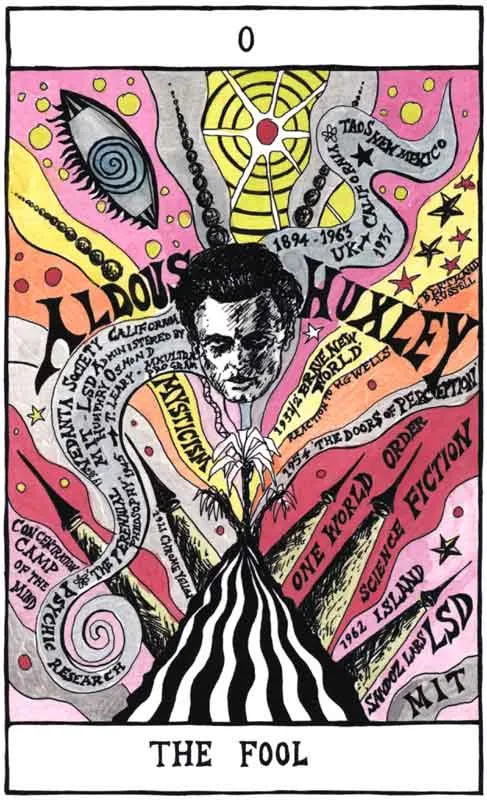
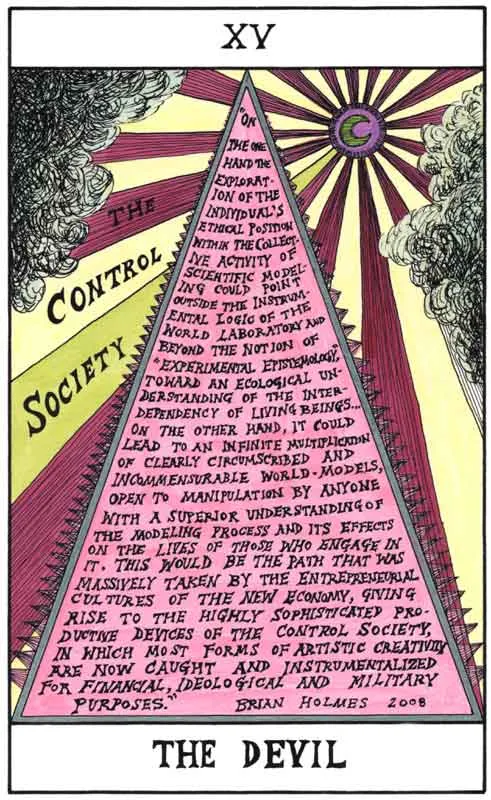
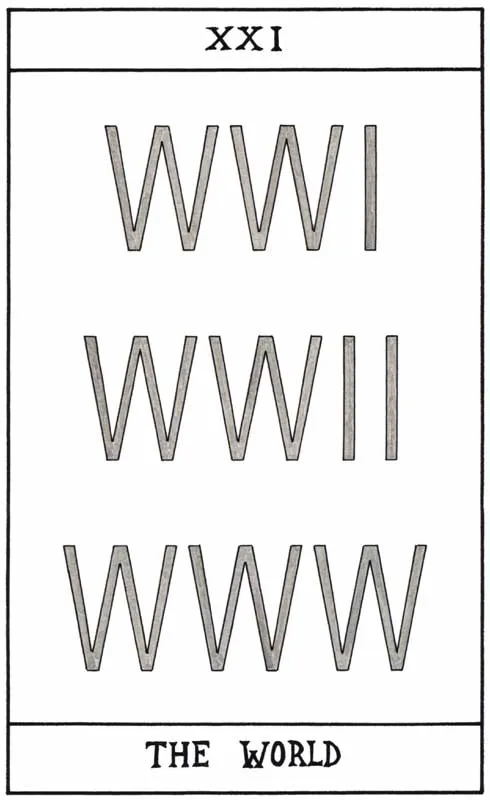
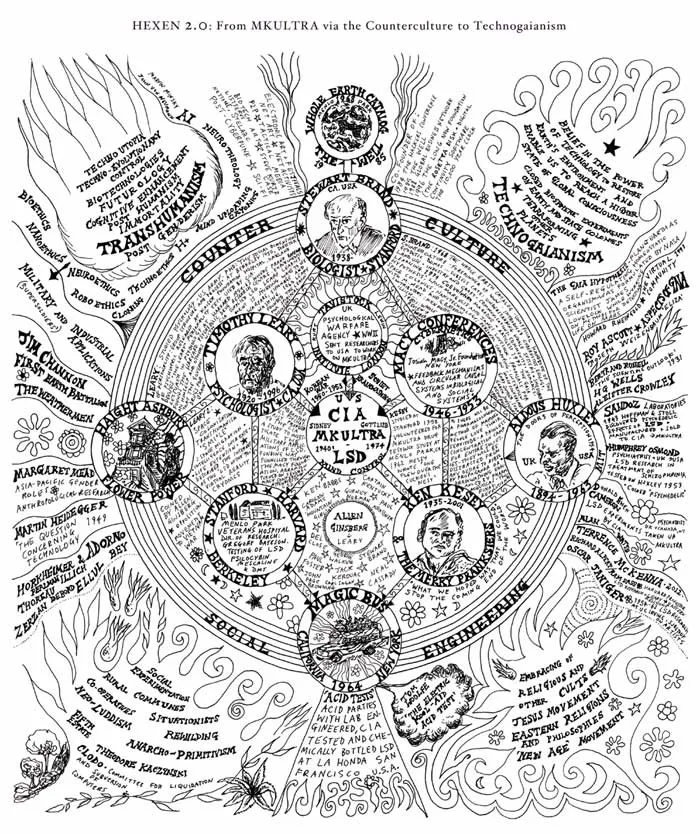
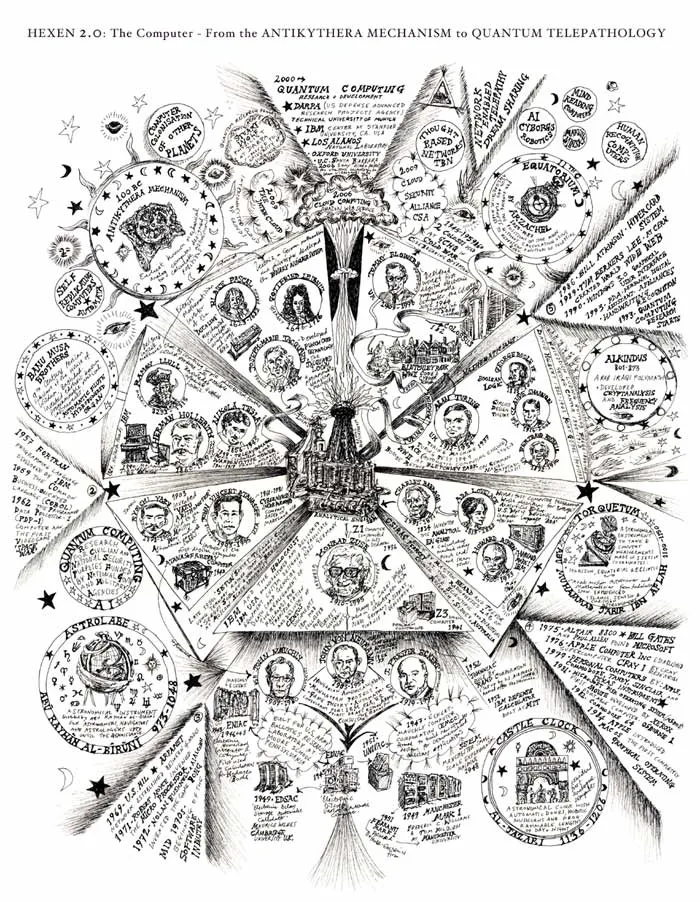
BY DAMJAN JOVANOVIC
I first saw HEXEN 2.0 in Berlin in the spring of 2013, at the Haus der Kulturen der Welt, in an exhibition called The Whole Earth. Its curators, Diedrich Diederichsen and Anselm Franke, had built it as a room-sized argument, with vitrines of Whole Earth Catalog issues, Fuller domes, Ant Farm, issues of Radical Software, the Portola Institute and the WELL arranged along the line Fred Turner had drawn in From Counterculture to Cyberculture, from the Trips Festival to Silicon Valley. Suzanne Treister’s work was in the hall in three parts. Five ink drawings the size of doors hung on freestanding frames, each one a history plotted as a tangle of names and dates under a title of the form “from X via Y to Z.” A grid of thirty small portraits of the scientists who attended the Macy Conferences on cybernetics hung beside a bilingual wall text. And on a white panel among the exhibition’s black scaffolding, sixteen tarot cards were pinned flat in four blocks of four.
The selection had an order. Eleven of the cards were trumps, running upward from the High Priestess, who on this deck is the Macy Conferences, through Norbert Wiener on the Chariot, cybernetics on the Wheel of Fortune, Stewart Brand on the Hanged Man, John von Neumann as Death and ARPANET as Temperance, to the World, which carries only three lines of grey capitals reading WWI, WWII, WWW. After the World came five cards from the suits, among them Utopia and Technogaianism. Pinned in that sequence beside the Catalog, the cards read as a story with a direction, a history of the counterculture ascending through cybernetics and the network toward a planetary whole and ending in its own utopia, and I read them the way the room asked them to be read, as one more diagram among diagrams, a set of illuminated footnotes to Turner. Nothing in the room suggested that the object was meant to be picked up.
It took several years and a different kind of evidence to see what the panel had been holding still. Since 2014 the deck has been dealt in public, in group readings where a room supplies a question about the future and a reader lays the cards out on a table, and the photographs of those evenings, which the artist posts on her site, show an object with a different form of existence from the one on the wall. A deck pinned in order is a diagram with a destination. A deck dealt is a world that comes into being in the dealing, the same seventy-eight cards producing a different configuration of the same history each time, with most of the cards left face down in the box. Most worlds are made to be entered, with a geography to cross and a chronology to follow. This one is made to be operated, and the operator is whoever is holding the cards. The panel in Berlin and the table in the reading room hold the same cards in two different geometries, and the distance between them runs through everything the deck does.
Seventy-eight slots
HEXEN 2.0 is a project in five parts, made between 2009 and 2011 and acquired whole by Tate in 2018 as 167 objects: five large ink-and-watercolor diagrams, a deck of seventy-eight cards, a fifteen-minute video with two stills, thirty photo-text portraits of the Macy attendees together with a gematria of their names, and fifty pencil drawings of book covers, rendered in mirror image, from Thoreau’s Walden to Kaczynski’s manifesto. Its subject is the history that runs from the wartime origins of cybernetics through the CIA’s mind-control programs, the psychedelic counterculture, ARPANET, the Whole Earth Catalog, the Unabomber, Total Information Awareness and Web 2.0, toward what the project, after Deleuze, calls the control society. Treister has said that the idea came to her on a residency in the Texas desert in early 2009, when she saw a possible connection between the mid-century theory of feedback and the online social media of the present, and that the link was feedback itself, a loop that can produce human connection or governmental control depending on who closes it.
The deck is the part of the project that gets used. Each of its seventy-eight cards carries one figure, event, institution or idea from that history, drawn and hand-colored in the alchemical-psychedelic manner Treister had developed over the preceding decade, and each card also carries the office of the tarot card whose position it occupies. Aldous Huxley is the Fool, which in the old decks is the wanderer at the edge of a cliff, and on Treister’s card he stands at the brink of a striped abyss with mescaline spiraling up one side and Island and Brave New World along the other. Timothy Leary is the Magician, with a mushroom for a hat and the Harvard Psilocybin Project of 1960 written into the rays around his head. The Macy Conferences are the High Priestess, keeper of the hidden book, and her card is a tablet listing the attendees beside the Beekman Tower Hotel where they met. Wiener is the Chariot. Cybernetics is the Wheel of Fortune. Ted Kaczynski is the Hermit, alone with his Montana cabin. Brand is the Hanged Man. Von Neumann, who worked on the bomb, invented game theory and the stored-program computer, and died in 1957, is Death. ARPANET is Temperance, the card of mixing, drawn as a network diagram with four nodes. The control society is the Devil. The Total Information Awareness program is the Tower, drawn as the NSA’s Fort Meade headquarters with colored streams of financial, airline, email and phone data pouring out of its roof. Quantum computing and artificial intelligence share the Star, transhumanism is the Moon, anarcho-primitivism is the Sun, ethics is Judgement, and the World is the tally of wars and web.
The four suits, which Treister calls Chalices, Pentacles, Wands and Swords, hold the other fifty-six, and while she has never published a key to them the assignments fall into a legible pattern. Chalices carry the writers, dreamers and thinkers of the inner life: Thoreau on the Ace, Lovecraft on the Five, Mumford, Rousseau, Ken Kesey, Ada Lovelace, Stafford Beer as King. Pentacles carry infrastructure and economy: the Whole Earth Catalog, Tim Berners-Lee, internet governance, Soviet ternary computers, Oppenheimer, economic cybernetics as King. Wands carry energy and revolt: Richard Stallman, the French computer saboteurs CLODO, Blake, hackers, Turing, LSD, Hannah Arendt, Nikola Tesla as King. Swords carry the state, the corporation and the instruments of control: cyberwar, MKULTRA, Google, US Cyber Command, the Tavistock Institute, drones, IBM. The pattern has exceptions, since Heidegger is a Sword and Kurt Lewin is a Pentacle, and the exceptions show that the sorting was done by hand and by judgment.
The double exposure on every card turns the deck from an illustrated index into a world. A tarot trump is already a position in a cosmology. The twenty-two trumps of the fifteenth-century Italian decks are a procession of estates and powers, Emperor and Pope and Lovers and Death and Devil and Tower and Star and Moon and Sun and the Last Judgement and the World, a Renaissance picture of everything that can happen to a soul. Treister keeps the procession and changes the occupants, so that each card reads twice at once, as a twentieth-century fact and as the Renaissance office the fact now holds. She describes the method on the deck itself, where the cards’ original symbolism is said to work as ciphers competing with the new content for meaning. The old cosmos shows through the new one like a watermark.
The judgments live in that competition, and they are small enough to miss. The Empress, the card of fertility and worldly power, is a grey field of some sixty intelligence-agency acronyms with their countries, CIA and NSA and MI6, Mossad and FSB and BND, even the Serbian BIA, with no face anywhere on it: power as a mother without a body. The Sun, the card of clarity and return, is anarcho-primitivism, a mountain lettered with an end to industrial civilization above a flowering tree, so that the return to nature occupies the brightest slot in the deck. The Moon, the card of illusion and the uncanny, is transhumanism, its vocabulary of mind uploading and cryonics and extropianism laid out in banded clouds. Brand on the Hanged Man is the counterculture suspended upside down and becoming, in that inverted position, cyberculture. And the two cards that close the sequence, Judgement and the World, are the only two in the deck with no drawing on them. One is the bare word ETHICS. The other is a tally of two world wars and a web. The cosmos ends in a demand and a sum.
The ordered deck
Shown in numerical order, as the curators had it in Berlin, the sequence of trumps tells a story of its own, and the tarot’s modern interpreters have a genre for it. From the middle of the twentieth century the twenty-two trumps have been read as a journey, the Fool setting out at zero and arriving at the World at twenty-one, and in Sallie Nichols’s Jungian version of 1980 the journey is the process of individuation: the psyche meeting the figures of its unconscious one by one, confronting its shadow, suffering the collapse of its defenses, and integrating what it finds into a realized Self, which the World card figures as a dancer in a wreath.
I think that Treister’s sequence supports the same reading with a collective subject in place of a person. Perception opens with Huxley and Leary. The High Priestess guards a hidden book, and here the book is the transactions of the Macy Conferences, the moment when a group of scientists set out to describe the mind as a system of feedback and in doing so wrote the first page of its self-description. The Lovers are Mead and Bateson, married in 1936 and divorced in 1950, bound under an eye. The Chariot is Wiener, the first steering. The Hermit is Kaczynski, the Unabomber, withdrawal into the woods. The Wheel turns cybernetics. The Hanged Man is Brand, the counterculture reversed into cyberculture. Death is von Neumann, and Temperance, the angel pouring water between two vessels, is ARPANET. Then comes the Devil, the control society, which in Nichols’s sequence is the shadow the psyche has to face before it can go further, and the Tower, struck by lightning, is Total Information Awareness. After the collapse come the Star, which is quantum computing and artificial intelligence, the Moon’s transhumanist illusions, the Sun’s return to earth, and Judgement, which on this deck is only the word ETHICS. The World that completes the sequence is WWI, WWII, WWW: the planetary whole arrived at through two world wars and a network, with the violence inside the integration.
The Jesuit paleontologist Pierre Teilhard de Chardin supplied a word for the planetary result in the 1920s, the noosphere, a layer of thought forming around the earth as the biosphere had formed before it, and in his posthumous The Phenomenon of Man he described its convergence toward a point of total integration. By the mid-1990s the network culture Treister draws on had adopted him as its prophet, most visibly in a Wired feature of June 1995 that described the globe clothing itself with a brain. No card carries Teilhard, and Treister has never framed the deck this way. The sequence carries the reading anyway, and read in order the trumps of HEXEN 2.0 are a map of the individuation of the noosphere through technology, a collective mind learning to model itself, meeting its shadow in the apparatus of control, and arriving at a World that is also a web.
The reading depends on the order, and the order exists only while the cards are held still. A developmental story needs its stations in sequence, and a sequence is a tree: a root at zero, a crown at twenty-one, every card on the path between them. The panel at HKW presented this tree, eleven trumps ascending to the World and a coda of utopia and technogaianism, and it presented the California story in the form California had told it about itself, the counterculture maturing into the network and the network into a planetary mind. Shuffled, the story comes apart. The World can come up first, the Devil can come up last, and the destination is wherever the reader’s question takes it.
The rooted twin
The five historical diagrams make the tree explicit. Treister calls them the key to the project. Each plots a history as a branching flow across the sheet, with names, dates and institutions as nodes and hand-drawn lines as connections, in the manner of the conspiracy wall or of Mark Lombardi’s narrative structures, and each carries a chain for a title: from National Socialism via cybernetics and the Macy Conferences to neo-totalitarianism; from MKULTRA via the counterculture to technogaianism; from ARPANET to DARWARS via the internet. They have roots, in Diogenes or in the Antikythera mechanism or in the Third Reich, and they have crowns, in the Unabomber or quantum telepathology or neo-totalitarianism, and everything on the sheet is on a path from the one to the other. Andrew Pickering, the historian of cybernetics, reviewing the first showing at the Science Museum in 2012, praised them for a quality their titles disown, observing that history is not like the univocal chains of cause and effect that historians offer, and the praise is accurate: the sheets themselves are tangles, and the titles are the only straight lines on them.
The deck is the same material with the lines cut. Every node on the diagrams that made it onto a card has been separated from every other node and placed in a box, and the only connections that survive are the ones a spread produces. On the evening of 8 April 2015, in a white room at the ICA in London with fluorescent tubes overhead and a few dozen people on orange chairs, the writer Mark Pilkington shuffled the deck and asked the room what it wanted to know about the future. Someone wrote the answers down on a sheet of paper that the artist later posted on her website: society, economics, energy, climate, war, culture, astrophysics, biotech and cloning, artificial intelligence, communications technologies, survival, the evolution of the species, freedom, control. Under the list, in a larger hand, a second line: fears, hopes, fantasies, projections, perspectives, alt realities. The cards were dealt in a Celtic Cross on a black table, and the one that landed at the center, and which by one eyewitness account came up first and last that evening, was the Hanged Man, Brand suspended in a sunburst with the Catalog, the WELL, the Hackers Conference and the Long Now Foundation radiating from his hat like the dates on a saint’s halo. The man whose Catalog had anchored the Berlin exhibition came up in London as a card turned over on a table, with no line drawn to him from anything.
Five and a half years later, in December 2020, the deck was dealt online from the Warburg Institute during a double book launch for a facsimile of Aby Warburg’s Bilderatlas Mnemosyne and Ignota’s Atlas of Anomalous AI. The question that night, posed by the publisher Ben Vickers, was how artificial intelligence might be used for healing. The first spread put Brand at the top again. Below him came William Blake and Robert Oppenheimer, and below them von Neumann’s Death, the Ace of Pentacles, which is the 2002 National Science Foundation report on converging nano, bio, info and cognitive technologies, and Judgement, the bare word ETHICS. The second spread began with the Ten of Swords, the card of ruin, which on this deck is DARWARS, a DARPA training program built on the model of massively multiplayer online games, and ended with the Seven of Swords, which carries a picture of a séance the artist staged, digitally, among the dead founders of cybernetics. Asked about artificial intelligence, the deck produced no station on a journey toward the Star. It produced Ethics, Death and a fabricated séance, in a configuration that no ordered reading of the trumps could have predicted.
The project therefore issues one history in two geometries: a rooted version that asserts its chains, hangs in a national collection and supports a developmental story when its cards are pinned in sequence, and an unrooted version that is dealt in public and connects differently every time. Both are drawn by the same hand from the same research. They differ in what can be done with them. A diagram can be read, and it can be wrong. A deck can be played, and a deal is never wrong, only more or less useful for the question in the room. Fifteen years after the diagrams were finished, the deck is the part of HEXEN 2.0 still being performed, at UCL and the ICA and a festival in Oxfordshire and a science gallery and the Warburg, and the sequel Treister made in 2024 kept the deck and its group readings and came with a guide for them. Neither geometry is truer than the other. The tree says where a thing came from and where it is going, and a tree of this kind has to be defended at every joint, while a deal has no joints to defend. Nobody gathers in a room to argue with a diagram. People do gather to read a deck, and the questions they bring, on the ICA’s sheet, are the questions of people who want to know what to do.
The occult tradition has its own theory of why a game outlives its authors. In The Tarot of the Bohemians (1889) the French occultist Papus argued that the Freemasons and the priests, intelligent and virtuous, had lost their traditions, while the gamblers who carried the tarot from town to town, ignorant of what it held, had kept it intact, and he praised the ancient initiates for entrusting their knowledge to vice rather than virtue. As history the claim runs backward, since the cards were a game in fifteenth-century Italy for three centuries before anyone read a secret into them. As an account of how a body of knowledge survives it fits HEXEN 2.0 closely: the diagrams, the serious and asserted version, hang in a museum, and the deck, the version made for play, is the one still in use. Treister’s deck also turns the legend around. Papus imagined a doctrine hidden from the profane inside a pastime. The cards Treister made carry no secret. Every fact on them is documented, the text is printed on the face, and the reading is done in the open by the people the history is about.
The Chariot and the Wheel
Wiener’s card is the one card in the deck whose new occupant and old office coincide without irony. The Chariot in the Marseille tradition is a crowned figure standing in a car drawn by two horses, mastering opposed forces by holding them in tension, and its usual meaning is control, will, steering. Wiener coined the word cybernetics in 1947 from the Greek for steersman, and on his card he rides as the charioteer with two red wheels beside him, one lettered with The Human Use of Human Beings and the other with God & Golem, Inc., a formula from Cybernetics in the hub between them, and around the rim the facts of a life that refused its own applications: anti-aircraft research in the war, a declined invitation to the Manhattan Project, the anti-militarization of science. The card is a portrait of the man who invented the theory of control and then spent the rest of his life warning about it, placed on the card of control.
The Wheel of Fortune, three positions later, carries cybernetics itself, and Treister puts Wiener’s face at the axle. The wheel is divided into two halves lettered NEGATIVE FEEDBACK and POSITIVE FEEDBACK, and around them run the concepts the discipline generated, homeostasis and self-regulating systems and second-order cybernetics, the places it went, Soviet planning, the late-sixties counterculture, Web 2.0, and on the lower rim the place it ended: commodification, manipulation and surveillance of the individual. At the foot of the card is a sentence from Steve Heims, the historian of the Macy group, to the effect that such hypotheses are better suited for manipulation and control than for love and understanding. The Wheel is the card of fortune’s turning, of rise and fall beyond the will of the person on the rim, and cybernetics is drawn as a wheel whose two halves are the two directions feedback can run, with the steersman at the still point in the middle.
These two cards state the project’s thesis in the deck’s own format. Cybernetics was a theory of steering that became a machinery of steering, and the man at the hub had seen it coming. The deck adds the reader to the thesis. A tarot reading runs as a feedback loop: a question goes in, cards come out, an interpretation forms between reader and querent, the interpretation modifies the question, and the loop runs until a story stabilizes that neither party wrote alone. Treister took a history of feedback and put it into the one traditional format whose entire operation is feedback, and then she handed the deck to a room. The Macy scientists set out to build a science of control by describing how systems steer themselves through their environments. Sixty years later their history was steering itself through a public, one spread at a time.
The recursion goes one level further. Heinz von Foerster, who joined the Macy group in 1949 and gave the conferences their name, observed that a theory of the brain has to account for the brain that writes it, and that cybernetics, once it enters its own domain, has to account for the cybernetician. Treister’s video, the Cybernetic Séance, has an actor read this passage in the voice of a dead man. The séance is a doctored photograph in which the Macy attendees have been inserted around the table of a nineteenth-century spiritualist sitting, and the soundtrack is readings from Bateson, Mead, Lewin and von Foerster. One of Mead’s passages, taken from a 1976 conversation with Bateson conducted by Brand for his CoEvolution Quarterly, recalls proposing that the systems theorists apply their principles to their own society, and Ross Ashby’s reply, asking whether she meant they should apply their principles to themselves. On Treister’s own account, the séance is the only part of HEXEN 2.0 that depicts a scene that never took place, and it appears inside the deck. The Seven of Swords, the traditional card of stealth and deception, carries the séance image, the dead scientists around their table threaded by a pink figure-eight loop. The deck contains a card depicting a component of the project the deck belongs to, and the artist placed her one admitted fabrication on the card for trickery. When the Warburg spread of 2020 dealt the Seven of Swords in answer to a question about artificial intelligence, the system was, in Ashby’s sense, applying its principles to itself.
What a format does to a fact
HEXEN 2.0 is made of documented history, and the tarot format acts on that history the way any format acts on its material, which makes the deck an unusually clean specimen of what worldmaking does to facts.
Nelson Goodman, in Ways of Worldmaking, lists the operations by which worlds are made from other worlds: composition and decomposition, weighting, ordering, deletion and supplementation, deformation. He adds that worldmaking always starts from worlds already on hand, so that the making is a remaking. The tarot performs all five operations mechanically. It composes by putting Mead and Bateson on one card as the Lovers. It weights by arcana, so that Wiener as a trump outranks Turing as a Seven of Wands, and by rank, so that Stafford Beer as King of Chalices outranks Kesey as Knave. It orders by number, and the order is the one the individuation reading needs. It deletes by having seventy-eight slots and no more: Claude Shannon attended the conferences and has a portrait in the photo-text series, and there is no card for him. And it deforms, since a fact placed on a card takes on the tone of the card. MKULTRA is the Three of Swords, in the scenic tradition the card of heartbreak, three blades through a heart, and the CIA’s behavior-control experiments, drawn as a purple disc inside a triangle surrounded by hypnosis, electrodes, subliminal perception and unwitting participants, sit on the card of a broken heart. DARWARS is the Ten of Swords, the worst card in the deck, the body face down with ten blades in its back, and the card’s own cartouche describes the program in DARPA’s language as online virtual role-playing games and worlds built on the example of commercial persistent multiplayer online games. The arc that begins with ARPANET ends, on the deck’s card of ruin, in a game.
In each case the format converts an assertion into a position. The diagrams’ titles are chains, and chains carry a burden of proof that the record does not always meet. The CIA did not exist when the conferences began, and the documented money runs from the agency through the Macy Foundation to one attendee’s LSD research after the series had ended. Henry Murray’s stress experiments on the undergraduate Kaczynski at Harvard are real, and their funding by any mind-control program is undocumented. LifeLog was cancelled the day Facebook launched, which is a date and not a link. A diagram lettered “from, via, to” asserts the chain and inherits its weak links. A card asserts nothing. MKULTRA on the Three of Swords claims no cause and every tone. The fact is there, drawn with the care of medieval marginalia, and its relation to the fact on the next card is left to the deal.
Will Wiles, reviewing the deck in 2012, counted this against it. Shuffling, he wrote, made history vague and plastic, and the suits flattened Kaczynski beside Gibson and Turing and Arendt as if they were of a kind. Thirteen years later, reviewing the sequel, he had come round: Treister supplies the push-pins and the reader supplies the red wool. Both observations are correct, and they describe the same property. A history whose connections are dealt carries no burden of proof, and whether that is a loss of rigor or a gain in use depends on what the history is for. Treister’s own answer, on the site where the deck lives, is that in the tarot works real histories are reconfigured stylistically into alchemical art forms to open other ways of thinking about their subjects. The facts are fixed and their configuration is free.
The steersman handed over
Treister’s phrase for the deck’s purpose, given in an interview in 2022, is a tarot allowing groups of users to construct and analyze alternative futures. The construction is the point. She built the system: seventy-eight slots, each with its double meaning, its old office and its new occupant, and a topology of trumps over suits and ranks within suits that determines what can be said and how loudly. Then she gave the deck away by performing it in public and letting the room steer. Pilkington reads, the audience supplies the question, the deal supplies the configuration, and the discussion supplies the story. At the Science Gallery in London in 2019 the format was three half-hour sessions of four cards each, and Pilkington’s report on the artist’s site describes the conversations turning to democratic process, climate, and the role of the young, none of which is on any card.
In one familiar version of authorship the maker builds a world and the visitor walks through it. In another, cybernetic version, the maker builds a system and steers it from inside, correcting course by feedback rather than executing a plan. HEXEN 2.0 hands the steering to the audience. The author sets the constraints and the reader authors each world that comes out of them, and the author’s own emblem for the arrangement, Wiener on the Chariot and again at the hub of the Wheel, is the man whose word for the whole discipline was the steersman.
The audience is also the subject. The deck is a history of the theory of control, built as a control device, read by the people the theory was about, and von Foerster’s second-order turn, the insistence that the observer belongs inside the system observed, is enacted every time a group of people in a control society sit down to deal the cards of the control society and ask them what is going to happen. Jakob von Uexküll’s Theoretische Biologie is among the fifty books Treister drew. No card carries him, and his idea runs through the whole operation: a world is what a system can perceive and act on, and in this deck the perceiving system is the room. Read in order, the trumps describe a collective mind individuating toward a planetary whole. Dealt, they put a small piece of that collective mind at a table and let it watch itself think.
The Devil’s fork
The Devil card carries no drawing of a devil. It is a pink pyramid filled with someone else’s prose, the only trump in the deck that is a quotation about method, under a purple sun bearing the letter C. The prose is credited to Brian Holmes and dated 2008, and it comes from an essay Holmes wrote on Lutz Dammbeck’s documentary Das Netz, a 2003 film subtitled The Unabomber, LSD and the Internet that runs the same circuit HEXEN 2.0 runs, interviewing Brand and von Foerster and John Brockman and corresponding with Kaczynski. No published writing on the deck has noticed that its Devil is a passage about Dammbeck’s film, which puts the nearest prior work on the whole subject inside the project at one remove and by the artist’s own hand.
The passage is a fork. Holmes is describing the dilemma of second-order cybernetics, the point at which the scientists realized that modeling a system alters it. On one side, he writes, the exploration of the modeler’s own position inside the model could point toward an ecological understanding of living beings’ interdependence. On the other, it could lead to an infinite multiplication of incommensurable world-models, open to manipulation by anyone with a superior understanding of the modeling process. The second path, the card continues, is the one the entrepreneurial cultures of the new economy took, and it produced the devices of the control society. Treister’s transcription cuts one sentence from Holmes, the one that gives the good path its names, Bateson, Varela, Guattari, so that the card keeps the fork and removes the signposts on the branch that leads out. The Devil, on this deck, describes world-modeling as the instrument of control, and the names on the way out stay in the artist’s drawer.
In the ordered reading the Devil is the shadow, the station at which the collective mind confronts what its own modeling has made. In the dealt reading it is one card among seventy-eight, and the deck as a whole answers it. The danger Holmes identifies is asymmetry: many world-models, and a few people who understand the modeling process well enough to steer everyone else’s. A tarot reading is a modeling process whose understanding is distributed. Everyone at the table can see the cards, everyone can read the text on them, everyone contributes to the interpretation, and the model that results is built in the open by the people it is a model of. Treister takes the control society’s method and runs it with the lights on and the querents in the room, performing the operation the Devil describes under conditions that reverse its politics.
The theatre and the box
The historical form closest to what Treister built is a piece of Renaissance furniture. In the 1530s Giulio Camillo, a scholar working with a French king’s money, constructed a wooden theatre in which the whole of knowledge was arranged in slots on seven planetary grades, so that a person standing on the stage, where the audience would normally sit, could look out at the tiers and retrieve any item of learning by its position. Frances Yates recovered the story in The Art of Memory, and Erasmus, who heard about the device from a friend, found it faintly alarming. Camillo’s theatre was a world made to be operated, with no geography and no chronology, a topology of slots and a procedure for retrieval, and an operator in the middle in place of a visitor moving through. HEXEN 2.0 is a memory theatre at the scale of a playing card, with the difference that its slots are shuffled, so that the retrieval is never the same twice and the operator is a group rather than a scholar. The seven grades have become four suits and twenty-two trumps. The stage has become a black table in a white room.
The box holds as much of the world as the table shows. A four-card reading leaves seventy-four cards unturned, and a Celtic Cross leaves sixty-eight. Every spread is a deletion, in Goodman’s sense, and the deck stores its own remainder in the box, where the cards not dealt keep their potential for the next question. A second remainder lies outside the deck: Pickering asked where Grey Walter was, and the British cyberneticians are absent from the thirty portraits, as is the spiritualist current that ran through Ashby’s and Beer’s later lives, while the other cybernetics, the Chilean and the Soviet, appear on single minor cards. A third remainder sits inside a single card, in the sentence Treister cut from Holmes. A world that is dealt keeps most of itself in reserve. The table holds a sample, the sample changes, and the reserve makes the next sample possible. The ordered reading has no remainder at all, since every trump has its station, and its completeness is the price of its destination.
Post-Truth on the Wheel
In 2024 Treister finished HEXEN 5.0, which she has called an attempt to bring the earlier tarot up to date. It is another seventy-eight cards, with six diagrams and a set of works made with AI, and the change that matters is on the trumps. The Wheel of Fortune, which in 2.0 carried cybernetics with Wiener at the hub, now carries Post-Truth. Death, which carried von Neumann, now carries Climate Change. The offices are the same and the occupants have been rotated by thirteen years of history. Laid side by side, the two Wheels show the discipline of control replaced by the condition it produced, and the ordered reading changes with them: the noosphere’s journey now passes through a Wheel on which truth itself turns, and the Death it must survive is planetary.
Revision, in a world that exists in the dealing, takes this form. A novel is revised by its author and a game is patched by its studio, and in both cases the world changes once, for everyone, from above. A deck is revised by its reader every time it is dealt, and the artist’s revision, when it comes, is one more deal at a larger scale: the same slots, new cards, the same table. HEXEN 5.0 shipped with a guide to group readings, so the practice that kept 2.0 alive is now part of the object. The trumps still support the story I read on the panel in Berlin, the collective mind ascending through cybernetics and the network toward a World that is also a web, and the story is still there whenever the cards are put back in order.
ENDNOTES
On the Haus der Kulturen der Welt. The Whole Earth: California and the Disappearance of the Outside ran at HKW from 26 April to 1 July 2013, curated by Diedrich Diederichsen and Anselm Franke, with Turner’s From Counterculture to Cyberculture (2006) acknowledged as a principal source and excerpts from Adam Curtis’s All Watched Over by Machines of Loving Grace screened in the show. Treister’s installation page records the three components hung: the five diagrams, the tarot, and the Macy portraits with the Gematria. The selection on the tarot panel is read from her installation photographs, which agree with my memory of the room: the eleven trumps are the High Priestess, Chariot, Justice, Hermit, Wheel of Fortune, Strength, Hanged Man, Death, Temperance, Moon and World, in ascending order, and the suit cards legible in the photographs include the Seven of Chalices (Utopia), the Knave of Pentacles (Technogaianism), the Three of Swords (MKULTRA) and the Knave of Swords (the Interplanetary Internet). Whether the selection was Treister’s or the curators’ is not recorded.
On the ordered deck. Reading the trumps as a journey from the Fool to the World is a twentieth-century practice; its most influential popular form is Eden Gray’s A Complete Guide to the Tarot (1970), and its Jungian form is Sallie Nichols, Jung and Tarot: An Archetypal Journey (Weiser, 1980), which treats the sequence as individuation and the World as the realized Self. Jung himself touched the cards only in passing, in the Visions Seminar of 1933, where he described them as psychological images to be played with. The term noosphere was worked out in Paris in 1922 in conversations among Teilhard, the philosopher Édouard Le Roy and the geochemist Vladimir Vernadsky, whose biosphere it extends; Le Roy was first to use it in print, in 1927. Teilhard’s Le Phénomène humain was written between 1938 and 1940 and published after his death, in 1955 (English 1959). Jennifer Cobb Kreisberg’s “A Globe, Clothing Itself with a Brain” appeared in Wired 3.06, June 1995. Applying the individuation reading to Treister’s trumps, and the noosphere to its subject, is my speculation: nothing in Treister’s statements or in the critical literature frames the deck this way, and the reading holds only for the trumps in numerical order.
On the parts and their whereabouts. The five diagrams are From Diogenes of Sinope to Anarcho-Primitivism and the Unabomber via Science-Fiction, From MKULTRA via the Counterculture to Technogaianism, From National Socialism via Cybernetics and the Macy Conferences to Neo-Totalitarianism, The Computer: From the Antikythera Mechanism to Quantum Telepathology, and From ARPANET to DARWARS via the Internet, each 122 by 152 centimeters. Tate holds the project entire (T16225 to T16229, acquired 2018), the Science Museum Group holds the diagrams as prints, and MACBA holds the 2012 deck. The deck was published by Black Dog in 2012 alongside a book with a single essay by Lars Bang Larsen, reprinted in 2016, and reissued boxed by Cosmogenesis in November 2024. The first showing was at the Science Museum, London, 7 March to 1 May 2012, so the work opened in a museum of science before any gallery showed it.
On the tarot’s skeleton. Treister’s deck numbers Justice VIII and Strength XI, the order of the Marseille pattern and of the fifteenth-century Italian decks; the Golden Dawn and, following them, the 1909 Waite–Smith deck swapped the two to fit an astrological scheme. A scene on every card, minor cards included, is the Waite–Smith innovation, so the deck’s skeleton is older than its skin. “Chalices” appears in no standard English deck, which use Cups, and its faintly ecclesiastical register is presumably deliberate. The reading of the fifteenth-century trumps as a procession of estates and powers is Michael Dummett’s, in The Game of Tarot (1980), which established that the cards were a game for more than three centuries before they became a divinatory instrument; the Warburg’s 2025 exhibition Tarot: Origins and Afterlives took that history as its frame and hung HEXEN 2.0 in a final room its curator described as a serious game for modeling complexity.
On Papus and the game as vessel. The claim that the tarot preserved an ancient wisdom disguised as a game begins with Antoine Court de Gébelin, who identified it as the Egyptian Book of Thoth in the eighth volume of Le Monde primitif (1781). Papus (Gérard Encausse) gave the idea its moral form in Le Tarot des Bohémiens (1889; English 1892), in the passage contrasting the virtuous Freemason and priest, who lost their traditions, with the gambler, who kept his without understanding it. The more elaborate story of a council of Egyptian priests choosing to entrust their wisdom to vice rather than virtue circulates in later popular retellings; I have not found its first source. Dummett’s history reverses the chronology: the game came first, around 1440 in northern Italy, and the secret was read into it in 1781.
On the Chariot and the Wheel. Everything cited from the cards is legible on them. Wiener’s card records the 1943 paper with Rosenblueth and Bigelow, “Behavior, Purpose and Teleology,” and the MIT position, alongside the two books and the two refusals. The Heims sentence at the foot of the Wheel is attributed on the card to The Cybernetics Group (1991); I have not located it in the book and quote it as the card gives it. Wiener’s account of the coinage is in the introduction to Cybernetics (1948), where he credits Maxwell’s 1868 paper on governors and, later, Ampère’s cybernétique of 1834. The deck’s backs carry an explosion of data through the Intercloud, according to Bonnie Cehovet’s 2012 review of the physical deck.
On Calvino. In the note to The Castle of Crossed Destinies (1969, in the Franco Maria Ricci edition with the Visconti-Sforza deck; 1973 with the Marseille deck) he describes the tarot as a machine for constructing stories, and in the 1967 lecture "Cybernetics and Ghosts" he had already defined literature as a combinatorial game pursuing the possibilities implicit in its own material. A tarot novel written under the sign of cybernetics preceded a cybernetics history written as a tarot by four decades, and the Warburg's 2025 exhibition hung Calvino's book and Treister's deck in the same building without drawing the line between them. The Oulipo, founded in 1960, and Queneau's Cent mille milliards de poèmes (1961) are the deck's other combinatorial cousins.
On Goodman and the operations. Ways of Worldmaking (Hackett, 1978), chapter I, section 4, lists composition and decomposition, weighting, ordering, deletion and supplementation, and deformation; the remark that worldmaking always starts from worlds already on hand is on page 6. The application to a tarot is mine and close to literal, since the format performs each operation by construction. Shannon’s absence from the deck is confirmed against the full card list; he has a portrait in the Macy series, as do all thirty attendees Treister drew. The reading tradition for the Three and Ten of Swords is Waite’s Pictorial Key to the Tarot (1910), and Pamela Colman Smith’s images, the pierced heart and the prone body, have carried those meanings into every scenic deck since.
On the record and the chains. The Macy Conferences ran from March 1946 to April 1953 under the Josiah Macy Jr. Foundation, chaired by Warren McCulloch and organized by Frank Fremont-Smith, and took the name “Cybernetics” in 1949 at von Foerster’s suggestion; Steve Heims’s The Cybernetics Group (MIT Press, 1991) and Claus Pias’s edition of the transactions (2003, English 2016) are the standard accounts. The CIA’s use of the Macy Foundation as a channel for Harold Abramson’s LSD research from 1953 is documented in John Marks’s The Search for the “Manchurian Candidate” (1979) from released agency files; Abramson attended the conferences and is among Treister’s thirty portraits. Henry Murray’s Harvard study of 1959 to 1962, in which Kaczynski was a subject code-named Lawful, is described by Alston Chase in The Atlantic (June 2000) and in Harvard and the Unabomber (2003), which is among the drawn books; Chase disclaims any deterministic link. DARWARS was a DARPA training program begun in 2003; its best-known product ran on the engine of the commercial game Operation Flashpoint. Pickering’s review, “Cybernetic Magic,” appeared in Mute on 24 May 2012; Wiles’s 2012 review was in Icon (8 June) and his review of HEXEN 5.0 in Apollo (11 April 2025).
On the Devil and Dammbeck. Brian Holmes’s essay, “Filming the World Laboratory: Cybernetic History in Das Netz,” was posted on his Continental Drift site on 13 October 2008. The card’s text matches the essay verbatim apart from the omitted sentence on Bateson, Varela and Guattari, whose work Holmes promised to describe in a following essay. “Experimental epistemology” is McCulloch’s phrase for cybernetics; “world laboratory” is Holmes’s. Dammbeck’s Das Netz premiered in 2003 and was released in German cinemas and as a book (Das Netz: Die Konstruktion des Unabombers, Edition Nautilus) in 2004 and 2005; the English release is titled The Net: The Unabomber, LSD and the Internet. Treister has never, to my knowledge, mentioned Dammbeck in an interview, and Larsen’s catalogue essay mentions neither him nor Holmes; the card is the only place the connection is made, and the artist made it.
On Camillo. Frances Yates, The Art of Memory (1966), chapter VI, reconstructs the theatre from Camillo’s posthumous L’Idea del Theatro (1550) and from the letters of Viglius Zuichemus to Erasmus; Viglius saw the wooden model in Venice in 1532, and the theatre, commissioned by Francis I, was never completed. The comparison of the theatre and the deck is mine and rests on a shared structure, an operator inside a spatialized store of knowledge, with no historical link implied. Aubrey Birch’s 2017 thesis on HEXEN 2.0 reads the deck through the adjacent tradition of Khunrath, Bruno and Llull, and Larsen’s essay places Treister in the Radical Enlightenment of Jonathan Israel’s Spinozists, a different lineage and a different claim.
On the two geometries. The distinction between rooted and unrooted worlds, the tree that flows from an origin and the knot that binds incompatible strands without one, is developed in “The Tree and the Knot” and “Why Games Make Knots”; the cybernetic account of authorship as steering from inside is in “The Steersman”; the second-order Umwelt, a world in which the observed system is also the observer, is in the essay on Solaris and Uexküll. HEXEN 2.0 is the first case in which both geometries occur inside a single work made by one person from one body of research, and here the tree and the knot are two states of one object, the deck in order and the deck dealt.
On HEXEN 5.0. Treister dates the sequel to 2023 and 2024; it comprises seventy-eight cards, six diagrams and fifteen AI-generated works, and the deck was published by Cosmogenesis in October 2025 with a guide to group readings. The substitutions on the Wheel and on Death are reported by Will Wiles in Apollo (11 April 2025), who also gives Leary as the original Fool, which is an error; the 2012 deck and the artist’s own index give Huxley. Treister’s description of 5.0 as an attempt to bring the earlier tarot up to date is from Burlington Contemporary (September 2024).
Image Credits -
Suzanne Treister, HEXEN 2.0/Tarot/0 The Fool: Aldous Huxley, 2009–11. The deck's wanderer stands at the brink of a striped abyss, with mescaline on one side and One World Order on the other.
Suzanne Treister, HEXEN 2.0/Tarot/XV The Devil: The Control Society, 2009–11. The card has no devil on it, only Brian Holmes's 2008 passage on the incommensurable world-models of the control society.
Suzanne Treister, HEXEN 2.0/Tarot/XXI The World: WWI WWII WWW, 2009–11. The last trump has no image, and the whole is a tally of two wars and a web.
Suzanne Treister, HEXEN 2.0/Historical Diagrams/From MKULTRA via the Counterculture to Technogaianism, 2009–11. The CIA's acid tests, the Merry Pranksters and the Whole Earth Catalog, drawn as one lineage.
Suzanne Treister, HEXEN 2.0/Historical Diagrams/The Computer: From the Antikythera Mechanism to Quantum Telepathology, 2009–11. Two thousand years of calculating machines, drawn as a single tree with the computer at its crown.
I first saw HEXEN 2.0 in Berlin in the spring of 2013, at the Haus der Kulturen der Welt, in an exhibition called The Whole Earth. Its curators, Diedrich Diederichsen and Anselm Franke, had built it as a room-sized argument, with vitrines of Whole Earth Catalog issues, Fuller domes, Ant Farm, issues of Radical Software, the Portola Institute and the WELL arranged along the line Fred Turner had drawn in From Counterculture to Cyberculture, from the Trips Festival to Silicon Valley. Suzanne Treister’s work was in the hall in three parts. Five ink drawings the size of doors hung on freestanding frames, each one a history plotted as a tangle of names and dates under a title of the form “from X via Y to Z.” A grid of thirty small portraits of the scientists who attended the Macy Conferences on cybernetics hung beside a bilingual wall text. And on a white panel among the exhibition’s black scaffolding, sixteen tarot cards were pinned flat in four blocks of four.
The selection had an order. Eleven of the cards were trumps, running upward from the High Priestess, who on this deck is the Macy Conferences, through Norbert Wiener on the Chariot, cybernetics on the Wheel of Fortune, Stewart Brand on the Hanged Man, John von Neumann as Death and ARPANET as Temperance, to the World, which carries only three lines of grey capitals reading WWI, WWII, WWW. After the World came five cards from the suits, among them Utopia and Technogaianism. Pinned in that sequence beside the Catalog, the cards read as a story with a direction, a history of the counterculture ascending through cybernetics and the network toward a planetary whole and ending in its own utopia, and I read them the way the room asked them to be read, as one more diagram among diagrams, a set of illuminated footnotes to Turner. Nothing in the room suggested that the object was meant to be picked up.
It took several years and a different kind of evidence to see what the panel had been holding still. Since 2014 the deck has been dealt in public, in group readings where a room supplies a question about the future and a reader lays the cards out on a table, and the photographs of those evenings, which the artist posts on her site, show an object with a different form of existence from the one on the wall. A deck pinned in order is a diagram with a destination. A deck dealt is a world that comes into being in the dealing, the same seventy-eight cards producing a different configuration of the same history each time, with most of the cards left face down in the box. Most worlds are made to be entered, with a geography to cross and a chronology to follow. This one is made to be operated, and the operator is whoever is holding the cards. The panel in Berlin and the table in the reading room hold the same cards in two different geometries, and the distance between them runs through everything the deck does.
Seventy-eight slots
HEXEN 2.0 is a project in five parts, made between 2009 and 2011 and acquired whole by Tate in 2018 as 167 objects: five large ink-and-watercolor diagrams, a deck of seventy-eight cards, a fifteen-minute video with two stills, thirty photo-text portraits of the Macy attendees together with a gematria of their names, and fifty pencil drawings of book covers, rendered in mirror image, from Thoreau’s Walden to Kaczynski’s manifesto. Its subject is the history that runs from the wartime origins of cybernetics through the CIA’s mind-control programs, the psychedelic counterculture, ARPANET, the Whole Earth Catalog, the Unabomber, Total Information Awareness and Web 2.0, toward what the project, after Deleuze, calls the control society. Treister has said that the idea came to her on a residency in the Texas desert in early 2009, when she saw a possible connection between the mid-century theory of feedback and the online social media of the present, and that the link was feedback itself, a loop that can produce human connection or governmental control depending on who closes it.
The deck is the part of the project that gets used. Each of its seventy-eight cards carries one figure, event, institution or idea from that history, drawn and hand-colored in the alchemical-psychedelic manner Treister had developed over the preceding decade, and each card also carries the office of the tarot card whose position it occupies. Aldous Huxley is the Fool, which in the old decks is the wanderer at the edge of a cliff, and on Treister’s card he stands at the brink of a striped abyss with mescaline spiraling up one side and Island and Brave New World along the other. Timothy Leary is the Magician, with a mushroom for a hat and the Harvard Psilocybin Project of 1960 written into the rays around his head. The Macy Conferences are the High Priestess, keeper of the hidden book, and her card is a tablet listing the attendees beside the Beekman Tower Hotel where they met. Wiener is the Chariot. Cybernetics is the Wheel of Fortune. Ted Kaczynski is the Hermit, alone with his Montana cabin. Brand is the Hanged Man. Von Neumann, who worked on the bomb, invented game theory and the stored-program computer, and died in 1957, is Death. ARPANET is Temperance, the card of mixing, drawn as a network diagram with four nodes. The control society is the Devil. The Total Information Awareness program is the Tower, drawn as the NSA’s Fort Meade headquarters with colored streams of financial, airline, email and phone data pouring out of its roof. Quantum computing and artificial intelligence share the Star, transhumanism is the Moon, anarcho-primitivism is the Sun, ethics is Judgement, and the World is the tally of wars and web.
The four suits, which Treister calls Chalices, Pentacles, Wands and Swords, hold the other fifty-six, and while she has never published a key to them the assignments fall into a legible pattern. Chalices carry the writers, dreamers and thinkers of the inner life: Thoreau on the Ace, Lovecraft on the Five, Mumford, Rousseau, Ken Kesey, Ada Lovelace, Stafford Beer as King. Pentacles carry infrastructure and economy: the Whole Earth Catalog, Tim Berners-Lee, internet governance, Soviet ternary computers, Oppenheimer, economic cybernetics as King. Wands carry energy and revolt: Richard Stallman, the French computer saboteurs CLODO, Blake, hackers, Turing, LSD, Hannah Arendt, Nikola Tesla as King. Swords carry the state, the corporation and the instruments of control: cyberwar, MKULTRA, Google, US Cyber Command, the Tavistock Institute, drones, IBM. The pattern has exceptions, since Heidegger is a Sword and Kurt Lewin is a Pentacle, and the exceptions show that the sorting was done by hand and by judgment.
The double exposure on every card turns the deck from an illustrated index into a world. A tarot trump is already a position in a cosmology. The twenty-two trumps of the fifteenth-century Italian decks are a procession of estates and powers, Emperor and Pope and Lovers and Death and Devil and Tower and Star and Moon and Sun and the Last Judgement and the World, a Renaissance picture of everything that can happen to a soul. Treister keeps the procession and changes the occupants, so that each card reads twice at once, as a twentieth-century fact and as the Renaissance office the fact now holds. She describes the method on the deck itself, where the cards’ original symbolism is said to work as ciphers competing with the new content for meaning. The old cosmos shows through the new one like a watermark.
The judgments live in that competition, and they are small enough to miss. The Empress, the card of fertility and worldly power, is a grey field of some sixty intelligence-agency acronyms with their countries, CIA and NSA and MI6, Mossad and FSB and BND, even the Serbian BIA, with no face anywhere on it: power as a mother without a body. The Sun, the card of clarity and return, is anarcho-primitivism, a mountain lettered with an end to industrial civilization above a flowering tree, so that the return to nature occupies the brightest slot in the deck. The Moon, the card of illusion and the uncanny, is transhumanism, its vocabulary of mind uploading and cryonics and extropianism laid out in banded clouds. Brand on the Hanged Man is the counterculture suspended upside down and becoming, in that inverted position, cyberculture. And the two cards that close the sequence, Judgement and the World, are the only two in the deck with no drawing on them. One is the bare word ETHICS. The other is a tally of two world wars and a web. The cosmos ends in a demand and a sum.
The ordered deck
Shown in numerical order, as the curators had it in Berlin, the sequence of trumps tells a story of its own, and the tarot’s modern interpreters have a genre for it. From the middle of the twentieth century the twenty-two trumps have been read as a journey, the Fool setting out at zero and arriving at the World at twenty-one, and in Sallie Nichols’s Jungian version of 1980 the journey is the process of individuation: the psyche meeting the figures of its unconscious one by one, confronting its shadow, suffering the collapse of its defenses, and integrating what it finds into a realized Self, which the World card figures as a dancer in a wreath.
I think that Treister’s sequence supports the same reading with a collective subject in place of a person. Perception opens with Huxley and Leary. The High Priestess guards a hidden book, and here the book is the transactions of the Macy Conferences, the moment when a group of scientists set out to describe the mind as a system of feedback and in doing so wrote the first page of its self-description. The Lovers are Mead and Bateson, married in 1936 and divorced in 1950, bound under an eye. The Chariot is Wiener, the first steering. The Hermit is Kaczynski, the Unabomber, withdrawal into the woods. The Wheel turns cybernetics. The Hanged Man is Brand, the counterculture reversed into cyberculture. Death is von Neumann, and Temperance, the angel pouring water between two vessels, is ARPANET. Then comes the Devil, the control society, which in Nichols’s sequence is the shadow the psyche has to face before it can go further, and the Tower, struck by lightning, is Total Information Awareness. After the collapse come the Star, which is quantum computing and artificial intelligence, the Moon’s transhumanist illusions, the Sun’s return to earth, and Judgement, which on this deck is only the word ETHICS. The World that completes the sequence is WWI, WWII, WWW: the planetary whole arrived at through two world wars and a network, with the violence inside the integration.
The Jesuit paleontologist Pierre Teilhard de Chardin supplied a word for the planetary result in the 1920s, the noosphere, a layer of thought forming around the earth as the biosphere had formed before it, and in his posthumous The Phenomenon of Man he described its convergence toward a point of total integration. By the mid-1990s the network culture Treister draws on had adopted him as its prophet, most visibly in a Wired feature of June 1995 that described the globe clothing itself with a brain. No card carries Teilhard, and Treister has never framed the deck this way. The sequence carries the reading anyway, and read in order the trumps of HEXEN 2.0 are a map of the individuation of the noosphere through technology, a collective mind learning to model itself, meeting its shadow in the apparatus of control, and arriving at a World that is also a web.
The reading depends on the order, and the order exists only while the cards are held still. A developmental story needs its stations in sequence, and a sequence is a tree: a root at zero, a crown at twenty-one, every card on the path between them. The panel at HKW presented this tree, eleven trumps ascending to the World and a coda of utopia and technogaianism, and it presented the California story in the form California had told it about itself, the counterculture maturing into the network and the network into a planetary mind. Shuffled, the story comes apart. The World can come up first, the Devil can come up last, and the destination is wherever the reader’s question takes it.
The rooted twin
The five historical diagrams make the tree explicit. Treister calls them the key to the project. Each plots a history as a branching flow across the sheet, with names, dates and institutions as nodes and hand-drawn lines as connections, in the manner of the conspiracy wall or of Mark Lombardi’s narrative structures, and each carries a chain for a title: from National Socialism via cybernetics and the Macy Conferences to neo-totalitarianism; from MKULTRA via the counterculture to technogaianism; from ARPANET to DARWARS via the internet. They have roots, in Diogenes or in the Antikythera mechanism or in the Third Reich, and they have crowns, in the Unabomber or quantum telepathology or neo-totalitarianism, and everything on the sheet is on a path from the one to the other. Andrew Pickering, the historian of cybernetics, reviewing the first showing at the Science Museum in 2012, praised them for a quality their titles disown, observing that history is not like the univocal chains of cause and effect that historians offer, and the praise is accurate: the sheets themselves are tangles, and the titles are the only straight lines on them.
The deck is the same material with the lines cut. Every node on the diagrams that made it onto a card has been separated from every other node and placed in a box, and the only connections that survive are the ones a spread produces. On the evening of 8 April 2015, in a white room at the ICA in London with fluorescent tubes overhead and a few dozen people on orange chairs, the writer Mark Pilkington shuffled the deck and asked the room what it wanted to know about the future. Someone wrote the answers down on a sheet of paper that the artist later posted on her website: society, economics, energy, climate, war, culture, astrophysics, biotech and cloning, artificial intelligence, communications technologies, survival, the evolution of the species, freedom, control. Under the list, in a larger hand, a second line: fears, hopes, fantasies, projections, perspectives, alt realities. The cards were dealt in a Celtic Cross on a black table, and the one that landed at the center, and which by one eyewitness account came up first and last that evening, was the Hanged Man, Brand suspended in a sunburst with the Catalog, the WELL, the Hackers Conference and the Long Now Foundation radiating from his hat like the dates on a saint’s halo. The man whose Catalog had anchored the Berlin exhibition came up in London as a card turned over on a table, with no line drawn to him from anything.
Five and a half years later, in December 2020, the deck was dealt online from the Warburg Institute during a double book launch for a facsimile of Aby Warburg’s Bilderatlas Mnemosyne and Ignota’s Atlas of Anomalous AI. The question that night, posed by the publisher Ben Vickers, was how artificial intelligence might be used for healing. The first spread put Brand at the top again. Below him came William Blake and Robert Oppenheimer, and below them von Neumann’s Death, the Ace of Pentacles, which is the 2002 National Science Foundation report on converging nano, bio, info and cognitive technologies, and Judgement, the bare word ETHICS. The second spread began with the Ten of Swords, the card of ruin, which on this deck is DARWARS, a DARPA training program built on the model of massively multiplayer online games, and ended with the Seven of Swords, which carries a picture of a séance the artist staged, digitally, among the dead founders of cybernetics. Asked about artificial intelligence, the deck produced no station on a journey toward the Star. It produced Ethics, Death and a fabricated séance, in a configuration that no ordered reading of the trumps could have predicted.
The project therefore issues one history in two geometries: a rooted version that asserts its chains, hangs in a national collection and supports a developmental story when its cards are pinned in sequence, and an unrooted version that is dealt in public and connects differently every time. Both are drawn by the same hand from the same research. They differ in what can be done with them. A diagram can be read, and it can be wrong. A deck can be played, and a deal is never wrong, only more or less useful for the question in the room. Fifteen years after the diagrams were finished, the deck is the part of HEXEN 2.0 still being performed, at UCL and the ICA and a festival in Oxfordshire and a science gallery and the Warburg, and the sequel Treister made in 2024 kept the deck and its group readings and came with a guide for them. Neither geometry is truer than the other. The tree says where a thing came from and where it is going, and a tree of this kind has to be defended at every joint, while a deal has no joints to defend. Nobody gathers in a room to argue with a diagram. People do gather to read a deck, and the questions they bring, on the ICA’s sheet, are the questions of people who want to know what to do.
The occult tradition has its own theory of why a game outlives its authors. In The Tarot of the Bohemians (1889) the French occultist Papus argued that the Freemasons and the priests, intelligent and virtuous, had lost their traditions, while the gamblers who carried the tarot from town to town, ignorant of what it held, had kept it intact, and he praised the ancient initiates for entrusting their knowledge to vice rather than virtue. As history the claim runs backward, since the cards were a game in fifteenth-century Italy for three centuries before anyone read a secret into them. As an account of how a body of knowledge survives it fits HEXEN 2.0 closely: the diagrams, the serious and asserted version, hang in a museum, and the deck, the version made for play, is the one still in use. Treister’s deck also turns the legend around. Papus imagined a doctrine hidden from the profane inside a pastime. The cards Treister made carry no secret. Every fact on them is documented, the text is printed on the face, and the reading is done in the open by the people the history is about.
The Chariot and the Wheel
Wiener’s card is the one card in the deck whose new occupant and old office coincide without irony. The Chariot in the Marseille tradition is a crowned figure standing in a car drawn by two horses, mastering opposed forces by holding them in tension, and its usual meaning is control, will, steering. Wiener coined the word cybernetics in 1947 from the Greek for steersman, and on his card he rides as the charioteer with two red wheels beside him, one lettered with The Human Use of Human Beings and the other with God & Golem, Inc., a formula from Cybernetics in the hub between them, and around the rim the facts of a life that refused its own applications: anti-aircraft research in the war, a declined invitation to the Manhattan Project, the anti-militarization of science. The card is a portrait of the man who invented the theory of control and then spent the rest of his life warning about it, placed on the card of control.
The Wheel of Fortune, three positions later, carries cybernetics itself, and Treister puts Wiener’s face at the axle. The wheel is divided into two halves lettered NEGATIVE FEEDBACK and POSITIVE FEEDBACK, and around them run the concepts the discipline generated, homeostasis and self-regulating systems and second-order cybernetics, the places it went, Soviet planning, the late-sixties counterculture, Web 2.0, and on the lower rim the place it ended: commodification, manipulation and surveillance of the individual. At the foot of the card is a sentence from Steve Heims, the historian of the Macy group, to the effect that such hypotheses are better suited for manipulation and control than for love and understanding. The Wheel is the card of fortune’s turning, of rise and fall beyond the will of the person on the rim, and cybernetics is drawn as a wheel whose two halves are the two directions feedback can run, with the steersman at the still point in the middle.
These two cards state the project’s thesis in the deck’s own format. Cybernetics was a theory of steering that became a machinery of steering, and the man at the hub had seen it coming. The deck adds the reader to the thesis. A tarot reading runs as a feedback loop: a question goes in, cards come out, an interpretation forms between reader and querent, the interpretation modifies the question, and the loop runs until a story stabilizes that neither party wrote alone. Treister took a history of feedback and put it into the one traditional format whose entire operation is feedback, and then she handed the deck to a room. The Macy scientists set out to build a science of control by describing how systems steer themselves through their environments. Sixty years later their history was steering itself through a public, one spread at a time.
The recursion goes one level further. Heinz von Foerster, who joined the Macy group in 1949 and gave the conferences their name, observed that a theory of the brain has to account for the brain that writes it, and that cybernetics, once it enters its own domain, has to account for the cybernetician. Treister’s video, the Cybernetic Séance, has an actor read this passage in the voice of a dead man. The séance is a doctored photograph in which the Macy attendees have been inserted around the table of a nineteenth-century spiritualist sitting, and the soundtrack is readings from Bateson, Mead, Lewin and von Foerster. One of Mead’s passages, taken from a 1976 conversation with Bateson conducted by Brand for his CoEvolution Quarterly, recalls proposing that the systems theorists apply their principles to their own society, and Ross Ashby’s reply, asking whether she meant they should apply their principles to themselves. On Treister’s own account, the séance is the only part of HEXEN 2.0 that depicts a scene that never took place, and it appears inside the deck. The Seven of Swords, the traditional card of stealth and deception, carries the séance image, the dead scientists around their table threaded by a pink figure-eight loop. The deck contains a card depicting a component of the project the deck belongs to, and the artist placed her one admitted fabrication on the card for trickery. When the Warburg spread of 2020 dealt the Seven of Swords in answer to a question about artificial intelligence, the system was, in Ashby’s sense, applying its principles to itself.
What a format does to a fact
HEXEN 2.0 is made of documented history, and the tarot format acts on that history the way any format acts on its material, which makes the deck an unusually clean specimen of what worldmaking does to facts.
Nelson Goodman, in Ways of Worldmaking, lists the operations by which worlds are made from other worlds: composition and decomposition, weighting, ordering, deletion and supplementation, deformation. He adds that worldmaking always starts from worlds already on hand, so that the making is a remaking. The tarot performs all five operations mechanically. It composes by putting Mead and Bateson on one card as the Lovers. It weights by arcana, so that Wiener as a trump outranks Turing as a Seven of Wands, and by rank, so that Stafford Beer as King of Chalices outranks Kesey as Knave. It orders by number, and the order is the one the individuation reading needs. It deletes by having seventy-eight slots and no more: Claude Shannon attended the conferences and has a portrait in the photo-text series, and there is no card for him. And it deforms, since a fact placed on a card takes on the tone of the card. MKULTRA is the Three of Swords, in the scenic tradition the card of heartbreak, three blades through a heart, and the CIA’s behavior-control experiments, drawn as a purple disc inside a triangle surrounded by hypnosis, electrodes, subliminal perception and unwitting participants, sit on the card of a broken heart. DARWARS is the Ten of Swords, the worst card in the deck, the body face down with ten blades in its back, and the card’s own cartouche describes the program in DARPA’s language as online virtual role-playing games and worlds built on the example of commercial persistent multiplayer online games. The arc that begins with ARPANET ends, on the deck’s card of ruin, in a game.
In each case the format converts an assertion into a position. The diagrams’ titles are chains, and chains carry a burden of proof that the record does not always meet. The CIA did not exist when the conferences began, and the documented money runs from the agency through the Macy Foundation to one attendee’s LSD research after the series had ended. Henry Murray’s stress experiments on the undergraduate Kaczynski at Harvard are real, and their funding by any mind-control program is undocumented. LifeLog was cancelled the day Facebook launched, which is a date and not a link. A diagram lettered “from, via, to” asserts the chain and inherits its weak links. A card asserts nothing. MKULTRA on the Three of Swords claims no cause and every tone. The fact is there, drawn with the care of medieval marginalia, and its relation to the fact on the next card is left to the deal.
Will Wiles, reviewing the deck in 2012, counted this against it. Shuffling, he wrote, made history vague and plastic, and the suits flattened Kaczynski beside Gibson and Turing and Arendt as if they were of a kind. Thirteen years later, reviewing the sequel, he had come round: Treister supplies the push-pins and the reader supplies the red wool. Both observations are correct, and they describe the same property. A history whose connections are dealt carries no burden of proof, and whether that is a loss of rigor or a gain in use depends on what the history is for. Treister’s own answer, on the site where the deck lives, is that in the tarot works real histories are reconfigured stylistically into alchemical art forms to open other ways of thinking about their subjects. The facts are fixed and their configuration is free.
The steersman handed over
Treister’s phrase for the deck’s purpose, given in an interview in 2022, is a tarot allowing groups of users to construct and analyze alternative futures. The construction is the point. She built the system: seventy-eight slots, each with its double meaning, its old office and its new occupant, and a topology of trumps over suits and ranks within suits that determines what can be said and how loudly. Then she gave the deck away by performing it in public and letting the room steer. Pilkington reads, the audience supplies the question, the deal supplies the configuration, and the discussion supplies the story. At the Science Gallery in London in 2019 the format was three half-hour sessions of four cards each, and Pilkington’s report on the artist’s site describes the conversations turning to democratic process, climate, and the role of the young, none of which is on any card.
In one familiar version of authorship the maker builds a world and the visitor walks through it. In another, cybernetic version, the maker builds a system and steers it from inside, correcting course by feedback rather than executing a plan. HEXEN 2.0 hands the steering to the audience. The author sets the constraints and the reader authors each world that comes out of them, and the author’s own emblem for the arrangement, Wiener on the Chariot and again at the hub of the Wheel, is the man whose word for the whole discipline was the steersman.
The audience is also the subject. The deck is a history of the theory of control, built as a control device, read by the people the theory was about, and von Foerster’s second-order turn, the insistence that the observer belongs inside the system observed, is enacted every time a group of people in a control society sit down to deal the cards of the control society and ask them what is going to happen. Jakob von Uexküll’s Theoretische Biologie is among the fifty books Treister drew. No card carries him, and his idea runs through the whole operation: a world is what a system can perceive and act on, and in this deck the perceiving system is the room. Read in order, the trumps describe a collective mind individuating toward a planetary whole. Dealt, they put a small piece of that collective mind at a table and let it watch itself think.
The Devil’s fork
The Devil card carries no drawing of a devil. It is a pink pyramid filled with someone else’s prose, the only trump in the deck that is a quotation about method, under a purple sun bearing the letter C. The prose is credited to Brian Holmes and dated 2008, and it comes from an essay Holmes wrote on Lutz Dammbeck’s documentary Das Netz, a 2003 film subtitled The Unabomber, LSD and the Internet that runs the same circuit HEXEN 2.0 runs, interviewing Brand and von Foerster and John Brockman and corresponding with Kaczynski. No published writing on the deck has noticed that its Devil is a passage about Dammbeck’s film, which puts the nearest prior work on the whole subject inside the project at one remove and by the artist’s own hand.
The passage is a fork. Holmes is describing the dilemma of second-order cybernetics, the point at which the scientists realized that modeling a system alters it. On one side, he writes, the exploration of the modeler’s own position inside the model could point toward an ecological understanding of living beings’ interdependence. On the other, it could lead to an infinite multiplication of incommensurable world-models, open to manipulation by anyone with a superior understanding of the modeling process. The second path, the card continues, is the one the entrepreneurial cultures of the new economy took, and it produced the devices of the control society. Treister’s transcription cuts one sentence from Holmes, the one that gives the good path its names, Bateson, Varela, Guattari, so that the card keeps the fork and removes the signposts on the branch that leads out. The Devil, on this deck, describes world-modeling as the instrument of control, and the names on the way out stay in the artist’s drawer.
In the ordered reading the Devil is the shadow, the station at which the collective mind confronts what its own modeling has made. In the dealt reading it is one card among seventy-eight, and the deck as a whole answers it. The danger Holmes identifies is asymmetry: many world-models, and a few people who understand the modeling process well enough to steer everyone else’s. A tarot reading is a modeling process whose understanding is distributed. Everyone at the table can see the cards, everyone can read the text on them, everyone contributes to the interpretation, and the model that results is built in the open by the people it is a model of. Treister takes the control society’s method and runs it with the lights on and the querents in the room, performing the operation the Devil describes under conditions that reverse its politics.
The theatre and the box
The historical form closest to what Treister built is a piece of Renaissance furniture. In the 1530s Giulio Camillo, a scholar working with a French king’s money, constructed a wooden theatre in which the whole of knowledge was arranged in slots on seven planetary grades, so that a person standing on the stage, where the audience would normally sit, could look out at the tiers and retrieve any item of learning by its position. Frances Yates recovered the story in The Art of Memory, and Erasmus, who heard about the device from a friend, found it faintly alarming. Camillo’s theatre was a world made to be operated, with no geography and no chronology, a topology of slots and a procedure for retrieval, and an operator in the middle in place of a visitor moving through. HEXEN 2.0 is a memory theatre at the scale of a playing card, with the difference that its slots are shuffled, so that the retrieval is never the same twice and the operator is a group rather than a scholar. The seven grades have become four suits and twenty-two trumps. The stage has become a black table in a white room.
The box holds as much of the world as the table shows. A four-card reading leaves seventy-four cards unturned, and a Celtic Cross leaves sixty-eight. Every spread is a deletion, in Goodman’s sense, and the deck stores its own remainder in the box, where the cards not dealt keep their potential for the next question. A second remainder lies outside the deck: Pickering asked where Grey Walter was, and the British cyberneticians are absent from the thirty portraits, as is the spiritualist current that ran through Ashby’s and Beer’s later lives, while the other cybernetics, the Chilean and the Soviet, appear on single minor cards. A third remainder sits inside a single card, in the sentence Treister cut from Holmes. A world that is dealt keeps most of itself in reserve. The table holds a sample, the sample changes, and the reserve makes the next sample possible. The ordered reading has no remainder at all, since every trump has its station, and its completeness is the price of its destination.
Post-Truth on the Wheel
In 2024 Treister finished HEXEN 5.0, which she has called an attempt to bring the earlier tarot up to date. It is another seventy-eight cards, with six diagrams and a set of works made with AI, and the change that matters is on the trumps. The Wheel of Fortune, which in 2.0 carried cybernetics with Wiener at the hub, now carries Post-Truth. Death, which carried von Neumann, now carries Climate Change. The offices are the same and the occupants have been rotated by thirteen years of history. Laid side by side, the two Wheels show the discipline of control replaced by the condition it produced, and the ordered reading changes with them: the noosphere’s journey now passes through a Wheel on which truth itself turns, and the Death it must survive is planetary.
Revision, in a world that exists in the dealing, takes this form. A novel is revised by its author and a game is patched by its studio, and in both cases the world changes once, for everyone, from above. A deck is revised by its reader every time it is dealt, and the artist’s revision, when it comes, is one more deal at a larger scale: the same slots, new cards, the same table. HEXEN 5.0 shipped with a guide to group readings, so the practice that kept 2.0 alive is now part of the object. The trumps still support the story I read on the panel in Berlin, the collective mind ascending through cybernetics and the network toward a World that is also a web, and the story is still there whenever the cards are put back in order.
ENDNOTES
On the Haus der Kulturen der Welt. The Whole Earth: California and the Disappearance of the Outside ran at HKW from 26 April to 1 July 2013, curated by Diedrich Diederichsen and Anselm Franke, with Turner’s From Counterculture to Cyberculture (2006) acknowledged as a principal source and excerpts from Adam Curtis’s All Watched Over by Machines of Loving Grace screened in the show. Treister’s installation page records the three components hung: the five diagrams, the tarot, and the Macy portraits with the Gematria. The selection on the tarot panel is read from her installation photographs, which agree with my memory of the room: the eleven trumps are the High Priestess, Chariot, Justice, Hermit, Wheel of Fortune, Strength, Hanged Man, Death, Temperance, Moon and World, in ascending order, and the suit cards legible in the photographs include the Seven of Chalices (Utopia), the Knave of Pentacles (Technogaianism), the Three of Swords (MKULTRA) and the Knave of Swords (the Interplanetary Internet). Whether the selection was Treister’s or the curators’ is not recorded.
On the ordered deck. Reading the trumps as a journey from the Fool to the World is a twentieth-century practice; its most influential popular form is Eden Gray’s A Complete Guide to the Tarot (1970), and its Jungian form is Sallie Nichols, Jung and Tarot: An Archetypal Journey (Weiser, 1980), which treats the sequence as individuation and the World as the realized Self. Jung himself touched the cards only in passing, in the Visions Seminar of 1933, where he described them as psychological images to be played with. The term noosphere was worked out in Paris in 1922 in conversations among Teilhard, the philosopher Édouard Le Roy and the geochemist Vladimir Vernadsky, whose biosphere it extends; Le Roy was first to use it in print, in 1927. Teilhard’s Le Phénomène humain was written between 1938 and 1940 and published after his death, in 1955 (English 1959). Jennifer Cobb Kreisberg’s “A Globe, Clothing Itself with a Brain” appeared in Wired 3.06, June 1995. Applying the individuation reading to Treister’s trumps, and the noosphere to its subject, is my speculation: nothing in Treister’s statements or in the critical literature frames the deck this way, and the reading holds only for the trumps in numerical order.
On the parts and their whereabouts. The five diagrams are From Diogenes of Sinope to Anarcho-Primitivism and the Unabomber via Science-Fiction, From MKULTRA via the Counterculture to Technogaianism, From National Socialism via Cybernetics and the Macy Conferences to Neo-Totalitarianism, The Computer: From the Antikythera Mechanism to Quantum Telepathology, and From ARPANET to DARWARS via the Internet, each 122 by 152 centimeters. Tate holds the project entire (T16225 to T16229, acquired 2018), the Science Museum Group holds the diagrams as prints, and MACBA holds the 2012 deck. The deck was published by Black Dog in 2012 alongside a book with a single essay by Lars Bang Larsen, reprinted in 2016, and reissued boxed by Cosmogenesis in November 2024. The first showing was at the Science Museum, London, 7 March to 1 May 2012, so the work opened in a museum of science before any gallery showed it.
On the tarot’s skeleton. Treister’s deck numbers Justice VIII and Strength XI, the order of the Marseille pattern and of the fifteenth-century Italian decks; the Golden Dawn and, following them, the 1909 Waite–Smith deck swapped the two to fit an astrological scheme. A scene on every card, minor cards included, is the Waite–Smith innovation, so the deck’s skeleton is older than its skin. “Chalices” appears in no standard English deck, which use Cups, and its faintly ecclesiastical register is presumably deliberate. The reading of the fifteenth-century trumps as a procession of estates and powers is Michael Dummett’s, in The Game of Tarot (1980), which established that the cards were a game for more than three centuries before they became a divinatory instrument; the Warburg’s 2025 exhibition Tarot: Origins and Afterlives took that history as its frame and hung HEXEN 2.0 in a final room its curator described as a serious game for modeling complexity.
On Papus and the game as vessel. The claim that the tarot preserved an ancient wisdom disguised as a game begins with Antoine Court de Gébelin, who identified it as the Egyptian Book of Thoth in the eighth volume of Le Monde primitif (1781). Papus (Gérard Encausse) gave the idea its moral form in Le Tarot des Bohémiens (1889; English 1892), in the passage contrasting the virtuous Freemason and priest, who lost their traditions, with the gambler, who kept his without understanding it. The more elaborate story of a council of Egyptian priests choosing to entrust their wisdom to vice rather than virtue circulates in later popular retellings; I have not found its first source. Dummett’s history reverses the chronology: the game came first, around 1440 in northern Italy, and the secret was read into it in 1781.
On the Chariot and the Wheel. Everything cited from the cards is legible on them. Wiener’s card records the 1943 paper with Rosenblueth and Bigelow, “Behavior, Purpose and Teleology,” and the MIT position, alongside the two books and the two refusals. The Heims sentence at the foot of the Wheel is attributed on the card to The Cybernetics Group (1991); I have not located it in the book and quote it as the card gives it. Wiener’s account of the coinage is in the introduction to Cybernetics (1948), where he credits Maxwell’s 1868 paper on governors and, later, Ampère’s cybernétique of 1834. The deck’s backs carry an explosion of data through the Intercloud, according to Bonnie Cehovet’s 2012 review of the physical deck.
On Calvino. In the note to The Castle of Crossed Destinies (1969, in the Franco Maria Ricci edition with the Visconti-Sforza deck; 1973 with the Marseille deck) he describes the tarot as a machine for constructing stories, and in the 1967 lecture "Cybernetics and Ghosts" he had already defined literature as a combinatorial game pursuing the possibilities implicit in its own material. A tarot novel written under the sign of cybernetics preceded a cybernetics history written as a tarot by four decades, and the Warburg's 2025 exhibition hung Calvino's book and Treister's deck in the same building without drawing the line between them. The Oulipo, founded in 1960, and Queneau's Cent mille milliards de poèmes (1961) are the deck's other combinatorial cousins.
On Goodman and the operations. Ways of Worldmaking (Hackett, 1978), chapter I, section 4, lists composition and decomposition, weighting, ordering, deletion and supplementation, and deformation; the remark that worldmaking always starts from worlds already on hand is on page 6. The application to a tarot is mine and close to literal, since the format performs each operation by construction. Shannon’s absence from the deck is confirmed against the full card list; he has a portrait in the Macy series, as do all thirty attendees Treister drew. The reading tradition for the Three and Ten of Swords is Waite’s Pictorial Key to the Tarot (1910), and Pamela Colman Smith’s images, the pierced heart and the prone body, have carried those meanings into every scenic deck since.
On the record and the chains. The Macy Conferences ran from March 1946 to April 1953 under the Josiah Macy Jr. Foundation, chaired by Warren McCulloch and organized by Frank Fremont-Smith, and took the name “Cybernetics” in 1949 at von Foerster’s suggestion; Steve Heims’s The Cybernetics Group (MIT Press, 1991) and Claus Pias’s edition of the transactions (2003, English 2016) are the standard accounts. The CIA’s use of the Macy Foundation as a channel for Harold Abramson’s LSD research from 1953 is documented in John Marks’s The Search for the “Manchurian Candidate” (1979) from released agency files; Abramson attended the conferences and is among Treister’s thirty portraits. Henry Murray’s Harvard study of 1959 to 1962, in which Kaczynski was a subject code-named Lawful, is described by Alston Chase in The Atlantic (June 2000) and in Harvard and the Unabomber (2003), which is among the drawn books; Chase disclaims any deterministic link. DARWARS was a DARPA training program begun in 2003; its best-known product ran on the engine of the commercial game Operation Flashpoint. Pickering’s review, “Cybernetic Magic,” appeared in Mute on 24 May 2012; Wiles’s 2012 review was in Icon (8 June) and his review of HEXEN 5.0 in Apollo (11 April 2025).
On the Devil and Dammbeck. Brian Holmes’s essay, “Filming the World Laboratory: Cybernetic History in Das Netz,” was posted on his Continental Drift site on 13 October 2008. The card’s text matches the essay verbatim apart from the omitted sentence on Bateson, Varela and Guattari, whose work Holmes promised to describe in a following essay. “Experimental epistemology” is McCulloch’s phrase for cybernetics; “world laboratory” is Holmes’s. Dammbeck’s Das Netz premiered in 2003 and was released in German cinemas and as a book (Das Netz: Die Konstruktion des Unabombers, Edition Nautilus) in 2004 and 2005; the English release is titled The Net: The Unabomber, LSD and the Internet. Treister has never, to my knowledge, mentioned Dammbeck in an interview, and Larsen’s catalogue essay mentions neither him nor Holmes; the card is the only place the connection is made, and the artist made it.
On Camillo. Frances Yates, The Art of Memory (1966), chapter VI, reconstructs the theatre from Camillo’s posthumous L’Idea del Theatro (1550) and from the letters of Viglius Zuichemus to Erasmus; Viglius saw the wooden model in Venice in 1532, and the theatre, commissioned by Francis I, was never completed. The comparison of the theatre and the deck is mine and rests on a shared structure, an operator inside a spatialized store of knowledge, with no historical link implied. Aubrey Birch’s 2017 thesis on HEXEN 2.0 reads the deck through the adjacent tradition of Khunrath, Bruno and Llull, and Larsen’s essay places Treister in the Radical Enlightenment of Jonathan Israel’s Spinozists, a different lineage and a different claim.
On the two geometries. The distinction between rooted and unrooted worlds, the tree that flows from an origin and the knot that binds incompatible strands without one, is developed in “The Tree and the Knot” and “Why Games Make Knots”; the cybernetic account of authorship as steering from inside is in “The Steersman”; the second-order Umwelt, a world in which the observed system is also the observer, is in the essay on Solaris and Uexküll. HEXEN 2.0 is the first case in which both geometries occur inside a single work made by one person from one body of research, and here the tree and the knot are two states of one object, the deck in order and the deck dealt.
On HEXEN 5.0. Treister dates the sequel to 2023 and 2024; it comprises seventy-eight cards, six diagrams and fifteen AI-generated works, and the deck was published by Cosmogenesis in October 2025 with a guide to group readings. The substitutions on the Wheel and on Death are reported by Will Wiles in Apollo (11 April 2025), who also gives Leary as the original Fool, which is an error; the 2012 deck and the artist’s own index give Huxley. Treister’s description of 5.0 as an attempt to bring the earlier tarot up to date is from Burlington Contemporary (September 2024).
Image Credits -
Suzanne Treister, HEXEN 2.0/Tarot/0 The Fool: Aldous Huxley, 2009–11. The deck's wanderer stands at the brink of a striped abyss, with mescaline on one side and One World Order on the other.
Suzanne Treister, HEXEN 2.0/Tarot/XV The Devil: The Control Society, 2009–11. The card has no devil on it, only Brian Holmes's 2008 passage on the incommensurable world-models of the control society.
Suzanne Treister, HEXEN 2.0/Tarot/XXI The World: WWI WWII WWW, 2009–11. The last trump has no image, and the whole is a tally of two wars and a web.
Suzanne Treister, HEXEN 2.0/Historical Diagrams/From MKULTRA via the Counterculture to Technogaianism, 2009–11. The CIA's acid tests, the Merry Pranksters and the Whole Earth Catalog, drawn as one lineage.
Suzanne Treister, HEXEN 2.0/Historical Diagrams/The Computer: From the Antikythera Mechanism to Quantum Telepathology, 2009–11. Two thousand years of calculating machines, drawn as a single tree with the computer at its crown.
Damjan Jovanovic is a designer whose work explores video games as cultural forms for constructing new world-images. He is the co-founder of the Los Angeles-based Studio Lifeforms.
Follow his substack Worldmaking Project
BY DAMJAN JOVANOVIC
I first saw HEXEN 2.0 in Berlin in the spring of 2013, at the Haus der Kulturen der Welt, in an exhibition called The Whole Earth. Its curators, Diedrich Diederichsen and Anselm Franke, had built it as a room-sized argument, with vitrines of Whole Earth Catalog issues, Fuller domes, Ant Farm, issues of Radical Software, the Portola Institute and the WELL arranged along the line Fred Turner had drawn in From Counterculture to Cyberculture, from the Trips Festival to Silicon Valley. Suzanne Treister’s work was in the hall in three parts. Five ink drawings the size of doors hung on freestanding frames, each one a history plotted as a tangle of names and dates under a title of the form “from X via Y to Z.” A grid of thirty small portraits of the scientists who attended the Macy Conferences on cybernetics hung beside a bilingual wall text. And on a white panel among the exhibition’s black scaffolding, sixteen tarot cards were pinned flat in four blocks of four.
The selection had an order. Eleven of the cards were trumps, running upward from the High Priestess, who on this deck is the Macy Conferences, through Norbert Wiener on the Chariot, cybernetics on the Wheel of Fortune, Stewart Brand on the Hanged Man, John von Neumann as Death and ARPANET as Temperance, to the World, which carries only three lines of grey capitals reading WWI, WWII, WWW. After the World came five cards from the suits, among them Utopia and Technogaianism. Pinned in that sequence beside the Catalog, the cards read as a story with a direction, a history of the counterculture ascending through cybernetics and the network toward a planetary whole and ending in its own utopia, and I read them the way the room asked them to be read, as one more diagram among diagrams, a set of illuminated footnotes to Turner. Nothing in the room suggested that the object was meant to be picked up.
It took several years and a different kind of evidence to see what the panel had been holding still. Since 2014 the deck has been dealt in public, in group readings where a room supplies a question about the future and a reader lays the cards out on a table, and the photographs of those evenings, which the artist posts on her site, show an object with a different form of existence from the one on the wall. A deck pinned in order is a diagram with a destination. A deck dealt is a world that comes into being in the dealing, the same seventy-eight cards producing a different configuration of the same history each time, with most of the cards left face down in the box. Most worlds are made to be entered, with a geography to cross and a chronology to follow. This one is made to be operated, and the operator is whoever is holding the cards. The panel in Berlin and the table in the reading room hold the same cards in two different geometries, and the distance between them runs through everything the deck does.
Seventy-eight slots
HEXEN 2.0 is a project in five parts, made between 2009 and 2011 and acquired whole by Tate in 2018 as 167 objects: five large ink-and-watercolor diagrams, a deck of seventy-eight cards, a fifteen-minute video with two stills, thirty photo-text portraits of the Macy attendees together with a gematria of their names, and fifty pencil drawings of book covers, rendered in mirror image, from Thoreau’s Walden to Kaczynski’s manifesto. Its subject is the history that runs from the wartime origins of cybernetics through the CIA’s mind-control programs, the psychedelic counterculture, ARPANET, the Whole Earth Catalog, the Unabomber, Total Information Awareness and Web 2.0, toward what the project, after Deleuze, calls the control society. Treister has said that the idea came to her on a residency in the Texas desert in early 2009, when she saw a possible connection between the mid-century theory of feedback and the online social media of the present, and that the link was feedback itself, a loop that can produce human connection or governmental control depending on who closes it.
The deck is the part of the project that gets used. Each of its seventy-eight cards carries one figure, event, institution or idea from that history, drawn and hand-colored in the alchemical-psychedelic manner Treister had developed over the preceding decade, and each card also carries the office of the tarot card whose position it occupies. Aldous Huxley is the Fool, which in the old decks is the wanderer at the edge of a cliff, and on Treister’s card he stands at the brink of a striped abyss with mescaline spiraling up one side and Island and Brave New World along the other. Timothy Leary is the Magician, with a mushroom for a hat and the Harvard Psilocybin Project of 1960 written into the rays around his head. The Macy Conferences are the High Priestess, keeper of the hidden book, and her card is a tablet listing the attendees beside the Beekman Tower Hotel where they met. Wiener is the Chariot. Cybernetics is the Wheel of Fortune. Ted Kaczynski is the Hermit, alone with his Montana cabin. Brand is the Hanged Man. Von Neumann, who worked on the bomb, invented game theory and the stored-program computer, and died in 1957, is Death. ARPANET is Temperance, the card of mixing, drawn as a network diagram with four nodes. The control society is the Devil. The Total Information Awareness program is the Tower, drawn as the NSA’s Fort Meade headquarters with colored streams of financial, airline, email and phone data pouring out of its roof. Quantum computing and artificial intelligence share the Star, transhumanism is the Moon, anarcho-primitivism is the Sun, ethics is Judgement, and the World is the tally of wars and web.
The four suits, which Treister calls Chalices, Pentacles, Wands and Swords, hold the other fifty-six, and while she has never published a key to them the assignments fall into a legible pattern. Chalices carry the writers, dreamers and thinkers of the inner life: Thoreau on the Ace, Lovecraft on the Five, Mumford, Rousseau, Ken Kesey, Ada Lovelace, Stafford Beer as King. Pentacles carry infrastructure and economy: the Whole Earth Catalog, Tim Berners-Lee, internet governance, Soviet ternary computers, Oppenheimer, economic cybernetics as King. Wands carry energy and revolt: Richard Stallman, the French computer saboteurs CLODO, Blake, hackers, Turing, LSD, Hannah Arendt, Nikola Tesla as King. Swords carry the state, the corporation and the instruments of control: cyberwar, MKULTRA, Google, US Cyber Command, the Tavistock Institute, drones, IBM. The pattern has exceptions, since Heidegger is a Sword and Kurt Lewin is a Pentacle, and the exceptions show that the sorting was done by hand and by judgment.
The double exposure on every card turns the deck from an illustrated index into a world. A tarot trump is already a position in a cosmology. The twenty-two trumps of the fifteenth-century Italian decks are a procession of estates and powers, Emperor and Pope and Lovers and Death and Devil and Tower and Star and Moon and Sun and the Last Judgement and the World, a Renaissance picture of everything that can happen to a soul. Treister keeps the procession and changes the occupants, so that each card reads twice at once, as a twentieth-century fact and as the Renaissance office the fact now holds. She describes the method on the deck itself, where the cards’ original symbolism is said to work as ciphers competing with the new content for meaning. The old cosmos shows through the new one like a watermark.
The judgments live in that competition, and they are small enough to miss. The Empress, the card of fertility and worldly power, is a grey field of some sixty intelligence-agency acronyms with their countries, CIA and NSA and MI6, Mossad and FSB and BND, even the Serbian BIA, with no face anywhere on it: power as a mother without a body. The Sun, the card of clarity and return, is anarcho-primitivism, a mountain lettered with an end to industrial civilization above a flowering tree, so that the return to nature occupies the brightest slot in the deck. The Moon, the card of illusion and the uncanny, is transhumanism, its vocabulary of mind uploading and cryonics and extropianism laid out in banded clouds. Brand on the Hanged Man is the counterculture suspended upside down and becoming, in that inverted position, cyberculture. And the two cards that close the sequence, Judgement and the World, are the only two in the deck with no drawing on them. One is the bare word ETHICS. The other is a tally of two world wars and a web. The cosmos ends in a demand and a sum.
The ordered deck
Shown in numerical order, as the curators had it in Berlin, the sequence of trumps tells a story of its own, and the tarot’s modern interpreters have a genre for it. From the middle of the twentieth century the twenty-two trumps have been read as a journey, the Fool setting out at zero and arriving at the World at twenty-one, and in Sallie Nichols’s Jungian version of 1980 the journey is the process of individuation: the psyche meeting the figures of its unconscious one by one, confronting its shadow, suffering the collapse of its defenses, and integrating what it finds into a realized Self, which the World card figures as a dancer in a wreath.
I think that Treister’s sequence supports the same reading with a collective subject in place of a person. Perception opens with Huxley and Leary. The High Priestess guards a hidden book, and here the book is the transactions of the Macy Conferences, the moment when a group of scientists set out to describe the mind as a system of feedback and in doing so wrote the first page of its self-description. The Lovers are Mead and Bateson, married in 1936 and divorced in 1950, bound under an eye. The Chariot is Wiener, the first steering. The Hermit is Kaczynski, the Unabomber, withdrawal into the woods. The Wheel turns cybernetics. The Hanged Man is Brand, the counterculture reversed into cyberculture. Death is von Neumann, and Temperance, the angel pouring water between two vessels, is ARPANET. Then comes the Devil, the control society, which in Nichols’s sequence is the shadow the psyche has to face before it can go further, and the Tower, struck by lightning, is Total Information Awareness. After the collapse come the Star, which is quantum computing and artificial intelligence, the Moon’s transhumanist illusions, the Sun’s return to earth, and Judgement, which on this deck is only the word ETHICS. The World that completes the sequence is WWI, WWII, WWW: the planetary whole arrived at through two world wars and a network, with the violence inside the integration.
The Jesuit paleontologist Pierre Teilhard de Chardin supplied a word for the planetary result in the 1920s, the noosphere, a layer of thought forming around the earth as the biosphere had formed before it, and in his posthumous The Phenomenon of Man he described its convergence toward a point of total integration. By the mid-1990s the network culture Treister draws on had adopted him as its prophet, most visibly in a Wired feature of June 1995 that described the globe clothing itself with a brain. No card carries Teilhard, and Treister has never framed the deck this way. The sequence carries the reading anyway, and read in order the trumps of HEXEN 2.0 are a map of the individuation of the noosphere through technology, a collective mind learning to model itself, meeting its shadow in the apparatus of control, and arriving at a World that is also a web.
The reading depends on the order, and the order exists only while the cards are held still. A developmental story needs its stations in sequence, and a sequence is a tree: a root at zero, a crown at twenty-one, every card on the path between them. The panel at HKW presented this tree, eleven trumps ascending to the World and a coda of utopia and technogaianism, and it presented the California story in the form California had told it about itself, the counterculture maturing into the network and the network into a planetary mind. Shuffled, the story comes apart. The World can come up first, the Devil can come up last, and the destination is wherever the reader’s question takes it.
The rooted twin
The five historical diagrams make the tree explicit. Treister calls them the key to the project. Each plots a history as a branching flow across the sheet, with names, dates and institutions as nodes and hand-drawn lines as connections, in the manner of the conspiracy wall or of Mark Lombardi’s narrative structures, and each carries a chain for a title: from National Socialism via cybernetics and the Macy Conferences to neo-totalitarianism; from MKULTRA via the counterculture to technogaianism; from ARPANET to DARWARS via the internet. They have roots, in Diogenes or in the Antikythera mechanism or in the Third Reich, and they have crowns, in the Unabomber or quantum telepathology or neo-totalitarianism, and everything on the sheet is on a path from the one to the other. Andrew Pickering, the historian of cybernetics, reviewing the first showing at the Science Museum in 2012, praised them for a quality their titles disown, observing that history is not like the univocal chains of cause and effect that historians offer, and the praise is accurate: the sheets themselves are tangles, and the titles are the only straight lines on them.
The deck is the same material with the lines cut. Every node on the diagrams that made it onto a card has been separated from every other node and placed in a box, and the only connections that survive are the ones a spread produces. On the evening of 8 April 2015, in a white room at the ICA in London with fluorescent tubes overhead and a few dozen people on orange chairs, the writer Mark Pilkington shuffled the deck and asked the room what it wanted to know about the future. Someone wrote the answers down on a sheet of paper that the artist later posted on her website: society, economics, energy, climate, war, culture, astrophysics, biotech and cloning, artificial intelligence, communications technologies, survival, the evolution of the species, freedom, control. Under the list, in a larger hand, a second line: fears, hopes, fantasies, projections, perspectives, alt realities. The cards were dealt in a Celtic Cross on a black table, and the one that landed at the center, and which by one eyewitness account came up first and last that evening, was the Hanged Man, Brand suspended in a sunburst with the Catalog, the WELL, the Hackers Conference and the Long Now Foundation radiating from his hat like the dates on a saint’s halo. The man whose Catalog had anchored the Berlin exhibition came up in London as a card turned over on a table, with no line drawn to him from anything.
Five and a half years later, in December 2020, the deck was dealt online from the Warburg Institute during a double book launch for a facsimile of Aby Warburg’s Bilderatlas Mnemosyne and Ignota’s Atlas of Anomalous AI. The question that night, posed by the publisher Ben Vickers, was how artificial intelligence might be used for healing. The first spread put Brand at the top again. Below him came William Blake and Robert Oppenheimer, and below them von Neumann’s Death, the Ace of Pentacles, which is the 2002 National Science Foundation report on converging nano, bio, info and cognitive technologies, and Judgement, the bare word ETHICS. The second spread began with the Ten of Swords, the card of ruin, which on this deck is DARWARS, a DARPA training program built on the model of massively multiplayer online games, and ended with the Seven of Swords, which carries a picture of a séance the artist staged, digitally, among the dead founders of cybernetics. Asked about artificial intelligence, the deck produced no station on a journey toward the Star. It produced Ethics, Death and a fabricated séance, in a configuration that no ordered reading of the trumps could have predicted.
The project therefore issues one history in two geometries: a rooted version that asserts its chains, hangs in a national collection and supports a developmental story when its cards are pinned in sequence, and an unrooted version that is dealt in public and connects differently every time. Both are drawn by the same hand from the same research. They differ in what can be done with them. A diagram can be read, and it can be wrong. A deck can be played, and a deal is never wrong, only more or less useful for the question in the room. Fifteen years after the diagrams were finished, the deck is the part of HEXEN 2.0 still being performed, at UCL and the ICA and a festival in Oxfordshire and a science gallery and the Warburg, and the sequel Treister made in 2024 kept the deck and its group readings and came with a guide for them. Neither geometry is truer than the other. The tree says where a thing came from and where it is going, and a tree of this kind has to be defended at every joint, while a deal has no joints to defend. Nobody gathers in a room to argue with a diagram. People do gather to read a deck, and the questions they bring, on the ICA’s sheet, are the questions of people who want to know what to do.
The occult tradition has its own theory of why a game outlives its authors. In The Tarot of the Bohemians (1889) the French occultist Papus argued that the Freemasons and the priests, intelligent and virtuous, had lost their traditions, while the gamblers who carried the tarot from town to town, ignorant of what it held, had kept it intact, and he praised the ancient initiates for entrusting their knowledge to vice rather than virtue. As history the claim runs backward, since the cards were a game in fifteenth-century Italy for three centuries before anyone read a secret into them. As an account of how a body of knowledge survives it fits HEXEN 2.0 closely: the diagrams, the serious and asserted version, hang in a museum, and the deck, the version made for play, is the one still in use. Treister’s deck also turns the legend around. Papus imagined a doctrine hidden from the profane inside a pastime. The cards Treister made carry no secret. Every fact on them is documented, the text is printed on the face, and the reading is done in the open by the people the history is about.
The Chariot and the Wheel
Wiener’s card is the one card in the deck whose new occupant and old office coincide without irony. The Chariot in the Marseille tradition is a crowned figure standing in a car drawn by two horses, mastering opposed forces by holding them in tension, and its usual meaning is control, will, steering. Wiener coined the word cybernetics in 1947 from the Greek for steersman, and on his card he rides as the charioteer with two red wheels beside him, one lettered with The Human Use of Human Beings and the other with God & Golem, Inc., a formula from Cybernetics in the hub between them, and around the rim the facts of a life that refused its own applications: anti-aircraft research in the war, a declined invitation to the Manhattan Project, the anti-militarization of science. The card is a portrait of the man who invented the theory of control and then spent the rest of his life warning about it, placed on the card of control.
The Wheel of Fortune, three positions later, carries cybernetics itself, and Treister puts Wiener’s face at the axle. The wheel is divided into two halves lettered NEGATIVE FEEDBACK and POSITIVE FEEDBACK, and around them run the concepts the discipline generated, homeostasis and self-regulating systems and second-order cybernetics, the places it went, Soviet planning, the late-sixties counterculture, Web 2.0, and on the lower rim the place it ended: commodification, manipulation and surveillance of the individual. At the foot of the card is a sentence from Steve Heims, the historian of the Macy group, to the effect that such hypotheses are better suited for manipulation and control than for love and understanding. The Wheel is the card of fortune’s turning, of rise and fall beyond the will of the person on the rim, and cybernetics is drawn as a wheel whose two halves are the two directions feedback can run, with the steersman at the still point in the middle.
These two cards state the project’s thesis in the deck’s own format. Cybernetics was a theory of steering that became a machinery of steering, and the man at the hub had seen it coming. The deck adds the reader to the thesis. A tarot reading runs as a feedback loop: a question goes in, cards come out, an interpretation forms between reader and querent, the interpretation modifies the question, and the loop runs until a story stabilizes that neither party wrote alone. Treister took a history of feedback and put it into the one traditional format whose entire operation is feedback, and then she handed the deck to a room. The Macy scientists set out to build a science of control by describing how systems steer themselves through their environments. Sixty years later their history was steering itself through a public, one spread at a time.
The recursion goes one level further. Heinz von Foerster, who joined the Macy group in 1949 and gave the conferences their name, observed that a theory of the brain has to account for the brain that writes it, and that cybernetics, once it enters its own domain, has to account for the cybernetician. Treister’s video, the Cybernetic Séance, has an actor read this passage in the voice of a dead man. The séance is a doctored photograph in which the Macy attendees have been inserted around the table of a nineteenth-century spiritualist sitting, and the soundtrack is readings from Bateson, Mead, Lewin and von Foerster. One of Mead’s passages, taken from a 1976 conversation with Bateson conducted by Brand for his CoEvolution Quarterly, recalls proposing that the systems theorists apply their principles to their own society, and Ross Ashby’s reply, asking whether she meant they should apply their principles to themselves. On Treister’s own account, the séance is the only part of HEXEN 2.0 that depicts a scene that never took place, and it appears inside the deck. The Seven of Swords, the traditional card of stealth and deception, carries the séance image, the dead scientists around their table threaded by a pink figure-eight loop. The deck contains a card depicting a component of the project the deck belongs to, and the artist placed her one admitted fabrication on the card for trickery. When the Warburg spread of 2020 dealt the Seven of Swords in answer to a question about artificial intelligence, the system was, in Ashby’s sense, applying its principles to itself.
What a format does to a fact
HEXEN 2.0 is made of documented history, and the tarot format acts on that history the way any format acts on its material, which makes the deck an unusually clean specimen of what worldmaking does to facts.
Nelson Goodman, in Ways of Worldmaking, lists the operations by which worlds are made from other worlds: composition and decomposition, weighting, ordering, deletion and supplementation, deformation. He adds that worldmaking always starts from worlds already on hand, so that the making is a remaking. The tarot performs all five operations mechanically. It composes by putting Mead and Bateson on one card as the Lovers. It weights by arcana, so that Wiener as a trump outranks Turing as a Seven of Wands, and by rank, so that Stafford Beer as King of Chalices outranks Kesey as Knave. It orders by number, and the order is the one the individuation reading needs. It deletes by having seventy-eight slots and no more: Claude Shannon attended the conferences and has a portrait in the photo-text series, and there is no card for him. And it deforms, since a fact placed on a card takes on the tone of the card. MKULTRA is the Three of Swords, in the scenic tradition the card of heartbreak, three blades through a heart, and the CIA’s behavior-control experiments, drawn as a purple disc inside a triangle surrounded by hypnosis, electrodes, subliminal perception and unwitting participants, sit on the card of a broken heart. DARWARS is the Ten of Swords, the worst card in the deck, the body face down with ten blades in its back, and the card’s own cartouche describes the program in DARPA’s language as online virtual role-playing games and worlds built on the example of commercial persistent multiplayer online games. The arc that begins with ARPANET ends, on the deck’s card of ruin, in a game.
In each case the format converts an assertion into a position. The diagrams’ titles are chains, and chains carry a burden of proof that the record does not always meet. The CIA did not exist when the conferences began, and the documented money runs from the agency through the Macy Foundation to one attendee’s LSD research after the series had ended. Henry Murray’s stress experiments on the undergraduate Kaczynski at Harvard are real, and their funding by any mind-control program is undocumented. LifeLog was cancelled the day Facebook launched, which is a date and not a link. A diagram lettered “from, via, to” asserts the chain and inherits its weak links. A card asserts nothing. MKULTRA on the Three of Swords claims no cause and every tone. The fact is there, drawn with the care of medieval marginalia, and its relation to the fact on the next card is left to the deal.
Will Wiles, reviewing the deck in 2012, counted this against it. Shuffling, he wrote, made history vague and plastic, and the suits flattened Kaczynski beside Gibson and Turing and Arendt as if they were of a kind. Thirteen years later, reviewing the sequel, he had come round: Treister supplies the push-pins and the reader supplies the red wool. Both observations are correct, and they describe the same property. A history whose connections are dealt carries no burden of proof, and whether that is a loss of rigor or a gain in use depends on what the history is for. Treister’s own answer, on the site where the deck lives, is that in the tarot works real histories are reconfigured stylistically into alchemical art forms to open other ways of thinking about their subjects. The facts are fixed and their configuration is free.
The steersman handed over
Treister’s phrase for the deck’s purpose, given in an interview in 2022, is a tarot allowing groups of users to construct and analyze alternative futures. The construction is the point. She built the system: seventy-eight slots, each with its double meaning, its old office and its new occupant, and a topology of trumps over suits and ranks within suits that determines what can be said and how loudly. Then she gave the deck away by performing it in public and letting the room steer. Pilkington reads, the audience supplies the question, the deal supplies the configuration, and the discussion supplies the story. At the Science Gallery in London in 2019 the format was three half-hour sessions of four cards each, and Pilkington’s report on the artist’s site describes the conversations turning to democratic process, climate, and the role of the young, none of which is on any card.
In one familiar version of authorship the maker builds a world and the visitor walks through it. In another, cybernetic version, the maker builds a system and steers it from inside, correcting course by feedback rather than executing a plan. HEXEN 2.0 hands the steering to the audience. The author sets the constraints and the reader authors each world that comes out of them, and the author’s own emblem for the arrangement, Wiener on the Chariot and again at the hub of the Wheel, is the man whose word for the whole discipline was the steersman.
The audience is also the subject. The deck is a history of the theory of control, built as a control device, read by the people the theory was about, and von Foerster’s second-order turn, the insistence that the observer belongs inside the system observed, is enacted every time a group of people in a control society sit down to deal the cards of the control society and ask them what is going to happen. Jakob von Uexküll’s Theoretische Biologie is among the fifty books Treister drew. No card carries him, and his idea runs through the whole operation: a world is what a system can perceive and act on, and in this deck the perceiving system is the room. Read in order, the trumps describe a collective mind individuating toward a planetary whole. Dealt, they put a small piece of that collective mind at a table and let it watch itself think.
The Devil’s fork
The Devil card carries no drawing of a devil. It is a pink pyramid filled with someone else’s prose, the only trump in the deck that is a quotation about method, under a purple sun bearing the letter C. The prose is credited to Brian Holmes and dated 2008, and it comes from an essay Holmes wrote on Lutz Dammbeck’s documentary Das Netz, a 2003 film subtitled The Unabomber, LSD and the Internet that runs the same circuit HEXEN 2.0 runs, interviewing Brand and von Foerster and John Brockman and corresponding with Kaczynski. No published writing on the deck has noticed that its Devil is a passage about Dammbeck’s film, which puts the nearest prior work on the whole subject inside the project at one remove and by the artist’s own hand.
The passage is a fork. Holmes is describing the dilemma of second-order cybernetics, the point at which the scientists realized that modeling a system alters it. On one side, he writes, the exploration of the modeler’s own position inside the model could point toward an ecological understanding of living beings’ interdependence. On the other, it could lead to an infinite multiplication of incommensurable world-models, open to manipulation by anyone with a superior understanding of the modeling process. The second path, the card continues, is the one the entrepreneurial cultures of the new economy took, and it produced the devices of the control society. Treister’s transcription cuts one sentence from Holmes, the one that gives the good path its names, Bateson, Varela, Guattari, so that the card keeps the fork and removes the signposts on the branch that leads out. The Devil, on this deck, describes world-modeling as the instrument of control, and the names on the way out stay in the artist’s drawer.
In the ordered reading the Devil is the shadow, the station at which the collective mind confronts what its own modeling has made. In the dealt reading it is one card among seventy-eight, and the deck as a whole answers it. The danger Holmes identifies is asymmetry: many world-models, and a few people who understand the modeling process well enough to steer everyone else’s. A tarot reading is a modeling process whose understanding is distributed. Everyone at the table can see the cards, everyone can read the text on them, everyone contributes to the interpretation, and the model that results is built in the open by the people it is a model of. Treister takes the control society’s method and runs it with the lights on and the querents in the room, performing the operation the Devil describes under conditions that reverse its politics.
The theatre and the box
The historical form closest to what Treister built is a piece of Renaissance furniture. In the 1530s Giulio Camillo, a scholar working with a French king’s money, constructed a wooden theatre in which the whole of knowledge was arranged in slots on seven planetary grades, so that a person standing on the stage, where the audience would normally sit, could look out at the tiers and retrieve any item of learning by its position. Frances Yates recovered the story in The Art of Memory, and Erasmus, who heard about the device from a friend, found it faintly alarming. Camillo’s theatre was a world made to be operated, with no geography and no chronology, a topology of slots and a procedure for retrieval, and an operator in the middle in place of a visitor moving through. HEXEN 2.0 is a memory theatre at the scale of a playing card, with the difference that its slots are shuffled, so that the retrieval is never the same twice and the operator is a group rather than a scholar. The seven grades have become four suits and twenty-two trumps. The stage has become a black table in a white room.
The box holds as much of the world as the table shows. A four-card reading leaves seventy-four cards unturned, and a Celtic Cross leaves sixty-eight. Every spread is a deletion, in Goodman’s sense, and the deck stores its own remainder in the box, where the cards not dealt keep their potential for the next question. A second remainder lies outside the deck: Pickering asked where Grey Walter was, and the British cyberneticians are absent from the thirty portraits, as is the spiritualist current that ran through Ashby’s and Beer’s later lives, while the other cybernetics, the Chilean and the Soviet, appear on single minor cards. A third remainder sits inside a single card, in the sentence Treister cut from Holmes. A world that is dealt keeps most of itself in reserve. The table holds a sample, the sample changes, and the reserve makes the next sample possible. The ordered reading has no remainder at all, since every trump has its station, and its completeness is the price of its destination.
Post-Truth on the Wheel
In 2024 Treister finished HEXEN 5.0, which she has called an attempt to bring the earlier tarot up to date. It is another seventy-eight cards, with six diagrams and a set of works made with AI, and the change that matters is on the trumps. The Wheel of Fortune, which in 2.0 carried cybernetics with Wiener at the hub, now carries Post-Truth. Death, which carried von Neumann, now carries Climate Change. The offices are the same and the occupants have been rotated by thirteen years of history. Laid side by side, the two Wheels show the discipline of control replaced by the condition it produced, and the ordered reading changes with them: the noosphere’s journey now passes through a Wheel on which truth itself turns, and the Death it must survive is planetary.
Revision, in a world that exists in the dealing, takes this form. A novel is revised by its author and a game is patched by its studio, and in both cases the world changes once, for everyone, from above. A deck is revised by its reader every time it is dealt, and the artist’s revision, when it comes, is one more deal at a larger scale: the same slots, new cards, the same table. HEXEN 5.0 shipped with a guide to group readings, so the practice that kept 2.0 alive is now part of the object. The trumps still support the story I read on the panel in Berlin, the collective mind ascending through cybernetics and the network toward a World that is also a web, and the story is still there whenever the cards are put back in order.
ENDNOTES
On the Haus der Kulturen der Welt. The Whole Earth: California and the Disappearance of the Outside ran at HKW from 26 April to 1 July 2013, curated by Diedrich Diederichsen and Anselm Franke, with Turner’s From Counterculture to Cyberculture (2006) acknowledged as a principal source and excerpts from Adam Curtis’s All Watched Over by Machines of Loving Grace screened in the show. Treister’s installation page records the three components hung: the five diagrams, the tarot, and the Macy portraits with the Gematria. The selection on the tarot panel is read from her installation photographs, which agree with my memory of the room: the eleven trumps are the High Priestess, Chariot, Justice, Hermit, Wheel of Fortune, Strength, Hanged Man, Death, Temperance, Moon and World, in ascending order, and the suit cards legible in the photographs include the Seven of Chalices (Utopia), the Knave of Pentacles (Technogaianism), the Three of Swords (MKULTRA) and the Knave of Swords (the Interplanetary Internet). Whether the selection was Treister’s or the curators’ is not recorded.
On the ordered deck. Reading the trumps as a journey from the Fool to the World is a twentieth-century practice; its most influential popular form is Eden Gray’s A Complete Guide to the Tarot (1970), and its Jungian form is Sallie Nichols, Jung and Tarot: An Archetypal Journey (Weiser, 1980), which treats the sequence as individuation and the World as the realized Self. Jung himself touched the cards only in passing, in the Visions Seminar of 1933, where he described them as psychological images to be played with. The term noosphere was worked out in Paris in 1922 in conversations among Teilhard, the philosopher Édouard Le Roy and the geochemist Vladimir Vernadsky, whose biosphere it extends; Le Roy was first to use it in print, in 1927. Teilhard’s Le Phénomène humain was written between 1938 and 1940 and published after his death, in 1955 (English 1959). Jennifer Cobb Kreisberg’s “A Globe, Clothing Itself with a Brain” appeared in Wired 3.06, June 1995. Applying the individuation reading to Treister’s trumps, and the noosphere to its subject, is my speculation: nothing in Treister’s statements or in the critical literature frames the deck this way, and the reading holds only for the trumps in numerical order.
On the parts and their whereabouts. The five diagrams are From Diogenes of Sinope to Anarcho-Primitivism and the Unabomber via Science-Fiction, From MKULTRA via the Counterculture to Technogaianism, From National Socialism via Cybernetics and the Macy Conferences to Neo-Totalitarianism, The Computer: From the Antikythera Mechanism to Quantum Telepathology, and From ARPANET to DARWARS via the Internet, each 122 by 152 centimeters. Tate holds the project entire (T16225 to T16229, acquired 2018), the Science Museum Group holds the diagrams as prints, and MACBA holds the 2012 deck. The deck was published by Black Dog in 2012 alongside a book with a single essay by Lars Bang Larsen, reprinted in 2016, and reissued boxed by Cosmogenesis in November 2024. The first showing was at the Science Museum, London, 7 March to 1 May 2012, so the work opened in a museum of science before any gallery showed it.
On the tarot’s skeleton. Treister’s deck numbers Justice VIII and Strength XI, the order of the Marseille pattern and of the fifteenth-century Italian decks; the Golden Dawn and, following them, the 1909 Waite–Smith deck swapped the two to fit an astrological scheme. A scene on every card, minor cards included, is the Waite–Smith innovation, so the deck’s skeleton is older than its skin. “Chalices” appears in no standard English deck, which use Cups, and its faintly ecclesiastical register is presumably deliberate. The reading of the fifteenth-century trumps as a procession of estates and powers is Michael Dummett’s, in The Game of Tarot (1980), which established that the cards were a game for more than three centuries before they became a divinatory instrument; the Warburg’s 2025 exhibition Tarot: Origins and Afterlives took that history as its frame and hung HEXEN 2.0 in a final room its curator described as a serious game for modeling complexity.
On Papus and the game as vessel. The claim that the tarot preserved an ancient wisdom disguised as a game begins with Antoine Court de Gébelin, who identified it as the Egyptian Book of Thoth in the eighth volume of Le Monde primitif (1781). Papus (Gérard Encausse) gave the idea its moral form in Le Tarot des Bohémiens (1889; English 1892), in the passage contrasting the virtuous Freemason and priest, who lost their traditions, with the gambler, who kept his without understanding it. The more elaborate story of a council of Egyptian priests choosing to entrust their wisdom to vice rather than virtue circulates in later popular retellings; I have not found its first source. Dummett’s history reverses the chronology: the game came first, around 1440 in northern Italy, and the secret was read into it in 1781.
On the Chariot and the Wheel. Everything cited from the cards is legible on them. Wiener’s card records the 1943 paper with Rosenblueth and Bigelow, “Behavior, Purpose and Teleology,” and the MIT position, alongside the two books and the two refusals. The Heims sentence at the foot of the Wheel is attributed on the card to The Cybernetics Group (1991); I have not located it in the book and quote it as the card gives it. Wiener’s account of the coinage is in the introduction to Cybernetics (1948), where he credits Maxwell’s 1868 paper on governors and, later, Ampère’s cybernétique of 1834. The deck’s backs carry an explosion of data through the Intercloud, according to Bonnie Cehovet’s 2012 review of the physical deck.
On Calvino. In the note to The Castle of Crossed Destinies (1969, in the Franco Maria Ricci edition with the Visconti-Sforza deck; 1973 with the Marseille deck) he describes the tarot as a machine for constructing stories, and in the 1967 lecture "Cybernetics and Ghosts" he had already defined literature as a combinatorial game pursuing the possibilities implicit in its own material. A tarot novel written under the sign of cybernetics preceded a cybernetics history written as a tarot by four decades, and the Warburg's 2025 exhibition hung Calvino's book and Treister's deck in the same building without drawing the line between them. The Oulipo, founded in 1960, and Queneau's Cent mille milliards de poèmes (1961) are the deck's other combinatorial cousins.
On Goodman and the operations. Ways of Worldmaking (Hackett, 1978), chapter I, section 4, lists composition and decomposition, weighting, ordering, deletion and supplementation, and deformation; the remark that worldmaking always starts from worlds already on hand is on page 6. The application to a tarot is mine and close to literal, since the format performs each operation by construction. Shannon’s absence from the deck is confirmed against the full card list; he has a portrait in the Macy series, as do all thirty attendees Treister drew. The reading tradition for the Three and Ten of Swords is Waite’s Pictorial Key to the Tarot (1910), and Pamela Colman Smith’s images, the pierced heart and the prone body, have carried those meanings into every scenic deck since.
On the record and the chains. The Macy Conferences ran from March 1946 to April 1953 under the Josiah Macy Jr. Foundation, chaired by Warren McCulloch and organized by Frank Fremont-Smith, and took the name “Cybernetics” in 1949 at von Foerster’s suggestion; Steve Heims’s The Cybernetics Group (MIT Press, 1991) and Claus Pias’s edition of the transactions (2003, English 2016) are the standard accounts. The CIA’s use of the Macy Foundation as a channel for Harold Abramson’s LSD research from 1953 is documented in John Marks’s The Search for the “Manchurian Candidate” (1979) from released agency files; Abramson attended the conferences and is among Treister’s thirty portraits. Henry Murray’s Harvard study of 1959 to 1962, in which Kaczynski was a subject code-named Lawful, is described by Alston Chase in The Atlantic (June 2000) and in Harvard and the Unabomber (2003), which is among the drawn books; Chase disclaims any deterministic link. DARWARS was a DARPA training program begun in 2003; its best-known product ran on the engine of the commercial game Operation Flashpoint. Pickering’s review, “Cybernetic Magic,” appeared in Mute on 24 May 2012; Wiles’s 2012 review was in Icon (8 June) and his review of HEXEN 5.0 in Apollo (11 April 2025).
On the Devil and Dammbeck. Brian Holmes’s essay, “Filming the World Laboratory: Cybernetic History in Das Netz,” was posted on his Continental Drift site on 13 October 2008. The card’s text matches the essay verbatim apart from the omitted sentence on Bateson, Varela and Guattari, whose work Holmes promised to describe in a following essay. “Experimental epistemology” is McCulloch’s phrase for cybernetics; “world laboratory” is Holmes’s. Dammbeck’s Das Netz premiered in 2003 and was released in German cinemas and as a book (Das Netz: Die Konstruktion des Unabombers, Edition Nautilus) in 2004 and 2005; the English release is titled The Net: The Unabomber, LSD and the Internet. Treister has never, to my knowledge, mentioned Dammbeck in an interview, and Larsen’s catalogue essay mentions neither him nor Holmes; the card is the only place the connection is made, and the artist made it.
On Camillo. Frances Yates, The Art of Memory (1966), chapter VI, reconstructs the theatre from Camillo’s posthumous L’Idea del Theatro (1550) and from the letters of Viglius Zuichemus to Erasmus; Viglius saw the wooden model in Venice in 1532, and the theatre, commissioned by Francis I, was never completed. The comparison of the theatre and the deck is mine and rests on a shared structure, an operator inside a spatialized store of knowledge, with no historical link implied. Aubrey Birch’s 2017 thesis on HEXEN 2.0 reads the deck through the adjacent tradition of Khunrath, Bruno and Llull, and Larsen’s essay places Treister in the Radical Enlightenment of Jonathan Israel’s Spinozists, a different lineage and a different claim.
On the two geometries. The distinction between rooted and unrooted worlds, the tree that flows from an origin and the knot that binds incompatible strands without one, is developed in “The Tree and the Knot” and “Why Games Make Knots”; the cybernetic account of authorship as steering from inside is in “The Steersman”; the second-order Umwelt, a world in which the observed system is also the observer, is in the essay on Solaris and Uexküll. HEXEN 2.0 is the first case in which both geometries occur inside a single work made by one person from one body of research, and here the tree and the knot are two states of one object, the deck in order and the deck dealt.
On HEXEN 5.0. Treister dates the sequel to 2023 and 2024; it comprises seventy-eight cards, six diagrams and fifteen AI-generated works, and the deck was published by Cosmogenesis in October 2025 with a guide to group readings. The substitutions on the Wheel and on Death are reported by Will Wiles in Apollo (11 April 2025), who also gives Leary as the original Fool, which is an error; the 2012 deck and the artist’s own index give Huxley. Treister’s description of 5.0 as an attempt to bring the earlier tarot up to date is from Burlington Contemporary (September 2024).
Image Credits -
Suzanne Treister, HEXEN 2.0/Tarot/0 The Fool: Aldous Huxley, 2009–11. The deck's wanderer stands at the brink of a striped abyss, with mescaline on one side and One World Order on the other.
Suzanne Treister, HEXEN 2.0/Tarot/XV The Devil: The Control Society, 2009–11. The card has no devil on it, only Brian Holmes's 2008 passage on the incommensurable world-models of the control society.
Suzanne Treister, HEXEN 2.0/Tarot/XXI The World: WWI WWII WWW, 2009–11. The last trump has no image, and the whole is a tally of two wars and a web.
Suzanne Treister, HEXEN 2.0/Historical Diagrams/From MKULTRA via the Counterculture to Technogaianism, 2009–11. The CIA's acid tests, the Merry Pranksters and the Whole Earth Catalog, drawn as one lineage.
Suzanne Treister, HEXEN 2.0/Historical Diagrams/The Computer: From the Antikythera Mechanism to Quantum Telepathology, 2009–11. Two thousand years of calculating machines, drawn as a single tree with the computer at its crown.
I first saw HEXEN 2.0 in Berlin in the spring of 2013, at the Haus der Kulturen der Welt, in an exhibition called The Whole Earth. Its curators, Diedrich Diederichsen and Anselm Franke, had built it as a room-sized argument, with vitrines of Whole Earth Catalog issues, Fuller domes, Ant Farm, issues of Radical Software, the Portola Institute and the WELL arranged along the line Fred Turner had drawn in From Counterculture to Cyberculture, from the Trips Festival to Silicon Valley. Suzanne Treister’s work was in the hall in three parts. Five ink drawings the size of doors hung on freestanding frames, each one a history plotted as a tangle of names and dates under a title of the form “from X via Y to Z.” A grid of thirty small portraits of the scientists who attended the Macy Conferences on cybernetics hung beside a bilingual wall text. And on a white panel among the exhibition’s black scaffolding, sixteen tarot cards were pinned flat in four blocks of four.
The selection had an order. Eleven of the cards were trumps, running upward from the High Priestess, who on this deck is the Macy Conferences, through Norbert Wiener on the Chariot, cybernetics on the Wheel of Fortune, Stewart Brand on the Hanged Man, John von Neumann as Death and ARPANET as Temperance, to the World, which carries only three lines of grey capitals reading WWI, WWII, WWW. After the World came five cards from the suits, among them Utopia and Technogaianism. Pinned in that sequence beside the Catalog, the cards read as a story with a direction, a history of the counterculture ascending through cybernetics and the network toward a planetary whole and ending in its own utopia, and I read them the way the room asked them to be read, as one more diagram among diagrams, a set of illuminated footnotes to Turner. Nothing in the room suggested that the object was meant to be picked up.
It took several years and a different kind of evidence to see what the panel had been holding still. Since 2014 the deck has been dealt in public, in group readings where a room supplies a question about the future and a reader lays the cards out on a table, and the photographs of those evenings, which the artist posts on her site, show an object with a different form of existence from the one on the wall. A deck pinned in order is a diagram with a destination. A deck dealt is a world that comes into being in the dealing, the same seventy-eight cards producing a different configuration of the same history each time, with most of the cards left face down in the box. Most worlds are made to be entered, with a geography to cross and a chronology to follow. This one is made to be operated, and the operator is whoever is holding the cards. The panel in Berlin and the table in the reading room hold the same cards in two different geometries, and the distance between them runs through everything the deck does.
Seventy-eight slots
HEXEN 2.0 is a project in five parts, made between 2009 and 2011 and acquired whole by Tate in 2018 as 167 objects: five large ink-and-watercolor diagrams, a deck of seventy-eight cards, a fifteen-minute video with two stills, thirty photo-text portraits of the Macy attendees together with a gematria of their names, and fifty pencil drawings of book covers, rendered in mirror image, from Thoreau’s Walden to Kaczynski’s manifesto. Its subject is the history that runs from the wartime origins of cybernetics through the CIA’s mind-control programs, the psychedelic counterculture, ARPANET, the Whole Earth Catalog, the Unabomber, Total Information Awareness and Web 2.0, toward what the project, after Deleuze, calls the control society. Treister has said that the idea came to her on a residency in the Texas desert in early 2009, when she saw a possible connection between the mid-century theory of feedback and the online social media of the present, and that the link was feedback itself, a loop that can produce human connection or governmental control depending on who closes it.
The deck is the part of the project that gets used. Each of its seventy-eight cards carries one figure, event, institution or idea from that history, drawn and hand-colored in the alchemical-psychedelic manner Treister had developed over the preceding decade, and each card also carries the office of the tarot card whose position it occupies. Aldous Huxley is the Fool, which in the old decks is the wanderer at the edge of a cliff, and on Treister’s card he stands at the brink of a striped abyss with mescaline spiraling up one side and Island and Brave New World along the other. Timothy Leary is the Magician, with a mushroom for a hat and the Harvard Psilocybin Project of 1960 written into the rays around his head. The Macy Conferences are the High Priestess, keeper of the hidden book, and her card is a tablet listing the attendees beside the Beekman Tower Hotel where they met. Wiener is the Chariot. Cybernetics is the Wheel of Fortune. Ted Kaczynski is the Hermit, alone with his Montana cabin. Brand is the Hanged Man. Von Neumann, who worked on the bomb, invented game theory and the stored-program computer, and died in 1957, is Death. ARPANET is Temperance, the card of mixing, drawn as a network diagram with four nodes. The control society is the Devil. The Total Information Awareness program is the Tower, drawn as the NSA’s Fort Meade headquarters with colored streams of financial, airline, email and phone data pouring out of its roof. Quantum computing and artificial intelligence share the Star, transhumanism is the Moon, anarcho-primitivism is the Sun, ethics is Judgement, and the World is the tally of wars and web.
The four suits, which Treister calls Chalices, Pentacles, Wands and Swords, hold the other fifty-six, and while she has never published a key to them the assignments fall into a legible pattern. Chalices carry the writers, dreamers and thinkers of the inner life: Thoreau on the Ace, Lovecraft on the Five, Mumford, Rousseau, Ken Kesey, Ada Lovelace, Stafford Beer as King. Pentacles carry infrastructure and economy: the Whole Earth Catalog, Tim Berners-Lee, internet governance, Soviet ternary computers, Oppenheimer, economic cybernetics as King. Wands carry energy and revolt: Richard Stallman, the French computer saboteurs CLODO, Blake, hackers, Turing, LSD, Hannah Arendt, Nikola Tesla as King. Swords carry the state, the corporation and the instruments of control: cyberwar, MKULTRA, Google, US Cyber Command, the Tavistock Institute, drones, IBM. The pattern has exceptions, since Heidegger is a Sword and Kurt Lewin is a Pentacle, and the exceptions show that the sorting was done by hand and by judgment.
The double exposure on every card turns the deck from an illustrated index into a world. A tarot trump is already a position in a cosmology. The twenty-two trumps of the fifteenth-century Italian decks are a procession of estates and powers, Emperor and Pope and Lovers and Death and Devil and Tower and Star and Moon and Sun and the Last Judgement and the World, a Renaissance picture of everything that can happen to a soul. Treister keeps the procession and changes the occupants, so that each card reads twice at once, as a twentieth-century fact and as the Renaissance office the fact now holds. She describes the method on the deck itself, where the cards’ original symbolism is said to work as ciphers competing with the new content for meaning. The old cosmos shows through the new one like a watermark.
The judgments live in that competition, and they are small enough to miss. The Empress, the card of fertility and worldly power, is a grey field of some sixty intelligence-agency acronyms with their countries, CIA and NSA and MI6, Mossad and FSB and BND, even the Serbian BIA, with no face anywhere on it: power as a mother without a body. The Sun, the card of clarity and return, is anarcho-primitivism, a mountain lettered with an end to industrial civilization above a flowering tree, so that the return to nature occupies the brightest slot in the deck. The Moon, the card of illusion and the uncanny, is transhumanism, its vocabulary of mind uploading and cryonics and extropianism laid out in banded clouds. Brand on the Hanged Man is the counterculture suspended upside down and becoming, in that inverted position, cyberculture. And the two cards that close the sequence, Judgement and the World, are the only two in the deck with no drawing on them. One is the bare word ETHICS. The other is a tally of two world wars and a web. The cosmos ends in a demand and a sum.
The ordered deck
Shown in numerical order, as the curators had it in Berlin, the sequence of trumps tells a story of its own, and the tarot’s modern interpreters have a genre for it. From the middle of the twentieth century the twenty-two trumps have been read as a journey, the Fool setting out at zero and arriving at the World at twenty-one, and in Sallie Nichols’s Jungian version of 1980 the journey is the process of individuation: the psyche meeting the figures of its unconscious one by one, confronting its shadow, suffering the collapse of its defenses, and integrating what it finds into a realized Self, which the World card figures as a dancer in a wreath.
I think that Treister’s sequence supports the same reading with a collective subject in place of a person. Perception opens with Huxley and Leary. The High Priestess guards a hidden book, and here the book is the transactions of the Macy Conferences, the moment when a group of scientists set out to describe the mind as a system of feedback and in doing so wrote the first page of its self-description. The Lovers are Mead and Bateson, married in 1936 and divorced in 1950, bound under an eye. The Chariot is Wiener, the first steering. The Hermit is Kaczynski, the Unabomber, withdrawal into the woods. The Wheel turns cybernetics. The Hanged Man is Brand, the counterculture reversed into cyberculture. Death is von Neumann, and Temperance, the angel pouring water between two vessels, is ARPANET. Then comes the Devil, the control society, which in Nichols’s sequence is the shadow the psyche has to face before it can go further, and the Tower, struck by lightning, is Total Information Awareness. After the collapse come the Star, which is quantum computing and artificial intelligence, the Moon’s transhumanist illusions, the Sun’s return to earth, and Judgement, which on this deck is only the word ETHICS. The World that completes the sequence is WWI, WWII, WWW: the planetary whole arrived at through two world wars and a network, with the violence inside the integration.
The Jesuit paleontologist Pierre Teilhard de Chardin supplied a word for the planetary result in the 1920s, the noosphere, a layer of thought forming around the earth as the biosphere had formed before it, and in his posthumous The Phenomenon of Man he described its convergence toward a point of total integration. By the mid-1990s the network culture Treister draws on had adopted him as its prophet, most visibly in a Wired feature of June 1995 that described the globe clothing itself with a brain. No card carries Teilhard, and Treister has never framed the deck this way. The sequence carries the reading anyway, and read in order the trumps of HEXEN 2.0 are a map of the individuation of the noosphere through technology, a collective mind learning to model itself, meeting its shadow in the apparatus of control, and arriving at a World that is also a web.
The reading depends on the order, and the order exists only while the cards are held still. A developmental story needs its stations in sequence, and a sequence is a tree: a root at zero, a crown at twenty-one, every card on the path between them. The panel at HKW presented this tree, eleven trumps ascending to the World and a coda of utopia and technogaianism, and it presented the California story in the form California had told it about itself, the counterculture maturing into the network and the network into a planetary mind. Shuffled, the story comes apart. The World can come up first, the Devil can come up last, and the destination is wherever the reader’s question takes it.
The rooted twin
The five historical diagrams make the tree explicit. Treister calls them the key to the project. Each plots a history as a branching flow across the sheet, with names, dates and institutions as nodes and hand-drawn lines as connections, in the manner of the conspiracy wall or of Mark Lombardi’s narrative structures, and each carries a chain for a title: from National Socialism via cybernetics and the Macy Conferences to neo-totalitarianism; from MKULTRA via the counterculture to technogaianism; from ARPANET to DARWARS via the internet. They have roots, in Diogenes or in the Antikythera mechanism or in the Third Reich, and they have crowns, in the Unabomber or quantum telepathology or neo-totalitarianism, and everything on the sheet is on a path from the one to the other. Andrew Pickering, the historian of cybernetics, reviewing the first showing at the Science Museum in 2012, praised them for a quality their titles disown, observing that history is not like the univocal chains of cause and effect that historians offer, and the praise is accurate: the sheets themselves are tangles, and the titles are the only straight lines on them.
The deck is the same material with the lines cut. Every node on the diagrams that made it onto a card has been separated from every other node and placed in a box, and the only connections that survive are the ones a spread produces. On the evening of 8 April 2015, in a white room at the ICA in London with fluorescent tubes overhead and a few dozen people on orange chairs, the writer Mark Pilkington shuffled the deck and asked the room what it wanted to know about the future. Someone wrote the answers down on a sheet of paper that the artist later posted on her website: society, economics, energy, climate, war, culture, astrophysics, biotech and cloning, artificial intelligence, communications technologies, survival, the evolution of the species, freedom, control. Under the list, in a larger hand, a second line: fears, hopes, fantasies, projections, perspectives, alt realities. The cards were dealt in a Celtic Cross on a black table, and the one that landed at the center, and which by one eyewitness account came up first and last that evening, was the Hanged Man, Brand suspended in a sunburst with the Catalog, the WELL, the Hackers Conference and the Long Now Foundation radiating from his hat like the dates on a saint’s halo. The man whose Catalog had anchored the Berlin exhibition came up in London as a card turned over on a table, with no line drawn to him from anything.
Five and a half years later, in December 2020, the deck was dealt online from the Warburg Institute during a double book launch for a facsimile of Aby Warburg’s Bilderatlas Mnemosyne and Ignota’s Atlas of Anomalous AI. The question that night, posed by the publisher Ben Vickers, was how artificial intelligence might be used for healing. The first spread put Brand at the top again. Below him came William Blake and Robert Oppenheimer, and below them von Neumann’s Death, the Ace of Pentacles, which is the 2002 National Science Foundation report on converging nano, bio, info and cognitive technologies, and Judgement, the bare word ETHICS. The second spread began with the Ten of Swords, the card of ruin, which on this deck is DARWARS, a DARPA training program built on the model of massively multiplayer online games, and ended with the Seven of Swords, which carries a picture of a séance the artist staged, digitally, among the dead founders of cybernetics. Asked about artificial intelligence, the deck produced no station on a journey toward the Star. It produced Ethics, Death and a fabricated séance, in a configuration that no ordered reading of the trumps could have predicted.
The project therefore issues one history in two geometries: a rooted version that asserts its chains, hangs in a national collection and supports a developmental story when its cards are pinned in sequence, and an unrooted version that is dealt in public and connects differently every time. Both are drawn by the same hand from the same research. They differ in what can be done with them. A diagram can be read, and it can be wrong. A deck can be played, and a deal is never wrong, only more or less useful for the question in the room. Fifteen years after the diagrams were finished, the deck is the part of HEXEN 2.0 still being performed, at UCL and the ICA and a festival in Oxfordshire and a science gallery and the Warburg, and the sequel Treister made in 2024 kept the deck and its group readings and came with a guide for them. Neither geometry is truer than the other. The tree says where a thing came from and where it is going, and a tree of this kind has to be defended at every joint, while a deal has no joints to defend. Nobody gathers in a room to argue with a diagram. People do gather to read a deck, and the questions they bring, on the ICA’s sheet, are the questions of people who want to know what to do.
The occult tradition has its own theory of why a game outlives its authors. In The Tarot of the Bohemians (1889) the French occultist Papus argued that the Freemasons and the priests, intelligent and virtuous, had lost their traditions, while the gamblers who carried the tarot from town to town, ignorant of what it held, had kept it intact, and he praised the ancient initiates for entrusting their knowledge to vice rather than virtue. As history the claim runs backward, since the cards were a game in fifteenth-century Italy for three centuries before anyone read a secret into them. As an account of how a body of knowledge survives it fits HEXEN 2.0 closely: the diagrams, the serious and asserted version, hang in a museum, and the deck, the version made for play, is the one still in use. Treister’s deck also turns the legend around. Papus imagined a doctrine hidden from the profane inside a pastime. The cards Treister made carry no secret. Every fact on them is documented, the text is printed on the face, and the reading is done in the open by the people the history is about.
The Chariot and the Wheel
Wiener’s card is the one card in the deck whose new occupant and old office coincide without irony. The Chariot in the Marseille tradition is a crowned figure standing in a car drawn by two horses, mastering opposed forces by holding them in tension, and its usual meaning is control, will, steering. Wiener coined the word cybernetics in 1947 from the Greek for steersman, and on his card he rides as the charioteer with two red wheels beside him, one lettered with The Human Use of Human Beings and the other with God & Golem, Inc., a formula from Cybernetics in the hub between them, and around the rim the facts of a life that refused its own applications: anti-aircraft research in the war, a declined invitation to the Manhattan Project, the anti-militarization of science. The card is a portrait of the man who invented the theory of control and then spent the rest of his life warning about it, placed on the card of control.
The Wheel of Fortune, three positions later, carries cybernetics itself, and Treister puts Wiener’s face at the axle. The wheel is divided into two halves lettered NEGATIVE FEEDBACK and POSITIVE FEEDBACK, and around them run the concepts the discipline generated, homeostasis and self-regulating systems and second-order cybernetics, the places it went, Soviet planning, the late-sixties counterculture, Web 2.0, and on the lower rim the place it ended: commodification, manipulation and surveillance of the individual. At the foot of the card is a sentence from Steve Heims, the historian of the Macy group, to the effect that such hypotheses are better suited for manipulation and control than for love and understanding. The Wheel is the card of fortune’s turning, of rise and fall beyond the will of the person on the rim, and cybernetics is drawn as a wheel whose two halves are the two directions feedback can run, with the steersman at the still point in the middle.
These two cards state the project’s thesis in the deck’s own format. Cybernetics was a theory of steering that became a machinery of steering, and the man at the hub had seen it coming. The deck adds the reader to the thesis. A tarot reading runs as a feedback loop: a question goes in, cards come out, an interpretation forms between reader and querent, the interpretation modifies the question, and the loop runs until a story stabilizes that neither party wrote alone. Treister took a history of feedback and put it into the one traditional format whose entire operation is feedback, and then she handed the deck to a room. The Macy scientists set out to build a science of control by describing how systems steer themselves through their environments. Sixty years later their history was steering itself through a public, one spread at a time.
The recursion goes one level further. Heinz von Foerster, who joined the Macy group in 1949 and gave the conferences their name, observed that a theory of the brain has to account for the brain that writes it, and that cybernetics, once it enters its own domain, has to account for the cybernetician. Treister’s video, the Cybernetic Séance, has an actor read this passage in the voice of a dead man. The séance is a doctored photograph in which the Macy attendees have been inserted around the table of a nineteenth-century spiritualist sitting, and the soundtrack is readings from Bateson, Mead, Lewin and von Foerster. One of Mead’s passages, taken from a 1976 conversation with Bateson conducted by Brand for his CoEvolution Quarterly, recalls proposing that the systems theorists apply their principles to their own society, and Ross Ashby’s reply, asking whether she meant they should apply their principles to themselves. On Treister’s own account, the séance is the only part of HEXEN 2.0 that depicts a scene that never took place, and it appears inside the deck. The Seven of Swords, the traditional card of stealth and deception, carries the séance image, the dead scientists around their table threaded by a pink figure-eight loop. The deck contains a card depicting a component of the project the deck belongs to, and the artist placed her one admitted fabrication on the card for trickery. When the Warburg spread of 2020 dealt the Seven of Swords in answer to a question about artificial intelligence, the system was, in Ashby’s sense, applying its principles to itself.
What a format does to a fact
HEXEN 2.0 is made of documented history, and the tarot format acts on that history the way any format acts on its material, which makes the deck an unusually clean specimen of what worldmaking does to facts.
Nelson Goodman, in Ways of Worldmaking, lists the operations by which worlds are made from other worlds: composition and decomposition, weighting, ordering, deletion and supplementation, deformation. He adds that worldmaking always starts from worlds already on hand, so that the making is a remaking. The tarot performs all five operations mechanically. It composes by putting Mead and Bateson on one card as the Lovers. It weights by arcana, so that Wiener as a trump outranks Turing as a Seven of Wands, and by rank, so that Stafford Beer as King of Chalices outranks Kesey as Knave. It orders by number, and the order is the one the individuation reading needs. It deletes by having seventy-eight slots and no more: Claude Shannon attended the conferences and has a portrait in the photo-text series, and there is no card for him. And it deforms, since a fact placed on a card takes on the tone of the card. MKULTRA is the Three of Swords, in the scenic tradition the card of heartbreak, three blades through a heart, and the CIA’s behavior-control experiments, drawn as a purple disc inside a triangle surrounded by hypnosis, electrodes, subliminal perception and unwitting participants, sit on the card of a broken heart. DARWARS is the Ten of Swords, the worst card in the deck, the body face down with ten blades in its back, and the card’s own cartouche describes the program in DARPA’s language as online virtual role-playing games and worlds built on the example of commercial persistent multiplayer online games. The arc that begins with ARPANET ends, on the deck’s card of ruin, in a game.
In each case the format converts an assertion into a position. The diagrams’ titles are chains, and chains carry a burden of proof that the record does not always meet. The CIA did not exist when the conferences began, and the documented money runs from the agency through the Macy Foundation to one attendee’s LSD research after the series had ended. Henry Murray’s stress experiments on the undergraduate Kaczynski at Harvard are real, and their funding by any mind-control program is undocumented. LifeLog was cancelled the day Facebook launched, which is a date and not a link. A diagram lettered “from, via, to” asserts the chain and inherits its weak links. A card asserts nothing. MKULTRA on the Three of Swords claims no cause and every tone. The fact is there, drawn with the care of medieval marginalia, and its relation to the fact on the next card is left to the deal.
Will Wiles, reviewing the deck in 2012, counted this against it. Shuffling, he wrote, made history vague and plastic, and the suits flattened Kaczynski beside Gibson and Turing and Arendt as if they were of a kind. Thirteen years later, reviewing the sequel, he had come round: Treister supplies the push-pins and the reader supplies the red wool. Both observations are correct, and they describe the same property. A history whose connections are dealt carries no burden of proof, and whether that is a loss of rigor or a gain in use depends on what the history is for. Treister’s own answer, on the site where the deck lives, is that in the tarot works real histories are reconfigured stylistically into alchemical art forms to open other ways of thinking about their subjects. The facts are fixed and their configuration is free.
The steersman handed over
Treister’s phrase for the deck’s purpose, given in an interview in 2022, is a tarot allowing groups of users to construct and analyze alternative futures. The construction is the point. She built the system: seventy-eight slots, each with its double meaning, its old office and its new occupant, and a topology of trumps over suits and ranks within suits that determines what can be said and how loudly. Then she gave the deck away by performing it in public and letting the room steer. Pilkington reads, the audience supplies the question, the deal supplies the configuration, and the discussion supplies the story. At the Science Gallery in London in 2019 the format was three half-hour sessions of four cards each, and Pilkington’s report on the artist’s site describes the conversations turning to democratic process, climate, and the role of the young, none of which is on any card.
In one familiar version of authorship the maker builds a world and the visitor walks through it. In another, cybernetic version, the maker builds a system and steers it from inside, correcting course by feedback rather than executing a plan. HEXEN 2.0 hands the steering to the audience. The author sets the constraints and the reader authors each world that comes out of them, and the author’s own emblem for the arrangement, Wiener on the Chariot and again at the hub of the Wheel, is the man whose word for the whole discipline was the steersman.
The audience is also the subject. The deck is a history of the theory of control, built as a control device, read by the people the theory was about, and von Foerster’s second-order turn, the insistence that the observer belongs inside the system observed, is enacted every time a group of people in a control society sit down to deal the cards of the control society and ask them what is going to happen. Jakob von Uexküll’s Theoretische Biologie is among the fifty books Treister drew. No card carries him, and his idea runs through the whole operation: a world is what a system can perceive and act on, and in this deck the perceiving system is the room. Read in order, the trumps describe a collective mind individuating toward a planetary whole. Dealt, they put a small piece of that collective mind at a table and let it watch itself think.
The Devil’s fork
The Devil card carries no drawing of a devil. It is a pink pyramid filled with someone else’s prose, the only trump in the deck that is a quotation about method, under a purple sun bearing the letter C. The prose is credited to Brian Holmes and dated 2008, and it comes from an essay Holmes wrote on Lutz Dammbeck’s documentary Das Netz, a 2003 film subtitled The Unabomber, LSD and the Internet that runs the same circuit HEXEN 2.0 runs, interviewing Brand and von Foerster and John Brockman and corresponding with Kaczynski. No published writing on the deck has noticed that its Devil is a passage about Dammbeck’s film, which puts the nearest prior work on the whole subject inside the project at one remove and by the artist’s own hand.
The passage is a fork. Holmes is describing the dilemma of second-order cybernetics, the point at which the scientists realized that modeling a system alters it. On one side, he writes, the exploration of the modeler’s own position inside the model could point toward an ecological understanding of living beings’ interdependence. On the other, it could lead to an infinite multiplication of incommensurable world-models, open to manipulation by anyone with a superior understanding of the modeling process. The second path, the card continues, is the one the entrepreneurial cultures of the new economy took, and it produced the devices of the control society. Treister’s transcription cuts one sentence from Holmes, the one that gives the good path its names, Bateson, Varela, Guattari, so that the card keeps the fork and removes the signposts on the branch that leads out. The Devil, on this deck, describes world-modeling as the instrument of control, and the names on the way out stay in the artist’s drawer.
In the ordered reading the Devil is the shadow, the station at which the collective mind confronts what its own modeling has made. In the dealt reading it is one card among seventy-eight, and the deck as a whole answers it. The danger Holmes identifies is asymmetry: many world-models, and a few people who understand the modeling process well enough to steer everyone else’s. A tarot reading is a modeling process whose understanding is distributed. Everyone at the table can see the cards, everyone can read the text on them, everyone contributes to the interpretation, and the model that results is built in the open by the people it is a model of. Treister takes the control society’s method and runs it with the lights on and the querents in the room, performing the operation the Devil describes under conditions that reverse its politics.
The theatre and the box
The historical form closest to what Treister built is a piece of Renaissance furniture. In the 1530s Giulio Camillo, a scholar working with a French king’s money, constructed a wooden theatre in which the whole of knowledge was arranged in slots on seven planetary grades, so that a person standing on the stage, where the audience would normally sit, could look out at the tiers and retrieve any item of learning by its position. Frances Yates recovered the story in The Art of Memory, and Erasmus, who heard about the device from a friend, found it faintly alarming. Camillo’s theatre was a world made to be operated, with no geography and no chronology, a topology of slots and a procedure for retrieval, and an operator in the middle in place of a visitor moving through. HEXEN 2.0 is a memory theatre at the scale of a playing card, with the difference that its slots are shuffled, so that the retrieval is never the same twice and the operator is a group rather than a scholar. The seven grades have become four suits and twenty-two trumps. The stage has become a black table in a white room.
The box holds as much of the world as the table shows. A four-card reading leaves seventy-four cards unturned, and a Celtic Cross leaves sixty-eight. Every spread is a deletion, in Goodman’s sense, and the deck stores its own remainder in the box, where the cards not dealt keep their potential for the next question. A second remainder lies outside the deck: Pickering asked where Grey Walter was, and the British cyberneticians are absent from the thirty portraits, as is the spiritualist current that ran through Ashby’s and Beer’s later lives, while the other cybernetics, the Chilean and the Soviet, appear on single minor cards. A third remainder sits inside a single card, in the sentence Treister cut from Holmes. A world that is dealt keeps most of itself in reserve. The table holds a sample, the sample changes, and the reserve makes the next sample possible. The ordered reading has no remainder at all, since every trump has its station, and its completeness is the price of its destination.
Post-Truth on the Wheel
In 2024 Treister finished HEXEN 5.0, which she has called an attempt to bring the earlier tarot up to date. It is another seventy-eight cards, with six diagrams and a set of works made with AI, and the change that matters is on the trumps. The Wheel of Fortune, which in 2.0 carried cybernetics with Wiener at the hub, now carries Post-Truth. Death, which carried von Neumann, now carries Climate Change. The offices are the same and the occupants have been rotated by thirteen years of history. Laid side by side, the two Wheels show the discipline of control replaced by the condition it produced, and the ordered reading changes with them: the noosphere’s journey now passes through a Wheel on which truth itself turns, and the Death it must survive is planetary.
Revision, in a world that exists in the dealing, takes this form. A novel is revised by its author and a game is patched by its studio, and in both cases the world changes once, for everyone, from above. A deck is revised by its reader every time it is dealt, and the artist’s revision, when it comes, is one more deal at a larger scale: the same slots, new cards, the same table. HEXEN 5.0 shipped with a guide to group readings, so the practice that kept 2.0 alive is now part of the object. The trumps still support the story I read on the panel in Berlin, the collective mind ascending through cybernetics and the network toward a World that is also a web, and the story is still there whenever the cards are put back in order.
ENDNOTES
On the Haus der Kulturen der Welt. The Whole Earth: California and the Disappearance of the Outside ran at HKW from 26 April to 1 July 2013, curated by Diedrich Diederichsen and Anselm Franke, with Turner’s From Counterculture to Cyberculture (2006) acknowledged as a principal source and excerpts from Adam Curtis’s All Watched Over by Machines of Loving Grace screened in the show. Treister’s installation page records the three components hung: the five diagrams, the tarot, and the Macy portraits with the Gematria. The selection on the tarot panel is read from her installation photographs, which agree with my memory of the room: the eleven trumps are the High Priestess, Chariot, Justice, Hermit, Wheel of Fortune, Strength, Hanged Man, Death, Temperance, Moon and World, in ascending order, and the suit cards legible in the photographs include the Seven of Chalices (Utopia), the Knave of Pentacles (Technogaianism), the Three of Swords (MKULTRA) and the Knave of Swords (the Interplanetary Internet). Whether the selection was Treister’s or the curators’ is not recorded.
On the ordered deck. Reading the trumps as a journey from the Fool to the World is a twentieth-century practice; its most influential popular form is Eden Gray’s A Complete Guide to the Tarot (1970), and its Jungian form is Sallie Nichols, Jung and Tarot: An Archetypal Journey (Weiser, 1980), which treats the sequence as individuation and the World as the realized Self. Jung himself touched the cards only in passing, in the Visions Seminar of 1933, where he described them as psychological images to be played with. The term noosphere was worked out in Paris in 1922 in conversations among Teilhard, the philosopher Édouard Le Roy and the geochemist Vladimir Vernadsky, whose biosphere it extends; Le Roy was first to use it in print, in 1927. Teilhard’s Le Phénomène humain was written between 1938 and 1940 and published after his death, in 1955 (English 1959). Jennifer Cobb Kreisberg’s “A Globe, Clothing Itself with a Brain” appeared in Wired 3.06, June 1995. Applying the individuation reading to Treister’s trumps, and the noosphere to its subject, is my speculation: nothing in Treister’s statements or in the critical literature frames the deck this way, and the reading holds only for the trumps in numerical order.
On the parts and their whereabouts. The five diagrams are From Diogenes of Sinope to Anarcho-Primitivism and the Unabomber via Science-Fiction, From MKULTRA via the Counterculture to Technogaianism, From National Socialism via Cybernetics and the Macy Conferences to Neo-Totalitarianism, The Computer: From the Antikythera Mechanism to Quantum Telepathology, and From ARPANET to DARWARS via the Internet, each 122 by 152 centimeters. Tate holds the project entire (T16225 to T16229, acquired 2018), the Science Museum Group holds the diagrams as prints, and MACBA holds the 2012 deck. The deck was published by Black Dog in 2012 alongside a book with a single essay by Lars Bang Larsen, reprinted in 2016, and reissued boxed by Cosmogenesis in November 2024. The first showing was at the Science Museum, London, 7 March to 1 May 2012, so the work opened in a museum of science before any gallery showed it.
On the tarot’s skeleton. Treister’s deck numbers Justice VIII and Strength XI, the order of the Marseille pattern and of the fifteenth-century Italian decks; the Golden Dawn and, following them, the 1909 Waite–Smith deck swapped the two to fit an astrological scheme. A scene on every card, minor cards included, is the Waite–Smith innovation, so the deck’s skeleton is older than its skin. “Chalices” appears in no standard English deck, which use Cups, and its faintly ecclesiastical register is presumably deliberate. The reading of the fifteenth-century trumps as a procession of estates and powers is Michael Dummett’s, in The Game of Tarot (1980), which established that the cards were a game for more than three centuries before they became a divinatory instrument; the Warburg’s 2025 exhibition Tarot: Origins and Afterlives took that history as its frame and hung HEXEN 2.0 in a final room its curator described as a serious game for modeling complexity.
On Papus and the game as vessel. The claim that the tarot preserved an ancient wisdom disguised as a game begins with Antoine Court de Gébelin, who identified it as the Egyptian Book of Thoth in the eighth volume of Le Monde primitif (1781). Papus (Gérard Encausse) gave the idea its moral form in Le Tarot des Bohémiens (1889; English 1892), in the passage contrasting the virtuous Freemason and priest, who lost their traditions, with the gambler, who kept his without understanding it. The more elaborate story of a council of Egyptian priests choosing to entrust their wisdom to vice rather than virtue circulates in later popular retellings; I have not found its first source. Dummett’s history reverses the chronology: the game came first, around 1440 in northern Italy, and the secret was read into it in 1781.
On the Chariot and the Wheel. Everything cited from the cards is legible on them. Wiener’s card records the 1943 paper with Rosenblueth and Bigelow, “Behavior, Purpose and Teleology,” and the MIT position, alongside the two books and the two refusals. The Heims sentence at the foot of the Wheel is attributed on the card to The Cybernetics Group (1991); I have not located it in the book and quote it as the card gives it. Wiener’s account of the coinage is in the introduction to Cybernetics (1948), where he credits Maxwell’s 1868 paper on governors and, later, Ampère’s cybernétique of 1834. The deck’s backs carry an explosion of data through the Intercloud, according to Bonnie Cehovet’s 2012 review of the physical deck.
On Calvino. In the note to The Castle of Crossed Destinies (1969, in the Franco Maria Ricci edition with the Visconti-Sforza deck; 1973 with the Marseille deck) he describes the tarot as a machine for constructing stories, and in the 1967 lecture "Cybernetics and Ghosts" he had already defined literature as a combinatorial game pursuing the possibilities implicit in its own material. A tarot novel written under the sign of cybernetics preceded a cybernetics history written as a tarot by four decades, and the Warburg's 2025 exhibition hung Calvino's book and Treister's deck in the same building without drawing the line between them. The Oulipo, founded in 1960, and Queneau's Cent mille milliards de poèmes (1961) are the deck's other combinatorial cousins.
On Goodman and the operations. Ways of Worldmaking (Hackett, 1978), chapter I, section 4, lists composition and decomposition, weighting, ordering, deletion and supplementation, and deformation; the remark that worldmaking always starts from worlds already on hand is on page 6. The application to a tarot is mine and close to literal, since the format performs each operation by construction. Shannon’s absence from the deck is confirmed against the full card list; he has a portrait in the Macy series, as do all thirty attendees Treister drew. The reading tradition for the Three and Ten of Swords is Waite’s Pictorial Key to the Tarot (1910), and Pamela Colman Smith’s images, the pierced heart and the prone body, have carried those meanings into every scenic deck since.
On the record and the chains. The Macy Conferences ran from March 1946 to April 1953 under the Josiah Macy Jr. Foundation, chaired by Warren McCulloch and organized by Frank Fremont-Smith, and took the name “Cybernetics” in 1949 at von Foerster’s suggestion; Steve Heims’s The Cybernetics Group (MIT Press, 1991) and Claus Pias’s edition of the transactions (2003, English 2016) are the standard accounts. The CIA’s use of the Macy Foundation as a channel for Harold Abramson’s LSD research from 1953 is documented in John Marks’s The Search for the “Manchurian Candidate” (1979) from released agency files; Abramson attended the conferences and is among Treister’s thirty portraits. Henry Murray’s Harvard study of 1959 to 1962, in which Kaczynski was a subject code-named Lawful, is described by Alston Chase in The Atlantic (June 2000) and in Harvard and the Unabomber (2003), which is among the drawn books; Chase disclaims any deterministic link. DARWARS was a DARPA training program begun in 2003; its best-known product ran on the engine of the commercial game Operation Flashpoint. Pickering’s review, “Cybernetic Magic,” appeared in Mute on 24 May 2012; Wiles’s 2012 review was in Icon (8 June) and his review of HEXEN 5.0 in Apollo (11 April 2025).
On the Devil and Dammbeck. Brian Holmes’s essay, “Filming the World Laboratory: Cybernetic History in Das Netz,” was posted on his Continental Drift site on 13 October 2008. The card’s text matches the essay verbatim apart from the omitted sentence on Bateson, Varela and Guattari, whose work Holmes promised to describe in a following essay. “Experimental epistemology” is McCulloch’s phrase for cybernetics; “world laboratory” is Holmes’s. Dammbeck’s Das Netz premiered in 2003 and was released in German cinemas and as a book (Das Netz: Die Konstruktion des Unabombers, Edition Nautilus) in 2004 and 2005; the English release is titled The Net: The Unabomber, LSD and the Internet. Treister has never, to my knowledge, mentioned Dammbeck in an interview, and Larsen’s catalogue essay mentions neither him nor Holmes; the card is the only place the connection is made, and the artist made it.
On Camillo. Frances Yates, The Art of Memory (1966), chapter VI, reconstructs the theatre from Camillo’s posthumous L’Idea del Theatro (1550) and from the letters of Viglius Zuichemus to Erasmus; Viglius saw the wooden model in Venice in 1532, and the theatre, commissioned by Francis I, was never completed. The comparison of the theatre and the deck is mine and rests on a shared structure, an operator inside a spatialized store of knowledge, with no historical link implied. Aubrey Birch’s 2017 thesis on HEXEN 2.0 reads the deck through the adjacent tradition of Khunrath, Bruno and Llull, and Larsen’s essay places Treister in the Radical Enlightenment of Jonathan Israel’s Spinozists, a different lineage and a different claim.
On the two geometries. The distinction between rooted and unrooted worlds, the tree that flows from an origin and the knot that binds incompatible strands without one, is developed in “The Tree and the Knot” and “Why Games Make Knots”; the cybernetic account of authorship as steering from inside is in “The Steersman”; the second-order Umwelt, a world in which the observed system is also the observer, is in the essay on Solaris and Uexküll. HEXEN 2.0 is the first case in which both geometries occur inside a single work made by one person from one body of research, and here the tree and the knot are two states of one object, the deck in order and the deck dealt.
On HEXEN 5.0. Treister dates the sequel to 2023 and 2024; it comprises seventy-eight cards, six diagrams and fifteen AI-generated works, and the deck was published by Cosmogenesis in October 2025 with a guide to group readings. The substitutions on the Wheel and on Death are reported by Will Wiles in Apollo (11 April 2025), who also gives Leary as the original Fool, which is an error; the 2012 deck and the artist’s own index give Huxley. Treister’s description of 5.0 as an attempt to bring the earlier tarot up to date is from Burlington Contemporary (September 2024).
Image Credits -
Suzanne Treister, HEXEN 2.0/Tarot/0 The Fool: Aldous Huxley, 2009–11. The deck's wanderer stands at the brink of a striped abyss, with mescaline on one side and One World Order on the other.
Suzanne Treister, HEXEN 2.0/Tarot/XV The Devil: The Control Society, 2009–11. The card has no devil on it, only Brian Holmes's 2008 passage on the incommensurable world-models of the control society.
Suzanne Treister, HEXEN 2.0/Tarot/XXI The World: WWI WWII WWW, 2009–11. The last trump has no image, and the whole is a tally of two wars and a web.
Suzanne Treister, HEXEN 2.0/Historical Diagrams/From MKULTRA via the Counterculture to Technogaianism, 2009–11. The CIA's acid tests, the Merry Pranksters and the Whole Earth Catalog, drawn as one lineage.
Suzanne Treister, HEXEN 2.0/Historical Diagrams/The Computer: From the Antikythera Mechanism to Quantum Telepathology, 2009–11. Two thousand years of calculating machines, drawn as a single tree with the computer at its crown.
Damjan Jovanovic is a designer whose work explores video games as cultural forms for constructing new world-images. He is the co-founder of the Los Angeles-based Studio Lifeforms.
Follow his substack Worldmaking Project
BY DAMJAN JOVANOVIC
I first saw HEXEN 2.0 in Berlin in the spring of 2013, at the Haus der Kulturen der Welt, in an exhibition called The Whole Earth. Its curators, Diedrich Diederichsen and Anselm Franke, had built it as a room-sized argument, with vitrines of Whole Earth Catalog issues, Fuller domes, Ant Farm, issues of Radical Software, the Portola Institute and the WELL arranged along the line Fred Turner had drawn in From Counterculture to Cyberculture, from the Trips Festival to Silicon Valley. Suzanne Treister’s work was in the hall in three parts. Five ink drawings the size of doors hung on freestanding frames, each one a history plotted as a tangle of names and dates under a title of the form “from X via Y to Z.” A grid of thirty small portraits of the scientists who attended the Macy Conferences on cybernetics hung beside a bilingual wall text. And on a white panel among the exhibition’s black scaffolding, sixteen tarot cards were pinned flat in four blocks of four.
The selection had an order. Eleven of the cards were trumps, running upward from the High Priestess, who on this deck is the Macy Conferences, through Norbert Wiener on the Chariot, cybernetics on the Wheel of Fortune, Stewart Brand on the Hanged Man, John von Neumann as Death and ARPANET as Temperance, to the World, which carries only three lines of grey capitals reading WWI, WWII, WWW. After the World came five cards from the suits, among them Utopia and Technogaianism. Pinned in that sequence beside the Catalog, the cards read as a story with a direction, a history of the counterculture ascending through cybernetics and the network toward a planetary whole and ending in its own utopia, and I read them the way the room asked them to be read, as one more diagram among diagrams, a set of illuminated footnotes to Turner. Nothing in the room suggested that the object was meant to be picked up.
It took several years and a different kind of evidence to see what the panel had been holding still. Since 2014 the deck has been dealt in public, in group readings where a room supplies a question about the future and a reader lays the cards out on a table, and the photographs of those evenings, which the artist posts on her site, show an object with a different form of existence from the one on the wall. A deck pinned in order is a diagram with a destination. A deck dealt is a world that comes into being in the dealing, the same seventy-eight cards producing a different configuration of the same history each time, with most of the cards left face down in the box. Most worlds are made to be entered, with a geography to cross and a chronology to follow. This one is made to be operated, and the operator is whoever is holding the cards. The panel in Berlin and the table in the reading room hold the same cards in two different geometries, and the distance between them runs through everything the deck does.
Seventy-eight slots
HEXEN 2.0 is a project in five parts, made between 2009 and 2011 and acquired whole by Tate in 2018 as 167 objects: five large ink-and-watercolor diagrams, a deck of seventy-eight cards, a fifteen-minute video with two stills, thirty photo-text portraits of the Macy attendees together with a gematria of their names, and fifty pencil drawings of book covers, rendered in mirror image, from Thoreau’s Walden to Kaczynski’s manifesto. Its subject is the history that runs from the wartime origins of cybernetics through the CIA’s mind-control programs, the psychedelic counterculture, ARPANET, the Whole Earth Catalog, the Unabomber, Total Information Awareness and Web 2.0, toward what the project, after Deleuze, calls the control society. Treister has said that the idea came to her on a residency in the Texas desert in early 2009, when she saw a possible connection between the mid-century theory of feedback and the online social media of the present, and that the link was feedback itself, a loop that can produce human connection or governmental control depending on who closes it.
The deck is the part of the project that gets used. Each of its seventy-eight cards carries one figure, event, institution or idea from that history, drawn and hand-colored in the alchemical-psychedelic manner Treister had developed over the preceding decade, and each card also carries the office of the tarot card whose position it occupies. Aldous Huxley is the Fool, which in the old decks is the wanderer at the edge of a cliff, and on Treister’s card he stands at the brink of a striped abyss with mescaline spiraling up one side and Island and Brave New World along the other. Timothy Leary is the Magician, with a mushroom for a hat and the Harvard Psilocybin Project of 1960 written into the rays around his head. The Macy Conferences are the High Priestess, keeper of the hidden book, and her card is a tablet listing the attendees beside the Beekman Tower Hotel where they met. Wiener is the Chariot. Cybernetics is the Wheel of Fortune. Ted Kaczynski is the Hermit, alone with his Montana cabin. Brand is the Hanged Man. Von Neumann, who worked on the bomb, invented game theory and the stored-program computer, and died in 1957, is Death. ARPANET is Temperance, the card of mixing, drawn as a network diagram with four nodes. The control society is the Devil. The Total Information Awareness program is the Tower, drawn as the NSA’s Fort Meade headquarters with colored streams of financial, airline, email and phone data pouring out of its roof. Quantum computing and artificial intelligence share the Star, transhumanism is the Moon, anarcho-primitivism is the Sun, ethics is Judgement, and the World is the tally of wars and web.
The four suits, which Treister calls Chalices, Pentacles, Wands and Swords, hold the other fifty-six, and while she has never published a key to them the assignments fall into a legible pattern. Chalices carry the writers, dreamers and thinkers of the inner life: Thoreau on the Ace, Lovecraft on the Five, Mumford, Rousseau, Ken Kesey, Ada Lovelace, Stafford Beer as King. Pentacles carry infrastructure and economy: the Whole Earth Catalog, Tim Berners-Lee, internet governance, Soviet ternary computers, Oppenheimer, economic cybernetics as King. Wands carry energy and revolt: Richard Stallman, the French computer saboteurs CLODO, Blake, hackers, Turing, LSD, Hannah Arendt, Nikola Tesla as King. Swords carry the state, the corporation and the instruments of control: cyberwar, MKULTRA, Google, US Cyber Command, the Tavistock Institute, drones, IBM. The pattern has exceptions, since Heidegger is a Sword and Kurt Lewin is a Pentacle, and the exceptions show that the sorting was done by hand and by judgment.
The double exposure on every card turns the deck from an illustrated index into a world. A tarot trump is already a position in a cosmology. The twenty-two trumps of the fifteenth-century Italian decks are a procession of estates and powers, Emperor and Pope and Lovers and Death and Devil and Tower and Star and Moon and Sun and the Last Judgement and the World, a Renaissance picture of everything that can happen to a soul. Treister keeps the procession and changes the occupants, so that each card reads twice at once, as a twentieth-century fact and as the Renaissance office the fact now holds. She describes the method on the deck itself, where the cards’ original symbolism is said to work as ciphers competing with the new content for meaning. The old cosmos shows through the new one like a watermark.
The judgments live in that competition, and they are small enough to miss. The Empress, the card of fertility and worldly power, is a grey field of some sixty intelligence-agency acronyms with their countries, CIA and NSA and MI6, Mossad and FSB and BND, even the Serbian BIA, with no face anywhere on it: power as a mother without a body. The Sun, the card of clarity and return, is anarcho-primitivism, a mountain lettered with an end to industrial civilization above a flowering tree, so that the return to nature occupies the brightest slot in the deck. The Moon, the card of illusion and the uncanny, is transhumanism, its vocabulary of mind uploading and cryonics and extropianism laid out in banded clouds. Brand on the Hanged Man is the counterculture suspended upside down and becoming, in that inverted position, cyberculture. And the two cards that close the sequence, Judgement and the World, are the only two in the deck with no drawing on them. One is the bare word ETHICS. The other is a tally of two world wars and a web. The cosmos ends in a demand and a sum.
The ordered deck
Shown in numerical order, as the curators had it in Berlin, the sequence of trumps tells a story of its own, and the tarot’s modern interpreters have a genre for it. From the middle of the twentieth century the twenty-two trumps have been read as a journey, the Fool setting out at zero and arriving at the World at twenty-one, and in Sallie Nichols’s Jungian version of 1980 the journey is the process of individuation: the psyche meeting the figures of its unconscious one by one, confronting its shadow, suffering the collapse of its defenses, and integrating what it finds into a realized Self, which the World card figures as a dancer in a wreath.
I think that Treister’s sequence supports the same reading with a collective subject in place of a person. Perception opens with Huxley and Leary. The High Priestess guards a hidden book, and here the book is the transactions of the Macy Conferences, the moment when a group of scientists set out to describe the mind as a system of feedback and in doing so wrote the first page of its self-description. The Lovers are Mead and Bateson, married in 1936 and divorced in 1950, bound under an eye. The Chariot is Wiener, the first steering. The Hermit is Kaczynski, the Unabomber, withdrawal into the woods. The Wheel turns cybernetics. The Hanged Man is Brand, the counterculture reversed into cyberculture. Death is von Neumann, and Temperance, the angel pouring water between two vessels, is ARPANET. Then comes the Devil, the control society, which in Nichols’s sequence is the shadow the psyche has to face before it can go further, and the Tower, struck by lightning, is Total Information Awareness. After the collapse come the Star, which is quantum computing and artificial intelligence, the Moon’s transhumanist illusions, the Sun’s return to earth, and Judgement, which on this deck is only the word ETHICS. The World that completes the sequence is WWI, WWII, WWW: the planetary whole arrived at through two world wars and a network, with the violence inside the integration.
The Jesuit paleontologist Pierre Teilhard de Chardin supplied a word for the planetary result in the 1920s, the noosphere, a layer of thought forming around the earth as the biosphere had formed before it, and in his posthumous The Phenomenon of Man he described its convergence toward a point of total integration. By the mid-1990s the network culture Treister draws on had adopted him as its prophet, most visibly in a Wired feature of June 1995 that described the globe clothing itself with a brain. No card carries Teilhard, and Treister has never framed the deck this way. The sequence carries the reading anyway, and read in order the trumps of HEXEN 2.0 are a map of the individuation of the noosphere through technology, a collective mind learning to model itself, meeting its shadow in the apparatus of control, and arriving at a World that is also a web.
The reading depends on the order, and the order exists only while the cards are held still. A developmental story needs its stations in sequence, and a sequence is a tree: a root at zero, a crown at twenty-one, every card on the path between them. The panel at HKW presented this tree, eleven trumps ascending to the World and a coda of utopia and technogaianism, and it presented the California story in the form California had told it about itself, the counterculture maturing into the network and the network into a planetary mind. Shuffled, the story comes apart. The World can come up first, the Devil can come up last, and the destination is wherever the reader’s question takes it.
The rooted twin
The five historical diagrams make the tree explicit. Treister calls them the key to the project. Each plots a history as a branching flow across the sheet, with names, dates and institutions as nodes and hand-drawn lines as connections, in the manner of the conspiracy wall or of Mark Lombardi’s narrative structures, and each carries a chain for a title: from National Socialism via cybernetics and the Macy Conferences to neo-totalitarianism; from MKULTRA via the counterculture to technogaianism; from ARPANET to DARWARS via the internet. They have roots, in Diogenes or in the Antikythera mechanism or in the Third Reich, and they have crowns, in the Unabomber or quantum telepathology or neo-totalitarianism, and everything on the sheet is on a path from the one to the other. Andrew Pickering, the historian of cybernetics, reviewing the first showing at the Science Museum in 2012, praised them for a quality their titles disown, observing that history is not like the univocal chains of cause and effect that historians offer, and the praise is accurate: the sheets themselves are tangles, and the titles are the only straight lines on them.
The deck is the same material with the lines cut. Every node on the diagrams that made it onto a card has been separated from every other node and placed in a box, and the only connections that survive are the ones a spread produces. On the evening of 8 April 2015, in a white room at the ICA in London with fluorescent tubes overhead and a few dozen people on orange chairs, the writer Mark Pilkington shuffled the deck and asked the room what it wanted to know about the future. Someone wrote the answers down on a sheet of paper that the artist later posted on her website: society, economics, energy, climate, war, culture, astrophysics, biotech and cloning, artificial intelligence, communications technologies, survival, the evolution of the species, freedom, control. Under the list, in a larger hand, a second line: fears, hopes, fantasies, projections, perspectives, alt realities. The cards were dealt in a Celtic Cross on a black table, and the one that landed at the center, and which by one eyewitness account came up first and last that evening, was the Hanged Man, Brand suspended in a sunburst with the Catalog, the WELL, the Hackers Conference and the Long Now Foundation radiating from his hat like the dates on a saint’s halo. The man whose Catalog had anchored the Berlin exhibition came up in London as a card turned over on a table, with no line drawn to him from anything.
Five and a half years later, in December 2020, the deck was dealt online from the Warburg Institute during a double book launch for a facsimile of Aby Warburg’s Bilderatlas Mnemosyne and Ignota’s Atlas of Anomalous AI. The question that night, posed by the publisher Ben Vickers, was how artificial intelligence might be used for healing. The first spread put Brand at the top again. Below him came William Blake and Robert Oppenheimer, and below them von Neumann’s Death, the Ace of Pentacles, which is the 2002 National Science Foundation report on converging nano, bio, info and cognitive technologies, and Judgement, the bare word ETHICS. The second spread began with the Ten of Swords, the card of ruin, which on this deck is DARWARS, a DARPA training program built on the model of massively multiplayer online games, and ended with the Seven of Swords, which carries a picture of a séance the artist staged, digitally, among the dead founders of cybernetics. Asked about artificial intelligence, the deck produced no station on a journey toward the Star. It produced Ethics, Death and a fabricated séance, in a configuration that no ordered reading of the trumps could have predicted.
The project therefore issues one history in two geometries: a rooted version that asserts its chains, hangs in a national collection and supports a developmental story when its cards are pinned in sequence, and an unrooted version that is dealt in public and connects differently every time. Both are drawn by the same hand from the same research. They differ in what can be done with them. A diagram can be read, and it can be wrong. A deck can be played, and a deal is never wrong, only more or less useful for the question in the room. Fifteen years after the diagrams were finished, the deck is the part of HEXEN 2.0 still being performed, at UCL and the ICA and a festival in Oxfordshire and a science gallery and the Warburg, and the sequel Treister made in 2024 kept the deck and its group readings and came with a guide for them. Neither geometry is truer than the other. The tree says where a thing came from and where it is going, and a tree of this kind has to be defended at every joint, while a deal has no joints to defend. Nobody gathers in a room to argue with a diagram. People do gather to read a deck, and the questions they bring, on the ICA’s sheet, are the questions of people who want to know what to do.
The occult tradition has its own theory of why a game outlives its authors. In The Tarot of the Bohemians (1889) the French occultist Papus argued that the Freemasons and the priests, intelligent and virtuous, had lost their traditions, while the gamblers who carried the tarot from town to town, ignorant of what it held, had kept it intact, and he praised the ancient initiates for entrusting their knowledge to vice rather than virtue. As history the claim runs backward, since the cards were a game in fifteenth-century Italy for three centuries before anyone read a secret into them. As an account of how a body of knowledge survives it fits HEXEN 2.0 closely: the diagrams, the serious and asserted version, hang in a museum, and the deck, the version made for play, is the one still in use. Treister’s deck also turns the legend around. Papus imagined a doctrine hidden from the profane inside a pastime. The cards Treister made carry no secret. Every fact on them is documented, the text is printed on the face, and the reading is done in the open by the people the history is about.
The Chariot and the Wheel
Wiener’s card is the one card in the deck whose new occupant and old office coincide without irony. The Chariot in the Marseille tradition is a crowned figure standing in a car drawn by two horses, mastering opposed forces by holding them in tension, and its usual meaning is control, will, steering. Wiener coined the word cybernetics in 1947 from the Greek for steersman, and on his card he rides as the charioteer with two red wheels beside him, one lettered with The Human Use of Human Beings and the other with God & Golem, Inc., a formula from Cybernetics in the hub between them, and around the rim the facts of a life that refused its own applications: anti-aircraft research in the war, a declined invitation to the Manhattan Project, the anti-militarization of science. The card is a portrait of the man who invented the theory of control and then spent the rest of his life warning about it, placed on the card of control.
The Wheel of Fortune, three positions later, carries cybernetics itself, and Treister puts Wiener’s face at the axle. The wheel is divided into two halves lettered NEGATIVE FEEDBACK and POSITIVE FEEDBACK, and around them run the concepts the discipline generated, homeostasis and self-regulating systems and second-order cybernetics, the places it went, Soviet planning, the late-sixties counterculture, Web 2.0, and on the lower rim the place it ended: commodification, manipulation and surveillance of the individual. At the foot of the card is a sentence from Steve Heims, the historian of the Macy group, to the effect that such hypotheses are better suited for manipulation and control than for love and understanding. The Wheel is the card of fortune’s turning, of rise and fall beyond the will of the person on the rim, and cybernetics is drawn as a wheel whose two halves are the two directions feedback can run, with the steersman at the still point in the middle.
These two cards state the project’s thesis in the deck’s own format. Cybernetics was a theory of steering that became a machinery of steering, and the man at the hub had seen it coming. The deck adds the reader to the thesis. A tarot reading runs as a feedback loop: a question goes in, cards come out, an interpretation forms between reader and querent, the interpretation modifies the question, and the loop runs until a story stabilizes that neither party wrote alone. Treister took a history of feedback and put it into the one traditional format whose entire operation is feedback, and then she handed the deck to a room. The Macy scientists set out to build a science of control by describing how systems steer themselves through their environments. Sixty years later their history was steering itself through a public, one spread at a time.
The recursion goes one level further. Heinz von Foerster, who joined the Macy group in 1949 and gave the conferences their name, observed that a theory of the brain has to account for the brain that writes it, and that cybernetics, once it enters its own domain, has to account for the cybernetician. Treister’s video, the Cybernetic Séance, has an actor read this passage in the voice of a dead man. The séance is a doctored photograph in which the Macy attendees have been inserted around the table of a nineteenth-century spiritualist sitting, and the soundtrack is readings from Bateson, Mead, Lewin and von Foerster. One of Mead’s passages, taken from a 1976 conversation with Bateson conducted by Brand for his CoEvolution Quarterly, recalls proposing that the systems theorists apply their principles to their own society, and Ross Ashby’s reply, asking whether she meant they should apply their principles to themselves. On Treister’s own account, the séance is the only part of HEXEN 2.0 that depicts a scene that never took place, and it appears inside the deck. The Seven of Swords, the traditional card of stealth and deception, carries the séance image, the dead scientists around their table threaded by a pink figure-eight loop. The deck contains a card depicting a component of the project the deck belongs to, and the artist placed her one admitted fabrication on the card for trickery. When the Warburg spread of 2020 dealt the Seven of Swords in answer to a question about artificial intelligence, the system was, in Ashby’s sense, applying its principles to itself.
What a format does to a fact
HEXEN 2.0 is made of documented history, and the tarot format acts on that history the way any format acts on its material, which makes the deck an unusually clean specimen of what worldmaking does to facts.
Nelson Goodman, in Ways of Worldmaking, lists the operations by which worlds are made from other worlds: composition and decomposition, weighting, ordering, deletion and supplementation, deformation. He adds that worldmaking always starts from worlds already on hand, so that the making is a remaking. The tarot performs all five operations mechanically. It composes by putting Mead and Bateson on one card as the Lovers. It weights by arcana, so that Wiener as a trump outranks Turing as a Seven of Wands, and by rank, so that Stafford Beer as King of Chalices outranks Kesey as Knave. It orders by number, and the order is the one the individuation reading needs. It deletes by having seventy-eight slots and no more: Claude Shannon attended the conferences and has a portrait in the photo-text series, and there is no card for him. And it deforms, since a fact placed on a card takes on the tone of the card. MKULTRA is the Three of Swords, in the scenic tradition the card of heartbreak, three blades through a heart, and the CIA’s behavior-control experiments, drawn as a purple disc inside a triangle surrounded by hypnosis, electrodes, subliminal perception and unwitting participants, sit on the card of a broken heart. DARWARS is the Ten of Swords, the worst card in the deck, the body face down with ten blades in its back, and the card’s own cartouche describes the program in DARPA’s language as online virtual role-playing games and worlds built on the example of commercial persistent multiplayer online games. The arc that begins with ARPANET ends, on the deck’s card of ruin, in a game.
In each case the format converts an assertion into a position. The diagrams’ titles are chains, and chains carry a burden of proof that the record does not always meet. The CIA did not exist when the conferences began, and the documented money runs from the agency through the Macy Foundation to one attendee’s LSD research after the series had ended. Henry Murray’s stress experiments on the undergraduate Kaczynski at Harvard are real, and their funding by any mind-control program is undocumented. LifeLog was cancelled the day Facebook launched, which is a date and not a link. A diagram lettered “from, via, to” asserts the chain and inherits its weak links. A card asserts nothing. MKULTRA on the Three of Swords claims no cause and every tone. The fact is there, drawn with the care of medieval marginalia, and its relation to the fact on the next card is left to the deal.
Will Wiles, reviewing the deck in 2012, counted this against it. Shuffling, he wrote, made history vague and plastic, and the suits flattened Kaczynski beside Gibson and Turing and Arendt as if they were of a kind. Thirteen years later, reviewing the sequel, he had come round: Treister supplies the push-pins and the reader supplies the red wool. Both observations are correct, and they describe the same property. A history whose connections are dealt carries no burden of proof, and whether that is a loss of rigor or a gain in use depends on what the history is for. Treister’s own answer, on the site where the deck lives, is that in the tarot works real histories are reconfigured stylistically into alchemical art forms to open other ways of thinking about their subjects. The facts are fixed and their configuration is free.
The steersman handed over
Treister’s phrase for the deck’s purpose, given in an interview in 2022, is a tarot allowing groups of users to construct and analyze alternative futures. The construction is the point. She built the system: seventy-eight slots, each with its double meaning, its old office and its new occupant, and a topology of trumps over suits and ranks within suits that determines what can be said and how loudly. Then she gave the deck away by performing it in public and letting the room steer. Pilkington reads, the audience supplies the question, the deal supplies the configuration, and the discussion supplies the story. At the Science Gallery in London in 2019 the format was three half-hour sessions of four cards each, and Pilkington’s report on the artist’s site describes the conversations turning to democratic process, climate, and the role of the young, none of which is on any card.
In one familiar version of authorship the maker builds a world and the visitor walks through it. In another, cybernetic version, the maker builds a system and steers it from inside, correcting course by feedback rather than executing a plan. HEXEN 2.0 hands the steering to the audience. The author sets the constraints and the reader authors each world that comes out of them, and the author’s own emblem for the arrangement, Wiener on the Chariot and again at the hub of the Wheel, is the man whose word for the whole discipline was the steersman.
The audience is also the subject. The deck is a history of the theory of control, built as a control device, read by the people the theory was about, and von Foerster’s second-order turn, the insistence that the observer belongs inside the system observed, is enacted every time a group of people in a control society sit down to deal the cards of the control society and ask them what is going to happen. Jakob von Uexküll’s Theoretische Biologie is among the fifty books Treister drew. No card carries him, and his idea runs through the whole operation: a world is what a system can perceive and act on, and in this deck the perceiving system is the room. Read in order, the trumps describe a collective mind individuating toward a planetary whole. Dealt, they put a small piece of that collective mind at a table and let it watch itself think.
The Devil’s fork
The Devil card carries no drawing of a devil. It is a pink pyramid filled with someone else’s prose, the only trump in the deck that is a quotation about method, under a purple sun bearing the letter C. The prose is credited to Brian Holmes and dated 2008, and it comes from an essay Holmes wrote on Lutz Dammbeck’s documentary Das Netz, a 2003 film subtitled The Unabomber, LSD and the Internet that runs the same circuit HEXEN 2.0 runs, interviewing Brand and von Foerster and John Brockman and corresponding with Kaczynski. No published writing on the deck has noticed that its Devil is a passage about Dammbeck’s film, which puts the nearest prior work on the whole subject inside the project at one remove and by the artist’s own hand.
The passage is a fork. Holmes is describing the dilemma of second-order cybernetics, the point at which the scientists realized that modeling a system alters it. On one side, he writes, the exploration of the modeler’s own position inside the model could point toward an ecological understanding of living beings’ interdependence. On the other, it could lead to an infinite multiplication of incommensurable world-models, open to manipulation by anyone with a superior understanding of the modeling process. The second path, the card continues, is the one the entrepreneurial cultures of the new economy took, and it produced the devices of the control society. Treister’s transcription cuts one sentence from Holmes, the one that gives the good path its names, Bateson, Varela, Guattari, so that the card keeps the fork and removes the signposts on the branch that leads out. The Devil, on this deck, describes world-modeling as the instrument of control, and the names on the way out stay in the artist’s drawer.
In the ordered reading the Devil is the shadow, the station at which the collective mind confronts what its own modeling has made. In the dealt reading it is one card among seventy-eight, and the deck as a whole answers it. The danger Holmes identifies is asymmetry: many world-models, and a few people who understand the modeling process well enough to steer everyone else’s. A tarot reading is a modeling process whose understanding is distributed. Everyone at the table can see the cards, everyone can read the text on them, everyone contributes to the interpretation, and the model that results is built in the open by the people it is a model of. Treister takes the control society’s method and runs it with the lights on and the querents in the room, performing the operation the Devil describes under conditions that reverse its politics.
The theatre and the box
The historical form closest to what Treister built is a piece of Renaissance furniture. In the 1530s Giulio Camillo, a scholar working with a French king’s money, constructed a wooden theatre in which the whole of knowledge was arranged in slots on seven planetary grades, so that a person standing on the stage, where the audience would normally sit, could look out at the tiers and retrieve any item of learning by its position. Frances Yates recovered the story in The Art of Memory, and Erasmus, who heard about the device from a friend, found it faintly alarming. Camillo’s theatre was a world made to be operated, with no geography and no chronology, a topology of slots and a procedure for retrieval, and an operator in the middle in place of a visitor moving through. HEXEN 2.0 is a memory theatre at the scale of a playing card, with the difference that its slots are shuffled, so that the retrieval is never the same twice and the operator is a group rather than a scholar. The seven grades have become four suits and twenty-two trumps. The stage has become a black table in a white room.
The box holds as much of the world as the table shows. A four-card reading leaves seventy-four cards unturned, and a Celtic Cross leaves sixty-eight. Every spread is a deletion, in Goodman’s sense, and the deck stores its own remainder in the box, where the cards not dealt keep their potential for the next question. A second remainder lies outside the deck: Pickering asked where Grey Walter was, and the British cyberneticians are absent from the thirty portraits, as is the spiritualist current that ran through Ashby’s and Beer’s later lives, while the other cybernetics, the Chilean and the Soviet, appear on single minor cards. A third remainder sits inside a single card, in the sentence Treister cut from Holmes. A world that is dealt keeps most of itself in reserve. The table holds a sample, the sample changes, and the reserve makes the next sample possible. The ordered reading has no remainder at all, since every trump has its station, and its completeness is the price of its destination.
Post-Truth on the Wheel
In 2024 Treister finished HEXEN 5.0, which she has called an attempt to bring the earlier tarot up to date. It is another seventy-eight cards, with six diagrams and a set of works made with AI, and the change that matters is on the trumps. The Wheel of Fortune, which in 2.0 carried cybernetics with Wiener at the hub, now carries Post-Truth. Death, which carried von Neumann, now carries Climate Change. The offices are the same and the occupants have been rotated by thirteen years of history. Laid side by side, the two Wheels show the discipline of control replaced by the condition it produced, and the ordered reading changes with them: the noosphere’s journey now passes through a Wheel on which truth itself turns, and the Death it must survive is planetary.
Revision, in a world that exists in the dealing, takes this form. A novel is revised by its author and a game is patched by its studio, and in both cases the world changes once, for everyone, from above. A deck is revised by its reader every time it is dealt, and the artist’s revision, when it comes, is one more deal at a larger scale: the same slots, new cards, the same table. HEXEN 5.0 shipped with a guide to group readings, so the practice that kept 2.0 alive is now part of the object. The trumps still support the story I read on the panel in Berlin, the collective mind ascending through cybernetics and the network toward a World that is also a web, and the story is still there whenever the cards are put back in order.
ENDNOTES
On the Haus der Kulturen der Welt. The Whole Earth: California and the Disappearance of the Outside ran at HKW from 26 April to 1 July 2013, curated by Diedrich Diederichsen and Anselm Franke, with Turner’s From Counterculture to Cyberculture (2006) acknowledged as a principal source and excerpts from Adam Curtis’s All Watched Over by Machines of Loving Grace screened in the show. Treister’s installation page records the three components hung: the five diagrams, the tarot, and the Macy portraits with the Gematria. The selection on the tarot panel is read from her installation photographs, which agree with my memory of the room: the eleven trumps are the High Priestess, Chariot, Justice, Hermit, Wheel of Fortune, Strength, Hanged Man, Death, Temperance, Moon and World, in ascending order, and the suit cards legible in the photographs include the Seven of Chalices (Utopia), the Knave of Pentacles (Technogaianism), the Three of Swords (MKULTRA) and the Knave of Swords (the Interplanetary Internet). Whether the selection was Treister’s or the curators’ is not recorded.
On the ordered deck. Reading the trumps as a journey from the Fool to the World is a twentieth-century practice; its most influential popular form is Eden Gray’s A Complete Guide to the Tarot (1970), and its Jungian form is Sallie Nichols, Jung and Tarot: An Archetypal Journey (Weiser, 1980), which treats the sequence as individuation and the World as the realized Self. Jung himself touched the cards only in passing, in the Visions Seminar of 1933, where he described them as psychological images to be played with. The term noosphere was worked out in Paris in 1922 in conversations among Teilhard, the philosopher Édouard Le Roy and the geochemist Vladimir Vernadsky, whose biosphere it extends; Le Roy was first to use it in print, in 1927. Teilhard’s Le Phénomène humain was written between 1938 and 1940 and published after his death, in 1955 (English 1959). Jennifer Cobb Kreisberg’s “A Globe, Clothing Itself with a Brain” appeared in Wired 3.06, June 1995. Applying the individuation reading to Treister’s trumps, and the noosphere to its subject, is my speculation: nothing in Treister’s statements or in the critical literature frames the deck this way, and the reading holds only for the trumps in numerical order.
On the parts and their whereabouts. The five diagrams are From Diogenes of Sinope to Anarcho-Primitivism and the Unabomber via Science-Fiction, From MKULTRA via the Counterculture to Technogaianism, From National Socialism via Cybernetics and the Macy Conferences to Neo-Totalitarianism, The Computer: From the Antikythera Mechanism to Quantum Telepathology, and From ARPANET to DARWARS via the Internet, each 122 by 152 centimeters. Tate holds the project entire (T16225 to T16229, acquired 2018), the Science Museum Group holds the diagrams as prints, and MACBA holds the 2012 deck. The deck was published by Black Dog in 2012 alongside a book with a single essay by Lars Bang Larsen, reprinted in 2016, and reissued boxed by Cosmogenesis in November 2024. The first showing was at the Science Museum, London, 7 March to 1 May 2012, so the work opened in a museum of science before any gallery showed it.
On the tarot’s skeleton. Treister’s deck numbers Justice VIII and Strength XI, the order of the Marseille pattern and of the fifteenth-century Italian decks; the Golden Dawn and, following them, the 1909 Waite–Smith deck swapped the two to fit an astrological scheme. A scene on every card, minor cards included, is the Waite–Smith innovation, so the deck’s skeleton is older than its skin. “Chalices” appears in no standard English deck, which use Cups, and its faintly ecclesiastical register is presumably deliberate. The reading of the fifteenth-century trumps as a procession of estates and powers is Michael Dummett’s, in The Game of Tarot (1980), which established that the cards were a game for more than three centuries before they became a divinatory instrument; the Warburg’s 2025 exhibition Tarot: Origins and Afterlives took that history as its frame and hung HEXEN 2.0 in a final room its curator described as a serious game for modeling complexity.
On Papus and the game as vessel. The claim that the tarot preserved an ancient wisdom disguised as a game begins with Antoine Court de Gébelin, who identified it as the Egyptian Book of Thoth in the eighth volume of Le Monde primitif (1781). Papus (Gérard Encausse) gave the idea its moral form in Le Tarot des Bohémiens (1889; English 1892), in the passage contrasting the virtuous Freemason and priest, who lost their traditions, with the gambler, who kept his without understanding it. The more elaborate story of a council of Egyptian priests choosing to entrust their wisdom to vice rather than virtue circulates in later popular retellings; I have not found its first source. Dummett’s history reverses the chronology: the game came first, around 1440 in northern Italy, and the secret was read into it in 1781.
On the Chariot and the Wheel. Everything cited from the cards is legible on them. Wiener’s card records the 1943 paper with Rosenblueth and Bigelow, “Behavior, Purpose and Teleology,” and the MIT position, alongside the two books and the two refusals. The Heims sentence at the foot of the Wheel is attributed on the card to The Cybernetics Group (1991); I have not located it in the book and quote it as the card gives it. Wiener’s account of the coinage is in the introduction to Cybernetics (1948), where he credits Maxwell’s 1868 paper on governors and, later, Ampère’s cybernétique of 1834. The deck’s backs carry an explosion of data through the Intercloud, according to Bonnie Cehovet’s 2012 review of the physical deck.
On Calvino. In the note to The Castle of Crossed Destinies (1969, in the Franco Maria Ricci edition with the Visconti-Sforza deck; 1973 with the Marseille deck) he describes the tarot as a machine for constructing stories, and in the 1967 lecture "Cybernetics and Ghosts" he had already defined literature as a combinatorial game pursuing the possibilities implicit in its own material. A tarot novel written under the sign of cybernetics preceded a cybernetics history written as a tarot by four decades, and the Warburg's 2025 exhibition hung Calvino's book and Treister's deck in the same building without drawing the line between them. The Oulipo, founded in 1960, and Queneau's Cent mille milliards de poèmes (1961) are the deck's other combinatorial cousins.
On Goodman and the operations. Ways of Worldmaking (Hackett, 1978), chapter I, section 4, lists composition and decomposition, weighting, ordering, deletion and supplementation, and deformation; the remark that worldmaking always starts from worlds already on hand is on page 6. The application to a tarot is mine and close to literal, since the format performs each operation by construction. Shannon’s absence from the deck is confirmed against the full card list; he has a portrait in the Macy series, as do all thirty attendees Treister drew. The reading tradition for the Three and Ten of Swords is Waite’s Pictorial Key to the Tarot (1910), and Pamela Colman Smith’s images, the pierced heart and the prone body, have carried those meanings into every scenic deck since.
On the record and the chains. The Macy Conferences ran from March 1946 to April 1953 under the Josiah Macy Jr. Foundation, chaired by Warren McCulloch and organized by Frank Fremont-Smith, and took the name “Cybernetics” in 1949 at von Foerster’s suggestion; Steve Heims’s The Cybernetics Group (MIT Press, 1991) and Claus Pias’s edition of the transactions (2003, English 2016) are the standard accounts. The CIA’s use of the Macy Foundation as a channel for Harold Abramson’s LSD research from 1953 is documented in John Marks’s The Search for the “Manchurian Candidate” (1979) from released agency files; Abramson attended the conferences and is among Treister’s thirty portraits. Henry Murray’s Harvard study of 1959 to 1962, in which Kaczynski was a subject code-named Lawful, is described by Alston Chase in The Atlantic (June 2000) and in Harvard and the Unabomber (2003), which is among the drawn books; Chase disclaims any deterministic link. DARWARS was a DARPA training program begun in 2003; its best-known product ran on the engine of the commercial game Operation Flashpoint. Pickering’s review, “Cybernetic Magic,” appeared in Mute on 24 May 2012; Wiles’s 2012 review was in Icon (8 June) and his review of HEXEN 5.0 in Apollo (11 April 2025).
On the Devil and Dammbeck. Brian Holmes’s essay, “Filming the World Laboratory: Cybernetic History in Das Netz,” was posted on his Continental Drift site on 13 October 2008. The card’s text matches the essay verbatim apart from the omitted sentence on Bateson, Varela and Guattari, whose work Holmes promised to describe in a following essay. “Experimental epistemology” is McCulloch’s phrase for cybernetics; “world laboratory” is Holmes’s. Dammbeck’s Das Netz premiered in 2003 and was released in German cinemas and as a book (Das Netz: Die Konstruktion des Unabombers, Edition Nautilus) in 2004 and 2005; the English release is titled The Net: The Unabomber, LSD and the Internet. Treister has never, to my knowledge, mentioned Dammbeck in an interview, and Larsen’s catalogue essay mentions neither him nor Holmes; the card is the only place the connection is made, and the artist made it.
On Camillo. Frances Yates, The Art of Memory (1966), chapter VI, reconstructs the theatre from Camillo’s posthumous L’Idea del Theatro (1550) and from the letters of Viglius Zuichemus to Erasmus; Viglius saw the wooden model in Venice in 1532, and the theatre, commissioned by Francis I, was never completed. The comparison of the theatre and the deck is mine and rests on a shared structure, an operator inside a spatialized store of knowledge, with no historical link implied. Aubrey Birch’s 2017 thesis on HEXEN 2.0 reads the deck through the adjacent tradition of Khunrath, Bruno and Llull, and Larsen’s essay places Treister in the Radical Enlightenment of Jonathan Israel’s Spinozists, a different lineage and a different claim.
On the two geometries. The distinction between rooted and unrooted worlds, the tree that flows from an origin and the knot that binds incompatible strands without one, is developed in “The Tree and the Knot” and “Why Games Make Knots”; the cybernetic account of authorship as steering from inside is in “The Steersman”; the second-order Umwelt, a world in which the observed system is also the observer, is in the essay on Solaris and Uexküll. HEXEN 2.0 is the first case in which both geometries occur inside a single work made by one person from one body of research, and here the tree and the knot are two states of one object, the deck in order and the deck dealt.
On HEXEN 5.0. Treister dates the sequel to 2023 and 2024; it comprises seventy-eight cards, six diagrams and fifteen AI-generated works, and the deck was published by Cosmogenesis in October 2025 with a guide to group readings. The substitutions on the Wheel and on Death are reported by Will Wiles in Apollo (11 April 2025), who also gives Leary as the original Fool, which is an error; the 2012 deck and the artist’s own index give Huxley. Treister’s description of 5.0 as an attempt to bring the earlier tarot up to date is from Burlington Contemporary (September 2024).
Image Credits -
Suzanne Treister, HEXEN 2.0/Tarot/0 The Fool: Aldous Huxley, 2009–11. The deck's wanderer stands at the brink of a striped abyss, with mescaline on one side and One World Order on the other.
Suzanne Treister, HEXEN 2.0/Tarot/XV The Devil: The Control Society, 2009–11. The card has no devil on it, only Brian Holmes's 2008 passage on the incommensurable world-models of the control society.
Suzanne Treister, HEXEN 2.0/Tarot/XXI The World: WWI WWII WWW, 2009–11. The last trump has no image, and the whole is a tally of two wars and a web.
Suzanne Treister, HEXEN 2.0/Historical Diagrams/From MKULTRA via the Counterculture to Technogaianism, 2009–11. The CIA's acid tests, the Merry Pranksters and the Whole Earth Catalog, drawn as one lineage.
Suzanne Treister, HEXEN 2.0/Historical Diagrams/The Computer: From the Antikythera Mechanism to Quantum Telepathology, 2009–11. Two thousand years of calculating machines, drawn as a single tree with the computer at its crown.
I first saw HEXEN 2.0 in Berlin in the spring of 2013, at the Haus der Kulturen der Welt, in an exhibition called The Whole Earth. Its curators, Diedrich Diederichsen and Anselm Franke, had built it as a room-sized argument, with vitrines of Whole Earth Catalog issues, Fuller domes, Ant Farm, issues of Radical Software, the Portola Institute and the WELL arranged along the line Fred Turner had drawn in From Counterculture to Cyberculture, from the Trips Festival to Silicon Valley. Suzanne Treister’s work was in the hall in three parts. Five ink drawings the size of doors hung on freestanding frames, each one a history plotted as a tangle of names and dates under a title of the form “from X via Y to Z.” A grid of thirty small portraits of the scientists who attended the Macy Conferences on cybernetics hung beside a bilingual wall text. And on a white panel among the exhibition’s black scaffolding, sixteen tarot cards were pinned flat in four blocks of four.
The selection had an order. Eleven of the cards were trumps, running upward from the High Priestess, who on this deck is the Macy Conferences, through Norbert Wiener on the Chariot, cybernetics on the Wheel of Fortune, Stewart Brand on the Hanged Man, John von Neumann as Death and ARPANET as Temperance, to the World, which carries only three lines of grey capitals reading WWI, WWII, WWW. After the World came five cards from the suits, among them Utopia and Technogaianism. Pinned in that sequence beside the Catalog, the cards read as a story with a direction, a history of the counterculture ascending through cybernetics and the network toward a planetary whole and ending in its own utopia, and I read them the way the room asked them to be read, as one more diagram among diagrams, a set of illuminated footnotes to Turner. Nothing in the room suggested that the object was meant to be picked up.
It took several years and a different kind of evidence to see what the panel had been holding still. Since 2014 the deck has been dealt in public, in group readings where a room supplies a question about the future and a reader lays the cards out on a table, and the photographs of those evenings, which the artist posts on her site, show an object with a different form of existence from the one on the wall. A deck pinned in order is a diagram with a destination. A deck dealt is a world that comes into being in the dealing, the same seventy-eight cards producing a different configuration of the same history each time, with most of the cards left face down in the box. Most worlds are made to be entered, with a geography to cross and a chronology to follow. This one is made to be operated, and the operator is whoever is holding the cards. The panel in Berlin and the table in the reading room hold the same cards in two different geometries, and the distance between them runs through everything the deck does.
Seventy-eight slots
HEXEN 2.0 is a project in five parts, made between 2009 and 2011 and acquired whole by Tate in 2018 as 167 objects: five large ink-and-watercolor diagrams, a deck of seventy-eight cards, a fifteen-minute video with two stills, thirty photo-text portraits of the Macy attendees together with a gematria of their names, and fifty pencil drawings of book covers, rendered in mirror image, from Thoreau’s Walden to Kaczynski’s manifesto. Its subject is the history that runs from the wartime origins of cybernetics through the CIA’s mind-control programs, the psychedelic counterculture, ARPANET, the Whole Earth Catalog, the Unabomber, Total Information Awareness and Web 2.0, toward what the project, after Deleuze, calls the control society. Treister has said that the idea came to her on a residency in the Texas desert in early 2009, when she saw a possible connection between the mid-century theory of feedback and the online social media of the present, and that the link was feedback itself, a loop that can produce human connection or governmental control depending on who closes it.
The deck is the part of the project that gets used. Each of its seventy-eight cards carries one figure, event, institution or idea from that history, drawn and hand-colored in the alchemical-psychedelic manner Treister had developed over the preceding decade, and each card also carries the office of the tarot card whose position it occupies. Aldous Huxley is the Fool, which in the old decks is the wanderer at the edge of a cliff, and on Treister’s card he stands at the brink of a striped abyss with mescaline spiraling up one side and Island and Brave New World along the other. Timothy Leary is the Magician, with a mushroom for a hat and the Harvard Psilocybin Project of 1960 written into the rays around his head. The Macy Conferences are the High Priestess, keeper of the hidden book, and her card is a tablet listing the attendees beside the Beekman Tower Hotel where they met. Wiener is the Chariot. Cybernetics is the Wheel of Fortune. Ted Kaczynski is the Hermit, alone with his Montana cabin. Brand is the Hanged Man. Von Neumann, who worked on the bomb, invented game theory and the stored-program computer, and died in 1957, is Death. ARPANET is Temperance, the card of mixing, drawn as a network diagram with four nodes. The control society is the Devil. The Total Information Awareness program is the Tower, drawn as the NSA’s Fort Meade headquarters with colored streams of financial, airline, email and phone data pouring out of its roof. Quantum computing and artificial intelligence share the Star, transhumanism is the Moon, anarcho-primitivism is the Sun, ethics is Judgement, and the World is the tally of wars and web.
The four suits, which Treister calls Chalices, Pentacles, Wands and Swords, hold the other fifty-six, and while she has never published a key to them the assignments fall into a legible pattern. Chalices carry the writers, dreamers and thinkers of the inner life: Thoreau on the Ace, Lovecraft on the Five, Mumford, Rousseau, Ken Kesey, Ada Lovelace, Stafford Beer as King. Pentacles carry infrastructure and economy: the Whole Earth Catalog, Tim Berners-Lee, internet governance, Soviet ternary computers, Oppenheimer, economic cybernetics as King. Wands carry energy and revolt: Richard Stallman, the French computer saboteurs CLODO, Blake, hackers, Turing, LSD, Hannah Arendt, Nikola Tesla as King. Swords carry the state, the corporation and the instruments of control: cyberwar, MKULTRA, Google, US Cyber Command, the Tavistock Institute, drones, IBM. The pattern has exceptions, since Heidegger is a Sword and Kurt Lewin is a Pentacle, and the exceptions show that the sorting was done by hand and by judgment.
The double exposure on every card turns the deck from an illustrated index into a world. A tarot trump is already a position in a cosmology. The twenty-two trumps of the fifteenth-century Italian decks are a procession of estates and powers, Emperor and Pope and Lovers and Death and Devil and Tower and Star and Moon and Sun and the Last Judgement and the World, a Renaissance picture of everything that can happen to a soul. Treister keeps the procession and changes the occupants, so that each card reads twice at once, as a twentieth-century fact and as the Renaissance office the fact now holds. She describes the method on the deck itself, where the cards’ original symbolism is said to work as ciphers competing with the new content for meaning. The old cosmos shows through the new one like a watermark.
The judgments live in that competition, and they are small enough to miss. The Empress, the card of fertility and worldly power, is a grey field of some sixty intelligence-agency acronyms with their countries, CIA and NSA and MI6, Mossad and FSB and BND, even the Serbian BIA, with no face anywhere on it: power as a mother without a body. The Sun, the card of clarity and return, is anarcho-primitivism, a mountain lettered with an end to industrial civilization above a flowering tree, so that the return to nature occupies the brightest slot in the deck. The Moon, the card of illusion and the uncanny, is transhumanism, its vocabulary of mind uploading and cryonics and extropianism laid out in banded clouds. Brand on the Hanged Man is the counterculture suspended upside down and becoming, in that inverted position, cyberculture. And the two cards that close the sequence, Judgement and the World, are the only two in the deck with no drawing on them. One is the bare word ETHICS. The other is a tally of two world wars and a web. The cosmos ends in a demand and a sum.
The ordered deck
Shown in numerical order, as the curators had it in Berlin, the sequence of trumps tells a story of its own, and the tarot’s modern interpreters have a genre for it. From the middle of the twentieth century the twenty-two trumps have been read as a journey, the Fool setting out at zero and arriving at the World at twenty-one, and in Sallie Nichols’s Jungian version of 1980 the journey is the process of individuation: the psyche meeting the figures of its unconscious one by one, confronting its shadow, suffering the collapse of its defenses, and integrating what it finds into a realized Self, which the World card figures as a dancer in a wreath.
I think that Treister’s sequence supports the same reading with a collective subject in place of a person. Perception opens with Huxley and Leary. The High Priestess guards a hidden book, and here the book is the transactions of the Macy Conferences, the moment when a group of scientists set out to describe the mind as a system of feedback and in doing so wrote the first page of its self-description. The Lovers are Mead and Bateson, married in 1936 and divorced in 1950, bound under an eye. The Chariot is Wiener, the first steering. The Hermit is Kaczynski, the Unabomber, withdrawal into the woods. The Wheel turns cybernetics. The Hanged Man is Brand, the counterculture reversed into cyberculture. Death is von Neumann, and Temperance, the angel pouring water between two vessels, is ARPANET. Then comes the Devil, the control society, which in Nichols’s sequence is the shadow the psyche has to face before it can go further, and the Tower, struck by lightning, is Total Information Awareness. After the collapse come the Star, which is quantum computing and artificial intelligence, the Moon’s transhumanist illusions, the Sun’s return to earth, and Judgement, which on this deck is only the word ETHICS. The World that completes the sequence is WWI, WWII, WWW: the planetary whole arrived at through two world wars and a network, with the violence inside the integration.
The Jesuit paleontologist Pierre Teilhard de Chardin supplied a word for the planetary result in the 1920s, the noosphere, a layer of thought forming around the earth as the biosphere had formed before it, and in his posthumous The Phenomenon of Man he described its convergence toward a point of total integration. By the mid-1990s the network culture Treister draws on had adopted him as its prophet, most visibly in a Wired feature of June 1995 that described the globe clothing itself with a brain. No card carries Teilhard, and Treister has never framed the deck this way. The sequence carries the reading anyway, and read in order the trumps of HEXEN 2.0 are a map of the individuation of the noosphere through technology, a collective mind learning to model itself, meeting its shadow in the apparatus of control, and arriving at a World that is also a web.
The reading depends on the order, and the order exists only while the cards are held still. A developmental story needs its stations in sequence, and a sequence is a tree: a root at zero, a crown at twenty-one, every card on the path between them. The panel at HKW presented this tree, eleven trumps ascending to the World and a coda of utopia and technogaianism, and it presented the California story in the form California had told it about itself, the counterculture maturing into the network and the network into a planetary mind. Shuffled, the story comes apart. The World can come up first, the Devil can come up last, and the destination is wherever the reader’s question takes it.
The rooted twin
The five historical diagrams make the tree explicit. Treister calls them the key to the project. Each plots a history as a branching flow across the sheet, with names, dates and institutions as nodes and hand-drawn lines as connections, in the manner of the conspiracy wall or of Mark Lombardi’s narrative structures, and each carries a chain for a title: from National Socialism via cybernetics and the Macy Conferences to neo-totalitarianism; from MKULTRA via the counterculture to technogaianism; from ARPANET to DARWARS via the internet. They have roots, in Diogenes or in the Antikythera mechanism or in the Third Reich, and they have crowns, in the Unabomber or quantum telepathology or neo-totalitarianism, and everything on the sheet is on a path from the one to the other. Andrew Pickering, the historian of cybernetics, reviewing the first showing at the Science Museum in 2012, praised them for a quality their titles disown, observing that history is not like the univocal chains of cause and effect that historians offer, and the praise is accurate: the sheets themselves are tangles, and the titles are the only straight lines on them.
The deck is the same material with the lines cut. Every node on the diagrams that made it onto a card has been separated from every other node and placed in a box, and the only connections that survive are the ones a spread produces. On the evening of 8 April 2015, in a white room at the ICA in London with fluorescent tubes overhead and a few dozen people on orange chairs, the writer Mark Pilkington shuffled the deck and asked the room what it wanted to know about the future. Someone wrote the answers down on a sheet of paper that the artist later posted on her website: society, economics, energy, climate, war, culture, astrophysics, biotech and cloning, artificial intelligence, communications technologies, survival, the evolution of the species, freedom, control. Under the list, in a larger hand, a second line: fears, hopes, fantasies, projections, perspectives, alt realities. The cards were dealt in a Celtic Cross on a black table, and the one that landed at the center, and which by one eyewitness account came up first and last that evening, was the Hanged Man, Brand suspended in a sunburst with the Catalog, the WELL, the Hackers Conference and the Long Now Foundation radiating from his hat like the dates on a saint’s halo. The man whose Catalog had anchored the Berlin exhibition came up in London as a card turned over on a table, with no line drawn to him from anything.
Five and a half years later, in December 2020, the deck was dealt online from the Warburg Institute during a double book launch for a facsimile of Aby Warburg’s Bilderatlas Mnemosyne and Ignota’s Atlas of Anomalous AI. The question that night, posed by the publisher Ben Vickers, was how artificial intelligence might be used for healing. The first spread put Brand at the top again. Below him came William Blake and Robert Oppenheimer, and below them von Neumann’s Death, the Ace of Pentacles, which is the 2002 National Science Foundation report on converging nano, bio, info and cognitive technologies, and Judgement, the bare word ETHICS. The second spread began with the Ten of Swords, the card of ruin, which on this deck is DARWARS, a DARPA training program built on the model of massively multiplayer online games, and ended with the Seven of Swords, which carries a picture of a séance the artist staged, digitally, among the dead founders of cybernetics. Asked about artificial intelligence, the deck produced no station on a journey toward the Star. It produced Ethics, Death and a fabricated séance, in a configuration that no ordered reading of the trumps could have predicted.
The project therefore issues one history in two geometries: a rooted version that asserts its chains, hangs in a national collection and supports a developmental story when its cards are pinned in sequence, and an unrooted version that is dealt in public and connects differently every time. Both are drawn by the same hand from the same research. They differ in what can be done with them. A diagram can be read, and it can be wrong. A deck can be played, and a deal is never wrong, only more or less useful for the question in the room. Fifteen years after the diagrams were finished, the deck is the part of HEXEN 2.0 still being performed, at UCL and the ICA and a festival in Oxfordshire and a science gallery and the Warburg, and the sequel Treister made in 2024 kept the deck and its group readings and came with a guide for them. Neither geometry is truer than the other. The tree says where a thing came from and where it is going, and a tree of this kind has to be defended at every joint, while a deal has no joints to defend. Nobody gathers in a room to argue with a diagram. People do gather to read a deck, and the questions they bring, on the ICA’s sheet, are the questions of people who want to know what to do.
The occult tradition has its own theory of why a game outlives its authors. In The Tarot of the Bohemians (1889) the French occultist Papus argued that the Freemasons and the priests, intelligent and virtuous, had lost their traditions, while the gamblers who carried the tarot from town to town, ignorant of what it held, had kept it intact, and he praised the ancient initiates for entrusting their knowledge to vice rather than virtue. As history the claim runs backward, since the cards were a game in fifteenth-century Italy for three centuries before anyone read a secret into them. As an account of how a body of knowledge survives it fits HEXEN 2.0 closely: the diagrams, the serious and asserted version, hang in a museum, and the deck, the version made for play, is the one still in use. Treister’s deck also turns the legend around. Papus imagined a doctrine hidden from the profane inside a pastime. The cards Treister made carry no secret. Every fact on them is documented, the text is printed on the face, and the reading is done in the open by the people the history is about.
The Chariot and the Wheel
Wiener’s card is the one card in the deck whose new occupant and old office coincide without irony. The Chariot in the Marseille tradition is a crowned figure standing in a car drawn by two horses, mastering opposed forces by holding them in tension, and its usual meaning is control, will, steering. Wiener coined the word cybernetics in 1947 from the Greek for steersman, and on his card he rides as the charioteer with two red wheels beside him, one lettered with The Human Use of Human Beings and the other with God & Golem, Inc., a formula from Cybernetics in the hub between them, and around the rim the facts of a life that refused its own applications: anti-aircraft research in the war, a declined invitation to the Manhattan Project, the anti-militarization of science. The card is a portrait of the man who invented the theory of control and then spent the rest of his life warning about it, placed on the card of control.
The Wheel of Fortune, three positions later, carries cybernetics itself, and Treister puts Wiener’s face at the axle. The wheel is divided into two halves lettered NEGATIVE FEEDBACK and POSITIVE FEEDBACK, and around them run the concepts the discipline generated, homeostasis and self-regulating systems and second-order cybernetics, the places it went, Soviet planning, the late-sixties counterculture, Web 2.0, and on the lower rim the place it ended: commodification, manipulation and surveillance of the individual. At the foot of the card is a sentence from Steve Heims, the historian of the Macy group, to the effect that such hypotheses are better suited for manipulation and control than for love and understanding. The Wheel is the card of fortune’s turning, of rise and fall beyond the will of the person on the rim, and cybernetics is drawn as a wheel whose two halves are the two directions feedback can run, with the steersman at the still point in the middle.
These two cards state the project’s thesis in the deck’s own format. Cybernetics was a theory of steering that became a machinery of steering, and the man at the hub had seen it coming. The deck adds the reader to the thesis. A tarot reading runs as a feedback loop: a question goes in, cards come out, an interpretation forms between reader and querent, the interpretation modifies the question, and the loop runs until a story stabilizes that neither party wrote alone. Treister took a history of feedback and put it into the one traditional format whose entire operation is feedback, and then she handed the deck to a room. The Macy scientists set out to build a science of control by describing how systems steer themselves through their environments. Sixty years later their history was steering itself through a public, one spread at a time.
The recursion goes one level further. Heinz von Foerster, who joined the Macy group in 1949 and gave the conferences their name, observed that a theory of the brain has to account for the brain that writes it, and that cybernetics, once it enters its own domain, has to account for the cybernetician. Treister’s video, the Cybernetic Séance, has an actor read this passage in the voice of a dead man. The séance is a doctored photograph in which the Macy attendees have been inserted around the table of a nineteenth-century spiritualist sitting, and the soundtrack is readings from Bateson, Mead, Lewin and von Foerster. One of Mead’s passages, taken from a 1976 conversation with Bateson conducted by Brand for his CoEvolution Quarterly, recalls proposing that the systems theorists apply their principles to their own society, and Ross Ashby’s reply, asking whether she meant they should apply their principles to themselves. On Treister’s own account, the séance is the only part of HEXEN 2.0 that depicts a scene that never took place, and it appears inside the deck. The Seven of Swords, the traditional card of stealth and deception, carries the séance image, the dead scientists around their table threaded by a pink figure-eight loop. The deck contains a card depicting a component of the project the deck belongs to, and the artist placed her one admitted fabrication on the card for trickery. When the Warburg spread of 2020 dealt the Seven of Swords in answer to a question about artificial intelligence, the system was, in Ashby’s sense, applying its principles to itself.
What a format does to a fact
HEXEN 2.0 is made of documented history, and the tarot format acts on that history the way any format acts on its material, which makes the deck an unusually clean specimen of what worldmaking does to facts.
Nelson Goodman, in Ways of Worldmaking, lists the operations by which worlds are made from other worlds: composition and decomposition, weighting, ordering, deletion and supplementation, deformation. He adds that worldmaking always starts from worlds already on hand, so that the making is a remaking. The tarot performs all five operations mechanically. It composes by putting Mead and Bateson on one card as the Lovers. It weights by arcana, so that Wiener as a trump outranks Turing as a Seven of Wands, and by rank, so that Stafford Beer as King of Chalices outranks Kesey as Knave. It orders by number, and the order is the one the individuation reading needs. It deletes by having seventy-eight slots and no more: Claude Shannon attended the conferences and has a portrait in the photo-text series, and there is no card for him. And it deforms, since a fact placed on a card takes on the tone of the card. MKULTRA is the Three of Swords, in the scenic tradition the card of heartbreak, three blades through a heart, and the CIA’s behavior-control experiments, drawn as a purple disc inside a triangle surrounded by hypnosis, electrodes, subliminal perception and unwitting participants, sit on the card of a broken heart. DARWARS is the Ten of Swords, the worst card in the deck, the body face down with ten blades in its back, and the card’s own cartouche describes the program in DARPA’s language as online virtual role-playing games and worlds built on the example of commercial persistent multiplayer online games. The arc that begins with ARPANET ends, on the deck’s card of ruin, in a game.
In each case the format converts an assertion into a position. The diagrams’ titles are chains, and chains carry a burden of proof that the record does not always meet. The CIA did not exist when the conferences began, and the documented money runs from the agency through the Macy Foundation to one attendee’s LSD research after the series had ended. Henry Murray’s stress experiments on the undergraduate Kaczynski at Harvard are real, and their funding by any mind-control program is undocumented. LifeLog was cancelled the day Facebook launched, which is a date and not a link. A diagram lettered “from, via, to” asserts the chain and inherits its weak links. A card asserts nothing. MKULTRA on the Three of Swords claims no cause and every tone. The fact is there, drawn with the care of medieval marginalia, and its relation to the fact on the next card is left to the deal.
Will Wiles, reviewing the deck in 2012, counted this against it. Shuffling, he wrote, made history vague and plastic, and the suits flattened Kaczynski beside Gibson and Turing and Arendt as if they were of a kind. Thirteen years later, reviewing the sequel, he had come round: Treister supplies the push-pins and the reader supplies the red wool. Both observations are correct, and they describe the same property. A history whose connections are dealt carries no burden of proof, and whether that is a loss of rigor or a gain in use depends on what the history is for. Treister’s own answer, on the site where the deck lives, is that in the tarot works real histories are reconfigured stylistically into alchemical art forms to open other ways of thinking about their subjects. The facts are fixed and their configuration is free.
The steersman handed over
Treister’s phrase for the deck’s purpose, given in an interview in 2022, is a tarot allowing groups of users to construct and analyze alternative futures. The construction is the point. She built the system: seventy-eight slots, each with its double meaning, its old office and its new occupant, and a topology of trumps over suits and ranks within suits that determines what can be said and how loudly. Then she gave the deck away by performing it in public and letting the room steer. Pilkington reads, the audience supplies the question, the deal supplies the configuration, and the discussion supplies the story. At the Science Gallery in London in 2019 the format was three half-hour sessions of four cards each, and Pilkington’s report on the artist’s site describes the conversations turning to democratic process, climate, and the role of the young, none of which is on any card.
In one familiar version of authorship the maker builds a world and the visitor walks through it. In another, cybernetic version, the maker builds a system and steers it from inside, correcting course by feedback rather than executing a plan. HEXEN 2.0 hands the steering to the audience. The author sets the constraints and the reader authors each world that comes out of them, and the author’s own emblem for the arrangement, Wiener on the Chariot and again at the hub of the Wheel, is the man whose word for the whole discipline was the steersman.
The audience is also the subject. The deck is a history of the theory of control, built as a control device, read by the people the theory was about, and von Foerster’s second-order turn, the insistence that the observer belongs inside the system observed, is enacted every time a group of people in a control society sit down to deal the cards of the control society and ask them what is going to happen. Jakob von Uexküll’s Theoretische Biologie is among the fifty books Treister drew. No card carries him, and his idea runs through the whole operation: a world is what a system can perceive and act on, and in this deck the perceiving system is the room. Read in order, the trumps describe a collective mind individuating toward a planetary whole. Dealt, they put a small piece of that collective mind at a table and let it watch itself think.
The Devil’s fork
The Devil card carries no drawing of a devil. It is a pink pyramid filled with someone else’s prose, the only trump in the deck that is a quotation about method, under a purple sun bearing the letter C. The prose is credited to Brian Holmes and dated 2008, and it comes from an essay Holmes wrote on Lutz Dammbeck’s documentary Das Netz, a 2003 film subtitled The Unabomber, LSD and the Internet that runs the same circuit HEXEN 2.0 runs, interviewing Brand and von Foerster and John Brockman and corresponding with Kaczynski. No published writing on the deck has noticed that its Devil is a passage about Dammbeck’s film, which puts the nearest prior work on the whole subject inside the project at one remove and by the artist’s own hand.
The passage is a fork. Holmes is describing the dilemma of second-order cybernetics, the point at which the scientists realized that modeling a system alters it. On one side, he writes, the exploration of the modeler’s own position inside the model could point toward an ecological understanding of living beings’ interdependence. On the other, it could lead to an infinite multiplication of incommensurable world-models, open to manipulation by anyone with a superior understanding of the modeling process. The second path, the card continues, is the one the entrepreneurial cultures of the new economy took, and it produced the devices of the control society. Treister’s transcription cuts one sentence from Holmes, the one that gives the good path its names, Bateson, Varela, Guattari, so that the card keeps the fork and removes the signposts on the branch that leads out. The Devil, on this deck, describes world-modeling as the instrument of control, and the names on the way out stay in the artist’s drawer.
In the ordered reading the Devil is the shadow, the station at which the collective mind confronts what its own modeling has made. In the dealt reading it is one card among seventy-eight, and the deck as a whole answers it. The danger Holmes identifies is asymmetry: many world-models, and a few people who understand the modeling process well enough to steer everyone else’s. A tarot reading is a modeling process whose understanding is distributed. Everyone at the table can see the cards, everyone can read the text on them, everyone contributes to the interpretation, and the model that results is built in the open by the people it is a model of. Treister takes the control society’s method and runs it with the lights on and the querents in the room, performing the operation the Devil describes under conditions that reverse its politics.
The theatre and the box
The historical form closest to what Treister built is a piece of Renaissance furniture. In the 1530s Giulio Camillo, a scholar working with a French king’s money, constructed a wooden theatre in which the whole of knowledge was arranged in slots on seven planetary grades, so that a person standing on the stage, where the audience would normally sit, could look out at the tiers and retrieve any item of learning by its position. Frances Yates recovered the story in The Art of Memory, and Erasmus, who heard about the device from a friend, found it faintly alarming. Camillo’s theatre was a world made to be operated, with no geography and no chronology, a topology of slots and a procedure for retrieval, and an operator in the middle in place of a visitor moving through. HEXEN 2.0 is a memory theatre at the scale of a playing card, with the difference that its slots are shuffled, so that the retrieval is never the same twice and the operator is a group rather than a scholar. The seven grades have become four suits and twenty-two trumps. The stage has become a black table in a white room.
The box holds as much of the world as the table shows. A four-card reading leaves seventy-four cards unturned, and a Celtic Cross leaves sixty-eight. Every spread is a deletion, in Goodman’s sense, and the deck stores its own remainder in the box, where the cards not dealt keep their potential for the next question. A second remainder lies outside the deck: Pickering asked where Grey Walter was, and the British cyberneticians are absent from the thirty portraits, as is the spiritualist current that ran through Ashby’s and Beer’s later lives, while the other cybernetics, the Chilean and the Soviet, appear on single minor cards. A third remainder sits inside a single card, in the sentence Treister cut from Holmes. A world that is dealt keeps most of itself in reserve. The table holds a sample, the sample changes, and the reserve makes the next sample possible. The ordered reading has no remainder at all, since every trump has its station, and its completeness is the price of its destination.
Post-Truth on the Wheel
In 2024 Treister finished HEXEN 5.0, which she has called an attempt to bring the earlier tarot up to date. It is another seventy-eight cards, with six diagrams and a set of works made with AI, and the change that matters is on the trumps. The Wheel of Fortune, which in 2.0 carried cybernetics with Wiener at the hub, now carries Post-Truth. Death, which carried von Neumann, now carries Climate Change. The offices are the same and the occupants have been rotated by thirteen years of history. Laid side by side, the two Wheels show the discipline of control replaced by the condition it produced, and the ordered reading changes with them: the noosphere’s journey now passes through a Wheel on which truth itself turns, and the Death it must survive is planetary.
Revision, in a world that exists in the dealing, takes this form. A novel is revised by its author and a game is patched by its studio, and in both cases the world changes once, for everyone, from above. A deck is revised by its reader every time it is dealt, and the artist’s revision, when it comes, is one more deal at a larger scale: the same slots, new cards, the same table. HEXEN 5.0 shipped with a guide to group readings, so the practice that kept 2.0 alive is now part of the object. The trumps still support the story I read on the panel in Berlin, the collective mind ascending through cybernetics and the network toward a World that is also a web, and the story is still there whenever the cards are put back in order.
ENDNOTES
On the Haus der Kulturen der Welt. The Whole Earth: California and the Disappearance of the Outside ran at HKW from 26 April to 1 July 2013, curated by Diedrich Diederichsen and Anselm Franke, with Turner’s From Counterculture to Cyberculture (2006) acknowledged as a principal source and excerpts from Adam Curtis’s All Watched Over by Machines of Loving Grace screened in the show. Treister’s installation page records the three components hung: the five diagrams, the tarot, and the Macy portraits with the Gematria. The selection on the tarot panel is read from her installation photographs, which agree with my memory of the room: the eleven trumps are the High Priestess, Chariot, Justice, Hermit, Wheel of Fortune, Strength, Hanged Man, Death, Temperance, Moon and World, in ascending order, and the suit cards legible in the photographs include the Seven of Chalices (Utopia), the Knave of Pentacles (Technogaianism), the Three of Swords (MKULTRA) and the Knave of Swords (the Interplanetary Internet). Whether the selection was Treister’s or the curators’ is not recorded.
On the ordered deck. Reading the trumps as a journey from the Fool to the World is a twentieth-century practice; its most influential popular form is Eden Gray’s A Complete Guide to the Tarot (1970), and its Jungian form is Sallie Nichols, Jung and Tarot: An Archetypal Journey (Weiser, 1980), which treats the sequence as individuation and the World as the realized Self. Jung himself touched the cards only in passing, in the Visions Seminar of 1933, where he described them as psychological images to be played with. The term noosphere was worked out in Paris in 1922 in conversations among Teilhard, the philosopher Édouard Le Roy and the geochemist Vladimir Vernadsky, whose biosphere it extends; Le Roy was first to use it in print, in 1927. Teilhard’s Le Phénomène humain was written between 1938 and 1940 and published after his death, in 1955 (English 1959). Jennifer Cobb Kreisberg’s “A Globe, Clothing Itself with a Brain” appeared in Wired 3.06, June 1995. Applying the individuation reading to Treister’s trumps, and the noosphere to its subject, is my speculation: nothing in Treister’s statements or in the critical literature frames the deck this way, and the reading holds only for the trumps in numerical order.
On the parts and their whereabouts. The five diagrams are From Diogenes of Sinope to Anarcho-Primitivism and the Unabomber via Science-Fiction, From MKULTRA via the Counterculture to Technogaianism, From National Socialism via Cybernetics and the Macy Conferences to Neo-Totalitarianism, The Computer: From the Antikythera Mechanism to Quantum Telepathology, and From ARPANET to DARWARS via the Internet, each 122 by 152 centimeters. Tate holds the project entire (T16225 to T16229, acquired 2018), the Science Museum Group holds the diagrams as prints, and MACBA holds the 2012 deck. The deck was published by Black Dog in 2012 alongside a book with a single essay by Lars Bang Larsen, reprinted in 2016, and reissued boxed by Cosmogenesis in November 2024. The first showing was at the Science Museum, London, 7 March to 1 May 2012, so the work opened in a museum of science before any gallery showed it.
On the tarot’s skeleton. Treister’s deck numbers Justice VIII and Strength XI, the order of the Marseille pattern and of the fifteenth-century Italian decks; the Golden Dawn and, following them, the 1909 Waite–Smith deck swapped the two to fit an astrological scheme. A scene on every card, minor cards included, is the Waite–Smith innovation, so the deck’s skeleton is older than its skin. “Chalices” appears in no standard English deck, which use Cups, and its faintly ecclesiastical register is presumably deliberate. The reading of the fifteenth-century trumps as a procession of estates and powers is Michael Dummett’s, in The Game of Tarot (1980), which established that the cards were a game for more than three centuries before they became a divinatory instrument; the Warburg’s 2025 exhibition Tarot: Origins and Afterlives took that history as its frame and hung HEXEN 2.0 in a final room its curator described as a serious game for modeling complexity.
On Papus and the game as vessel. The claim that the tarot preserved an ancient wisdom disguised as a game begins with Antoine Court de Gébelin, who identified it as the Egyptian Book of Thoth in the eighth volume of Le Monde primitif (1781). Papus (Gérard Encausse) gave the idea its moral form in Le Tarot des Bohémiens (1889; English 1892), in the passage contrasting the virtuous Freemason and priest, who lost their traditions, with the gambler, who kept his without understanding it. The more elaborate story of a council of Egyptian priests choosing to entrust their wisdom to vice rather than virtue circulates in later popular retellings; I have not found its first source. Dummett’s history reverses the chronology: the game came first, around 1440 in northern Italy, and the secret was read into it in 1781.
On the Chariot and the Wheel. Everything cited from the cards is legible on them. Wiener’s card records the 1943 paper with Rosenblueth and Bigelow, “Behavior, Purpose and Teleology,” and the MIT position, alongside the two books and the two refusals. The Heims sentence at the foot of the Wheel is attributed on the card to The Cybernetics Group (1991); I have not located it in the book and quote it as the card gives it. Wiener’s account of the coinage is in the introduction to Cybernetics (1948), where he credits Maxwell’s 1868 paper on governors and, later, Ampère’s cybernétique of 1834. The deck’s backs carry an explosion of data through the Intercloud, according to Bonnie Cehovet’s 2012 review of the physical deck.
On Calvino. In the note to The Castle of Crossed Destinies (1969, in the Franco Maria Ricci edition with the Visconti-Sforza deck; 1973 with the Marseille deck) he describes the tarot as a machine for constructing stories, and in the 1967 lecture "Cybernetics and Ghosts" he had already defined literature as a combinatorial game pursuing the possibilities implicit in its own material. A tarot novel written under the sign of cybernetics preceded a cybernetics history written as a tarot by four decades, and the Warburg's 2025 exhibition hung Calvino's book and Treister's deck in the same building without drawing the line between them. The Oulipo, founded in 1960, and Queneau's Cent mille milliards de poèmes (1961) are the deck's other combinatorial cousins.
On Goodman and the operations. Ways of Worldmaking (Hackett, 1978), chapter I, section 4, lists composition and decomposition, weighting, ordering, deletion and supplementation, and deformation; the remark that worldmaking always starts from worlds already on hand is on page 6. The application to a tarot is mine and close to literal, since the format performs each operation by construction. Shannon’s absence from the deck is confirmed against the full card list; he has a portrait in the Macy series, as do all thirty attendees Treister drew. The reading tradition for the Three and Ten of Swords is Waite’s Pictorial Key to the Tarot (1910), and Pamela Colman Smith’s images, the pierced heart and the prone body, have carried those meanings into every scenic deck since.
On the record and the chains. The Macy Conferences ran from March 1946 to April 1953 under the Josiah Macy Jr. Foundation, chaired by Warren McCulloch and organized by Frank Fremont-Smith, and took the name “Cybernetics” in 1949 at von Foerster’s suggestion; Steve Heims’s The Cybernetics Group (MIT Press, 1991) and Claus Pias’s edition of the transactions (2003, English 2016) are the standard accounts. The CIA’s use of the Macy Foundation as a channel for Harold Abramson’s LSD research from 1953 is documented in John Marks’s The Search for the “Manchurian Candidate” (1979) from released agency files; Abramson attended the conferences and is among Treister’s thirty portraits. Henry Murray’s Harvard study of 1959 to 1962, in which Kaczynski was a subject code-named Lawful, is described by Alston Chase in The Atlantic (June 2000) and in Harvard and the Unabomber (2003), which is among the drawn books; Chase disclaims any deterministic link. DARWARS was a DARPA training program begun in 2003; its best-known product ran on the engine of the commercial game Operation Flashpoint. Pickering’s review, “Cybernetic Magic,” appeared in Mute on 24 May 2012; Wiles’s 2012 review was in Icon (8 June) and his review of HEXEN 5.0 in Apollo (11 April 2025).
On the Devil and Dammbeck. Brian Holmes’s essay, “Filming the World Laboratory: Cybernetic History in Das Netz,” was posted on his Continental Drift site on 13 October 2008. The card’s text matches the essay verbatim apart from the omitted sentence on Bateson, Varela and Guattari, whose work Holmes promised to describe in a following essay. “Experimental epistemology” is McCulloch’s phrase for cybernetics; “world laboratory” is Holmes’s. Dammbeck’s Das Netz premiered in 2003 and was released in German cinemas and as a book (Das Netz: Die Konstruktion des Unabombers, Edition Nautilus) in 2004 and 2005; the English release is titled The Net: The Unabomber, LSD and the Internet. Treister has never, to my knowledge, mentioned Dammbeck in an interview, and Larsen’s catalogue essay mentions neither him nor Holmes; the card is the only place the connection is made, and the artist made it.
On Camillo. Frances Yates, The Art of Memory (1966), chapter VI, reconstructs the theatre from Camillo’s posthumous L’Idea del Theatro (1550) and from the letters of Viglius Zuichemus to Erasmus; Viglius saw the wooden model in Venice in 1532, and the theatre, commissioned by Francis I, was never completed. The comparison of the theatre and the deck is mine and rests on a shared structure, an operator inside a spatialized store of knowledge, with no historical link implied. Aubrey Birch’s 2017 thesis on HEXEN 2.0 reads the deck through the adjacent tradition of Khunrath, Bruno and Llull, and Larsen’s essay places Treister in the Radical Enlightenment of Jonathan Israel’s Spinozists, a different lineage and a different claim.
On the two geometries. The distinction between rooted and unrooted worlds, the tree that flows from an origin and the knot that binds incompatible strands without one, is developed in “The Tree and the Knot” and “Why Games Make Knots”; the cybernetic account of authorship as steering from inside is in “The Steersman”; the second-order Umwelt, a world in which the observed system is also the observer, is in the essay on Solaris and Uexküll. HEXEN 2.0 is the first case in which both geometries occur inside a single work made by one person from one body of research, and here the tree and the knot are two states of one object, the deck in order and the deck dealt.
On HEXEN 5.0. Treister dates the sequel to 2023 and 2024; it comprises seventy-eight cards, six diagrams and fifteen AI-generated works, and the deck was published by Cosmogenesis in October 2025 with a guide to group readings. The substitutions on the Wheel and on Death are reported by Will Wiles in Apollo (11 April 2025), who also gives Leary as the original Fool, which is an error; the 2012 deck and the artist’s own index give Huxley. Treister’s description of 5.0 as an attempt to bring the earlier tarot up to date is from Burlington Contemporary (September 2024).
Image Credits -
Suzanne Treister, HEXEN 2.0/Tarot/0 The Fool: Aldous Huxley, 2009–11. The deck's wanderer stands at the brink of a striped abyss, with mescaline on one side and One World Order on the other.
Suzanne Treister, HEXEN 2.0/Tarot/XV The Devil: The Control Society, 2009–11. The card has no devil on it, only Brian Holmes's 2008 passage on the incommensurable world-models of the control society.
Suzanne Treister, HEXEN 2.0/Tarot/XXI The World: WWI WWII WWW, 2009–11. The last trump has no image, and the whole is a tally of two wars and a web.
Suzanne Treister, HEXEN 2.0/Historical Diagrams/From MKULTRA via the Counterculture to Technogaianism, 2009–11. The CIA's acid tests, the Merry Pranksters and the Whole Earth Catalog, drawn as one lineage.
Suzanne Treister, HEXEN 2.0/Historical Diagrams/The Computer: From the Antikythera Mechanism to Quantum Telepathology, 2009–11. Two thousand years of calculating machines, drawn as a single tree with the computer at its crown.
Damjan Jovanovic is a designer whose work explores video games as cultural forms for constructing new world-images. He is the co-founder of the Los Angeles-based Studio Lifeforms.
Follow his substack Worldmaking Project