
BY DEEN SHARP AND MICHAEL SORKIN
This Introductory excerpt is taken from Sorkin, Michael, and Deen Sharp (eds.). Open Gaza: Architectures of Hope. Cairo: American University in Cairo Press, 2021.
At the Fun Time beach café located on the Khan Younis seafront in Gaza, a small group of Palestinian men were watching the 2014 World Cup semifinal between the Netherlands and Argentina. Bilal al-Astal and the soccer fans gathered with him were not given the chance to find out which team would proceed to the global spectacle of the World Cup final. As al-Astal stated in his testimony to the Israeli NGO B’Tselem:
We watched the first half of
the match together. We drank
tea and coffee and there was
a relaxed mood. We didn’t hear
any airplanes nearby. Suddenly,
there was a loud explosion. By
the time I realized what was
happening, I found myself buried
under a pile of sand and dirt.(1)
Such is the nature of daily life for Gazans: a schizophrenic rift between simple enjoyments that are routine for most of us and sudden eruptions of lethal violence from above. Urbanity instantaneously turns to terror.
The Gaza Strip is one of the most beleaguered environments on earth. Crammed into a space of 139 square miles (360 square kilometers), 1.8 million people live under siege in conditions that continue to plummet to ever more unimaginable depths of degradation and despair. In 2014, Operation Protective Edge (OPE), the third major Israeli assault on Gaza in six years, brought destruction on a scale that shocked both residents and long-time observers. As Sara Roy, who has worked for over thirty years on and in Gaza, wrote shortly after the end of OPE: “I can say without hesitation that I have never seen the kind of human, physical, and psychological destruction that I see there today.(2) OPE only accelerated the conclusions of an infamous UN report published in 2012 that questioned whether Gaza would still be a “livable place” by 2020.(3)
The violence unleashed by Israel during OPE provided the impetus for Terreform to think about the sorts of productive interventions that might result from bringing together an eclectic group of designers, environmentalists, planners, activists, and scholars—from Palestine and Israel, the US, the UK, India, and elsewhere. Our aim was not simply to denounce or “deconstruct” the literal deconstruction of Gaza by remorseless bombing and blockade, but to imagine and celebrate the spaces of steadfastness and even hope. As firm believers in the “right to the city,” we approach Gaza not for its scenographic horror but always as authentically urban, in defense of what we see as a critical avenue of resistance: imagining a better place for its citizens, one in which gathering in a café or taking a dip in the sea no longer brings the constant threat of sudden death.
We are not Panglossian, naively optimistic, and this volume firmly rejects the immiserization of Gazans. It does so by insisting on the particularity of alternatives, by seeing Gazans as people filled with aspiration, not as statistics—subjects to be destroyed—or the numbed inhabitants of a completely bare life. Gaza and Palestine are more than occupied territories under siege, and existence there is not defined solely by Israeli domination. The projects and essays in this volume engage Gaza beyond the malign logic of bombing and blockade. They consider how life could be improved in Gaza within the limitations imposed by Israeli malevolence but also reach beyond this framework of endless war to imagine Gaza in a future without conflict.
While the Israeli siege aspires to control the minutest details of Gazans’ everyday lives, down to the toothpaste they can or cannot use, the people of Gaza still dream, fantasize, and live in ways that lie outside the coercive and seemingly overwhelming logics of the Israel-Palestine conflict. As Atef Abu Saif writes in his diary, even in the context of a mere twelve-hour truce during OPE, city life quickly returned to the streets and people went about their daily lives: “People in their thousands on the street, buying food, moving from one place to another; the shops open, kids playing in the streets. It is a city that has poured itself out into a few moments of peace.”(4)
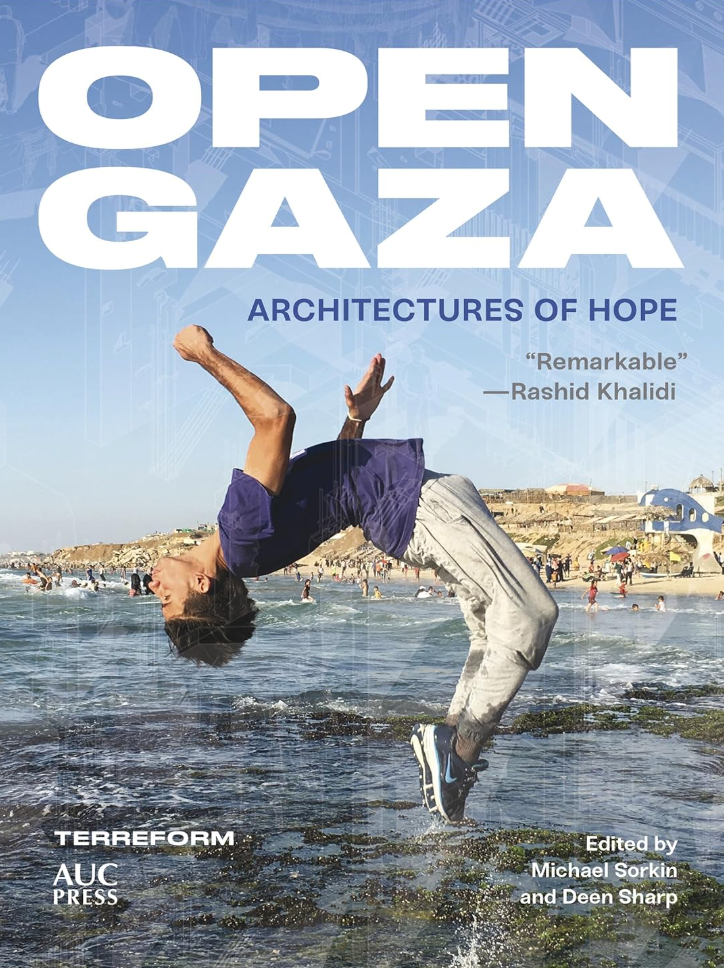
The cover of this book articulates our intent, as editors, to both illuminate the Israeli siege and thwart its imposed logic. It shows a member of the Parkour group in Gaza founded by Mohammed Aljakhabir and Ahmad Matar in 2007 in the Khan Younis refugee camp. Parkour has provided an important set of practices through which Gazan youth can escape the oppression of the occupation. Parkour is, Matar has said, “the only thing that I could do, and the only thing that helped me to keep hope that the future is coming, and that something will happen for me . . .For us in Gaza, we practiced Parkour to feel our freedom. Because it’s the sport that we can fly, we can jump over the obstacles, there is nothing [that] can stop us.”(5) Open Gaza illuminates the incredible energy and ingenuity of the inhabitants of Gaza that is being so brutally stultified by the Israeli occupation. But it is also important to stress that both Aljakhabir and Matar have escaped the occupation, with many other members of the Parkour movement, by leaving Gaza. The cover of this book also marks the simultaneous presence of hope and its absence, or what the Palestinian poet Mahmoud Darwish called the “presence of absence.”(6)
Open Gaza reassembles many members of a cohort that contributed to two earlier volumes: The Next Jerusalem: Sharing the Divided City (2002)(7) and Against the Wall (2005).(8) Although these books track a rapid descent from the myopic optimism that followed the Oslo agreement to the agenda of repression and apartheid concealed behind its false promise, both—like the present volume—engage authors from inside the space of conflict and from outside. These assemblies of Palestinians, Israelis, and “others” have sought to upend the representation of Palestinians, so often obscured through the lenses of colonialism and its attendant Orientalism. These books offered not simply a riposte to mainstream depictions and analysis, but also progressive visions of a shared and open future for Palestinians and Israelis.
In the years since the publication of these earlier works, reality has, alas, been far more cruel than progressive: the arguments made in The Next Jerusalem and Against the Wall have not only gone unheeded but the violence, separation, and oppression that they described have only intensified. Calls to tear down the wall have been met with the construction of more walls, trenches, and wires. In Gaza, where hundreds have been shot dead for approaching its incarcerating edge, the building of divides has been particularly intensive. In August 2018, the Israeli Ministry of Defense released new images of a two-hundred-meter long sea barrier designed to further blockade Gaza, consisting of three layers: a fifty-meter-wide sea-level platform made of armored stone, a six-meter-high barbed-wire fence, and an additional wall to surround the barrier itself. Israel is building walls upon walls in its efforts to seal off Gaza from the world, and we denounce not simply these constructions but also the cohort of “professionals”—engineers, architects, planners, and apologetic academics—which enables and defends them.
The ever-expanding consequences of the blockade for Palestinian life have been profound, and the siege of Gaza has resulted in extremes of poverty, humiliation, injury, murder, and what Sara Roy has termed “de-development.” In this volume, Tareq Baconi writes that the Israeli blockade of Gaza is not merely about containment, but about terrorizing a population into submission. To a substantial extent, this strategy is working. The stresses imposed by the siege—and the petty crime, kidnappings, and domestic violence that have become normalized as a result—all work to tear the Palestinian social fabric apart. But Baconi argues that Israel’s enclosure of Gaza has failed to completely dominate the more emotional, metaphysical realm, nor has it succeeded in destroying the solidarity of citizens under siege (and, in this way, Gaza reproduces the unexpected stiffening of resolve during the bombing campaigns and sieges of the Second World War or Vietnam). Indeed, the very familiarity of the daily horrors that occur in the Strip breaks the blockade and carries the cause of Gaza to the broader world. Protests in support of Gaza in Istanbul, San Diego, Oslo, and Osaka bind the territory to a broader humanity—a glimmer of hope in an otherwise desolate context. No matter how high the fence or unrelenting the systems of control, Gaza cannot be sealed off from the world. Despite the risks in even the most basic everyday acts—like watching a soccer match on TV at the beach—Gazans find ways to be in the world, to be part of its cultures of normality. Open Gaza celebrates the tenacity revealed in the heroic pursuit of what, for most of us, seems simply banal.
Like its contributors, the work in this volume is surely eclectic and does not aspire to any version of a “complete” picture; an acknowledgment that no single discourse is adequate to the urban, and certainly not to Gaza’s complexities. Engaging the tools of architecture and planning, the social sciences, environmentalism, and critical theory, it rises in defense of expansiveness, of freedom of thought and imagination, and proudly celebrates Gaza’s courage and positive capability. The tunnels, for instance, that have been built in the Strip in an attempt to circumvent the blockade articulate the ingenuity and steadfastness of Gaza’s inhabitants. Dramatic images of cows, fridges, and even full-sized SUVs being smuggled through these subterranean passages have circulated around the global mediascape. A chapter in this book (authored under a pseudonym—which reminds us of the constant danger that accompanies being in and writing about Gaza) takes us into tunnels between Gaza and Egypt. The author and illustrator depict the sophisticated engineering and complex sociopolitical organization required to keep them operating, as well as the perverse routines—the smuggler’s Expedia—needed to negotiate them.
The tunnels have been particularly critical for the smuggling of basic construction materials, such as steel and cement, that have otherwise been banned from Gaza by the blockade. Several contributors describe the extensive lengths to which Israel has gone to ensure that Gaza’s reconstruction is interrupted and controlled. The Gaza Reconstruction Mechanism (GRM), a tripartite agreement between the Palestinian Authority, the Israeli government, and the United Nations, was introduced in 2014 following the destruction caused by OPE. The contributions by the Royal College of Art and Pietro Stefanini argue, however, that far from facilitating reconstruction, the GRM has entrenched the blockade of Gaza and allowed Israel to control what can be built, as well as how, when, and where. This reinforces the sick circular economy of destruction and reconstruction that continuously engorges arms makers and contractors.
The GRM also introduced a centralized database system to collect microdata from every corner of Gaza. Francesco Sebregondi argues that the GRM has effectively turned Gaza into a version of the latest technocratic wet dream, the “smart city.” While the “smart” technology utilized in the GRM is relatively rudimentary, it nonetheless offers us an insight into how the operation of smart cities—in which we all increasingly live—can be a dominating and oppressive technology of power. The deployment of these tools and techniques in Gaza powerfully illuminates just how problematic the questions of who manages and oversees the smart city and who controls the data it harvests really are. It also dramatically returns the smart city to its military point of origin, to the electronic battlefield and “networkcentric” warfare. In this sense, Gaza is not unique but is the embodiment in extremis of the new normal for cities around the globe.
Beyond its analytical pieces on Gaza’s predicament and history, this volume also offers a series of more speculative interventions that, while grounded in Gaza’s particularities, take flight—like the kids of Parkour—to suggest directions in which a reimagined Gaza might grow and prosper. While these visionary forays offer strategies for wisely deploying resources in line with sustainable best practices, our objective is not to elaborate a model that obliges Gaza to “live within its means” but to unpack ideas about both limits and possibilities. These schemes include a blueprint for a solar-powered Gaza from Chris Mackey and Rafi Segal, which proposes a distributed energy infrastructure that could constitute a protective solar dome. Alberto Foyo and Postopia imagine Gaza’s potential to develop a fabric of architecture and agriculture that can help heal “Gaza’s burned skin,” while Romi Khosla proposes the construction of a Nakba memorial to act as a place of dialogue and reconciliation. Other architectural and urbanist propositions envision new ways in which to reread and redraw Gaza’s urban fabric. Helga Tawil-Souri proposes an Internet Pigeon Network (IPN) to create a self-reliant, Israel-free means of sending and receiving data in Gaza. This IPN, Tawil-Souri argues, would offer Gazans the ability to control their own communications infrastructure and creatively embrace the “low-technologization”that has been imposed on them by the Israeli blockade, forcing them to survive on an “ecological footprint” that is less than one-tenth of the world’s average.
Embedded in these imaginative pitches for Gaza are arguments about how this beleaguered place can reclaim its independence and dignity through the agency of space. It was the fatal delusion of modernist architecture and planning that their spatial practices could by themselves transform the social and political realms. We are under no such illusions. Nor do we have the slightest doubt that substantive change can only occur if Israel’s boot is lifted from Gazan throats and Palestinian national aspirations are realized. We take special, dispirited note of the insanity of two current, externally proposed extraterritorial “solutions” to Gaza’s problems: the periodically mooted Israeli project to build an island in the Mediterranean three miles offshore—connected to Gaza via a tenuous bridge—to house an easily controlled airport, seaport, electric plant, and logistics hub; and the Trump-Kushner plan to employ Gazans as laborers in a Special Economic Zone under Egyptian sovereignty deep in the Sinai. Both resemble the situation in the American South not so long ago, where male descendants of freed slaves were imprisoned by the state in huge numbers and then hired out by their jailers to work in the very same cotton fields their ancestors cultivated as chattel.
These absurd declarations of a willingness to spend billions to “improve” the situation in Gaza as long as they do not actually have to be spent in Gaza constitute the kind of colonial villainy this volume vehemently opposes. Gaza needs a seaport, an airport, a robust source of energy, and a vibrant and diversified economy on its own territory. For this to happen, the Israeli siege on Gaza must end. Gazans—and all Palestinians—must be given control over the social, political, and economic resources that frame their own lives. Gaza’s “de-development” will continue as long as Israel represses Palestinian sovereignty and autonomy. While it seems today that we have never been further from any possibility of Palestinians being able to truly rule their own lives, or further from a durable peace for Gaza, this absence makes this volume—and every other expansive assertion of Gaza’s humanity—all the more urgent and necessary.
Open Gaza Now!
Michael Sorkin and Deen Sharp
New York City, Terreform, 2020
(1). B’Tselem, “Bilal al-Astal Recounts Bombing That Killed 9 in Gazan Café, Where He and Others Were Watching a World Cup Match,” July 15, 2014.
(2). Sara Roy, The Gaza Strip: The Political Economy of De-Development. 3rd ed.(Washington, DC: Institute for Palestine Studies, 2016).
(3). United Nations Country Team in the Occupied Palestinian Territory, “Gaza in 2020: A Livable Place?” (UNRWA, August 2012).
(4). Atef Abu Saif, “Life under Fire in Gaza: The Diary of a Palestinian,” The Guardian, July 28, 2018.
(5). Sarah Illingworth, “Learning Parkour in Gaza Made Me Feel Free,” Huffington Post, February 22, 2017.
(6). Mahmoud Darwish, In the Presence of Absence, translated by Sinan Antoon (New York: Archipelago, 2011).
(7). Michael Sorkin, ed., The Next Jerusalem: Sharing the Divided City (New York:Monacelli Press, 2002).
(8). Michael Sorkin, ed., Against the Wall: Israel’s Barrier to Peace (New York: The New Press, 2005).
This Introductory excerpt is taken from Sorkin, Michael, and Deen Sharp (eds.). Open Gaza: Architectures of Hope. Cairo: American University in Cairo Press, 2021.
At the Fun Time beach café located on the Khan Younis seafront in Gaza, a small group of Palestinian men were watching the 2014 World Cup semifinal between the Netherlands and Argentina. Bilal al-Astal and the soccer fans gathered with him were not given the chance to find out which team would proceed to the global spectacle of the World Cup final. As al-Astal stated in his testimony to the Israeli NGO B’Tselem:
We watched the first half of
the match together. We drank
tea and coffee and there was
a relaxed mood. We didn’t hear
any airplanes nearby. Suddenly,
there was a loud explosion. By
the time I realized what was
happening, I found myself buried
under a pile of sand and dirt.(1)
Such is the nature of daily life for Gazans: a schizophrenic rift between simple enjoyments that are routine for most of us and sudden eruptions of lethal violence from above. Urbanity instantaneously turns to terror.
The Gaza Strip is one of the most beleaguered environments on earth. Crammed into a space of 139 square miles (360 square kilometers), 1.8 million people live under siege in conditions that continue to plummet to ever more unimaginable depths of degradation and despair. In 2014, Operation Protective Edge (OPE), the third major Israeli assault on Gaza in six years, brought destruction on a scale that shocked both residents and long-time observers. As Sara Roy, who has worked for over thirty years on and in Gaza, wrote shortly after the end of OPE: “I can say without hesitation that I have never seen the kind of human, physical, and psychological destruction that I see there today.(2) OPE only accelerated the conclusions of an infamous UN report published in 2012 that questioned whether Gaza would still be a “livable place” by 2020.(3)
The violence unleashed by Israel during OPE provided the impetus for Terreform to think about the sorts of productive interventions that might result from bringing together an eclectic group of designers, environmentalists, planners, activists, and scholars—from Palestine and Israel, the US, the UK, India, and elsewhere. Our aim was not simply to denounce or “deconstruct” the literal deconstruction of Gaza by remorseless bombing and blockade, but to imagine and celebrate the spaces of steadfastness and even hope. As firm believers in the “right to the city,” we approach Gaza not for its scenographic horror but always as authentically urban, in defense of what we see as a critical avenue of resistance: imagining a better place for its citizens, one in which gathering in a café or taking a dip in the sea no longer brings the constant threat of sudden death.
We are not Panglossian, naively optimistic, and this volume firmly rejects the immiserization of Gazans. It does so by insisting on the particularity of alternatives, by seeing Gazans as people filled with aspiration, not as statistics—subjects to be destroyed—or the numbed inhabitants of a completely bare life. Gaza and Palestine are more than occupied territories under siege, and existence there is not defined solely by Israeli domination. The projects and essays in this volume engage Gaza beyond the malign logic of bombing and blockade. They consider how life could be improved in Gaza within the limitations imposed by Israeli malevolence but also reach beyond this framework of endless war to imagine Gaza in a future without conflict.
While the Israeli siege aspires to control the minutest details of Gazans’ everyday lives, down to the toothpaste they can or cannot use, the people of Gaza still dream, fantasize, and live in ways that lie outside the coercive and seemingly overwhelming logics of the Israel-Palestine conflict. As Atef Abu Saif writes in his diary, even in the context of a mere twelve-hour truce during OPE, city life quickly returned to the streets and people went about their daily lives: “People in their thousands on the street, buying food, moving from one place to another; the shops open, kids playing in the streets. It is a city that has poured itself out into a few moments of peace.”(4)
The cover of this book articulates our intent, as editors, to both illuminate the Israeli siege and thwart its imposed logic. It shows a member of the Parkour group in Gaza founded by Mohammed Aljakhabir and Ahmad Matar in 2007 in the Khan Younis refugee camp. Parkour has provided an important set of practices through which Gazan youth can escape the oppression of the occupation. Parkour is, Matar has said, “the only thing that I could do, and the only thing that helped me to keep hope that the future is coming, and that something will happen for me . . .For us in Gaza, we practiced Parkour to feel our freedom. Because it’s the sport that we can fly, we can jump over the obstacles, there is nothing [that] can stop us.”(5) Open Gaza illuminates the incredible energy and ingenuity of the inhabitants of Gaza that is being so brutally stultified by the Israeli occupation. But it is also important to stress that both Aljakhabir and Matar have escaped the occupation, with many other members of the Parkour movement, by leaving Gaza. The cover of this book also marks the simultaneous presence of hope and its absence, or what the Palestinian poet Mahmoud Darwish called the “presence of absence.”(6)
Open Gaza reassembles many members of a cohort that contributed to two earlier volumes: The Next Jerusalem: Sharing the Divided City (2002)(7) and Against the Wall (2005).(8) Although these books track a rapid descent from the myopic optimism that followed the Oslo agreement to the agenda of repression and apartheid concealed behind its false promise, both—like the present volume—engage authors from inside the space of conflict and from outside. These assemblies of Palestinians, Israelis, and “others” have sought to upend the representation of Palestinians, so often obscured through the lenses of colonialism and its attendant Orientalism. These books offered not simply a riposte to mainstream depictions and analysis, but also progressive visions of a shared and open future for Palestinians and Israelis.
In the years since the publication of these earlier works, reality has, alas, been far more cruel than progressive: the arguments made in The Next Jerusalem and Against the Wall have not only gone unheeded but the violence, separation, and oppression that they described have only intensified. Calls to tear down the wall have been met with the construction of more walls, trenches, and wires. In Gaza, where hundreds have been shot dead for approaching its incarcerating edge, the building of divides has been particularly intensive. In August 2018, the Israeli Ministry of Defense released new images of a two-hundred-meter long sea barrier designed to further blockade Gaza, consisting of three layers: a fifty-meter-wide sea-level platform made of armored stone, a six-meter-high barbed-wire fence, and an additional wall to surround the barrier itself. Israel is building walls upon walls in its efforts to seal off Gaza from the world, and we denounce not simply these constructions but also the cohort of “professionals”—engineers, architects, planners, and apologetic academics—which enables and defends them.
The ever-expanding consequences of the blockade for Palestinian life have been profound, and the siege of Gaza has resulted in extremes of poverty, humiliation, injury, murder, and what Sara Roy has termed “de-development.” In this volume, Tareq Baconi writes that the Israeli blockade of Gaza is not merely about containment, but about terrorizing a population into submission. To a substantial extent, this strategy is working. The stresses imposed by the siege—and the petty crime, kidnappings, and domestic violence that have become normalized as a result—all work to tear the Palestinian social fabric apart. But Baconi argues that Israel’s enclosure of Gaza has failed to completely dominate the more emotional, metaphysical realm, nor has it succeeded in destroying the solidarity of citizens under siege (and, in this way, Gaza reproduces the unexpected stiffening of resolve during the bombing campaigns and sieges of the Second World War or Vietnam). Indeed, the very familiarity of the daily horrors that occur in the Strip breaks the blockade and carries the cause of Gaza to the broader world. Protests in support of Gaza in Istanbul, San Diego, Oslo, and Osaka bind the territory to a broader humanity—a glimmer of hope in an otherwise desolate context. No matter how high the fence or unrelenting the systems of control, Gaza cannot be sealed off from the world. Despite the risks in even the most basic everyday acts—like watching a soccer match on TV at the beach—Gazans find ways to be in the world, to be part of its cultures of normality. Open Gaza celebrates the tenacity revealed in the heroic pursuit of what, for most of us, seems simply banal.
Like its contributors, the work in this volume is surely eclectic and does not aspire to any version of a “complete” picture; an acknowledgment that no single discourse is adequate to the urban, and certainly not to Gaza’s complexities. Engaging the tools of architecture and planning, the social sciences, environmentalism, and critical theory, it rises in defense of expansiveness, of freedom of thought and imagination, and proudly celebrates Gaza’s courage and positive capability. The tunnels, for instance, that have been built in the Strip in an attempt to circumvent the blockade articulate the ingenuity and steadfastness of Gaza’s inhabitants. Dramatic images of cows, fridges, and even full-sized SUVs being smuggled through these subterranean passages have circulated around the global mediascape. A chapter in this book (authored under a pseudonym—which reminds us of the constant danger that accompanies being in and writing about Gaza) takes us into tunnels between Gaza and Egypt. The author and illustrator depict the sophisticated engineering and complex sociopolitical organization required to keep them operating, as well as the perverse routines—the smuggler’s Expedia—needed to negotiate them.
The tunnels have been particularly critical for the smuggling of basic construction materials, such as steel and cement, that have otherwise been banned from Gaza by the blockade. Several contributors describe the extensive lengths to which Israel has gone to ensure that Gaza’s reconstruction is interrupted and controlled. The Gaza Reconstruction Mechanism (GRM), a tripartite agreement between the Palestinian Authority, the Israeli government, and the United Nations, was introduced in 2014 following the destruction caused by OPE. The contributions by the Royal College of Art and Pietro Stefanini argue, however, that far from facilitating reconstruction, the GRM has entrenched the blockade of Gaza and allowed Israel to control what can be built, as well as how, when, and where. This reinforces the sick circular economy of destruction and reconstruction that continuously engorges arms makers and contractors.
The GRM also introduced a centralized database system to collect microdata from every corner of Gaza. Francesco Sebregondi argues that the GRM has effectively turned Gaza into a version of the latest technocratic wet dream, the “smart city.” While the “smart” technology utilized in the GRM is relatively rudimentary, it nonetheless offers us an insight into how the operation of smart cities—in which we all increasingly live—can be a dominating and oppressive technology of power. The deployment of these tools and techniques in Gaza powerfully illuminates just how problematic the questions of who manages and oversees the smart city and who controls the data it harvests really are. It also dramatically returns the smart city to its military point of origin, to the electronic battlefield and “networkcentric” warfare. In this sense, Gaza is not unique but is the embodiment in extremis of the new normal for cities around the globe.
Beyond its analytical pieces on Gaza’s predicament and history, this volume also offers a series of more speculative interventions that, while grounded in Gaza’s particularities, take flight—like the kids of Parkour—to suggest directions in which a reimagined Gaza might grow and prosper. While these visionary forays offer strategies for wisely deploying resources in line with sustainable best practices, our objective is not to elaborate a model that obliges Gaza to “live within its means” but to unpack ideas about both limits and possibilities. These schemes include a blueprint for a solar-powered Gaza from Chris Mackey and Rafi Segal, which proposes a distributed energy infrastructure that could constitute a protective solar dome. Alberto Foyo and Postopia imagine Gaza’s potential to develop a fabric of architecture and agriculture that can help heal “Gaza’s burned skin,” while Romi Khosla proposes the construction of a Nakba memorial to act as a place of dialogue and reconciliation. Other architectural and urbanist propositions envision new ways in which to reread and redraw Gaza’s urban fabric. Helga Tawil-Souri proposes an Internet Pigeon Network (IPN) to create a self-reliant, Israel-free means of sending and receiving data in Gaza. This IPN, Tawil-Souri argues, would offer Gazans the ability to control their own communications infrastructure and creatively embrace the “low-technologization”that has been imposed on them by the Israeli blockade, forcing them to survive on an “ecological footprint” that is less than one-tenth of the world’s average.
Embedded in these imaginative pitches for Gaza are arguments about how this beleaguered place can reclaim its independence and dignity through the agency of space. It was the fatal delusion of modernist architecture and planning that their spatial practices could by themselves transform the social and political realms. We are under no such illusions. Nor do we have the slightest doubt that substantive change can only occur if Israel’s boot is lifted from Gazan throats and Palestinian national aspirations are realized. We take special, dispirited note of the insanity of two current, externally proposed extraterritorial “solutions” to Gaza’s problems: the periodically mooted Israeli project to build an island in the Mediterranean three miles offshore—connected to Gaza via a tenuous bridge—to house an easily controlled airport, seaport, electric plant, and logistics hub; and the Trump-Kushner plan to employ Gazans as laborers in a Special Economic Zone under Egyptian sovereignty deep in the Sinai. Both resemble the situation in the American South not so long ago, where male descendants of freed slaves were imprisoned by the state in huge numbers and then hired out by their jailers to work in the very same cotton fields their ancestors cultivated as chattel.
These absurd declarations of a willingness to spend billions to “improve” the situation in Gaza as long as they do not actually have to be spent in Gaza constitute the kind of colonial villainy this volume vehemently opposes. Gaza needs a seaport, an airport, a robust source of energy, and a vibrant and diversified economy on its own territory. For this to happen, the Israeli siege on Gaza must end. Gazans—and all Palestinians—must be given control over the social, political, and economic resources that frame their own lives. Gaza’s “de-development” will continue as long as Israel represses Palestinian sovereignty and autonomy. While it seems today that we have never been further from any possibility of Palestinians being able to truly rule their own lives, or further from a durable peace for Gaza, this absence makes this volume—and every other expansive assertion of Gaza’s humanity—all the more urgent and necessary.
Open Gaza Now!
Michael Sorkin and Deen Sharp
New York City, Terreform, 2020
(1). B’Tselem, “Bilal al-Astal Recounts Bombing That Killed 9 in Gazan Café, Where He and Others Were Watching a World Cup Match,” July 15, 2014.
(2). Sara Roy, The Gaza Strip: The Political Economy of De-Development. 3rd ed.(Washington, DC: Institute for Palestine Studies, 2016).
(3). United Nations Country Team in the Occupied Palestinian Territory, “Gaza in 2020: A Livable Place?” (UNRWA, August 2012).
(4). Atef Abu Saif, “Life under Fire in Gaza: The Diary of a Palestinian,” The Guardian, July 28, 2018.
(5). Sarah Illingworth, “Learning Parkour in Gaza Made Me Feel Free,” Huffington Post, February 22, 2017.
(6). Mahmoud Darwish, In the Presence of Absence, translated by Sinan Antoon (New York: Archipelago, 2011).
(7). Michael Sorkin, ed., The Next Jerusalem: Sharing the Divided City (New York:Monacelli Press, 2002).
(8). Michael Sorkin, ed., Against the Wall: Israel’s Barrier to Peace (New York: The New Press, 2005).
Terreform is a suggestive variation on "Terraform" [Latin terra, earth + formare, to shape, fashion, build], originally coined by Jack Williamson in his 1942 science-fiction story, Collision Orbit, to describe the process of transforming the environments of other planets to enable them to support life. Terreform is a non-profit 501(c)(3), urban research studio and advocacy group. Founded in 2005 by Michael Sorkin, its mission is to investigate the forms, policies, technologies, and practices that will yield equitable, sustainable, and beautiful cities for our urbanizing planet. Terreform works as a “friend of the court,” dedicated to raising urban expectations and to advocating innovative and progressive ideas as widely as possible. We undertake self-initiated investigations into both local and global issues and make research and design available to community and other organizations to support independent environmental and planning initiatives.
Michael Sorkin (1948–2020) was the founder and president of Terreform. Sorkin was an architect whose practice crossed design, criticism, and pedagogy. He is the author or editor for over twenty books, including The Next Jerusalem: Sharing the Divided City (Monacelli, 2002) and Against the Wall: Israel’s Barrier to Peace (The New Press, 2005). In 2000, he was appointed the Distinguished Professor of Architecture and Director of the Graduate Program in Urban Design at the City College of New York, CUNY, and in 2014 he was made an honorary member of the Architectural Association in London.
Deen Sharp PhD Graduate Center, CUNY, is the co-director of Terreform, Center for Advanced Urban Research and a visiting fellow in human geography at the London School of Economics. He was previously a post-doctoral fellow at the Aga Khan Program for Islamic Architecture at the Massachusetts Institute of Technology (MIT). He is the co-editor of Beyond the Square: Urbanism and the Arab Uprisings (Urban Research, 2016) and has published in a number of scholarly journals, edited books, and e-zines.
BY DEEN SHARP AND MICHAEL SORKIN
This Introductory excerpt is taken from Sorkin, Michael, and Deen Sharp (eds.). Open Gaza: Architectures of Hope. Cairo: American University in Cairo Press, 2021.
At the Fun Time beach café located on the Khan Younis seafront in Gaza, a small group of Palestinian men were watching the 2014 World Cup semifinal between the Netherlands and Argentina. Bilal al-Astal and the soccer fans gathered with him were not given the chance to find out which team would proceed to the global spectacle of the World Cup final. As al-Astal stated in his testimony to the Israeli NGO B’Tselem:
We watched the first half of
the match together. We drank
tea and coffee and there was
a relaxed mood. We didn’t hear
any airplanes nearby. Suddenly,
there was a loud explosion. By
the time I realized what was
happening, I found myself buried
under a pile of sand and dirt.(1)
Such is the nature of daily life for Gazans: a schizophrenic rift between simple enjoyments that are routine for most of us and sudden eruptions of lethal violence from above. Urbanity instantaneously turns to terror.
The Gaza Strip is one of the most beleaguered environments on earth. Crammed into a space of 139 square miles (360 square kilometers), 1.8 million people live under siege in conditions that continue to plummet to ever more unimaginable depths of degradation and despair. In 2014, Operation Protective Edge (OPE), the third major Israeli assault on Gaza in six years, brought destruction on a scale that shocked both residents and long-time observers. As Sara Roy, who has worked for over thirty years on and in Gaza, wrote shortly after the end of OPE: “I can say without hesitation that I have never seen the kind of human, physical, and psychological destruction that I see there today.(2) OPE only accelerated the conclusions of an infamous UN report published in 2012 that questioned whether Gaza would still be a “livable place” by 2020.(3)
The violence unleashed by Israel during OPE provided the impetus for Terreform to think about the sorts of productive interventions that might result from bringing together an eclectic group of designers, environmentalists, planners, activists, and scholars—from Palestine and Israel, the US, the UK, India, and elsewhere. Our aim was not simply to denounce or “deconstruct” the literal deconstruction of Gaza by remorseless bombing and blockade, but to imagine and celebrate the spaces of steadfastness and even hope. As firm believers in the “right to the city,” we approach Gaza not for its scenographic horror but always as authentically urban, in defense of what we see as a critical avenue of resistance: imagining a better place for its citizens, one in which gathering in a café or taking a dip in the sea no longer brings the constant threat of sudden death.
We are not Panglossian, naively optimistic, and this volume firmly rejects the immiserization of Gazans. It does so by insisting on the particularity of alternatives, by seeing Gazans as people filled with aspiration, not as statistics—subjects to be destroyed—or the numbed inhabitants of a completely bare life. Gaza and Palestine are more than occupied territories under siege, and existence there is not defined solely by Israeli domination. The projects and essays in this volume engage Gaza beyond the malign logic of bombing and blockade. They consider how life could be improved in Gaza within the limitations imposed by Israeli malevolence but also reach beyond this framework of endless war to imagine Gaza in a future without conflict.
While the Israeli siege aspires to control the minutest details of Gazans’ everyday lives, down to the toothpaste they can or cannot use, the people of Gaza still dream, fantasize, and live in ways that lie outside the coercive and seemingly overwhelming logics of the Israel-Palestine conflict. As Atef Abu Saif writes in his diary, even in the context of a mere twelve-hour truce during OPE, city life quickly returned to the streets and people went about their daily lives: “People in their thousands on the street, buying food, moving from one place to another; the shops open, kids playing in the streets. It is a city that has poured itself out into a few moments of peace.”(4)
The cover of this book articulates our intent, as editors, to both illuminate the Israeli siege and thwart its imposed logic. It shows a member of the Parkour group in Gaza founded by Mohammed Aljakhabir and Ahmad Matar in 2007 in the Khan Younis refugee camp. Parkour has provided an important set of practices through which Gazan youth can escape the oppression of the occupation. Parkour is, Matar has said, “the only thing that I could do, and the only thing that helped me to keep hope that the future is coming, and that something will happen for me . . .For us in Gaza, we practiced Parkour to feel our freedom. Because it’s the sport that we can fly, we can jump over the obstacles, there is nothing [that] can stop us.”(5) Open Gaza illuminates the incredible energy and ingenuity of the inhabitants of Gaza that is being so brutally stultified by the Israeli occupation. But it is also important to stress that both Aljakhabir and Matar have escaped the occupation, with many other members of the Parkour movement, by leaving Gaza. The cover of this book also marks the simultaneous presence of hope and its absence, or what the Palestinian poet Mahmoud Darwish called the “presence of absence.”(6)
Open Gaza reassembles many members of a cohort that contributed to two earlier volumes: The Next Jerusalem: Sharing the Divided City (2002)(7) and Against the Wall (2005).(8) Although these books track a rapid descent from the myopic optimism that followed the Oslo agreement to the agenda of repression and apartheid concealed behind its false promise, both—like the present volume—engage authors from inside the space of conflict and from outside. These assemblies of Palestinians, Israelis, and “others” have sought to upend the representation of Palestinians, so often obscured through the lenses of colonialism and its attendant Orientalism. These books offered not simply a riposte to mainstream depictions and analysis, but also progressive visions of a shared and open future for Palestinians and Israelis.
In the years since the publication of these earlier works, reality has, alas, been far more cruel than progressive: the arguments made in The Next Jerusalem and Against the Wall have not only gone unheeded but the violence, separation, and oppression that they described have only intensified. Calls to tear down the wall have been met with the construction of more walls, trenches, and wires. In Gaza, where hundreds have been shot dead for approaching its incarcerating edge, the building of divides has been particularly intensive. In August 2018, the Israeli Ministry of Defense released new images of a two-hundred-meter long sea barrier designed to further blockade Gaza, consisting of three layers: a fifty-meter-wide sea-level platform made of armored stone, a six-meter-high barbed-wire fence, and an additional wall to surround the barrier itself. Israel is building walls upon walls in its efforts to seal off Gaza from the world, and we denounce not simply these constructions but also the cohort of “professionals”—engineers, architects, planners, and apologetic academics—which enables and defends them.
The ever-expanding consequences of the blockade for Palestinian life have been profound, and the siege of Gaza has resulted in extremes of poverty, humiliation, injury, murder, and what Sara Roy has termed “de-development.” In this volume, Tareq Baconi writes that the Israeli blockade of Gaza is not merely about containment, but about terrorizing a population into submission. To a substantial extent, this strategy is working. The stresses imposed by the siege—and the petty crime, kidnappings, and domestic violence that have become normalized as a result—all work to tear the Palestinian social fabric apart. But Baconi argues that Israel’s enclosure of Gaza has failed to completely dominate the more emotional, metaphysical realm, nor has it succeeded in destroying the solidarity of citizens under siege (and, in this way, Gaza reproduces the unexpected stiffening of resolve during the bombing campaigns and sieges of the Second World War or Vietnam). Indeed, the very familiarity of the daily horrors that occur in the Strip breaks the blockade and carries the cause of Gaza to the broader world. Protests in support of Gaza in Istanbul, San Diego, Oslo, and Osaka bind the territory to a broader humanity—a glimmer of hope in an otherwise desolate context. No matter how high the fence or unrelenting the systems of control, Gaza cannot be sealed off from the world. Despite the risks in even the most basic everyday acts—like watching a soccer match on TV at the beach—Gazans find ways to be in the world, to be part of its cultures of normality. Open Gaza celebrates the tenacity revealed in the heroic pursuit of what, for most of us, seems simply banal.
Like its contributors, the work in this volume is surely eclectic and does not aspire to any version of a “complete” picture; an acknowledgment that no single discourse is adequate to the urban, and certainly not to Gaza’s complexities. Engaging the tools of architecture and planning, the social sciences, environmentalism, and critical theory, it rises in defense of expansiveness, of freedom of thought and imagination, and proudly celebrates Gaza’s courage and positive capability. The tunnels, for instance, that have been built in the Strip in an attempt to circumvent the blockade articulate the ingenuity and steadfastness of Gaza’s inhabitants. Dramatic images of cows, fridges, and even full-sized SUVs being smuggled through these subterranean passages have circulated around the global mediascape. A chapter in this book (authored under a pseudonym—which reminds us of the constant danger that accompanies being in and writing about Gaza) takes us into tunnels between Gaza and Egypt. The author and illustrator depict the sophisticated engineering and complex sociopolitical organization required to keep them operating, as well as the perverse routines—the smuggler’s Expedia—needed to negotiate them.
The tunnels have been particularly critical for the smuggling of basic construction materials, such as steel and cement, that have otherwise been banned from Gaza by the blockade. Several contributors describe the extensive lengths to which Israel has gone to ensure that Gaza’s reconstruction is interrupted and controlled. The Gaza Reconstruction Mechanism (GRM), a tripartite agreement between the Palestinian Authority, the Israeli government, and the United Nations, was introduced in 2014 following the destruction caused by OPE. The contributions by the Royal College of Art and Pietro Stefanini argue, however, that far from facilitating reconstruction, the GRM has entrenched the blockade of Gaza and allowed Israel to control what can be built, as well as how, when, and where. This reinforces the sick circular economy of destruction and reconstruction that continuously engorges arms makers and contractors.
The GRM also introduced a centralized database system to collect microdata from every corner of Gaza. Francesco Sebregondi argues that the GRM has effectively turned Gaza into a version of the latest technocratic wet dream, the “smart city.” While the “smart” technology utilized in the GRM is relatively rudimentary, it nonetheless offers us an insight into how the operation of smart cities—in which we all increasingly live—can be a dominating and oppressive technology of power. The deployment of these tools and techniques in Gaza powerfully illuminates just how problematic the questions of who manages and oversees the smart city and who controls the data it harvests really are. It also dramatically returns the smart city to its military point of origin, to the electronic battlefield and “networkcentric” warfare. In this sense, Gaza is not unique but is the embodiment in extremis of the new normal for cities around the globe.
Beyond its analytical pieces on Gaza’s predicament and history, this volume also offers a series of more speculative interventions that, while grounded in Gaza’s particularities, take flight—like the kids of Parkour—to suggest directions in which a reimagined Gaza might grow and prosper. While these visionary forays offer strategies for wisely deploying resources in line with sustainable best practices, our objective is not to elaborate a model that obliges Gaza to “live within its means” but to unpack ideas about both limits and possibilities. These schemes include a blueprint for a solar-powered Gaza from Chris Mackey and Rafi Segal, which proposes a distributed energy infrastructure that could constitute a protective solar dome. Alberto Foyo and Postopia imagine Gaza’s potential to develop a fabric of architecture and agriculture that can help heal “Gaza’s burned skin,” while Romi Khosla proposes the construction of a Nakba memorial to act as a place of dialogue and reconciliation. Other architectural and urbanist propositions envision new ways in which to reread and redraw Gaza’s urban fabric. Helga Tawil-Souri proposes an Internet Pigeon Network (IPN) to create a self-reliant, Israel-free means of sending and receiving data in Gaza. This IPN, Tawil-Souri argues, would offer Gazans the ability to control their own communications infrastructure and creatively embrace the “low-technologization”that has been imposed on them by the Israeli blockade, forcing them to survive on an “ecological footprint” that is less than one-tenth of the world’s average.
Embedded in these imaginative pitches for Gaza are arguments about how this beleaguered place can reclaim its independence and dignity through the agency of space. It was the fatal delusion of modernist architecture and planning that their spatial practices could by themselves transform the social and political realms. We are under no such illusions. Nor do we have the slightest doubt that substantive change can only occur if Israel’s boot is lifted from Gazan throats and Palestinian national aspirations are realized. We take special, dispirited note of the insanity of two current, externally proposed extraterritorial “solutions” to Gaza’s problems: the periodically mooted Israeli project to build an island in the Mediterranean three miles offshore—connected to Gaza via a tenuous bridge—to house an easily controlled airport, seaport, electric plant, and logistics hub; and the Trump-Kushner plan to employ Gazans as laborers in a Special Economic Zone under Egyptian sovereignty deep in the Sinai. Both resemble the situation in the American South not so long ago, where male descendants of freed slaves were imprisoned by the state in huge numbers and then hired out by their jailers to work in the very same cotton fields their ancestors cultivated as chattel.
These absurd declarations of a willingness to spend billions to “improve” the situation in Gaza as long as they do not actually have to be spent in Gaza constitute the kind of colonial villainy this volume vehemently opposes. Gaza needs a seaport, an airport, a robust source of energy, and a vibrant and diversified economy on its own territory. For this to happen, the Israeli siege on Gaza must end. Gazans—and all Palestinians—must be given control over the social, political, and economic resources that frame their own lives. Gaza’s “de-development” will continue as long as Israel represses Palestinian sovereignty and autonomy. While it seems today that we have never been further from any possibility of Palestinians being able to truly rule their own lives, or further from a durable peace for Gaza, this absence makes this volume—and every other expansive assertion of Gaza’s humanity—all the more urgent and necessary.
Open Gaza Now!
Michael Sorkin and Deen Sharp
New York City, Terreform, 2020
(1). B’Tselem, “Bilal al-Astal Recounts Bombing That Killed 9 in Gazan Café, Where He and Others Were Watching a World Cup Match,” July 15, 2014.
(2). Sara Roy, The Gaza Strip: The Political Economy of De-Development. 3rd ed.(Washington, DC: Institute for Palestine Studies, 2016).
(3). United Nations Country Team in the Occupied Palestinian Territory, “Gaza in 2020: A Livable Place?” (UNRWA, August 2012).
(4). Atef Abu Saif, “Life under Fire in Gaza: The Diary of a Palestinian,” The Guardian, July 28, 2018.
(5). Sarah Illingworth, “Learning Parkour in Gaza Made Me Feel Free,” Huffington Post, February 22, 2017.
(6). Mahmoud Darwish, In the Presence of Absence, translated by Sinan Antoon (New York: Archipelago, 2011).
(7). Michael Sorkin, ed., The Next Jerusalem: Sharing the Divided City (New York:Monacelli Press, 2002).
(8). Michael Sorkin, ed., Against the Wall: Israel’s Barrier to Peace (New York: The New Press, 2005).
This Introductory excerpt is taken from Sorkin, Michael, and Deen Sharp (eds.). Open Gaza: Architectures of Hope. Cairo: American University in Cairo Press, 2021.
At the Fun Time beach café located on the Khan Younis seafront in Gaza, a small group of Palestinian men were watching the 2014 World Cup semifinal between the Netherlands and Argentina. Bilal al-Astal and the soccer fans gathered with him were not given the chance to find out which team would proceed to the global spectacle of the World Cup final. As al-Astal stated in his testimony to the Israeli NGO B’Tselem:
We watched the first half of
the match together. We drank
tea and coffee and there was
a relaxed mood. We didn’t hear
any airplanes nearby. Suddenly,
there was a loud explosion. By
the time I realized what was
happening, I found myself buried
under a pile of sand and dirt.(1)
Such is the nature of daily life for Gazans: a schizophrenic rift between simple enjoyments that are routine for most of us and sudden eruptions of lethal violence from above. Urbanity instantaneously turns to terror.
The Gaza Strip is one of the most beleaguered environments on earth. Crammed into a space of 139 square miles (360 square kilometers), 1.8 million people live under siege in conditions that continue to plummet to ever more unimaginable depths of degradation and despair. In 2014, Operation Protective Edge (OPE), the third major Israeli assault on Gaza in six years, brought destruction on a scale that shocked both residents and long-time observers. As Sara Roy, who has worked for over thirty years on and in Gaza, wrote shortly after the end of OPE: “I can say without hesitation that I have never seen the kind of human, physical, and psychological destruction that I see there today.(2) OPE only accelerated the conclusions of an infamous UN report published in 2012 that questioned whether Gaza would still be a “livable place” by 2020.(3)
The violence unleashed by Israel during OPE provided the impetus for Terreform to think about the sorts of productive interventions that might result from bringing together an eclectic group of designers, environmentalists, planners, activists, and scholars—from Palestine and Israel, the US, the UK, India, and elsewhere. Our aim was not simply to denounce or “deconstruct” the literal deconstruction of Gaza by remorseless bombing and blockade, but to imagine and celebrate the spaces of steadfastness and even hope. As firm believers in the “right to the city,” we approach Gaza not for its scenographic horror but always as authentically urban, in defense of what we see as a critical avenue of resistance: imagining a better place for its citizens, one in which gathering in a café or taking a dip in the sea no longer brings the constant threat of sudden death.
We are not Panglossian, naively optimistic, and this volume firmly rejects the immiserization of Gazans. It does so by insisting on the particularity of alternatives, by seeing Gazans as people filled with aspiration, not as statistics—subjects to be destroyed—or the numbed inhabitants of a completely bare life. Gaza and Palestine are more than occupied territories under siege, and existence there is not defined solely by Israeli domination. The projects and essays in this volume engage Gaza beyond the malign logic of bombing and blockade. They consider how life could be improved in Gaza within the limitations imposed by Israeli malevolence but also reach beyond this framework of endless war to imagine Gaza in a future without conflict.
While the Israeli siege aspires to control the minutest details of Gazans’ everyday lives, down to the toothpaste they can or cannot use, the people of Gaza still dream, fantasize, and live in ways that lie outside the coercive and seemingly overwhelming logics of the Israel-Palestine conflict. As Atef Abu Saif writes in his diary, even in the context of a mere twelve-hour truce during OPE, city life quickly returned to the streets and people went about their daily lives: “People in their thousands on the street, buying food, moving from one place to another; the shops open, kids playing in the streets. It is a city that has poured itself out into a few moments of peace.”(4)
The cover of this book articulates our intent, as editors, to both illuminate the Israeli siege and thwart its imposed logic. It shows a member of the Parkour group in Gaza founded by Mohammed Aljakhabir and Ahmad Matar in 2007 in the Khan Younis refugee camp. Parkour has provided an important set of practices through which Gazan youth can escape the oppression of the occupation. Parkour is, Matar has said, “the only thing that I could do, and the only thing that helped me to keep hope that the future is coming, and that something will happen for me . . .For us in Gaza, we practiced Parkour to feel our freedom. Because it’s the sport that we can fly, we can jump over the obstacles, there is nothing [that] can stop us.”(5) Open Gaza illuminates the incredible energy and ingenuity of the inhabitants of Gaza that is being so brutally stultified by the Israeli occupation. But it is also important to stress that both Aljakhabir and Matar have escaped the occupation, with many other members of the Parkour movement, by leaving Gaza. The cover of this book also marks the simultaneous presence of hope and its absence, or what the Palestinian poet Mahmoud Darwish called the “presence of absence.”(6)
Open Gaza reassembles many members of a cohort that contributed to two earlier volumes: The Next Jerusalem: Sharing the Divided City (2002)(7) and Against the Wall (2005).(8) Although these books track a rapid descent from the myopic optimism that followed the Oslo agreement to the agenda of repression and apartheid concealed behind its false promise, both—like the present volume—engage authors from inside the space of conflict and from outside. These assemblies of Palestinians, Israelis, and “others” have sought to upend the representation of Palestinians, so often obscured through the lenses of colonialism and its attendant Orientalism. These books offered not simply a riposte to mainstream depictions and analysis, but also progressive visions of a shared and open future for Palestinians and Israelis.
In the years since the publication of these earlier works, reality has, alas, been far more cruel than progressive: the arguments made in The Next Jerusalem and Against the Wall have not only gone unheeded but the violence, separation, and oppression that they described have only intensified. Calls to tear down the wall have been met with the construction of more walls, trenches, and wires. In Gaza, where hundreds have been shot dead for approaching its incarcerating edge, the building of divides has been particularly intensive. In August 2018, the Israeli Ministry of Defense released new images of a two-hundred-meter long sea barrier designed to further blockade Gaza, consisting of three layers: a fifty-meter-wide sea-level platform made of armored stone, a six-meter-high barbed-wire fence, and an additional wall to surround the barrier itself. Israel is building walls upon walls in its efforts to seal off Gaza from the world, and we denounce not simply these constructions but also the cohort of “professionals”—engineers, architects, planners, and apologetic academics—which enables and defends them.
The ever-expanding consequences of the blockade for Palestinian life have been profound, and the siege of Gaza has resulted in extremes of poverty, humiliation, injury, murder, and what Sara Roy has termed “de-development.” In this volume, Tareq Baconi writes that the Israeli blockade of Gaza is not merely about containment, but about terrorizing a population into submission. To a substantial extent, this strategy is working. The stresses imposed by the siege—and the petty crime, kidnappings, and domestic violence that have become normalized as a result—all work to tear the Palestinian social fabric apart. But Baconi argues that Israel’s enclosure of Gaza has failed to completely dominate the more emotional, metaphysical realm, nor has it succeeded in destroying the solidarity of citizens under siege (and, in this way, Gaza reproduces the unexpected stiffening of resolve during the bombing campaigns and sieges of the Second World War or Vietnam). Indeed, the very familiarity of the daily horrors that occur in the Strip breaks the blockade and carries the cause of Gaza to the broader world. Protests in support of Gaza in Istanbul, San Diego, Oslo, and Osaka bind the territory to a broader humanity—a glimmer of hope in an otherwise desolate context. No matter how high the fence or unrelenting the systems of control, Gaza cannot be sealed off from the world. Despite the risks in even the most basic everyday acts—like watching a soccer match on TV at the beach—Gazans find ways to be in the world, to be part of its cultures of normality. Open Gaza celebrates the tenacity revealed in the heroic pursuit of what, for most of us, seems simply banal.
Like its contributors, the work in this volume is surely eclectic and does not aspire to any version of a “complete” picture; an acknowledgment that no single discourse is adequate to the urban, and certainly not to Gaza’s complexities. Engaging the tools of architecture and planning, the social sciences, environmentalism, and critical theory, it rises in defense of expansiveness, of freedom of thought and imagination, and proudly celebrates Gaza’s courage and positive capability. The tunnels, for instance, that have been built in the Strip in an attempt to circumvent the blockade articulate the ingenuity and steadfastness of Gaza’s inhabitants. Dramatic images of cows, fridges, and even full-sized SUVs being smuggled through these subterranean passages have circulated around the global mediascape. A chapter in this book (authored under a pseudonym—which reminds us of the constant danger that accompanies being in and writing about Gaza) takes us into tunnels between Gaza and Egypt. The author and illustrator depict the sophisticated engineering and complex sociopolitical organization required to keep them operating, as well as the perverse routines—the smuggler’s Expedia—needed to negotiate them.
The tunnels have been particularly critical for the smuggling of basic construction materials, such as steel and cement, that have otherwise been banned from Gaza by the blockade. Several contributors describe the extensive lengths to which Israel has gone to ensure that Gaza’s reconstruction is interrupted and controlled. The Gaza Reconstruction Mechanism (GRM), a tripartite agreement between the Palestinian Authority, the Israeli government, and the United Nations, was introduced in 2014 following the destruction caused by OPE. The contributions by the Royal College of Art and Pietro Stefanini argue, however, that far from facilitating reconstruction, the GRM has entrenched the blockade of Gaza and allowed Israel to control what can be built, as well as how, when, and where. This reinforces the sick circular economy of destruction and reconstruction that continuously engorges arms makers and contractors.
The GRM also introduced a centralized database system to collect microdata from every corner of Gaza. Francesco Sebregondi argues that the GRM has effectively turned Gaza into a version of the latest technocratic wet dream, the “smart city.” While the “smart” technology utilized in the GRM is relatively rudimentary, it nonetheless offers us an insight into how the operation of smart cities—in which we all increasingly live—can be a dominating and oppressive technology of power. The deployment of these tools and techniques in Gaza powerfully illuminates just how problematic the questions of who manages and oversees the smart city and who controls the data it harvests really are. It also dramatically returns the smart city to its military point of origin, to the electronic battlefield and “networkcentric” warfare. In this sense, Gaza is not unique but is the embodiment in extremis of the new normal for cities around the globe.
Beyond its analytical pieces on Gaza’s predicament and history, this volume also offers a series of more speculative interventions that, while grounded in Gaza’s particularities, take flight—like the kids of Parkour—to suggest directions in which a reimagined Gaza might grow and prosper. While these visionary forays offer strategies for wisely deploying resources in line with sustainable best practices, our objective is not to elaborate a model that obliges Gaza to “live within its means” but to unpack ideas about both limits and possibilities. These schemes include a blueprint for a solar-powered Gaza from Chris Mackey and Rafi Segal, which proposes a distributed energy infrastructure that could constitute a protective solar dome. Alberto Foyo and Postopia imagine Gaza’s potential to develop a fabric of architecture and agriculture that can help heal “Gaza’s burned skin,” while Romi Khosla proposes the construction of a Nakba memorial to act as a place of dialogue and reconciliation. Other architectural and urbanist propositions envision new ways in which to reread and redraw Gaza’s urban fabric. Helga Tawil-Souri proposes an Internet Pigeon Network (IPN) to create a self-reliant, Israel-free means of sending and receiving data in Gaza. This IPN, Tawil-Souri argues, would offer Gazans the ability to control their own communications infrastructure and creatively embrace the “low-technologization”that has been imposed on them by the Israeli blockade, forcing them to survive on an “ecological footprint” that is less than one-tenth of the world’s average.
Embedded in these imaginative pitches for Gaza are arguments about how this beleaguered place can reclaim its independence and dignity through the agency of space. It was the fatal delusion of modernist architecture and planning that their spatial practices could by themselves transform the social and political realms. We are under no such illusions. Nor do we have the slightest doubt that substantive change can only occur if Israel’s boot is lifted from Gazan throats and Palestinian national aspirations are realized. We take special, dispirited note of the insanity of two current, externally proposed extraterritorial “solutions” to Gaza’s problems: the periodically mooted Israeli project to build an island in the Mediterranean three miles offshore—connected to Gaza via a tenuous bridge—to house an easily controlled airport, seaport, electric plant, and logistics hub; and the Trump-Kushner plan to employ Gazans as laborers in a Special Economic Zone under Egyptian sovereignty deep in the Sinai. Both resemble the situation in the American South not so long ago, where male descendants of freed slaves were imprisoned by the state in huge numbers and then hired out by their jailers to work in the very same cotton fields their ancestors cultivated as chattel.
These absurd declarations of a willingness to spend billions to “improve” the situation in Gaza as long as they do not actually have to be spent in Gaza constitute the kind of colonial villainy this volume vehemently opposes. Gaza needs a seaport, an airport, a robust source of energy, and a vibrant and diversified economy on its own territory. For this to happen, the Israeli siege on Gaza must end. Gazans—and all Palestinians—must be given control over the social, political, and economic resources that frame their own lives. Gaza’s “de-development” will continue as long as Israel represses Palestinian sovereignty and autonomy. While it seems today that we have never been further from any possibility of Palestinians being able to truly rule their own lives, or further from a durable peace for Gaza, this absence makes this volume—and every other expansive assertion of Gaza’s humanity—all the more urgent and necessary.
Open Gaza Now!
Michael Sorkin and Deen Sharp
New York City, Terreform, 2020
(1). B’Tselem, “Bilal al-Astal Recounts Bombing That Killed 9 in Gazan Café, Where He and Others Were Watching a World Cup Match,” July 15, 2014.
(2). Sara Roy, The Gaza Strip: The Political Economy of De-Development. 3rd ed.(Washington, DC: Institute for Palestine Studies, 2016).
(3). United Nations Country Team in the Occupied Palestinian Territory, “Gaza in 2020: A Livable Place?” (UNRWA, August 2012).
(4). Atef Abu Saif, “Life under Fire in Gaza: The Diary of a Palestinian,” The Guardian, July 28, 2018.
(5). Sarah Illingworth, “Learning Parkour in Gaza Made Me Feel Free,” Huffington Post, February 22, 2017.
(6). Mahmoud Darwish, In the Presence of Absence, translated by Sinan Antoon (New York: Archipelago, 2011).
(7). Michael Sorkin, ed., The Next Jerusalem: Sharing the Divided City (New York:Monacelli Press, 2002).
(8). Michael Sorkin, ed., Against the Wall: Israel’s Barrier to Peace (New York: The New Press, 2005).
Terreform is a suggestive variation on "Terraform" [Latin terra, earth + formare, to shape, fashion, build], originally coined by Jack Williamson in his 1942 science-fiction story, Collision Orbit, to describe the process of transforming the environments of other planets to enable them to support life. Terreform is a non-profit 501(c)(3), urban research studio and advocacy group. Founded in 2005 by Michael Sorkin, its mission is to investigate the forms, policies, technologies, and practices that will yield equitable, sustainable, and beautiful cities for our urbanizing planet. Terreform works as a “friend of the court,” dedicated to raising urban expectations and to advocating innovative and progressive ideas as widely as possible. We undertake self-initiated investigations into both local and global issues and make research and design available to community and other organizations to support independent environmental and planning initiatives.
Michael Sorkin (1948–2020) was the founder and president of Terreform. Sorkin was an architect whose practice crossed design, criticism, and pedagogy. He is the author or editor for over twenty books, including The Next Jerusalem: Sharing the Divided City (Monacelli, 2002) and Against the Wall: Israel’s Barrier to Peace (The New Press, 2005). In 2000, he was appointed the Distinguished Professor of Architecture and Director of the Graduate Program in Urban Design at the City College of New York, CUNY, and in 2014 he was made an honorary member of the Architectural Association in London.
Deen Sharp PhD Graduate Center, CUNY, is the co-director of Terreform, Center for Advanced Urban Research and a visiting fellow in human geography at the London School of Economics. He was previously a post-doctoral fellow at the Aga Khan Program for Islamic Architecture at the Massachusetts Institute of Technology (MIT). He is the co-editor of Beyond the Square: Urbanism and the Arab Uprisings (Urban Research, 2016) and has published in a number of scholarly journals, edited books, and e-zines.
BY DEEN SHARP AND MICHAEL SORKIN
This Introductory excerpt is taken from Sorkin, Michael, and Deen Sharp (eds.). Open Gaza: Architectures of Hope. Cairo: American University in Cairo Press, 2021.
At the Fun Time beach café located on the Khan Younis seafront in Gaza, a small group of Palestinian men were watching the 2014 World Cup semifinal between the Netherlands and Argentina. Bilal al-Astal and the soccer fans gathered with him were not given the chance to find out which team would proceed to the global spectacle of the World Cup final. As al-Astal stated in his testimony to the Israeli NGO B’Tselem:
We watched the first half of
the match together. We drank
tea and coffee and there was
a relaxed mood. We didn’t hear
any airplanes nearby. Suddenly,
there was a loud explosion. By
the time I realized what was
happening, I found myself buried
under a pile of sand and dirt.(1)
Such is the nature of daily life for Gazans: a schizophrenic rift between simple enjoyments that are routine for most of us and sudden eruptions of lethal violence from above. Urbanity instantaneously turns to terror.
The Gaza Strip is one of the most beleaguered environments on earth. Crammed into a space of 139 square miles (360 square kilometers), 1.8 million people live under siege in conditions that continue to plummet to ever more unimaginable depths of degradation and despair. In 2014, Operation Protective Edge (OPE), the third major Israeli assault on Gaza in six years, brought destruction on a scale that shocked both residents and long-time observers. As Sara Roy, who has worked for over thirty years on and in Gaza, wrote shortly after the end of OPE: “I can say without hesitation that I have never seen the kind of human, physical, and psychological destruction that I see there today.(2) OPE only accelerated the conclusions of an infamous UN report published in 2012 that questioned whether Gaza would still be a “livable place” by 2020.(3)
The violence unleashed by Israel during OPE provided the impetus for Terreform to think about the sorts of productive interventions that might result from bringing together an eclectic group of designers, environmentalists, planners, activists, and scholars—from Palestine and Israel, the US, the UK, India, and elsewhere. Our aim was not simply to denounce or “deconstruct” the literal deconstruction of Gaza by remorseless bombing and blockade, but to imagine and celebrate the spaces of steadfastness and even hope. As firm believers in the “right to the city,” we approach Gaza not for its scenographic horror but always as authentically urban, in defense of what we see as a critical avenue of resistance: imagining a better place for its citizens, one in which gathering in a café or taking a dip in the sea no longer brings the constant threat of sudden death.
We are not Panglossian, naively optimistic, and this volume firmly rejects the immiserization of Gazans. It does so by insisting on the particularity of alternatives, by seeing Gazans as people filled with aspiration, not as statistics—subjects to be destroyed—or the numbed inhabitants of a completely bare life. Gaza and Palestine are more than occupied territories under siege, and existence there is not defined solely by Israeli domination. The projects and essays in this volume engage Gaza beyond the malign logic of bombing and blockade. They consider how life could be improved in Gaza within the limitations imposed by Israeli malevolence but also reach beyond this framework of endless war to imagine Gaza in a future without conflict.
While the Israeli siege aspires to control the minutest details of Gazans’ everyday lives, down to the toothpaste they can or cannot use, the people of Gaza still dream, fantasize, and live in ways that lie outside the coercive and seemingly overwhelming logics of the Israel-Palestine conflict. As Atef Abu Saif writes in his diary, even in the context of a mere twelve-hour truce during OPE, city life quickly returned to the streets and people went about their daily lives: “People in their thousands on the street, buying food, moving from one place to another; the shops open, kids playing in the streets. It is a city that has poured itself out into a few moments of peace.”(4)
The cover of this book articulates our intent, as editors, to both illuminate the Israeli siege and thwart its imposed logic. It shows a member of the Parkour group in Gaza founded by Mohammed Aljakhabir and Ahmad Matar in 2007 in the Khan Younis refugee camp. Parkour has provided an important set of practices through which Gazan youth can escape the oppression of the occupation. Parkour is, Matar has said, “the only thing that I could do, and the only thing that helped me to keep hope that the future is coming, and that something will happen for me . . .For us in Gaza, we practiced Parkour to feel our freedom. Because it’s the sport that we can fly, we can jump over the obstacles, there is nothing [that] can stop us.”(5) Open Gaza illuminates the incredible energy and ingenuity of the inhabitants of Gaza that is being so brutally stultified by the Israeli occupation. But it is also important to stress that both Aljakhabir and Matar have escaped the occupation, with many other members of the Parkour movement, by leaving Gaza. The cover of this book also marks the simultaneous presence of hope and its absence, or what the Palestinian poet Mahmoud Darwish called the “presence of absence.”(6)
Open Gaza reassembles many members of a cohort that contributed to two earlier volumes: The Next Jerusalem: Sharing the Divided City (2002)(7) and Against the Wall (2005).(8) Although these books track a rapid descent from the myopic optimism that followed the Oslo agreement to the agenda of repression and apartheid concealed behind its false promise, both—like the present volume—engage authors from inside the space of conflict and from outside. These assemblies of Palestinians, Israelis, and “others” have sought to upend the representation of Palestinians, so often obscured through the lenses of colonialism and its attendant Orientalism. These books offered not simply a riposte to mainstream depictions and analysis, but also progressive visions of a shared and open future for Palestinians and Israelis.
In the years since the publication of these earlier works, reality has, alas, been far more cruel than progressive: the arguments made in The Next Jerusalem and Against the Wall have not only gone unheeded but the violence, separation, and oppression that they described have only intensified. Calls to tear down the wall have been met with the construction of more walls, trenches, and wires. In Gaza, where hundreds have been shot dead for approaching its incarcerating edge, the building of divides has been particularly intensive. In August 2018, the Israeli Ministry of Defense released new images of a two-hundred-meter long sea barrier designed to further blockade Gaza, consisting of three layers: a fifty-meter-wide sea-level platform made of armored stone, a six-meter-high barbed-wire fence, and an additional wall to surround the barrier itself. Israel is building walls upon walls in its efforts to seal off Gaza from the world, and we denounce not simply these constructions but also the cohort of “professionals”—engineers, architects, planners, and apologetic academics—which enables and defends them.
The ever-expanding consequences of the blockade for Palestinian life have been profound, and the siege of Gaza has resulted in extremes of poverty, humiliation, injury, murder, and what Sara Roy has termed “de-development.” In this volume, Tareq Baconi writes that the Israeli blockade of Gaza is not merely about containment, but about terrorizing a population into submission. To a substantial extent, this strategy is working. The stresses imposed by the siege—and the petty crime, kidnappings, and domestic violence that have become normalized as a result—all work to tear the Palestinian social fabric apart. But Baconi argues that Israel’s enclosure of Gaza has failed to completely dominate the more emotional, metaphysical realm, nor has it succeeded in destroying the solidarity of citizens under siege (and, in this way, Gaza reproduces the unexpected stiffening of resolve during the bombing campaigns and sieges of the Second World War or Vietnam). Indeed, the very familiarity of the daily horrors that occur in the Strip breaks the blockade and carries the cause of Gaza to the broader world. Protests in support of Gaza in Istanbul, San Diego, Oslo, and Osaka bind the territory to a broader humanity—a glimmer of hope in an otherwise desolate context. No matter how high the fence or unrelenting the systems of control, Gaza cannot be sealed off from the world. Despite the risks in even the most basic everyday acts—like watching a soccer match on TV at the beach—Gazans find ways to be in the world, to be part of its cultures of normality. Open Gaza celebrates the tenacity revealed in the heroic pursuit of what, for most of us, seems simply banal.
Like its contributors, the work in this volume is surely eclectic and does not aspire to any version of a “complete” picture; an acknowledgment that no single discourse is adequate to the urban, and certainly not to Gaza’s complexities. Engaging the tools of architecture and planning, the social sciences, environmentalism, and critical theory, it rises in defense of expansiveness, of freedom of thought and imagination, and proudly celebrates Gaza’s courage and positive capability. The tunnels, for instance, that have been built in the Strip in an attempt to circumvent the blockade articulate the ingenuity and steadfastness of Gaza’s inhabitants. Dramatic images of cows, fridges, and even full-sized SUVs being smuggled through these subterranean passages have circulated around the global mediascape. A chapter in this book (authored under a pseudonym—which reminds us of the constant danger that accompanies being in and writing about Gaza) takes us into tunnels between Gaza and Egypt. The author and illustrator depict the sophisticated engineering and complex sociopolitical organization required to keep them operating, as well as the perverse routines—the smuggler’s Expedia—needed to negotiate them.
The tunnels have been particularly critical for the smuggling of basic construction materials, such as steel and cement, that have otherwise been banned from Gaza by the blockade. Several contributors describe the extensive lengths to which Israel has gone to ensure that Gaza’s reconstruction is interrupted and controlled. The Gaza Reconstruction Mechanism (GRM), a tripartite agreement between the Palestinian Authority, the Israeli government, and the United Nations, was introduced in 2014 following the destruction caused by OPE. The contributions by the Royal College of Art and Pietro Stefanini argue, however, that far from facilitating reconstruction, the GRM has entrenched the blockade of Gaza and allowed Israel to control what can be built, as well as how, when, and where. This reinforces the sick circular economy of destruction and reconstruction that continuously engorges arms makers and contractors.
The GRM also introduced a centralized database system to collect microdata from every corner of Gaza. Francesco Sebregondi argues that the GRM has effectively turned Gaza into a version of the latest technocratic wet dream, the “smart city.” While the “smart” technology utilized in the GRM is relatively rudimentary, it nonetheless offers us an insight into how the operation of smart cities—in which we all increasingly live—can be a dominating and oppressive technology of power. The deployment of these tools and techniques in Gaza powerfully illuminates just how problematic the questions of who manages and oversees the smart city and who controls the data it harvests really are. It also dramatically returns the smart city to its military point of origin, to the electronic battlefield and “networkcentric” warfare. In this sense, Gaza is not unique but is the embodiment in extremis of the new normal for cities around the globe.
Beyond its analytical pieces on Gaza’s predicament and history, this volume also offers a series of more speculative interventions that, while grounded in Gaza’s particularities, take flight—like the kids of Parkour—to suggest directions in which a reimagined Gaza might grow and prosper. While these visionary forays offer strategies for wisely deploying resources in line with sustainable best practices, our objective is not to elaborate a model that obliges Gaza to “live within its means” but to unpack ideas about both limits and possibilities. These schemes include a blueprint for a solar-powered Gaza from Chris Mackey and Rafi Segal, which proposes a distributed energy infrastructure that could constitute a protective solar dome. Alberto Foyo and Postopia imagine Gaza’s potential to develop a fabric of architecture and agriculture that can help heal “Gaza’s burned skin,” while Romi Khosla proposes the construction of a Nakba memorial to act as a place of dialogue and reconciliation. Other architectural and urbanist propositions envision new ways in which to reread and redraw Gaza’s urban fabric. Helga Tawil-Souri proposes an Internet Pigeon Network (IPN) to create a self-reliant, Israel-free means of sending and receiving data in Gaza. This IPN, Tawil-Souri argues, would offer Gazans the ability to control their own communications infrastructure and creatively embrace the “low-technologization”that has been imposed on them by the Israeli blockade, forcing them to survive on an “ecological footprint” that is less than one-tenth of the world’s average.
Embedded in these imaginative pitches for Gaza are arguments about how this beleaguered place can reclaim its independence and dignity through the agency of space. It was the fatal delusion of modernist architecture and planning that their spatial practices could by themselves transform the social and political realms. We are under no such illusions. Nor do we have the slightest doubt that substantive change can only occur if Israel’s boot is lifted from Gazan throats and Palestinian national aspirations are realized. We take special, dispirited note of the insanity of two current, externally proposed extraterritorial “solutions” to Gaza’s problems: the periodically mooted Israeli project to build an island in the Mediterranean three miles offshore—connected to Gaza via a tenuous bridge—to house an easily controlled airport, seaport, electric plant, and logistics hub; and the Trump-Kushner plan to employ Gazans as laborers in a Special Economic Zone under Egyptian sovereignty deep in the Sinai. Both resemble the situation in the American South not so long ago, where male descendants of freed slaves were imprisoned by the state in huge numbers and then hired out by their jailers to work in the very same cotton fields their ancestors cultivated as chattel.
These absurd declarations of a willingness to spend billions to “improve” the situation in Gaza as long as they do not actually have to be spent in Gaza constitute the kind of colonial villainy this volume vehemently opposes. Gaza needs a seaport, an airport, a robust source of energy, and a vibrant and diversified economy on its own territory. For this to happen, the Israeli siege on Gaza must end. Gazans—and all Palestinians—must be given control over the social, political, and economic resources that frame their own lives. Gaza’s “de-development” will continue as long as Israel represses Palestinian sovereignty and autonomy. While it seems today that we have never been further from any possibility of Palestinians being able to truly rule their own lives, or further from a durable peace for Gaza, this absence makes this volume—and every other expansive assertion of Gaza’s humanity—all the more urgent and necessary.
Open Gaza Now!
Michael Sorkin and Deen Sharp
New York City, Terreform, 2020
(1). B’Tselem, “Bilal al-Astal Recounts Bombing That Killed 9 in Gazan Café, Where He and Others Were Watching a World Cup Match,” July 15, 2014.
(2). Sara Roy, The Gaza Strip: The Political Economy of De-Development. 3rd ed.(Washington, DC: Institute for Palestine Studies, 2016).
(3). United Nations Country Team in the Occupied Palestinian Territory, “Gaza in 2020: A Livable Place?” (UNRWA, August 2012).
(4). Atef Abu Saif, “Life under Fire in Gaza: The Diary of a Palestinian,” The Guardian, July 28, 2018.
(5). Sarah Illingworth, “Learning Parkour in Gaza Made Me Feel Free,” Huffington Post, February 22, 2017.
(6). Mahmoud Darwish, In the Presence of Absence, translated by Sinan Antoon (New York: Archipelago, 2011).
(7). Michael Sorkin, ed., The Next Jerusalem: Sharing the Divided City (New York:Monacelli Press, 2002).
(8). Michael Sorkin, ed., Against the Wall: Israel’s Barrier to Peace (New York: The New Press, 2005).
This Introductory excerpt is taken from Sorkin, Michael, and Deen Sharp (eds.). Open Gaza: Architectures of Hope. Cairo: American University in Cairo Press, 2021.
At the Fun Time beach café located on the Khan Younis seafront in Gaza, a small group of Palestinian men were watching the 2014 World Cup semifinal between the Netherlands and Argentina. Bilal al-Astal and the soccer fans gathered with him were not given the chance to find out which team would proceed to the global spectacle of the World Cup final. As al-Astal stated in his testimony to the Israeli NGO B’Tselem:
We watched the first half of
the match together. We drank
tea and coffee and there was
a relaxed mood. We didn’t hear
any airplanes nearby. Suddenly,
there was a loud explosion. By
the time I realized what was
happening, I found myself buried
under a pile of sand and dirt.(1)
Such is the nature of daily life for Gazans: a schizophrenic rift between simple enjoyments that are routine for most of us and sudden eruptions of lethal violence from above. Urbanity instantaneously turns to terror.
The Gaza Strip is one of the most beleaguered environments on earth. Crammed into a space of 139 square miles (360 square kilometers), 1.8 million people live under siege in conditions that continue to plummet to ever more unimaginable depths of degradation and despair. In 2014, Operation Protective Edge (OPE), the third major Israeli assault on Gaza in six years, brought destruction on a scale that shocked both residents and long-time observers. As Sara Roy, who has worked for over thirty years on and in Gaza, wrote shortly after the end of OPE: “I can say without hesitation that I have never seen the kind of human, physical, and psychological destruction that I see there today.(2) OPE only accelerated the conclusions of an infamous UN report published in 2012 that questioned whether Gaza would still be a “livable place” by 2020.(3)
The violence unleashed by Israel during OPE provided the impetus for Terreform to think about the sorts of productive interventions that might result from bringing together an eclectic group of designers, environmentalists, planners, activists, and scholars—from Palestine and Israel, the US, the UK, India, and elsewhere. Our aim was not simply to denounce or “deconstruct” the literal deconstruction of Gaza by remorseless bombing and blockade, but to imagine and celebrate the spaces of steadfastness and even hope. As firm believers in the “right to the city,” we approach Gaza not for its scenographic horror but always as authentically urban, in defense of what we see as a critical avenue of resistance: imagining a better place for its citizens, one in which gathering in a café or taking a dip in the sea no longer brings the constant threat of sudden death.
We are not Panglossian, naively optimistic, and this volume firmly rejects the immiserization of Gazans. It does so by insisting on the particularity of alternatives, by seeing Gazans as people filled with aspiration, not as statistics—subjects to be destroyed—or the numbed inhabitants of a completely bare life. Gaza and Palestine are more than occupied territories under siege, and existence there is not defined solely by Israeli domination. The projects and essays in this volume engage Gaza beyond the malign logic of bombing and blockade. They consider how life could be improved in Gaza within the limitations imposed by Israeli malevolence but also reach beyond this framework of endless war to imagine Gaza in a future without conflict.
While the Israeli siege aspires to control the minutest details of Gazans’ everyday lives, down to the toothpaste they can or cannot use, the people of Gaza still dream, fantasize, and live in ways that lie outside the coercive and seemingly overwhelming logics of the Israel-Palestine conflict. As Atef Abu Saif writes in his diary, even in the context of a mere twelve-hour truce during OPE, city life quickly returned to the streets and people went about their daily lives: “People in their thousands on the street, buying food, moving from one place to another; the shops open, kids playing in the streets. It is a city that has poured itself out into a few moments of peace.”(4)
The cover of this book articulates our intent, as editors, to both illuminate the Israeli siege and thwart its imposed logic. It shows a member of the Parkour group in Gaza founded by Mohammed Aljakhabir and Ahmad Matar in 2007 in the Khan Younis refugee camp. Parkour has provided an important set of practices through which Gazan youth can escape the oppression of the occupation. Parkour is, Matar has said, “the only thing that I could do, and the only thing that helped me to keep hope that the future is coming, and that something will happen for me . . .For us in Gaza, we practiced Parkour to feel our freedom. Because it’s the sport that we can fly, we can jump over the obstacles, there is nothing [that] can stop us.”(5) Open Gaza illuminates the incredible energy and ingenuity of the inhabitants of Gaza that is being so brutally stultified by the Israeli occupation. But it is also important to stress that both Aljakhabir and Matar have escaped the occupation, with many other members of the Parkour movement, by leaving Gaza. The cover of this book also marks the simultaneous presence of hope and its absence, or what the Palestinian poet Mahmoud Darwish called the “presence of absence.”(6)
Open Gaza reassembles many members of a cohort that contributed to two earlier volumes: The Next Jerusalem: Sharing the Divided City (2002)(7) and Against the Wall (2005).(8) Although these books track a rapid descent from the myopic optimism that followed the Oslo agreement to the agenda of repression and apartheid concealed behind its false promise, both—like the present volume—engage authors from inside the space of conflict and from outside. These assemblies of Palestinians, Israelis, and “others” have sought to upend the representation of Palestinians, so often obscured through the lenses of colonialism and its attendant Orientalism. These books offered not simply a riposte to mainstream depictions and analysis, but also progressive visions of a shared and open future for Palestinians and Israelis.
In the years since the publication of these earlier works, reality has, alas, been far more cruel than progressive: the arguments made in The Next Jerusalem and Against the Wall have not only gone unheeded but the violence, separation, and oppression that they described have only intensified. Calls to tear down the wall have been met with the construction of more walls, trenches, and wires. In Gaza, where hundreds have been shot dead for approaching its incarcerating edge, the building of divides has been particularly intensive. In August 2018, the Israeli Ministry of Defense released new images of a two-hundred-meter long sea barrier designed to further blockade Gaza, consisting of three layers: a fifty-meter-wide sea-level platform made of armored stone, a six-meter-high barbed-wire fence, and an additional wall to surround the barrier itself. Israel is building walls upon walls in its efforts to seal off Gaza from the world, and we denounce not simply these constructions but also the cohort of “professionals”—engineers, architects, planners, and apologetic academics—which enables and defends them.
The ever-expanding consequences of the blockade for Palestinian life have been profound, and the siege of Gaza has resulted in extremes of poverty, humiliation, injury, murder, and what Sara Roy has termed “de-development.” In this volume, Tareq Baconi writes that the Israeli blockade of Gaza is not merely about containment, but about terrorizing a population into submission. To a substantial extent, this strategy is working. The stresses imposed by the siege—and the petty crime, kidnappings, and domestic violence that have become normalized as a result—all work to tear the Palestinian social fabric apart. But Baconi argues that Israel’s enclosure of Gaza has failed to completely dominate the more emotional, metaphysical realm, nor has it succeeded in destroying the solidarity of citizens under siege (and, in this way, Gaza reproduces the unexpected stiffening of resolve during the bombing campaigns and sieges of the Second World War or Vietnam). Indeed, the very familiarity of the daily horrors that occur in the Strip breaks the blockade and carries the cause of Gaza to the broader world. Protests in support of Gaza in Istanbul, San Diego, Oslo, and Osaka bind the territory to a broader humanity—a glimmer of hope in an otherwise desolate context. No matter how high the fence or unrelenting the systems of control, Gaza cannot be sealed off from the world. Despite the risks in even the most basic everyday acts—like watching a soccer match on TV at the beach—Gazans find ways to be in the world, to be part of its cultures of normality. Open Gaza celebrates the tenacity revealed in the heroic pursuit of what, for most of us, seems simply banal.
Like its contributors, the work in this volume is surely eclectic and does not aspire to any version of a “complete” picture; an acknowledgment that no single discourse is adequate to the urban, and certainly not to Gaza’s complexities. Engaging the tools of architecture and planning, the social sciences, environmentalism, and critical theory, it rises in defense of expansiveness, of freedom of thought and imagination, and proudly celebrates Gaza’s courage and positive capability. The tunnels, for instance, that have been built in the Strip in an attempt to circumvent the blockade articulate the ingenuity and steadfastness of Gaza’s inhabitants. Dramatic images of cows, fridges, and even full-sized SUVs being smuggled through these subterranean passages have circulated around the global mediascape. A chapter in this book (authored under a pseudonym—which reminds us of the constant danger that accompanies being in and writing about Gaza) takes us into tunnels between Gaza and Egypt. The author and illustrator depict the sophisticated engineering and complex sociopolitical organization required to keep them operating, as well as the perverse routines—the smuggler’s Expedia—needed to negotiate them.
The tunnels have been particularly critical for the smuggling of basic construction materials, such as steel and cement, that have otherwise been banned from Gaza by the blockade. Several contributors describe the extensive lengths to which Israel has gone to ensure that Gaza’s reconstruction is interrupted and controlled. The Gaza Reconstruction Mechanism (GRM), a tripartite agreement between the Palestinian Authority, the Israeli government, and the United Nations, was introduced in 2014 following the destruction caused by OPE. The contributions by the Royal College of Art and Pietro Stefanini argue, however, that far from facilitating reconstruction, the GRM has entrenched the blockade of Gaza and allowed Israel to control what can be built, as well as how, when, and where. This reinforces the sick circular economy of destruction and reconstruction that continuously engorges arms makers and contractors.
The GRM also introduced a centralized database system to collect microdata from every corner of Gaza. Francesco Sebregondi argues that the GRM has effectively turned Gaza into a version of the latest technocratic wet dream, the “smart city.” While the “smart” technology utilized in the GRM is relatively rudimentary, it nonetheless offers us an insight into how the operation of smart cities—in which we all increasingly live—can be a dominating and oppressive technology of power. The deployment of these tools and techniques in Gaza powerfully illuminates just how problematic the questions of who manages and oversees the smart city and who controls the data it harvests really are. It also dramatically returns the smart city to its military point of origin, to the electronic battlefield and “networkcentric” warfare. In this sense, Gaza is not unique but is the embodiment in extremis of the new normal for cities around the globe.
Beyond its analytical pieces on Gaza’s predicament and history, this volume also offers a series of more speculative interventions that, while grounded in Gaza’s particularities, take flight—like the kids of Parkour—to suggest directions in which a reimagined Gaza might grow and prosper. While these visionary forays offer strategies for wisely deploying resources in line with sustainable best practices, our objective is not to elaborate a model that obliges Gaza to “live within its means” but to unpack ideas about both limits and possibilities. These schemes include a blueprint for a solar-powered Gaza from Chris Mackey and Rafi Segal, which proposes a distributed energy infrastructure that could constitute a protective solar dome. Alberto Foyo and Postopia imagine Gaza’s potential to develop a fabric of architecture and agriculture that can help heal “Gaza’s burned skin,” while Romi Khosla proposes the construction of a Nakba memorial to act as a place of dialogue and reconciliation. Other architectural and urbanist propositions envision new ways in which to reread and redraw Gaza’s urban fabric. Helga Tawil-Souri proposes an Internet Pigeon Network (IPN) to create a self-reliant, Israel-free means of sending and receiving data in Gaza. This IPN, Tawil-Souri argues, would offer Gazans the ability to control their own communications infrastructure and creatively embrace the “low-technologization”that has been imposed on them by the Israeli blockade, forcing them to survive on an “ecological footprint” that is less than one-tenth of the world’s average.
Embedded in these imaginative pitches for Gaza are arguments about how this beleaguered place can reclaim its independence and dignity through the agency of space. It was the fatal delusion of modernist architecture and planning that their spatial practices could by themselves transform the social and political realms. We are under no such illusions. Nor do we have the slightest doubt that substantive change can only occur if Israel’s boot is lifted from Gazan throats and Palestinian national aspirations are realized. We take special, dispirited note of the insanity of two current, externally proposed extraterritorial “solutions” to Gaza’s problems: the periodically mooted Israeli project to build an island in the Mediterranean three miles offshore—connected to Gaza via a tenuous bridge—to house an easily controlled airport, seaport, electric plant, and logistics hub; and the Trump-Kushner plan to employ Gazans as laborers in a Special Economic Zone under Egyptian sovereignty deep in the Sinai. Both resemble the situation in the American South not so long ago, where male descendants of freed slaves were imprisoned by the state in huge numbers and then hired out by their jailers to work in the very same cotton fields their ancestors cultivated as chattel.
These absurd declarations of a willingness to spend billions to “improve” the situation in Gaza as long as they do not actually have to be spent in Gaza constitute the kind of colonial villainy this volume vehemently opposes. Gaza needs a seaport, an airport, a robust source of energy, and a vibrant and diversified economy on its own territory. For this to happen, the Israeli siege on Gaza must end. Gazans—and all Palestinians—must be given control over the social, political, and economic resources that frame their own lives. Gaza’s “de-development” will continue as long as Israel represses Palestinian sovereignty and autonomy. While it seems today that we have never been further from any possibility of Palestinians being able to truly rule their own lives, or further from a durable peace for Gaza, this absence makes this volume—and every other expansive assertion of Gaza’s humanity—all the more urgent and necessary.
Open Gaza Now!
Michael Sorkin and Deen Sharp
New York City, Terreform, 2020
(1). B’Tselem, “Bilal al-Astal Recounts Bombing That Killed 9 in Gazan Café, Where He and Others Were Watching a World Cup Match,” July 15, 2014.
(2). Sara Roy, The Gaza Strip: The Political Economy of De-Development. 3rd ed.(Washington, DC: Institute for Palestine Studies, 2016).
(3). United Nations Country Team in the Occupied Palestinian Territory, “Gaza in 2020: A Livable Place?” (UNRWA, August 2012).
(4). Atef Abu Saif, “Life under Fire in Gaza: The Diary of a Palestinian,” The Guardian, July 28, 2018.
(5). Sarah Illingworth, “Learning Parkour in Gaza Made Me Feel Free,” Huffington Post, February 22, 2017.
(6). Mahmoud Darwish, In the Presence of Absence, translated by Sinan Antoon (New York: Archipelago, 2011).
(7). Michael Sorkin, ed., The Next Jerusalem: Sharing the Divided City (New York:Monacelli Press, 2002).
(8). Michael Sorkin, ed., Against the Wall: Israel’s Barrier to Peace (New York: The New Press, 2005).
Terreform is a suggestive variation on "Terraform" [Latin terra, earth + formare, to shape, fashion, build], originally coined by Jack Williamson in his 1942 science-fiction story, Collision Orbit, to describe the process of transforming the environments of other planets to enable them to support life. Terreform is a non-profit 501(c)(3), urban research studio and advocacy group. Founded in 2005 by Michael Sorkin, its mission is to investigate the forms, policies, technologies, and practices that will yield equitable, sustainable, and beautiful cities for our urbanizing planet. Terreform works as a “friend of the court,” dedicated to raising urban expectations and to advocating innovative and progressive ideas as widely as possible. We undertake self-initiated investigations into both local and global issues and make research and design available to community and other organizations to support independent environmental and planning initiatives.
Michael Sorkin (1948–2020) was the founder and president of Terreform. Sorkin was an architect whose practice crossed design, criticism, and pedagogy. He is the author or editor for over twenty books, including The Next Jerusalem: Sharing the Divided City (Monacelli, 2002) and Against the Wall: Israel’s Barrier to Peace (The New Press, 2005). In 2000, he was appointed the Distinguished Professor of Architecture and Director of the Graduate Program in Urban Design at the City College of New York, CUNY, and in 2014 he was made an honorary member of the Architectural Association in London.
Deen Sharp PhD Graduate Center, CUNY, is the co-director of Terreform, Center for Advanced Urban Research and a visiting fellow in human geography at the London School of Economics. He was previously a post-doctoral fellow at the Aga Khan Program for Islamic Architecture at the Massachusetts Institute of Technology (MIT). He is the co-editor of Beyond the Square: Urbanism and the Arab Uprisings (Urban Research, 2016) and has published in a number of scholarly journals, edited books, and e-zines.
BY DEEN SHARP AND MICHAEL SORKIN
This Introductory excerpt is taken from Sorkin, Michael, and Deen Sharp (eds.). Open Gaza: Architectures of Hope. Cairo: American University in Cairo Press, 2021.
At the Fun Time beach café located on the Khan Younis seafront in Gaza, a small group of Palestinian men were watching the 2014 World Cup semifinal between the Netherlands and Argentina. Bilal al-Astal and the soccer fans gathered with him were not given the chance to find out which team would proceed to the global spectacle of the World Cup final. As al-Astal stated in his testimony to the Israeli NGO B’Tselem:
We watched the first half of
the match together. We drank
tea and coffee and there was
a relaxed mood. We didn’t hear
any airplanes nearby. Suddenly,
there was a loud explosion. By
the time I realized what was
happening, I found myself buried
under a pile of sand and dirt.(1)
Such is the nature of daily life for Gazans: a schizophrenic rift between simple enjoyments that are routine for most of us and sudden eruptions of lethal violence from above. Urbanity instantaneously turns to terror.
The Gaza Strip is one of the most beleaguered environments on earth. Crammed into a space of 139 square miles (360 square kilometers), 1.8 million people live under siege in conditions that continue to plummet to ever more unimaginable depths of degradation and despair. In 2014, Operation Protective Edge (OPE), the third major Israeli assault on Gaza in six years, brought destruction on a scale that shocked both residents and long-time observers. As Sara Roy, who has worked for over thirty years on and in Gaza, wrote shortly after the end of OPE: “I can say without hesitation that I have never seen the kind of human, physical, and psychological destruction that I see there today.(2) OPE only accelerated the conclusions of an infamous UN report published in 2012 that questioned whether Gaza would still be a “livable place” by 2020.(3)
The violence unleashed by Israel during OPE provided the impetus for Terreform to think about the sorts of productive interventions that might result from bringing together an eclectic group of designers, environmentalists, planners, activists, and scholars—from Palestine and Israel, the US, the UK, India, and elsewhere. Our aim was not simply to denounce or “deconstruct” the literal deconstruction of Gaza by remorseless bombing and blockade, but to imagine and celebrate the spaces of steadfastness and even hope. As firm believers in the “right to the city,” we approach Gaza not for its scenographic horror but always as authentically urban, in defense of what we see as a critical avenue of resistance: imagining a better place for its citizens, one in which gathering in a café or taking a dip in the sea no longer brings the constant threat of sudden death.
We are not Panglossian, naively optimistic, and this volume firmly rejects the immiserization of Gazans. It does so by insisting on the particularity of alternatives, by seeing Gazans as people filled with aspiration, not as statistics—subjects to be destroyed—or the numbed inhabitants of a completely bare life. Gaza and Palestine are more than occupied territories under siege, and existence there is not defined solely by Israeli domination. The projects and essays in this volume engage Gaza beyond the malign logic of bombing and blockade. They consider how life could be improved in Gaza within the limitations imposed by Israeli malevolence but also reach beyond this framework of endless war to imagine Gaza in a future without conflict.
While the Israeli siege aspires to control the minutest details of Gazans’ everyday lives, down to the toothpaste they can or cannot use, the people of Gaza still dream, fantasize, and live in ways that lie outside the coercive and seemingly overwhelming logics of the Israel-Palestine conflict. As Atef Abu Saif writes in his diary, even in the context of a mere twelve-hour truce during OPE, city life quickly returned to the streets and people went about their daily lives: “People in their thousands on the street, buying food, moving from one place to another; the shops open, kids playing in the streets. It is a city that has poured itself out into a few moments of peace.”(4)
The cover of this book articulates our intent, as editors, to both illuminate the Israeli siege and thwart its imposed logic. It shows a member of the Parkour group in Gaza founded by Mohammed Aljakhabir and Ahmad Matar in 2007 in the Khan Younis refugee camp. Parkour has provided an important set of practices through which Gazan youth can escape the oppression of the occupation. Parkour is, Matar has said, “the only thing that I could do, and the only thing that helped me to keep hope that the future is coming, and that something will happen for me . . .For us in Gaza, we practiced Parkour to feel our freedom. Because it’s the sport that we can fly, we can jump over the obstacles, there is nothing [that] can stop us.”(5) Open Gaza illuminates the incredible energy and ingenuity of the inhabitants of Gaza that is being so brutally stultified by the Israeli occupation. But it is also important to stress that both Aljakhabir and Matar have escaped the occupation, with many other members of the Parkour movement, by leaving Gaza. The cover of this book also marks the simultaneous presence of hope and its absence, or what the Palestinian poet Mahmoud Darwish called the “presence of absence.”(6)
Open Gaza reassembles many members of a cohort that contributed to two earlier volumes: The Next Jerusalem: Sharing the Divided City (2002)(7) and Against the Wall (2005).(8) Although these books track a rapid descent from the myopic optimism that followed the Oslo agreement to the agenda of repression and apartheid concealed behind its false promise, both—like the present volume—engage authors from inside the space of conflict and from outside. These assemblies of Palestinians, Israelis, and “others” have sought to upend the representation of Palestinians, so often obscured through the lenses of colonialism and its attendant Orientalism. These books offered not simply a riposte to mainstream depictions and analysis, but also progressive visions of a shared and open future for Palestinians and Israelis.
In the years since the publication of these earlier works, reality has, alas, been far more cruel than progressive: the arguments made in The Next Jerusalem and Against the Wall have not only gone unheeded but the violence, separation, and oppression that they described have only intensified. Calls to tear down the wall have been met with the construction of more walls, trenches, and wires. In Gaza, where hundreds have been shot dead for approaching its incarcerating edge, the building of divides has been particularly intensive. In August 2018, the Israeli Ministry of Defense released new images of a two-hundred-meter long sea barrier designed to further blockade Gaza, consisting of three layers: a fifty-meter-wide sea-level platform made of armored stone, a six-meter-high barbed-wire fence, and an additional wall to surround the barrier itself. Israel is building walls upon walls in its efforts to seal off Gaza from the world, and we denounce not simply these constructions but also the cohort of “professionals”—engineers, architects, planners, and apologetic academics—which enables and defends them.
The ever-expanding consequences of the blockade for Palestinian life have been profound, and the siege of Gaza has resulted in extremes of poverty, humiliation, injury, murder, and what Sara Roy has termed “de-development.” In this volume, Tareq Baconi writes that the Israeli blockade of Gaza is not merely about containment, but about terrorizing a population into submission. To a substantial extent, this strategy is working. The stresses imposed by the siege—and the petty crime, kidnappings, and domestic violence that have become normalized as a result—all work to tear the Palestinian social fabric apart. But Baconi argues that Israel’s enclosure of Gaza has failed to completely dominate the more emotional, metaphysical realm, nor has it succeeded in destroying the solidarity of citizens under siege (and, in this way, Gaza reproduces the unexpected stiffening of resolve during the bombing campaigns and sieges of the Second World War or Vietnam). Indeed, the very familiarity of the daily horrors that occur in the Strip breaks the blockade and carries the cause of Gaza to the broader world. Protests in support of Gaza in Istanbul, San Diego, Oslo, and Osaka bind the territory to a broader humanity—a glimmer of hope in an otherwise desolate context. No matter how high the fence or unrelenting the systems of control, Gaza cannot be sealed off from the world. Despite the risks in even the most basic everyday acts—like watching a soccer match on TV at the beach—Gazans find ways to be in the world, to be part of its cultures of normality. Open Gaza celebrates the tenacity revealed in the heroic pursuit of what, for most of us, seems simply banal.
Like its contributors, the work in this volume is surely eclectic and does not aspire to any version of a “complete” picture; an acknowledgment that no single discourse is adequate to the urban, and certainly not to Gaza’s complexities. Engaging the tools of architecture and planning, the social sciences, environmentalism, and critical theory, it rises in defense of expansiveness, of freedom of thought and imagination, and proudly celebrates Gaza’s courage and positive capability. The tunnels, for instance, that have been built in the Strip in an attempt to circumvent the blockade articulate the ingenuity and steadfastness of Gaza’s inhabitants. Dramatic images of cows, fridges, and even full-sized SUVs being smuggled through these subterranean passages have circulated around the global mediascape. A chapter in this book (authored under a pseudonym—which reminds us of the constant danger that accompanies being in and writing about Gaza) takes us into tunnels between Gaza and Egypt. The author and illustrator depict the sophisticated engineering and complex sociopolitical organization required to keep them operating, as well as the perverse routines—the smuggler’s Expedia—needed to negotiate them.
The tunnels have been particularly critical for the smuggling of basic construction materials, such as steel and cement, that have otherwise been banned from Gaza by the blockade. Several contributors describe the extensive lengths to which Israel has gone to ensure that Gaza’s reconstruction is interrupted and controlled. The Gaza Reconstruction Mechanism (GRM), a tripartite agreement between the Palestinian Authority, the Israeli government, and the United Nations, was introduced in 2014 following the destruction caused by OPE. The contributions by the Royal College of Art and Pietro Stefanini argue, however, that far from facilitating reconstruction, the GRM has entrenched the blockade of Gaza and allowed Israel to control what can be built, as well as how, when, and where. This reinforces the sick circular economy of destruction and reconstruction that continuously engorges arms makers and contractors.
The GRM also introduced a centralized database system to collect microdata from every corner of Gaza. Francesco Sebregondi argues that the GRM has effectively turned Gaza into a version of the latest technocratic wet dream, the “smart city.” While the “smart” technology utilized in the GRM is relatively rudimentary, it nonetheless offers us an insight into how the operation of smart cities—in which we all increasingly live—can be a dominating and oppressive technology of power. The deployment of these tools and techniques in Gaza powerfully illuminates just how problematic the questions of who manages and oversees the smart city and who controls the data it harvests really are. It also dramatically returns the smart city to its military point of origin, to the electronic battlefield and “networkcentric” warfare. In this sense, Gaza is not unique but is the embodiment in extremis of the new normal for cities around the globe.
Beyond its analytical pieces on Gaza’s predicament and history, this volume also offers a series of more speculative interventions that, while grounded in Gaza’s particularities, take flight—like the kids of Parkour—to suggest directions in which a reimagined Gaza might grow and prosper. While these visionary forays offer strategies for wisely deploying resources in line with sustainable best practices, our objective is not to elaborate a model that obliges Gaza to “live within its means” but to unpack ideas about both limits and possibilities. These schemes include a blueprint for a solar-powered Gaza from Chris Mackey and Rafi Segal, which proposes a distributed energy infrastructure that could constitute a protective solar dome. Alberto Foyo and Postopia imagine Gaza’s potential to develop a fabric of architecture and agriculture that can help heal “Gaza’s burned skin,” while Romi Khosla proposes the construction of a Nakba memorial to act as a place of dialogue and reconciliation. Other architectural and urbanist propositions envision new ways in which to reread and redraw Gaza’s urban fabric. Helga Tawil-Souri proposes an Internet Pigeon Network (IPN) to create a self-reliant, Israel-free means of sending and receiving data in Gaza. This IPN, Tawil-Souri argues, would offer Gazans the ability to control their own communications infrastructure and creatively embrace the “low-technologization”that has been imposed on them by the Israeli blockade, forcing them to survive on an “ecological footprint” that is less than one-tenth of the world’s average.
Embedded in these imaginative pitches for Gaza are arguments about how this beleaguered place can reclaim its independence and dignity through the agency of space. It was the fatal delusion of modernist architecture and planning that their spatial practices could by themselves transform the social and political realms. We are under no such illusions. Nor do we have the slightest doubt that substantive change can only occur if Israel’s boot is lifted from Gazan throats and Palestinian national aspirations are realized. We take special, dispirited note of the insanity of two current, externally proposed extraterritorial “solutions” to Gaza’s problems: the periodically mooted Israeli project to build an island in the Mediterranean three miles offshore—connected to Gaza via a tenuous bridge—to house an easily controlled airport, seaport, electric plant, and logistics hub; and the Trump-Kushner plan to employ Gazans as laborers in a Special Economic Zone under Egyptian sovereignty deep in the Sinai. Both resemble the situation in the American South not so long ago, where male descendants of freed slaves were imprisoned by the state in huge numbers and then hired out by their jailers to work in the very same cotton fields their ancestors cultivated as chattel.
These absurd declarations of a willingness to spend billions to “improve” the situation in Gaza as long as they do not actually have to be spent in Gaza constitute the kind of colonial villainy this volume vehemently opposes. Gaza needs a seaport, an airport, a robust source of energy, and a vibrant and diversified economy on its own territory. For this to happen, the Israeli siege on Gaza must end. Gazans—and all Palestinians—must be given control over the social, political, and economic resources that frame their own lives. Gaza’s “de-development” will continue as long as Israel represses Palestinian sovereignty and autonomy. While it seems today that we have never been further from any possibility of Palestinians being able to truly rule their own lives, or further from a durable peace for Gaza, this absence makes this volume—and every other expansive assertion of Gaza’s humanity—all the more urgent and necessary.
Open Gaza Now!
Michael Sorkin and Deen Sharp
New York City, Terreform, 2020
(1). B’Tselem, “Bilal al-Astal Recounts Bombing That Killed 9 in Gazan Café, Where He and Others Were Watching a World Cup Match,” July 15, 2014.
(2). Sara Roy, The Gaza Strip: The Political Economy of De-Development. 3rd ed.(Washington, DC: Institute for Palestine Studies, 2016).
(3). United Nations Country Team in the Occupied Palestinian Territory, “Gaza in 2020: A Livable Place?” (UNRWA, August 2012).
(4). Atef Abu Saif, “Life under Fire in Gaza: The Diary of a Palestinian,” The Guardian, July 28, 2018.
(5). Sarah Illingworth, “Learning Parkour in Gaza Made Me Feel Free,” Huffington Post, February 22, 2017.
(6). Mahmoud Darwish, In the Presence of Absence, translated by Sinan Antoon (New York: Archipelago, 2011).
(7). Michael Sorkin, ed., The Next Jerusalem: Sharing the Divided City (New York:Monacelli Press, 2002).
(8). Michael Sorkin, ed., Against the Wall: Israel’s Barrier to Peace (New York: The New Press, 2005).
This Introductory excerpt is taken from Sorkin, Michael, and Deen Sharp (eds.). Open Gaza: Architectures of Hope. Cairo: American University in Cairo Press, 2021.
At the Fun Time beach café located on the Khan Younis seafront in Gaza, a small group of Palestinian men were watching the 2014 World Cup semifinal between the Netherlands and Argentina. Bilal al-Astal and the soccer fans gathered with him were not given the chance to find out which team would proceed to the global spectacle of the World Cup final. As al-Astal stated in his testimony to the Israeli NGO B’Tselem:
We watched the first half of
the match together. We drank
tea and coffee and there was
a relaxed mood. We didn’t hear
any airplanes nearby. Suddenly,
there was a loud explosion. By
the time I realized what was
happening, I found myself buried
under a pile of sand and dirt.(1)
Such is the nature of daily life for Gazans: a schizophrenic rift between simple enjoyments that are routine for most of us and sudden eruptions of lethal violence from above. Urbanity instantaneously turns to terror.
The Gaza Strip is one of the most beleaguered environments on earth. Crammed into a space of 139 square miles (360 square kilometers), 1.8 million people live under siege in conditions that continue to plummet to ever more unimaginable depths of degradation and despair. In 2014, Operation Protective Edge (OPE), the third major Israeli assault on Gaza in six years, brought destruction on a scale that shocked both residents and long-time observers. As Sara Roy, who has worked for over thirty years on and in Gaza, wrote shortly after the end of OPE: “I can say without hesitation that I have never seen the kind of human, physical, and psychological destruction that I see there today.(2) OPE only accelerated the conclusions of an infamous UN report published in 2012 that questioned whether Gaza would still be a “livable place” by 2020.(3)
The violence unleashed by Israel during OPE provided the impetus for Terreform to think about the sorts of productive interventions that might result from bringing together an eclectic group of designers, environmentalists, planners, activists, and scholars—from Palestine and Israel, the US, the UK, India, and elsewhere. Our aim was not simply to denounce or “deconstruct” the literal deconstruction of Gaza by remorseless bombing and blockade, but to imagine and celebrate the spaces of steadfastness and even hope. As firm believers in the “right to the city,” we approach Gaza not for its scenographic horror but always as authentically urban, in defense of what we see as a critical avenue of resistance: imagining a better place for its citizens, one in which gathering in a café or taking a dip in the sea no longer brings the constant threat of sudden death.
We are not Panglossian, naively optimistic, and this volume firmly rejects the immiserization of Gazans. It does so by insisting on the particularity of alternatives, by seeing Gazans as people filled with aspiration, not as statistics—subjects to be destroyed—or the numbed inhabitants of a completely bare life. Gaza and Palestine are more than occupied territories under siege, and existence there is not defined solely by Israeli domination. The projects and essays in this volume engage Gaza beyond the malign logic of bombing and blockade. They consider how life could be improved in Gaza within the limitations imposed by Israeli malevolence but also reach beyond this framework of endless war to imagine Gaza in a future without conflict.
While the Israeli siege aspires to control the minutest details of Gazans’ everyday lives, down to the toothpaste they can or cannot use, the people of Gaza still dream, fantasize, and live in ways that lie outside the coercive and seemingly overwhelming logics of the Israel-Palestine conflict. As Atef Abu Saif writes in his diary, even in the context of a mere twelve-hour truce during OPE, city life quickly returned to the streets and people went about their daily lives: “People in their thousands on the street, buying food, moving from one place to another; the shops open, kids playing in the streets. It is a city that has poured itself out into a few moments of peace.”(4)
The cover of this book articulates our intent, as editors, to both illuminate the Israeli siege and thwart its imposed logic. It shows a member of the Parkour group in Gaza founded by Mohammed Aljakhabir and Ahmad Matar in 2007 in the Khan Younis refugee camp. Parkour has provided an important set of practices through which Gazan youth can escape the oppression of the occupation. Parkour is, Matar has said, “the only thing that I could do, and the only thing that helped me to keep hope that the future is coming, and that something will happen for me . . .For us in Gaza, we practiced Parkour to feel our freedom. Because it’s the sport that we can fly, we can jump over the obstacles, there is nothing [that] can stop us.”(5) Open Gaza illuminates the incredible energy and ingenuity of the inhabitants of Gaza that is being so brutally stultified by the Israeli occupation. But it is also important to stress that both Aljakhabir and Matar have escaped the occupation, with many other members of the Parkour movement, by leaving Gaza. The cover of this book also marks the simultaneous presence of hope and its absence, or what the Palestinian poet Mahmoud Darwish called the “presence of absence.”(6)
Open Gaza reassembles many members of a cohort that contributed to two earlier volumes: The Next Jerusalem: Sharing the Divided City (2002)(7) and Against the Wall (2005).(8) Although these books track a rapid descent from the myopic optimism that followed the Oslo agreement to the agenda of repression and apartheid concealed behind its false promise, both—like the present volume—engage authors from inside the space of conflict and from outside. These assemblies of Palestinians, Israelis, and “others” have sought to upend the representation of Palestinians, so often obscured through the lenses of colonialism and its attendant Orientalism. These books offered not simply a riposte to mainstream depictions and analysis, but also progressive visions of a shared and open future for Palestinians and Israelis.
In the years since the publication of these earlier works, reality has, alas, been far more cruel than progressive: the arguments made in The Next Jerusalem and Against the Wall have not only gone unheeded but the violence, separation, and oppression that they described have only intensified. Calls to tear down the wall have been met with the construction of more walls, trenches, and wires. In Gaza, where hundreds have been shot dead for approaching its incarcerating edge, the building of divides has been particularly intensive. In August 2018, the Israeli Ministry of Defense released new images of a two-hundred-meter long sea barrier designed to further blockade Gaza, consisting of three layers: a fifty-meter-wide sea-level platform made of armored stone, a six-meter-high barbed-wire fence, and an additional wall to surround the barrier itself. Israel is building walls upon walls in its efforts to seal off Gaza from the world, and we denounce not simply these constructions but also the cohort of “professionals”—engineers, architects, planners, and apologetic academics—which enables and defends them.
The ever-expanding consequences of the blockade for Palestinian life have been profound, and the siege of Gaza has resulted in extremes of poverty, humiliation, injury, murder, and what Sara Roy has termed “de-development.” In this volume, Tareq Baconi writes that the Israeli blockade of Gaza is not merely about containment, but about terrorizing a population into submission. To a substantial extent, this strategy is working. The stresses imposed by the siege—and the petty crime, kidnappings, and domestic violence that have become normalized as a result—all work to tear the Palestinian social fabric apart. But Baconi argues that Israel’s enclosure of Gaza has failed to completely dominate the more emotional, metaphysical realm, nor has it succeeded in destroying the solidarity of citizens under siege (and, in this way, Gaza reproduces the unexpected stiffening of resolve during the bombing campaigns and sieges of the Second World War or Vietnam). Indeed, the very familiarity of the daily horrors that occur in the Strip breaks the blockade and carries the cause of Gaza to the broader world. Protests in support of Gaza in Istanbul, San Diego, Oslo, and Osaka bind the territory to a broader humanity—a glimmer of hope in an otherwise desolate context. No matter how high the fence or unrelenting the systems of control, Gaza cannot be sealed off from the world. Despite the risks in even the most basic everyday acts—like watching a soccer match on TV at the beach—Gazans find ways to be in the world, to be part of its cultures of normality. Open Gaza celebrates the tenacity revealed in the heroic pursuit of what, for most of us, seems simply banal.
Like its contributors, the work in this volume is surely eclectic and does not aspire to any version of a “complete” picture; an acknowledgment that no single discourse is adequate to the urban, and certainly not to Gaza’s complexities. Engaging the tools of architecture and planning, the social sciences, environmentalism, and critical theory, it rises in defense of expansiveness, of freedom of thought and imagination, and proudly celebrates Gaza’s courage and positive capability. The tunnels, for instance, that have been built in the Strip in an attempt to circumvent the blockade articulate the ingenuity and steadfastness of Gaza’s inhabitants. Dramatic images of cows, fridges, and even full-sized SUVs being smuggled through these subterranean passages have circulated around the global mediascape. A chapter in this book (authored under a pseudonym—which reminds us of the constant danger that accompanies being in and writing about Gaza) takes us into tunnels between Gaza and Egypt. The author and illustrator depict the sophisticated engineering and complex sociopolitical organization required to keep them operating, as well as the perverse routines—the smuggler’s Expedia—needed to negotiate them.
The tunnels have been particularly critical for the smuggling of basic construction materials, such as steel and cement, that have otherwise been banned from Gaza by the blockade. Several contributors describe the extensive lengths to which Israel has gone to ensure that Gaza’s reconstruction is interrupted and controlled. The Gaza Reconstruction Mechanism (GRM), a tripartite agreement between the Palestinian Authority, the Israeli government, and the United Nations, was introduced in 2014 following the destruction caused by OPE. The contributions by the Royal College of Art and Pietro Stefanini argue, however, that far from facilitating reconstruction, the GRM has entrenched the blockade of Gaza and allowed Israel to control what can be built, as well as how, when, and where. This reinforces the sick circular economy of destruction and reconstruction that continuously engorges arms makers and contractors.
The GRM also introduced a centralized database system to collect microdata from every corner of Gaza. Francesco Sebregondi argues that the GRM has effectively turned Gaza into a version of the latest technocratic wet dream, the “smart city.” While the “smart” technology utilized in the GRM is relatively rudimentary, it nonetheless offers us an insight into how the operation of smart cities—in which we all increasingly live—can be a dominating and oppressive technology of power. The deployment of these tools and techniques in Gaza powerfully illuminates just how problematic the questions of who manages and oversees the smart city and who controls the data it harvests really are. It also dramatically returns the smart city to its military point of origin, to the electronic battlefield and “networkcentric” warfare. In this sense, Gaza is not unique but is the embodiment in extremis of the new normal for cities around the globe.
Beyond its analytical pieces on Gaza’s predicament and history, this volume also offers a series of more speculative interventions that, while grounded in Gaza’s particularities, take flight—like the kids of Parkour—to suggest directions in which a reimagined Gaza might grow and prosper. While these visionary forays offer strategies for wisely deploying resources in line with sustainable best practices, our objective is not to elaborate a model that obliges Gaza to “live within its means” but to unpack ideas about both limits and possibilities. These schemes include a blueprint for a solar-powered Gaza from Chris Mackey and Rafi Segal, which proposes a distributed energy infrastructure that could constitute a protective solar dome. Alberto Foyo and Postopia imagine Gaza’s potential to develop a fabric of architecture and agriculture that can help heal “Gaza’s burned skin,” while Romi Khosla proposes the construction of a Nakba memorial to act as a place of dialogue and reconciliation. Other architectural and urbanist propositions envision new ways in which to reread and redraw Gaza’s urban fabric. Helga Tawil-Souri proposes an Internet Pigeon Network (IPN) to create a self-reliant, Israel-free means of sending and receiving data in Gaza. This IPN, Tawil-Souri argues, would offer Gazans the ability to control their own communications infrastructure and creatively embrace the “low-technologization”that has been imposed on them by the Israeli blockade, forcing them to survive on an “ecological footprint” that is less than one-tenth of the world’s average.
Embedded in these imaginative pitches for Gaza are arguments about how this beleaguered place can reclaim its independence and dignity through the agency of space. It was the fatal delusion of modernist architecture and planning that their spatial practices could by themselves transform the social and political realms. We are under no such illusions. Nor do we have the slightest doubt that substantive change can only occur if Israel’s boot is lifted from Gazan throats and Palestinian national aspirations are realized. We take special, dispirited note of the insanity of two current, externally proposed extraterritorial “solutions” to Gaza’s problems: the periodically mooted Israeli project to build an island in the Mediterranean three miles offshore—connected to Gaza via a tenuous bridge—to house an easily controlled airport, seaport, electric plant, and logistics hub; and the Trump-Kushner plan to employ Gazans as laborers in a Special Economic Zone under Egyptian sovereignty deep in the Sinai. Both resemble the situation in the American South not so long ago, where male descendants of freed slaves were imprisoned by the state in huge numbers and then hired out by their jailers to work in the very same cotton fields their ancestors cultivated as chattel.
These absurd declarations of a willingness to spend billions to “improve” the situation in Gaza as long as they do not actually have to be spent in Gaza constitute the kind of colonial villainy this volume vehemently opposes. Gaza needs a seaport, an airport, a robust source of energy, and a vibrant and diversified economy on its own territory. For this to happen, the Israeli siege on Gaza must end. Gazans—and all Palestinians—must be given control over the social, political, and economic resources that frame their own lives. Gaza’s “de-development” will continue as long as Israel represses Palestinian sovereignty and autonomy. While it seems today that we have never been further from any possibility of Palestinians being able to truly rule their own lives, or further from a durable peace for Gaza, this absence makes this volume—and every other expansive assertion of Gaza’s humanity—all the more urgent and necessary.
Open Gaza Now!
Michael Sorkin and Deen Sharp
New York City, Terreform, 2020
(1). B’Tselem, “Bilal al-Astal Recounts Bombing That Killed 9 in Gazan Café, Where He and Others Were Watching a World Cup Match,” July 15, 2014.
(2). Sara Roy, The Gaza Strip: The Political Economy of De-Development. 3rd ed.(Washington, DC: Institute for Palestine Studies, 2016).
(3). United Nations Country Team in the Occupied Palestinian Territory, “Gaza in 2020: A Livable Place?” (UNRWA, August 2012).
(4). Atef Abu Saif, “Life under Fire in Gaza: The Diary of a Palestinian,” The Guardian, July 28, 2018.
(5). Sarah Illingworth, “Learning Parkour in Gaza Made Me Feel Free,” Huffington Post, February 22, 2017.
(6). Mahmoud Darwish, In the Presence of Absence, translated by Sinan Antoon (New York: Archipelago, 2011).
(7). Michael Sorkin, ed., The Next Jerusalem: Sharing the Divided City (New York:Monacelli Press, 2002).
(8). Michael Sorkin, ed., Against the Wall: Israel’s Barrier to Peace (New York: The New Press, 2005).
Terreform is a suggestive variation on "Terraform" [Latin terra, earth + formare, to shape, fashion, build], originally coined by Jack Williamson in his 1942 science-fiction story, Collision Orbit, to describe the process of transforming the environments of other planets to enable them to support life. Terreform is a non-profit 501(c)(3), urban research studio and advocacy group. Founded in 2005 by Michael Sorkin, its mission is to investigate the forms, policies, technologies, and practices that will yield equitable, sustainable, and beautiful cities for our urbanizing planet. Terreform works as a “friend of the court,” dedicated to raising urban expectations and to advocating innovative and progressive ideas as widely as possible. We undertake self-initiated investigations into both local and global issues and make research and design available to community and other organizations to support independent environmental and planning initiatives.
Michael Sorkin (1948–2020) was the founder and president of Terreform. Sorkin was an architect whose practice crossed design, criticism, and pedagogy. He is the author or editor for over twenty books, including The Next Jerusalem: Sharing the Divided City (Monacelli, 2002) and Against the Wall: Israel’s Barrier to Peace (The New Press, 2005). In 2000, he was appointed the Distinguished Professor of Architecture and Director of the Graduate Program in Urban Design at the City College of New York, CUNY, and in 2014 he was made an honorary member of the Architectural Association in London.
Deen Sharp PhD Graduate Center, CUNY, is the co-director of Terreform, Center for Advanced Urban Research and a visiting fellow in human geography at the London School of Economics. He was previously a post-doctoral fellow at the Aga Khan Program for Islamic Architecture at the Massachusetts Institute of Technology (MIT). He is the co-editor of Beyond the Square: Urbanism and the Arab Uprisings (Urban Research, 2016) and has published in a number of scholarly journals, edited books, and e-zines.