BY THE JAN VAN EYCK ACADEMIE
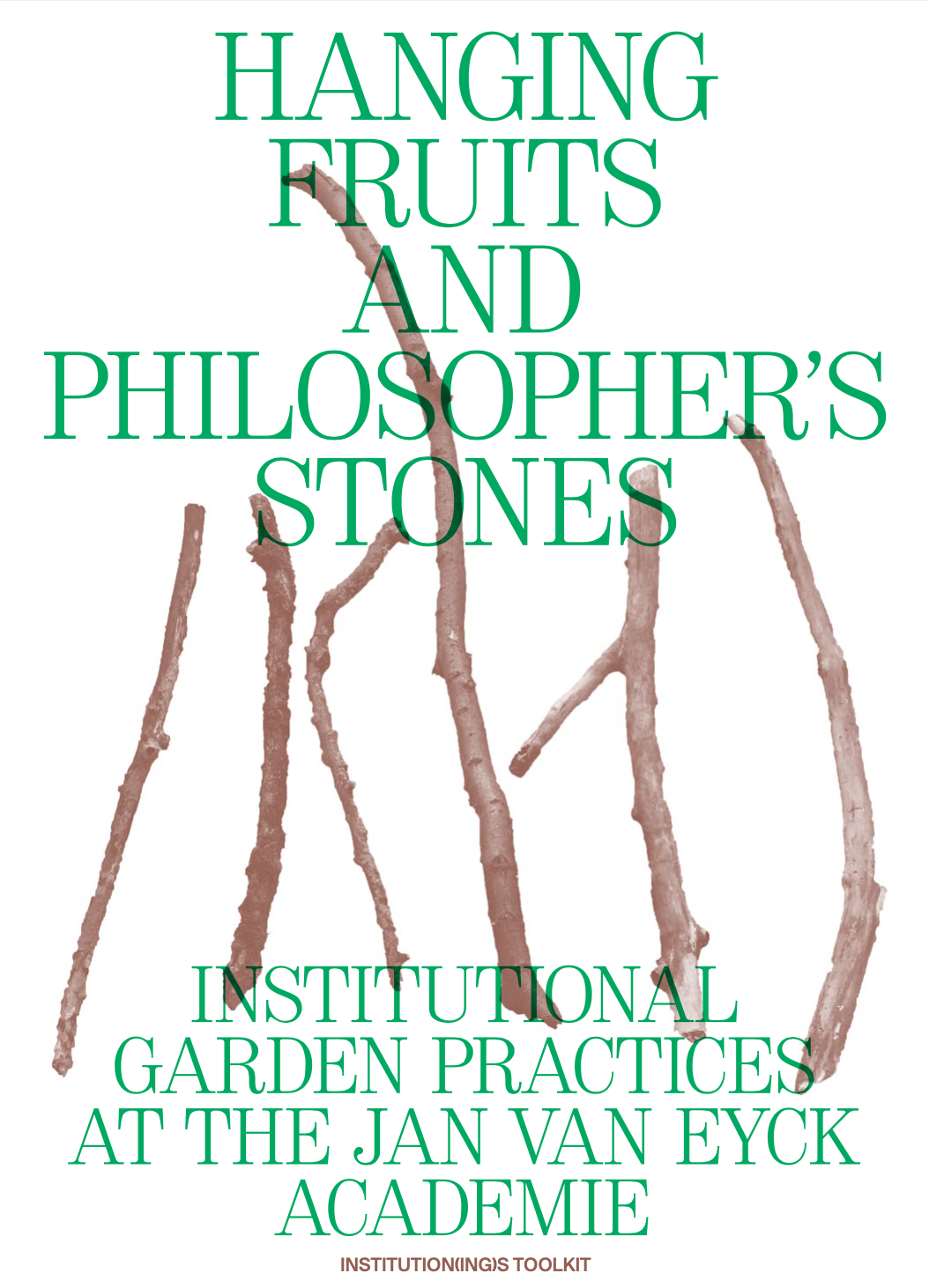
INSTITUTIONAL GARDEN PRACTICES AT THE JAN VAN EYCK ACADEMIE: A TOOLKIT
This little toolkit looks back at five years of gardening at the Jan van Eyck Academie. By gardening, we do not refer here exclusively to the practice that combines a variety of actions such as sowing seedlings, planting, pruning, harvesting, and shoveling. We consider gardening as a broader term that also includes questioning, remembering, reviving, discovering, connecting and caring.
The toolkit presents a nonexhaustive selection of contributions from JvE alumni, who engaged with, reflected on, and transitioned through a little plot of land hidden in the core of the academy. Called the Vegetable Garden, this plot of land has been a crossover of practices differently related to the Nature Research department and the Food Lab. Collectively maintained, the garden provided the academy’s café with for instance a seasonal tisane, a selection of herbs, fruits and plants from our growing Food Forest concept, a yearly yield of grapes, a variety of berries and an everchanging selection of vegetables and fruits brought and grown by the participants. This has offered and will continue to offer the participants sensory and sensorial networks to ponder a multiplicity of questions and experiment with a variety of modes of multi-species collaboration.
As you will read, the toolkit is shaped by hanging fruits and philosophers stones, ducks and coffee beans, grass and compost, a variety of ferments and dyes, architectural hums. It gathers texts, poems, recipes, maps, drawings: we consider these the traces of thinking and making processes that emerged over five years at the Jan van Eyck Academie. We want to thank all the contributors who generously agreed to share this, sometimes unpublished, often exploratory, always inspiring material. Our gratitude also goes to all the other artists, colleagues, advisors, and collaborators who have contributed to the life of the garden and inspired us to think about the material and metaphorical significance of institutional garden practices.
Giulia Bellinetti (Nature Research Department & Future Materials Lab)
Marente van der Valk (Food Lab)
This is an extract of selected pages from the toolkit, download the full version here.
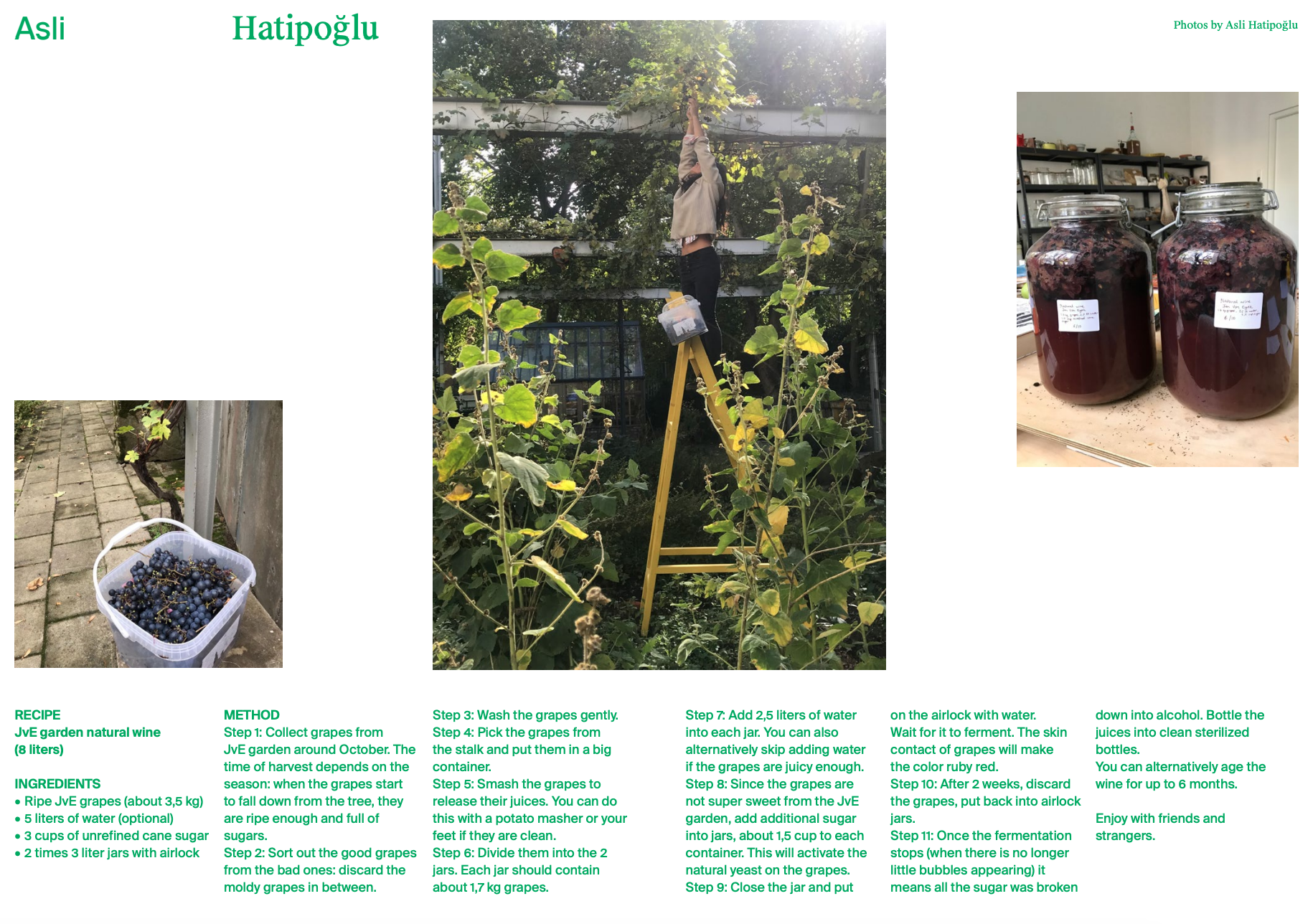
Asli Hatipoğlu (TR/TH/NL) is an interdisciplinary artist whose social practice focuses on curating participatory dinners and installations that shed light on how culinary history and agricultural politics are changing our relationship to food. From working with micro-scale bacteria and yeasts responsible in fermentation to insects such as the domesticated silkworm, Asli critically investigates ways of relating to our environment and ourselves. She has been working with the shifting narrative of an artist and a tour-guide, merging fiction and reality with story-telling in performative acts as a way to critically question today’s systems of production. By engaging people in conversation, she opens dialogue in critical thinking looking at the past and present use of landscapes and their speculative futures. Asli deepened her knowledge of fermentation during her residency at the Food Lab Jan van Eyck Academie 2020- 2021, along with participating in festivals such as Food Art Film Festival JvE (NL), Taking Root–Food Art Film Festival CCA Glasgow (UK), Foodculture Days Vevey (CH), Japanese Knotweed Festival at Mediamatic (NL), Zamus Theaterhaus Cologne (DE), Bazaar Festival (CZ), Kiemkracht festival Ghent (BE). She has followed an artistic research residency at A.PASS (Advanced performance and scenography studies) in Belgium. Her works have been exhibited and performed in places such as Textiel Museum Tilburg (NL), Villa Filanda Antonini (IT), Nesse Terneuzen (NL), Kunstverein Bielefeld (DE), Lantz’scher park Dusseldorf (DE), Zuiderzee Museum Enkhuizen (NL), Radius CCA Delft (NL), Het Nieuwe Instituut Rotterdam (NL), Jan Van Eyck Academie Maastricht (NL), Kunsthaus NRW Kornelimünster (DE), Kafkarna Prague (CZ), Hectolitre Art space Brussels (BE).
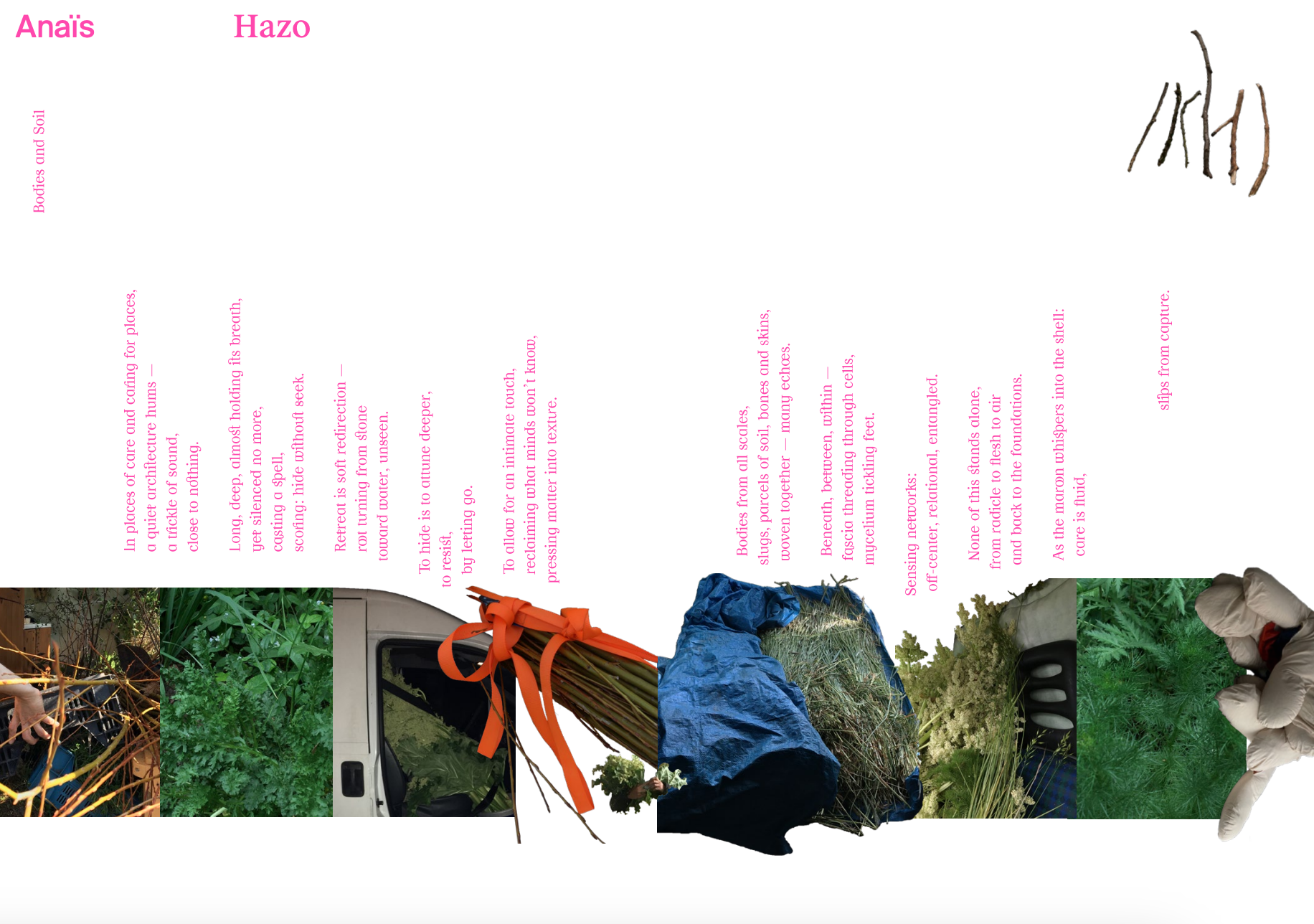
Anaïs Hazo (1989) is a French artist living and working between France and the Netherlands. Drawing from vernacular, feminist, and anthropological embodied research, she uses various humble, malleable materials: clay, textiles, food, plants, texts. Her multi-faceted practice unfolds into scores, artifacts, tools and spaces — shelters for regeneration and resistance. Rooted in her Caribbean heritage and inspired by maroon strategies of concealment and resilience, it merges artistic and therapeutic approaches into a form of “quiet activism.” Her trajectory includes numerous international residencies. At the Jan van Eyck Academie, she worked with and within the institution’s garden to craft a hidden space in which to retreat. This process significantly shaped her early care-centered artistic frameworks in relation to contemporary social and ecological issues. Hazo is also a birth doula and a myofascial release practitioner. In 2025, she returned to the Jan van Eyck and gave her first massages to the staff and participants of the Academie. She is currently developing a long-term studio, where she will host the public for treatments.
Elia Nurvista is an Indonesian artist and independent artistic researcher whose work examines the politics of food through contemporary art, research, and pedagogy. Using food as a social, political, and ecological lens, she explores labour, extraction, everyday consumption, and collective knowledge, while tracing their entanglements with ecology, gender, class, and geopolitics. Her practice spans workshops, study groups, publications, site-specific projects, performance, video, and installation. In 2015, she initiated Bakudapan Food Study Group, a Yogyakarta- based artistic research collective focused on food within broader cultural and political contexts. Through Bakudapan, she has developed collaborative research, publications, and public projects grounded in complementarity and camaraderie. She lives and works in Yogyakarta, Indonesia.
This Toolkit is issued by the Jan van Eyck Academie and is developed within the European Cooperation Project Institution(ing)s: Co-Creating Inclusive and Sustainable European Art Institutions. Contributors: Suzanne Bernhardt, Proyecto Cocuyo, Luca Gerry Conte, Cristina Flores Pescorán, Yoeri Guépin, Kexin Hao, Asli Hatipoğlu, Anaïs Hazo, Elia Nurvista, Nickie Sigurdsson. Text & Editing: Giulia Bellinetti and Marente van der Valk. Design: Ton van de Ven Partners:
Institution(ing)s is a mediumscale collaboration project co-funded by the European Union. Views and opinions expressed are however those of the author(s) only and do not necessarily reflect those of the European Union or the European Education and Culture Executive Agency (EACEA). Neither the European Union nor EACEA can be held responsible for them.
BY THE JAN VAN EYCK ACADEMIE
INSTITUTIONAL GARDEN PRACTICES AT THE JAN VAN EYCK ACADEMIE: A TOOLKIT
This little toolkit looks back at five years of gardening at the Jan van Eyck Academie. By gardening, we do not refer here exclusively to the practice that combines a variety of actions such as sowing seedlings, planting, pruning, harvesting, and shoveling. We consider gardening as a broader term that also includes questioning, remembering, reviving, discovering, connecting and caring.
The toolkit presents a nonexhaustive selection of contributions from JvE alumni, who engaged with, reflected on, and transitioned through a little plot of land hidden in the core of the academy. Called the Vegetable Garden, this plot of land has been a crossover of practices differently related to the Nature Research department and the Food Lab. Collectively maintained, the garden provided the academy’s café with for instance a seasonal tisane, a selection of herbs, fruits and plants from our growing Food Forest concept, a yearly yield of grapes, a variety of berries and an everchanging selection of vegetables and fruits brought and grown by the participants. This has offered and will continue to offer the participants sensory and sensorial networks to ponder a multiplicity of questions and experiment with a variety of modes of multi-species collaboration.
As you will read, the toolkit is shaped by hanging fruits and philosophers stones, ducks and coffee beans, grass and compost, a variety of ferments and dyes, architectural hums. It gathers texts, poems, recipes, maps, drawings: we consider these the traces of thinking and making processes that emerged over five years at the Jan van Eyck Academie. We want to thank all the contributors who generously agreed to share this, sometimes unpublished, often exploratory, always inspiring material. Our gratitude also goes to all the other artists, colleagues, advisors, and collaborators who have contributed to the life of the garden and inspired us to think about the material and metaphorical significance of institutional garden practices.
Giulia Bellinetti (Nature Research Department & Future Materials Lab)
Marente van der Valk (Food Lab)
This is an extract of selected pages from the toolkit, download the full version here.
INSTITUTIONAL GARDEN PRACTICES AT THE JAN VAN EYCK ACADEMIE: A TOOLKIT
This little toolkit looks back at five years of gardening at the Jan van Eyck Academie. By gardening, we do not refer here exclusively to the practice that combines a variety of actions such as sowing seedlings, planting, pruning, harvesting, and shoveling. We consider gardening as a broader term that also includes questioning, remembering, reviving, discovering, connecting and caring.
The toolkit presents a nonexhaustive selection of contributions from JvE alumni, who engaged with, reflected on, and transitioned through a little plot of land hidden in the core of the academy. Called the Vegetable Garden, this plot of land has been a crossover of practices differently related to the Nature Research department and the Food Lab. Collectively maintained, the garden provided the academy’s café with for instance a seasonal tisane, a selection of herbs, fruits and plants from our growing Food Forest concept, a yearly yield of grapes, a variety of berries and an everchanging selection of vegetables and fruits brought and grown by the participants. This has offered and will continue to offer the participants sensory and sensorial networks to ponder a multiplicity of questions and experiment with a variety of modes of multi-species collaboration.
As you will read, the toolkit is shaped by hanging fruits and philosophers stones, ducks and coffee beans, grass and compost, a variety of ferments and dyes, architectural hums. It gathers texts, poems, recipes, maps, drawings: we consider these the traces of thinking and making processes that emerged over five years at the Jan van Eyck Academie. We want to thank all the contributors who generously agreed to share this, sometimes unpublished, often exploratory, always inspiring material. Our gratitude also goes to all the other artists, colleagues, advisors, and collaborators who have contributed to the life of the garden and inspired us to think about the material and metaphorical significance of institutional garden practices.
Giulia Bellinetti (Nature Research Department & Future Materials Lab)
Marente van der Valk (Food Lab)
This is an extract of selected pages from the toolkit, download the full version here.
Asli Hatipoğlu (TR/TH/NL) is an interdisciplinary artist whose social practice focuses on curating participatory dinners and installations that shed light on how culinary history and agricultural politics are changing our relationship to food. From working with micro-scale bacteria and yeasts responsible in fermentation to insects such as the domesticated silkworm, Asli critically investigates ways of relating to our environment and ourselves. She has been working with the shifting narrative of an artist and a tour-guide, merging fiction and reality with story-telling in performative acts as a way to critically question today’s systems of production. By engaging people in conversation, she opens dialogue in critical thinking looking at the past and present use of landscapes and their speculative futures. Asli deepened her knowledge of fermentation during her residency at the Food Lab Jan van Eyck Academie 2020- 2021, along with participating in festivals such as Food Art Film Festival JvE (NL), Taking Root–Food Art Film Festival CCA Glasgow (UK), Foodculture Days Vevey (CH), Japanese Knotweed Festival at Mediamatic (NL), Zamus Theaterhaus Cologne (DE), Bazaar Festival (CZ), Kiemkracht festival Ghent (BE). She has followed an artistic research residency at A.PASS (Advanced performance and scenography studies) in Belgium. Her works have been exhibited and performed in places such as Textiel Museum Tilburg (NL), Villa Filanda Antonini (IT), Nesse Terneuzen (NL), Kunstverein Bielefeld (DE), Lantz’scher park Dusseldorf (DE), Zuiderzee Museum Enkhuizen (NL), Radius CCA Delft (NL), Het Nieuwe Instituut Rotterdam (NL), Jan Van Eyck Academie Maastricht (NL), Kunsthaus NRW Kornelimünster (DE), Kafkarna Prague (CZ), Hectolitre Art space Brussels (BE).
Anaïs Hazo (1989) is a French artist living and working between France and the Netherlands. Drawing from vernacular, feminist, and anthropological embodied research, she uses various humble, malleable materials: clay, textiles, food, plants, texts. Her multi-faceted practice unfolds into scores, artifacts, tools and spaces — shelters for regeneration and resistance. Rooted in her Caribbean heritage and inspired by maroon strategies of concealment and resilience, it merges artistic and therapeutic approaches into a form of “quiet activism.” Her trajectory includes numerous international residencies. At the Jan van Eyck Academie, she worked with and within the institution’s garden to craft a hidden space in which to retreat. This process significantly shaped her early care-centered artistic frameworks in relation to contemporary social and ecological issues. Hazo is also a birth doula and a myofascial release practitioner. In 2025, she returned to the Jan van Eyck and gave her first massages to the staff and participants of the Academie. She is currently developing a long-term studio, where she will host the public for treatments.
Elia Nurvista is an Indonesian artist and independent artistic researcher whose work examines the politics of food through contemporary art, research, and pedagogy. Using food as a social, political, and ecological lens, she explores labour, extraction, everyday consumption, and collective knowledge, while tracing their entanglements with ecology, gender, class, and geopolitics. Her practice spans workshops, study groups, publications, site-specific projects, performance, video, and installation. In 2015, she initiated Bakudapan Food Study Group, a Yogyakarta- based artistic research collective focused on food within broader cultural and political contexts. Through Bakudapan, she has developed collaborative research, publications, and public projects grounded in complementarity and camaraderie. She lives and works in Yogyakarta, Indonesia.
This Toolkit is issued by the Jan van Eyck Academie and is developed within the European Cooperation Project Institution(ing)s: Co-Creating Inclusive and Sustainable European Art Institutions. Contributors: Suzanne Bernhardt, Proyecto Cocuyo, Luca Gerry Conte, Cristina Flores Pescorán, Yoeri Guépin, Kexin Hao, Asli Hatipoğlu, Anaïs Hazo, Elia Nurvista, Nickie Sigurdsson. Text & Editing: Giulia Bellinetti and Marente van der Valk. Design: Ton van de Ven Partners:
Institution(ing)s is a mediumscale collaboration project co-funded by the European Union. Views and opinions expressed are however those of the author(s) only and do not necessarily reflect those of the European Union or the European Education and Culture Executive Agency (EACEA). Neither the European Union nor EACEA can be held responsible for them.