BY GEOFFREY LILLEMON
An electric cauldron controller made during a two week Anthropic micro residency where I used Claude to explore how ritualistic behavior can drive digital art, immersive environments, and sound. Part of <Please Touch the Art>, a research project by AIxDESIGN, with findings presented at Nxt Museum.
The cauldron is ringed with 8 piezo sensors that pick up every tap, knock, and stir as a live signal which can be mapped to anything, so a simple physical gesture becomes a way to control visuals, sound, spatial installations.Hardware Stack:Arduino UNO Q for sensors (piezo) and (psu-gyroscope) + Arduino Leonardo for L.E.D control.
See Geoffrey's website for demos of how a digital artwork can be controlled by stick tapping or how spatial audio can be distributed by moving marbles along the rim or how a neural network can be glitched based on stirring the cauldron.
An electric cauldron controller made during a two week Anthropic micro residency where I used Claude to explore how ritualistic behavior can drive digital art, immersive environments, and sound. Part of <Please Touch the Art>, a research project by AIxDESIGN, with findings presented at Nxt Museum.
The cauldron is ringed with 8 piezo sensors that pick up every tap, knock, and stir as a live signal which can be mapped to anything, so a simple physical gesture becomes a way to control visuals, sound, spatial installations.Hardware Stack:Arduino UNO Q for sensors (piezo) and (psu-gyroscope) + Arduino Leonardo for L.E.D control.
See Geoffrey's website for demos of how a digital artwork can be controlled by stick tapping or how spatial audio can be distributed by moving marbles along the rim or how a neural network can be glitched based on stirring the cauldron.
Geoffrey Lillemon (b. 1981, USA/ NETHERLANDS) is an Amsterdam-based digital artist and a defining figure of the early-2000s interactive avant-garde. Rising to prominence through his legendary platform Oculart, Lillemon carved a path distinctly separate from the raw, code-breaking Net Art of the 1990s. Instead, he was among the first to transform the web browser into a theater for high-fidelity interactive art—orchestrating collisions between classical romanticism, the macabre, and bleeding-edge computation.For over two decades, Lillemon has treated code, CGI, and procedural logic as materials for modern alchemy. Today, he constructs autonomous digital ecosystems and speculative realities. By blending traditional art motifs with real-time technologies, he creates living artworks that perform, react, and decay in the browser. His work deliberately pushes technological perfection to its breaking point to explore human vulnerability, mortality, and the infinite depths of the digital subconscious.Lillemon’s artworks reside in the permanent collection of the Stedelijk Museum in Amsterdam, and have been exhibited at major institutions including Museum Boijmans Van Beuningen in Rotterdam and as the Invité d'Honneur at the Centre Pompidou in Paris. Fiercely rooted in contemporary fine art, his boundary-pushing aesthetic has continuously infiltrated mainstream visual culture through historic collaborations across avant-garde fashion, music, and immersive experiences such as the Nxt Museum.
BY GEOFFREY LILLEMON
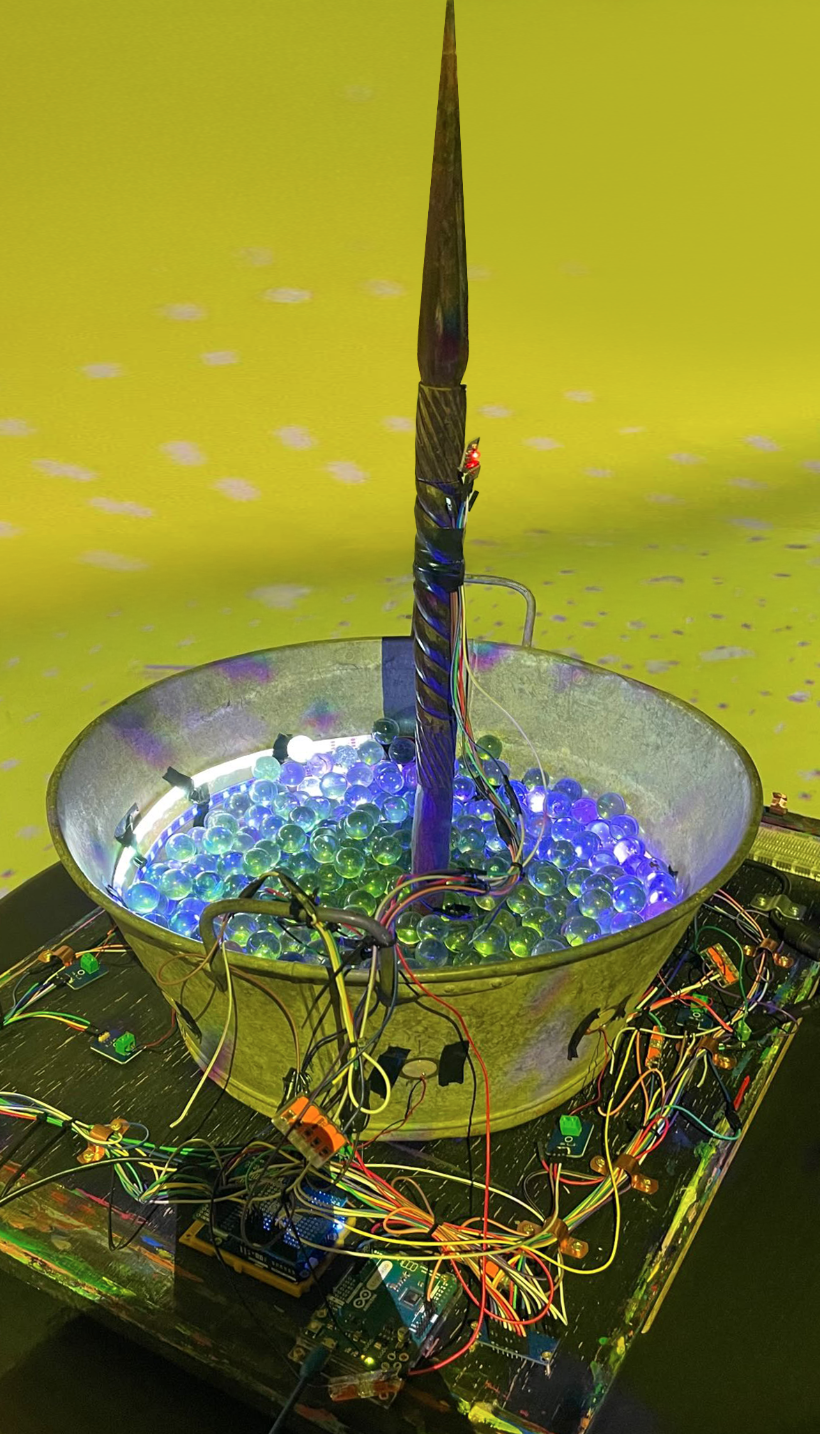
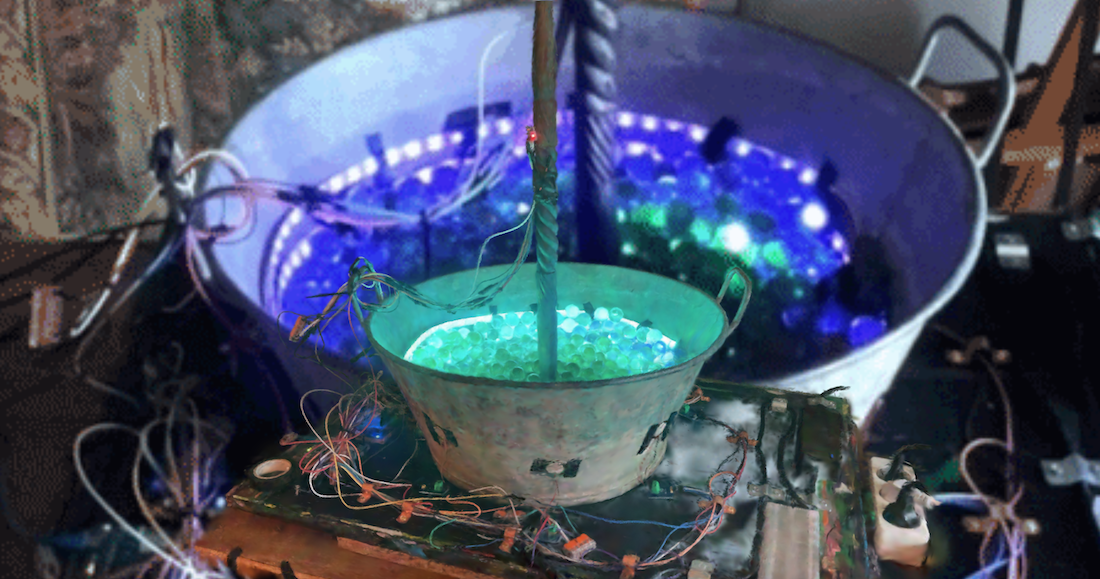
An electric cauldron controller made during a two week Anthropic micro residency where I used Claude to explore how ritualistic behavior can drive digital art, immersive environments, and sound. Part of <Please Touch the Art>, a research project by AIxDESIGN, with findings presented at Nxt Museum.
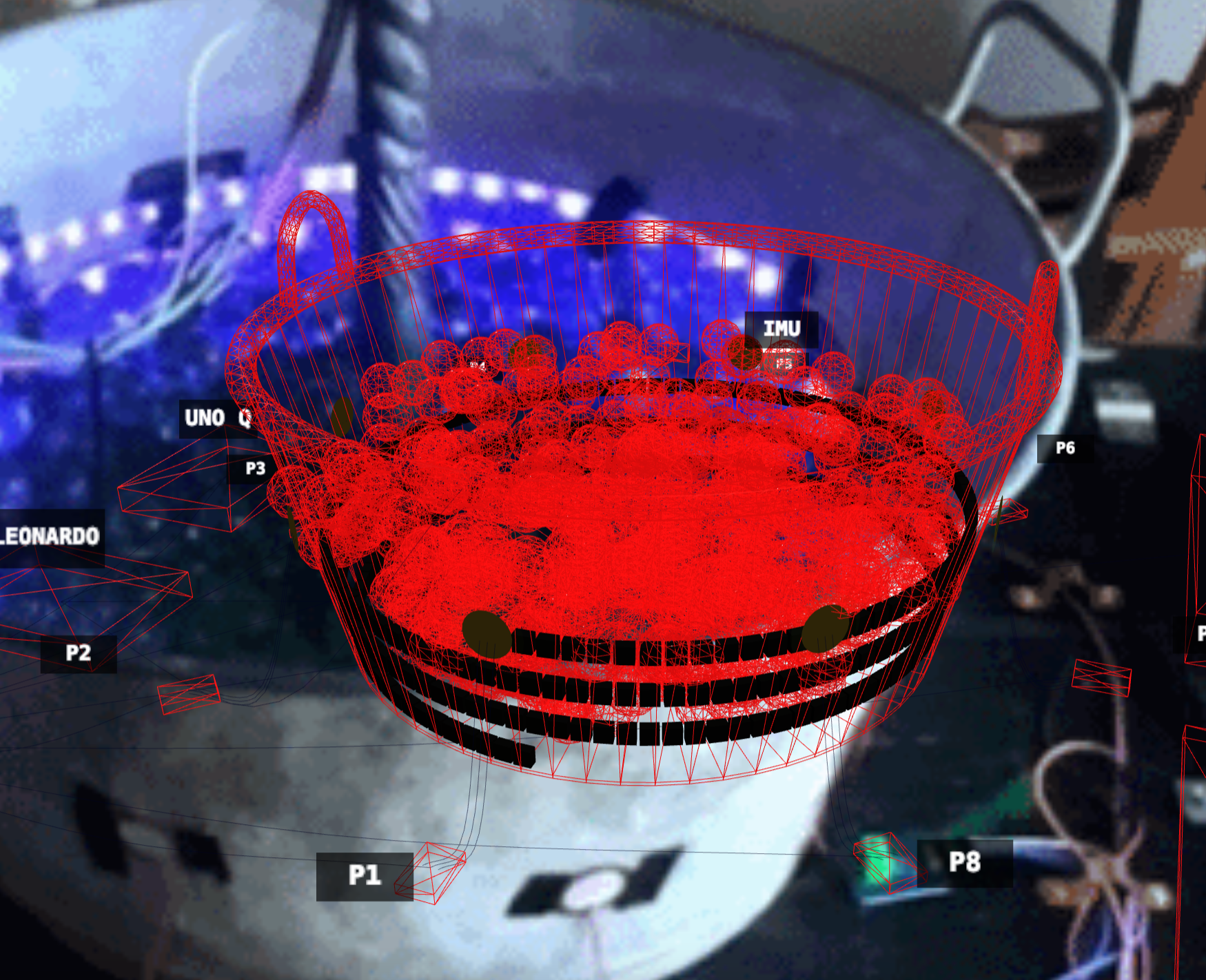
The cauldron is ringed with 8 piezo sensors that pick up every tap, knock, and stir as a live signal which can be mapped to anything, so a simple physical gesture becomes a way to control visuals, sound, spatial installations.Hardware Stack:Arduino UNO Q for sensors (piezo) and (psu-gyroscope) + Arduino Leonardo for L.E.D control.
See Geoffrey's website for demos of how a digital artwork can be controlled by stick tapping or how spatial audio can be distributed by moving marbles along the rim or how a neural network can be glitched based on stirring the cauldron.
An electric cauldron controller made during a two week Anthropic micro residency where I used Claude to explore how ritualistic behavior can drive digital art, immersive environments, and sound. Part of <Please Touch the Art>, a research project by AIxDESIGN, with findings presented at Nxt Museum.
The cauldron is ringed with 8 piezo sensors that pick up every tap, knock, and stir as a live signal which can be mapped to anything, so a simple physical gesture becomes a way to control visuals, sound, spatial installations.Hardware Stack:Arduino UNO Q for sensors (piezo) and (psu-gyroscope) + Arduino Leonardo for L.E.D control.
See Geoffrey's website for demos of how a digital artwork can be controlled by stick tapping or how spatial audio can be distributed by moving marbles along the rim or how a neural network can be glitched based on stirring the cauldron.
Geoffrey Lillemon (b. 1981, USA/ NETHERLANDS) is an Amsterdam-based digital artist and a defining figure of the early-2000s interactive avant-garde. Rising to prominence through his legendary platform Oculart, Lillemon carved a path distinctly separate from the raw, code-breaking Net Art of the 1990s. Instead, he was among the first to transform the web browser into a theater for high-fidelity interactive art—orchestrating collisions between classical romanticism, the macabre, and bleeding-edge computation.For over two decades, Lillemon has treated code, CGI, and procedural logic as materials for modern alchemy. Today, he constructs autonomous digital ecosystems and speculative realities. By blending traditional art motifs with real-time technologies, he creates living artworks that perform, react, and decay in the browser. His work deliberately pushes technological perfection to its breaking point to explore human vulnerability, mortality, and the infinite depths of the digital subconscious.Lillemon’s artworks reside in the permanent collection of the Stedelijk Museum in Amsterdam, and have been exhibited at major institutions including Museum Boijmans Van Beuningen in Rotterdam and as the Invité d'Honneur at the Centre Pompidou in Paris. Fiercely rooted in contemporary fine art, his boundary-pushing aesthetic has continuously infiltrated mainstream visual culture through historic collaborations across avant-garde fashion, music, and immersive experiences such as the Nxt Museum.
BY GEOFFREY LILLEMON
An electric cauldron controller made during a two week Anthropic micro residency where I used Claude to explore how ritualistic behavior can drive digital art, immersive environments, and sound. Part of <Please Touch the Art>, a research project by AIxDESIGN, with findings presented at Nxt Museum.
The cauldron is ringed with 8 piezo sensors that pick up every tap, knock, and stir as a live signal which can be mapped to anything, so a simple physical gesture becomes a way to control visuals, sound, spatial installations.Hardware Stack:Arduino UNO Q for sensors (piezo) and (psu-gyroscope) + Arduino Leonardo for L.E.D control.
See Geoffrey's website for demos of how a digital artwork can be controlled by stick tapping or how spatial audio can be distributed by moving marbles along the rim or how a neural network can be glitched based on stirring the cauldron.
An electric cauldron controller made during a two week Anthropic micro residency where I used Claude to explore how ritualistic behavior can drive digital art, immersive environments, and sound. Part of <Please Touch the Art>, a research project by AIxDESIGN, with findings presented at Nxt Museum.
The cauldron is ringed with 8 piezo sensors that pick up every tap, knock, and stir as a live signal which can be mapped to anything, so a simple physical gesture becomes a way to control visuals, sound, spatial installations.Hardware Stack:Arduino UNO Q for sensors (piezo) and (psu-gyroscope) + Arduino Leonardo for L.E.D control.
See Geoffrey's website for demos of how a digital artwork can be controlled by stick tapping or how spatial audio can be distributed by moving marbles along the rim or how a neural network can be glitched based on stirring the cauldron.
Geoffrey Lillemon (b. 1981, USA/ NETHERLANDS) is an Amsterdam-based digital artist and a defining figure of the early-2000s interactive avant-garde. Rising to prominence through his legendary platform Oculart, Lillemon carved a path distinctly separate from the raw, code-breaking Net Art of the 1990s. Instead, he was among the first to transform the web browser into a theater for high-fidelity interactive art—orchestrating collisions between classical romanticism, the macabre, and bleeding-edge computation.For over two decades, Lillemon has treated code, CGI, and procedural logic as materials for modern alchemy. Today, he constructs autonomous digital ecosystems and speculative realities. By blending traditional art motifs with real-time technologies, he creates living artworks that perform, react, and decay in the browser. His work deliberately pushes technological perfection to its breaking point to explore human vulnerability, mortality, and the infinite depths of the digital subconscious.Lillemon’s artworks reside in the permanent collection of the Stedelijk Museum in Amsterdam, and have been exhibited at major institutions including Museum Boijmans Van Beuningen in Rotterdam and as the Invité d'Honneur at the Centre Pompidou in Paris. Fiercely rooted in contemporary fine art, his boundary-pushing aesthetic has continuously infiltrated mainstream visual culture through historic collaborations across avant-garde fashion, music, and immersive experiences such as the Nxt Museum.
BY GEOFFREY LILLEMON
An electric cauldron controller made during a two week Anthropic micro residency where I used Claude to explore how ritualistic behavior can drive digital art, immersive environments, and sound. Part of <Please Touch the Art>, a research project by AIxDESIGN, with findings presented at Nxt Museum.
The cauldron is ringed with 8 piezo sensors that pick up every tap, knock, and stir as a live signal which can be mapped to anything, so a simple physical gesture becomes a way to control visuals, sound, spatial installations.Hardware Stack:Arduino UNO Q for sensors (piezo) and (psu-gyroscope) + Arduino Leonardo for L.E.D control.
See Geoffrey's website for demos of how a digital artwork can be controlled by stick tapping or how spatial audio can be distributed by moving marbles along the rim or how a neural network can be glitched based on stirring the cauldron.
An electric cauldron controller made during a two week Anthropic micro residency where I used Claude to explore how ritualistic behavior can drive digital art, immersive environments, and sound. Part of <Please Touch the Art>, a research project by AIxDESIGN, with findings presented at Nxt Museum.
The cauldron is ringed with 8 piezo sensors that pick up every tap, knock, and stir as a live signal which can be mapped to anything, so a simple physical gesture becomes a way to control visuals, sound, spatial installations.Hardware Stack:Arduino UNO Q for sensors (piezo) and (psu-gyroscope) + Arduino Leonardo for L.E.D control.
See Geoffrey's website for demos of how a digital artwork can be controlled by stick tapping or how spatial audio can be distributed by moving marbles along the rim or how a neural network can be glitched based on stirring the cauldron.
Geoffrey Lillemon (b. 1981, USA/ NETHERLANDS) is an Amsterdam-based digital artist and a defining figure of the early-2000s interactive avant-garde. Rising to prominence through his legendary platform Oculart, Lillemon carved a path distinctly separate from the raw, code-breaking Net Art of the 1990s. Instead, he was among the first to transform the web browser into a theater for high-fidelity interactive art—orchestrating collisions between classical romanticism, the macabre, and bleeding-edge computation.For over two decades, Lillemon has treated code, CGI, and procedural logic as materials for modern alchemy. Today, he constructs autonomous digital ecosystems and speculative realities. By blending traditional art motifs with real-time technologies, he creates living artworks that perform, react, and decay in the browser. His work deliberately pushes technological perfection to its breaking point to explore human vulnerability, mortality, and the infinite depths of the digital subconscious.Lillemon’s artworks reside in the permanent collection of the Stedelijk Museum in Amsterdam, and have been exhibited at major institutions including Museum Boijmans Van Beuningen in Rotterdam and as the Invité d'Honneur at the Centre Pompidou in Paris. Fiercely rooted in contemporary fine art, his boundary-pushing aesthetic has continuously infiltrated mainstream visual culture through historic collaborations across avant-garde fashion, music, and immersive experiences such as the Nxt Museum.