INTERVIEW WITH EMILY ALDEN
JF - In My Head invites us into the intimate landscape of listening, where listening becomes visible through the body. What first moved you to explore your own experience of hearing loss through movement and sound, and how has the creative process reshaped the way you understand sound itself?
EA - It largely began during a time in my life with a noticeable a shift in my hearing both in my personal life and within work where I was travelling independently for a research project in Norway, Belgium, London and the Midlands. The project focussed on creative development as a choreographer, spending time moving between new spaces, places, navigating conversation, being in creative processes where aurally and spatially I was receiving instruction slightly differently than I had in a number of years. I began to be drawn to patterns in behaviour, in particular a gravitation toward quieter spaces where reflection could happen, something which I now know was helping me to manage ‘listening fatigue’ - when your brain is essentially working in overdrive to process auditory information, often filling in the gaps of conversations, making connections and sense of sounds that are incomplete (for me it is the lower registers that I find hardest to hear, and vowels). Periods of quiet are a tonic, a balm for helping the sometimes exhausting experience of working so hard, even if it may not seem so from those around you. It’s an internal, invisible experience, which I think is in part where the power of In My Head lies. It calves out a very specific way for this experience, and the consequences of them, to be shared.
Also, whilst on the research trip I walked a lot, which is when I started using my camera much more intensely to document my travels and experiences through photography. I gravitated toward wanting to search out architecture and natural environments. I realise in hindsight all these experiences I was drawn to were quiet pursuits. They demanded very little from my hearing, they allowed that sense to either be hyper tuned in to something very specific that I could give my whole attention to, or it switched off the use of that sense almost completely. The focus became much more about the visual. I also found I was much more aware of my ‘whole body listening’, hyper aware of my surroundings was intense, I still vividly recall this time with such detail even now 10 years later.
Some of these experiences were very satisfying, some were very frustrating, and I found I was having to work harder than I realised I should to be able to be ‘in sync’ with those around me. I felt a disconnect, a form of isolation, I guess. Socialising I found harder, I couldn’t always keep pace with conversation, especially if in busy restaurants or bars talking to unfamiliar people and the patterns in how they talk being very new information to constantly process.
Returning home and sharing some of these experiences launched me into a very intense and vibrant creative time, diving into a research period focussed on sound, the visceral experience of losing sound, what that means as a dancer, a human, an artist. Dance is my first language, a physical language and one that has trained my body and mind to be attuned to space and rhythm and timing and so much more. Drawing on my dancer knowledge has felt very natural, and also extremely vulnerable at times, as you are sharing such a deeply personal experience using your body as a tool of expression, connection, language, which I’m used to doing, but not quite in the way I found myself working during the research and making of this work. The body is its own sonic world; every person’s hearing is as individual as a fingerprint. Through this project I have learnt a deep respect for sound and silence too, and how being able to access it, or not, can have huge ramifications across all areas of someone's life.
JF - Sound in the work seems to behave almost like a material presence that can overwhelm, distort and disappear. Sound and movement are entangled through live recordings of your heartbeat, pulse and body, as one responds to another. How did you begin to think about sound as something the body can encounter, resist, or inhabit?
EA - I think one of the starting points that I would draw on is that sound is physical, it is vibration, and energy and affects substances and objects that it encounters. The body is largely made of water, sound can be physically felt in the body to much more of a complex degree than we consider in everyday life, through bone, flesh, nerves, cells, skin. Through the research with the collaborators, we discussed and tested all kinds of sound; sounds that comfort, that are uncomfortable, natural, digital, found sound, composed sound, repetitious sound, pattern, in and out of sync and the absence of sound.
Guided by my personal experiences exploring the ranges of sound became a key component of the research, I hear higher ranges clearly, the piano featuring in the piece being a nod to a sonic world where things have an ease, there is a sense of relaxing, of comfort. The lower ranges are much more ungraspable, there’s more searching, constant unease, fractious sounds that really pull your attention. The heartbeat: hearing and feeling your own heartbeat is extraordinarily powerful. It is life (literally the first time hearing my son’s heartbeat before he was born was a moment I will never forget). It is blood. Muscle. Sinew. Electricity. Power. Force. Nature.
We carry this beating heart around with us constantly and pay it very little attention. When you hear it - the heartbeat - and feel it; the vibration, the shifting atoms in a space (particularly the first time I heard it in the technical rehearsals using a sub -base speaker!) it brings it into full volume, literally, in sensation as well as audibly. Sharing that with a room of people I am discovering is quite a special experience. Being in control of that, when I take the microphone towards or away from my body, finding and re-finding the pulse is very empowering for someone who in day-to-day life has a relationship with sound that is much more fragile and delicate where I am not in control of it. Creating a ‘live’ space in performance to take the audience with me to explore in real time sound as an every changing, living entity is a key component of the work and one of the most exciting (and daunting, as it is of course unpredictable as it is so live) aspects of performing I have experienced in my career.
JF - Much of the sonic world of the piece emerges from your own body. What discoveries did you make from the body becoming both the source of sound and the site of listening?
EA - That it is the most incredible, challenging, deeply moving, complex and never-ending source of information. It is a never-ending loop in and of itself that is constantly changing. Working with Daniel Hayes, the sound designer, brought a technical understanding of sound to the process that led to a rigorous and vibrant experimental time exploring specific technical kit, recording and editing techniques, discovering key components of the design that bring my inner world to life.
The sound design captures one person’s experience of hearing loss at a particular point in time. It plays with time, the push, pull of what was, is and might be. I hope it highlights the deeply complex, layered, fragile and profound experience just one person’s experience can be. To invoke empathy - not irritability or infuriation as is very common for those surrounding people dealing with hearing loss - I hope the piece highlights how deeply affecting losing sound and the connection to the world around them can be, often losing people by proxy.
Sound becomes broken, fragmented, distorted, amplified in unexpected ways in the piece. We explored using a variety of ways to capture sound from the body and field recordings, including binaural sound, using contact mics, as well as multiple microphones in performance. The piece currently only uses one microphone. We discovered through the creative process that stripping back, using simple techniques to record, amplify, play and distort the sound, were enough to achieve what the work was asking for.
Excerpt text from live performance In My Head -
I Quiet
A silent echo
I know
But I feel
Room
Where but I try to catch them
From the lips drip away
Shards of broken glass
Full of sound, but I am still
The one who is Quiet
My brain
Fill the silence
Language
Turn to fill my stomach
Rumbles and rumbles
Where does it end
Words hard to hear
It rumbles, but it is Quiet
Out of the ground looking for
Looking for a spark to intervene with
Do you feel like I am here
In the room, our room
Where the laughter
—--
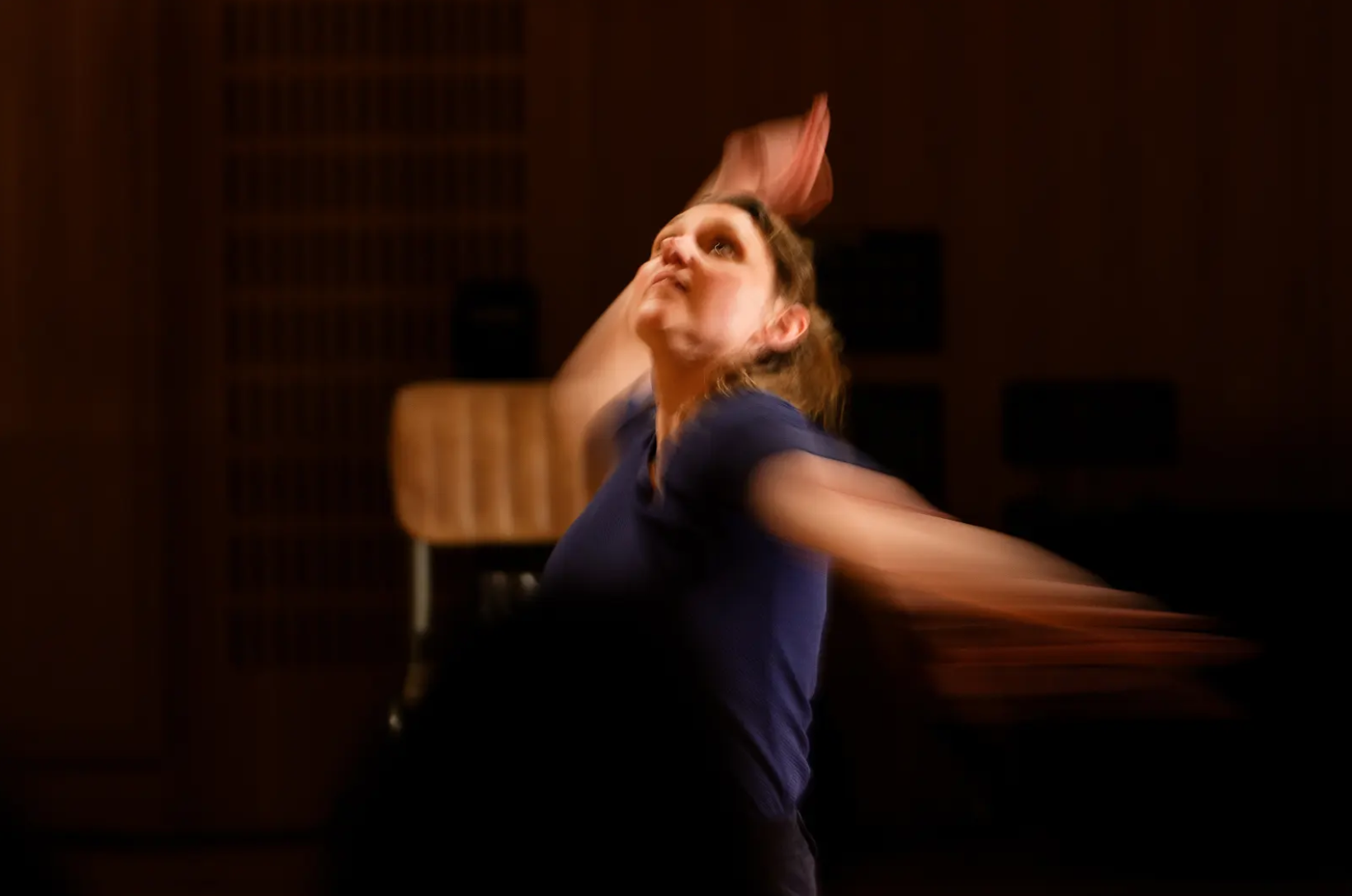
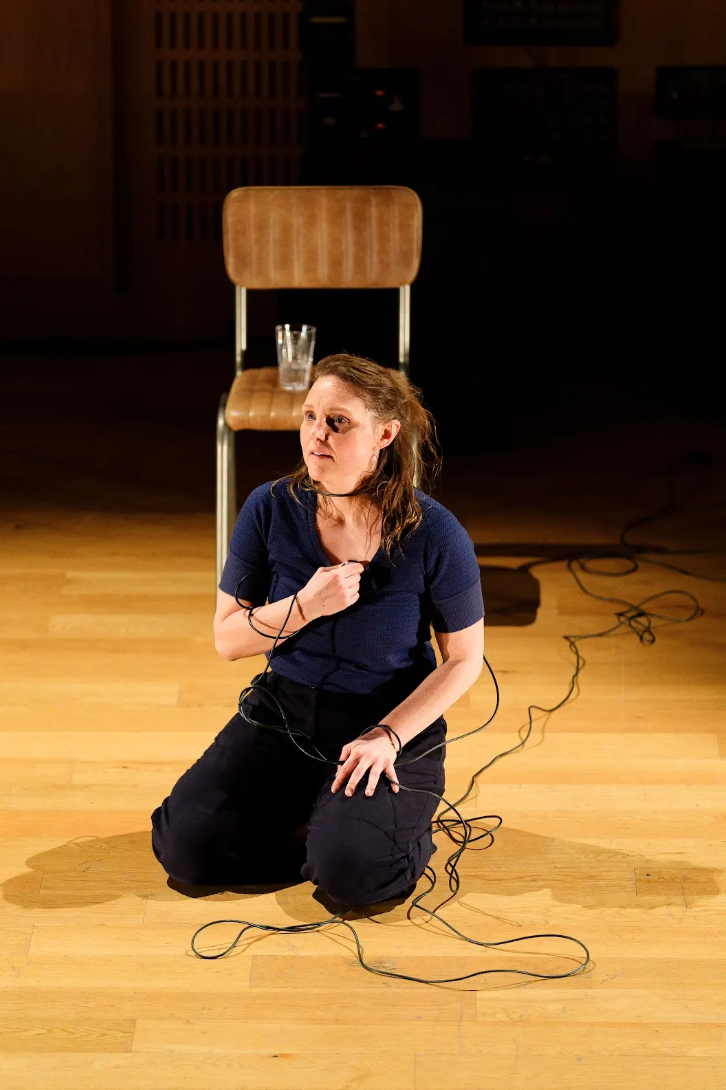
Images: Steve Tanner
In My Head is performed and created by Emily Alden
Sound Design Daniel Hayes
Initial concept dramaturgy and direction Sue Maclaine
Produced by imPOSSIBLE Producing
Initial support includes Hall for Cornwall, Kneehigh Theatre and AMATA, Falmouth University.
JF - In My Head invites us into the intimate landscape of listening, where listening becomes visible through the body. What first moved you to explore your own experience of hearing loss through movement and sound, and how has the creative process reshaped the way you understand sound itself?
EA - It largely began during a time in my life with a noticeable a shift in my hearing both in my personal life and within work where I was travelling independently for a research project in Norway, Belgium, London and the Midlands. The project focussed on creative development as a choreographer, spending time moving between new spaces, places, navigating conversation, being in creative processes where aurally and spatially I was receiving instruction slightly differently than I had in a number of years. I began to be drawn to patterns in behaviour, in particular a gravitation toward quieter spaces where reflection could happen, something which I now know was helping me to manage ‘listening fatigue’ - when your brain is essentially working in overdrive to process auditory information, often filling in the gaps of conversations, making connections and sense of sounds that are incomplete (for me it is the lower registers that I find hardest to hear, and vowels). Periods of quiet are a tonic, a balm for helping the sometimes exhausting experience of working so hard, even if it may not seem so from those around you. It’s an internal, invisible experience, which I think is in part where the power of In My Head lies. It calves out a very specific way for this experience, and the consequences of them, to be shared.
Also, whilst on the research trip I walked a lot, which is when I started using my camera much more intensely to document my travels and experiences through photography. I gravitated toward wanting to search out architecture and natural environments. I realise in hindsight all these experiences I was drawn to were quiet pursuits. They demanded very little from my hearing, they allowed that sense to either be hyper tuned in to something very specific that I could give my whole attention to, or it switched off the use of that sense almost completely. The focus became much more about the visual. I also found I was much more aware of my ‘whole body listening’, hyper aware of my surroundings was intense, I still vividly recall this time with such detail even now 10 years later.
Some of these experiences were very satisfying, some were very frustrating, and I found I was having to work harder than I realised I should to be able to be ‘in sync’ with those around me. I felt a disconnect, a form of isolation, I guess. Socialising I found harder, I couldn’t always keep pace with conversation, especially if in busy restaurants or bars talking to unfamiliar people and the patterns in how they talk being very new information to constantly process.
Returning home and sharing some of these experiences launched me into a very intense and vibrant creative time, diving into a research period focussed on sound, the visceral experience of losing sound, what that means as a dancer, a human, an artist. Dance is my first language, a physical language and one that has trained my body and mind to be attuned to space and rhythm and timing and so much more. Drawing on my dancer knowledge has felt very natural, and also extremely vulnerable at times, as you are sharing such a deeply personal experience using your body as a tool of expression, connection, language, which I’m used to doing, but not quite in the way I found myself working during the research and making of this work. The body is its own sonic world; every person’s hearing is as individual as a fingerprint. Through this project I have learnt a deep respect for sound and silence too, and how being able to access it, or not, can have huge ramifications across all areas of someone's life.
JF - Sound in the work seems to behave almost like a material presence that can overwhelm, distort and disappear. Sound and movement are entangled through live recordings of your heartbeat, pulse and body, as one responds to another. How did you begin to think about sound as something the body can encounter, resist, or inhabit?
EA - I think one of the starting points that I would draw on is that sound is physical, it is vibration, and energy and affects substances and objects that it encounters. The body is largely made of water, sound can be physically felt in the body to much more of a complex degree than we consider in everyday life, through bone, flesh, nerves, cells, skin. Through the research with the collaborators, we discussed and tested all kinds of sound; sounds that comfort, that are uncomfortable, natural, digital, found sound, composed sound, repetitious sound, pattern, in and out of sync and the absence of sound.
Guided by my personal experiences exploring the ranges of sound became a key component of the research, I hear higher ranges clearly, the piano featuring in the piece being a nod to a sonic world where things have an ease, there is a sense of relaxing, of comfort. The lower ranges are much more ungraspable, there’s more searching, constant unease, fractious sounds that really pull your attention. The heartbeat: hearing and feeling your own heartbeat is extraordinarily powerful. It is life (literally the first time hearing my son’s heartbeat before he was born was a moment I will never forget). It is blood. Muscle. Sinew. Electricity. Power. Force. Nature.
We carry this beating heart around with us constantly and pay it very little attention. When you hear it - the heartbeat - and feel it; the vibration, the shifting atoms in a space (particularly the first time I heard it in the technical rehearsals using a sub -base speaker!) it brings it into full volume, literally, in sensation as well as audibly. Sharing that with a room of people I am discovering is quite a special experience. Being in control of that, when I take the microphone towards or away from my body, finding and re-finding the pulse is very empowering for someone who in day-to-day life has a relationship with sound that is much more fragile and delicate where I am not in control of it. Creating a ‘live’ space in performance to take the audience with me to explore in real time sound as an every changing, living entity is a key component of the work and one of the most exciting (and daunting, as it is of course unpredictable as it is so live) aspects of performing I have experienced in my career.
JF - Much of the sonic world of the piece emerges from your own body. What discoveries did you make from the body becoming both the source of sound and the site of listening?
EA - That it is the most incredible, challenging, deeply moving, complex and never-ending source of information. It is a never-ending loop in and of itself that is constantly changing. Working with Daniel Hayes, the sound designer, brought a technical understanding of sound to the process that led to a rigorous and vibrant experimental time exploring specific technical kit, recording and editing techniques, discovering key components of the design that bring my inner world to life.
The sound design captures one person’s experience of hearing loss at a particular point in time. It plays with time, the push, pull of what was, is and might be. I hope it highlights the deeply complex, layered, fragile and profound experience just one person’s experience can be. To invoke empathy - not irritability or infuriation as is very common for those surrounding people dealing with hearing loss - I hope the piece highlights how deeply affecting losing sound and the connection to the world around them can be, often losing people by proxy.
Sound becomes broken, fragmented, distorted, amplified in unexpected ways in the piece. We explored using a variety of ways to capture sound from the body and field recordings, including binaural sound, using contact mics, as well as multiple microphones in performance. The piece currently only uses one microphone. We discovered through the creative process that stripping back, using simple techniques to record, amplify, play and distort the sound, were enough to achieve what the work was asking for.
Excerpt text from live performance In My Head -
I Quiet
A silent echo
I know
But I feel
Room
Where but I try to catch them
From the lips drip away
Shards of broken glass
Full of sound, but I am still
The one who is Quiet
My brain
Fill the silence
Language
Turn to fill my stomach
Rumbles and rumbles
Where does it end
Words hard to hear
It rumbles, but it is Quiet
Out of the ground looking for
Looking for a spark to intervene with
Do you feel like I am here
In the room, our room
Where the laughter
—--
Images: Steve Tanner
In My Head is performed and created by Emily Alden
Sound Design Daniel Hayes
Initial concept dramaturgy and direction Sue Maclaine
Produced by imPOSSIBLE Producing
Initial support includes Hall for Cornwall, Kneehigh Theatre and AMATA, Falmouth University.
Find out more about the project including the Research and Development phase here.
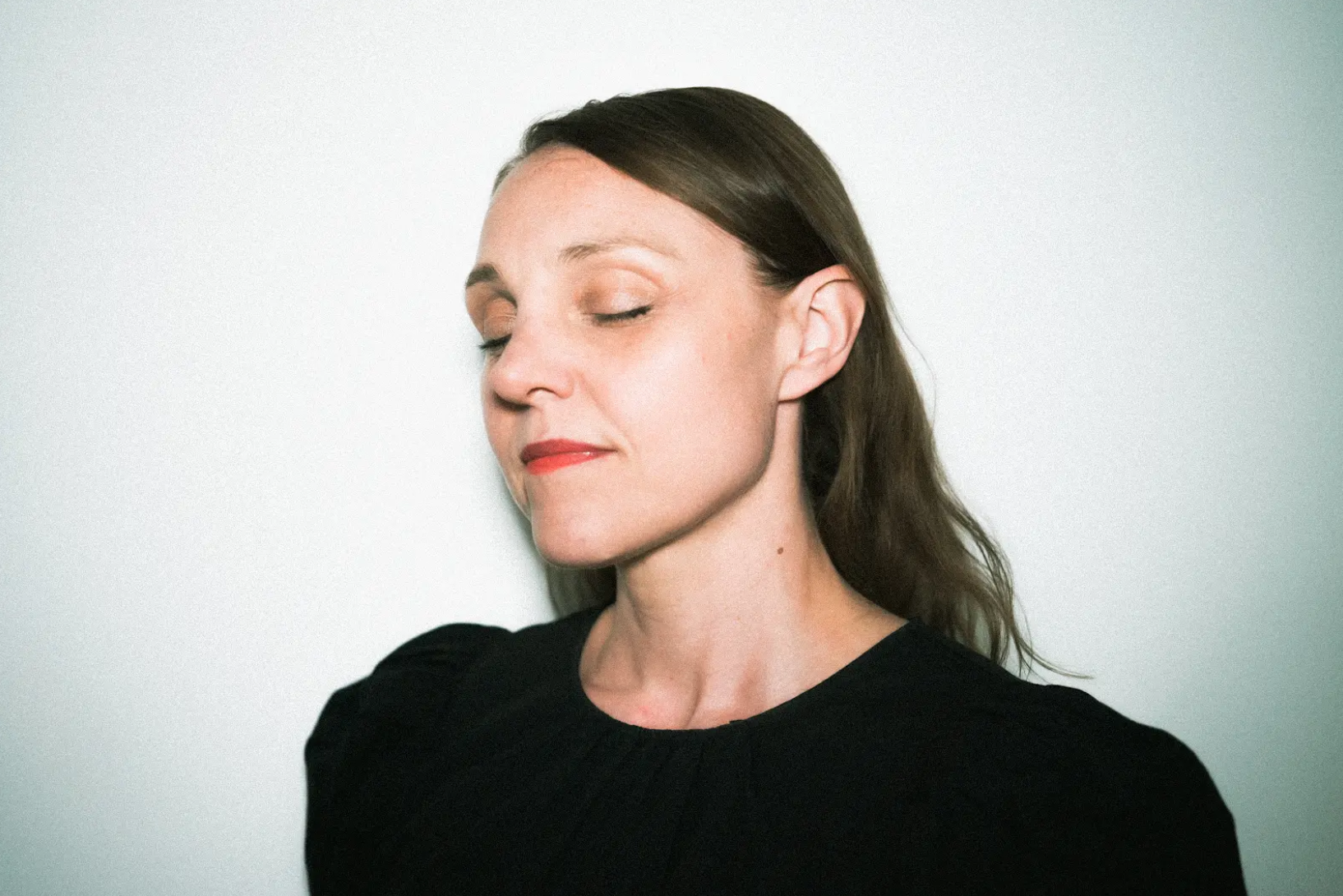
Emily Alden is a dancer & choreographer working across dance & theatre, live & digital formats, & communities. Originally from the Midlands, she trained in Contemporary Dance at Bretton Hall College of Arts in Yorkshire & is now based in Cornwall. Her extensive performance career spans national & international touring including Northern Ireland & the USA, site-specific work, small to large-scale productions, working with companies & artists including Rosemary Lee, WildWorks, Kneehigh Theatre, Simon Birch Dance Company, Cscape Dance, Yael Flexer & Agnieszka Błońska.
She is currently developing In My Head, a new one woman dance theatre work exploring everyday sound & hearing loss with an original, innovative sound design by Dan Hayes. Supported in 2019 through a Developing Your Creative Practice (DYCP) grant from Arts Council England, with additional support from Hall for Cornwall, AMATA (Falmouth University), and Kneehigh Theatre. After a hiatus the project is being revived being produced by Impossible Producing, with work-in-progress sharing’s being performed at Falmouth International Arts Festival in March 2026 & touring in 2026/27 and beyond.
INTERVIEW WITH EMILY ALDEN
JF - In My Head invites us into the intimate landscape of listening, where listening becomes visible through the body. What first moved you to explore your own experience of hearing loss through movement and sound, and how has the creative process reshaped the way you understand sound itself?
EA - It largely began during a time in my life with a noticeable a shift in my hearing both in my personal life and within work where I was travelling independently for a research project in Norway, Belgium, London and the Midlands. The project focussed on creative development as a choreographer, spending time moving between new spaces, places, navigating conversation, being in creative processes where aurally and spatially I was receiving instruction slightly differently than I had in a number of years. I began to be drawn to patterns in behaviour, in particular a gravitation toward quieter spaces where reflection could happen, something which I now know was helping me to manage ‘listening fatigue’ - when your brain is essentially working in overdrive to process auditory information, often filling in the gaps of conversations, making connections and sense of sounds that are incomplete (for me it is the lower registers that I find hardest to hear, and vowels). Periods of quiet are a tonic, a balm for helping the sometimes exhausting experience of working so hard, even if it may not seem so from those around you. It’s an internal, invisible experience, which I think is in part where the power of In My Head lies. It calves out a very specific way for this experience, and the consequences of them, to be shared.
Also, whilst on the research trip I walked a lot, which is when I started using my camera much more intensely to document my travels and experiences through photography. I gravitated toward wanting to search out architecture and natural environments. I realise in hindsight all these experiences I was drawn to were quiet pursuits. They demanded very little from my hearing, they allowed that sense to either be hyper tuned in to something very specific that I could give my whole attention to, or it switched off the use of that sense almost completely. The focus became much more about the visual. I also found I was much more aware of my ‘whole body listening’, hyper aware of my surroundings was intense, I still vividly recall this time with such detail even now 10 years later.
Some of these experiences were very satisfying, some were very frustrating, and I found I was having to work harder than I realised I should to be able to be ‘in sync’ with those around me. I felt a disconnect, a form of isolation, I guess. Socialising I found harder, I couldn’t always keep pace with conversation, especially if in busy restaurants or bars talking to unfamiliar people and the patterns in how they talk being very new information to constantly process.
Returning home and sharing some of these experiences launched me into a very intense and vibrant creative time, diving into a research period focussed on sound, the visceral experience of losing sound, what that means as a dancer, a human, an artist. Dance is my first language, a physical language and one that has trained my body and mind to be attuned to space and rhythm and timing and so much more. Drawing on my dancer knowledge has felt very natural, and also extremely vulnerable at times, as you are sharing such a deeply personal experience using your body as a tool of expression, connection, language, which I’m used to doing, but not quite in the way I found myself working during the research and making of this work. The body is its own sonic world; every person’s hearing is as individual as a fingerprint. Through this project I have learnt a deep respect for sound and silence too, and how being able to access it, or not, can have huge ramifications across all areas of someone's life.
JF - Sound in the work seems to behave almost like a material presence that can overwhelm, distort and disappear. Sound and movement are entangled through live recordings of your heartbeat, pulse and body, as one responds to another. How did you begin to think about sound as something the body can encounter, resist, or inhabit?
EA - I think one of the starting points that I would draw on is that sound is physical, it is vibration, and energy and affects substances and objects that it encounters. The body is largely made of water, sound can be physically felt in the body to much more of a complex degree than we consider in everyday life, through bone, flesh, nerves, cells, skin. Through the research with the collaborators, we discussed and tested all kinds of sound; sounds that comfort, that are uncomfortable, natural, digital, found sound, composed sound, repetitious sound, pattern, in and out of sync and the absence of sound.
Guided by my personal experiences exploring the ranges of sound became a key component of the research, I hear higher ranges clearly, the piano featuring in the piece being a nod to a sonic world where things have an ease, there is a sense of relaxing, of comfort. The lower ranges are much more ungraspable, there’s more searching, constant unease, fractious sounds that really pull your attention. The heartbeat: hearing and feeling your own heartbeat is extraordinarily powerful. It is life (literally the first time hearing my son’s heartbeat before he was born was a moment I will never forget). It is blood. Muscle. Sinew. Electricity. Power. Force. Nature.
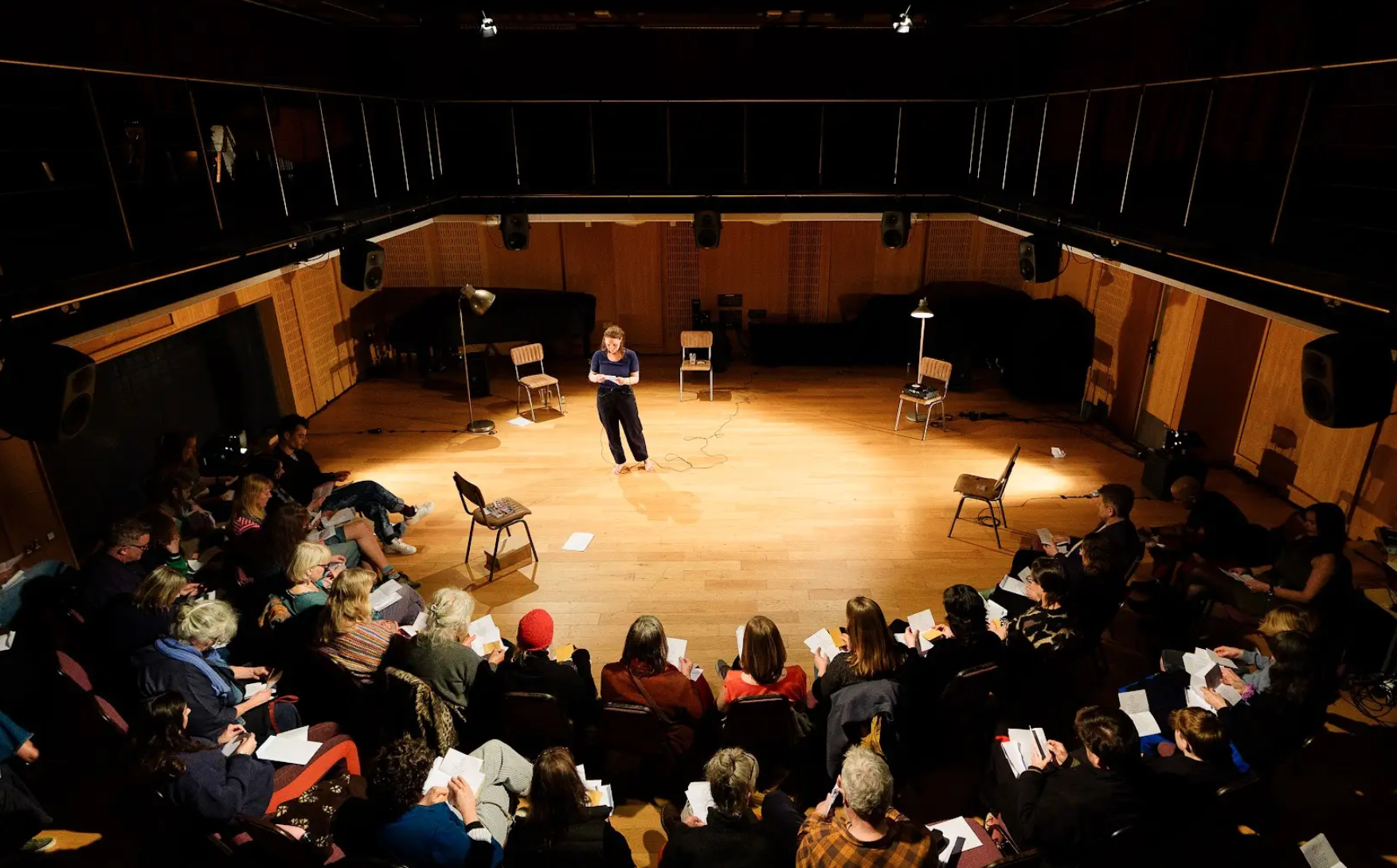
We carry this beating heart around with us constantly and pay it very little attention. When you hear it - the heartbeat - and feel it; the vibration, the shifting atoms in a space (particularly the first time I heard it in the technical rehearsals using a sub -base speaker!) it brings it into full volume, literally, in sensation as well as audibly. Sharing that with a room of people I am discovering is quite a special experience. Being in control of that, when I take the microphone towards or away from my body, finding and re-finding the pulse is very empowering for someone who in day-to-day life has a relationship with sound that is much more fragile and delicate where I am not in control of it. Creating a ‘live’ space in performance to take the audience with me to explore in real time sound as an every changing, living entity is a key component of the work and one of the most exciting (and daunting, as it is of course unpredictable as it is so live) aspects of performing I have experienced in my career.
JF - Much of the sonic world of the piece emerges from your own body. What discoveries did you make from the body becoming both the source of sound and the site of listening?
EA - That it is the most incredible, challenging, deeply moving, complex and never-ending source of information. It is a never-ending loop in and of itself that is constantly changing. Working with Daniel Hayes, the sound designer, brought a technical understanding of sound to the process that led to a rigorous and vibrant experimental time exploring specific technical kit, recording and editing techniques, discovering key components of the design that bring my inner world to life.
The sound design captures one person’s experience of hearing loss at a particular point in time. It plays with time, the push, pull of what was, is and might be. I hope it highlights the deeply complex, layered, fragile and profound experience just one person’s experience can be. To invoke empathy - not irritability or infuriation as is very common for those surrounding people dealing with hearing loss - I hope the piece highlights how deeply affecting losing sound and the connection to the world around them can be, often losing people by proxy.
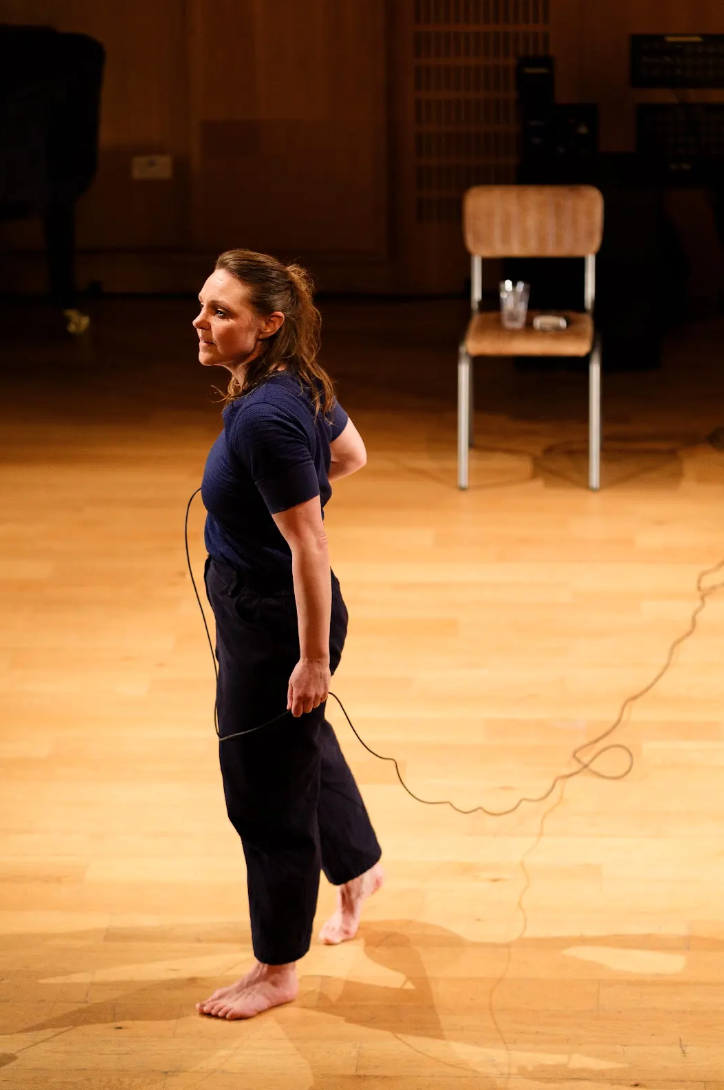
Sound becomes broken, fragmented, distorted, amplified in unexpected ways in the piece. We explored using a variety of ways to capture sound from the body and field recordings, including binaural sound, using contact mics, as well as multiple microphones in performance. The piece currently only uses one microphone. We discovered through the creative process that stripping back, using simple techniques to record, amplify, play and distort the sound, were enough to achieve what the work was asking for.
Excerpt text from live performance In My Head -
I Quiet
A silent echo
I know
But I feel
Room
Where but I try to catch them
From the lips drip away
Shards of broken glass
Full of sound, but I am still
The one who is Quiet
My brain
Fill the silence
Language
Turn to fill my stomach
Rumbles and rumbles
Where does it end
Words hard to hear
It rumbles, but it is Quiet
Out of the ground looking for
Looking for a spark to intervene with
Do you feel like I am here
In the room, our room
Where the laughter
—--
Images: Steve Tanner
In My Head is performed and created by Emily Alden
Sound Design Daniel Hayes
Initial concept dramaturgy and direction Sue Maclaine
Produced by imPOSSIBLE Producing
Initial support includes Hall for Cornwall, Kneehigh Theatre and AMATA, Falmouth University.
JF - In My Head invites us into the intimate landscape of listening, where listening becomes visible through the body. What first moved you to explore your own experience of hearing loss through movement and sound, and how has the creative process reshaped the way you understand sound itself?
EA - It largely began during a time in my life with a noticeable a shift in my hearing both in my personal life and within work where I was travelling independently for a research project in Norway, Belgium, London and the Midlands. The project focussed on creative development as a choreographer, spending time moving between new spaces, places, navigating conversation, being in creative processes where aurally and spatially I was receiving instruction slightly differently than I had in a number of years. I began to be drawn to patterns in behaviour, in particular a gravitation toward quieter spaces where reflection could happen, something which I now know was helping me to manage ‘listening fatigue’ - when your brain is essentially working in overdrive to process auditory information, often filling in the gaps of conversations, making connections and sense of sounds that are incomplete (for me it is the lower registers that I find hardest to hear, and vowels). Periods of quiet are a tonic, a balm for helping the sometimes exhausting experience of working so hard, even if it may not seem so from those around you. It’s an internal, invisible experience, which I think is in part where the power of In My Head lies. It calves out a very specific way for this experience, and the consequences of them, to be shared.
Also, whilst on the research trip I walked a lot, which is when I started using my camera much more intensely to document my travels and experiences through photography. I gravitated toward wanting to search out architecture and natural environments. I realise in hindsight all these experiences I was drawn to were quiet pursuits. They demanded very little from my hearing, they allowed that sense to either be hyper tuned in to something very specific that I could give my whole attention to, or it switched off the use of that sense almost completely. The focus became much more about the visual. I also found I was much more aware of my ‘whole body listening’, hyper aware of my surroundings was intense, I still vividly recall this time with such detail even now 10 years later.
Some of these experiences were very satisfying, some were very frustrating, and I found I was having to work harder than I realised I should to be able to be ‘in sync’ with those around me. I felt a disconnect, a form of isolation, I guess. Socialising I found harder, I couldn’t always keep pace with conversation, especially if in busy restaurants or bars talking to unfamiliar people and the patterns in how they talk being very new information to constantly process.
Returning home and sharing some of these experiences launched me into a very intense and vibrant creative time, diving into a research period focussed on sound, the visceral experience of losing sound, what that means as a dancer, a human, an artist. Dance is my first language, a physical language and one that has trained my body and mind to be attuned to space and rhythm and timing and so much more. Drawing on my dancer knowledge has felt very natural, and also extremely vulnerable at times, as you are sharing such a deeply personal experience using your body as a tool of expression, connection, language, which I’m used to doing, but not quite in the way I found myself working during the research and making of this work. The body is its own sonic world; every person’s hearing is as individual as a fingerprint. Through this project I have learnt a deep respect for sound and silence too, and how being able to access it, or not, can have huge ramifications across all areas of someone's life.
JF - Sound in the work seems to behave almost like a material presence that can overwhelm, distort and disappear. Sound and movement are entangled through live recordings of your heartbeat, pulse and body, as one responds to another. How did you begin to think about sound as something the body can encounter, resist, or inhabit?
EA - I think one of the starting points that I would draw on is that sound is physical, it is vibration, and energy and affects substances and objects that it encounters. The body is largely made of water, sound can be physically felt in the body to much more of a complex degree than we consider in everyday life, through bone, flesh, nerves, cells, skin. Through the research with the collaborators, we discussed and tested all kinds of sound; sounds that comfort, that are uncomfortable, natural, digital, found sound, composed sound, repetitious sound, pattern, in and out of sync and the absence of sound.
Guided by my personal experiences exploring the ranges of sound became a key component of the research, I hear higher ranges clearly, the piano featuring in the piece being a nod to a sonic world where things have an ease, there is a sense of relaxing, of comfort. The lower ranges are much more ungraspable, there’s more searching, constant unease, fractious sounds that really pull your attention. The heartbeat: hearing and feeling your own heartbeat is extraordinarily powerful. It is life (literally the first time hearing my son’s heartbeat before he was born was a moment I will never forget). It is blood. Muscle. Sinew. Electricity. Power. Force. Nature.
We carry this beating heart around with us constantly and pay it very little attention. When you hear it - the heartbeat - and feel it; the vibration, the shifting atoms in a space (particularly the first time I heard it in the technical rehearsals using a sub -base speaker!) it brings it into full volume, literally, in sensation as well as audibly. Sharing that with a room of people I am discovering is quite a special experience. Being in control of that, when I take the microphone towards or away from my body, finding and re-finding the pulse is very empowering for someone who in day-to-day life has a relationship with sound that is much more fragile and delicate where I am not in control of it. Creating a ‘live’ space in performance to take the audience with me to explore in real time sound as an every changing, living entity is a key component of the work and one of the most exciting (and daunting, as it is of course unpredictable as it is so live) aspects of performing I have experienced in my career.
JF - Much of the sonic world of the piece emerges from your own body. What discoveries did you make from the body becoming both the source of sound and the site of listening?
EA - That it is the most incredible, challenging, deeply moving, complex and never-ending source of information. It is a never-ending loop in and of itself that is constantly changing. Working with Daniel Hayes, the sound designer, brought a technical understanding of sound to the process that led to a rigorous and vibrant experimental time exploring specific technical kit, recording and editing techniques, discovering key components of the design that bring my inner world to life.
The sound design captures one person’s experience of hearing loss at a particular point in time. It plays with time, the push, pull of what was, is and might be. I hope it highlights the deeply complex, layered, fragile and profound experience just one person’s experience can be. To invoke empathy - not irritability or infuriation as is very common for those surrounding people dealing with hearing loss - I hope the piece highlights how deeply affecting losing sound and the connection to the world around them can be, often losing people by proxy.
Sound becomes broken, fragmented, distorted, amplified in unexpected ways in the piece. We explored using a variety of ways to capture sound from the body and field recordings, including binaural sound, using contact mics, as well as multiple microphones in performance. The piece currently only uses one microphone. We discovered through the creative process that stripping back, using simple techniques to record, amplify, play and distort the sound, were enough to achieve what the work was asking for.
Excerpt text from live performance In My Head -
I Quiet
A silent echo
I know
But I feel
Room
Where but I try to catch them
From the lips drip away
Shards of broken glass
Full of sound, but I am still
The one who is Quiet
My brain
Fill the silence
Language
Turn to fill my stomach
Rumbles and rumbles
Where does it end
Words hard to hear
It rumbles, but it is Quiet
Out of the ground looking for
Looking for a spark to intervene with
Do you feel like I am here
In the room, our room
Where the laughter
—--
Images: Steve Tanner
In My Head is performed and created by Emily Alden
Sound Design Daniel Hayes
Initial concept dramaturgy and direction Sue Maclaine
Produced by imPOSSIBLE Producing
Initial support includes Hall for Cornwall, Kneehigh Theatre and AMATA, Falmouth University.
Find out more about the project including the Research and Development phase here.
Emily Alden is a dancer & choreographer working across dance & theatre, live & digital formats, & communities. Originally from the Midlands, she trained in Contemporary Dance at Bretton Hall College of Arts in Yorkshire & is now based in Cornwall. Her extensive performance career spans national & international touring including Northern Ireland & the USA, site-specific work, small to large-scale productions, working with companies & artists including Rosemary Lee, WildWorks, Kneehigh Theatre, Simon Birch Dance Company, Cscape Dance, Yael Flexer & Agnieszka Błońska.
She is currently developing In My Head, a new one woman dance theatre work exploring everyday sound & hearing loss with an original, innovative sound design by Dan Hayes. Supported in 2019 through a Developing Your Creative Practice (DYCP) grant from Arts Council England, with additional support from Hall for Cornwall, AMATA (Falmouth University), and Kneehigh Theatre. After a hiatus the project is being revived being produced by Impossible Producing, with work-in-progress sharing’s being performed at Falmouth International Arts Festival in March 2026 & touring in 2026/27 and beyond.
INTERVIEW WITH EMILY ALDEN
JF - In My Head invites us into the intimate landscape of listening, where listening becomes visible through the body. What first moved you to explore your own experience of hearing loss through movement and sound, and how has the creative process reshaped the way you understand sound itself?
EA - It largely began during a time in my life with a noticeable a shift in my hearing both in my personal life and within work where I was travelling independently for a research project in Norway, Belgium, London and the Midlands. The project focussed on creative development as a choreographer, spending time moving between new spaces, places, navigating conversation, being in creative processes where aurally and spatially I was receiving instruction slightly differently than I had in a number of years. I began to be drawn to patterns in behaviour, in particular a gravitation toward quieter spaces where reflection could happen, something which I now know was helping me to manage ‘listening fatigue’ - when your brain is essentially working in overdrive to process auditory information, often filling in the gaps of conversations, making connections and sense of sounds that are incomplete (for me it is the lower registers that I find hardest to hear, and vowels). Periods of quiet are a tonic, a balm for helping the sometimes exhausting experience of working so hard, even if it may not seem so from those around you. It’s an internal, invisible experience, which I think is in part where the power of In My Head lies. It calves out a very specific way for this experience, and the consequences of them, to be shared.
Also, whilst on the research trip I walked a lot, which is when I started using my camera much more intensely to document my travels and experiences through photography. I gravitated toward wanting to search out architecture and natural environments. I realise in hindsight all these experiences I was drawn to were quiet pursuits. They demanded very little from my hearing, they allowed that sense to either be hyper tuned in to something very specific that I could give my whole attention to, or it switched off the use of that sense almost completely. The focus became much more about the visual. I also found I was much more aware of my ‘whole body listening’, hyper aware of my surroundings was intense, I still vividly recall this time with such detail even now 10 years later.
Some of these experiences were very satisfying, some were very frustrating, and I found I was having to work harder than I realised I should to be able to be ‘in sync’ with those around me. I felt a disconnect, a form of isolation, I guess. Socialising I found harder, I couldn’t always keep pace with conversation, especially if in busy restaurants or bars talking to unfamiliar people and the patterns in how they talk being very new information to constantly process.
Returning home and sharing some of these experiences launched me into a very intense and vibrant creative time, diving into a research period focussed on sound, the visceral experience of losing sound, what that means as a dancer, a human, an artist. Dance is my first language, a physical language and one that has trained my body and mind to be attuned to space and rhythm and timing and so much more. Drawing on my dancer knowledge has felt very natural, and also extremely vulnerable at times, as you are sharing such a deeply personal experience using your body as a tool of expression, connection, language, which I’m used to doing, but not quite in the way I found myself working during the research and making of this work. The body is its own sonic world; every person’s hearing is as individual as a fingerprint. Through this project I have learnt a deep respect for sound and silence too, and how being able to access it, or not, can have huge ramifications across all areas of someone's life.
JF - Sound in the work seems to behave almost like a material presence that can overwhelm, distort and disappear. Sound and movement are entangled through live recordings of your heartbeat, pulse and body, as one responds to another. How did you begin to think about sound as something the body can encounter, resist, or inhabit?
EA - I think one of the starting points that I would draw on is that sound is physical, it is vibration, and energy and affects substances and objects that it encounters. The body is largely made of water, sound can be physically felt in the body to much more of a complex degree than we consider in everyday life, through bone, flesh, nerves, cells, skin. Through the research with the collaborators, we discussed and tested all kinds of sound; sounds that comfort, that are uncomfortable, natural, digital, found sound, composed sound, repetitious sound, pattern, in and out of sync and the absence of sound.
Guided by my personal experiences exploring the ranges of sound became a key component of the research, I hear higher ranges clearly, the piano featuring in the piece being a nod to a sonic world where things have an ease, there is a sense of relaxing, of comfort. The lower ranges are much more ungraspable, there’s more searching, constant unease, fractious sounds that really pull your attention. The heartbeat: hearing and feeling your own heartbeat is extraordinarily powerful. It is life (literally the first time hearing my son’s heartbeat before he was born was a moment I will never forget). It is blood. Muscle. Sinew. Electricity. Power. Force. Nature.
We carry this beating heart around with us constantly and pay it very little attention. When you hear it - the heartbeat - and feel it; the vibration, the shifting atoms in a space (particularly the first time I heard it in the technical rehearsals using a sub -base speaker!) it brings it into full volume, literally, in sensation as well as audibly. Sharing that with a room of people I am discovering is quite a special experience. Being in control of that, when I take the microphone towards or away from my body, finding and re-finding the pulse is very empowering for someone who in day-to-day life has a relationship with sound that is much more fragile and delicate where I am not in control of it. Creating a ‘live’ space in performance to take the audience with me to explore in real time sound as an every changing, living entity is a key component of the work and one of the most exciting (and daunting, as it is of course unpredictable as it is so live) aspects of performing I have experienced in my career.
JF - Much of the sonic world of the piece emerges from your own body. What discoveries did you make from the body becoming both the source of sound and the site of listening?
EA - That it is the most incredible, challenging, deeply moving, complex and never-ending source of information. It is a never-ending loop in and of itself that is constantly changing. Working with Daniel Hayes, the sound designer, brought a technical understanding of sound to the process that led to a rigorous and vibrant experimental time exploring specific technical kit, recording and editing techniques, discovering key components of the design that bring my inner world to life.
The sound design captures one person’s experience of hearing loss at a particular point in time. It plays with time, the push, pull of what was, is and might be. I hope it highlights the deeply complex, layered, fragile and profound experience just one person’s experience can be. To invoke empathy - not irritability or infuriation as is very common for those surrounding people dealing with hearing loss - I hope the piece highlights how deeply affecting losing sound and the connection to the world around them can be, often losing people by proxy.
Sound becomes broken, fragmented, distorted, amplified in unexpected ways in the piece. We explored using a variety of ways to capture sound from the body and field recordings, including binaural sound, using contact mics, as well as multiple microphones in performance. The piece currently only uses one microphone. We discovered through the creative process that stripping back, using simple techniques to record, amplify, play and distort the sound, were enough to achieve what the work was asking for.
Excerpt text from live performance In My Head -
I Quiet
A silent echo
I know
But I feel
Room
Where but I try to catch them
From the lips drip away
Shards of broken glass
Full of sound, but I am still
The one who is Quiet
My brain
Fill the silence
Language
Turn to fill my stomach
Rumbles and rumbles
Where does it end
Words hard to hear
It rumbles, but it is Quiet
Out of the ground looking for
Looking for a spark to intervene with
Do you feel like I am here
In the room, our room
Where the laughter
—--
Images: Steve Tanner
In My Head is performed and created by Emily Alden
Sound Design Daniel Hayes
Initial concept dramaturgy and direction Sue Maclaine
Produced by imPOSSIBLE Producing
Initial support includes Hall for Cornwall, Kneehigh Theatre and AMATA, Falmouth University.
JF - In My Head invites us into the intimate landscape of listening, where listening becomes visible through the body. What first moved you to explore your own experience of hearing loss through movement and sound, and how has the creative process reshaped the way you understand sound itself?
EA - It largely began during a time in my life with a noticeable a shift in my hearing both in my personal life and within work where I was travelling independently for a research project in Norway, Belgium, London and the Midlands. The project focussed on creative development as a choreographer, spending time moving between new spaces, places, navigating conversation, being in creative processes where aurally and spatially I was receiving instruction slightly differently than I had in a number of years. I began to be drawn to patterns in behaviour, in particular a gravitation toward quieter spaces where reflection could happen, something which I now know was helping me to manage ‘listening fatigue’ - when your brain is essentially working in overdrive to process auditory information, often filling in the gaps of conversations, making connections and sense of sounds that are incomplete (for me it is the lower registers that I find hardest to hear, and vowels). Periods of quiet are a tonic, a balm for helping the sometimes exhausting experience of working so hard, even if it may not seem so from those around you. It’s an internal, invisible experience, which I think is in part where the power of In My Head lies. It calves out a very specific way for this experience, and the consequences of them, to be shared.
Also, whilst on the research trip I walked a lot, which is when I started using my camera much more intensely to document my travels and experiences through photography. I gravitated toward wanting to search out architecture and natural environments. I realise in hindsight all these experiences I was drawn to were quiet pursuits. They demanded very little from my hearing, they allowed that sense to either be hyper tuned in to something very specific that I could give my whole attention to, or it switched off the use of that sense almost completely. The focus became much more about the visual. I also found I was much more aware of my ‘whole body listening’, hyper aware of my surroundings was intense, I still vividly recall this time with such detail even now 10 years later.
Some of these experiences were very satisfying, some were very frustrating, and I found I was having to work harder than I realised I should to be able to be ‘in sync’ with those around me. I felt a disconnect, a form of isolation, I guess. Socialising I found harder, I couldn’t always keep pace with conversation, especially if in busy restaurants or bars talking to unfamiliar people and the patterns in how they talk being very new information to constantly process.
Returning home and sharing some of these experiences launched me into a very intense and vibrant creative time, diving into a research period focussed on sound, the visceral experience of losing sound, what that means as a dancer, a human, an artist. Dance is my first language, a physical language and one that has trained my body and mind to be attuned to space and rhythm and timing and so much more. Drawing on my dancer knowledge has felt very natural, and also extremely vulnerable at times, as you are sharing such a deeply personal experience using your body as a tool of expression, connection, language, which I’m used to doing, but not quite in the way I found myself working during the research and making of this work. The body is its own sonic world; every person’s hearing is as individual as a fingerprint. Through this project I have learnt a deep respect for sound and silence too, and how being able to access it, or not, can have huge ramifications across all areas of someone's life.
JF - Sound in the work seems to behave almost like a material presence that can overwhelm, distort and disappear. Sound and movement are entangled through live recordings of your heartbeat, pulse and body, as one responds to another. How did you begin to think about sound as something the body can encounter, resist, or inhabit?
EA - I think one of the starting points that I would draw on is that sound is physical, it is vibration, and energy and affects substances and objects that it encounters. The body is largely made of water, sound can be physically felt in the body to much more of a complex degree than we consider in everyday life, through bone, flesh, nerves, cells, skin. Through the research with the collaborators, we discussed and tested all kinds of sound; sounds that comfort, that are uncomfortable, natural, digital, found sound, composed sound, repetitious sound, pattern, in and out of sync and the absence of sound.
Guided by my personal experiences exploring the ranges of sound became a key component of the research, I hear higher ranges clearly, the piano featuring in the piece being a nod to a sonic world where things have an ease, there is a sense of relaxing, of comfort. The lower ranges are much more ungraspable, there’s more searching, constant unease, fractious sounds that really pull your attention. The heartbeat: hearing and feeling your own heartbeat is extraordinarily powerful. It is life (literally the first time hearing my son’s heartbeat before he was born was a moment I will never forget). It is blood. Muscle. Sinew. Electricity. Power. Force. Nature.
We carry this beating heart around with us constantly and pay it very little attention. When you hear it - the heartbeat - and feel it; the vibration, the shifting atoms in a space (particularly the first time I heard it in the technical rehearsals using a sub -base speaker!) it brings it into full volume, literally, in sensation as well as audibly. Sharing that with a room of people I am discovering is quite a special experience. Being in control of that, when I take the microphone towards or away from my body, finding and re-finding the pulse is very empowering for someone who in day-to-day life has a relationship with sound that is much more fragile and delicate where I am not in control of it. Creating a ‘live’ space in performance to take the audience with me to explore in real time sound as an every changing, living entity is a key component of the work and one of the most exciting (and daunting, as it is of course unpredictable as it is so live) aspects of performing I have experienced in my career.
JF - Much of the sonic world of the piece emerges from your own body. What discoveries did you make from the body becoming both the source of sound and the site of listening?
EA - That it is the most incredible, challenging, deeply moving, complex and never-ending source of information. It is a never-ending loop in and of itself that is constantly changing. Working with Daniel Hayes, the sound designer, brought a technical understanding of sound to the process that led to a rigorous and vibrant experimental time exploring specific technical kit, recording and editing techniques, discovering key components of the design that bring my inner world to life.
The sound design captures one person’s experience of hearing loss at a particular point in time. It plays with time, the push, pull of what was, is and might be. I hope it highlights the deeply complex, layered, fragile and profound experience just one person’s experience can be. To invoke empathy - not irritability or infuriation as is very common for those surrounding people dealing with hearing loss - I hope the piece highlights how deeply affecting losing sound and the connection to the world around them can be, often losing people by proxy.
Sound becomes broken, fragmented, distorted, amplified in unexpected ways in the piece. We explored using a variety of ways to capture sound from the body and field recordings, including binaural sound, using contact mics, as well as multiple microphones in performance. The piece currently only uses one microphone. We discovered through the creative process that stripping back, using simple techniques to record, amplify, play and distort the sound, were enough to achieve what the work was asking for.
Excerpt text from live performance In My Head -
I Quiet
A silent echo
I know
But I feel
Room
Where but I try to catch them
From the lips drip away
Shards of broken glass
Full of sound, but I am still
The one who is Quiet
My brain
Fill the silence
Language
Turn to fill my stomach
Rumbles and rumbles
Where does it end
Words hard to hear
It rumbles, but it is Quiet
Out of the ground looking for
Looking for a spark to intervene with
Do you feel like I am here
In the room, our room
Where the laughter
—--
Images: Steve Tanner
In My Head is performed and created by Emily Alden
Sound Design Daniel Hayes
Initial concept dramaturgy and direction Sue Maclaine
Produced by imPOSSIBLE Producing
Initial support includes Hall for Cornwall, Kneehigh Theatre and AMATA, Falmouth University.
Find out more about the project including the Research and Development phase here.
Emily Alden is a dancer & choreographer working across dance & theatre, live & digital formats, & communities. Originally from the Midlands, she trained in Contemporary Dance at Bretton Hall College of Arts in Yorkshire & is now based in Cornwall. Her extensive performance career spans national & international touring including Northern Ireland & the USA, site-specific work, small to large-scale productions, working with companies & artists including Rosemary Lee, WildWorks, Kneehigh Theatre, Simon Birch Dance Company, Cscape Dance, Yael Flexer & Agnieszka Błońska.
She is currently developing In My Head, a new one woman dance theatre work exploring everyday sound & hearing loss with an original, innovative sound design by Dan Hayes. Supported in 2019 through a Developing Your Creative Practice (DYCP) grant from Arts Council England, with additional support from Hall for Cornwall, AMATA (Falmouth University), and Kneehigh Theatre. After a hiatus the project is being revived being produced by Impossible Producing, with work-in-progress sharing’s being performed at Falmouth International Arts Festival in March 2026 & touring in 2026/27 and beyond.
INTERVIEW WITH EMILY ALDEN
JF - In My Head invites us into the intimate landscape of listening, where listening becomes visible through the body. What first moved you to explore your own experience of hearing loss through movement and sound, and how has the creative process reshaped the way you understand sound itself?
EA - It largely began during a time in my life with a noticeable a shift in my hearing both in my personal life and within work where I was travelling independently for a research project in Norway, Belgium, London and the Midlands. The project focussed on creative development as a choreographer, spending time moving between new spaces, places, navigating conversation, being in creative processes where aurally and spatially I was receiving instruction slightly differently than I had in a number of years. I began to be drawn to patterns in behaviour, in particular a gravitation toward quieter spaces where reflection could happen, something which I now know was helping me to manage ‘listening fatigue’ - when your brain is essentially working in overdrive to process auditory information, often filling in the gaps of conversations, making connections and sense of sounds that are incomplete (for me it is the lower registers that I find hardest to hear, and vowels). Periods of quiet are a tonic, a balm for helping the sometimes exhausting experience of working so hard, even if it may not seem so from those around you. It’s an internal, invisible experience, which I think is in part where the power of In My Head lies. It calves out a very specific way for this experience, and the consequences of them, to be shared.
Also, whilst on the research trip I walked a lot, which is when I started using my camera much more intensely to document my travels and experiences through photography. I gravitated toward wanting to search out architecture and natural environments. I realise in hindsight all these experiences I was drawn to were quiet pursuits. They demanded very little from my hearing, they allowed that sense to either be hyper tuned in to something very specific that I could give my whole attention to, or it switched off the use of that sense almost completely. The focus became much more about the visual. I also found I was much more aware of my ‘whole body listening’, hyper aware of my surroundings was intense, I still vividly recall this time with such detail even now 10 years later.
Some of these experiences were very satisfying, some were very frustrating, and I found I was having to work harder than I realised I should to be able to be ‘in sync’ with those around me. I felt a disconnect, a form of isolation, I guess. Socialising I found harder, I couldn’t always keep pace with conversation, especially if in busy restaurants or bars talking to unfamiliar people and the patterns in how they talk being very new information to constantly process.
Returning home and sharing some of these experiences launched me into a very intense and vibrant creative time, diving into a research period focussed on sound, the visceral experience of losing sound, what that means as a dancer, a human, an artist. Dance is my first language, a physical language and one that has trained my body and mind to be attuned to space and rhythm and timing and so much more. Drawing on my dancer knowledge has felt very natural, and also extremely vulnerable at times, as you are sharing such a deeply personal experience using your body as a tool of expression, connection, language, which I’m used to doing, but not quite in the way I found myself working during the research and making of this work. The body is its own sonic world; every person’s hearing is as individual as a fingerprint. Through this project I have learnt a deep respect for sound and silence too, and how being able to access it, or not, can have huge ramifications across all areas of someone's life.
JF - Sound in the work seems to behave almost like a material presence that can overwhelm, distort and disappear. Sound and movement are entangled through live recordings of your heartbeat, pulse and body, as one responds to another. How did you begin to think about sound as something the body can encounter, resist, or inhabit?
EA - I think one of the starting points that I would draw on is that sound is physical, it is vibration, and energy and affects substances and objects that it encounters. The body is largely made of water, sound can be physically felt in the body to much more of a complex degree than we consider in everyday life, through bone, flesh, nerves, cells, skin. Through the research with the collaborators, we discussed and tested all kinds of sound; sounds that comfort, that are uncomfortable, natural, digital, found sound, composed sound, repetitious sound, pattern, in and out of sync and the absence of sound.
Guided by my personal experiences exploring the ranges of sound became a key component of the research, I hear higher ranges clearly, the piano featuring in the piece being a nod to a sonic world where things have an ease, there is a sense of relaxing, of comfort. The lower ranges are much more ungraspable, there’s more searching, constant unease, fractious sounds that really pull your attention. The heartbeat: hearing and feeling your own heartbeat is extraordinarily powerful. It is life (literally the first time hearing my son’s heartbeat before he was born was a moment I will never forget). It is blood. Muscle. Sinew. Electricity. Power. Force. Nature.
We carry this beating heart around with us constantly and pay it very little attention. When you hear it - the heartbeat - and feel it; the vibration, the shifting atoms in a space (particularly the first time I heard it in the technical rehearsals using a sub -base speaker!) it brings it into full volume, literally, in sensation as well as audibly. Sharing that with a room of people I am discovering is quite a special experience. Being in control of that, when I take the microphone towards or away from my body, finding and re-finding the pulse is very empowering for someone who in day-to-day life has a relationship with sound that is much more fragile and delicate where I am not in control of it. Creating a ‘live’ space in performance to take the audience with me to explore in real time sound as an every changing, living entity is a key component of the work and one of the most exciting (and daunting, as it is of course unpredictable as it is so live) aspects of performing I have experienced in my career.
JF - Much of the sonic world of the piece emerges from your own body. What discoveries did you make from the body becoming both the source of sound and the site of listening?
EA - That it is the most incredible, challenging, deeply moving, complex and never-ending source of information. It is a never-ending loop in and of itself that is constantly changing. Working with Daniel Hayes, the sound designer, brought a technical understanding of sound to the process that led to a rigorous and vibrant experimental time exploring specific technical kit, recording and editing techniques, discovering key components of the design that bring my inner world to life.
The sound design captures one person’s experience of hearing loss at a particular point in time. It plays with time, the push, pull of what was, is and might be. I hope it highlights the deeply complex, layered, fragile and profound experience just one person’s experience can be. To invoke empathy - not irritability or infuriation as is very common for those surrounding people dealing with hearing loss - I hope the piece highlights how deeply affecting losing sound and the connection to the world around them can be, often losing people by proxy.
Sound becomes broken, fragmented, distorted, amplified in unexpected ways in the piece. We explored using a variety of ways to capture sound from the body and field recordings, including binaural sound, using contact mics, as well as multiple microphones in performance. The piece currently only uses one microphone. We discovered through the creative process that stripping back, using simple techniques to record, amplify, play and distort the sound, were enough to achieve what the work was asking for.
Excerpt text from live performance In My Head -
I Quiet
A silent echo
I know
But I feel
Room
Where but I try to catch them
From the lips drip away
Shards of broken glass
Full of sound, but I am still
The one who is Quiet
My brain
Fill the silence
Language
Turn to fill my stomach
Rumbles and rumbles
Where does it end
Words hard to hear
It rumbles, but it is Quiet
Out of the ground looking for
Looking for a spark to intervene with
Do you feel like I am here
In the room, our room
Where the laughter
—--
Images: Steve Tanner
In My Head is performed and created by Emily Alden
Sound Design Daniel Hayes
Initial concept dramaturgy and direction Sue Maclaine
Produced by imPOSSIBLE Producing
Initial support includes Hall for Cornwall, Kneehigh Theatre and AMATA, Falmouth University.
JF - In My Head invites us into the intimate landscape of listening, where listening becomes visible through the body. What first moved you to explore your own experience of hearing loss through movement and sound, and how has the creative process reshaped the way you understand sound itself?
EA - It largely began during a time in my life with a noticeable a shift in my hearing both in my personal life and within work where I was travelling independently for a research project in Norway, Belgium, London and the Midlands. The project focussed on creative development as a choreographer, spending time moving between new spaces, places, navigating conversation, being in creative processes where aurally and spatially I was receiving instruction slightly differently than I had in a number of years. I began to be drawn to patterns in behaviour, in particular a gravitation toward quieter spaces where reflection could happen, something which I now know was helping me to manage ‘listening fatigue’ - when your brain is essentially working in overdrive to process auditory information, often filling in the gaps of conversations, making connections and sense of sounds that are incomplete (for me it is the lower registers that I find hardest to hear, and vowels). Periods of quiet are a tonic, a balm for helping the sometimes exhausting experience of working so hard, even if it may not seem so from those around you. It’s an internal, invisible experience, which I think is in part where the power of In My Head lies. It calves out a very specific way for this experience, and the consequences of them, to be shared.
Also, whilst on the research trip I walked a lot, which is when I started using my camera much more intensely to document my travels and experiences through photography. I gravitated toward wanting to search out architecture and natural environments. I realise in hindsight all these experiences I was drawn to were quiet pursuits. They demanded very little from my hearing, they allowed that sense to either be hyper tuned in to something very specific that I could give my whole attention to, or it switched off the use of that sense almost completely. The focus became much more about the visual. I also found I was much more aware of my ‘whole body listening’, hyper aware of my surroundings was intense, I still vividly recall this time with such detail even now 10 years later.
Some of these experiences were very satisfying, some were very frustrating, and I found I was having to work harder than I realised I should to be able to be ‘in sync’ with those around me. I felt a disconnect, a form of isolation, I guess. Socialising I found harder, I couldn’t always keep pace with conversation, especially if in busy restaurants or bars talking to unfamiliar people and the patterns in how they talk being very new information to constantly process.
Returning home and sharing some of these experiences launched me into a very intense and vibrant creative time, diving into a research period focussed on sound, the visceral experience of losing sound, what that means as a dancer, a human, an artist. Dance is my first language, a physical language and one that has trained my body and mind to be attuned to space and rhythm and timing and so much more. Drawing on my dancer knowledge has felt very natural, and also extremely vulnerable at times, as you are sharing such a deeply personal experience using your body as a tool of expression, connection, language, which I’m used to doing, but not quite in the way I found myself working during the research and making of this work. The body is its own sonic world; every person’s hearing is as individual as a fingerprint. Through this project I have learnt a deep respect for sound and silence too, and how being able to access it, or not, can have huge ramifications across all areas of someone's life.
JF - Sound in the work seems to behave almost like a material presence that can overwhelm, distort and disappear. Sound and movement are entangled through live recordings of your heartbeat, pulse and body, as one responds to another. How did you begin to think about sound as something the body can encounter, resist, or inhabit?
EA - I think one of the starting points that I would draw on is that sound is physical, it is vibration, and energy and affects substances and objects that it encounters. The body is largely made of water, sound can be physically felt in the body to much more of a complex degree than we consider in everyday life, through bone, flesh, nerves, cells, skin. Through the research with the collaborators, we discussed and tested all kinds of sound; sounds that comfort, that are uncomfortable, natural, digital, found sound, composed sound, repetitious sound, pattern, in and out of sync and the absence of sound.
Guided by my personal experiences exploring the ranges of sound became a key component of the research, I hear higher ranges clearly, the piano featuring in the piece being a nod to a sonic world where things have an ease, there is a sense of relaxing, of comfort. The lower ranges are much more ungraspable, there’s more searching, constant unease, fractious sounds that really pull your attention. The heartbeat: hearing and feeling your own heartbeat is extraordinarily powerful. It is life (literally the first time hearing my son’s heartbeat before he was born was a moment I will never forget). It is blood. Muscle. Sinew. Electricity. Power. Force. Nature.
We carry this beating heart around with us constantly and pay it very little attention. When you hear it - the heartbeat - and feel it; the vibration, the shifting atoms in a space (particularly the first time I heard it in the technical rehearsals using a sub -base speaker!) it brings it into full volume, literally, in sensation as well as audibly. Sharing that with a room of people I am discovering is quite a special experience. Being in control of that, when I take the microphone towards or away from my body, finding and re-finding the pulse is very empowering for someone who in day-to-day life has a relationship with sound that is much more fragile and delicate where I am not in control of it. Creating a ‘live’ space in performance to take the audience with me to explore in real time sound as an every changing, living entity is a key component of the work and one of the most exciting (and daunting, as it is of course unpredictable as it is so live) aspects of performing I have experienced in my career.
JF - Much of the sonic world of the piece emerges from your own body. What discoveries did you make from the body becoming both the source of sound and the site of listening?
EA - That it is the most incredible, challenging, deeply moving, complex and never-ending source of information. It is a never-ending loop in and of itself that is constantly changing. Working with Daniel Hayes, the sound designer, brought a technical understanding of sound to the process that led to a rigorous and vibrant experimental time exploring specific technical kit, recording and editing techniques, discovering key components of the design that bring my inner world to life.
The sound design captures one person’s experience of hearing loss at a particular point in time. It plays with time, the push, pull of what was, is and might be. I hope it highlights the deeply complex, layered, fragile and profound experience just one person’s experience can be. To invoke empathy - not irritability or infuriation as is very common for those surrounding people dealing with hearing loss - I hope the piece highlights how deeply affecting losing sound and the connection to the world around them can be, often losing people by proxy.
Sound becomes broken, fragmented, distorted, amplified in unexpected ways in the piece. We explored using a variety of ways to capture sound from the body and field recordings, including binaural sound, using contact mics, as well as multiple microphones in performance. The piece currently only uses one microphone. We discovered through the creative process that stripping back, using simple techniques to record, amplify, play and distort the sound, were enough to achieve what the work was asking for.
Excerpt text from live performance In My Head -
I Quiet
A silent echo
I know
But I feel
Room
Where but I try to catch them
From the lips drip away
Shards of broken glass
Full of sound, but I am still
The one who is Quiet
My brain
Fill the silence
Language
Turn to fill my stomach
Rumbles and rumbles
Where does it end
Words hard to hear
It rumbles, but it is Quiet
Out of the ground looking for
Looking for a spark to intervene with
Do you feel like I am here
In the room, our room
Where the laughter
—--
Images: Steve Tanner
In My Head is performed and created by Emily Alden
Sound Design Daniel Hayes
Initial concept dramaturgy and direction Sue Maclaine
Produced by imPOSSIBLE Producing
Initial support includes Hall for Cornwall, Kneehigh Theatre and AMATA, Falmouth University.
Find out more about the project including the Research and Development phase here.
Emily Alden is a dancer & choreographer working across dance & theatre, live & digital formats, & communities. Originally from the Midlands, she trained in Contemporary Dance at Bretton Hall College of Arts in Yorkshire & is now based in Cornwall. Her extensive performance career spans national & international touring including Northern Ireland & the USA, site-specific work, small to large-scale productions, working with companies & artists including Rosemary Lee, WildWorks, Kneehigh Theatre, Simon Birch Dance Company, Cscape Dance, Yael Flexer & Agnieszka Błońska.
She is currently developing In My Head, a new one woman dance theatre work exploring everyday sound & hearing loss with an original, innovative sound design by Dan Hayes. Supported in 2019 through a Developing Your Creative Practice (DYCP) grant from Arts Council England, with additional support from Hall for Cornwall, AMATA (Falmouth University), and Kneehigh Theatre. After a hiatus the project is being revived being produced by Impossible Producing, with work-in-progress sharing’s being performed at Falmouth International Arts Festival in March 2026 & touring in 2026/27 and beyond.