
BY FERAL PRACTICE
Tonal is an artist project about water and rivers by Feral Practice.
Over the last year Feral Practice has been walking and talking with people whose lives are shaped by water.
You can find out more and listen to the podcast at tonal-uk.com or listen wherever you find your podcasts by searching Tonal – Rivers Beyond Sewage.
On the website there are three programmes for radio that edit excerpts from the podcasts to more succinctly cover the main issues facing UK rivers today. One is on pollution, one on flow and containment, and this third one focuses on our human relationship with rivers, rivers as legal persons and sacred beings.
Below is a transcript of Tonal podcast episode: River Being: On Our Human Relationship With Rivers. Interviewees include author, activist and gardener Anita Roy, poet Graham Ryan, spirit practitioner Jane Emberton, lawyer for nature and river guardian Paul Powlesland, Director of Love our Ouze Matthew Bird and author Peter Reason. You can listen to the audio version here.
If rivers are indeed alive, are they legal persons and/or sacred beings?
Anita Roy: Water in the natural landscape, it does draw you in. I think most people just like the slowing down that it invites you to experience.
Graeme Ryan: We're so caught up in our own individual identities. The river is just profligate, it's just flowing. You know, it goes way beyond our little individual egos and bags of skin.
Jane Embleton: I feel like it's the blood really of the earth, without rivers we'd be nothing, it's sort of like the circulatory system.
Paul Powlesland: If the current system worked, of relating to nature as a resource to be managed, these problems wouldn't be here. You need to relate to it as a being, some might say sacred being, with its own interests and which needs to have legal structures that uphold those interests and fight for its interests within our system.
Matthew Bird: Everybody just felt that something needed to happen, so the idea was to put on this river festival. I was working on it from the district council point of view, and it was fantastic and we had about 1600 people there.
Feral Practice: Wow!
Matthew Bird: It unleashed something, that people were just looking to find out about the river and be more engaged. This isn't just a load of water washing down,
Peter Reason: it's an ecology of presence, it's an ecology of life and that ecology holds itself together by mutual communication. Everything is in touch with everything else. All things, all beings are a network, a poetic network of interaction.
Anita Roy, Transition Town Wellington, author.
Anita Roy: It's literally reflective, so there's a kind of invitation to look at the world a bit upside down-y! It feels like it's, I mean if you're next to a river, it feels like you're next to something which is alive. That has its own, I want to say, will. I mean it knows what it's doing sort of thing. It's on a journey, literally because it's always flowing and you're kind of irrelevant to it, which is I think a very restful thing to experience.
Feral Practice: I think there's a kind of mystery because there's always the visible and the invisible aspects of it…under the surface. You're in one world, but your imagination's led to a different world.
AR: So I have a model, which I really like, and it started with just a way of understanding how a piece of writing works. Is it a mirror or is it a window? In the mirror stage, obviously when you look in a mirror, you're looking mostly at yourself and that can be, you know, to adjust your hair or to figure out, you know, if you've got a spot on your face! Usually there's some kind of critical judgment going on there and it's about you. It's about your own subjectivity and yourself as a person. So self is centre stage.
Then there's a window, which is, again, a sheet of glass but it's transparent. You're looking through it. It's framing something and it's a way of telling your reader something about what's out there. The window stage I think of as the stage in which science exists or geography or any of those kind of subjects which are actually about the world. They're not about you or yourself. That's not centre stage.
And then there's pond which is when you're looking in a pond, you're doing several things at once. You can see your reflection but that's not taking centre stage. When you look in a pond you can see the water itself. You can see through the water to what's in the water, tadpoles and whatever, and plants, that are growing in the water and the pebbles on the bottom. You can see the water and the sunshine and the way that it glints off the water and you can get a sense of the quality of the water. And you can see yourself, but you can also see the tree behind you and you can see the sky above that. When you look in a pond what you're experiencing is yourself and the world as being part of a continuum.
In the mirror stage subject and object are very clearly defined and the focus is on subject. In the window stage subject and object are clearly defined and the focus is on the object. And in the pond stage you have a sense of reciprocity and connection and the same breeze which is making the leaves quiver above your head is that which you can feel on your skin and you can see rippling the water. It's much more holistic.
Paul Powlesland: River Roding Trust, Lawyers for Nature
FP: Can you just talk through the concept of legal personhood?
Paul Powlesland: In simple terms it's the ability to sue and be sued within our current legal system, to engage in the legal system. So for instance if someone damages the Roding now. A charity or an organisational individual can bring a claim to stop that but the river itself can't. You know we already have non-human legal persons - charities, companies, the National Trust, Thames 21, Tesco. Effectively you have their foundational documents that says what the interests of those entities are. So with charities it would be their charitable objects, with companies it's their company objects and then you have humans who go and speak for that within the system. If you remove their legal personality you remove their abilities that exist in the current system.
And that's sewage outlet that's a physical example of the failure of the current system. It's illegal and yet it's happening. And I've literally sent the Environment Agency a video of it, the illegal act happening and they just - nothing, nothing, nothing. And you imagine that for any other entity where you just you can just commit crimes against them at will - what would happen to them?
FP: So some rivers are legal persons.
PP: Yeah, it's starting to happen around the world. So you've got the Whanganui River in New Zealand. It's starting to happen in the UK. It's difficult because of the legal context. So the Ouse is not quite there yet, it's like a kind of first start for it but it's not actually got legal personhood yet.
FP: That's the Ouse in Sussex isn't it?
PP: Yeah; and arguably no river really does yet. Although there's an interesting thing where you can kind of play with that because in a sense, through my actions I am giving the river legal personhood, and anybody can do that - you can just go to your river and act as if it already has those rights and forcefully speak for them.
FP: What do you think it would take to get legal personhood in the UK?
PP: The way look at it it's not just going to fall down from the sky. In general for these kinds of things people demand it first and the politicians provide it next. So it's going to take a movement of people around the country demanding it and I think that has the most likelihood of happening where it's not just people asking for it in the abstract but people who are asking for it for their specific river, as part of a whole national change. That approach is more likely to furnish different examples that show why it's needed. It won't be academically argued into giving legal personhood for rivers. It's going to say well that's weird and pointless because we've already got environmental laws. So, me being able to say here are a dozen examples where the current system has failed and where legal personality would help to address them - that, then magnified to every river around the country would begin to give the scale of a movement that would be needed to get this.
FP: Can you say something about when you swore an oath on the River Roding?
PP: I was doing jury service and was thinking about whether I would affirm, so take a non-religious oath, or swear on the bible, and neither of them was really meaningful for me. I was going to court, and I suddenly thought: ah, wait a second what's meaningful for me is the river! So I went back to the river I got some water from it took it into court with me and then told the usher I wanted to swear my oath on the river. There was a bit of legal argument but whether it was valid. In the end I took I swore on the river and also took an affirmation as well to make sure all the bases were covered. I brought out the water into a plastic cup in the court and said ‘I swear by the River Roding from her source in Mole Hill Green to her confluence with the Thames in Barking that I will faithfully try this case and give a true verdict according to the evidence’.
There are a lot of different reasons for doing that, partially genuinely because it was meaningful for me and it felt like a real change in my relationship with the river to publicly declare that, but also, it's like we need to change people's underlying relationship to nature and one of the ways we do that is by showing it. I guess some people might have seen it as nutty or a bit strange, but ultimately tens of thousands of people around the country were like oh wow there's this barrister guy who holds nature in such reverence he took an oath on it.
Matthew Bird, Love Our Ouse
Matthew Bird: We do this community river mapping where we have these big A0 aerial photographs of the whole river, getting people to express their thoughts on the river. You use Post-it notes, you theme it, and so we captured lots of memories, their hopes and their fears for the river so that informed quite a lot of work we did next.
FP: Okay
MB: And then we also had this rights of rivers workshop there, so just asking people - if there was a charter for the river what might they like to see on there? That started our whole sort of engagement with rights.
FP: I love the fact that it's come from the big event you know rather than starting small and working up to something big you started with 1600 people, and gathered!
MB: Yeah, yeah! I mean I think I think everybody was quite surprised and blown away by it including ourselves.
We're in the chamber, you know it's a full council meeting, quite intimidating atmosphere if you're not used to it and I read the motion out and the first two people said: ‘how could you give the river legal rights? I mean imagine the river having legal rights?’
FP: Yeah!
MB: Yeah! It's like, yeah imagine that!
But then, one of the conservative councillors in fact said ‘Well actually, I do care about the river, and it's not in a good state and it's really important to me! And she actually said ‘I'm a woman of the earth’ at one point! And it just started this whole chain of comment and conversation around people being curious and ‘why not?’. So yeah, it was passed.
FP: So the motion originally was to do this two-year process to develop a charter, is that correct?
MB: That's exactly it.
FP: Okay. And so you've been speaking to the community, but also to a much wider international community of people that are more ahead of the game than we are in the UK.
MB: Yeah, that's right. What happened next was that the Guardian got in touch and they did an article, which we were like, wow that's quite incredible! And then it was just this torrent of interest. I mean it was it was completely insane. I mean we just we just couldn't actually keep up with it. We didn't we didn't answer everything in the end because it was just so many people from so many different aspects and globally. I mean I've lost track of all the stuff we've done but one that stands out is talking to Al Jazeera about rights of the Sussex Ouse! You know it felt like there was that interest, and I suppose the important thing to us was that there was interest locally.
We're now, two years and a bit years later, there's 20 rivers working on this. When that motion went through I think there were four?
FP: In the UK we're talking about?
M: In the UK. And there have been I think three other successful council motions since then so in a very short space of time it's an idea that has sort of…um
FP: Gathered force
MB: Yeah it's gathered force.
FP: Can we say actually what the charter says? What is it?
MB: So yes, the Ouse River Charter. The rights are: the right to exist in its natural state, the right to flow, the right to perform essential natural functions within the river catchment, the right to feed and be fed from sustainable aquifers, the right to be free from pollution, the right to native biodiversity, the right to regeneration and restoration, and really importantly - the right to an active and influential voice.
FP: And that was one that you added to something more universal?
MB: Yeah, the first seven of those rights that are read out are basically what constitutes the universal declaration on river rights. We wanted to make it absolutely specific to the Ouse. And more importantly just to reflect the different voices along the Ouse. Tasha was running a workshop on the railway land trust with young people and they said you know one of the rights should be the right for the river to marry any river of its choice! You know so people came up with lots of different rights, but the right to an influential and active voice is I think at the heart of the matter, because some of those rights people already understand and are working on.
FP: Yeah and arguably when people push back against this idea they say there are already environmental laws that enshrine some of these topics, but that idea of the influential and active voice puts the relationship of the river and the people of the river hand in hand.
MB: It does. And I think the relational aspects of it are absolutely key. Just being a framework is quite a seismic shift and yes there is some legislation but the fact is it's piecemeal, it's not strong enough. The people responsible for enforcing that legislation are just not resourced enough and so it's not just the river that's being failed, it's communities.
FP: Yeah. Do you feel like it's a map that other river catchments and other communities can adopt, or would you suggest that every catchment or river community needs to sort of find its own way through the landscape?
MB: Yeah, I think it's a bit of both. I mean we do get asked quite a lot to talk to other rivers and everybody is kind of approaching the rights in a slightly different way you know for some it's more of a, almost a spiritual thing and more of a sort of you know creative process. For others it is very much a practical application. I think we need something nationally. We need some consensus of approach. Yeah at the moment there are two networks there's a Rights of Nature Network which is a very legally sort of focus network and then there's River Rights UK which is is quite academic, community focused and I suppose personally I think they need to come together.
I think the really important thing is that you know we have catchment partnerships, but I think the partnerships really need to grasp this you know because they tend to be working in quite traditional ways - with the Environment Agency, with the water companies, and they're quite technical right, which is really important, but there's not a sort of consistent framework approach.
FP: It's very much still the water as a resource for human populations, would you agree?
MB: Yes. I suppose the whole point of this is that we need to be at the same level as nature, so it needs to be sort of, decisions need to be taken with nature in the room with the river in the room some companies like Lush for instance they've got nature on the board.
FP: Is the river on the board of the council?
MB: No, but I suppose that's what we're wrestling with at the moment and what the council is wrestling with is that you know practically how do you implement this? We have a symposium coming up that is looking at exactly that. Being able to kind of test the rights in some sort of live situations, but that requires some real focus. We're starting to think that actually if we are going to be confident about us being able to do this, we need to sort of be resource to do it. And the same goes for other groups you know so I would like to see something nationally.
Graeme Ryan, poet, Fire River Poets
Graeme Ryan: Everything. everything's conscious. I would describe river as an incredibly dynamic being which is going through metamorphosis all the time. It's like the Heraclitus thing isn't it - you never step in the same river twice. It's a carrier of consciousness and it's a particular kind of consciousness which is different to something more static. So this incredible dynamism, this incredible flow of a river is just another kind of consciousness, but a very special one because it's bringing from source to sea, it's traveling through landscapes, it's a life-giver, in terms of the water. It's magic, it's a magical thing. And for those reasons, it's sacred.
What's outside, what's inside. That sound of the river now is, it's, it's a thread between the two, it's a connection between the two. Because on one level, we're human beings and we've sat by rivers since whenever.
Do you know this woman called Barbara, I can't remember her surname now, [Smuts] who lived with baboons in Tanzania?
FP: Don't think so.
GR: It's this incredible incident she described, she kind of got accepted by the troop at a distance and she followed them around for over a year. There was one particular occasion where the troop were walking back to their roosting trees somewhere near the shores of Lake Navashya. They were walking along a stream and then with no kind of warning they just all sat down by the stream, or in the stream and sat on stones. And they just sat there. And she was going - what is going on here? What is this about? Like, what are they paying attention to? And she says - all I can imagine is that they were connecting to this water, they were sort of tapping into some bigger consciousness. And then eventually I think the matriarch of the group just stood up and they set off to their roosting trees, but she'd never seen this behaviour before. They weren't drinking from the river, they weren't trying to eat, they weren't foraging. They were just sat, and they were just contemplating.
So, not just humans but in our kind of ancestry, going back and back and back. It's the source of life I suppose.
Jane Embleton, wise woman and river pilgrim
Jane Embleton: So it all started on the Solstice 2016. I decided to camp out at the source of the River Tone overnight, get up really early and then walk home. And that night I had a dream of dancing to music that nobody else could hear. So I was dancing away to some jungle type drums and everyone was looking at me a bit strangely thinking ‘what's up with her?’ But I knew that it was quite a prophetic dream and it wasn't a run of the mill dream, it was a really nice one.
Over the Christmas period there were three incidents involving dogs… so it's like, there's something really going on here! With dogs and the river, and I sort of pondered it, and as quite often happens I wake up in the morning and go ‘ah, that's what that's all about then.’ I remembered that the Girt Dog of Langport is a landscape feature. There's an ear lake, and the nose of the dog is Burrow Mump and its tongue is the River Tone. I got the idea that the river, the dog, was sick and needed some healing. So, by walking the river maybe we could apply medicines and elixirs to the dog and make the dog feel better.
Four or five days later three people in the course of three days rang up that I didn't know and said - I've got the idea that I need to contact you for some reason, and it feels like it's got something to do with the River Tone.
FP: The signs were becoming quite clear.
JE: The signs were very clear! There was no doubt about it. So we met up as soon as we possibly could and had supper at my house. I looked for the map of the dog, showed them that the Tone was the tongue and that's where the whole idea of walking the Tone started.
FP: You've walked the length of the Tone three times you said. Is that each time performing actions and rituals along the way?
JE: The first time was a fact finding mission from the source to where it joins the River Parret at Burrow Bridge and then right to Burnham. The River Parret goes through Bridgewater and then out at Burnham on Sea. That took about seven days.
Then we divided the river up between the six of us and each of us took on a bit to walk and keep checking in with. Then the following year we walked it from where it joins at Burrow Bridge near Athelney and walked it back to the source. The Kogi people… you know the Kogi people from Columbia? They walk rivers the whole time and think it's just as important the upstream as the downstream, because there's always an exchange of information going in both directions. So it felt really important to do both. Each time we got to a bridge we would put a remedy in.
FP: And this is a kind of herbal remedy?
JE: Homeopathic, herbal, radionic. Hello river!
FP: Can you tell me something about how you drop into that listening?
JE: I think I use proper night dreaming a lot. If I've got a conundrum I might go to bed thinking - please show me, what's the significance of this. Sometimes I'll have a dream that is really specifically showing me what it's all about and other times I just wake up in the morning like - oh okay I've got it now. And then, if I'm out walking with a group, we’ll all be picking up on different things. I'm very visual, I notice things. If I'm on my own I'll be using all my senses, including how easy it is to walk. If you're using your five senses well then the sixth sense will drop in. If you're really paying attention then suddenly insights will come to you.
FP: Do you talk to yourself if you're on your own?
JE: No, I talk to you the river, and birds and a beautiful flower but not to myself.
It makes a huge difference to be working on these subtle levels. It really does have huge impact, financial consequences for people. At the Oxford Real Farming Conference there was a presentation about trauma in the land… That's not exactly reaching the mainstream, but it's got much more of a reach than we would’ve probably had 10 years ago. These are proper people that get paid quite a lot of money to go and do consultations with farmers in South Africa and Australia because it helps them with their yields.
Peter Reason, author and academic
Peter Reason: What I try to do, my intention is, to do all this in ceremony. By that I mean you create a different kind of space from the everyday, taken for granted. It’s like going into church and doing a genuflection or something like that. So, this is where I begin. Come on then, do come, first gateway.
FP: Do you want to go round?
PR: Let’s go in together. Oh, no..
FP: There’s not room
PR: There's no room is there!
FP: Bit snuggly with a rucksack on!
PR: That's why it's called a kiss gate!
So… this is where I say all my relations. It means that I'm not just doing this for myself. This is for all beings, because changing our relationship with the world is central to whatever sustainability issues we need to address. Then I usually do my mantra walking across here, which is - walking the green earth, walking the green earth, walking the green earth… I learned a long time ago, it's rather beautiful. My intent there is to ground myself in just being here and attend to the place.
Good afternoon rivers! Good afternoon! This is Peter, Wolfheart, Dances in Beauty. And this is Fiona my friend.
FP: Good afternoon rivers!
PR: We've come to be with you this afternoon, and we ask for your teaching.
I call to the East. I call for new insights, I call for an understanding, a vision of a new way of being on the planet for we humans. I call to the West, and I ask that that's not just an idea, but something we embody in our lives and our practice. And I call to the South. I call for emotions, I call for the emotions to flow rather than be stuck, and I call that nothing be done to harm the children. And I call to the North. I call for wisdom, I call for that wisdom which is rooted in the heart. Blessed be.
So then I just sit down and see what's gonna happen.
Sometimes I get bored and nothing happens, and, you know, feel inadequate. And other times I can get completely overwhelmed by something very very beautiful or something that I don't normally see.
When I first started coming I was getting a lot of visits from kingfishers and some of them were very closely related to particular prayers I made. The morning of our first Living Waters [group enquiry programme] I came down here and I asked for blessing on the course before we started and four kingfishers arrived! Or was it six? It was six.
FP: Six kingfishers?!
PR: There's one! There's one! I haven't seen a kingfisher here for ages! That’s so interesting that we're talking about them and, and it's in the same place!
FP: Yeah, and one came to say hello!
PR: Then one day with my little enquiry group, the first enquiry group, we had this terrible thing. One of the women went down to visit her river in America and there was a big crunch under her wheel. She thought she'd both broken her tire, so she stopped and got out, and she'd run over a turtle. It was still alive but smashed up.
FP: Oh ,oh dear!
PR: So she picked it up and apologized, whatever you do, put it in the river. We talked about that and it turned out another man had not run over a turtle but had seen one smashed, and we talked about the damage that we do to the world.
I thought from my Buddhist training that there was some sort of deep apology needed. I remembered the prostrations we were taught in Buddhism, the full-bodied prostrations where you bow and take the bow right down onto the ground. So I thought, well that's what I should do… But it also felt a bit pretentious. So I came down here in the dark and I said, well this is what I said I do, so I'll do it. I started to do the prostrations and to ask for forgiveness. It felt very silly and very moving at the same time. I sort of was partly worried about how muddy I was going to get and partly thinking this is important to do this.
FP: Yes.
PR: When I when I finished I sat here. Somewhere around here. I just looked and watched and then I heard this, I heard this wing-beat coming from behind me and it was swans, flew overhead. But they didn't disappear, they turned around and flew around over my head and then went off again. And you know, my hair stands on end to tell you about it. It was just remarkable and completely apposite to the situation we were in. Some sense of my apology being acknowledged.
If we call to the world as a living being, not only we're acknowledging it, but we may also be inviting a response. From an animist point of view the world is full of persons. From a from a panpsychic point of view, which is within western philosophy, the argument is that the universe isn't just a mechanical collection of stuff, it. From the beginning, the material and the subjective or the spiritual or whatever they are, they are two sides of the same coin. They are part and parcel.
So the communication is symbolic. I don't mean that in the Jungian sense. It's through the symbolic presence of things. So, when I'm talking about Kingfisher and one flies past, we could say that's a coincidence, but part of our enquiry is to see if that happens sufficiently often that it's not a coincidence. And it also happens at that moment. You could be, you need to be cautious, because you can get into being pixelated, you know, airhead. But also, these are things that that happen that we must not dismiss, not just get pulled into a mechanical worldview.
FP: So how do you feel it's changed you or your relationship to river over the last five years?
PR: I'm much more aware of how human-centric we all are. And I'm much more - I don't think I'm using the word lightly - I'm much more heartbroken. About the absence of so many creatures.
[silence, with birds]
PR: I just felt then, in that little bit of silence, again it dropped deeper. I dropped deeper.
And in the silence there's something else one might be able to hear.
FP: It’s a kind of patterning.
PR: Patterning?
FP: Patterning - where things start to feel like they are interacting - the shapes, the ripples, the sounds. So, there's this kind of sense of aliveness that's intricately active. If that makes sense?
PR: Yeah it does. It makes very good sense. A nice way of putting it. I feel I can hear something too but I don't think it's a sound.
Tonal is supported by the Firepool Centre for Digital Innovation and produced by Ginkgo Projects.
Image Credits:
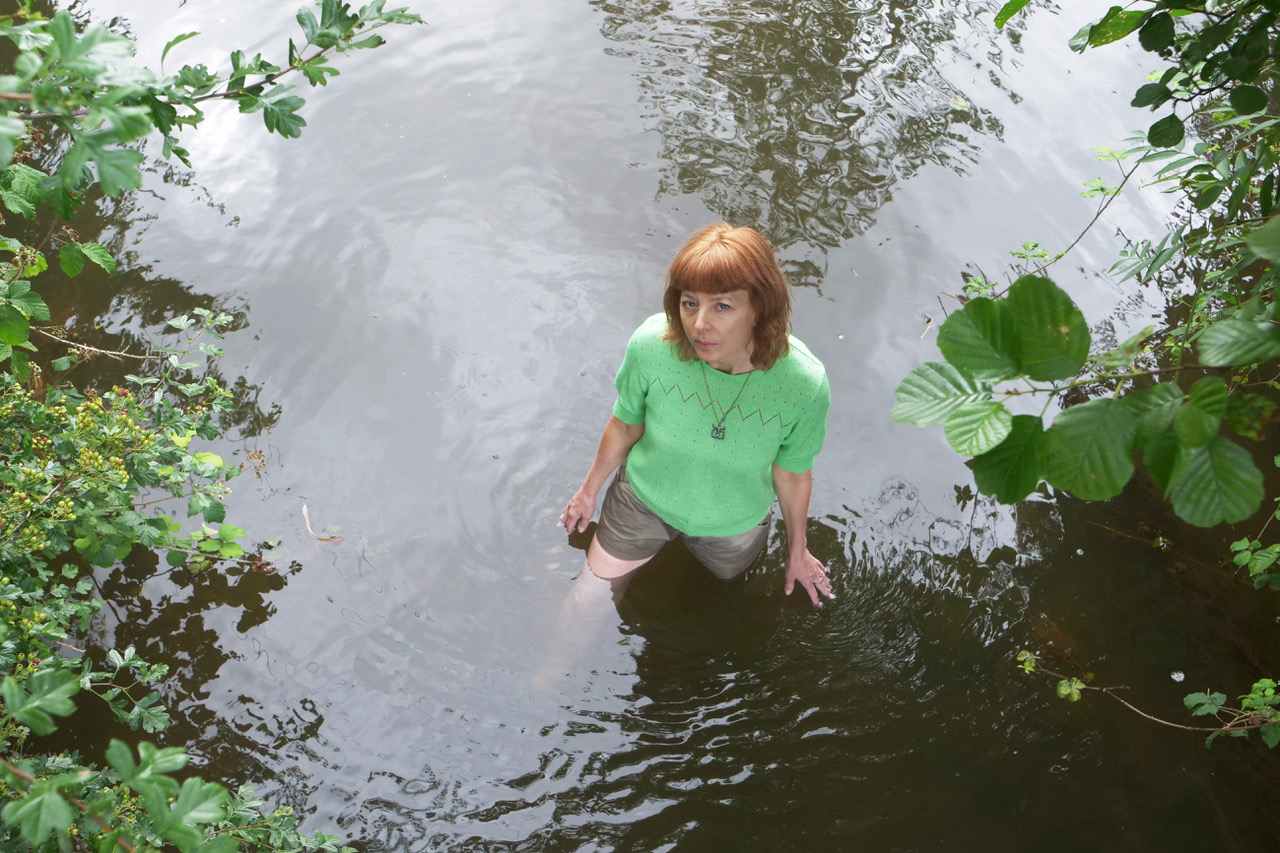
- Feral Practice in the River Tone
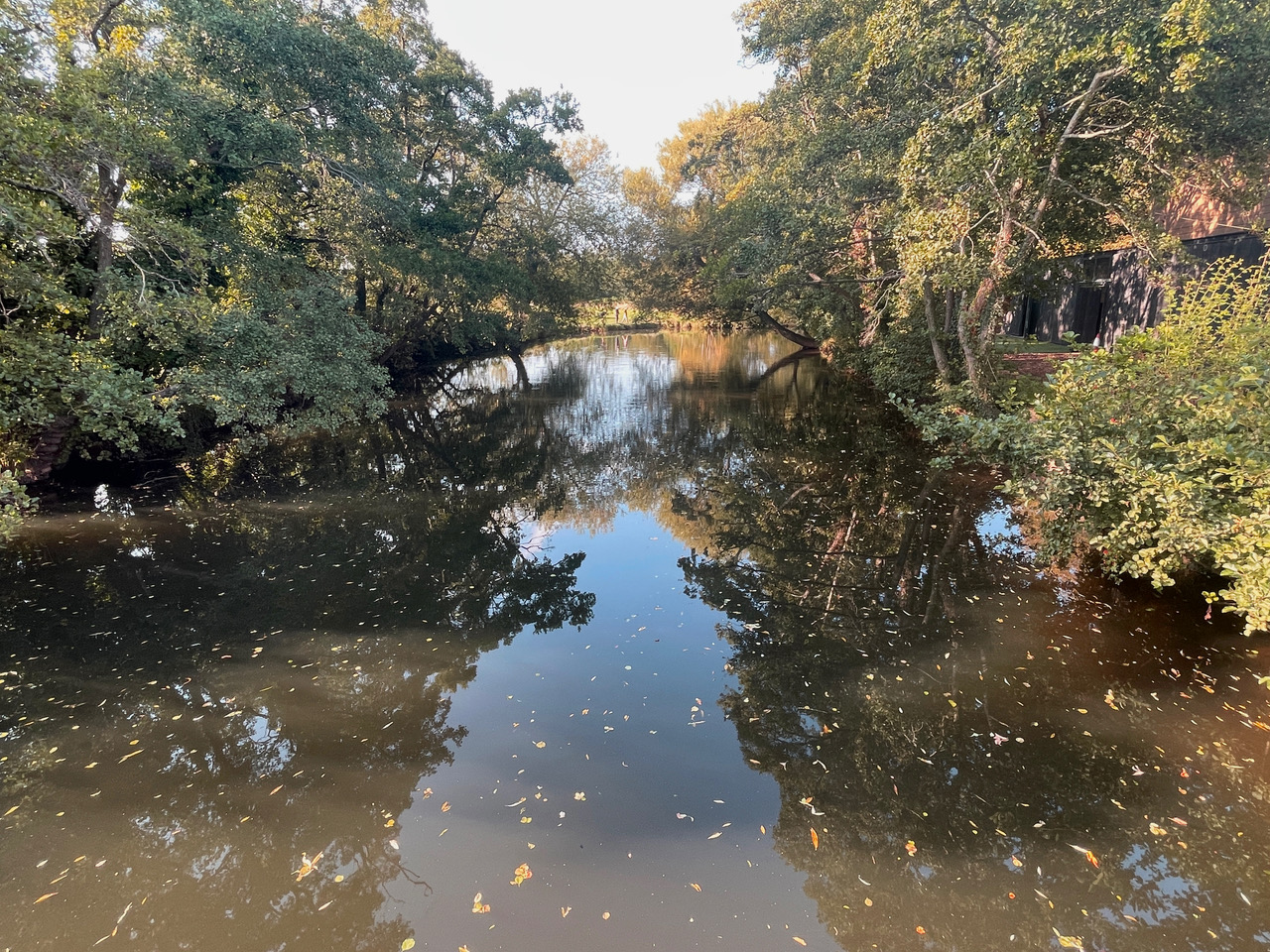
- River Tone French Weir Park
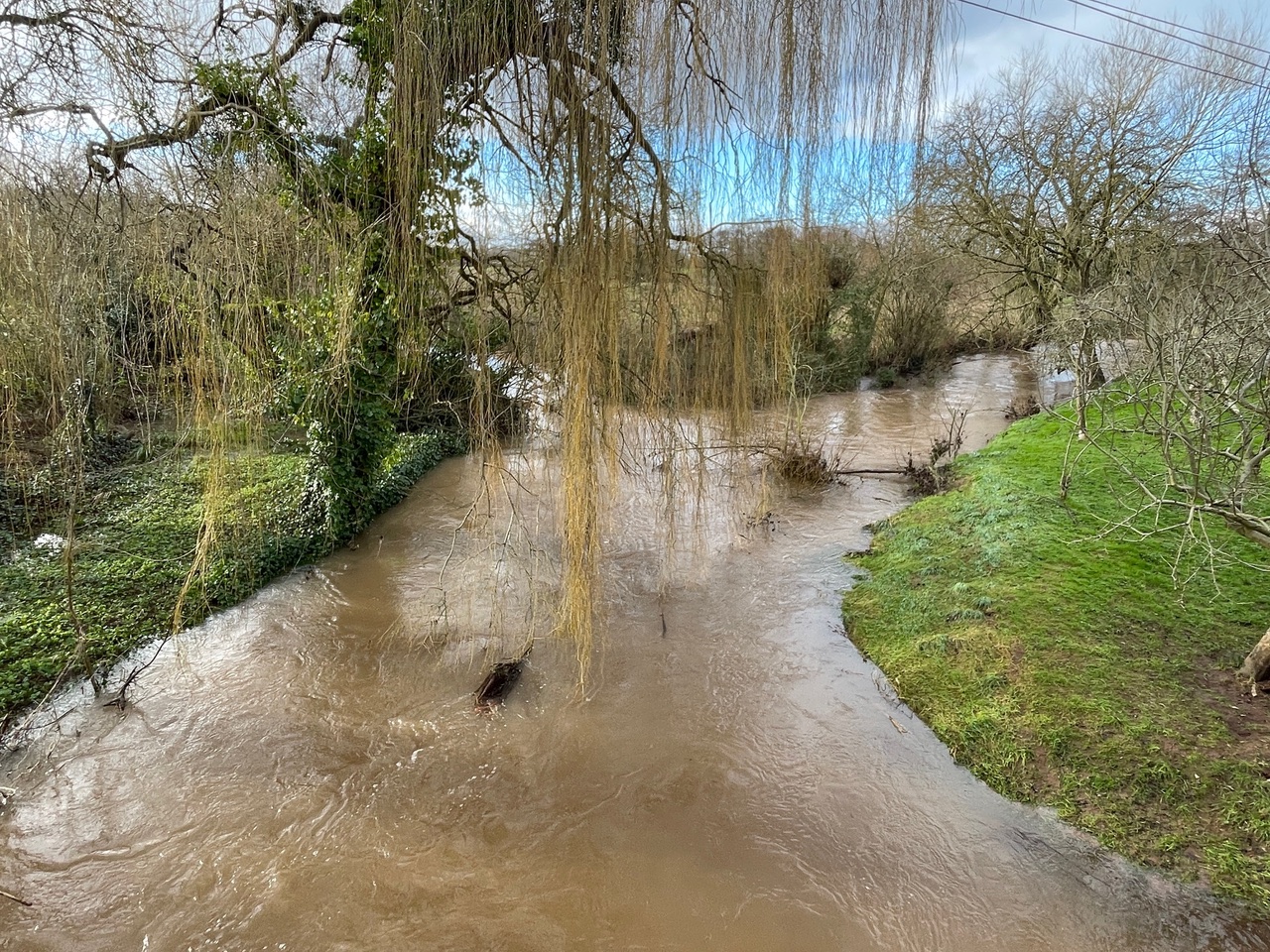
- River Tone from the bridge in Bradford
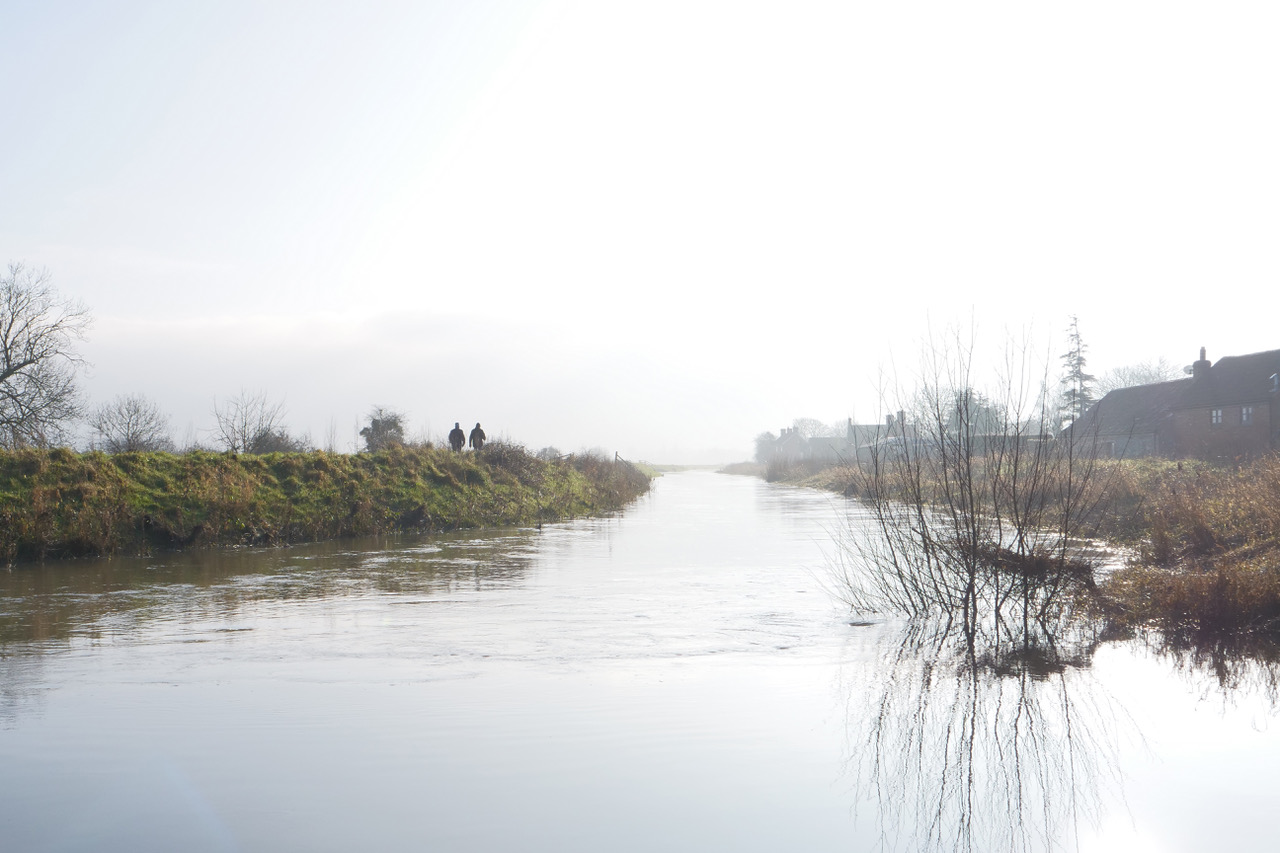
- Parrett-Tone confluence
- River Tone above Clatworthy
- Girt Dog of Langport
Tonal is an artist project about water and rivers by Feral Practice.
Over the last year Feral Practice has been walking and talking with people whose lives are shaped by water.
You can find out more and listen to the podcast at tonal-uk.com or listen wherever you find your podcasts by searching Tonal – Rivers Beyond Sewage.
On the website there are three programmes for radio that edit excerpts from the podcasts to more succinctly cover the main issues facing UK rivers today. One is on pollution, one on flow and containment, and this third one focuses on our human relationship with rivers, rivers as legal persons and sacred beings.
Below is a transcript of Tonal podcast episode: River Being: On Our Human Relationship With Rivers. Interviewees include author, activist and gardener Anita Roy, poet Graham Ryan, spirit practitioner Jane Emberton, lawyer for nature and river guardian Paul Powlesland, Director of Love our Ouze Matthew Bird and author Peter Reason. You can listen to the audio version here.
If rivers are indeed alive, are they legal persons and/or sacred beings?
Anita Roy: Water in the natural landscape, it does draw you in. I think most people just like the slowing down that it invites you to experience.
Graeme Ryan: We're so caught up in our own individual identities. The river is just profligate, it's just flowing. You know, it goes way beyond our little individual egos and bags of skin.
Jane Embleton: I feel like it's the blood really of the earth, without rivers we'd be nothing, it's sort of like the circulatory system.
Paul Powlesland: If the current system worked, of relating to nature as a resource to be managed, these problems wouldn't be here. You need to relate to it as a being, some might say sacred being, with its own interests and which needs to have legal structures that uphold those interests and fight for its interests within our system.
Matthew Bird: Everybody just felt that something needed to happen, so the idea was to put on this river festival. I was working on it from the district council point of view, and it was fantastic and we had about 1600 people there.
Feral Practice: Wow!
Matthew Bird: It unleashed something, that people were just looking to find out about the river and be more engaged. This isn't just a load of water washing down,
Peter Reason: it's an ecology of presence, it's an ecology of life and that ecology holds itself together by mutual communication. Everything is in touch with everything else. All things, all beings are a network, a poetic network of interaction.
Anita Roy, Transition Town Wellington, author.
Anita Roy: It's literally reflective, so there's a kind of invitation to look at the world a bit upside down-y! It feels like it's, I mean if you're next to a river, it feels like you're next to something which is alive. That has its own, I want to say, will. I mean it knows what it's doing sort of thing. It's on a journey, literally because it's always flowing and you're kind of irrelevant to it, which is I think a very restful thing to experience.
Feral Practice: I think there's a kind of mystery because there's always the visible and the invisible aspects of it…under the surface. You're in one world, but your imagination's led to a different world.
AR: So I have a model, which I really like, and it started with just a way of understanding how a piece of writing works. Is it a mirror or is it a window? In the mirror stage, obviously when you look in a mirror, you're looking mostly at yourself and that can be, you know, to adjust your hair or to figure out, you know, if you've got a spot on your face! Usually there's some kind of critical judgment going on there and it's about you. It's about your own subjectivity and yourself as a person. So self is centre stage.
Then there's a window, which is, again, a sheet of glass but it's transparent. You're looking through it. It's framing something and it's a way of telling your reader something about what's out there. The window stage I think of as the stage in which science exists or geography or any of those kind of subjects which are actually about the world. They're not about you or yourself. That's not centre stage.
And then there's pond which is when you're looking in a pond, you're doing several things at once. You can see your reflection but that's not taking centre stage. When you look in a pond you can see the water itself. You can see through the water to what's in the water, tadpoles and whatever, and plants, that are growing in the water and the pebbles on the bottom. You can see the water and the sunshine and the way that it glints off the water and you can get a sense of the quality of the water. And you can see yourself, but you can also see the tree behind you and you can see the sky above that. When you look in a pond what you're experiencing is yourself and the world as being part of a continuum.
In the mirror stage subject and object are very clearly defined and the focus is on subject. In the window stage subject and object are clearly defined and the focus is on the object. And in the pond stage you have a sense of reciprocity and connection and the same breeze which is making the leaves quiver above your head is that which you can feel on your skin and you can see rippling the water. It's much more holistic.
Paul Powlesland: River Roding Trust, Lawyers for Nature
FP: Can you just talk through the concept of legal personhood?
Paul Powlesland: In simple terms it's the ability to sue and be sued within our current legal system, to engage in the legal system. So for instance if someone damages the Roding now. A charity or an organisational individual can bring a claim to stop that but the river itself can't. You know we already have non-human legal persons - charities, companies, the National Trust, Thames 21, Tesco. Effectively you have their foundational documents that says what the interests of those entities are. So with charities it would be their charitable objects, with companies it's their company objects and then you have humans who go and speak for that within the system. If you remove their legal personality you remove their abilities that exist in the current system.
And that's sewage outlet that's a physical example of the failure of the current system. It's illegal and yet it's happening. And I've literally sent the Environment Agency a video of it, the illegal act happening and they just - nothing, nothing, nothing. And you imagine that for any other entity where you just you can just commit crimes against them at will - what would happen to them?
FP: So some rivers are legal persons.
PP: Yeah, it's starting to happen around the world. So you've got the Whanganui River in New Zealand. It's starting to happen in the UK. It's difficult because of the legal context. So the Ouse is not quite there yet, it's like a kind of first start for it but it's not actually got legal personhood yet.
FP: That's the Ouse in Sussex isn't it?
PP: Yeah; and arguably no river really does yet. Although there's an interesting thing where you can kind of play with that because in a sense, through my actions I am giving the river legal personhood, and anybody can do that - you can just go to your river and act as if it already has those rights and forcefully speak for them.
FP: What do you think it would take to get legal personhood in the UK?
PP: The way look at it it's not just going to fall down from the sky. In general for these kinds of things people demand it first and the politicians provide it next. So it's going to take a movement of people around the country demanding it and I think that has the most likelihood of happening where it's not just people asking for it in the abstract but people who are asking for it for their specific river, as part of a whole national change. That approach is more likely to furnish different examples that show why it's needed. It won't be academically argued into giving legal personhood for rivers. It's going to say well that's weird and pointless because we've already got environmental laws. So, me being able to say here are a dozen examples where the current system has failed and where legal personality would help to address them - that, then magnified to every river around the country would begin to give the scale of a movement that would be needed to get this.
FP: Can you say something about when you swore an oath on the River Roding?
PP: I was doing jury service and was thinking about whether I would affirm, so take a non-religious oath, or swear on the bible, and neither of them was really meaningful for me. I was going to court, and I suddenly thought: ah, wait a second what's meaningful for me is the river! So I went back to the river I got some water from it took it into court with me and then told the usher I wanted to swear my oath on the river. There was a bit of legal argument but whether it was valid. In the end I took I swore on the river and also took an affirmation as well to make sure all the bases were covered. I brought out the water into a plastic cup in the court and said ‘I swear by the River Roding from her source in Mole Hill Green to her confluence with the Thames in Barking that I will faithfully try this case and give a true verdict according to the evidence’.
There are a lot of different reasons for doing that, partially genuinely because it was meaningful for me and it felt like a real change in my relationship with the river to publicly declare that, but also, it's like we need to change people's underlying relationship to nature and one of the ways we do that is by showing it. I guess some people might have seen it as nutty or a bit strange, but ultimately tens of thousands of people around the country were like oh wow there's this barrister guy who holds nature in such reverence he took an oath on it.
Matthew Bird, Love Our Ouse
Matthew Bird: We do this community river mapping where we have these big A0 aerial photographs of the whole river, getting people to express their thoughts on the river. You use Post-it notes, you theme it, and so we captured lots of memories, their hopes and their fears for the river so that informed quite a lot of work we did next.
FP: Okay
MB: And then we also had this rights of rivers workshop there, so just asking people - if there was a charter for the river what might they like to see on there? That started our whole sort of engagement with rights.
FP: I love the fact that it's come from the big event you know rather than starting small and working up to something big you started with 1600 people, and gathered!
MB: Yeah, yeah! I mean I think I think everybody was quite surprised and blown away by it including ourselves.
We're in the chamber, you know it's a full council meeting, quite intimidating atmosphere if you're not used to it and I read the motion out and the first two people said: ‘how could you give the river legal rights? I mean imagine the river having legal rights?’
FP: Yeah!
MB: Yeah! It's like, yeah imagine that!
But then, one of the conservative councillors in fact said ‘Well actually, I do care about the river, and it's not in a good state and it's really important to me! And she actually said ‘I'm a woman of the earth’ at one point! And it just started this whole chain of comment and conversation around people being curious and ‘why not?’. So yeah, it was passed.
FP: So the motion originally was to do this two-year process to develop a charter, is that correct?
MB: That's exactly it.
FP: Okay. And so you've been speaking to the community, but also to a much wider international community of people that are more ahead of the game than we are in the UK.
MB: Yeah, that's right. What happened next was that the Guardian got in touch and they did an article, which we were like, wow that's quite incredible! And then it was just this torrent of interest. I mean it was it was completely insane. I mean we just we just couldn't actually keep up with it. We didn't we didn't answer everything in the end because it was just so many people from so many different aspects and globally. I mean I've lost track of all the stuff we've done but one that stands out is talking to Al Jazeera about rights of the Sussex Ouse! You know it felt like there was that interest, and I suppose the important thing to us was that there was interest locally.
We're now, two years and a bit years later, there's 20 rivers working on this. When that motion went through I think there were four?
FP: In the UK we're talking about?
M: In the UK. And there have been I think three other successful council motions since then so in a very short space of time it's an idea that has sort of…um
FP: Gathered force
MB: Yeah it's gathered force.
FP: Can we say actually what the charter says? What is it?
MB: So yes, the Ouse River Charter. The rights are: the right to exist in its natural state, the right to flow, the right to perform essential natural functions within the river catchment, the right to feed and be fed from sustainable aquifers, the right to be free from pollution, the right to native biodiversity, the right to regeneration and restoration, and really importantly - the right to an active and influential voice.
FP: And that was one that you added to something more universal?
MB: Yeah, the first seven of those rights that are read out are basically what constitutes the universal declaration on river rights. We wanted to make it absolutely specific to the Ouse. And more importantly just to reflect the different voices along the Ouse. Tasha was running a workshop on the railway land trust with young people and they said you know one of the rights should be the right for the river to marry any river of its choice! You know so people came up with lots of different rights, but the right to an influential and active voice is I think at the heart of the matter, because some of those rights people already understand and are working on.
FP: Yeah and arguably when people push back against this idea they say there are already environmental laws that enshrine some of these topics, but that idea of the influential and active voice puts the relationship of the river and the people of the river hand in hand.
MB: It does. And I think the relational aspects of it are absolutely key. Just being a framework is quite a seismic shift and yes there is some legislation but the fact is it's piecemeal, it's not strong enough. The people responsible for enforcing that legislation are just not resourced enough and so it's not just the river that's being failed, it's communities.
FP: Yeah. Do you feel like it's a map that other river catchments and other communities can adopt, or would you suggest that every catchment or river community needs to sort of find its own way through the landscape?
MB: Yeah, I think it's a bit of both. I mean we do get asked quite a lot to talk to other rivers and everybody is kind of approaching the rights in a slightly different way you know for some it's more of a, almost a spiritual thing and more of a sort of you know creative process. For others it is very much a practical application. I think we need something nationally. We need some consensus of approach. Yeah at the moment there are two networks there's a Rights of Nature Network which is a very legally sort of focus network and then there's River Rights UK which is is quite academic, community focused and I suppose personally I think they need to come together.
I think the really important thing is that you know we have catchment partnerships, but I think the partnerships really need to grasp this you know because they tend to be working in quite traditional ways - with the Environment Agency, with the water companies, and they're quite technical right, which is really important, but there's not a sort of consistent framework approach.
FP: It's very much still the water as a resource for human populations, would you agree?
MB: Yes. I suppose the whole point of this is that we need to be at the same level as nature, so it needs to be sort of, decisions need to be taken with nature in the room with the river in the room some companies like Lush for instance they've got nature on the board.
FP: Is the river on the board of the council?
MB: No, but I suppose that's what we're wrestling with at the moment and what the council is wrestling with is that you know practically how do you implement this? We have a symposium coming up that is looking at exactly that. Being able to kind of test the rights in some sort of live situations, but that requires some real focus. We're starting to think that actually if we are going to be confident about us being able to do this, we need to sort of be resource to do it. And the same goes for other groups you know so I would like to see something nationally.
Graeme Ryan, poet, Fire River Poets
Graeme Ryan: Everything. everything's conscious. I would describe river as an incredibly dynamic being which is going through metamorphosis all the time. It's like the Heraclitus thing isn't it - you never step in the same river twice. It's a carrier of consciousness and it's a particular kind of consciousness which is different to something more static. So this incredible dynamism, this incredible flow of a river is just another kind of consciousness, but a very special one because it's bringing from source to sea, it's traveling through landscapes, it's a life-giver, in terms of the water. It's magic, it's a magical thing. And for those reasons, it's sacred.
What's outside, what's inside. That sound of the river now is, it's, it's a thread between the two, it's a connection between the two. Because on one level, we're human beings and we've sat by rivers since whenever.
Do you know this woman called Barbara, I can't remember her surname now, [Smuts] who lived with baboons in Tanzania?
FP: Don't think so.
GR: It's this incredible incident she described, she kind of got accepted by the troop at a distance and she followed them around for over a year. There was one particular occasion where the troop were walking back to their roosting trees somewhere near the shores of Lake Navashya. They were walking along a stream and then with no kind of warning they just all sat down by the stream, or in the stream and sat on stones. And they just sat there. And she was going - what is going on here? What is this about? Like, what are they paying attention to? And she says - all I can imagine is that they were connecting to this water, they were sort of tapping into some bigger consciousness. And then eventually I think the matriarch of the group just stood up and they set off to their roosting trees, but she'd never seen this behaviour before. They weren't drinking from the river, they weren't trying to eat, they weren't foraging. They were just sat, and they were just contemplating.
So, not just humans but in our kind of ancestry, going back and back and back. It's the source of life I suppose.
Jane Embleton, wise woman and river pilgrim
Jane Embleton: So it all started on the Solstice 2016. I decided to camp out at the source of the River Tone overnight, get up really early and then walk home. And that night I had a dream of dancing to music that nobody else could hear. So I was dancing away to some jungle type drums and everyone was looking at me a bit strangely thinking ‘what's up with her?’ But I knew that it was quite a prophetic dream and it wasn't a run of the mill dream, it was a really nice one.
Over the Christmas period there were three incidents involving dogs… so it's like, there's something really going on here! With dogs and the river, and I sort of pondered it, and as quite often happens I wake up in the morning and go ‘ah, that's what that's all about then.’ I remembered that the Girt Dog of Langport is a landscape feature. There's an ear lake, and the nose of the dog is Burrow Mump and its tongue is the River Tone. I got the idea that the river, the dog, was sick and needed some healing. So, by walking the river maybe we could apply medicines and elixirs to the dog and make the dog feel better.
Four or five days later three people in the course of three days rang up that I didn't know and said - I've got the idea that I need to contact you for some reason, and it feels like it's got something to do with the River Tone.
FP: The signs were becoming quite clear.
JE: The signs were very clear! There was no doubt about it. So we met up as soon as we possibly could and had supper at my house. I looked for the map of the dog, showed them that the Tone was the tongue and that's where the whole idea of walking the Tone started.
FP: You've walked the length of the Tone three times you said. Is that each time performing actions and rituals along the way?
JE: The first time was a fact finding mission from the source to where it joins the River Parret at Burrow Bridge and then right to Burnham. The River Parret goes through Bridgewater and then out at Burnham on Sea. That took about seven days.
Then we divided the river up between the six of us and each of us took on a bit to walk and keep checking in with. Then the following year we walked it from where it joins at Burrow Bridge near Athelney and walked it back to the source. The Kogi people… you know the Kogi people from Columbia? They walk rivers the whole time and think it's just as important the upstream as the downstream, because there's always an exchange of information going in both directions. So it felt really important to do both. Each time we got to a bridge we would put a remedy in.
FP: And this is a kind of herbal remedy?
JE: Homeopathic, herbal, radionic. Hello river!
FP: Can you tell me something about how you drop into that listening?
JE: I think I use proper night dreaming a lot. If I've got a conundrum I might go to bed thinking - please show me, what's the significance of this. Sometimes I'll have a dream that is really specifically showing me what it's all about and other times I just wake up in the morning like - oh okay I've got it now. And then, if I'm out walking with a group, we’ll all be picking up on different things. I'm very visual, I notice things. If I'm on my own I'll be using all my senses, including how easy it is to walk. If you're using your five senses well then the sixth sense will drop in. If you're really paying attention then suddenly insights will come to you.
FP: Do you talk to yourself if you're on your own?
JE: No, I talk to you the river, and birds and a beautiful flower but not to myself.
It makes a huge difference to be working on these subtle levels. It really does have huge impact, financial consequences for people. At the Oxford Real Farming Conference there was a presentation about trauma in the land… That's not exactly reaching the mainstream, but it's got much more of a reach than we would’ve probably had 10 years ago. These are proper people that get paid quite a lot of money to go and do consultations with farmers in South Africa and Australia because it helps them with their yields.
Peter Reason, author and academic
Peter Reason: What I try to do, my intention is, to do all this in ceremony. By that I mean you create a different kind of space from the everyday, taken for granted. It’s like going into church and doing a genuflection or something like that. So, this is where I begin. Come on then, do come, first gateway.
FP: Do you want to go round?
PR: Let’s go in together. Oh, no..
FP: There’s not room
PR: There's no room is there!
FP: Bit snuggly with a rucksack on!
PR: That's why it's called a kiss gate!
So… this is where I say all my relations. It means that I'm not just doing this for myself. This is for all beings, because changing our relationship with the world is central to whatever sustainability issues we need to address. Then I usually do my mantra walking across here, which is - walking the green earth, walking the green earth, walking the green earth… I learned a long time ago, it's rather beautiful. My intent there is to ground myself in just being here and attend to the place.
Good afternoon rivers! Good afternoon! This is Peter, Wolfheart, Dances in Beauty. And this is Fiona my friend.
FP: Good afternoon rivers!
PR: We've come to be with you this afternoon, and we ask for your teaching.
I call to the East. I call for new insights, I call for an understanding, a vision of a new way of being on the planet for we humans. I call to the West, and I ask that that's not just an idea, but something we embody in our lives and our practice. And I call to the South. I call for emotions, I call for the emotions to flow rather than be stuck, and I call that nothing be done to harm the children. And I call to the North. I call for wisdom, I call for that wisdom which is rooted in the heart. Blessed be.
So then I just sit down and see what's gonna happen.
Sometimes I get bored and nothing happens, and, you know, feel inadequate. And other times I can get completely overwhelmed by something very very beautiful or something that I don't normally see.
When I first started coming I was getting a lot of visits from kingfishers and some of them were very closely related to particular prayers I made. The morning of our first Living Waters [group enquiry programme] I came down here and I asked for blessing on the course before we started and four kingfishers arrived! Or was it six? It was six.
FP: Six kingfishers?!
PR: There's one! There's one! I haven't seen a kingfisher here for ages! That’s so interesting that we're talking about them and, and it's in the same place!
FP: Yeah, and one came to say hello!
PR: Then one day with my little enquiry group, the first enquiry group, we had this terrible thing. One of the women went down to visit her river in America and there was a big crunch under her wheel. She thought she'd both broken her tire, so she stopped and got out, and she'd run over a turtle. It was still alive but smashed up.
FP: Oh ,oh dear!
PR: So she picked it up and apologized, whatever you do, put it in the river. We talked about that and it turned out another man had not run over a turtle but had seen one smashed, and we talked about the damage that we do to the world.
I thought from my Buddhist training that there was some sort of deep apology needed. I remembered the prostrations we were taught in Buddhism, the full-bodied prostrations where you bow and take the bow right down onto the ground. So I thought, well that's what I should do… But it also felt a bit pretentious. So I came down here in the dark and I said, well this is what I said I do, so I'll do it. I started to do the prostrations and to ask for forgiveness. It felt very silly and very moving at the same time. I sort of was partly worried about how muddy I was going to get and partly thinking this is important to do this.
FP: Yes.
PR: When I when I finished I sat here. Somewhere around here. I just looked and watched and then I heard this, I heard this wing-beat coming from behind me and it was swans, flew overhead. But they didn't disappear, they turned around and flew around over my head and then went off again. And you know, my hair stands on end to tell you about it. It was just remarkable and completely apposite to the situation we were in. Some sense of my apology being acknowledged.
If we call to the world as a living being, not only we're acknowledging it, but we may also be inviting a response. From an animist point of view the world is full of persons. From a from a panpsychic point of view, which is within western philosophy, the argument is that the universe isn't just a mechanical collection of stuff, it. From the beginning, the material and the subjective or the spiritual or whatever they are, they are two sides of the same coin. They are part and parcel.
So the communication is symbolic. I don't mean that in the Jungian sense. It's through the symbolic presence of things. So, when I'm talking about Kingfisher and one flies past, we could say that's a coincidence, but part of our enquiry is to see if that happens sufficiently often that it's not a coincidence. And it also happens at that moment. You could be, you need to be cautious, because you can get into being pixelated, you know, airhead. But also, these are things that that happen that we must not dismiss, not just get pulled into a mechanical worldview.
FP: So how do you feel it's changed you or your relationship to river over the last five years?
PR: I'm much more aware of how human-centric we all are. And I'm much more - I don't think I'm using the word lightly - I'm much more heartbroken. About the absence of so many creatures.
[silence, with birds]
PR: I just felt then, in that little bit of silence, again it dropped deeper. I dropped deeper.
And in the silence there's something else one might be able to hear.
FP: It’s a kind of patterning.
PR: Patterning?
FP: Patterning - where things start to feel like they are interacting - the shapes, the ripples, the sounds. So, there's this kind of sense of aliveness that's intricately active. If that makes sense?
PR: Yeah it does. It makes very good sense. A nice way of putting it. I feel I can hear something too but I don't think it's a sound.
Tonal is supported by the Firepool Centre for Digital Innovation and produced by Ginkgo Projects.
Image Credits:
- Feral Practice in the River Tone
- River Tone French Weir Park
- River Tone from the bridge in Bradford
- Parrett-Tone confluence
- River Tone above Clatworthy
- Girt Dog of Langport
Fiona MacDonald works with human and nonhuman beings as Feral Practice to create art projects and interdisciplinary events that develop ethical and imaginative relations across species boundaries. Often people set up divisions between species and between different categories of knowledge and understanding, Feral Practice collaborates and converses across these barriers.
Our vulnerable, speculative approach brings experimental art into spaces of care and attentiveness for and with real, situated beings. We explore diverse aesthetics and foreground distinctive creaturely subjectivities. Each project is materially and conceptually responsive to its participants, context and audience, often utilising augmenting digital technologies alongside diverse analogue media, participation and voice.
Tonal is an audio project exploring water issues nationally with a special focus on the River Tone in Somerset. Each podcast episode is a riverside conversation with someone who has a strong personal or professional relationship to water and the river, building a broad base of knowledge from many distinctive perspectives. Tonal is a project by artist Feral Practice.

BY FERAL PRACTICE
Tonal is an artist project about water and rivers by Feral Practice.
Over the last year Feral Practice has been walking and talking with people whose lives are shaped by water.
You can find out more and listen to the podcast at tonal-uk.com or listen wherever you find your podcasts by searching Tonal – Rivers Beyond Sewage.
On the website there are three programmes for radio that edit excerpts from the podcasts to more succinctly cover the main issues facing UK rivers today. One is on pollution, one on flow and containment, and this third one focuses on our human relationship with rivers, rivers as legal persons and sacred beings.
Below is a transcript of Tonal podcast episode: River Being: On Our Human Relationship With Rivers. Interviewees include author, activist and gardener Anita Roy, poet Graham Ryan, spirit practitioner Jane Emberton, lawyer for nature and river guardian Paul Powlesland, Director of Love our Ouze Matthew Bird and author Peter Reason. You can listen to the audio version here.
If rivers are indeed alive, are they legal persons and/or sacred beings?
Anita Roy: Water in the natural landscape, it does draw you in. I think most people just like the slowing down that it invites you to experience.
Graeme Ryan: We're so caught up in our own individual identities. The river is just profligate, it's just flowing. You know, it goes way beyond our little individual egos and bags of skin.
Jane Embleton: I feel like it's the blood really of the earth, without rivers we'd be nothing, it's sort of like the circulatory system.
Paul Powlesland: If the current system worked, of relating to nature as a resource to be managed, these problems wouldn't be here. You need to relate to it as a being, some might say sacred being, with its own interests and which needs to have legal structures that uphold those interests and fight for its interests within our system.
Matthew Bird: Everybody just felt that something needed to happen, so the idea was to put on this river festival. I was working on it from the district council point of view, and it was fantastic and we had about 1600 people there.
Feral Practice: Wow!
Matthew Bird: It unleashed something, that people were just looking to find out about the river and be more engaged. This isn't just a load of water washing down,
Peter Reason: it's an ecology of presence, it's an ecology of life and that ecology holds itself together by mutual communication. Everything is in touch with everything else. All things, all beings are a network, a poetic network of interaction.
Anita Roy, Transition Town Wellington, author.
Anita Roy: It's literally reflective, so there's a kind of invitation to look at the world a bit upside down-y! It feels like it's, I mean if you're next to a river, it feels like you're next to something which is alive. That has its own, I want to say, will. I mean it knows what it's doing sort of thing. It's on a journey, literally because it's always flowing and you're kind of irrelevant to it, which is I think a very restful thing to experience.
Feral Practice: I think there's a kind of mystery because there's always the visible and the invisible aspects of it…under the surface. You're in one world, but your imagination's led to a different world.
AR: So I have a model, which I really like, and it started with just a way of understanding how a piece of writing works. Is it a mirror or is it a window? In the mirror stage, obviously when you look in a mirror, you're looking mostly at yourself and that can be, you know, to adjust your hair or to figure out, you know, if you've got a spot on your face! Usually there's some kind of critical judgment going on there and it's about you. It's about your own subjectivity and yourself as a person. So self is centre stage.
Then there's a window, which is, again, a sheet of glass but it's transparent. You're looking through it. It's framing something and it's a way of telling your reader something about what's out there. The window stage I think of as the stage in which science exists or geography or any of those kind of subjects which are actually about the world. They're not about you or yourself. That's not centre stage.
And then there's pond which is when you're looking in a pond, you're doing several things at once. You can see your reflection but that's not taking centre stage. When you look in a pond you can see the water itself. You can see through the water to what's in the water, tadpoles and whatever, and plants, that are growing in the water and the pebbles on the bottom. You can see the water and the sunshine and the way that it glints off the water and you can get a sense of the quality of the water. And you can see yourself, but you can also see the tree behind you and you can see the sky above that. When you look in a pond what you're experiencing is yourself and the world as being part of a continuum.
In the mirror stage subject and object are very clearly defined and the focus is on subject. In the window stage subject and object are clearly defined and the focus is on the object. And in the pond stage you have a sense of reciprocity and connection and the same breeze which is making the leaves quiver above your head is that which you can feel on your skin and you can see rippling the water. It's much more holistic.
Paul Powlesland: River Roding Trust, Lawyers for Nature
FP: Can you just talk through the concept of legal personhood?
Paul Powlesland: In simple terms it's the ability to sue and be sued within our current legal system, to engage in the legal system. So for instance if someone damages the Roding now. A charity or an organisational individual can bring a claim to stop that but the river itself can't. You know we already have non-human legal persons - charities, companies, the National Trust, Thames 21, Tesco. Effectively you have their foundational documents that says what the interests of those entities are. So with charities it would be their charitable objects, with companies it's their company objects and then you have humans who go and speak for that within the system. If you remove their legal personality you remove their abilities that exist in the current system.
And that's sewage outlet that's a physical example of the failure of the current system. It's illegal and yet it's happening. And I've literally sent the Environment Agency a video of it, the illegal act happening and they just - nothing, nothing, nothing. And you imagine that for any other entity where you just you can just commit crimes against them at will - what would happen to them?
FP: So some rivers are legal persons.
PP: Yeah, it's starting to happen around the world. So you've got the Whanganui River in New Zealand. It's starting to happen in the UK. It's difficult because of the legal context. So the Ouse is not quite there yet, it's like a kind of first start for it but it's not actually got legal personhood yet.
FP: That's the Ouse in Sussex isn't it?
PP: Yeah; and arguably no river really does yet. Although there's an interesting thing where you can kind of play with that because in a sense, through my actions I am giving the river legal personhood, and anybody can do that - you can just go to your river and act as if it already has those rights and forcefully speak for them.
FP: What do you think it would take to get legal personhood in the UK?
PP: The way look at it it's not just going to fall down from the sky. In general for these kinds of things people demand it first and the politicians provide it next. So it's going to take a movement of people around the country demanding it and I think that has the most likelihood of happening where it's not just people asking for it in the abstract but people who are asking for it for their specific river, as part of a whole national change. That approach is more likely to furnish different examples that show why it's needed. It won't be academically argued into giving legal personhood for rivers. It's going to say well that's weird and pointless because we've already got environmental laws. So, me being able to say here are a dozen examples where the current system has failed and where legal personality would help to address them - that, then magnified to every river around the country would begin to give the scale of a movement that would be needed to get this.
FP: Can you say something about when you swore an oath on the River Roding?
PP: I was doing jury service and was thinking about whether I would affirm, so take a non-religious oath, or swear on the bible, and neither of them was really meaningful for me. I was going to court, and I suddenly thought: ah, wait a second what's meaningful for me is the river! So I went back to the river I got some water from it took it into court with me and then told the usher I wanted to swear my oath on the river. There was a bit of legal argument but whether it was valid. In the end I took I swore on the river and also took an affirmation as well to make sure all the bases were covered. I brought out the water into a plastic cup in the court and said ‘I swear by the River Roding from her source in Mole Hill Green to her confluence with the Thames in Barking that I will faithfully try this case and give a true verdict according to the evidence’.
There are a lot of different reasons for doing that, partially genuinely because it was meaningful for me and it felt like a real change in my relationship with the river to publicly declare that, but also, it's like we need to change people's underlying relationship to nature and one of the ways we do that is by showing it. I guess some people might have seen it as nutty or a bit strange, but ultimately tens of thousands of people around the country were like oh wow there's this barrister guy who holds nature in such reverence he took an oath on it.
Matthew Bird, Love Our Ouse
Matthew Bird: We do this community river mapping where we have these big A0 aerial photographs of the whole river, getting people to express their thoughts on the river. You use Post-it notes, you theme it, and so we captured lots of memories, their hopes and their fears for the river so that informed quite a lot of work we did next.
FP: Okay
MB: And then we also had this rights of rivers workshop there, so just asking people - if there was a charter for the river what might they like to see on there? That started our whole sort of engagement with rights.
FP: I love the fact that it's come from the big event you know rather than starting small and working up to something big you started with 1600 people, and gathered!
MB: Yeah, yeah! I mean I think I think everybody was quite surprised and blown away by it including ourselves.
We're in the chamber, you know it's a full council meeting, quite intimidating atmosphere if you're not used to it and I read the motion out and the first two people said: ‘how could you give the river legal rights? I mean imagine the river having legal rights?’
FP: Yeah!
MB: Yeah! It's like, yeah imagine that!
But then, one of the conservative councillors in fact said ‘Well actually, I do care about the river, and it's not in a good state and it's really important to me! And she actually said ‘I'm a woman of the earth’ at one point! And it just started this whole chain of comment and conversation around people being curious and ‘why not?’. So yeah, it was passed.
FP: So the motion originally was to do this two-year process to develop a charter, is that correct?
MB: That's exactly it.
FP: Okay. And so you've been speaking to the community, but also to a much wider international community of people that are more ahead of the game than we are in the UK.
MB: Yeah, that's right. What happened next was that the Guardian got in touch and they did an article, which we were like, wow that's quite incredible! And then it was just this torrent of interest. I mean it was it was completely insane. I mean we just we just couldn't actually keep up with it. We didn't we didn't answer everything in the end because it was just so many people from so many different aspects and globally. I mean I've lost track of all the stuff we've done but one that stands out is talking to Al Jazeera about rights of the Sussex Ouse! You know it felt like there was that interest, and I suppose the important thing to us was that there was interest locally.
We're now, two years and a bit years later, there's 20 rivers working on this. When that motion went through I think there were four?
FP: In the UK we're talking about?
M: In the UK. And there have been I think three other successful council motions since then so in a very short space of time it's an idea that has sort of…um
FP: Gathered force
MB: Yeah it's gathered force.
FP: Can we say actually what the charter says? What is it?
MB: So yes, the Ouse River Charter. The rights are: the right to exist in its natural state, the right to flow, the right to perform essential natural functions within the river catchment, the right to feed and be fed from sustainable aquifers, the right to be free from pollution, the right to native biodiversity, the right to regeneration and restoration, and really importantly - the right to an active and influential voice.
FP: And that was one that you added to something more universal?
MB: Yeah, the first seven of those rights that are read out are basically what constitutes the universal declaration on river rights. We wanted to make it absolutely specific to the Ouse. And more importantly just to reflect the different voices along the Ouse. Tasha was running a workshop on the railway land trust with young people and they said you know one of the rights should be the right for the river to marry any river of its choice! You know so people came up with lots of different rights, but the right to an influential and active voice is I think at the heart of the matter, because some of those rights people already understand and are working on.
FP: Yeah and arguably when people push back against this idea they say there are already environmental laws that enshrine some of these topics, but that idea of the influential and active voice puts the relationship of the river and the people of the river hand in hand.
MB: It does. And I think the relational aspects of it are absolutely key. Just being a framework is quite a seismic shift and yes there is some legislation but the fact is it's piecemeal, it's not strong enough. The people responsible for enforcing that legislation are just not resourced enough and so it's not just the river that's being failed, it's communities.
FP: Yeah. Do you feel like it's a map that other river catchments and other communities can adopt, or would you suggest that every catchment or river community needs to sort of find its own way through the landscape?
MB: Yeah, I think it's a bit of both. I mean we do get asked quite a lot to talk to other rivers and everybody is kind of approaching the rights in a slightly different way you know for some it's more of a, almost a spiritual thing and more of a sort of you know creative process. For others it is very much a practical application. I think we need something nationally. We need some consensus of approach. Yeah at the moment there are two networks there's a Rights of Nature Network which is a very legally sort of focus network and then there's River Rights UK which is is quite academic, community focused and I suppose personally I think they need to come together.
I think the really important thing is that you know we have catchment partnerships, but I think the partnerships really need to grasp this you know because they tend to be working in quite traditional ways - with the Environment Agency, with the water companies, and they're quite technical right, which is really important, but there's not a sort of consistent framework approach.
FP: It's very much still the water as a resource for human populations, would you agree?
MB: Yes. I suppose the whole point of this is that we need to be at the same level as nature, so it needs to be sort of, decisions need to be taken with nature in the room with the river in the room some companies like Lush for instance they've got nature on the board.
FP: Is the river on the board of the council?
MB: No, but I suppose that's what we're wrestling with at the moment and what the council is wrestling with is that you know practically how do you implement this? We have a symposium coming up that is looking at exactly that. Being able to kind of test the rights in some sort of live situations, but that requires some real focus. We're starting to think that actually if we are going to be confident about us being able to do this, we need to sort of be resource to do it. And the same goes for other groups you know so I would like to see something nationally.
Graeme Ryan, poet, Fire River Poets
Graeme Ryan: Everything. everything's conscious. I would describe river as an incredibly dynamic being which is going through metamorphosis all the time. It's like the Heraclitus thing isn't it - you never step in the same river twice. It's a carrier of consciousness and it's a particular kind of consciousness which is different to something more static. So this incredible dynamism, this incredible flow of a river is just another kind of consciousness, but a very special one because it's bringing from source to sea, it's traveling through landscapes, it's a life-giver, in terms of the water. It's magic, it's a magical thing. And for those reasons, it's sacred.
What's outside, what's inside. That sound of the river now is, it's, it's a thread between the two, it's a connection between the two. Because on one level, we're human beings and we've sat by rivers since whenever.
Do you know this woman called Barbara, I can't remember her surname now, [Smuts] who lived with baboons in Tanzania?
FP: Don't think so.
GR: It's this incredible incident she described, she kind of got accepted by the troop at a distance and she followed them around for over a year. There was one particular occasion where the troop were walking back to their roosting trees somewhere near the shores of Lake Navashya. They were walking along a stream and then with no kind of warning they just all sat down by the stream, or in the stream and sat on stones. And they just sat there. And she was going - what is going on here? What is this about? Like, what are they paying attention to? And she says - all I can imagine is that they were connecting to this water, they were sort of tapping into some bigger consciousness. And then eventually I think the matriarch of the group just stood up and they set off to their roosting trees, but she'd never seen this behaviour before. They weren't drinking from the river, they weren't trying to eat, they weren't foraging. They were just sat, and they were just contemplating.
So, not just humans but in our kind of ancestry, going back and back and back. It's the source of life I suppose.
Jane Embleton, wise woman and river pilgrim
Jane Embleton: So it all started on the Solstice 2016. I decided to camp out at the source of the River Tone overnight, get up really early and then walk home. And that night I had a dream of dancing to music that nobody else could hear. So I was dancing away to some jungle type drums and everyone was looking at me a bit strangely thinking ‘what's up with her?’ But I knew that it was quite a prophetic dream and it wasn't a run of the mill dream, it was a really nice one.
Over the Christmas period there were three incidents involving dogs… so it's like, there's something really going on here! With dogs and the river, and I sort of pondered it, and as quite often happens I wake up in the morning and go ‘ah, that's what that's all about then.’ I remembered that the Girt Dog of Langport is a landscape feature. There's an ear lake, and the nose of the dog is Burrow Mump and its tongue is the River Tone. I got the idea that the river, the dog, was sick and needed some healing. So, by walking the river maybe we could apply medicines and elixirs to the dog and make the dog feel better.
Four or five days later three people in the course of three days rang up that I didn't know and said - I've got the idea that I need to contact you for some reason, and it feels like it's got something to do with the River Tone.
FP: The signs were becoming quite clear.
JE: The signs were very clear! There was no doubt about it. So we met up as soon as we possibly could and had supper at my house. I looked for the map of the dog, showed them that the Tone was the tongue and that's where the whole idea of walking the Tone started.
FP: You've walked the length of the Tone three times you said. Is that each time performing actions and rituals along the way?
JE: The first time was a fact finding mission from the source to where it joins the River Parret at Burrow Bridge and then right to Burnham. The River Parret goes through Bridgewater and then out at Burnham on Sea. That took about seven days.
Then we divided the river up between the six of us and each of us took on a bit to walk and keep checking in with. Then the following year we walked it from where it joins at Burrow Bridge near Athelney and walked it back to the source. The Kogi people… you know the Kogi people from Columbia? They walk rivers the whole time and think it's just as important the upstream as the downstream, because there's always an exchange of information going in both directions. So it felt really important to do both. Each time we got to a bridge we would put a remedy in.
FP: And this is a kind of herbal remedy?
JE: Homeopathic, herbal, radionic. Hello river!
FP: Can you tell me something about how you drop into that listening?
JE: I think I use proper night dreaming a lot. If I've got a conundrum I might go to bed thinking - please show me, what's the significance of this. Sometimes I'll have a dream that is really specifically showing me what it's all about and other times I just wake up in the morning like - oh okay I've got it now. And then, if I'm out walking with a group, we’ll all be picking up on different things. I'm very visual, I notice things. If I'm on my own I'll be using all my senses, including how easy it is to walk. If you're using your five senses well then the sixth sense will drop in. If you're really paying attention then suddenly insights will come to you.
FP: Do you talk to yourself if you're on your own?
JE: No, I talk to you the river, and birds and a beautiful flower but not to myself.
It makes a huge difference to be working on these subtle levels. It really does have huge impact, financial consequences for people. At the Oxford Real Farming Conference there was a presentation about trauma in the land… That's not exactly reaching the mainstream, but it's got much more of a reach than we would’ve probably had 10 years ago. These are proper people that get paid quite a lot of money to go and do consultations with farmers in South Africa and Australia because it helps them with their yields.
Peter Reason, author and academic
Peter Reason: What I try to do, my intention is, to do all this in ceremony. By that I mean you create a different kind of space from the everyday, taken for granted. It’s like going into church and doing a genuflection or something like that. So, this is where I begin. Come on then, do come, first gateway.
FP: Do you want to go round?
PR: Let’s go in together. Oh, no..
FP: There’s not room
PR: There's no room is there!
FP: Bit snuggly with a rucksack on!
PR: That's why it's called a kiss gate!
So… this is where I say all my relations. It means that I'm not just doing this for myself. This is for all beings, because changing our relationship with the world is central to whatever sustainability issues we need to address. Then I usually do my mantra walking across here, which is - walking the green earth, walking the green earth, walking the green earth… I learned a long time ago, it's rather beautiful. My intent there is to ground myself in just being here and attend to the place.
Good afternoon rivers! Good afternoon! This is Peter, Wolfheart, Dances in Beauty. And this is Fiona my friend.
FP: Good afternoon rivers!
PR: We've come to be with you this afternoon, and we ask for your teaching.
I call to the East. I call for new insights, I call for an understanding, a vision of a new way of being on the planet for we humans. I call to the West, and I ask that that's not just an idea, but something we embody in our lives and our practice. And I call to the South. I call for emotions, I call for the emotions to flow rather than be stuck, and I call that nothing be done to harm the children. And I call to the North. I call for wisdom, I call for that wisdom which is rooted in the heart. Blessed be.
So then I just sit down and see what's gonna happen.
Sometimes I get bored and nothing happens, and, you know, feel inadequate. And other times I can get completely overwhelmed by something very very beautiful or something that I don't normally see.
When I first started coming I was getting a lot of visits from kingfishers and some of them were very closely related to particular prayers I made. The morning of our first Living Waters [group enquiry programme] I came down here and I asked for blessing on the course before we started and four kingfishers arrived! Or was it six? It was six.
FP: Six kingfishers?!
PR: There's one! There's one! I haven't seen a kingfisher here for ages! That’s so interesting that we're talking about them and, and it's in the same place!
FP: Yeah, and one came to say hello!
PR: Then one day with my little enquiry group, the first enquiry group, we had this terrible thing. One of the women went down to visit her river in America and there was a big crunch under her wheel. She thought she'd both broken her tire, so she stopped and got out, and she'd run over a turtle. It was still alive but smashed up.
FP: Oh ,oh dear!
PR: So she picked it up and apologized, whatever you do, put it in the river. We talked about that and it turned out another man had not run over a turtle but had seen one smashed, and we talked about the damage that we do to the world.
I thought from my Buddhist training that there was some sort of deep apology needed. I remembered the prostrations we were taught in Buddhism, the full-bodied prostrations where you bow and take the bow right down onto the ground. So I thought, well that's what I should do… But it also felt a bit pretentious. So I came down here in the dark and I said, well this is what I said I do, so I'll do it. I started to do the prostrations and to ask for forgiveness. It felt very silly and very moving at the same time. I sort of was partly worried about how muddy I was going to get and partly thinking this is important to do this.
FP: Yes.
PR: When I when I finished I sat here. Somewhere around here. I just looked and watched and then I heard this, I heard this wing-beat coming from behind me and it was swans, flew overhead. But they didn't disappear, they turned around and flew around over my head and then went off again. And you know, my hair stands on end to tell you about it. It was just remarkable and completely apposite to the situation we were in. Some sense of my apology being acknowledged.
If we call to the world as a living being, not only we're acknowledging it, but we may also be inviting a response. From an animist point of view the world is full of persons. From a from a panpsychic point of view, which is within western philosophy, the argument is that the universe isn't just a mechanical collection of stuff, it. From the beginning, the material and the subjective or the spiritual or whatever they are, they are two sides of the same coin. They are part and parcel.
So the communication is symbolic. I don't mean that in the Jungian sense. It's through the symbolic presence of things. So, when I'm talking about Kingfisher and one flies past, we could say that's a coincidence, but part of our enquiry is to see if that happens sufficiently often that it's not a coincidence. And it also happens at that moment. You could be, you need to be cautious, because you can get into being pixelated, you know, airhead. But also, these are things that that happen that we must not dismiss, not just get pulled into a mechanical worldview.
FP: So how do you feel it's changed you or your relationship to river over the last five years?
PR: I'm much more aware of how human-centric we all are. And I'm much more - I don't think I'm using the word lightly - I'm much more heartbroken. About the absence of so many creatures.
[silence, with birds]
PR: I just felt then, in that little bit of silence, again it dropped deeper. I dropped deeper.
And in the silence there's something else one might be able to hear.
FP: It’s a kind of patterning.
PR: Patterning?
FP: Patterning - where things start to feel like they are interacting - the shapes, the ripples, the sounds. So, there's this kind of sense of aliveness that's intricately active. If that makes sense?
PR: Yeah it does. It makes very good sense. A nice way of putting it. I feel I can hear something too but I don't think it's a sound.
Tonal is supported by the Firepool Centre for Digital Innovation and produced by Ginkgo Projects.
Image Credits:
- Feral Practice in the River Tone
- River Tone French Weir Park
- River Tone from the bridge in Bradford
- Parrett-Tone confluence
- River Tone above Clatworthy
- Girt Dog of Langport
Tonal is an artist project about water and rivers by Feral Practice.
Over the last year Feral Practice has been walking and talking with people whose lives are shaped by water.
You can find out more and listen to the podcast at tonal-uk.com or listen wherever you find your podcasts by searching Tonal – Rivers Beyond Sewage.
On the website there are three programmes for radio that edit excerpts from the podcasts to more succinctly cover the main issues facing UK rivers today. One is on pollution, one on flow and containment, and this third one focuses on our human relationship with rivers, rivers as legal persons and sacred beings.
Below is a transcript of Tonal podcast episode: River Being: On Our Human Relationship With Rivers. Interviewees include author, activist and gardener Anita Roy, poet Graham Ryan, spirit practitioner Jane Emberton, lawyer for nature and river guardian Paul Powlesland, Director of Love our Ouze Matthew Bird and author Peter Reason. You can listen to the audio version here.
If rivers are indeed alive, are they legal persons and/or sacred beings?
Anita Roy: Water in the natural landscape, it does draw you in. I think most people just like the slowing down that it invites you to experience.
Graeme Ryan: We're so caught up in our own individual identities. The river is just profligate, it's just flowing. You know, it goes way beyond our little individual egos and bags of skin.
Jane Embleton: I feel like it's the blood really of the earth, without rivers we'd be nothing, it's sort of like the circulatory system.
Paul Powlesland: If the current system worked, of relating to nature as a resource to be managed, these problems wouldn't be here. You need to relate to it as a being, some might say sacred being, with its own interests and which needs to have legal structures that uphold those interests and fight for its interests within our system.
Matthew Bird: Everybody just felt that something needed to happen, so the idea was to put on this river festival. I was working on it from the district council point of view, and it was fantastic and we had about 1600 people there.
Feral Practice: Wow!
Matthew Bird: It unleashed something, that people were just looking to find out about the river and be more engaged. This isn't just a load of water washing down,
Peter Reason: it's an ecology of presence, it's an ecology of life and that ecology holds itself together by mutual communication. Everything is in touch with everything else. All things, all beings are a network, a poetic network of interaction.
Anita Roy, Transition Town Wellington, author.
Anita Roy: It's literally reflective, so there's a kind of invitation to look at the world a bit upside down-y! It feels like it's, I mean if you're next to a river, it feels like you're next to something which is alive. That has its own, I want to say, will. I mean it knows what it's doing sort of thing. It's on a journey, literally because it's always flowing and you're kind of irrelevant to it, which is I think a very restful thing to experience.
Feral Practice: I think there's a kind of mystery because there's always the visible and the invisible aspects of it…under the surface. You're in one world, but your imagination's led to a different world.
AR: So I have a model, which I really like, and it started with just a way of understanding how a piece of writing works. Is it a mirror or is it a window? In the mirror stage, obviously when you look in a mirror, you're looking mostly at yourself and that can be, you know, to adjust your hair or to figure out, you know, if you've got a spot on your face! Usually there's some kind of critical judgment going on there and it's about you. It's about your own subjectivity and yourself as a person. So self is centre stage.
Then there's a window, which is, again, a sheet of glass but it's transparent. You're looking through it. It's framing something and it's a way of telling your reader something about what's out there. The window stage I think of as the stage in which science exists or geography or any of those kind of subjects which are actually about the world. They're not about you or yourself. That's not centre stage.
And then there's pond which is when you're looking in a pond, you're doing several things at once. You can see your reflection but that's not taking centre stage. When you look in a pond you can see the water itself. You can see through the water to what's in the water, tadpoles and whatever, and plants, that are growing in the water and the pebbles on the bottom. You can see the water and the sunshine and the way that it glints off the water and you can get a sense of the quality of the water. And you can see yourself, but you can also see the tree behind you and you can see the sky above that. When you look in a pond what you're experiencing is yourself and the world as being part of a continuum.
In the mirror stage subject and object are very clearly defined and the focus is on subject. In the window stage subject and object are clearly defined and the focus is on the object. And in the pond stage you have a sense of reciprocity and connection and the same breeze which is making the leaves quiver above your head is that which you can feel on your skin and you can see rippling the water. It's much more holistic.
Paul Powlesland: River Roding Trust, Lawyers for Nature
FP: Can you just talk through the concept of legal personhood?
Paul Powlesland: In simple terms it's the ability to sue and be sued within our current legal system, to engage in the legal system. So for instance if someone damages the Roding now. A charity or an organisational individual can bring a claim to stop that but the river itself can't. You know we already have non-human legal persons - charities, companies, the National Trust, Thames 21, Tesco. Effectively you have their foundational documents that says what the interests of those entities are. So with charities it would be their charitable objects, with companies it's their company objects and then you have humans who go and speak for that within the system. If you remove their legal personality you remove their abilities that exist in the current system.
And that's sewage outlet that's a physical example of the failure of the current system. It's illegal and yet it's happening. And I've literally sent the Environment Agency a video of it, the illegal act happening and they just - nothing, nothing, nothing. And you imagine that for any other entity where you just you can just commit crimes against them at will - what would happen to them?
FP: So some rivers are legal persons.
PP: Yeah, it's starting to happen around the world. So you've got the Whanganui River in New Zealand. It's starting to happen in the UK. It's difficult because of the legal context. So the Ouse is not quite there yet, it's like a kind of first start for it but it's not actually got legal personhood yet.
FP: That's the Ouse in Sussex isn't it?
PP: Yeah; and arguably no river really does yet. Although there's an interesting thing where you can kind of play with that because in a sense, through my actions I am giving the river legal personhood, and anybody can do that - you can just go to your river and act as if it already has those rights and forcefully speak for them.
FP: What do you think it would take to get legal personhood in the UK?
PP: The way look at it it's not just going to fall down from the sky. In general for these kinds of things people demand it first and the politicians provide it next. So it's going to take a movement of people around the country demanding it and I think that has the most likelihood of happening where it's not just people asking for it in the abstract but people who are asking for it for their specific river, as part of a whole national change. That approach is more likely to furnish different examples that show why it's needed. It won't be academically argued into giving legal personhood for rivers. It's going to say well that's weird and pointless because we've already got environmental laws. So, me being able to say here are a dozen examples where the current system has failed and where legal personality would help to address them - that, then magnified to every river around the country would begin to give the scale of a movement that would be needed to get this.
FP: Can you say something about when you swore an oath on the River Roding?
PP: I was doing jury service and was thinking about whether I would affirm, so take a non-religious oath, or swear on the bible, and neither of them was really meaningful for me. I was going to court, and I suddenly thought: ah, wait a second what's meaningful for me is the river! So I went back to the river I got some water from it took it into court with me and then told the usher I wanted to swear my oath on the river. There was a bit of legal argument but whether it was valid. In the end I took I swore on the river and also took an affirmation as well to make sure all the bases were covered. I brought out the water into a plastic cup in the court and said ‘I swear by the River Roding from her source in Mole Hill Green to her confluence with the Thames in Barking that I will faithfully try this case and give a true verdict according to the evidence’.
There are a lot of different reasons for doing that, partially genuinely because it was meaningful for me and it felt like a real change in my relationship with the river to publicly declare that, but also, it's like we need to change people's underlying relationship to nature and one of the ways we do that is by showing it. I guess some people might have seen it as nutty or a bit strange, but ultimately tens of thousands of people around the country were like oh wow there's this barrister guy who holds nature in such reverence he took an oath on it.
Matthew Bird, Love Our Ouse
Matthew Bird: We do this community river mapping where we have these big A0 aerial photographs of the whole river, getting people to express their thoughts on the river. You use Post-it notes, you theme it, and so we captured lots of memories, their hopes and their fears for the river so that informed quite a lot of work we did next.
FP: Okay
MB: And then we also had this rights of rivers workshop there, so just asking people - if there was a charter for the river what might they like to see on there? That started our whole sort of engagement with rights.
FP: I love the fact that it's come from the big event you know rather than starting small and working up to something big you started with 1600 people, and gathered!
MB: Yeah, yeah! I mean I think I think everybody was quite surprised and blown away by it including ourselves.
We're in the chamber, you know it's a full council meeting, quite intimidating atmosphere if you're not used to it and I read the motion out and the first two people said: ‘how could you give the river legal rights? I mean imagine the river having legal rights?’
FP: Yeah!
MB: Yeah! It's like, yeah imagine that!
But then, one of the conservative councillors in fact said ‘Well actually, I do care about the river, and it's not in a good state and it's really important to me! And she actually said ‘I'm a woman of the earth’ at one point! And it just started this whole chain of comment and conversation around people being curious and ‘why not?’. So yeah, it was passed.
FP: So the motion originally was to do this two-year process to develop a charter, is that correct?
MB: That's exactly it.
FP: Okay. And so you've been speaking to the community, but also to a much wider international community of people that are more ahead of the game than we are in the UK.
MB: Yeah, that's right. What happened next was that the Guardian got in touch and they did an article, which we were like, wow that's quite incredible! And then it was just this torrent of interest. I mean it was it was completely insane. I mean we just we just couldn't actually keep up with it. We didn't we didn't answer everything in the end because it was just so many people from so many different aspects and globally. I mean I've lost track of all the stuff we've done but one that stands out is talking to Al Jazeera about rights of the Sussex Ouse! You know it felt like there was that interest, and I suppose the important thing to us was that there was interest locally.
We're now, two years and a bit years later, there's 20 rivers working on this. When that motion went through I think there were four?
FP: In the UK we're talking about?
M: In the UK. And there have been I think three other successful council motions since then so in a very short space of time it's an idea that has sort of…um
FP: Gathered force
MB: Yeah it's gathered force.
FP: Can we say actually what the charter says? What is it?
MB: So yes, the Ouse River Charter. The rights are: the right to exist in its natural state, the right to flow, the right to perform essential natural functions within the river catchment, the right to feed and be fed from sustainable aquifers, the right to be free from pollution, the right to native biodiversity, the right to regeneration and restoration, and really importantly - the right to an active and influential voice.
FP: And that was one that you added to something more universal?
MB: Yeah, the first seven of those rights that are read out are basically what constitutes the universal declaration on river rights. We wanted to make it absolutely specific to the Ouse. And more importantly just to reflect the different voices along the Ouse. Tasha was running a workshop on the railway land trust with young people and they said you know one of the rights should be the right for the river to marry any river of its choice! You know so people came up with lots of different rights, but the right to an influential and active voice is I think at the heart of the matter, because some of those rights people already understand and are working on.
FP: Yeah and arguably when people push back against this idea they say there are already environmental laws that enshrine some of these topics, but that idea of the influential and active voice puts the relationship of the river and the people of the river hand in hand.
MB: It does. And I think the relational aspects of it are absolutely key. Just being a framework is quite a seismic shift and yes there is some legislation but the fact is it's piecemeal, it's not strong enough. The people responsible for enforcing that legislation are just not resourced enough and so it's not just the river that's being failed, it's communities.
FP: Yeah. Do you feel like it's a map that other river catchments and other communities can adopt, or would you suggest that every catchment or river community needs to sort of find its own way through the landscape?
MB: Yeah, I think it's a bit of both. I mean we do get asked quite a lot to talk to other rivers and everybody is kind of approaching the rights in a slightly different way you know for some it's more of a, almost a spiritual thing and more of a sort of you know creative process. For others it is very much a practical application. I think we need something nationally. We need some consensus of approach. Yeah at the moment there are two networks there's a Rights of Nature Network which is a very legally sort of focus network and then there's River Rights UK which is is quite academic, community focused and I suppose personally I think they need to come together.
I think the really important thing is that you know we have catchment partnerships, but I think the partnerships really need to grasp this you know because they tend to be working in quite traditional ways - with the Environment Agency, with the water companies, and they're quite technical right, which is really important, but there's not a sort of consistent framework approach.
FP: It's very much still the water as a resource for human populations, would you agree?
MB: Yes. I suppose the whole point of this is that we need to be at the same level as nature, so it needs to be sort of, decisions need to be taken with nature in the room with the river in the room some companies like Lush for instance they've got nature on the board.
FP: Is the river on the board of the council?
MB: No, but I suppose that's what we're wrestling with at the moment and what the council is wrestling with is that you know practically how do you implement this? We have a symposium coming up that is looking at exactly that. Being able to kind of test the rights in some sort of live situations, but that requires some real focus. We're starting to think that actually if we are going to be confident about us being able to do this, we need to sort of be resource to do it. And the same goes for other groups you know so I would like to see something nationally.
Graeme Ryan, poet, Fire River Poets
Graeme Ryan: Everything. everything's conscious. I would describe river as an incredibly dynamic being which is going through metamorphosis all the time. It's like the Heraclitus thing isn't it - you never step in the same river twice. It's a carrier of consciousness and it's a particular kind of consciousness which is different to something more static. So this incredible dynamism, this incredible flow of a river is just another kind of consciousness, but a very special one because it's bringing from source to sea, it's traveling through landscapes, it's a life-giver, in terms of the water. It's magic, it's a magical thing. And for those reasons, it's sacred.
What's outside, what's inside. That sound of the river now is, it's, it's a thread between the two, it's a connection between the two. Because on one level, we're human beings and we've sat by rivers since whenever.
Do you know this woman called Barbara, I can't remember her surname now, [Smuts] who lived with baboons in Tanzania?
FP: Don't think so.
GR: It's this incredible incident she described, she kind of got accepted by the troop at a distance and she followed them around for over a year. There was one particular occasion where the troop were walking back to their roosting trees somewhere near the shores of Lake Navashya. They were walking along a stream and then with no kind of warning they just all sat down by the stream, or in the stream and sat on stones. And they just sat there. And she was going - what is going on here? What is this about? Like, what are they paying attention to? And she says - all I can imagine is that they were connecting to this water, they were sort of tapping into some bigger consciousness. And then eventually I think the matriarch of the group just stood up and they set off to their roosting trees, but she'd never seen this behaviour before. They weren't drinking from the river, they weren't trying to eat, they weren't foraging. They were just sat, and they were just contemplating.
So, not just humans but in our kind of ancestry, going back and back and back. It's the source of life I suppose.
Jane Embleton, wise woman and river pilgrim
Jane Embleton: So it all started on the Solstice 2016. I decided to camp out at the source of the River Tone overnight, get up really early and then walk home. And that night I had a dream of dancing to music that nobody else could hear. So I was dancing away to some jungle type drums and everyone was looking at me a bit strangely thinking ‘what's up with her?’ But I knew that it was quite a prophetic dream and it wasn't a run of the mill dream, it was a really nice one.
Over the Christmas period there were three incidents involving dogs… so it's like, there's something really going on here! With dogs and the river, and I sort of pondered it, and as quite often happens I wake up in the morning and go ‘ah, that's what that's all about then.’ I remembered that the Girt Dog of Langport is a landscape feature. There's an ear lake, and the nose of the dog is Burrow Mump and its tongue is the River Tone. I got the idea that the river, the dog, was sick and needed some healing. So, by walking the river maybe we could apply medicines and elixirs to the dog and make the dog feel better.
Four or five days later three people in the course of three days rang up that I didn't know and said - I've got the idea that I need to contact you for some reason, and it feels like it's got something to do with the River Tone.
FP: The signs were becoming quite clear.
JE: The signs were very clear! There was no doubt about it. So we met up as soon as we possibly could and had supper at my house. I looked for the map of the dog, showed them that the Tone was the tongue and that's where the whole idea of walking the Tone started.
FP: You've walked the length of the Tone three times you said. Is that each time performing actions and rituals along the way?
JE: The first time was a fact finding mission from the source to where it joins the River Parret at Burrow Bridge and then right to Burnham. The River Parret goes through Bridgewater and then out at Burnham on Sea. That took about seven days.
Then we divided the river up between the six of us and each of us took on a bit to walk and keep checking in with. Then the following year we walked it from where it joins at Burrow Bridge near Athelney and walked it back to the source. The Kogi people… you know the Kogi people from Columbia? They walk rivers the whole time and think it's just as important the upstream as the downstream, because there's always an exchange of information going in both directions. So it felt really important to do both. Each time we got to a bridge we would put a remedy in.
FP: And this is a kind of herbal remedy?
JE: Homeopathic, herbal, radionic. Hello river!
FP: Can you tell me something about how you drop into that listening?
JE: I think I use proper night dreaming a lot. If I've got a conundrum I might go to bed thinking - please show me, what's the significance of this. Sometimes I'll have a dream that is really specifically showing me what it's all about and other times I just wake up in the morning like - oh okay I've got it now. And then, if I'm out walking with a group, we’ll all be picking up on different things. I'm very visual, I notice things. If I'm on my own I'll be using all my senses, including how easy it is to walk. If you're using your five senses well then the sixth sense will drop in. If you're really paying attention then suddenly insights will come to you.
FP: Do you talk to yourself if you're on your own?
JE: No, I talk to you the river, and birds and a beautiful flower but not to myself.
It makes a huge difference to be working on these subtle levels. It really does have huge impact, financial consequences for people. At the Oxford Real Farming Conference there was a presentation about trauma in the land… That's not exactly reaching the mainstream, but it's got much more of a reach than we would’ve probably had 10 years ago. These are proper people that get paid quite a lot of money to go and do consultations with farmers in South Africa and Australia because it helps them with their yields.
Peter Reason, author and academic
Peter Reason: What I try to do, my intention is, to do all this in ceremony. By that I mean you create a different kind of space from the everyday, taken for granted. It’s like going into church and doing a genuflection or something like that. So, this is where I begin. Come on then, do come, first gateway.
FP: Do you want to go round?
PR: Let’s go in together. Oh, no..
FP: There’s not room
PR: There's no room is there!
FP: Bit snuggly with a rucksack on!
PR: That's why it's called a kiss gate!
So… this is where I say all my relations. It means that I'm not just doing this for myself. This is for all beings, because changing our relationship with the world is central to whatever sustainability issues we need to address. Then I usually do my mantra walking across here, which is - walking the green earth, walking the green earth, walking the green earth… I learned a long time ago, it's rather beautiful. My intent there is to ground myself in just being here and attend to the place.
Good afternoon rivers! Good afternoon! This is Peter, Wolfheart, Dances in Beauty. And this is Fiona my friend.
FP: Good afternoon rivers!
PR: We've come to be with you this afternoon, and we ask for your teaching.
I call to the East. I call for new insights, I call for an understanding, a vision of a new way of being on the planet for we humans. I call to the West, and I ask that that's not just an idea, but something we embody in our lives and our practice. And I call to the South. I call for emotions, I call for the emotions to flow rather than be stuck, and I call that nothing be done to harm the children. And I call to the North. I call for wisdom, I call for that wisdom which is rooted in the heart. Blessed be.
So then I just sit down and see what's gonna happen.
Sometimes I get bored and nothing happens, and, you know, feel inadequate. And other times I can get completely overwhelmed by something very very beautiful or something that I don't normally see.
When I first started coming I was getting a lot of visits from kingfishers and some of them were very closely related to particular prayers I made. The morning of our first Living Waters [group enquiry programme] I came down here and I asked for blessing on the course before we started and four kingfishers arrived! Or was it six? It was six.
FP: Six kingfishers?!
PR: There's one! There's one! I haven't seen a kingfisher here for ages! That’s so interesting that we're talking about them and, and it's in the same place!
FP: Yeah, and one came to say hello!
PR: Then one day with my little enquiry group, the first enquiry group, we had this terrible thing. One of the women went down to visit her river in America and there was a big crunch under her wheel. She thought she'd both broken her tire, so she stopped and got out, and she'd run over a turtle. It was still alive but smashed up.
FP: Oh ,oh dear!
PR: So she picked it up and apologized, whatever you do, put it in the river. We talked about that and it turned out another man had not run over a turtle but had seen one smashed, and we talked about the damage that we do to the world.
I thought from my Buddhist training that there was some sort of deep apology needed. I remembered the prostrations we were taught in Buddhism, the full-bodied prostrations where you bow and take the bow right down onto the ground. So I thought, well that's what I should do… But it also felt a bit pretentious. So I came down here in the dark and I said, well this is what I said I do, so I'll do it. I started to do the prostrations and to ask for forgiveness. It felt very silly and very moving at the same time. I sort of was partly worried about how muddy I was going to get and partly thinking this is important to do this.
FP: Yes.
PR: When I when I finished I sat here. Somewhere around here. I just looked and watched and then I heard this, I heard this wing-beat coming from behind me and it was swans, flew overhead. But they didn't disappear, they turned around and flew around over my head and then went off again. And you know, my hair stands on end to tell you about it. It was just remarkable and completely apposite to the situation we were in. Some sense of my apology being acknowledged.
If we call to the world as a living being, not only we're acknowledging it, but we may also be inviting a response. From an animist point of view the world is full of persons. From a from a panpsychic point of view, which is within western philosophy, the argument is that the universe isn't just a mechanical collection of stuff, it. From the beginning, the material and the subjective or the spiritual or whatever they are, they are two sides of the same coin. They are part and parcel.
So the communication is symbolic. I don't mean that in the Jungian sense. It's through the symbolic presence of things. So, when I'm talking about Kingfisher and one flies past, we could say that's a coincidence, but part of our enquiry is to see if that happens sufficiently often that it's not a coincidence. And it also happens at that moment. You could be, you need to be cautious, because you can get into being pixelated, you know, airhead. But also, these are things that that happen that we must not dismiss, not just get pulled into a mechanical worldview.
FP: So how do you feel it's changed you or your relationship to river over the last five years?
PR: I'm much more aware of how human-centric we all are. And I'm much more - I don't think I'm using the word lightly - I'm much more heartbroken. About the absence of so many creatures.
[silence, with birds]
PR: I just felt then, in that little bit of silence, again it dropped deeper. I dropped deeper.
And in the silence there's something else one might be able to hear.
FP: It’s a kind of patterning.
PR: Patterning?
FP: Patterning - where things start to feel like they are interacting - the shapes, the ripples, the sounds. So, there's this kind of sense of aliveness that's intricately active. If that makes sense?
PR: Yeah it does. It makes very good sense. A nice way of putting it. I feel I can hear something too but I don't think it's a sound.
Tonal is supported by the Firepool Centre for Digital Innovation and produced by Ginkgo Projects.
Image Credits:
- Feral Practice in the River Tone
- River Tone French Weir Park
- River Tone from the bridge in Bradford
- Parrett-Tone confluence
- River Tone above Clatworthy
- Girt Dog of Langport
Fiona MacDonald works with human and nonhuman beings as Feral Practice to create art projects and interdisciplinary events that develop ethical and imaginative relations across species boundaries. Often people set up divisions between species and between different categories of knowledge and understanding, Feral Practice collaborates and converses across these barriers.
Our vulnerable, speculative approach brings experimental art into spaces of care and attentiveness for and with real, situated beings. We explore diverse aesthetics and foreground distinctive creaturely subjectivities. Each project is materially and conceptually responsive to its participants, context and audience, often utilising augmenting digital technologies alongside diverse analogue media, participation and voice.
Tonal is an audio project exploring water issues nationally with a special focus on the River Tone in Somerset. Each podcast episode is a riverside conversation with someone who has a strong personal or professional relationship to water and the river, building a broad base of knowledge from many distinctive perspectives. Tonal is a project by artist Feral Practice.
BY FERAL PRACTICE
Tonal is an artist project about water and rivers by Feral Practice.
Over the last year Feral Practice has been walking and talking with people whose lives are shaped by water.
You can find out more and listen to the podcast at tonal-uk.com or listen wherever you find your podcasts by searching Tonal – Rivers Beyond Sewage.
On the website there are three programmes for radio that edit excerpts from the podcasts to more succinctly cover the main issues facing UK rivers today. One is on pollution, one on flow and containment, and this third one focuses on our human relationship with rivers, rivers as legal persons and sacred beings.
Below is a transcript of Tonal podcast episode: River Being: On Our Human Relationship With Rivers. Interviewees include author, activist and gardener Anita Roy, poet Graham Ryan, spirit practitioner Jane Emberton, lawyer for nature and river guardian Paul Powlesland, Director of Love our Ouze Matthew Bird and author Peter Reason. You can listen to the audio version here.
If rivers are indeed alive, are they legal persons and/or sacred beings?
Anita Roy: Water in the natural landscape, it does draw you in. I think most people just like the slowing down that it invites you to experience.
Graeme Ryan: We're so caught up in our own individual identities. The river is just profligate, it's just flowing. You know, it goes way beyond our little individual egos and bags of skin.
Jane Embleton: I feel like it's the blood really of the earth, without rivers we'd be nothing, it's sort of like the circulatory system.
Paul Powlesland: If the current system worked, of relating to nature as a resource to be managed, these problems wouldn't be here. You need to relate to it as a being, some might say sacred being, with its own interests and which needs to have legal structures that uphold those interests and fight for its interests within our system.
Matthew Bird: Everybody just felt that something needed to happen, so the idea was to put on this river festival. I was working on it from the district council point of view, and it was fantastic and we had about 1600 people there.
Feral Practice: Wow!
Matthew Bird: It unleashed something, that people were just looking to find out about the river and be more engaged. This isn't just a load of water washing down,
Peter Reason: it's an ecology of presence, it's an ecology of life and that ecology holds itself together by mutual communication. Everything is in touch with everything else. All things, all beings are a network, a poetic network of interaction.
Anita Roy, Transition Town Wellington, author.
Anita Roy: It's literally reflective, so there's a kind of invitation to look at the world a bit upside down-y! It feels like it's, I mean if you're next to a river, it feels like you're next to something which is alive. That has its own, I want to say, will. I mean it knows what it's doing sort of thing. It's on a journey, literally because it's always flowing and you're kind of irrelevant to it, which is I think a very restful thing to experience.
Feral Practice: I think there's a kind of mystery because there's always the visible and the invisible aspects of it…under the surface. You're in one world, but your imagination's led to a different world.
AR: So I have a model, which I really like, and it started with just a way of understanding how a piece of writing works. Is it a mirror or is it a window? In the mirror stage, obviously when you look in a mirror, you're looking mostly at yourself and that can be, you know, to adjust your hair or to figure out, you know, if you've got a spot on your face! Usually there's some kind of critical judgment going on there and it's about you. It's about your own subjectivity and yourself as a person. So self is centre stage.
Then there's a window, which is, again, a sheet of glass but it's transparent. You're looking through it. It's framing something and it's a way of telling your reader something about what's out there. The window stage I think of as the stage in which science exists or geography or any of those kind of subjects which are actually about the world. They're not about you or yourself. That's not centre stage.
And then there's pond which is when you're looking in a pond, you're doing several things at once. You can see your reflection but that's not taking centre stage. When you look in a pond you can see the water itself. You can see through the water to what's in the water, tadpoles and whatever, and plants, that are growing in the water and the pebbles on the bottom. You can see the water and the sunshine and the way that it glints off the water and you can get a sense of the quality of the water. And you can see yourself, but you can also see the tree behind you and you can see the sky above that. When you look in a pond what you're experiencing is yourself and the world as being part of a continuum.
In the mirror stage subject and object are very clearly defined and the focus is on subject. In the window stage subject and object are clearly defined and the focus is on the object. And in the pond stage you have a sense of reciprocity and connection and the same breeze which is making the leaves quiver above your head is that which you can feel on your skin and you can see rippling the water. It's much more holistic.
Paul Powlesland: River Roding Trust, Lawyers for Nature
FP: Can you just talk through the concept of legal personhood?
Paul Powlesland: In simple terms it's the ability to sue and be sued within our current legal system, to engage in the legal system. So for instance if someone damages the Roding now. A charity or an organisational individual can bring a claim to stop that but the river itself can't. You know we already have non-human legal persons - charities, companies, the National Trust, Thames 21, Tesco. Effectively you have their foundational documents that says what the interests of those entities are. So with charities it would be their charitable objects, with companies it's their company objects and then you have humans who go and speak for that within the system. If you remove their legal personality you remove their abilities that exist in the current system.
And that's sewage outlet that's a physical example of the failure of the current system. It's illegal and yet it's happening. And I've literally sent the Environment Agency a video of it, the illegal act happening and they just - nothing, nothing, nothing. And you imagine that for any other entity where you just you can just commit crimes against them at will - what would happen to them?
FP: So some rivers are legal persons.
PP: Yeah, it's starting to happen around the world. So you've got the Whanganui River in New Zealand. It's starting to happen in the UK. It's difficult because of the legal context. So the Ouse is not quite there yet, it's like a kind of first start for it but it's not actually got legal personhood yet.
FP: That's the Ouse in Sussex isn't it?
PP: Yeah; and arguably no river really does yet. Although there's an interesting thing where you can kind of play with that because in a sense, through my actions I am giving the river legal personhood, and anybody can do that - you can just go to your river and act as if it already has those rights and forcefully speak for them.
FP: What do you think it would take to get legal personhood in the UK?
PP: The way look at it it's not just going to fall down from the sky. In general for these kinds of things people demand it first and the politicians provide it next. So it's going to take a movement of people around the country demanding it and I think that has the most likelihood of happening where it's not just people asking for it in the abstract but people who are asking for it for their specific river, as part of a whole national change. That approach is more likely to furnish different examples that show why it's needed. It won't be academically argued into giving legal personhood for rivers. It's going to say well that's weird and pointless because we've already got environmental laws. So, me being able to say here are a dozen examples where the current system has failed and where legal personality would help to address them - that, then magnified to every river around the country would begin to give the scale of a movement that would be needed to get this.
FP: Can you say something about when you swore an oath on the River Roding?
PP: I was doing jury service and was thinking about whether I would affirm, so take a non-religious oath, or swear on the bible, and neither of them was really meaningful for me. I was going to court, and I suddenly thought: ah, wait a second what's meaningful for me is the river! So I went back to the river I got some water from it took it into court with me and then told the usher I wanted to swear my oath on the river. There was a bit of legal argument but whether it was valid. In the end I took I swore on the river and also took an affirmation as well to make sure all the bases were covered. I brought out the water into a plastic cup in the court and said ‘I swear by the River Roding from her source in Mole Hill Green to her confluence with the Thames in Barking that I will faithfully try this case and give a true verdict according to the evidence’.
There are a lot of different reasons for doing that, partially genuinely because it was meaningful for me and it felt like a real change in my relationship with the river to publicly declare that, but also, it's like we need to change people's underlying relationship to nature and one of the ways we do that is by showing it. I guess some people might have seen it as nutty or a bit strange, but ultimately tens of thousands of people around the country were like oh wow there's this barrister guy who holds nature in such reverence he took an oath on it.
Matthew Bird, Love Our Ouse
Matthew Bird: We do this community river mapping where we have these big A0 aerial photographs of the whole river, getting people to express their thoughts on the river. You use Post-it notes, you theme it, and so we captured lots of memories, their hopes and their fears for the river so that informed quite a lot of work we did next.
FP: Okay
MB: And then we also had this rights of rivers workshop there, so just asking people - if there was a charter for the river what might they like to see on there? That started our whole sort of engagement with rights.
FP: I love the fact that it's come from the big event you know rather than starting small and working up to something big you started with 1600 people, and gathered!
MB: Yeah, yeah! I mean I think I think everybody was quite surprised and blown away by it including ourselves.
We're in the chamber, you know it's a full council meeting, quite intimidating atmosphere if you're not used to it and I read the motion out and the first two people said: ‘how could you give the river legal rights? I mean imagine the river having legal rights?’
FP: Yeah!
MB: Yeah! It's like, yeah imagine that!
But then, one of the conservative councillors in fact said ‘Well actually, I do care about the river, and it's not in a good state and it's really important to me! And she actually said ‘I'm a woman of the earth’ at one point! And it just started this whole chain of comment and conversation around people being curious and ‘why not?’. So yeah, it was passed.
FP: So the motion originally was to do this two-year process to develop a charter, is that correct?
MB: That's exactly it.
FP: Okay. And so you've been speaking to the community, but also to a much wider international community of people that are more ahead of the game than we are in the UK.
MB: Yeah, that's right. What happened next was that the Guardian got in touch and they did an article, which we were like, wow that's quite incredible! And then it was just this torrent of interest. I mean it was it was completely insane. I mean we just we just couldn't actually keep up with it. We didn't we didn't answer everything in the end because it was just so many people from so many different aspects and globally. I mean I've lost track of all the stuff we've done but one that stands out is talking to Al Jazeera about rights of the Sussex Ouse! You know it felt like there was that interest, and I suppose the important thing to us was that there was interest locally.
We're now, two years and a bit years later, there's 20 rivers working on this. When that motion went through I think there were four?
FP: In the UK we're talking about?
M: In the UK. And there have been I think three other successful council motions since then so in a very short space of time it's an idea that has sort of…um
FP: Gathered force
MB: Yeah it's gathered force.
FP: Can we say actually what the charter says? What is it?
MB: So yes, the Ouse River Charter. The rights are: the right to exist in its natural state, the right to flow, the right to perform essential natural functions within the river catchment, the right to feed and be fed from sustainable aquifers, the right to be free from pollution, the right to native biodiversity, the right to regeneration and restoration, and really importantly - the right to an active and influential voice.
FP: And that was one that you added to something more universal?
MB: Yeah, the first seven of those rights that are read out are basically what constitutes the universal declaration on river rights. We wanted to make it absolutely specific to the Ouse. And more importantly just to reflect the different voices along the Ouse. Tasha was running a workshop on the railway land trust with young people and they said you know one of the rights should be the right for the river to marry any river of its choice! You know so people came up with lots of different rights, but the right to an influential and active voice is I think at the heart of the matter, because some of those rights people already understand and are working on.
FP: Yeah and arguably when people push back against this idea they say there are already environmental laws that enshrine some of these topics, but that idea of the influential and active voice puts the relationship of the river and the people of the river hand in hand.
MB: It does. And I think the relational aspects of it are absolutely key. Just being a framework is quite a seismic shift and yes there is some legislation but the fact is it's piecemeal, it's not strong enough. The people responsible for enforcing that legislation are just not resourced enough and so it's not just the river that's being failed, it's communities.
FP: Yeah. Do you feel like it's a map that other river catchments and other communities can adopt, or would you suggest that every catchment or river community needs to sort of find its own way through the landscape?
MB: Yeah, I think it's a bit of both. I mean we do get asked quite a lot to talk to other rivers and everybody is kind of approaching the rights in a slightly different way you know for some it's more of a, almost a spiritual thing and more of a sort of you know creative process. For others it is very much a practical application. I think we need something nationally. We need some consensus of approach. Yeah at the moment there are two networks there's a Rights of Nature Network which is a very legally sort of focus network and then there's River Rights UK which is is quite academic, community focused and I suppose personally I think they need to come together.
I think the really important thing is that you know we have catchment partnerships, but I think the partnerships really need to grasp this you know because they tend to be working in quite traditional ways - with the Environment Agency, with the water companies, and they're quite technical right, which is really important, but there's not a sort of consistent framework approach.
FP: It's very much still the water as a resource for human populations, would you agree?
MB: Yes. I suppose the whole point of this is that we need to be at the same level as nature, so it needs to be sort of, decisions need to be taken with nature in the room with the river in the room some companies like Lush for instance they've got nature on the board.
FP: Is the river on the board of the council?
MB: No, but I suppose that's what we're wrestling with at the moment and what the council is wrestling with is that you know practically how do you implement this? We have a symposium coming up that is looking at exactly that. Being able to kind of test the rights in some sort of live situations, but that requires some real focus. We're starting to think that actually if we are going to be confident about us being able to do this, we need to sort of be resource to do it. And the same goes for other groups you know so I would like to see something nationally.
Graeme Ryan, poet, Fire River Poets
Graeme Ryan: Everything. everything's conscious. I would describe river as an incredibly dynamic being which is going through metamorphosis all the time. It's like the Heraclitus thing isn't it - you never step in the same river twice. It's a carrier of consciousness and it's a particular kind of consciousness which is different to something more static. So this incredible dynamism, this incredible flow of a river is just another kind of consciousness, but a very special one because it's bringing from source to sea, it's traveling through landscapes, it's a life-giver, in terms of the water. It's magic, it's a magical thing. And for those reasons, it's sacred.
What's outside, what's inside. That sound of the river now is, it's, it's a thread between the two, it's a connection between the two. Because on one level, we're human beings and we've sat by rivers since whenever.
Do you know this woman called Barbara, I can't remember her surname now, [Smuts] who lived with baboons in Tanzania?
FP: Don't think so.
GR: It's this incredible incident she described, she kind of got accepted by the troop at a distance and she followed them around for over a year. There was one particular occasion where the troop were walking back to their roosting trees somewhere near the shores of Lake Navashya. They were walking along a stream and then with no kind of warning they just all sat down by the stream, or in the stream and sat on stones. And they just sat there. And she was going - what is going on here? What is this about? Like, what are they paying attention to? And she says - all I can imagine is that they were connecting to this water, they were sort of tapping into some bigger consciousness. And then eventually I think the matriarch of the group just stood up and they set off to their roosting trees, but she'd never seen this behaviour before. They weren't drinking from the river, they weren't trying to eat, they weren't foraging. They were just sat, and they were just contemplating.
So, not just humans but in our kind of ancestry, going back and back and back. It's the source of life I suppose.
Jane Embleton, wise woman and river pilgrim
Jane Embleton: So it all started on the Solstice 2016. I decided to camp out at the source of the River Tone overnight, get up really early and then walk home. And that night I had a dream of dancing to music that nobody else could hear. So I was dancing away to some jungle type drums and everyone was looking at me a bit strangely thinking ‘what's up with her?’ But I knew that it was quite a prophetic dream and it wasn't a run of the mill dream, it was a really nice one.
Over the Christmas period there were three incidents involving dogs… so it's like, there's something really going on here! With dogs and the river, and I sort of pondered it, and as quite often happens I wake up in the morning and go ‘ah, that's what that's all about then.’ I remembered that the Girt Dog of Langport is a landscape feature. There's an ear lake, and the nose of the dog is Burrow Mump and its tongue is the River Tone. I got the idea that the river, the dog, was sick and needed some healing. So, by walking the river maybe we could apply medicines and elixirs to the dog and make the dog feel better.
Four or five days later three people in the course of three days rang up that I didn't know and said - I've got the idea that I need to contact you for some reason, and it feels like it's got something to do with the River Tone.
FP: The signs were becoming quite clear.
JE: The signs were very clear! There was no doubt about it. So we met up as soon as we possibly could and had supper at my house. I looked for the map of the dog, showed them that the Tone was the tongue and that's where the whole idea of walking the Tone started.
FP: You've walked the length of the Tone three times you said. Is that each time performing actions and rituals along the way?
JE: The first time was a fact finding mission from the source to where it joins the River Parret at Burrow Bridge and then right to Burnham. The River Parret goes through Bridgewater and then out at Burnham on Sea. That took about seven days.
Then we divided the river up between the six of us and each of us took on a bit to walk and keep checking in with. Then the following year we walked it from where it joins at Burrow Bridge near Athelney and walked it back to the source. The Kogi people… you know the Kogi people from Columbia? They walk rivers the whole time and think it's just as important the upstream as the downstream, because there's always an exchange of information going in both directions. So it felt really important to do both. Each time we got to a bridge we would put a remedy in.
FP: And this is a kind of herbal remedy?
JE: Homeopathic, herbal, radionic. Hello river!
FP: Can you tell me something about how you drop into that listening?
JE: I think I use proper night dreaming a lot. If I've got a conundrum I might go to bed thinking - please show me, what's the significance of this. Sometimes I'll have a dream that is really specifically showing me what it's all about and other times I just wake up in the morning like - oh okay I've got it now. And then, if I'm out walking with a group, we’ll all be picking up on different things. I'm very visual, I notice things. If I'm on my own I'll be using all my senses, including how easy it is to walk. If you're using your five senses well then the sixth sense will drop in. If you're really paying attention then suddenly insights will come to you.
FP: Do you talk to yourself if you're on your own?
JE: No, I talk to you the river, and birds and a beautiful flower but not to myself.
It makes a huge difference to be working on these subtle levels. It really does have huge impact, financial consequences for people. At the Oxford Real Farming Conference there was a presentation about trauma in the land… That's not exactly reaching the mainstream, but it's got much more of a reach than we would’ve probably had 10 years ago. These are proper people that get paid quite a lot of money to go and do consultations with farmers in South Africa and Australia because it helps them with their yields.
Peter Reason, author and academic
Peter Reason: What I try to do, my intention is, to do all this in ceremony. By that I mean you create a different kind of space from the everyday, taken for granted. It’s like going into church and doing a genuflection or something like that. So, this is where I begin. Come on then, do come, first gateway.
FP: Do you want to go round?
PR: Let’s go in together. Oh, no..
FP: There’s not room
PR: There's no room is there!
FP: Bit snuggly with a rucksack on!
PR: That's why it's called a kiss gate!
So… this is where I say all my relations. It means that I'm not just doing this for myself. This is for all beings, because changing our relationship with the world is central to whatever sustainability issues we need to address. Then I usually do my mantra walking across here, which is - walking the green earth, walking the green earth, walking the green earth… I learned a long time ago, it's rather beautiful. My intent there is to ground myself in just being here and attend to the place.
Good afternoon rivers! Good afternoon! This is Peter, Wolfheart, Dances in Beauty. And this is Fiona my friend.
FP: Good afternoon rivers!
PR: We've come to be with you this afternoon, and we ask for your teaching.
I call to the East. I call for new insights, I call for an understanding, a vision of a new way of being on the planet for we humans. I call to the West, and I ask that that's not just an idea, but something we embody in our lives and our practice. And I call to the South. I call for emotions, I call for the emotions to flow rather than be stuck, and I call that nothing be done to harm the children. And I call to the North. I call for wisdom, I call for that wisdom which is rooted in the heart. Blessed be.
So then I just sit down and see what's gonna happen.
Sometimes I get bored and nothing happens, and, you know, feel inadequate. And other times I can get completely overwhelmed by something very very beautiful or something that I don't normally see.
When I first started coming I was getting a lot of visits from kingfishers and some of them were very closely related to particular prayers I made. The morning of our first Living Waters [group enquiry programme] I came down here and I asked for blessing on the course before we started and four kingfishers arrived! Or was it six? It was six.
FP: Six kingfishers?!
PR: There's one! There's one! I haven't seen a kingfisher here for ages! That’s so interesting that we're talking about them and, and it's in the same place!
FP: Yeah, and one came to say hello!
PR: Then one day with my little enquiry group, the first enquiry group, we had this terrible thing. One of the women went down to visit her river in America and there was a big crunch under her wheel. She thought she'd both broken her tire, so she stopped and got out, and she'd run over a turtle. It was still alive but smashed up.
FP: Oh ,oh dear!
PR: So she picked it up and apologized, whatever you do, put it in the river. We talked about that and it turned out another man had not run over a turtle but had seen one smashed, and we talked about the damage that we do to the world.
I thought from my Buddhist training that there was some sort of deep apology needed. I remembered the prostrations we were taught in Buddhism, the full-bodied prostrations where you bow and take the bow right down onto the ground. So I thought, well that's what I should do… But it also felt a bit pretentious. So I came down here in the dark and I said, well this is what I said I do, so I'll do it. I started to do the prostrations and to ask for forgiveness. It felt very silly and very moving at the same time. I sort of was partly worried about how muddy I was going to get and partly thinking this is important to do this.
FP: Yes.
PR: When I when I finished I sat here. Somewhere around here. I just looked and watched and then I heard this, I heard this wing-beat coming from behind me and it was swans, flew overhead. But they didn't disappear, they turned around and flew around over my head and then went off again. And you know, my hair stands on end to tell you about it. It was just remarkable and completely apposite to the situation we were in. Some sense of my apology being acknowledged.
If we call to the world as a living being, not only we're acknowledging it, but we may also be inviting a response. From an animist point of view the world is full of persons. From a from a panpsychic point of view, which is within western philosophy, the argument is that the universe isn't just a mechanical collection of stuff, it. From the beginning, the material and the subjective or the spiritual or whatever they are, they are two sides of the same coin. They are part and parcel.
So the communication is symbolic. I don't mean that in the Jungian sense. It's through the symbolic presence of things. So, when I'm talking about Kingfisher and one flies past, we could say that's a coincidence, but part of our enquiry is to see if that happens sufficiently often that it's not a coincidence. And it also happens at that moment. You could be, you need to be cautious, because you can get into being pixelated, you know, airhead. But also, these are things that that happen that we must not dismiss, not just get pulled into a mechanical worldview.
FP: So how do you feel it's changed you or your relationship to river over the last five years?
PR: I'm much more aware of how human-centric we all are. And I'm much more - I don't think I'm using the word lightly - I'm much more heartbroken. About the absence of so many creatures.
[silence, with birds]
PR: I just felt then, in that little bit of silence, again it dropped deeper. I dropped deeper.
And in the silence there's something else one might be able to hear.
FP: It’s a kind of patterning.
PR: Patterning?
FP: Patterning - where things start to feel like they are interacting - the shapes, the ripples, the sounds. So, there's this kind of sense of aliveness that's intricately active. If that makes sense?
PR: Yeah it does. It makes very good sense. A nice way of putting it. I feel I can hear something too but I don't think it's a sound.
Tonal is supported by the Firepool Centre for Digital Innovation and produced by Ginkgo Projects.
Image Credits:
- Feral Practice in the River Tone
- River Tone French Weir Park
- River Tone from the bridge in Bradford
- Parrett-Tone confluence
- River Tone above Clatworthy
- Girt Dog of Langport
Tonal is an artist project about water and rivers by Feral Practice.
Over the last year Feral Practice has been walking and talking with people whose lives are shaped by water.
You can find out more and listen to the podcast at tonal-uk.com or listen wherever you find your podcasts by searching Tonal – Rivers Beyond Sewage.
On the website there are three programmes for radio that edit excerpts from the podcasts to more succinctly cover the main issues facing UK rivers today. One is on pollution, one on flow and containment, and this third one focuses on our human relationship with rivers, rivers as legal persons and sacred beings.
Below is a transcript of Tonal podcast episode: River Being: On Our Human Relationship With Rivers. Interviewees include author, activist and gardener Anita Roy, poet Graham Ryan, spirit practitioner Jane Emberton, lawyer for nature and river guardian Paul Powlesland, Director of Love our Ouze Matthew Bird and author Peter Reason. You can listen to the audio version here.
If rivers are indeed alive, are they legal persons and/or sacred beings?
Anita Roy: Water in the natural landscape, it does draw you in. I think most people just like the slowing down that it invites you to experience.
Graeme Ryan: We're so caught up in our own individual identities. The river is just profligate, it's just flowing. You know, it goes way beyond our little individual egos and bags of skin.
Jane Embleton: I feel like it's the blood really of the earth, without rivers we'd be nothing, it's sort of like the circulatory system.
Paul Powlesland: If the current system worked, of relating to nature as a resource to be managed, these problems wouldn't be here. You need to relate to it as a being, some might say sacred being, with its own interests and which needs to have legal structures that uphold those interests and fight for its interests within our system.
Matthew Bird: Everybody just felt that something needed to happen, so the idea was to put on this river festival. I was working on it from the district council point of view, and it was fantastic and we had about 1600 people there.
Feral Practice: Wow!
Matthew Bird: It unleashed something, that people were just looking to find out about the river and be more engaged. This isn't just a load of water washing down,
Peter Reason: it's an ecology of presence, it's an ecology of life and that ecology holds itself together by mutual communication. Everything is in touch with everything else. All things, all beings are a network, a poetic network of interaction.
Anita Roy, Transition Town Wellington, author.
Anita Roy: It's literally reflective, so there's a kind of invitation to look at the world a bit upside down-y! It feels like it's, I mean if you're next to a river, it feels like you're next to something which is alive. That has its own, I want to say, will. I mean it knows what it's doing sort of thing. It's on a journey, literally because it's always flowing and you're kind of irrelevant to it, which is I think a very restful thing to experience.
Feral Practice: I think there's a kind of mystery because there's always the visible and the invisible aspects of it…under the surface. You're in one world, but your imagination's led to a different world.
AR: So I have a model, which I really like, and it started with just a way of understanding how a piece of writing works. Is it a mirror or is it a window? In the mirror stage, obviously when you look in a mirror, you're looking mostly at yourself and that can be, you know, to adjust your hair or to figure out, you know, if you've got a spot on your face! Usually there's some kind of critical judgment going on there and it's about you. It's about your own subjectivity and yourself as a person. So self is centre stage.
Then there's a window, which is, again, a sheet of glass but it's transparent. You're looking through it. It's framing something and it's a way of telling your reader something about what's out there. The window stage I think of as the stage in which science exists or geography or any of those kind of subjects which are actually about the world. They're not about you or yourself. That's not centre stage.
And then there's pond which is when you're looking in a pond, you're doing several things at once. You can see your reflection but that's not taking centre stage. When you look in a pond you can see the water itself. You can see through the water to what's in the water, tadpoles and whatever, and plants, that are growing in the water and the pebbles on the bottom. You can see the water and the sunshine and the way that it glints off the water and you can get a sense of the quality of the water. And you can see yourself, but you can also see the tree behind you and you can see the sky above that. When you look in a pond what you're experiencing is yourself and the world as being part of a continuum.
In the mirror stage subject and object are very clearly defined and the focus is on subject. In the window stage subject and object are clearly defined and the focus is on the object. And in the pond stage you have a sense of reciprocity and connection and the same breeze which is making the leaves quiver above your head is that which you can feel on your skin and you can see rippling the water. It's much more holistic.
Paul Powlesland: River Roding Trust, Lawyers for Nature
FP: Can you just talk through the concept of legal personhood?
Paul Powlesland: In simple terms it's the ability to sue and be sued within our current legal system, to engage in the legal system. So for instance if someone damages the Roding now. A charity or an organisational individual can bring a claim to stop that but the river itself can't. You know we already have non-human legal persons - charities, companies, the National Trust, Thames 21, Tesco. Effectively you have their foundational documents that says what the interests of those entities are. So with charities it would be their charitable objects, with companies it's their company objects and then you have humans who go and speak for that within the system. If you remove their legal personality you remove their abilities that exist in the current system.
And that's sewage outlet that's a physical example of the failure of the current system. It's illegal and yet it's happening. And I've literally sent the Environment Agency a video of it, the illegal act happening and they just - nothing, nothing, nothing. And you imagine that for any other entity where you just you can just commit crimes against them at will - what would happen to them?
FP: So some rivers are legal persons.
PP: Yeah, it's starting to happen around the world. So you've got the Whanganui River in New Zealand. It's starting to happen in the UK. It's difficult because of the legal context. So the Ouse is not quite there yet, it's like a kind of first start for it but it's not actually got legal personhood yet.
FP: That's the Ouse in Sussex isn't it?
PP: Yeah; and arguably no river really does yet. Although there's an interesting thing where you can kind of play with that because in a sense, through my actions I am giving the river legal personhood, and anybody can do that - you can just go to your river and act as if it already has those rights and forcefully speak for them.
FP: What do you think it would take to get legal personhood in the UK?
PP: The way look at it it's not just going to fall down from the sky. In general for these kinds of things people demand it first and the politicians provide it next. So it's going to take a movement of people around the country demanding it and I think that has the most likelihood of happening where it's not just people asking for it in the abstract but people who are asking for it for their specific river, as part of a whole national change. That approach is more likely to furnish different examples that show why it's needed. It won't be academically argued into giving legal personhood for rivers. It's going to say well that's weird and pointless because we've already got environmental laws. So, me being able to say here are a dozen examples where the current system has failed and where legal personality would help to address them - that, then magnified to every river around the country would begin to give the scale of a movement that would be needed to get this.
FP: Can you say something about when you swore an oath on the River Roding?
PP: I was doing jury service and was thinking about whether I would affirm, so take a non-religious oath, or swear on the bible, and neither of them was really meaningful for me. I was going to court, and I suddenly thought: ah, wait a second what's meaningful for me is the river! So I went back to the river I got some water from it took it into court with me and then told the usher I wanted to swear my oath on the river. There was a bit of legal argument but whether it was valid. In the end I took I swore on the river and also took an affirmation as well to make sure all the bases were covered. I brought out the water into a plastic cup in the court and said ‘I swear by the River Roding from her source in Mole Hill Green to her confluence with the Thames in Barking that I will faithfully try this case and give a true verdict according to the evidence’.
There are a lot of different reasons for doing that, partially genuinely because it was meaningful for me and it felt like a real change in my relationship with the river to publicly declare that, but also, it's like we need to change people's underlying relationship to nature and one of the ways we do that is by showing it. I guess some people might have seen it as nutty or a bit strange, but ultimately tens of thousands of people around the country were like oh wow there's this barrister guy who holds nature in such reverence he took an oath on it.
Matthew Bird, Love Our Ouse
Matthew Bird: We do this community river mapping where we have these big A0 aerial photographs of the whole river, getting people to express their thoughts on the river. You use Post-it notes, you theme it, and so we captured lots of memories, their hopes and their fears for the river so that informed quite a lot of work we did next.
FP: Okay
MB: And then we also had this rights of rivers workshop there, so just asking people - if there was a charter for the river what might they like to see on there? That started our whole sort of engagement with rights.
FP: I love the fact that it's come from the big event you know rather than starting small and working up to something big you started with 1600 people, and gathered!
MB: Yeah, yeah! I mean I think I think everybody was quite surprised and blown away by it including ourselves.
We're in the chamber, you know it's a full council meeting, quite intimidating atmosphere if you're not used to it and I read the motion out and the first two people said: ‘how could you give the river legal rights? I mean imagine the river having legal rights?’
FP: Yeah!
MB: Yeah! It's like, yeah imagine that!
But then, one of the conservative councillors in fact said ‘Well actually, I do care about the river, and it's not in a good state and it's really important to me! And she actually said ‘I'm a woman of the earth’ at one point! And it just started this whole chain of comment and conversation around people being curious and ‘why not?’. So yeah, it was passed.
FP: So the motion originally was to do this two-year process to develop a charter, is that correct?
MB: That's exactly it.
FP: Okay. And so you've been speaking to the community, but also to a much wider international community of people that are more ahead of the game than we are in the UK.
MB: Yeah, that's right. What happened next was that the Guardian got in touch and they did an article, which we were like, wow that's quite incredible! And then it was just this torrent of interest. I mean it was it was completely insane. I mean we just we just couldn't actually keep up with it. We didn't we didn't answer everything in the end because it was just so many people from so many different aspects and globally. I mean I've lost track of all the stuff we've done but one that stands out is talking to Al Jazeera about rights of the Sussex Ouse! You know it felt like there was that interest, and I suppose the important thing to us was that there was interest locally.
We're now, two years and a bit years later, there's 20 rivers working on this. When that motion went through I think there were four?
FP: In the UK we're talking about?
M: In the UK. And there have been I think three other successful council motions since then so in a very short space of time it's an idea that has sort of…um
FP: Gathered force
MB: Yeah it's gathered force.
FP: Can we say actually what the charter says? What is it?
MB: So yes, the Ouse River Charter. The rights are: the right to exist in its natural state, the right to flow, the right to perform essential natural functions within the river catchment, the right to feed and be fed from sustainable aquifers, the right to be free from pollution, the right to native biodiversity, the right to regeneration and restoration, and really importantly - the right to an active and influential voice.
FP: And that was one that you added to something more universal?
MB: Yeah, the first seven of those rights that are read out are basically what constitutes the universal declaration on river rights. We wanted to make it absolutely specific to the Ouse. And more importantly just to reflect the different voices along the Ouse. Tasha was running a workshop on the railway land trust with young people and they said you know one of the rights should be the right for the river to marry any river of its choice! You know so people came up with lots of different rights, but the right to an influential and active voice is I think at the heart of the matter, because some of those rights people already understand and are working on.
FP: Yeah and arguably when people push back against this idea they say there are already environmental laws that enshrine some of these topics, but that idea of the influential and active voice puts the relationship of the river and the people of the river hand in hand.
MB: It does. And I think the relational aspects of it are absolutely key. Just being a framework is quite a seismic shift and yes there is some legislation but the fact is it's piecemeal, it's not strong enough. The people responsible for enforcing that legislation are just not resourced enough and so it's not just the river that's being failed, it's communities.
FP: Yeah. Do you feel like it's a map that other river catchments and other communities can adopt, or would you suggest that every catchment or river community needs to sort of find its own way through the landscape?
MB: Yeah, I think it's a bit of both. I mean we do get asked quite a lot to talk to other rivers and everybody is kind of approaching the rights in a slightly different way you know for some it's more of a, almost a spiritual thing and more of a sort of you know creative process. For others it is very much a practical application. I think we need something nationally. We need some consensus of approach. Yeah at the moment there are two networks there's a Rights of Nature Network which is a very legally sort of focus network and then there's River Rights UK which is is quite academic, community focused and I suppose personally I think they need to come together.
I think the really important thing is that you know we have catchment partnerships, but I think the partnerships really need to grasp this you know because they tend to be working in quite traditional ways - with the Environment Agency, with the water companies, and they're quite technical right, which is really important, but there's not a sort of consistent framework approach.
FP: It's very much still the water as a resource for human populations, would you agree?
MB: Yes. I suppose the whole point of this is that we need to be at the same level as nature, so it needs to be sort of, decisions need to be taken with nature in the room with the river in the room some companies like Lush for instance they've got nature on the board.
FP: Is the river on the board of the council?
MB: No, but I suppose that's what we're wrestling with at the moment and what the council is wrestling with is that you know practically how do you implement this? We have a symposium coming up that is looking at exactly that. Being able to kind of test the rights in some sort of live situations, but that requires some real focus. We're starting to think that actually if we are going to be confident about us being able to do this, we need to sort of be resource to do it. And the same goes for other groups you know so I would like to see something nationally.
Graeme Ryan, poet, Fire River Poets
Graeme Ryan: Everything. everything's conscious. I would describe river as an incredibly dynamic being which is going through metamorphosis all the time. It's like the Heraclitus thing isn't it - you never step in the same river twice. It's a carrier of consciousness and it's a particular kind of consciousness which is different to something more static. So this incredible dynamism, this incredible flow of a river is just another kind of consciousness, but a very special one because it's bringing from source to sea, it's traveling through landscapes, it's a life-giver, in terms of the water. It's magic, it's a magical thing. And for those reasons, it's sacred.
What's outside, what's inside. That sound of the river now is, it's, it's a thread between the two, it's a connection between the two. Because on one level, we're human beings and we've sat by rivers since whenever.
Do you know this woman called Barbara, I can't remember her surname now, [Smuts] who lived with baboons in Tanzania?
FP: Don't think so.
GR: It's this incredible incident she described, she kind of got accepted by the troop at a distance and she followed them around for over a year. There was one particular occasion where the troop were walking back to their roosting trees somewhere near the shores of Lake Navashya. They were walking along a stream and then with no kind of warning they just all sat down by the stream, or in the stream and sat on stones. And they just sat there. And she was going - what is going on here? What is this about? Like, what are they paying attention to? And she says - all I can imagine is that they were connecting to this water, they were sort of tapping into some bigger consciousness. And then eventually I think the matriarch of the group just stood up and they set off to their roosting trees, but she'd never seen this behaviour before. They weren't drinking from the river, they weren't trying to eat, they weren't foraging. They were just sat, and they were just contemplating.
So, not just humans but in our kind of ancestry, going back and back and back. It's the source of life I suppose.
Jane Embleton, wise woman and river pilgrim
Jane Embleton: So it all started on the Solstice 2016. I decided to camp out at the source of the River Tone overnight, get up really early and then walk home. And that night I had a dream of dancing to music that nobody else could hear. So I was dancing away to some jungle type drums and everyone was looking at me a bit strangely thinking ‘what's up with her?’ But I knew that it was quite a prophetic dream and it wasn't a run of the mill dream, it was a really nice one.
Over the Christmas period there were three incidents involving dogs… so it's like, there's something really going on here! With dogs and the river, and I sort of pondered it, and as quite often happens I wake up in the morning and go ‘ah, that's what that's all about then.’ I remembered that the Girt Dog of Langport is a landscape feature. There's an ear lake, and the nose of the dog is Burrow Mump and its tongue is the River Tone. I got the idea that the river, the dog, was sick and needed some healing. So, by walking the river maybe we could apply medicines and elixirs to the dog and make the dog feel better.
Four or five days later three people in the course of three days rang up that I didn't know and said - I've got the idea that I need to contact you for some reason, and it feels like it's got something to do with the River Tone.
FP: The signs were becoming quite clear.
JE: The signs were very clear! There was no doubt about it. So we met up as soon as we possibly could and had supper at my house. I looked for the map of the dog, showed them that the Tone was the tongue and that's where the whole idea of walking the Tone started.
FP: You've walked the length of the Tone three times you said. Is that each time performing actions and rituals along the way?
JE: The first time was a fact finding mission from the source to where it joins the River Parret at Burrow Bridge and then right to Burnham. The River Parret goes through Bridgewater and then out at Burnham on Sea. That took about seven days.
Then we divided the river up between the six of us and each of us took on a bit to walk and keep checking in with. Then the following year we walked it from where it joins at Burrow Bridge near Athelney and walked it back to the source. The Kogi people… you know the Kogi people from Columbia? They walk rivers the whole time and think it's just as important the upstream as the downstream, because there's always an exchange of information going in both directions. So it felt really important to do both. Each time we got to a bridge we would put a remedy in.
FP: And this is a kind of herbal remedy?
JE: Homeopathic, herbal, radionic. Hello river!
FP: Can you tell me something about how you drop into that listening?
JE: I think I use proper night dreaming a lot. If I've got a conundrum I might go to bed thinking - please show me, what's the significance of this. Sometimes I'll have a dream that is really specifically showing me what it's all about and other times I just wake up in the morning like - oh okay I've got it now. And then, if I'm out walking with a group, we’ll all be picking up on different things. I'm very visual, I notice things. If I'm on my own I'll be using all my senses, including how easy it is to walk. If you're using your five senses well then the sixth sense will drop in. If you're really paying attention then suddenly insights will come to you.
FP: Do you talk to yourself if you're on your own?
JE: No, I talk to you the river, and birds and a beautiful flower but not to myself.
It makes a huge difference to be working on these subtle levels. It really does have huge impact, financial consequences for people. At the Oxford Real Farming Conference there was a presentation about trauma in the land… That's not exactly reaching the mainstream, but it's got much more of a reach than we would’ve probably had 10 years ago. These are proper people that get paid quite a lot of money to go and do consultations with farmers in South Africa and Australia because it helps them with their yields.
Peter Reason, author and academic
Peter Reason: What I try to do, my intention is, to do all this in ceremony. By that I mean you create a different kind of space from the everyday, taken for granted. It’s like going into church and doing a genuflection or something like that. So, this is where I begin. Come on then, do come, first gateway.
FP: Do you want to go round?
PR: Let’s go in together. Oh, no..
FP: There’s not room
PR: There's no room is there!
FP: Bit snuggly with a rucksack on!
PR: That's why it's called a kiss gate!
So… this is where I say all my relations. It means that I'm not just doing this for myself. This is for all beings, because changing our relationship with the world is central to whatever sustainability issues we need to address. Then I usually do my mantra walking across here, which is - walking the green earth, walking the green earth, walking the green earth… I learned a long time ago, it's rather beautiful. My intent there is to ground myself in just being here and attend to the place.
Good afternoon rivers! Good afternoon! This is Peter, Wolfheart, Dances in Beauty. And this is Fiona my friend.
FP: Good afternoon rivers!
PR: We've come to be with you this afternoon, and we ask for your teaching.
I call to the East. I call for new insights, I call for an understanding, a vision of a new way of being on the planet for we humans. I call to the West, and I ask that that's not just an idea, but something we embody in our lives and our practice. And I call to the South. I call for emotions, I call for the emotions to flow rather than be stuck, and I call that nothing be done to harm the children. And I call to the North. I call for wisdom, I call for that wisdom which is rooted in the heart. Blessed be.
So then I just sit down and see what's gonna happen.
Sometimes I get bored and nothing happens, and, you know, feel inadequate. And other times I can get completely overwhelmed by something very very beautiful or something that I don't normally see.
When I first started coming I was getting a lot of visits from kingfishers and some of them were very closely related to particular prayers I made. The morning of our first Living Waters [group enquiry programme] I came down here and I asked for blessing on the course before we started and four kingfishers arrived! Or was it six? It was six.
FP: Six kingfishers?!
PR: There's one! There's one! I haven't seen a kingfisher here for ages! That’s so interesting that we're talking about them and, and it's in the same place!
FP: Yeah, and one came to say hello!
PR: Then one day with my little enquiry group, the first enquiry group, we had this terrible thing. One of the women went down to visit her river in America and there was a big crunch under her wheel. She thought she'd both broken her tire, so she stopped and got out, and she'd run over a turtle. It was still alive but smashed up.
FP: Oh ,oh dear!
PR: So she picked it up and apologized, whatever you do, put it in the river. We talked about that and it turned out another man had not run over a turtle but had seen one smashed, and we talked about the damage that we do to the world.
I thought from my Buddhist training that there was some sort of deep apology needed. I remembered the prostrations we were taught in Buddhism, the full-bodied prostrations where you bow and take the bow right down onto the ground. So I thought, well that's what I should do… But it also felt a bit pretentious. So I came down here in the dark and I said, well this is what I said I do, so I'll do it. I started to do the prostrations and to ask for forgiveness. It felt very silly and very moving at the same time. I sort of was partly worried about how muddy I was going to get and partly thinking this is important to do this.
FP: Yes.
PR: When I when I finished I sat here. Somewhere around here. I just looked and watched and then I heard this, I heard this wing-beat coming from behind me and it was swans, flew overhead. But they didn't disappear, they turned around and flew around over my head and then went off again. And you know, my hair stands on end to tell you about it. It was just remarkable and completely apposite to the situation we were in. Some sense of my apology being acknowledged.
If we call to the world as a living being, not only we're acknowledging it, but we may also be inviting a response. From an animist point of view the world is full of persons. From a from a panpsychic point of view, which is within western philosophy, the argument is that the universe isn't just a mechanical collection of stuff, it. From the beginning, the material and the subjective or the spiritual or whatever they are, they are two sides of the same coin. They are part and parcel.
So the communication is symbolic. I don't mean that in the Jungian sense. It's through the symbolic presence of things. So, when I'm talking about Kingfisher and one flies past, we could say that's a coincidence, but part of our enquiry is to see if that happens sufficiently often that it's not a coincidence. And it also happens at that moment. You could be, you need to be cautious, because you can get into being pixelated, you know, airhead. But also, these are things that that happen that we must not dismiss, not just get pulled into a mechanical worldview.
FP: So how do you feel it's changed you or your relationship to river over the last five years?
PR: I'm much more aware of how human-centric we all are. And I'm much more - I don't think I'm using the word lightly - I'm much more heartbroken. About the absence of so many creatures.
[silence, with birds]
PR: I just felt then, in that little bit of silence, again it dropped deeper. I dropped deeper.
And in the silence there's something else one might be able to hear.
FP: It’s a kind of patterning.
PR: Patterning?
FP: Patterning - where things start to feel like they are interacting - the shapes, the ripples, the sounds. So, there's this kind of sense of aliveness that's intricately active. If that makes sense?
PR: Yeah it does. It makes very good sense. A nice way of putting it. I feel I can hear something too but I don't think it's a sound.
Tonal is supported by the Firepool Centre for Digital Innovation and produced by Ginkgo Projects.
Image Credits:
- Feral Practice in the River Tone
- River Tone French Weir Park
- River Tone from the bridge in Bradford
- Parrett-Tone confluence
- River Tone above Clatworthy
- Girt Dog of Langport
Fiona MacDonald works with human and nonhuman beings as Feral Practice to create art projects and interdisciplinary events that develop ethical and imaginative relations across species boundaries. Often people set up divisions between species and between different categories of knowledge and understanding, Feral Practice collaborates and converses across these barriers.
Our vulnerable, speculative approach brings experimental art into spaces of care and attentiveness for and with real, situated beings. We explore diverse aesthetics and foreground distinctive creaturely subjectivities. Each project is materially and conceptually responsive to its participants, context and audience, often utilising augmenting digital technologies alongside diverse analogue media, participation and voice.
Tonal is an audio project exploring water issues nationally with a special focus on the River Tone in Somerset. Each podcast episode is a riverside conversation with someone who has a strong personal or professional relationship to water and the river, building a broad base of knowledge from many distinctive perspectives. Tonal is a project by artist Feral Practice.
BY FERAL PRACTICE
Tonal is an artist project about water and rivers by Feral Practice.
Over the last year Feral Practice has been walking and talking with people whose lives are shaped by water.
You can find out more and listen to the podcast at tonal-uk.com or listen wherever you find your podcasts by searching Tonal – Rivers Beyond Sewage.
On the website there are three programmes for radio that edit excerpts from the podcasts to more succinctly cover the main issues facing UK rivers today. One is on pollution, one on flow and containment, and this third one focuses on our human relationship with rivers, rivers as legal persons and sacred beings.
Below is a transcript of Tonal podcast episode: River Being: On Our Human Relationship With Rivers. Interviewees include author, activist and gardener Anita Roy, poet Graham Ryan, spirit practitioner Jane Emberton, lawyer for nature and river guardian Paul Powlesland, Director of Love our Ouze Matthew Bird and author Peter Reason. You can listen to the audio version here.
If rivers are indeed alive, are they legal persons and/or sacred beings?
Anita Roy: Water in the natural landscape, it does draw you in. I think most people just like the slowing down that it invites you to experience.
Graeme Ryan: We're so caught up in our own individual identities. The river is just profligate, it's just flowing. You know, it goes way beyond our little individual egos and bags of skin.
Jane Embleton: I feel like it's the blood really of the earth, without rivers we'd be nothing, it's sort of like the circulatory system.
Paul Powlesland: If the current system worked, of relating to nature as a resource to be managed, these problems wouldn't be here. You need to relate to it as a being, some might say sacred being, with its own interests and which needs to have legal structures that uphold those interests and fight for its interests within our system.
Matthew Bird: Everybody just felt that something needed to happen, so the idea was to put on this river festival. I was working on it from the district council point of view, and it was fantastic and we had about 1600 people there.
Feral Practice: Wow!
Matthew Bird: It unleashed something, that people were just looking to find out about the river and be more engaged. This isn't just a load of water washing down,
Peter Reason: it's an ecology of presence, it's an ecology of life and that ecology holds itself together by mutual communication. Everything is in touch with everything else. All things, all beings are a network, a poetic network of interaction.
Anita Roy, Transition Town Wellington, author.
Anita Roy: It's literally reflective, so there's a kind of invitation to look at the world a bit upside down-y! It feels like it's, I mean if you're next to a river, it feels like you're next to something which is alive. That has its own, I want to say, will. I mean it knows what it's doing sort of thing. It's on a journey, literally because it's always flowing and you're kind of irrelevant to it, which is I think a very restful thing to experience.
Feral Practice: I think there's a kind of mystery because there's always the visible and the invisible aspects of it…under the surface. You're in one world, but your imagination's led to a different world.
AR: So I have a model, which I really like, and it started with just a way of understanding how a piece of writing works. Is it a mirror or is it a window? In the mirror stage, obviously when you look in a mirror, you're looking mostly at yourself and that can be, you know, to adjust your hair or to figure out, you know, if you've got a spot on your face! Usually there's some kind of critical judgment going on there and it's about you. It's about your own subjectivity and yourself as a person. So self is centre stage.
Then there's a window, which is, again, a sheet of glass but it's transparent. You're looking through it. It's framing something and it's a way of telling your reader something about what's out there. The window stage I think of as the stage in which science exists or geography or any of those kind of subjects which are actually about the world. They're not about you or yourself. That's not centre stage.
And then there's pond which is when you're looking in a pond, you're doing several things at once. You can see your reflection but that's not taking centre stage. When you look in a pond you can see the water itself. You can see through the water to what's in the water, tadpoles and whatever, and plants, that are growing in the water and the pebbles on the bottom. You can see the water and the sunshine and the way that it glints off the water and you can get a sense of the quality of the water. And you can see yourself, but you can also see the tree behind you and you can see the sky above that. When you look in a pond what you're experiencing is yourself and the world as being part of a continuum.
In the mirror stage subject and object are very clearly defined and the focus is on subject. In the window stage subject and object are clearly defined and the focus is on the object. And in the pond stage you have a sense of reciprocity and connection and the same breeze which is making the leaves quiver above your head is that which you can feel on your skin and you can see rippling the water. It's much more holistic.
Paul Powlesland: River Roding Trust, Lawyers for Nature
FP: Can you just talk through the concept of legal personhood?
Paul Powlesland: In simple terms it's the ability to sue and be sued within our current legal system, to engage in the legal system. So for instance if someone damages the Roding now. A charity or an organisational individual can bring a claim to stop that but the river itself can't. You know we already have non-human legal persons - charities, companies, the National Trust, Thames 21, Tesco. Effectively you have their foundational documents that says what the interests of those entities are. So with charities it would be their charitable objects, with companies it's their company objects and then you have humans who go and speak for that within the system. If you remove their legal personality you remove their abilities that exist in the current system.
And that's sewage outlet that's a physical example of the failure of the current system. It's illegal and yet it's happening. And I've literally sent the Environment Agency a video of it, the illegal act happening and they just - nothing, nothing, nothing. And you imagine that for any other entity where you just you can just commit crimes against them at will - what would happen to them?
FP: So some rivers are legal persons.
PP: Yeah, it's starting to happen around the world. So you've got the Whanganui River in New Zealand. It's starting to happen in the UK. It's difficult because of the legal context. So the Ouse is not quite there yet, it's like a kind of first start for it but it's not actually got legal personhood yet.
FP: That's the Ouse in Sussex isn't it?
PP: Yeah; and arguably no river really does yet. Although there's an interesting thing where you can kind of play with that because in a sense, through my actions I am giving the river legal personhood, and anybody can do that - you can just go to your river and act as if it already has those rights and forcefully speak for them.
FP: What do you think it would take to get legal personhood in the UK?
PP: The way look at it it's not just going to fall down from the sky. In general for these kinds of things people demand it first and the politicians provide it next. So it's going to take a movement of people around the country demanding it and I think that has the most likelihood of happening where it's not just people asking for it in the abstract but people who are asking for it for their specific river, as part of a whole national change. That approach is more likely to furnish different examples that show why it's needed. It won't be academically argued into giving legal personhood for rivers. It's going to say well that's weird and pointless because we've already got environmental laws. So, me being able to say here are a dozen examples where the current system has failed and where legal personality would help to address them - that, then magnified to every river around the country would begin to give the scale of a movement that would be needed to get this.
FP: Can you say something about when you swore an oath on the River Roding?
PP: I was doing jury service and was thinking about whether I would affirm, so take a non-religious oath, or swear on the bible, and neither of them was really meaningful for me. I was going to court, and I suddenly thought: ah, wait a second what's meaningful for me is the river! So I went back to the river I got some water from it took it into court with me and then told the usher I wanted to swear my oath on the river. There was a bit of legal argument but whether it was valid. In the end I took I swore on the river and also took an affirmation as well to make sure all the bases were covered. I brought out the water into a plastic cup in the court and said ‘I swear by the River Roding from her source in Mole Hill Green to her confluence with the Thames in Barking that I will faithfully try this case and give a true verdict according to the evidence’.
There are a lot of different reasons for doing that, partially genuinely because it was meaningful for me and it felt like a real change in my relationship with the river to publicly declare that, but also, it's like we need to change people's underlying relationship to nature and one of the ways we do that is by showing it. I guess some people might have seen it as nutty or a bit strange, but ultimately tens of thousands of people around the country were like oh wow there's this barrister guy who holds nature in such reverence he took an oath on it.
Matthew Bird, Love Our Ouse
Matthew Bird: We do this community river mapping where we have these big A0 aerial photographs of the whole river, getting people to express their thoughts on the river. You use Post-it notes, you theme it, and so we captured lots of memories, their hopes and their fears for the river so that informed quite a lot of work we did next.
FP: Okay
MB: And then we also had this rights of rivers workshop there, so just asking people - if there was a charter for the river what might they like to see on there? That started our whole sort of engagement with rights.
FP: I love the fact that it's come from the big event you know rather than starting small and working up to something big you started with 1600 people, and gathered!
MB: Yeah, yeah! I mean I think I think everybody was quite surprised and blown away by it including ourselves.
We're in the chamber, you know it's a full council meeting, quite intimidating atmosphere if you're not used to it and I read the motion out and the first two people said: ‘how could you give the river legal rights? I mean imagine the river having legal rights?’
FP: Yeah!
MB: Yeah! It's like, yeah imagine that!
But then, one of the conservative councillors in fact said ‘Well actually, I do care about the river, and it's not in a good state and it's really important to me! And she actually said ‘I'm a woman of the earth’ at one point! And it just started this whole chain of comment and conversation around people being curious and ‘why not?’. So yeah, it was passed.
FP: So the motion originally was to do this two-year process to develop a charter, is that correct?
MB: That's exactly it.
FP: Okay. And so you've been speaking to the community, but also to a much wider international community of people that are more ahead of the game than we are in the UK.
MB: Yeah, that's right. What happened next was that the Guardian got in touch and they did an article, which we were like, wow that's quite incredible! And then it was just this torrent of interest. I mean it was it was completely insane. I mean we just we just couldn't actually keep up with it. We didn't we didn't answer everything in the end because it was just so many people from so many different aspects and globally. I mean I've lost track of all the stuff we've done but one that stands out is talking to Al Jazeera about rights of the Sussex Ouse! You know it felt like there was that interest, and I suppose the important thing to us was that there was interest locally.
We're now, two years and a bit years later, there's 20 rivers working on this. When that motion went through I think there were four?
FP: In the UK we're talking about?
M: In the UK. And there have been I think three other successful council motions since then so in a very short space of time it's an idea that has sort of…um
FP: Gathered force
MB: Yeah it's gathered force.
FP: Can we say actually what the charter says? What is it?
MB: So yes, the Ouse River Charter. The rights are: the right to exist in its natural state, the right to flow, the right to perform essential natural functions within the river catchment, the right to feed and be fed from sustainable aquifers, the right to be free from pollution, the right to native biodiversity, the right to regeneration and restoration, and really importantly - the right to an active and influential voice.
FP: And that was one that you added to something more universal?
MB: Yeah, the first seven of those rights that are read out are basically what constitutes the universal declaration on river rights. We wanted to make it absolutely specific to the Ouse. And more importantly just to reflect the different voices along the Ouse. Tasha was running a workshop on the railway land trust with young people and they said you know one of the rights should be the right for the river to marry any river of its choice! You know so people came up with lots of different rights, but the right to an influential and active voice is I think at the heart of the matter, because some of those rights people already understand and are working on.
FP: Yeah and arguably when people push back against this idea they say there are already environmental laws that enshrine some of these topics, but that idea of the influential and active voice puts the relationship of the river and the people of the river hand in hand.
MB: It does. And I think the relational aspects of it are absolutely key. Just being a framework is quite a seismic shift and yes there is some legislation but the fact is it's piecemeal, it's not strong enough. The people responsible for enforcing that legislation are just not resourced enough and so it's not just the river that's being failed, it's communities.
FP: Yeah. Do you feel like it's a map that other river catchments and other communities can adopt, or would you suggest that every catchment or river community needs to sort of find its own way through the landscape?
MB: Yeah, I think it's a bit of both. I mean we do get asked quite a lot to talk to other rivers and everybody is kind of approaching the rights in a slightly different way you know for some it's more of a, almost a spiritual thing and more of a sort of you know creative process. For others it is very much a practical application. I think we need something nationally. We need some consensus of approach. Yeah at the moment there are two networks there's a Rights of Nature Network which is a very legally sort of focus network and then there's River Rights UK which is is quite academic, community focused and I suppose personally I think they need to come together.
I think the really important thing is that you know we have catchment partnerships, but I think the partnerships really need to grasp this you know because they tend to be working in quite traditional ways - with the Environment Agency, with the water companies, and they're quite technical right, which is really important, but there's not a sort of consistent framework approach.
FP: It's very much still the water as a resource for human populations, would you agree?
MB: Yes. I suppose the whole point of this is that we need to be at the same level as nature, so it needs to be sort of, decisions need to be taken with nature in the room with the river in the room some companies like Lush for instance they've got nature on the board.
FP: Is the river on the board of the council?
MB: No, but I suppose that's what we're wrestling with at the moment and what the council is wrestling with is that you know practically how do you implement this? We have a symposium coming up that is looking at exactly that. Being able to kind of test the rights in some sort of live situations, but that requires some real focus. We're starting to think that actually if we are going to be confident about us being able to do this, we need to sort of be resource to do it. And the same goes for other groups you know so I would like to see something nationally.
Graeme Ryan, poet, Fire River Poets
Graeme Ryan: Everything. everything's conscious. I would describe river as an incredibly dynamic being which is going through metamorphosis all the time. It's like the Heraclitus thing isn't it - you never step in the same river twice. It's a carrier of consciousness and it's a particular kind of consciousness which is different to something more static. So this incredible dynamism, this incredible flow of a river is just another kind of consciousness, but a very special one because it's bringing from source to sea, it's traveling through landscapes, it's a life-giver, in terms of the water. It's magic, it's a magical thing. And for those reasons, it's sacred.
What's outside, what's inside. That sound of the river now is, it's, it's a thread between the two, it's a connection between the two. Because on one level, we're human beings and we've sat by rivers since whenever.
Do you know this woman called Barbara, I can't remember her surname now, [Smuts] who lived with baboons in Tanzania?
FP: Don't think so.
GR: It's this incredible incident she described, she kind of got accepted by the troop at a distance and she followed them around for over a year. There was one particular occasion where the troop were walking back to their roosting trees somewhere near the shores of Lake Navashya. They were walking along a stream and then with no kind of warning they just all sat down by the stream, or in the stream and sat on stones. And they just sat there. And she was going - what is going on here? What is this about? Like, what are they paying attention to? And she says - all I can imagine is that they were connecting to this water, they were sort of tapping into some bigger consciousness. And then eventually I think the matriarch of the group just stood up and they set off to their roosting trees, but she'd never seen this behaviour before. They weren't drinking from the river, they weren't trying to eat, they weren't foraging. They were just sat, and they were just contemplating.
So, not just humans but in our kind of ancestry, going back and back and back. It's the source of life I suppose.
Jane Embleton, wise woman and river pilgrim
Jane Embleton: So it all started on the Solstice 2016. I decided to camp out at the source of the River Tone overnight, get up really early and then walk home. And that night I had a dream of dancing to music that nobody else could hear. So I was dancing away to some jungle type drums and everyone was looking at me a bit strangely thinking ‘what's up with her?’ But I knew that it was quite a prophetic dream and it wasn't a run of the mill dream, it was a really nice one.
Over the Christmas period there were three incidents involving dogs… so it's like, there's something really going on here! With dogs and the river, and I sort of pondered it, and as quite often happens I wake up in the morning and go ‘ah, that's what that's all about then.’ I remembered that the Girt Dog of Langport is a landscape feature. There's an ear lake, and the nose of the dog is Burrow Mump and its tongue is the River Tone. I got the idea that the river, the dog, was sick and needed some healing. So, by walking the river maybe we could apply medicines and elixirs to the dog and make the dog feel better.
Four or five days later three people in the course of three days rang up that I didn't know and said - I've got the idea that I need to contact you for some reason, and it feels like it's got something to do with the River Tone.
FP: The signs were becoming quite clear.
JE: The signs were very clear! There was no doubt about it. So we met up as soon as we possibly could and had supper at my house. I looked for the map of the dog, showed them that the Tone was the tongue and that's where the whole idea of walking the Tone started.
FP: You've walked the length of the Tone three times you said. Is that each time performing actions and rituals along the way?
JE: The first time was a fact finding mission from the source to where it joins the River Parret at Burrow Bridge and then right to Burnham. The River Parret goes through Bridgewater and then out at Burnham on Sea. That took about seven days.
Then we divided the river up between the six of us and each of us took on a bit to walk and keep checking in with. Then the following year we walked it from where it joins at Burrow Bridge near Athelney and walked it back to the source. The Kogi people… you know the Kogi people from Columbia? They walk rivers the whole time and think it's just as important the upstream as the downstream, because there's always an exchange of information going in both directions. So it felt really important to do both. Each time we got to a bridge we would put a remedy in.
FP: And this is a kind of herbal remedy?
JE: Homeopathic, herbal, radionic. Hello river!
FP: Can you tell me something about how you drop into that listening?
JE: I think I use proper night dreaming a lot. If I've got a conundrum I might go to bed thinking - please show me, what's the significance of this. Sometimes I'll have a dream that is really specifically showing me what it's all about and other times I just wake up in the morning like - oh okay I've got it now. And then, if I'm out walking with a group, we’ll all be picking up on different things. I'm very visual, I notice things. If I'm on my own I'll be using all my senses, including how easy it is to walk. If you're using your five senses well then the sixth sense will drop in. If you're really paying attention then suddenly insights will come to you.
FP: Do you talk to yourself if you're on your own?
JE: No, I talk to you the river, and birds and a beautiful flower but not to myself.
It makes a huge difference to be working on these subtle levels. It really does have huge impact, financial consequences for people. At the Oxford Real Farming Conference there was a presentation about trauma in the land… That's not exactly reaching the mainstream, but it's got much more of a reach than we would’ve probably had 10 years ago. These are proper people that get paid quite a lot of money to go and do consultations with farmers in South Africa and Australia because it helps them with their yields.
Peter Reason, author and academic
Peter Reason: What I try to do, my intention is, to do all this in ceremony. By that I mean you create a different kind of space from the everyday, taken for granted. It’s like going into church and doing a genuflection or something like that. So, this is where I begin. Come on then, do come, first gateway.
FP: Do you want to go round?
PR: Let’s go in together. Oh, no..
FP: There’s not room
PR: There's no room is there!
FP: Bit snuggly with a rucksack on!
PR: That's why it's called a kiss gate!
So… this is where I say all my relations. It means that I'm not just doing this for myself. This is for all beings, because changing our relationship with the world is central to whatever sustainability issues we need to address. Then I usually do my mantra walking across here, which is - walking the green earth, walking the green earth, walking the green earth… I learned a long time ago, it's rather beautiful. My intent there is to ground myself in just being here and attend to the place.
Good afternoon rivers! Good afternoon! This is Peter, Wolfheart, Dances in Beauty. And this is Fiona my friend.
FP: Good afternoon rivers!
PR: We've come to be with you this afternoon, and we ask for your teaching.
I call to the East. I call for new insights, I call for an understanding, a vision of a new way of being on the planet for we humans. I call to the West, and I ask that that's not just an idea, but something we embody in our lives and our practice. And I call to the South. I call for emotions, I call for the emotions to flow rather than be stuck, and I call that nothing be done to harm the children. And I call to the North. I call for wisdom, I call for that wisdom which is rooted in the heart. Blessed be.
So then I just sit down and see what's gonna happen.
Sometimes I get bored and nothing happens, and, you know, feel inadequate. And other times I can get completely overwhelmed by something very very beautiful or something that I don't normally see.
When I first started coming I was getting a lot of visits from kingfishers and some of them were very closely related to particular prayers I made. The morning of our first Living Waters [group enquiry programme] I came down here and I asked for blessing on the course before we started and four kingfishers arrived! Or was it six? It was six.
FP: Six kingfishers?!
PR: There's one! There's one! I haven't seen a kingfisher here for ages! That’s so interesting that we're talking about them and, and it's in the same place!
FP: Yeah, and one came to say hello!
PR: Then one day with my little enquiry group, the first enquiry group, we had this terrible thing. One of the women went down to visit her river in America and there was a big crunch under her wheel. She thought she'd both broken her tire, so she stopped and got out, and she'd run over a turtle. It was still alive but smashed up.
FP: Oh ,oh dear!
PR: So she picked it up and apologized, whatever you do, put it in the river. We talked about that and it turned out another man had not run over a turtle but had seen one smashed, and we talked about the damage that we do to the world.
I thought from my Buddhist training that there was some sort of deep apology needed. I remembered the prostrations we were taught in Buddhism, the full-bodied prostrations where you bow and take the bow right down onto the ground. So I thought, well that's what I should do… But it also felt a bit pretentious. So I came down here in the dark and I said, well this is what I said I do, so I'll do it. I started to do the prostrations and to ask for forgiveness. It felt very silly and very moving at the same time. I sort of was partly worried about how muddy I was going to get and partly thinking this is important to do this.
FP: Yes.
PR: When I when I finished I sat here. Somewhere around here. I just looked and watched and then I heard this, I heard this wing-beat coming from behind me and it was swans, flew overhead. But they didn't disappear, they turned around and flew around over my head and then went off again. And you know, my hair stands on end to tell you about it. It was just remarkable and completely apposite to the situation we were in. Some sense of my apology being acknowledged.
If we call to the world as a living being, not only we're acknowledging it, but we may also be inviting a response. From an animist point of view the world is full of persons. From a from a panpsychic point of view, which is within western philosophy, the argument is that the universe isn't just a mechanical collection of stuff, it. From the beginning, the material and the subjective or the spiritual or whatever they are, they are two sides of the same coin. They are part and parcel.
So the communication is symbolic. I don't mean that in the Jungian sense. It's through the symbolic presence of things. So, when I'm talking about Kingfisher and one flies past, we could say that's a coincidence, but part of our enquiry is to see if that happens sufficiently often that it's not a coincidence. And it also happens at that moment. You could be, you need to be cautious, because you can get into being pixelated, you know, airhead. But also, these are things that that happen that we must not dismiss, not just get pulled into a mechanical worldview.
FP: So how do you feel it's changed you or your relationship to river over the last five years?
PR: I'm much more aware of how human-centric we all are. And I'm much more - I don't think I'm using the word lightly - I'm much more heartbroken. About the absence of so many creatures.
[silence, with birds]
PR: I just felt then, in that little bit of silence, again it dropped deeper. I dropped deeper.
And in the silence there's something else one might be able to hear.
FP: It’s a kind of patterning.
PR: Patterning?
FP: Patterning - where things start to feel like they are interacting - the shapes, the ripples, the sounds. So, there's this kind of sense of aliveness that's intricately active. If that makes sense?
PR: Yeah it does. It makes very good sense. A nice way of putting it. I feel I can hear something too but I don't think it's a sound.
Tonal is supported by the Firepool Centre for Digital Innovation and produced by Ginkgo Projects.
Image Credits:
- Feral Practice in the River Tone
- River Tone French Weir Park
- River Tone from the bridge in Bradford
- Parrett-Tone confluence
- River Tone above Clatworthy
- Girt Dog of Langport
Tonal is an artist project about water and rivers by Feral Practice.
Over the last year Feral Practice has been walking and talking with people whose lives are shaped by water.
You can find out more and listen to the podcast at tonal-uk.com or listen wherever you find your podcasts by searching Tonal – Rivers Beyond Sewage.
On the website there are three programmes for radio that edit excerpts from the podcasts to more succinctly cover the main issues facing UK rivers today. One is on pollution, one on flow and containment, and this third one focuses on our human relationship with rivers, rivers as legal persons and sacred beings.
Below is a transcript of Tonal podcast episode: River Being: On Our Human Relationship With Rivers. Interviewees include author, activist and gardener Anita Roy, poet Graham Ryan, spirit practitioner Jane Emberton, lawyer for nature and river guardian Paul Powlesland, Director of Love our Ouze Matthew Bird and author Peter Reason. You can listen to the audio version here.
If rivers are indeed alive, are they legal persons and/or sacred beings?
Anita Roy: Water in the natural landscape, it does draw you in. I think most people just like the slowing down that it invites you to experience.
Graeme Ryan: We're so caught up in our own individual identities. The river is just profligate, it's just flowing. You know, it goes way beyond our little individual egos and bags of skin.
Jane Embleton: I feel like it's the blood really of the earth, without rivers we'd be nothing, it's sort of like the circulatory system.
Paul Powlesland: If the current system worked, of relating to nature as a resource to be managed, these problems wouldn't be here. You need to relate to it as a being, some might say sacred being, with its own interests and which needs to have legal structures that uphold those interests and fight for its interests within our system.
Matthew Bird: Everybody just felt that something needed to happen, so the idea was to put on this river festival. I was working on it from the district council point of view, and it was fantastic and we had about 1600 people there.
Feral Practice: Wow!
Matthew Bird: It unleashed something, that people were just looking to find out about the river and be more engaged. This isn't just a load of water washing down,
Peter Reason: it's an ecology of presence, it's an ecology of life and that ecology holds itself together by mutual communication. Everything is in touch with everything else. All things, all beings are a network, a poetic network of interaction.
Anita Roy, Transition Town Wellington, author.
Anita Roy: It's literally reflective, so there's a kind of invitation to look at the world a bit upside down-y! It feels like it's, I mean if you're next to a river, it feels like you're next to something which is alive. That has its own, I want to say, will. I mean it knows what it's doing sort of thing. It's on a journey, literally because it's always flowing and you're kind of irrelevant to it, which is I think a very restful thing to experience.
Feral Practice: I think there's a kind of mystery because there's always the visible and the invisible aspects of it…under the surface. You're in one world, but your imagination's led to a different world.
AR: So I have a model, which I really like, and it started with just a way of understanding how a piece of writing works. Is it a mirror or is it a window? In the mirror stage, obviously when you look in a mirror, you're looking mostly at yourself and that can be, you know, to adjust your hair or to figure out, you know, if you've got a spot on your face! Usually there's some kind of critical judgment going on there and it's about you. It's about your own subjectivity and yourself as a person. So self is centre stage.
Then there's a window, which is, again, a sheet of glass but it's transparent. You're looking through it. It's framing something and it's a way of telling your reader something about what's out there. The window stage I think of as the stage in which science exists or geography or any of those kind of subjects which are actually about the world. They're not about you or yourself. That's not centre stage.
And then there's pond which is when you're looking in a pond, you're doing several things at once. You can see your reflection but that's not taking centre stage. When you look in a pond you can see the water itself. You can see through the water to what's in the water, tadpoles and whatever, and plants, that are growing in the water and the pebbles on the bottom. You can see the water and the sunshine and the way that it glints off the water and you can get a sense of the quality of the water. And you can see yourself, but you can also see the tree behind you and you can see the sky above that. When you look in a pond what you're experiencing is yourself and the world as being part of a continuum.
In the mirror stage subject and object are very clearly defined and the focus is on subject. In the window stage subject and object are clearly defined and the focus is on the object. And in the pond stage you have a sense of reciprocity and connection and the same breeze which is making the leaves quiver above your head is that which you can feel on your skin and you can see rippling the water. It's much more holistic.
Paul Powlesland: River Roding Trust, Lawyers for Nature
FP: Can you just talk through the concept of legal personhood?
Paul Powlesland: In simple terms it's the ability to sue and be sued within our current legal system, to engage in the legal system. So for instance if someone damages the Roding now. A charity or an organisational individual can bring a claim to stop that but the river itself can't. You know we already have non-human legal persons - charities, companies, the National Trust, Thames 21, Tesco. Effectively you have their foundational documents that says what the interests of those entities are. So with charities it would be their charitable objects, with companies it's their company objects and then you have humans who go and speak for that within the system. If you remove their legal personality you remove their abilities that exist in the current system.
And that's sewage outlet that's a physical example of the failure of the current system. It's illegal and yet it's happening. And I've literally sent the Environment Agency a video of it, the illegal act happening and they just - nothing, nothing, nothing. And you imagine that for any other entity where you just you can just commit crimes against them at will - what would happen to them?
FP: So some rivers are legal persons.
PP: Yeah, it's starting to happen around the world. So you've got the Whanganui River in New Zealand. It's starting to happen in the UK. It's difficult because of the legal context. So the Ouse is not quite there yet, it's like a kind of first start for it but it's not actually got legal personhood yet.
FP: That's the Ouse in Sussex isn't it?
PP: Yeah; and arguably no river really does yet. Although there's an interesting thing where you can kind of play with that because in a sense, through my actions I am giving the river legal personhood, and anybody can do that - you can just go to your river and act as if it already has those rights and forcefully speak for them.
FP: What do you think it would take to get legal personhood in the UK?
PP: The way look at it it's not just going to fall down from the sky. In general for these kinds of things people demand it first and the politicians provide it next. So it's going to take a movement of people around the country demanding it and I think that has the most likelihood of happening where it's not just people asking for it in the abstract but people who are asking for it for their specific river, as part of a whole national change. That approach is more likely to furnish different examples that show why it's needed. It won't be academically argued into giving legal personhood for rivers. It's going to say well that's weird and pointless because we've already got environmental laws. So, me being able to say here are a dozen examples where the current system has failed and where legal personality would help to address them - that, then magnified to every river around the country would begin to give the scale of a movement that would be needed to get this.
FP: Can you say something about when you swore an oath on the River Roding?
PP: I was doing jury service and was thinking about whether I would affirm, so take a non-religious oath, or swear on the bible, and neither of them was really meaningful for me. I was going to court, and I suddenly thought: ah, wait a second what's meaningful for me is the river! So I went back to the river I got some water from it took it into court with me and then told the usher I wanted to swear my oath on the river. There was a bit of legal argument but whether it was valid. In the end I took I swore on the river and also took an affirmation as well to make sure all the bases were covered. I brought out the water into a plastic cup in the court and said ‘I swear by the River Roding from her source in Mole Hill Green to her confluence with the Thames in Barking that I will faithfully try this case and give a true verdict according to the evidence’.
There are a lot of different reasons for doing that, partially genuinely because it was meaningful for me and it felt like a real change in my relationship with the river to publicly declare that, but also, it's like we need to change people's underlying relationship to nature and one of the ways we do that is by showing it. I guess some people might have seen it as nutty or a bit strange, but ultimately tens of thousands of people around the country were like oh wow there's this barrister guy who holds nature in such reverence he took an oath on it.
Matthew Bird, Love Our Ouse
Matthew Bird: We do this community river mapping where we have these big A0 aerial photographs of the whole river, getting people to express their thoughts on the river. You use Post-it notes, you theme it, and so we captured lots of memories, their hopes and their fears for the river so that informed quite a lot of work we did next.
FP: Okay
MB: And then we also had this rights of rivers workshop there, so just asking people - if there was a charter for the river what might they like to see on there? That started our whole sort of engagement with rights.
FP: I love the fact that it's come from the big event you know rather than starting small and working up to something big you started with 1600 people, and gathered!
MB: Yeah, yeah! I mean I think I think everybody was quite surprised and blown away by it including ourselves.
We're in the chamber, you know it's a full council meeting, quite intimidating atmosphere if you're not used to it and I read the motion out and the first two people said: ‘how could you give the river legal rights? I mean imagine the river having legal rights?’
FP: Yeah!
MB: Yeah! It's like, yeah imagine that!
But then, one of the conservative councillors in fact said ‘Well actually, I do care about the river, and it's not in a good state and it's really important to me! And she actually said ‘I'm a woman of the earth’ at one point! And it just started this whole chain of comment and conversation around people being curious and ‘why not?’. So yeah, it was passed.
FP: So the motion originally was to do this two-year process to develop a charter, is that correct?
MB: That's exactly it.
FP: Okay. And so you've been speaking to the community, but also to a much wider international community of people that are more ahead of the game than we are in the UK.
MB: Yeah, that's right. What happened next was that the Guardian got in touch and they did an article, which we were like, wow that's quite incredible! And then it was just this torrent of interest. I mean it was it was completely insane. I mean we just we just couldn't actually keep up with it. We didn't we didn't answer everything in the end because it was just so many people from so many different aspects and globally. I mean I've lost track of all the stuff we've done but one that stands out is talking to Al Jazeera about rights of the Sussex Ouse! You know it felt like there was that interest, and I suppose the important thing to us was that there was interest locally.
We're now, two years and a bit years later, there's 20 rivers working on this. When that motion went through I think there were four?
FP: In the UK we're talking about?
M: In the UK. And there have been I think three other successful council motions since then so in a very short space of time it's an idea that has sort of…um
FP: Gathered force
MB: Yeah it's gathered force.
FP: Can we say actually what the charter says? What is it?
MB: So yes, the Ouse River Charter. The rights are: the right to exist in its natural state, the right to flow, the right to perform essential natural functions within the river catchment, the right to feed and be fed from sustainable aquifers, the right to be free from pollution, the right to native biodiversity, the right to regeneration and restoration, and really importantly - the right to an active and influential voice.
FP: And that was one that you added to something more universal?
MB: Yeah, the first seven of those rights that are read out are basically what constitutes the universal declaration on river rights. We wanted to make it absolutely specific to the Ouse. And more importantly just to reflect the different voices along the Ouse. Tasha was running a workshop on the railway land trust with young people and they said you know one of the rights should be the right for the river to marry any river of its choice! You know so people came up with lots of different rights, but the right to an influential and active voice is I think at the heart of the matter, because some of those rights people already understand and are working on.
FP: Yeah and arguably when people push back against this idea they say there are already environmental laws that enshrine some of these topics, but that idea of the influential and active voice puts the relationship of the river and the people of the river hand in hand.
MB: It does. And I think the relational aspects of it are absolutely key. Just being a framework is quite a seismic shift and yes there is some legislation but the fact is it's piecemeal, it's not strong enough. The people responsible for enforcing that legislation are just not resourced enough and so it's not just the river that's being failed, it's communities.
FP: Yeah. Do you feel like it's a map that other river catchments and other communities can adopt, or would you suggest that every catchment or river community needs to sort of find its own way through the landscape?
MB: Yeah, I think it's a bit of both. I mean we do get asked quite a lot to talk to other rivers and everybody is kind of approaching the rights in a slightly different way you know for some it's more of a, almost a spiritual thing and more of a sort of you know creative process. For others it is very much a practical application. I think we need something nationally. We need some consensus of approach. Yeah at the moment there are two networks there's a Rights of Nature Network which is a very legally sort of focus network and then there's River Rights UK which is is quite academic, community focused and I suppose personally I think they need to come together.
I think the really important thing is that you know we have catchment partnerships, but I think the partnerships really need to grasp this you know because they tend to be working in quite traditional ways - with the Environment Agency, with the water companies, and they're quite technical right, which is really important, but there's not a sort of consistent framework approach.
FP: It's very much still the water as a resource for human populations, would you agree?
MB: Yes. I suppose the whole point of this is that we need to be at the same level as nature, so it needs to be sort of, decisions need to be taken with nature in the room with the river in the room some companies like Lush for instance they've got nature on the board.
FP: Is the river on the board of the council?
MB: No, but I suppose that's what we're wrestling with at the moment and what the council is wrestling with is that you know practically how do you implement this? We have a symposium coming up that is looking at exactly that. Being able to kind of test the rights in some sort of live situations, but that requires some real focus. We're starting to think that actually if we are going to be confident about us being able to do this, we need to sort of be resource to do it. And the same goes for other groups you know so I would like to see something nationally.
Graeme Ryan, poet, Fire River Poets
Graeme Ryan: Everything. everything's conscious. I would describe river as an incredibly dynamic being which is going through metamorphosis all the time. It's like the Heraclitus thing isn't it - you never step in the same river twice. It's a carrier of consciousness and it's a particular kind of consciousness which is different to something more static. So this incredible dynamism, this incredible flow of a river is just another kind of consciousness, but a very special one because it's bringing from source to sea, it's traveling through landscapes, it's a life-giver, in terms of the water. It's magic, it's a magical thing. And for those reasons, it's sacred.
What's outside, what's inside. That sound of the river now is, it's, it's a thread between the two, it's a connection between the two. Because on one level, we're human beings and we've sat by rivers since whenever.
Do you know this woman called Barbara, I can't remember her surname now, [Smuts] who lived with baboons in Tanzania?
FP: Don't think so.
GR: It's this incredible incident she described, she kind of got accepted by the troop at a distance and she followed them around for over a year. There was one particular occasion where the troop were walking back to their roosting trees somewhere near the shores of Lake Navashya. They were walking along a stream and then with no kind of warning they just all sat down by the stream, or in the stream and sat on stones. And they just sat there. And she was going - what is going on here? What is this about? Like, what are they paying attention to? And she says - all I can imagine is that they were connecting to this water, they were sort of tapping into some bigger consciousness. And then eventually I think the matriarch of the group just stood up and they set off to their roosting trees, but she'd never seen this behaviour before. They weren't drinking from the river, they weren't trying to eat, they weren't foraging. They were just sat, and they were just contemplating.
So, not just humans but in our kind of ancestry, going back and back and back. It's the source of life I suppose.
Jane Embleton, wise woman and river pilgrim
Jane Embleton: So it all started on the Solstice 2016. I decided to camp out at the source of the River Tone overnight, get up really early and then walk home. And that night I had a dream of dancing to music that nobody else could hear. So I was dancing away to some jungle type drums and everyone was looking at me a bit strangely thinking ‘what's up with her?’ But I knew that it was quite a prophetic dream and it wasn't a run of the mill dream, it was a really nice one.
Over the Christmas period there were three incidents involving dogs… so it's like, there's something really going on here! With dogs and the river, and I sort of pondered it, and as quite often happens I wake up in the morning and go ‘ah, that's what that's all about then.’ I remembered that the Girt Dog of Langport is a landscape feature. There's an ear lake, and the nose of the dog is Burrow Mump and its tongue is the River Tone. I got the idea that the river, the dog, was sick and needed some healing. So, by walking the river maybe we could apply medicines and elixirs to the dog and make the dog feel better.
Four or five days later three people in the course of three days rang up that I didn't know and said - I've got the idea that I need to contact you for some reason, and it feels like it's got something to do with the River Tone.
FP: The signs were becoming quite clear.
JE: The signs were very clear! There was no doubt about it. So we met up as soon as we possibly could and had supper at my house. I looked for the map of the dog, showed them that the Tone was the tongue and that's where the whole idea of walking the Tone started.
FP: You've walked the length of the Tone three times you said. Is that each time performing actions and rituals along the way?
JE: The first time was a fact finding mission from the source to where it joins the River Parret at Burrow Bridge and then right to Burnham. The River Parret goes through Bridgewater and then out at Burnham on Sea. That took about seven days.
Then we divided the river up between the six of us and each of us took on a bit to walk and keep checking in with. Then the following year we walked it from where it joins at Burrow Bridge near Athelney and walked it back to the source. The Kogi people… you know the Kogi people from Columbia? They walk rivers the whole time and think it's just as important the upstream as the downstream, because there's always an exchange of information going in both directions. So it felt really important to do both. Each time we got to a bridge we would put a remedy in.
FP: And this is a kind of herbal remedy?
JE: Homeopathic, herbal, radionic. Hello river!
FP: Can you tell me something about how you drop into that listening?
JE: I think I use proper night dreaming a lot. If I've got a conundrum I might go to bed thinking - please show me, what's the significance of this. Sometimes I'll have a dream that is really specifically showing me what it's all about and other times I just wake up in the morning like - oh okay I've got it now. And then, if I'm out walking with a group, we’ll all be picking up on different things. I'm very visual, I notice things. If I'm on my own I'll be using all my senses, including how easy it is to walk. If you're using your five senses well then the sixth sense will drop in. If you're really paying attention then suddenly insights will come to you.
FP: Do you talk to yourself if you're on your own?
JE: No, I talk to you the river, and birds and a beautiful flower but not to myself.
It makes a huge difference to be working on these subtle levels. It really does have huge impact, financial consequences for people. At the Oxford Real Farming Conference there was a presentation about trauma in the land… That's not exactly reaching the mainstream, but it's got much more of a reach than we would’ve probably had 10 years ago. These are proper people that get paid quite a lot of money to go and do consultations with farmers in South Africa and Australia because it helps them with their yields.
Peter Reason, author and academic
Peter Reason: What I try to do, my intention is, to do all this in ceremony. By that I mean you create a different kind of space from the everyday, taken for granted. It’s like going into church and doing a genuflection or something like that. So, this is where I begin. Come on then, do come, first gateway.
FP: Do you want to go round?
PR: Let’s go in together. Oh, no..
FP: There’s not room
PR: There's no room is there!
FP: Bit snuggly with a rucksack on!
PR: That's why it's called a kiss gate!
So… this is where I say all my relations. It means that I'm not just doing this for myself. This is for all beings, because changing our relationship with the world is central to whatever sustainability issues we need to address. Then I usually do my mantra walking across here, which is - walking the green earth, walking the green earth, walking the green earth… I learned a long time ago, it's rather beautiful. My intent there is to ground myself in just being here and attend to the place.
Good afternoon rivers! Good afternoon! This is Peter, Wolfheart, Dances in Beauty. And this is Fiona my friend.
FP: Good afternoon rivers!
PR: We've come to be with you this afternoon, and we ask for your teaching.
I call to the East. I call for new insights, I call for an understanding, a vision of a new way of being on the planet for we humans. I call to the West, and I ask that that's not just an idea, but something we embody in our lives and our practice. And I call to the South. I call for emotions, I call for the emotions to flow rather than be stuck, and I call that nothing be done to harm the children. And I call to the North. I call for wisdom, I call for that wisdom which is rooted in the heart. Blessed be.
So then I just sit down and see what's gonna happen.
Sometimes I get bored and nothing happens, and, you know, feel inadequate. And other times I can get completely overwhelmed by something very very beautiful or something that I don't normally see.
When I first started coming I was getting a lot of visits from kingfishers and some of them were very closely related to particular prayers I made. The morning of our first Living Waters [group enquiry programme] I came down here and I asked for blessing on the course before we started and four kingfishers arrived! Or was it six? It was six.
FP: Six kingfishers?!
PR: There's one! There's one! I haven't seen a kingfisher here for ages! That’s so interesting that we're talking about them and, and it's in the same place!
FP: Yeah, and one came to say hello!
PR: Then one day with my little enquiry group, the first enquiry group, we had this terrible thing. One of the women went down to visit her river in America and there was a big crunch under her wheel. She thought she'd both broken her tire, so she stopped and got out, and she'd run over a turtle. It was still alive but smashed up.
FP: Oh ,oh dear!
PR: So she picked it up and apologized, whatever you do, put it in the river. We talked about that and it turned out another man had not run over a turtle but had seen one smashed, and we talked about the damage that we do to the world.
I thought from my Buddhist training that there was some sort of deep apology needed. I remembered the prostrations we were taught in Buddhism, the full-bodied prostrations where you bow and take the bow right down onto the ground. So I thought, well that's what I should do… But it also felt a bit pretentious. So I came down here in the dark and I said, well this is what I said I do, so I'll do it. I started to do the prostrations and to ask for forgiveness. It felt very silly and very moving at the same time. I sort of was partly worried about how muddy I was going to get and partly thinking this is important to do this.
FP: Yes.
PR: When I when I finished I sat here. Somewhere around here. I just looked and watched and then I heard this, I heard this wing-beat coming from behind me and it was swans, flew overhead. But they didn't disappear, they turned around and flew around over my head and then went off again. And you know, my hair stands on end to tell you about it. It was just remarkable and completely apposite to the situation we were in. Some sense of my apology being acknowledged.
If we call to the world as a living being, not only we're acknowledging it, but we may also be inviting a response. From an animist point of view the world is full of persons. From a from a panpsychic point of view, which is within western philosophy, the argument is that the universe isn't just a mechanical collection of stuff, it. From the beginning, the material and the subjective or the spiritual or whatever they are, they are two sides of the same coin. They are part and parcel.
So the communication is symbolic. I don't mean that in the Jungian sense. It's through the symbolic presence of things. So, when I'm talking about Kingfisher and one flies past, we could say that's a coincidence, but part of our enquiry is to see if that happens sufficiently often that it's not a coincidence. And it also happens at that moment. You could be, you need to be cautious, because you can get into being pixelated, you know, airhead. But also, these are things that that happen that we must not dismiss, not just get pulled into a mechanical worldview.
FP: So how do you feel it's changed you or your relationship to river over the last five years?
PR: I'm much more aware of how human-centric we all are. And I'm much more - I don't think I'm using the word lightly - I'm much more heartbroken. About the absence of so many creatures.
[silence, with birds]
PR: I just felt then, in that little bit of silence, again it dropped deeper. I dropped deeper.
And in the silence there's something else one might be able to hear.
FP: It’s a kind of patterning.
PR: Patterning?
FP: Patterning - where things start to feel like they are interacting - the shapes, the ripples, the sounds. So, there's this kind of sense of aliveness that's intricately active. If that makes sense?
PR: Yeah it does. It makes very good sense. A nice way of putting it. I feel I can hear something too but I don't think it's a sound.
Tonal is supported by the Firepool Centre for Digital Innovation and produced by Ginkgo Projects.
Image Credits:
- Feral Practice in the River Tone
- River Tone French Weir Park
- River Tone from the bridge in Bradford
- Parrett-Tone confluence
- River Tone above Clatworthy
- Girt Dog of Langport
Fiona MacDonald works with human and nonhuman beings as Feral Practice to create art projects and interdisciplinary events that develop ethical and imaginative relations across species boundaries. Often people set up divisions between species and between different categories of knowledge and understanding, Feral Practice collaborates and converses across these barriers.
Our vulnerable, speculative approach brings experimental art into spaces of care and attentiveness for and with real, situated beings. We explore diverse aesthetics and foreground distinctive creaturely subjectivities. Each project is materially and conceptually responsive to its participants, context and audience, often utilising augmenting digital technologies alongside diverse analogue media, participation and voice.
Tonal is an audio project exploring water issues nationally with a special focus on the River Tone in Somerset. Each podcast episode is a riverside conversation with someone who has a strong personal or professional relationship to water and the river, building a broad base of knowledge from many distinctive perspectives. Tonal is a project by artist Feral Practice.