BY KATE DONOVAN
of fiery meteors
Up until the turn of the last century, the term meteor was used to describe any atmospheric phenomena (McBeath 2004: 35); Meteorology is perhaps the only example of this extended use that has remained today. As such, meteors were divided into four primary categories:
aerial or airy meteors, which comprise the winds; aqueous or watery meteors, which include all forms of atmospheric precipitation, such as rain, snow and hail, but also things like mist, fog, frost, dew and even clouds; luminous meteors, which are not the ‘shooting-star’ type, but consist of other phenomena such as the aurora, the rainbow or any of the halo effects seen mainly with the Sun or Moon; and finally igneous or fiery meteors, which do include ‘modern’ meteors, and lightning, ball-lightning, will o’wisps (ignis fatuus, marsh lights or candles). (Ibid.)
The final category—igneous or fiery meteors—contains some of the phenomena that generate natural radio.
In 1563, William Fulke published his book of meteors: A Goodly Gallerye. This was not the first text on the matter, though it was apparently the first in English, and it “reflects speculation about the nature of the universe over hundreds of years” (Hornberger 1979: 16). This speculative aspect is partly why I am drawn towards it, but I share it with you here for two more reasons. Firstly, I was drawn towards these ways of describing the many meteoric events as processes of elemental exchange—as moments of push and pull, as moments of change through encounter—which is how I began thinking of the shooting star kind of meteor, how I began to think about radio-making and radio in general, and even how I am thinking of the processes of writing. The second reason is that it was from this book that I once read live on the radio; the olde English of it (with different spelling, the extra e’s, the long s that looks like an uncrossed f), which I had not practiced, nor maybe even read entirely through beforehand, made for constant disruptions to the reading (out loud) process. It sort of felt like reading~speaking as water flowing over unforeseen rocks: a kind of gentle yet effective disruption. This generated an unintentional rhythm, and through this quite an unexpected pace and tone developed. Maybe something similar will happen with your reading too (though I did not include the long s):
Of lights that goeth before [humans], and followeth them abrode in the fields by the night season
There is also a kind of light that is seen in the night season, and seemeth to goe before humans, or to followe them, leading them out of their waye unto waters, and other dangerous places. […] This impression seen on the lande, is called in latin, Ignis Fatuus, foolish fyre, that hurteth not, but only feareth foules.
[…]
The foulische fyre, is an Exhalation kendled by meanes of violent moving, when by could of the night, in the lowest region of the ayre, it is beaten downe, and then commonly, if it be light, seeketh to ascend upward, and is sent down againe, so it danseth up and downe, Els if it move not up and downe, it is a great lompe of glueyish or oyly matter, that by moving of the heate in it selfe, is enflamed of it selfe, as moyst haye wyll be kyndled of it self. In whote and fenny countries, these lyghtes are often seen, and where as is abondaunce of such unctuus and fat matter, as about churchyardes wher through the corruption of the bodies ther buried, the earth is ful of suche substance, wherefore in churchyardes, or places of common buriall, oftentimes ar such lightes seen […] (Fulke [1563] 1979: 24–25)
For better or for worse, I will allow us to be guided, or (mis)led, by the marsh lights, otherwise known as the ignis fatuus:
a pale, sometimes bright, flickering, mostly moving light of easily flammable gases, occurring over damp areas, caused by decomposition of organic matter (remains of plants, animals or human corpses) in anoxic conditions. […] This phenomenon was observed in different but very wet environments, for example: over swamps, peat-bogs, moorlands, swampy meadows, river embankments, recently fertilised soil, muddy ditches, sewage canals, watercourse and at cemeteries. (Źychowski 2014: 348) (1)
Decaying organic matter releases certain compounds into the air: “at ambient temperatures, the mixture of gases: phosphine, hydrogen, and unstable diphosphine self-ignites. Diphosphine (P2H4) itself is especially unstable and when contacting with the air also self-ignites” (354). 1 The process of such gaseous matter leaving, or being released from the earth naturally leads to an encounter with air; it is a movement between subterranean and atmospheric worlds that reveals itself through light.
It is during this process-encounter that photons are emitted, causing the fiery light. The photon of such fiery light is “a quantum of electromagnetic radiation” (Collins)—itself embodying an amphibious movement between the worlds of waves and particles. Marsh light is borne from a threshold, displaying the trickster dynamic of border-dweller. If we allow ourselves to take a small (quantum) leap, we could think of the elemental process-encounter of ignis fatuus as an example of quantum radio; the earth transmits, the air receives.
thresholds of process-encounter
From the elemental threshold of earth and air, let’s turn skyward to face another periphery, another threshold, this time atmospheric.
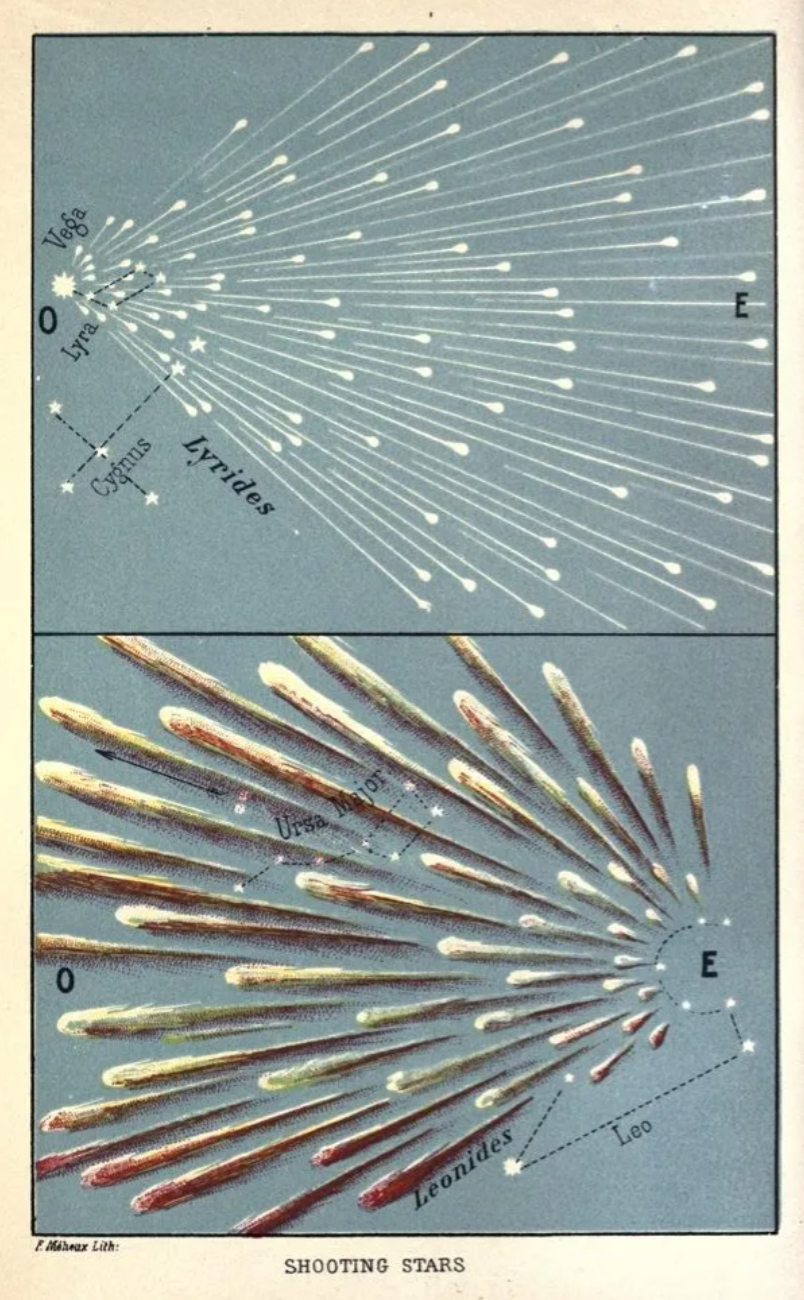
Electromagnetic radiation and celestial matter constantly bombard the planet Earth; the atmosphere acts as a protective layer, softening the reach of the sun’s rays, and dampening the blow of space matter. Meteors draw an evidence of this threshold between planetary atmosphere and outer space.The material encounter of the meteor with the threshold of the atmosphere signifies the meeting of two very different kinds of bodies. The meeting of atmospheric and celestial bodies results in the burning up of celestial matter in the upper atmosphere, marking its meeting with the Earth’s atmospheric periphery. We see (at night) and describe such an event as a shooting star, although they are not actually stars at all, but transient mixtures that only exist through encounter.
Unlike meteoroids (celestial bodies beyond the atmosphere of a planet or a moon), or meteorites (the remnant matter of some meteors that push through the atmosphere and come to land on a planet or a moon), meteors are not objects at all, but rather signifiers of process-encounter; their encounter with the atmospheric threshold of a planet or a moon results in a process of material change at great velocity. An electromagnetic signifier of a planetary threshold, we have much to learn from meteors.
the plural radio of meteors
During the process that is a meteor, radio waves are generated in the form of light. When we witness a meteor, we become receivers. As receivers of more-than-human radio, we are part of a more-than-human radio ecology. But meteors have a more complicated radio relation than only this; meteors have a plurality of radio relations: they generate and propagate. The ionised trails that are generated by meteors as they move through their process of transformation are also able to reflect radio signals back down to Earth, either directly back or bounced forward; this is a form of radio propagation often called Meteor Burst Communications.
This method is mainly used for military purposes, in amateur radio, as well as in climate data monitoring systems, such as Snow Telemetry (SNOTEL). SNOTEL is an automated system in which various climate related sensors—for snow depth, temperature, precipitation, etc—are set up in remote locations in order to regularly send back data to a collection centre. Such data is transmitted and received with a request> respond> acknowledge system—each step using the propagation capabilities of meteors within the transmission infrastructure; “this entire sequence of events occurs in less than a second” (Jernovics 1990). These automated (battery-powered and solar-recharged) systems are designed to operate unattended for around one year at a time. SNOTEL is an example of a certain dynamic of ‘sensing’: an automated, cybernetic, more-than-human listening, a monitoring of process and change. It is a kind of machine listening of elemental climate shifts and nuances, using technological infrastructures that rely upon natural phenomena as part of their system. It is an interesting combination: using the process of the meteor encounter in/as part of a system which works towards an objectification of planetary processes through datafication.
Another example of meteor trails bouncing signals back to Earth can be heard in the live meteor project, which allows one to listen to the phenomena of an anthropogenic radio signal being reflected back down to Earth by meteor trails in near real-time. (2) The audio signifier of a signal being bounced back to Earth is in the form of a ping sound, in amongst the sound of radio static. Rather than looking out for a shooting star, you are listening out for it.
In this sense, meteors signify a radio-plurality, because they not only generate bursts of radio waves upon meeting Earth’s atmosphere, but their trails also propagate signals.
learning from meteors: an ethics of doing
We can consider the plurality of meteors as generators as well as propagators of radio, but meteors are also bodies of disruption. One of the earliest scientific texts on the relation between meteors and anthropogenic radio signals was written by Hantaro Nagaoka and published in 1929. In it he considers the possibility that meteoric activity in the ionised layer of the atmosphere may affect radio transmission,mainly in the form of disturbance. This may lead us to questions of intention: what is disruption to some may be propagation to others. Although Nagaoka writes of “diffraction”,“discontinuity”, “irregular and diffuse reflections” (235), of course it is more complicated than this, and, at this point in historical time, also rather speculative. Nagaoka uses the image of light hitting a chaotically scratched mirror, which would affect its reflection in multiple ways—potentially diffracting it, potentially strengthening it (ibid.).
Meteors, in their relation to and with radio, can teach fluidity, plurality and gifting. The atmospheric encounter literally (and materially) changes them; this reminds me of Anna Tsing’s critique of individualism: “Self-contained individuals are not transformed by encounter. Maximizing their interests, they use encounters—but remain unchanged in them” (2015: 28). The plurality of radio doings that meteors display directs us towards feminist and decolonial thinking. (3) As meteors are our material ancestors, maybe we should listen to them. They display multiple simultaneous modes of being: the meteor-radio dynamic is one of disruption, propagation and generation:
Disruption, when signals are diverted from their intended path, which may be read, for example, as feminist killjoy tactics (Ahmed 2017; 2023) against racism and patriarchy, or working with decoloniality against modes of domination and extraction (Vázquez 2020); disruption is a form of resistance.
Propagation, when signals are intentionally bounced further, which may be read as a kind of generosity, or gifting. Again we can turn to Ahmed and the politics of citation: “Citation is how we acknowledge our debt to those who came before” (2017: 17). To propagate is to honour words, thoughts,ideas, research by acknowledging them and thus sharing them ethically further. We can also turn again to Vázquez and the pedagogies of relationality:
In the face of the unbearable debt of all that we have received, extracted, and consumed, the pedagogies of relationality call for engaging in an active politics of gratitude, of offering, of care. This is a sort of politics for the relational subject, to shift from the will to own, from the endless search for novelty, to the consciousness of owing and the practices of offering and gratitude. (2020: 173)
Generation, when signals are produced as part of the meteor as process-encounter, which may be read as a kind of creativity or imagination, for example Donna Haraway’s concept of speculative fabulation (2016) as a way to imagine other possible worlds, or Saidiya Hartman’s critical fabulation (2008), which was conceptualised in relation to the archive and Atlantic Slavery. Lapp explains: “Critical fabulation pushes other ways of knowing into view, ways of knowing that labor against the imperial archiving project and its world-collapsing impetus to reduce the lives of enslaved women and girls to passing mention” (2023: 126).
With the meteor’s radio relations in mind, they can guide us in an ethics of doing, to consider what’s important to us—in our creative practices, in our forms and methods of knowledge production, in our daily lives—to disrupt, to propagate, to generate.
Footnotes
1 Źychowski’s research (2014) is a poignant example of material mixtures in a forest in Poland: the human corpses from a mass grave, together with chemical remnants of ammunition, the acidic residue from pine trees, and the particularities of the layers of water and clay in this area.
2 “The meteor detector at LIVEMETEORS.com is located in DC Metropolitan area and is currently pointing the Yagi antenna at a TV tower in Canada broadcasting on channel 2 analog TV, around 55.24 MHz, or based on availability and propagation on channel 3 analog TV, around 61.260 MHz, likely located in Timmins, ON. Receiver is RTL/SDR and software is SDR#.”(Live Meteors).
3 See: Rolando Vázquez (2020), eg. “there is a plurality of worlds of sensing and meaning, a plurality of positionalities that dwell outside the narrative of modern aesthetics and epistemology and that have not been included, that have been suppressed” (165), as well as his thoughts on the plural-self as a relational person (136); Anna Tsing on Polyphony (2015: 23–24; 158); Lorraine Code on the collectivity of knowledge-making (2006).
This text is an adaptation of the ‘Interludes’ from my PhD project “Radio as Relation. Listening across Worlds of Artistic Research, Technologies & the More-than-human”, Potsdam University 2025.
First published by Robida in TRANSMISSIONS: Radio Essays on Edges, Crossings and Narrowcasting Borderlands, Aljaž Škrlep (Ed.), Robida, 2025 pp. 203-214.
References
Ahmed, Sara. The Feminist Killjoy Handbook. Duke University Press, 2023,
—. Living a Feminist Life. Duke University Press, 2017.
Code, Lorraine. Ecological Thinking. The Politics of Epistemic Location.Oxford University Press,2006
Fulke, William, and Theodore Hornberger. A Goodly Gallerye: William Fulke’s Book of Meteors.American Philosophical Society, 1979.
Haraway, Donna J. Staying with the Trouble: Making Kin in the Chthulucene. Duke University Press, 2016.
Hartman, Saidiya. “Venus in two acts.” Small Axe, vol. 12, no.2, 2008, pp. 1–14.
Jernovics, John P., Sr. Meteor Burst Communications: An Additional Means of Long-Haul Communications. U.S. Marine Corps, Command and Staff College, 1990.
Lapp, Jessica M. “‘The Only Way We Knew How:’ Provenancial Fabulation in Archives of Feminist Materials.” Archival Science, vol. 23, 2023, pp.117–136.
McBeath, Alastair. “Meteor Beliefs Project: ‘Meteor’ and Related Terms in English Usage.” WGN (Werkgroep Geminiden Nieuws), Journal of the International Meteor Organization, vol. 31, no. 1, 2004, pp. 35-38.
Live Meteors. “How Does This Work?” Live Meteors, www.livemeteors.com/how-does-this-work. Accessed 11 Oct. 2024.
Nagaoka, Hantaro. “Possibility of the Radio Transmission Being Disturbed by Meteoric
Showers.” Proceedings of the Imperial Academy, vol. 5, no. 6, 1929, pp. 233–236.
“Photon Definition and Meaning.” Collins English Dictionary,Harper Collins Publishers, www.collinsdictionary.com/dictionary/english/photon.
Accessed 19 Oct. 2024
Tsing, Anna Lowenhaupt. The mushroom at the end of the world: On the possibility of life in capitalist ruins. Princeton University
Press, 2015.
Vázquez, Rolando. Vistas of Modernity: Decolonial Aesthesis and the End of the Contemporary. Mondriaan Fund, 2020.
Żychowski, Józef. “Conditions Favoring the Occurrence of Ignis Fatuous Phenomenon Over a Mass Grave in Niepołomice (S Poland).” Procedia. Social and Behavioral Sciences, vol. 120, 2014, pp.347–355.
Image Credits
https://collection.sciencemuseumgroup.org.uk/objects/co64526/engraving-an-ignis-fatuus
https://tasmaniangeographic.com/flowers-of-the-sky-comets-throughout-history/#!gallery[1]/ML/11870
https://www.flickr.com/photos/mopa1/5711528390/in/photostream/
https://en.wikipedia.org/wiki/SNOTEL#/media/File:Meteor_Burst_SNOTEL.jpg
of fiery meteors
Up until the turn of the last century, the term meteor was used to describe any atmospheric phenomena (McBeath 2004: 35); Meteorology is perhaps the only example of this extended use that has remained today. As such, meteors were divided into four primary categories:
aerial or airy meteors, which comprise the winds; aqueous or watery meteors, which include all forms of atmospheric precipitation, such as rain, snow and hail, but also things like mist, fog, frost, dew and even clouds; luminous meteors, which are not the ‘shooting-star’ type, but consist of other phenomena such as the aurora, the rainbow or any of the halo effects seen mainly with the Sun or Moon; and finally igneous or fiery meteors, which do include ‘modern’ meteors, and lightning, ball-lightning, will o’wisps (ignis fatuus, marsh lights or candles). (Ibid.)
The final category—igneous or fiery meteors—contains some of the phenomena that generate natural radio.
In 1563, William Fulke published his book of meteors: A Goodly Gallerye. This was not the first text on the matter, though it was apparently the first in English, and it “reflects speculation about the nature of the universe over hundreds of years” (Hornberger 1979: 16). This speculative aspect is partly why I am drawn towards it, but I share it with you here for two more reasons. Firstly, I was drawn towards these ways of describing the many meteoric events as processes of elemental exchange—as moments of push and pull, as moments of change through encounter—which is how I began thinking of the shooting star kind of meteor, how I began to think about radio-making and radio in general, and even how I am thinking of the processes of writing. The second reason is that it was from this book that I once read live on the radio; the olde English of it (with different spelling, the extra e’s, the long s that looks like an uncrossed f), which I had not practiced, nor maybe even read entirely through beforehand, made for constant disruptions to the reading (out loud) process. It sort of felt like reading~speaking as water flowing over unforeseen rocks: a kind of gentle yet effective disruption. This generated an unintentional rhythm, and through this quite an unexpected pace and tone developed. Maybe something similar will happen with your reading too (though I did not include the long s):
Of lights that goeth before [humans], and followeth them abrode in the fields by the night season
There is also a kind of light that is seen in the night season, and seemeth to goe before humans, or to followe them, leading them out of their waye unto waters, and other dangerous places. […] This impression seen on the lande, is called in latin, Ignis Fatuus, foolish fyre, that hurteth not, but only feareth foules.
[…]
The foulische fyre, is an Exhalation kendled by meanes of violent moving, when by could of the night, in the lowest region of the ayre, it is beaten downe, and then commonly, if it be light, seeketh to ascend upward, and is sent down againe, so it danseth up and downe, Els if it move not up and downe, it is a great lompe of glueyish or oyly matter, that by moving of the heate in it selfe, is enflamed of it selfe, as moyst haye wyll be kyndled of it self. In whote and fenny countries, these lyghtes are often seen, and where as is abondaunce of such unctuus and fat matter, as about churchyardes wher through the corruption of the bodies ther buried, the earth is ful of suche substance, wherefore in churchyardes, or places of common buriall, oftentimes ar such lightes seen […] (Fulke [1563] 1979: 24–25)
For better or for worse, I will allow us to be guided, or (mis)led, by the marsh lights, otherwise known as the ignis fatuus:
a pale, sometimes bright, flickering, mostly moving light of easily flammable gases, occurring over damp areas, caused by decomposition of organic matter (remains of plants, animals or human corpses) in anoxic conditions. […] This phenomenon was observed in different but very wet environments, for example: over swamps, peat-bogs, moorlands, swampy meadows, river embankments, recently fertilised soil, muddy ditches, sewage canals, watercourse and at cemeteries. (Źychowski 2014: 348) (1)
Decaying organic matter releases certain compounds into the air: “at ambient temperatures, the mixture of gases: phosphine, hydrogen, and unstable diphosphine self-ignites. Diphosphine (P2H4) itself is especially unstable and when contacting with the air also self-ignites” (354). 1 The process of such gaseous matter leaving, or being released from the earth naturally leads to an encounter with air; it is a movement between subterranean and atmospheric worlds that reveals itself through light.
It is during this process-encounter that photons are emitted, causing the fiery light. The photon of such fiery light is “a quantum of electromagnetic radiation” (Collins)—itself embodying an amphibious movement between the worlds of waves and particles. Marsh light is borne from a threshold, displaying the trickster dynamic of border-dweller. If we allow ourselves to take a small (quantum) leap, we could think of the elemental process-encounter of ignis fatuus as an example of quantum radio; the earth transmits, the air receives.
thresholds of process-encounter
From the elemental threshold of earth and air, let’s turn skyward to face another periphery, another threshold, this time atmospheric.
Electromagnetic radiation and celestial matter constantly bombard the planet Earth; the atmosphere acts as a protective layer, softening the reach of the sun’s rays, and dampening the blow of space matter. Meteors draw an evidence of this threshold between planetary atmosphere and outer space.The material encounter of the meteor with the threshold of the atmosphere signifies the meeting of two very different kinds of bodies. The meeting of atmospheric and celestial bodies results in the burning up of celestial matter in the upper atmosphere, marking its meeting with the Earth’s atmospheric periphery. We see (at night) and describe such an event as a shooting star, although they are not actually stars at all, but transient mixtures that only exist through encounter.
Unlike meteoroids (celestial bodies beyond the atmosphere of a planet or a moon), or meteorites (the remnant matter of some meteors that push through the atmosphere and come to land on a planet or a moon), meteors are not objects at all, but rather signifiers of process-encounter; their encounter with the atmospheric threshold of a planet or a moon results in a process of material change at great velocity. An electromagnetic signifier of a planetary threshold, we have much to learn from meteors.
the plural radio of meteors
During the process that is a meteor, radio waves are generated in the form of light. When we witness a meteor, we become receivers. As receivers of more-than-human radio, we are part of a more-than-human radio ecology. But meteors have a more complicated radio relation than only this; meteors have a plurality of radio relations: they generate and propagate. The ionised trails that are generated by meteors as they move through their process of transformation are also able to reflect radio signals back down to Earth, either directly back or bounced forward; this is a form of radio propagation often called Meteor Burst Communications.
This method is mainly used for military purposes, in amateur radio, as well as in climate data monitoring systems, such as Snow Telemetry (SNOTEL). SNOTEL is an automated system in which various climate related sensors—for snow depth, temperature, precipitation, etc—are set up in remote locations in order to regularly send back data to a collection centre. Such data is transmitted and received with a request> respond> acknowledge system—each step using the propagation capabilities of meteors within the transmission infrastructure; “this entire sequence of events occurs in less than a second” (Jernovics 1990). These automated (battery-powered and solar-recharged) systems are designed to operate unattended for around one year at a time. SNOTEL is an example of a certain dynamic of ‘sensing’: an automated, cybernetic, more-than-human listening, a monitoring of process and change. It is a kind of machine listening of elemental climate shifts and nuances, using technological infrastructures that rely upon natural phenomena as part of their system. It is an interesting combination: using the process of the meteor encounter in/as part of a system which works towards an objectification of planetary processes through datafication.
Another example of meteor trails bouncing signals back to Earth can be heard in the live meteor project, which allows one to listen to the phenomena of an anthropogenic radio signal being reflected back down to Earth by meteor trails in near real-time. (2) The audio signifier of a signal being bounced back to Earth is in the form of a ping sound, in amongst the sound of radio static. Rather than looking out for a shooting star, you are listening out for it.
In this sense, meteors signify a radio-plurality, because they not only generate bursts of radio waves upon meeting Earth’s atmosphere, but their trails also propagate signals.
learning from meteors: an ethics of doing
We can consider the plurality of meteors as generators as well as propagators of radio, but meteors are also bodies of disruption. One of the earliest scientific texts on the relation between meteors and anthropogenic radio signals was written by Hantaro Nagaoka and published in 1929. In it he considers the possibility that meteoric activity in the ionised layer of the atmosphere may affect radio transmission,mainly in the form of disturbance. This may lead us to questions of intention: what is disruption to some may be propagation to others. Although Nagaoka writes of “diffraction”,“discontinuity”, “irregular and diffuse reflections” (235), of course it is more complicated than this, and, at this point in historical time, also rather speculative. Nagaoka uses the image of light hitting a chaotically scratched mirror, which would affect its reflection in multiple ways—potentially diffracting it, potentially strengthening it (ibid.).
Meteors, in their relation to and with radio, can teach fluidity, plurality and gifting. The atmospheric encounter literally (and materially) changes them; this reminds me of Anna Tsing’s critique of individualism: “Self-contained individuals are not transformed by encounter. Maximizing their interests, they use encounters—but remain unchanged in them” (2015: 28). The plurality of radio doings that meteors display directs us towards feminist and decolonial thinking. (3) As meteors are our material ancestors, maybe we should listen to them. They display multiple simultaneous modes of being: the meteor-radio dynamic is one of disruption, propagation and generation:
Disruption, when signals are diverted from their intended path, which may be read, for example, as feminist killjoy tactics (Ahmed 2017; 2023) against racism and patriarchy, or working with decoloniality against modes of domination and extraction (Vázquez 2020); disruption is a form of resistance.
Propagation, when signals are intentionally bounced further, which may be read as a kind of generosity, or gifting. Again we can turn to Ahmed and the politics of citation: “Citation is how we acknowledge our debt to those who came before” (2017: 17). To propagate is to honour words, thoughts,ideas, research by acknowledging them and thus sharing them ethically further. We can also turn again to Vázquez and the pedagogies of relationality:
In the face of the unbearable debt of all that we have received, extracted, and consumed, the pedagogies of relationality call for engaging in an active politics of gratitude, of offering, of care. This is a sort of politics for the relational subject, to shift from the will to own, from the endless search for novelty, to the consciousness of owing and the practices of offering and gratitude. (2020: 173)
Generation, when signals are produced as part of the meteor as process-encounter, which may be read as a kind of creativity or imagination, for example Donna Haraway’s concept of speculative fabulation (2016) as a way to imagine other possible worlds, or Saidiya Hartman’s critical fabulation (2008), which was conceptualised in relation to the archive and Atlantic Slavery. Lapp explains: “Critical fabulation pushes other ways of knowing into view, ways of knowing that labor against the imperial archiving project and its world-collapsing impetus to reduce the lives of enslaved women and girls to passing mention” (2023: 126).
With the meteor’s radio relations in mind, they can guide us in an ethics of doing, to consider what’s important to us—in our creative practices, in our forms and methods of knowledge production, in our daily lives—to disrupt, to propagate, to generate.
Footnotes
1 Źychowski’s research (2014) is a poignant example of material mixtures in a forest in Poland: the human corpses from a mass grave, together with chemical remnants of ammunition, the acidic residue from pine trees, and the particularities of the layers of water and clay in this area.
2 “The meteor detector at LIVEMETEORS.com is located in DC Metropolitan area and is currently pointing the Yagi antenna at a TV tower in Canada broadcasting on channel 2 analog TV, around 55.24 MHz, or based on availability and propagation on channel 3 analog TV, around 61.260 MHz, likely located in Timmins, ON. Receiver is RTL/SDR and software is SDR#.”(Live Meteors).
3 See: Rolando Vázquez (2020), eg. “there is a plurality of worlds of sensing and meaning, a plurality of positionalities that dwell outside the narrative of modern aesthetics and epistemology and that have not been included, that have been suppressed” (165), as well as his thoughts on the plural-self as a relational person (136); Anna Tsing on Polyphony (2015: 23–24; 158); Lorraine Code on the collectivity of knowledge-making (2006).
This text is an adaptation of the ‘Interludes’ from my PhD project “Radio as Relation. Listening across Worlds of Artistic Research, Technologies & the More-than-human”, Potsdam University 2025.
First published by Robida in TRANSMISSIONS: Radio Essays on Edges, Crossings and Narrowcasting Borderlands, Aljaž Škrlep (Ed.), Robida, 2025 pp. 203-214.
References
Ahmed, Sara. The Feminist Killjoy Handbook. Duke University Press, 2023,
—. Living a Feminist Life. Duke University Press, 2017.
Code, Lorraine. Ecological Thinking. The Politics of Epistemic Location.Oxford University Press,2006
Fulke, William, and Theodore Hornberger. A Goodly Gallerye: William Fulke’s Book of Meteors.American Philosophical Society, 1979.
Haraway, Donna J. Staying with the Trouble: Making Kin in the Chthulucene. Duke University Press, 2016.
Hartman, Saidiya. “Venus in two acts.” Small Axe, vol. 12, no.2, 2008, pp. 1–14.
Jernovics, John P., Sr. Meteor Burst Communications: An Additional Means of Long-Haul Communications. U.S. Marine Corps, Command and Staff College, 1990.
Lapp, Jessica M. “‘The Only Way We Knew How:’ Provenancial Fabulation in Archives of Feminist Materials.” Archival Science, vol. 23, 2023, pp.117–136.
McBeath, Alastair. “Meteor Beliefs Project: ‘Meteor’ and Related Terms in English Usage.” WGN (Werkgroep Geminiden Nieuws), Journal of the International Meteor Organization, vol. 31, no. 1, 2004, pp. 35-38.
Live Meteors. “How Does This Work?” Live Meteors, www.livemeteors.com/how-does-this-work. Accessed 11 Oct. 2024.
Nagaoka, Hantaro. “Possibility of the Radio Transmission Being Disturbed by Meteoric
Showers.” Proceedings of the Imperial Academy, vol. 5, no. 6, 1929, pp. 233–236.
“Photon Definition and Meaning.” Collins English Dictionary,Harper Collins Publishers, www.collinsdictionary.com/dictionary/english/photon.
Accessed 19 Oct. 2024
Tsing, Anna Lowenhaupt. The mushroom at the end of the world: On the possibility of life in capitalist ruins. Princeton University
Press, 2015.
Vázquez, Rolando. Vistas of Modernity: Decolonial Aesthesis and the End of the Contemporary. Mondriaan Fund, 2020.
Żychowski, Józef. “Conditions Favoring the Occurrence of Ignis Fatuous Phenomenon Over a Mass Grave in Niepołomice (S Poland).” Procedia. Social and Behavioral Sciences, vol. 120, 2014, pp.347–355.
Image Credits
https://collection.sciencemuseumgroup.org.uk/objects/co64526/engraving-an-ignis-fatuus
https://tasmaniangeographic.com/flowers-of-the-sky-comets-throughout-history/#!gallery[1]/ML/11870
https://www.flickr.com/photos/mopa1/5711528390/in/photostream/
https://en.wikipedia.org/wiki/SNOTEL#/media/File:Meteor_Burst_SNOTEL.jpg
Kate Donovan is an artist and researcher based in Berlin working on and with radio, listening, ecological thinking, the more-than-human, the trans-scalar, seeds, thresholds, amphibiousness...Much of her practice is together with others and circles around knowledge exchange and experimentation. She was part of the research group SENSING: the Knowledge of Sensitive Media (Potsdam), with a PhD project on Radio as Relation, and is a fellow of the 4A_Lab Berlin, Institute for Art History, Florence - Max-Planck-InstitutShe is also the co-founder of Radio Otherwise, an artistic research project motivated by the many knots which art, knowledge-making/sharing and communication encounter.


BY KATE DONOVAN
of fiery meteors
Up until the turn of the last century, the term meteor was used to describe any atmospheric phenomena (McBeath 2004: 35); Meteorology is perhaps the only example of this extended use that has remained today. As such, meteors were divided into four primary categories:
aerial or airy meteors, which comprise the winds; aqueous or watery meteors, which include all forms of atmospheric precipitation, such as rain, snow and hail, but also things like mist, fog, frost, dew and even clouds; luminous meteors, which are not the ‘shooting-star’ type, but consist of other phenomena such as the aurora, the rainbow or any of the halo effects seen mainly with the Sun or Moon; and finally igneous or fiery meteors, which do include ‘modern’ meteors, and lightning, ball-lightning, will o’wisps (ignis fatuus, marsh lights or candles). (Ibid.)
The final category—igneous or fiery meteors—contains some of the phenomena that generate natural radio.
In 1563, William Fulke published his book of meteors: A Goodly Gallerye. This was not the first text on the matter, though it was apparently the first in English, and it “reflects speculation about the nature of the universe over hundreds of years” (Hornberger 1979: 16). This speculative aspect is partly why I am drawn towards it, but I share it with you here for two more reasons. Firstly, I was drawn towards these ways of describing the many meteoric events as processes of elemental exchange—as moments of push and pull, as moments of change through encounter—which is how I began thinking of the shooting star kind of meteor, how I began to think about radio-making and radio in general, and even how I am thinking of the processes of writing. The second reason is that it was from this book that I once read live on the radio; the olde English of it (with different spelling, the extra e’s, the long s that looks like an uncrossed f), which I had not practiced, nor maybe even read entirely through beforehand, made for constant disruptions to the reading (out loud) process. It sort of felt like reading~speaking as water flowing over unforeseen rocks: a kind of gentle yet effective disruption. This generated an unintentional rhythm, and through this quite an unexpected pace and tone developed. Maybe something similar will happen with your reading too (though I did not include the long s):
Of lights that goeth before [humans], and followeth them abrode in the fields by the night season
There is also a kind of light that is seen in the night season, and seemeth to goe before humans, or to followe them, leading them out of their waye unto waters, and other dangerous places. […] This impression seen on the lande, is called in latin, Ignis Fatuus, foolish fyre, that hurteth not, but only feareth foules.
[…]
The foulische fyre, is an Exhalation kendled by meanes of violent moving, when by could of the night, in the lowest region of the ayre, it is beaten downe, and then commonly, if it be light, seeketh to ascend upward, and is sent down againe, so it danseth up and downe, Els if it move not up and downe, it is a great lompe of glueyish or oyly matter, that by moving of the heate in it selfe, is enflamed of it selfe, as moyst haye wyll be kyndled of it self. In whote and fenny countries, these lyghtes are often seen, and where as is abondaunce of such unctuus and fat matter, as about churchyardes wher through the corruption of the bodies ther buried, the earth is ful of suche substance, wherefore in churchyardes, or places of common buriall, oftentimes ar such lightes seen […] (Fulke [1563] 1979: 24–25)
For better or for worse, I will allow us to be guided, or (mis)led, by the marsh lights, otherwise known as the ignis fatuus:
a pale, sometimes bright, flickering, mostly moving light of easily flammable gases, occurring over damp areas, caused by decomposition of organic matter (remains of plants, animals or human corpses) in anoxic conditions. […] This phenomenon was observed in different but very wet environments, for example: over swamps, peat-bogs, moorlands, swampy meadows, river embankments, recently fertilised soil, muddy ditches, sewage canals, watercourse and at cemeteries. (Źychowski 2014: 348) (1)
Decaying organic matter releases certain compounds into the air: “at ambient temperatures, the mixture of gases: phosphine, hydrogen, and unstable diphosphine self-ignites. Diphosphine (P2H4) itself is especially unstable and when contacting with the air also self-ignites” (354). 1 The process of such gaseous matter leaving, or being released from the earth naturally leads to an encounter with air; it is a movement between subterranean and atmospheric worlds that reveals itself through light.
It is during this process-encounter that photons are emitted, causing the fiery light. The photon of such fiery light is “a quantum of electromagnetic radiation” (Collins)—itself embodying an amphibious movement between the worlds of waves and particles. Marsh light is borne from a threshold, displaying the trickster dynamic of border-dweller. If we allow ourselves to take a small (quantum) leap, we could think of the elemental process-encounter of ignis fatuus as an example of quantum radio; the earth transmits, the air receives.
thresholds of process-encounter
From the elemental threshold of earth and air, let’s turn skyward to face another periphery, another threshold, this time atmospheric.
Electromagnetic radiation and celestial matter constantly bombard the planet Earth; the atmosphere acts as a protective layer, softening the reach of the sun’s rays, and dampening the blow of space matter. Meteors draw an evidence of this threshold between planetary atmosphere and outer space.The material encounter of the meteor with the threshold of the atmosphere signifies the meeting of two very different kinds of bodies. The meeting of atmospheric and celestial bodies results in the burning up of celestial matter in the upper atmosphere, marking its meeting with the Earth’s atmospheric periphery. We see (at night) and describe such an event as a shooting star, although they are not actually stars at all, but transient mixtures that only exist through encounter.
Unlike meteoroids (celestial bodies beyond the atmosphere of a planet or a moon), or meteorites (the remnant matter of some meteors that push through the atmosphere and come to land on a planet or a moon), meteors are not objects at all, but rather signifiers of process-encounter; their encounter with the atmospheric threshold of a planet or a moon results in a process of material change at great velocity. An electromagnetic signifier of a planetary threshold, we have much to learn from meteors.
the plural radio of meteors
During the process that is a meteor, radio waves are generated in the form of light. When we witness a meteor, we become receivers. As receivers of more-than-human radio, we are part of a more-than-human radio ecology. But meteors have a more complicated radio relation than only this; meteors have a plurality of radio relations: they generate and propagate. The ionised trails that are generated by meteors as they move through their process of transformation are also able to reflect radio signals back down to Earth, either directly back or bounced forward; this is a form of radio propagation often called Meteor Burst Communications.
This method is mainly used for military purposes, in amateur radio, as well as in climate data monitoring systems, such as Snow Telemetry (SNOTEL). SNOTEL is an automated system in which various climate related sensors—for snow depth, temperature, precipitation, etc—are set up in remote locations in order to regularly send back data to a collection centre. Such data is transmitted and received with a request> respond> acknowledge system—each step using the propagation capabilities of meteors within the transmission infrastructure; “this entire sequence of events occurs in less than a second” (Jernovics 1990). These automated (battery-powered and solar-recharged) systems are designed to operate unattended for around one year at a time. SNOTEL is an example of a certain dynamic of ‘sensing’: an automated, cybernetic, more-than-human listening, a monitoring of process and change. It is a kind of machine listening of elemental climate shifts and nuances, using technological infrastructures that rely upon natural phenomena as part of their system. It is an interesting combination: using the process of the meteor encounter in/as part of a system which works towards an objectification of planetary processes through datafication.
Another example of meteor trails bouncing signals back to Earth can be heard in the live meteor project, which allows one to listen to the phenomena of an anthropogenic radio signal being reflected back down to Earth by meteor trails in near real-time. (2) The audio signifier of a signal being bounced back to Earth is in the form of a ping sound, in amongst the sound of radio static. Rather than looking out for a shooting star, you are listening out for it.
In this sense, meteors signify a radio-plurality, because they not only generate bursts of radio waves upon meeting Earth’s atmosphere, but their trails also propagate signals.
learning from meteors: an ethics of doing
We can consider the plurality of meteors as generators as well as propagators of radio, but meteors are also bodies of disruption. One of the earliest scientific texts on the relation between meteors and anthropogenic radio signals was written by Hantaro Nagaoka and published in 1929. In it he considers the possibility that meteoric activity in the ionised layer of the atmosphere may affect radio transmission,mainly in the form of disturbance. This may lead us to questions of intention: what is disruption to some may be propagation to others. Although Nagaoka writes of “diffraction”,“discontinuity”, “irregular and diffuse reflections” (235), of course it is more complicated than this, and, at this point in historical time, also rather speculative. Nagaoka uses the image of light hitting a chaotically scratched mirror, which would affect its reflection in multiple ways—potentially diffracting it, potentially strengthening it (ibid.).
Meteors, in their relation to and with radio, can teach fluidity, plurality and gifting. The atmospheric encounter literally (and materially) changes them; this reminds me of Anna Tsing’s critique of individualism: “Self-contained individuals are not transformed by encounter. Maximizing their interests, they use encounters—but remain unchanged in them” (2015: 28). The plurality of radio doings that meteors display directs us towards feminist and decolonial thinking. (3) As meteors are our material ancestors, maybe we should listen to them. They display multiple simultaneous modes of being: the meteor-radio dynamic is one of disruption, propagation and generation:
Disruption, when signals are diverted from their intended path, which may be read, for example, as feminist killjoy tactics (Ahmed 2017; 2023) against racism and patriarchy, or working with decoloniality against modes of domination and extraction (Vázquez 2020); disruption is a form of resistance.
Propagation, when signals are intentionally bounced further, which may be read as a kind of generosity, or gifting. Again we can turn to Ahmed and the politics of citation: “Citation is how we acknowledge our debt to those who came before” (2017: 17). To propagate is to honour words, thoughts,ideas, research by acknowledging them and thus sharing them ethically further. We can also turn again to Vázquez and the pedagogies of relationality:
In the face of the unbearable debt of all that we have received, extracted, and consumed, the pedagogies of relationality call for engaging in an active politics of gratitude, of offering, of care. This is a sort of politics for the relational subject, to shift from the will to own, from the endless search for novelty, to the consciousness of owing and the practices of offering and gratitude. (2020: 173)
Generation, when signals are produced as part of the meteor as process-encounter, which may be read as a kind of creativity or imagination, for example Donna Haraway’s concept of speculative fabulation (2016) as a way to imagine other possible worlds, or Saidiya Hartman’s critical fabulation (2008), which was conceptualised in relation to the archive and Atlantic Slavery. Lapp explains: “Critical fabulation pushes other ways of knowing into view, ways of knowing that labor against the imperial archiving project and its world-collapsing impetus to reduce the lives of enslaved women and girls to passing mention” (2023: 126).
With the meteor’s radio relations in mind, they can guide us in an ethics of doing, to consider what’s important to us—in our creative practices, in our forms and methods of knowledge production, in our daily lives—to disrupt, to propagate, to generate.
Footnotes
1 Źychowski’s research (2014) is a poignant example of material mixtures in a forest in Poland: the human corpses from a mass grave, together with chemical remnants of ammunition, the acidic residue from pine trees, and the particularities of the layers of water and clay in this area.
2 “The meteor detector at LIVEMETEORS.com is located in DC Metropolitan area and is currently pointing the Yagi antenna at a TV tower in Canada broadcasting on channel 2 analog TV, around 55.24 MHz, or based on availability and propagation on channel 3 analog TV, around 61.260 MHz, likely located in Timmins, ON. Receiver is RTL/SDR and software is SDR#.”(Live Meteors).
3 See: Rolando Vázquez (2020), eg. “there is a plurality of worlds of sensing and meaning, a plurality of positionalities that dwell outside the narrative of modern aesthetics and epistemology and that have not been included, that have been suppressed” (165), as well as his thoughts on the plural-self as a relational person (136); Anna Tsing on Polyphony (2015: 23–24; 158); Lorraine Code on the collectivity of knowledge-making (2006).
This text is an adaptation of the ‘Interludes’ from my PhD project “Radio as Relation. Listening across Worlds of Artistic Research, Technologies & the More-than-human”, Potsdam University 2025.
First published by Robida in TRANSMISSIONS: Radio Essays on Edges, Crossings and Narrowcasting Borderlands, Aljaž Škrlep (Ed.), Robida, 2025 pp. 203-214.
References
Ahmed, Sara. The Feminist Killjoy Handbook. Duke University Press, 2023,
—. Living a Feminist Life. Duke University Press, 2017.
Code, Lorraine. Ecological Thinking. The Politics of Epistemic Location.Oxford University Press,2006
Fulke, William, and Theodore Hornberger. A Goodly Gallerye: William Fulke’s Book of Meteors.American Philosophical Society, 1979.
Haraway, Donna J. Staying with the Trouble: Making Kin in the Chthulucene. Duke University Press, 2016.
Hartman, Saidiya. “Venus in two acts.” Small Axe, vol. 12, no.2, 2008, pp. 1–14.
Jernovics, John P., Sr. Meteor Burst Communications: An Additional Means of Long-Haul Communications. U.S. Marine Corps, Command and Staff College, 1990.
Lapp, Jessica M. “‘The Only Way We Knew How:’ Provenancial Fabulation in Archives of Feminist Materials.” Archival Science, vol. 23, 2023, pp.117–136.
McBeath, Alastair. “Meteor Beliefs Project: ‘Meteor’ and Related Terms in English Usage.” WGN (Werkgroep Geminiden Nieuws), Journal of the International Meteor Organization, vol. 31, no. 1, 2004, pp. 35-38.
Live Meteors. “How Does This Work?” Live Meteors, www.livemeteors.com/how-does-this-work. Accessed 11 Oct. 2024.
Nagaoka, Hantaro. “Possibility of the Radio Transmission Being Disturbed by Meteoric
Showers.” Proceedings of the Imperial Academy, vol. 5, no. 6, 1929, pp. 233–236.
“Photon Definition and Meaning.” Collins English Dictionary,Harper Collins Publishers, www.collinsdictionary.com/dictionary/english/photon.
Accessed 19 Oct. 2024
Tsing, Anna Lowenhaupt. The mushroom at the end of the world: On the possibility of life in capitalist ruins. Princeton University
Press, 2015.
Vázquez, Rolando. Vistas of Modernity: Decolonial Aesthesis and the End of the Contemporary. Mondriaan Fund, 2020.
Żychowski, Józef. “Conditions Favoring the Occurrence of Ignis Fatuous Phenomenon Over a Mass Grave in Niepołomice (S Poland).” Procedia. Social and Behavioral Sciences, vol. 120, 2014, pp.347–355.
Image Credits
https://collection.sciencemuseumgroup.org.uk/objects/co64526/engraving-an-ignis-fatuus
https://tasmaniangeographic.com/flowers-of-the-sky-comets-throughout-history/#!gallery[1]/ML/11870
https://www.flickr.com/photos/mopa1/5711528390/in/photostream/
https://en.wikipedia.org/wiki/SNOTEL#/media/File:Meteor_Burst_SNOTEL.jpg
of fiery meteors
Up until the turn of the last century, the term meteor was used to describe any atmospheric phenomena (McBeath 2004: 35); Meteorology is perhaps the only example of this extended use that has remained today. As such, meteors were divided into four primary categories:
aerial or airy meteors, which comprise the winds; aqueous or watery meteors, which include all forms of atmospheric precipitation, such as rain, snow and hail, but also things like mist, fog, frost, dew and even clouds; luminous meteors, which are not the ‘shooting-star’ type, but consist of other phenomena such as the aurora, the rainbow or any of the halo effects seen mainly with the Sun or Moon; and finally igneous or fiery meteors, which do include ‘modern’ meteors, and lightning, ball-lightning, will o’wisps (ignis fatuus, marsh lights or candles). (Ibid.)
The final category—igneous or fiery meteors—contains some of the phenomena that generate natural radio.
In 1563, William Fulke published his book of meteors: A Goodly Gallerye. This was not the first text on the matter, though it was apparently the first in English, and it “reflects speculation about the nature of the universe over hundreds of years” (Hornberger 1979: 16). This speculative aspect is partly why I am drawn towards it, but I share it with you here for two more reasons. Firstly, I was drawn towards these ways of describing the many meteoric events as processes of elemental exchange—as moments of push and pull, as moments of change through encounter—which is how I began thinking of the shooting star kind of meteor, how I began to think about radio-making and radio in general, and even how I am thinking of the processes of writing. The second reason is that it was from this book that I once read live on the radio; the olde English of it (with different spelling, the extra e’s, the long s that looks like an uncrossed f), which I had not practiced, nor maybe even read entirely through beforehand, made for constant disruptions to the reading (out loud) process. It sort of felt like reading~speaking as water flowing over unforeseen rocks: a kind of gentle yet effective disruption. This generated an unintentional rhythm, and through this quite an unexpected pace and tone developed. Maybe something similar will happen with your reading too (though I did not include the long s):
Of lights that goeth before [humans], and followeth them abrode in the fields by the night season
There is also a kind of light that is seen in the night season, and seemeth to goe before humans, or to followe them, leading them out of their waye unto waters, and other dangerous places. […] This impression seen on the lande, is called in latin, Ignis Fatuus, foolish fyre, that hurteth not, but only feareth foules.
[…]
The foulische fyre, is an Exhalation kendled by meanes of violent moving, when by could of the night, in the lowest region of the ayre, it is beaten downe, and then commonly, if it be light, seeketh to ascend upward, and is sent down againe, so it danseth up and downe, Els if it move not up and downe, it is a great lompe of glueyish or oyly matter, that by moving of the heate in it selfe, is enflamed of it selfe, as moyst haye wyll be kyndled of it self. In whote and fenny countries, these lyghtes are often seen, and where as is abondaunce of such unctuus and fat matter, as about churchyardes wher through the corruption of the bodies ther buried, the earth is ful of suche substance, wherefore in churchyardes, or places of common buriall, oftentimes ar such lightes seen […] (Fulke [1563] 1979: 24–25)
For better or for worse, I will allow us to be guided, or (mis)led, by the marsh lights, otherwise known as the ignis fatuus:
a pale, sometimes bright, flickering, mostly moving light of easily flammable gases, occurring over damp areas, caused by decomposition of organic matter (remains of plants, animals or human corpses) in anoxic conditions. […] This phenomenon was observed in different but very wet environments, for example: over swamps, peat-bogs, moorlands, swampy meadows, river embankments, recently fertilised soil, muddy ditches, sewage canals, watercourse and at cemeteries. (Źychowski 2014: 348) (1)
Decaying organic matter releases certain compounds into the air: “at ambient temperatures, the mixture of gases: phosphine, hydrogen, and unstable diphosphine self-ignites. Diphosphine (P2H4) itself is especially unstable and when contacting with the air also self-ignites” (354). 1 The process of such gaseous matter leaving, or being released from the earth naturally leads to an encounter with air; it is a movement between subterranean and atmospheric worlds that reveals itself through light.
It is during this process-encounter that photons are emitted, causing the fiery light. The photon of such fiery light is “a quantum of electromagnetic radiation” (Collins)—itself embodying an amphibious movement between the worlds of waves and particles. Marsh light is borne from a threshold, displaying the trickster dynamic of border-dweller. If we allow ourselves to take a small (quantum) leap, we could think of the elemental process-encounter of ignis fatuus as an example of quantum radio; the earth transmits, the air receives.
thresholds of process-encounter
From the elemental threshold of earth and air, let’s turn skyward to face another periphery, another threshold, this time atmospheric.
Electromagnetic radiation and celestial matter constantly bombard the planet Earth; the atmosphere acts as a protective layer, softening the reach of the sun’s rays, and dampening the blow of space matter. Meteors draw an evidence of this threshold between planetary atmosphere and outer space.The material encounter of the meteor with the threshold of the atmosphere signifies the meeting of two very different kinds of bodies. The meeting of atmospheric and celestial bodies results in the burning up of celestial matter in the upper atmosphere, marking its meeting with the Earth’s atmospheric periphery. We see (at night) and describe such an event as a shooting star, although they are not actually stars at all, but transient mixtures that only exist through encounter.
Unlike meteoroids (celestial bodies beyond the atmosphere of a planet or a moon), or meteorites (the remnant matter of some meteors that push through the atmosphere and come to land on a planet or a moon), meteors are not objects at all, but rather signifiers of process-encounter; their encounter with the atmospheric threshold of a planet or a moon results in a process of material change at great velocity. An electromagnetic signifier of a planetary threshold, we have much to learn from meteors.
the plural radio of meteors
During the process that is a meteor, radio waves are generated in the form of light. When we witness a meteor, we become receivers. As receivers of more-than-human radio, we are part of a more-than-human radio ecology. But meteors have a more complicated radio relation than only this; meteors have a plurality of radio relations: they generate and propagate. The ionised trails that are generated by meteors as they move through their process of transformation are also able to reflect radio signals back down to Earth, either directly back or bounced forward; this is a form of radio propagation often called Meteor Burst Communications.
This method is mainly used for military purposes, in amateur radio, as well as in climate data monitoring systems, such as Snow Telemetry (SNOTEL). SNOTEL is an automated system in which various climate related sensors—for snow depth, temperature, precipitation, etc—are set up in remote locations in order to regularly send back data to a collection centre. Such data is transmitted and received with a request> respond> acknowledge system—each step using the propagation capabilities of meteors within the transmission infrastructure; “this entire sequence of events occurs in less than a second” (Jernovics 1990). These automated (battery-powered and solar-recharged) systems are designed to operate unattended for around one year at a time. SNOTEL is an example of a certain dynamic of ‘sensing’: an automated, cybernetic, more-than-human listening, a monitoring of process and change. It is a kind of machine listening of elemental climate shifts and nuances, using technological infrastructures that rely upon natural phenomena as part of their system. It is an interesting combination: using the process of the meteor encounter in/as part of a system which works towards an objectification of planetary processes through datafication.
Another example of meteor trails bouncing signals back to Earth can be heard in the live meteor project, which allows one to listen to the phenomena of an anthropogenic radio signal being reflected back down to Earth by meteor trails in near real-time. (2) The audio signifier of a signal being bounced back to Earth is in the form of a ping sound, in amongst the sound of radio static. Rather than looking out for a shooting star, you are listening out for it.
In this sense, meteors signify a radio-plurality, because they not only generate bursts of radio waves upon meeting Earth’s atmosphere, but their trails also propagate signals.
learning from meteors: an ethics of doing
We can consider the plurality of meteors as generators as well as propagators of radio, but meteors are also bodies of disruption. One of the earliest scientific texts on the relation between meteors and anthropogenic radio signals was written by Hantaro Nagaoka and published in 1929. In it he considers the possibility that meteoric activity in the ionised layer of the atmosphere may affect radio transmission,mainly in the form of disturbance. This may lead us to questions of intention: what is disruption to some may be propagation to others. Although Nagaoka writes of “diffraction”,“discontinuity”, “irregular and diffuse reflections” (235), of course it is more complicated than this, and, at this point in historical time, also rather speculative. Nagaoka uses the image of light hitting a chaotically scratched mirror, which would affect its reflection in multiple ways—potentially diffracting it, potentially strengthening it (ibid.).
Meteors, in their relation to and with radio, can teach fluidity, plurality and gifting. The atmospheric encounter literally (and materially) changes them; this reminds me of Anna Tsing’s critique of individualism: “Self-contained individuals are not transformed by encounter. Maximizing their interests, they use encounters—but remain unchanged in them” (2015: 28). The plurality of radio doings that meteors display directs us towards feminist and decolonial thinking. (3) As meteors are our material ancestors, maybe we should listen to them. They display multiple simultaneous modes of being: the meteor-radio dynamic is one of disruption, propagation and generation:
Disruption, when signals are diverted from their intended path, which may be read, for example, as feminist killjoy tactics (Ahmed 2017; 2023) against racism and patriarchy, or working with decoloniality against modes of domination and extraction (Vázquez 2020); disruption is a form of resistance.
Propagation, when signals are intentionally bounced further, which may be read as a kind of generosity, or gifting. Again we can turn to Ahmed and the politics of citation: “Citation is how we acknowledge our debt to those who came before” (2017: 17). To propagate is to honour words, thoughts,ideas, research by acknowledging them and thus sharing them ethically further. We can also turn again to Vázquez and the pedagogies of relationality:
In the face of the unbearable debt of all that we have received, extracted, and consumed, the pedagogies of relationality call for engaging in an active politics of gratitude, of offering, of care. This is a sort of politics for the relational subject, to shift from the will to own, from the endless search for novelty, to the consciousness of owing and the practices of offering and gratitude. (2020: 173)
Generation, when signals are produced as part of the meteor as process-encounter, which may be read as a kind of creativity or imagination, for example Donna Haraway’s concept of speculative fabulation (2016) as a way to imagine other possible worlds, or Saidiya Hartman’s critical fabulation (2008), which was conceptualised in relation to the archive and Atlantic Slavery. Lapp explains: “Critical fabulation pushes other ways of knowing into view, ways of knowing that labor against the imperial archiving project and its world-collapsing impetus to reduce the lives of enslaved women and girls to passing mention” (2023: 126).
With the meteor’s radio relations in mind, they can guide us in an ethics of doing, to consider what’s important to us—in our creative practices, in our forms and methods of knowledge production, in our daily lives—to disrupt, to propagate, to generate.
Footnotes
1 Źychowski’s research (2014) is a poignant example of material mixtures in a forest in Poland: the human corpses from a mass grave, together with chemical remnants of ammunition, the acidic residue from pine trees, and the particularities of the layers of water and clay in this area.
2 “The meteor detector at LIVEMETEORS.com is located in DC Metropolitan area and is currently pointing the Yagi antenna at a TV tower in Canada broadcasting on channel 2 analog TV, around 55.24 MHz, or based on availability and propagation on channel 3 analog TV, around 61.260 MHz, likely located in Timmins, ON. Receiver is RTL/SDR and software is SDR#.”(Live Meteors).
3 See: Rolando Vázquez (2020), eg. “there is a plurality of worlds of sensing and meaning, a plurality of positionalities that dwell outside the narrative of modern aesthetics and epistemology and that have not been included, that have been suppressed” (165), as well as his thoughts on the plural-self as a relational person (136); Anna Tsing on Polyphony (2015: 23–24; 158); Lorraine Code on the collectivity of knowledge-making (2006).
This text is an adaptation of the ‘Interludes’ from my PhD project “Radio as Relation. Listening across Worlds of Artistic Research, Technologies & the More-than-human”, Potsdam University 2025.
First published by Robida in TRANSMISSIONS: Radio Essays on Edges, Crossings and Narrowcasting Borderlands, Aljaž Škrlep (Ed.), Robida, 2025 pp. 203-214.
References
Ahmed, Sara. The Feminist Killjoy Handbook. Duke University Press, 2023,
—. Living a Feminist Life. Duke University Press, 2017.
Code, Lorraine. Ecological Thinking. The Politics of Epistemic Location.Oxford University Press,2006
Fulke, William, and Theodore Hornberger. A Goodly Gallerye: William Fulke’s Book of Meteors.American Philosophical Society, 1979.
Haraway, Donna J. Staying with the Trouble: Making Kin in the Chthulucene. Duke University Press, 2016.
Hartman, Saidiya. “Venus in two acts.” Small Axe, vol. 12, no.2, 2008, pp. 1–14.
Jernovics, John P., Sr. Meteor Burst Communications: An Additional Means of Long-Haul Communications. U.S. Marine Corps, Command and Staff College, 1990.
Lapp, Jessica M. “‘The Only Way We Knew How:’ Provenancial Fabulation in Archives of Feminist Materials.” Archival Science, vol. 23, 2023, pp.117–136.
McBeath, Alastair. “Meteor Beliefs Project: ‘Meteor’ and Related Terms in English Usage.” WGN (Werkgroep Geminiden Nieuws), Journal of the International Meteor Organization, vol. 31, no. 1, 2004, pp. 35-38.
Live Meteors. “How Does This Work?” Live Meteors, www.livemeteors.com/how-does-this-work. Accessed 11 Oct. 2024.
Nagaoka, Hantaro. “Possibility of the Radio Transmission Being Disturbed by Meteoric
Showers.” Proceedings of the Imperial Academy, vol. 5, no. 6, 1929, pp. 233–236.
“Photon Definition and Meaning.” Collins English Dictionary,Harper Collins Publishers, www.collinsdictionary.com/dictionary/english/photon.
Accessed 19 Oct. 2024
Tsing, Anna Lowenhaupt. The mushroom at the end of the world: On the possibility of life in capitalist ruins. Princeton University
Press, 2015.
Vázquez, Rolando. Vistas of Modernity: Decolonial Aesthesis and the End of the Contemporary. Mondriaan Fund, 2020.
Żychowski, Józef. “Conditions Favoring the Occurrence of Ignis Fatuous Phenomenon Over a Mass Grave in Niepołomice (S Poland).” Procedia. Social and Behavioral Sciences, vol. 120, 2014, pp.347–355.
Image Credits
https://collection.sciencemuseumgroup.org.uk/objects/co64526/engraving-an-ignis-fatuus
https://tasmaniangeographic.com/flowers-of-the-sky-comets-throughout-history/#!gallery[1]/ML/11870
https://www.flickr.com/photos/mopa1/5711528390/in/photostream/
https://en.wikipedia.org/wiki/SNOTEL#/media/File:Meteor_Burst_SNOTEL.jpg
Kate Donovan is an artist and researcher based in Berlin working on and with radio, listening, ecological thinking, the more-than-human, the trans-scalar, seeds, thresholds, amphibiousness...Much of her practice is together with others and circles around knowledge exchange and experimentation. She was part of the research group SENSING: the Knowledge of Sensitive Media (Potsdam), with a PhD project on Radio as Relation, and is a fellow of the 4A_Lab Berlin, Institute for Art History, Florence - Max-Planck-InstitutShe is also the co-founder of Radio Otherwise, an artistic research project motivated by the many knots which art, knowledge-making/sharing and communication encounter.
BY KATE DONOVAN
of fiery meteors
Up until the turn of the last century, the term meteor was used to describe any atmospheric phenomena (McBeath 2004: 35); Meteorology is perhaps the only example of this extended use that has remained today. As such, meteors were divided into four primary categories:
aerial or airy meteors, which comprise the winds; aqueous or watery meteors, which include all forms of atmospheric precipitation, such as rain, snow and hail, but also things like mist, fog, frost, dew and even clouds; luminous meteors, which are not the ‘shooting-star’ type, but consist of other phenomena such as the aurora, the rainbow or any of the halo effects seen mainly with the Sun or Moon; and finally igneous or fiery meteors, which do include ‘modern’ meteors, and lightning, ball-lightning, will o’wisps (ignis fatuus, marsh lights or candles). (Ibid.)
The final category—igneous or fiery meteors—contains some of the phenomena that generate natural radio.
In 1563, William Fulke published his book of meteors: A Goodly Gallerye. This was not the first text on the matter, though it was apparently the first in English, and it “reflects speculation about the nature of the universe over hundreds of years” (Hornberger 1979: 16). This speculative aspect is partly why I am drawn towards it, but I share it with you here for two more reasons. Firstly, I was drawn towards these ways of describing the many meteoric events as processes of elemental exchange—as moments of push and pull, as moments of change through encounter—which is how I began thinking of the shooting star kind of meteor, how I began to think about radio-making and radio in general, and even how I am thinking of the processes of writing. The second reason is that it was from this book that I once read live on the radio; the olde English of it (with different spelling, the extra e’s, the long s that looks like an uncrossed f), which I had not practiced, nor maybe even read entirely through beforehand, made for constant disruptions to the reading (out loud) process. It sort of felt like reading~speaking as water flowing over unforeseen rocks: a kind of gentle yet effective disruption. This generated an unintentional rhythm, and through this quite an unexpected pace and tone developed. Maybe something similar will happen with your reading too (though I did not include the long s):
Of lights that goeth before [humans], and followeth them abrode in the fields by the night season
There is also a kind of light that is seen in the night season, and seemeth to goe before humans, or to followe them, leading them out of their waye unto waters, and other dangerous places. […] This impression seen on the lande, is called in latin, Ignis Fatuus, foolish fyre, that hurteth not, but only feareth foules.
[…]
The foulische fyre, is an Exhalation kendled by meanes of violent moving, when by could of the night, in the lowest region of the ayre, it is beaten downe, and then commonly, if it be light, seeketh to ascend upward, and is sent down againe, so it danseth up and downe, Els if it move not up and downe, it is a great lompe of glueyish or oyly matter, that by moving of the heate in it selfe, is enflamed of it selfe, as moyst haye wyll be kyndled of it self. In whote and fenny countries, these lyghtes are often seen, and where as is abondaunce of such unctuus and fat matter, as about churchyardes wher through the corruption of the bodies ther buried, the earth is ful of suche substance, wherefore in churchyardes, or places of common buriall, oftentimes ar such lightes seen […] (Fulke [1563] 1979: 24–25)
For better or for worse, I will allow us to be guided, or (mis)led, by the marsh lights, otherwise known as the ignis fatuus:
a pale, sometimes bright, flickering, mostly moving light of easily flammable gases, occurring over damp areas, caused by decomposition of organic matter (remains of plants, animals or human corpses) in anoxic conditions. […] This phenomenon was observed in different but very wet environments, for example: over swamps, peat-bogs, moorlands, swampy meadows, river embankments, recently fertilised soil, muddy ditches, sewage canals, watercourse and at cemeteries. (Źychowski 2014: 348) (1)
Decaying organic matter releases certain compounds into the air: “at ambient temperatures, the mixture of gases: phosphine, hydrogen, and unstable diphosphine self-ignites. Diphosphine (P2H4) itself is especially unstable and when contacting with the air also self-ignites” (354). 1 The process of such gaseous matter leaving, or being released from the earth naturally leads to an encounter with air; it is a movement between subterranean and atmospheric worlds that reveals itself through light.
It is during this process-encounter that photons are emitted, causing the fiery light. The photon of such fiery light is “a quantum of electromagnetic radiation” (Collins)—itself embodying an amphibious movement between the worlds of waves and particles. Marsh light is borne from a threshold, displaying the trickster dynamic of border-dweller. If we allow ourselves to take a small (quantum) leap, we could think of the elemental process-encounter of ignis fatuus as an example of quantum radio; the earth transmits, the air receives.
thresholds of process-encounter
From the elemental threshold of earth and air, let’s turn skyward to face another periphery, another threshold, this time atmospheric.
Electromagnetic radiation and celestial matter constantly bombard the planet Earth; the atmosphere acts as a protective layer, softening the reach of the sun’s rays, and dampening the blow of space matter. Meteors draw an evidence of this threshold between planetary atmosphere and outer space.The material encounter of the meteor with the threshold of the atmosphere signifies the meeting of two very different kinds of bodies. The meeting of atmospheric and celestial bodies results in the burning up of celestial matter in the upper atmosphere, marking its meeting with the Earth’s atmospheric periphery. We see (at night) and describe such an event as a shooting star, although they are not actually stars at all, but transient mixtures that only exist through encounter.
Unlike meteoroids (celestial bodies beyond the atmosphere of a planet or a moon), or meteorites (the remnant matter of some meteors that push through the atmosphere and come to land on a planet or a moon), meteors are not objects at all, but rather signifiers of process-encounter; their encounter with the atmospheric threshold of a planet or a moon results in a process of material change at great velocity. An electromagnetic signifier of a planetary threshold, we have much to learn from meteors.
the plural radio of meteors
During the process that is a meteor, radio waves are generated in the form of light. When we witness a meteor, we become receivers. As receivers of more-than-human radio, we are part of a more-than-human radio ecology. But meteors have a more complicated radio relation than only this; meteors have a plurality of radio relations: they generate and propagate. The ionised trails that are generated by meteors as they move through their process of transformation are also able to reflect radio signals back down to Earth, either directly back or bounced forward; this is a form of radio propagation often called Meteor Burst Communications.
This method is mainly used for military purposes, in amateur radio, as well as in climate data monitoring systems, such as Snow Telemetry (SNOTEL). SNOTEL is an automated system in which various climate related sensors—for snow depth, temperature, precipitation, etc—are set up in remote locations in order to regularly send back data to a collection centre. Such data is transmitted and received with a request> respond> acknowledge system—each step using the propagation capabilities of meteors within the transmission infrastructure; “this entire sequence of events occurs in less than a second” (Jernovics 1990). These automated (battery-powered and solar-recharged) systems are designed to operate unattended for around one year at a time. SNOTEL is an example of a certain dynamic of ‘sensing’: an automated, cybernetic, more-than-human listening, a monitoring of process and change. It is a kind of machine listening of elemental climate shifts and nuances, using technological infrastructures that rely upon natural phenomena as part of their system. It is an interesting combination: using the process of the meteor encounter in/as part of a system which works towards an objectification of planetary processes through datafication.
Another example of meteor trails bouncing signals back to Earth can be heard in the live meteor project, which allows one to listen to the phenomena of an anthropogenic radio signal being reflected back down to Earth by meteor trails in near real-time. (2) The audio signifier of a signal being bounced back to Earth is in the form of a ping sound, in amongst the sound of radio static. Rather than looking out for a shooting star, you are listening out for it.
In this sense, meteors signify a radio-plurality, because they not only generate bursts of radio waves upon meeting Earth’s atmosphere, but their trails also propagate signals.
learning from meteors: an ethics of doing
We can consider the plurality of meteors as generators as well as propagators of radio, but meteors are also bodies of disruption. One of the earliest scientific texts on the relation between meteors and anthropogenic radio signals was written by Hantaro Nagaoka and published in 1929. In it he considers the possibility that meteoric activity in the ionised layer of the atmosphere may affect radio transmission,mainly in the form of disturbance. This may lead us to questions of intention: what is disruption to some may be propagation to others. Although Nagaoka writes of “diffraction”,“discontinuity”, “irregular and diffuse reflections” (235), of course it is more complicated than this, and, at this point in historical time, also rather speculative. Nagaoka uses the image of light hitting a chaotically scratched mirror, which would affect its reflection in multiple ways—potentially diffracting it, potentially strengthening it (ibid.).
Meteors, in their relation to and with radio, can teach fluidity, plurality and gifting. The atmospheric encounter literally (and materially) changes them; this reminds me of Anna Tsing’s critique of individualism: “Self-contained individuals are not transformed by encounter. Maximizing their interests, they use encounters—but remain unchanged in them” (2015: 28). The plurality of radio doings that meteors display directs us towards feminist and decolonial thinking. (3) As meteors are our material ancestors, maybe we should listen to them. They display multiple simultaneous modes of being: the meteor-radio dynamic is one of disruption, propagation and generation:
Disruption, when signals are diverted from their intended path, which may be read, for example, as feminist killjoy tactics (Ahmed 2017; 2023) against racism and patriarchy, or working with decoloniality against modes of domination and extraction (Vázquez 2020); disruption is a form of resistance.
Propagation, when signals are intentionally bounced further, which may be read as a kind of generosity, or gifting. Again we can turn to Ahmed and the politics of citation: “Citation is how we acknowledge our debt to those who came before” (2017: 17). To propagate is to honour words, thoughts,ideas, research by acknowledging them and thus sharing them ethically further. We can also turn again to Vázquez and the pedagogies of relationality:
In the face of the unbearable debt of all that we have received, extracted, and consumed, the pedagogies of relationality call for engaging in an active politics of gratitude, of offering, of care. This is a sort of politics for the relational subject, to shift from the will to own, from the endless search for novelty, to the consciousness of owing and the practices of offering and gratitude. (2020: 173)
Generation, when signals are produced as part of the meteor as process-encounter, which may be read as a kind of creativity or imagination, for example Donna Haraway’s concept of speculative fabulation (2016) as a way to imagine other possible worlds, or Saidiya Hartman’s critical fabulation (2008), which was conceptualised in relation to the archive and Atlantic Slavery. Lapp explains: “Critical fabulation pushes other ways of knowing into view, ways of knowing that labor against the imperial archiving project and its world-collapsing impetus to reduce the lives of enslaved women and girls to passing mention” (2023: 126).
With the meteor’s radio relations in mind, they can guide us in an ethics of doing, to consider what’s important to us—in our creative practices, in our forms and methods of knowledge production, in our daily lives—to disrupt, to propagate, to generate.
Footnotes
1 Źychowski’s research (2014) is a poignant example of material mixtures in a forest in Poland: the human corpses from a mass grave, together with chemical remnants of ammunition, the acidic residue from pine trees, and the particularities of the layers of water and clay in this area.
2 “The meteor detector at LIVEMETEORS.com is located in DC Metropolitan area and is currently pointing the Yagi antenna at a TV tower in Canada broadcasting on channel 2 analog TV, around 55.24 MHz, or based on availability and propagation on channel 3 analog TV, around 61.260 MHz, likely located in Timmins, ON. Receiver is RTL/SDR and software is SDR#.”(Live Meteors).
3 See: Rolando Vázquez (2020), eg. “there is a plurality of worlds of sensing and meaning, a plurality of positionalities that dwell outside the narrative of modern aesthetics and epistemology and that have not been included, that have been suppressed” (165), as well as his thoughts on the plural-self as a relational person (136); Anna Tsing on Polyphony (2015: 23–24; 158); Lorraine Code on the collectivity of knowledge-making (2006).
This text is an adaptation of the ‘Interludes’ from my PhD project “Radio as Relation. Listening across Worlds of Artistic Research, Technologies & the More-than-human”, Potsdam University 2025.
First published by Robida in TRANSMISSIONS: Radio Essays on Edges, Crossings and Narrowcasting Borderlands, Aljaž Škrlep (Ed.), Robida, 2025 pp. 203-214.
References
Ahmed, Sara. The Feminist Killjoy Handbook. Duke University Press, 2023,
—. Living a Feminist Life. Duke University Press, 2017.
Code, Lorraine. Ecological Thinking. The Politics of Epistemic Location.Oxford University Press,2006
Fulke, William, and Theodore Hornberger. A Goodly Gallerye: William Fulke’s Book of Meteors.American Philosophical Society, 1979.
Haraway, Donna J. Staying with the Trouble: Making Kin in the Chthulucene. Duke University Press, 2016.
Hartman, Saidiya. “Venus in two acts.” Small Axe, vol. 12, no.2, 2008, pp. 1–14.
Jernovics, John P., Sr. Meteor Burst Communications: An Additional Means of Long-Haul Communications. U.S. Marine Corps, Command and Staff College, 1990.
Lapp, Jessica M. “‘The Only Way We Knew How:’ Provenancial Fabulation in Archives of Feminist Materials.” Archival Science, vol. 23, 2023, pp.117–136.
McBeath, Alastair. “Meteor Beliefs Project: ‘Meteor’ and Related Terms in English Usage.” WGN (Werkgroep Geminiden Nieuws), Journal of the International Meteor Organization, vol. 31, no. 1, 2004, pp. 35-38.
Live Meteors. “How Does This Work?” Live Meteors, www.livemeteors.com/how-does-this-work. Accessed 11 Oct. 2024.
Nagaoka, Hantaro. “Possibility of the Radio Transmission Being Disturbed by Meteoric
Showers.” Proceedings of the Imperial Academy, vol. 5, no. 6, 1929, pp. 233–236.
“Photon Definition and Meaning.” Collins English Dictionary,Harper Collins Publishers, www.collinsdictionary.com/dictionary/english/photon.
Accessed 19 Oct. 2024
Tsing, Anna Lowenhaupt. The mushroom at the end of the world: On the possibility of life in capitalist ruins. Princeton University
Press, 2015.
Vázquez, Rolando. Vistas of Modernity: Decolonial Aesthesis and the End of the Contemporary. Mondriaan Fund, 2020.
Żychowski, Józef. “Conditions Favoring the Occurrence of Ignis Fatuous Phenomenon Over a Mass Grave in Niepołomice (S Poland).” Procedia. Social and Behavioral Sciences, vol. 120, 2014, pp.347–355.
Image Credits
https://collection.sciencemuseumgroup.org.uk/objects/co64526/engraving-an-ignis-fatuus
https://tasmaniangeographic.com/flowers-of-the-sky-comets-throughout-history/#!gallery[1]/ML/11870
https://www.flickr.com/photos/mopa1/5711528390/in/photostream/
https://en.wikipedia.org/wiki/SNOTEL#/media/File:Meteor_Burst_SNOTEL.jpg
of fiery meteors
Up until the turn of the last century, the term meteor was used to describe any atmospheric phenomena (McBeath 2004: 35); Meteorology is perhaps the only example of this extended use that has remained today. As such, meteors were divided into four primary categories:
aerial or airy meteors, which comprise the winds; aqueous or watery meteors, which include all forms of atmospheric precipitation, such as rain, snow and hail, but also things like mist, fog, frost, dew and even clouds; luminous meteors, which are not the ‘shooting-star’ type, but consist of other phenomena such as the aurora, the rainbow or any of the halo effects seen mainly with the Sun or Moon; and finally igneous or fiery meteors, which do include ‘modern’ meteors, and lightning, ball-lightning, will o’wisps (ignis fatuus, marsh lights or candles). (Ibid.)
The final category—igneous or fiery meteors—contains some of the phenomena that generate natural radio.
In 1563, William Fulke published his book of meteors: A Goodly Gallerye. This was not the first text on the matter, though it was apparently the first in English, and it “reflects speculation about the nature of the universe over hundreds of years” (Hornberger 1979: 16). This speculative aspect is partly why I am drawn towards it, but I share it with you here for two more reasons. Firstly, I was drawn towards these ways of describing the many meteoric events as processes of elemental exchange—as moments of push and pull, as moments of change through encounter—which is how I began thinking of the shooting star kind of meteor, how I began to think about radio-making and radio in general, and even how I am thinking of the processes of writing. The second reason is that it was from this book that I once read live on the radio; the olde English of it (with different spelling, the extra e’s, the long s that looks like an uncrossed f), which I had not practiced, nor maybe even read entirely through beforehand, made for constant disruptions to the reading (out loud) process. It sort of felt like reading~speaking as water flowing over unforeseen rocks: a kind of gentle yet effective disruption. This generated an unintentional rhythm, and through this quite an unexpected pace and tone developed. Maybe something similar will happen with your reading too (though I did not include the long s):
Of lights that goeth before [humans], and followeth them abrode in the fields by the night season
There is also a kind of light that is seen in the night season, and seemeth to goe before humans, or to followe them, leading them out of their waye unto waters, and other dangerous places. […] This impression seen on the lande, is called in latin, Ignis Fatuus, foolish fyre, that hurteth not, but only feareth foules.
[…]
The foulische fyre, is an Exhalation kendled by meanes of violent moving, when by could of the night, in the lowest region of the ayre, it is beaten downe, and then commonly, if it be light, seeketh to ascend upward, and is sent down againe, so it danseth up and downe, Els if it move not up and downe, it is a great lompe of glueyish or oyly matter, that by moving of the heate in it selfe, is enflamed of it selfe, as moyst haye wyll be kyndled of it self. In whote and fenny countries, these lyghtes are often seen, and where as is abondaunce of such unctuus and fat matter, as about churchyardes wher through the corruption of the bodies ther buried, the earth is ful of suche substance, wherefore in churchyardes, or places of common buriall, oftentimes ar such lightes seen […] (Fulke [1563] 1979: 24–25)
For better or for worse, I will allow us to be guided, or (mis)led, by the marsh lights, otherwise known as the ignis fatuus:
a pale, sometimes bright, flickering, mostly moving light of easily flammable gases, occurring over damp areas, caused by decomposition of organic matter (remains of plants, animals or human corpses) in anoxic conditions. […] This phenomenon was observed in different but very wet environments, for example: over swamps, peat-bogs, moorlands, swampy meadows, river embankments, recently fertilised soil, muddy ditches, sewage canals, watercourse and at cemeteries. (Źychowski 2014: 348) (1)
Decaying organic matter releases certain compounds into the air: “at ambient temperatures, the mixture of gases: phosphine, hydrogen, and unstable diphosphine self-ignites. Diphosphine (P2H4) itself is especially unstable and when contacting with the air also self-ignites” (354). 1 The process of such gaseous matter leaving, or being released from the earth naturally leads to an encounter with air; it is a movement between subterranean and atmospheric worlds that reveals itself through light.
It is during this process-encounter that photons are emitted, causing the fiery light. The photon of such fiery light is “a quantum of electromagnetic radiation” (Collins)—itself embodying an amphibious movement between the worlds of waves and particles. Marsh light is borne from a threshold, displaying the trickster dynamic of border-dweller. If we allow ourselves to take a small (quantum) leap, we could think of the elemental process-encounter of ignis fatuus as an example of quantum radio; the earth transmits, the air receives.
thresholds of process-encounter
From the elemental threshold of earth and air, let’s turn skyward to face another periphery, another threshold, this time atmospheric.
Electromagnetic radiation and celestial matter constantly bombard the planet Earth; the atmosphere acts as a protective layer, softening the reach of the sun’s rays, and dampening the blow of space matter. Meteors draw an evidence of this threshold between planetary atmosphere and outer space.The material encounter of the meteor with the threshold of the atmosphere signifies the meeting of two very different kinds of bodies. The meeting of atmospheric and celestial bodies results in the burning up of celestial matter in the upper atmosphere, marking its meeting with the Earth’s atmospheric periphery. We see (at night) and describe such an event as a shooting star, although they are not actually stars at all, but transient mixtures that only exist through encounter.
Unlike meteoroids (celestial bodies beyond the atmosphere of a planet or a moon), or meteorites (the remnant matter of some meteors that push through the atmosphere and come to land on a planet or a moon), meteors are not objects at all, but rather signifiers of process-encounter; their encounter with the atmospheric threshold of a planet or a moon results in a process of material change at great velocity. An electromagnetic signifier of a planetary threshold, we have much to learn from meteors.
the plural radio of meteors
During the process that is a meteor, radio waves are generated in the form of light. When we witness a meteor, we become receivers. As receivers of more-than-human radio, we are part of a more-than-human radio ecology. But meteors have a more complicated radio relation than only this; meteors have a plurality of radio relations: they generate and propagate. The ionised trails that are generated by meteors as they move through their process of transformation are also able to reflect radio signals back down to Earth, either directly back or bounced forward; this is a form of radio propagation often called Meteor Burst Communications.
This method is mainly used for military purposes, in amateur radio, as well as in climate data monitoring systems, such as Snow Telemetry (SNOTEL). SNOTEL is an automated system in which various climate related sensors—for snow depth, temperature, precipitation, etc—are set up in remote locations in order to regularly send back data to a collection centre. Such data is transmitted and received with a request> respond> acknowledge system—each step using the propagation capabilities of meteors within the transmission infrastructure; “this entire sequence of events occurs in less than a second” (Jernovics 1990). These automated (battery-powered and solar-recharged) systems are designed to operate unattended for around one year at a time. SNOTEL is an example of a certain dynamic of ‘sensing’: an automated, cybernetic, more-than-human listening, a monitoring of process and change. It is a kind of machine listening of elemental climate shifts and nuances, using technological infrastructures that rely upon natural phenomena as part of their system. It is an interesting combination: using the process of the meteor encounter in/as part of a system which works towards an objectification of planetary processes through datafication.
Another example of meteor trails bouncing signals back to Earth can be heard in the live meteor project, which allows one to listen to the phenomena of an anthropogenic radio signal being reflected back down to Earth by meteor trails in near real-time. (2) The audio signifier of a signal being bounced back to Earth is in the form of a ping sound, in amongst the sound of radio static. Rather than looking out for a shooting star, you are listening out for it.
In this sense, meteors signify a radio-plurality, because they not only generate bursts of radio waves upon meeting Earth’s atmosphere, but their trails also propagate signals.
learning from meteors: an ethics of doing
We can consider the plurality of meteors as generators as well as propagators of radio, but meteors are also bodies of disruption. One of the earliest scientific texts on the relation between meteors and anthropogenic radio signals was written by Hantaro Nagaoka and published in 1929. In it he considers the possibility that meteoric activity in the ionised layer of the atmosphere may affect radio transmission,mainly in the form of disturbance. This may lead us to questions of intention: what is disruption to some may be propagation to others. Although Nagaoka writes of “diffraction”,“discontinuity”, “irregular and diffuse reflections” (235), of course it is more complicated than this, and, at this point in historical time, also rather speculative. Nagaoka uses the image of light hitting a chaotically scratched mirror, which would affect its reflection in multiple ways—potentially diffracting it, potentially strengthening it (ibid.).
Meteors, in their relation to and with radio, can teach fluidity, plurality and gifting. The atmospheric encounter literally (and materially) changes them; this reminds me of Anna Tsing’s critique of individualism: “Self-contained individuals are not transformed by encounter. Maximizing their interests, they use encounters—but remain unchanged in them” (2015: 28). The plurality of radio doings that meteors display directs us towards feminist and decolonial thinking. (3) As meteors are our material ancestors, maybe we should listen to them. They display multiple simultaneous modes of being: the meteor-radio dynamic is one of disruption, propagation and generation:
Disruption, when signals are diverted from their intended path, which may be read, for example, as feminist killjoy tactics (Ahmed 2017; 2023) against racism and patriarchy, or working with decoloniality against modes of domination and extraction (Vázquez 2020); disruption is a form of resistance.
Propagation, when signals are intentionally bounced further, which may be read as a kind of generosity, or gifting. Again we can turn to Ahmed and the politics of citation: “Citation is how we acknowledge our debt to those who came before” (2017: 17). To propagate is to honour words, thoughts,ideas, research by acknowledging them and thus sharing them ethically further. We can also turn again to Vázquez and the pedagogies of relationality:
In the face of the unbearable debt of all that we have received, extracted, and consumed, the pedagogies of relationality call for engaging in an active politics of gratitude, of offering, of care. This is a sort of politics for the relational subject, to shift from the will to own, from the endless search for novelty, to the consciousness of owing and the practices of offering and gratitude. (2020: 173)
Generation, when signals are produced as part of the meteor as process-encounter, which may be read as a kind of creativity or imagination, for example Donna Haraway’s concept of speculative fabulation (2016) as a way to imagine other possible worlds, or Saidiya Hartman’s critical fabulation (2008), which was conceptualised in relation to the archive and Atlantic Slavery. Lapp explains: “Critical fabulation pushes other ways of knowing into view, ways of knowing that labor against the imperial archiving project and its world-collapsing impetus to reduce the lives of enslaved women and girls to passing mention” (2023: 126).
With the meteor’s radio relations in mind, they can guide us in an ethics of doing, to consider what’s important to us—in our creative practices, in our forms and methods of knowledge production, in our daily lives—to disrupt, to propagate, to generate.
Footnotes
1 Źychowski’s research (2014) is a poignant example of material mixtures in a forest in Poland: the human corpses from a mass grave, together with chemical remnants of ammunition, the acidic residue from pine trees, and the particularities of the layers of water and clay in this area.
2 “The meteor detector at LIVEMETEORS.com is located in DC Metropolitan area and is currently pointing the Yagi antenna at a TV tower in Canada broadcasting on channel 2 analog TV, around 55.24 MHz, or based on availability and propagation on channel 3 analog TV, around 61.260 MHz, likely located in Timmins, ON. Receiver is RTL/SDR and software is SDR#.”(Live Meteors).
3 See: Rolando Vázquez (2020), eg. “there is a plurality of worlds of sensing and meaning, a plurality of positionalities that dwell outside the narrative of modern aesthetics and epistemology and that have not been included, that have been suppressed” (165), as well as his thoughts on the plural-self as a relational person (136); Anna Tsing on Polyphony (2015: 23–24; 158); Lorraine Code on the collectivity of knowledge-making (2006).
This text is an adaptation of the ‘Interludes’ from my PhD project “Radio as Relation. Listening across Worlds of Artistic Research, Technologies & the More-than-human”, Potsdam University 2025.
First published by Robida in TRANSMISSIONS: Radio Essays on Edges, Crossings and Narrowcasting Borderlands, Aljaž Škrlep (Ed.), Robida, 2025 pp. 203-214.
References
Ahmed, Sara. The Feminist Killjoy Handbook. Duke University Press, 2023,
—. Living a Feminist Life. Duke University Press, 2017.
Code, Lorraine. Ecological Thinking. The Politics of Epistemic Location.Oxford University Press,2006
Fulke, William, and Theodore Hornberger. A Goodly Gallerye: William Fulke’s Book of Meteors.American Philosophical Society, 1979.
Haraway, Donna J. Staying with the Trouble: Making Kin in the Chthulucene. Duke University Press, 2016.
Hartman, Saidiya. “Venus in two acts.” Small Axe, vol. 12, no.2, 2008, pp. 1–14.
Jernovics, John P., Sr. Meteor Burst Communications: An Additional Means of Long-Haul Communications. U.S. Marine Corps, Command and Staff College, 1990.
Lapp, Jessica M. “‘The Only Way We Knew How:’ Provenancial Fabulation in Archives of Feminist Materials.” Archival Science, vol. 23, 2023, pp.117–136.
McBeath, Alastair. “Meteor Beliefs Project: ‘Meteor’ and Related Terms in English Usage.” WGN (Werkgroep Geminiden Nieuws), Journal of the International Meteor Organization, vol. 31, no. 1, 2004, pp. 35-38.
Live Meteors. “How Does This Work?” Live Meteors, www.livemeteors.com/how-does-this-work. Accessed 11 Oct. 2024.
Nagaoka, Hantaro. “Possibility of the Radio Transmission Being Disturbed by Meteoric
Showers.” Proceedings of the Imperial Academy, vol. 5, no. 6, 1929, pp. 233–236.
“Photon Definition and Meaning.” Collins English Dictionary,Harper Collins Publishers, www.collinsdictionary.com/dictionary/english/photon.
Accessed 19 Oct. 2024
Tsing, Anna Lowenhaupt. The mushroom at the end of the world: On the possibility of life in capitalist ruins. Princeton University
Press, 2015.
Vázquez, Rolando. Vistas of Modernity: Decolonial Aesthesis and the End of the Contemporary. Mondriaan Fund, 2020.
Żychowski, Józef. “Conditions Favoring the Occurrence of Ignis Fatuous Phenomenon Over a Mass Grave in Niepołomice (S Poland).” Procedia. Social and Behavioral Sciences, vol. 120, 2014, pp.347–355.
Image Credits
https://collection.sciencemuseumgroup.org.uk/objects/co64526/engraving-an-ignis-fatuus
https://tasmaniangeographic.com/flowers-of-the-sky-comets-throughout-history/#!gallery[1]/ML/11870
https://www.flickr.com/photos/mopa1/5711528390/in/photostream/
https://en.wikipedia.org/wiki/SNOTEL#/media/File:Meteor_Burst_SNOTEL.jpg
Kate Donovan is an artist and researcher based in Berlin working on and with radio, listening, ecological thinking, the more-than-human, the trans-scalar, seeds, thresholds, amphibiousness...Much of her practice is together with others and circles around knowledge exchange and experimentation. She was part of the research group SENSING: the Knowledge of Sensitive Media (Potsdam), with a PhD project on Radio as Relation, and is a fellow of the 4A_Lab Berlin, Institute for Art History, Florence - Max-Planck-InstitutShe is also the co-founder of Radio Otherwise, an artistic research project motivated by the many knots which art, knowledge-making/sharing and communication encounter.
BY KATE DONOVAN
of fiery meteors
Up until the turn of the last century, the term meteor was used to describe any atmospheric phenomena (McBeath 2004: 35); Meteorology is perhaps the only example of this extended use that has remained today. As such, meteors were divided into four primary categories:
aerial or airy meteors, which comprise the winds; aqueous or watery meteors, which include all forms of atmospheric precipitation, such as rain, snow and hail, but also things like mist, fog, frost, dew and even clouds; luminous meteors, which are not the ‘shooting-star’ type, but consist of other phenomena such as the aurora, the rainbow or any of the halo effects seen mainly with the Sun or Moon; and finally igneous or fiery meteors, which do include ‘modern’ meteors, and lightning, ball-lightning, will o’wisps (ignis fatuus, marsh lights or candles). (Ibid.)
The final category—igneous or fiery meteors—contains some of the phenomena that generate natural radio.
In 1563, William Fulke published his book of meteors: A Goodly Gallerye. This was not the first text on the matter, though it was apparently the first in English, and it “reflects speculation about the nature of the universe over hundreds of years” (Hornberger 1979: 16). This speculative aspect is partly why I am drawn towards it, but I share it with you here for two more reasons. Firstly, I was drawn towards these ways of describing the many meteoric events as processes of elemental exchange—as moments of push and pull, as moments of change through encounter—which is how I began thinking of the shooting star kind of meteor, how I began to think about radio-making and radio in general, and even how I am thinking of the processes of writing. The second reason is that it was from this book that I once read live on the radio; the olde English of it (with different spelling, the extra e’s, the long s that looks like an uncrossed f), which I had not practiced, nor maybe even read entirely through beforehand, made for constant disruptions to the reading (out loud) process. It sort of felt like reading~speaking as water flowing over unforeseen rocks: a kind of gentle yet effective disruption. This generated an unintentional rhythm, and through this quite an unexpected pace and tone developed. Maybe something similar will happen with your reading too (though I did not include the long s):
Of lights that goeth before [humans], and followeth them abrode in the fields by the night season
There is also a kind of light that is seen in the night season, and seemeth to goe before humans, or to followe them, leading them out of their waye unto waters, and other dangerous places. […] This impression seen on the lande, is called in latin, Ignis Fatuus, foolish fyre, that hurteth not, but only feareth foules.
[…]
The foulische fyre, is an Exhalation kendled by meanes of violent moving, when by could of the night, in the lowest region of the ayre, it is beaten downe, and then commonly, if it be light, seeketh to ascend upward, and is sent down againe, so it danseth up and downe, Els if it move not up and downe, it is a great lompe of glueyish or oyly matter, that by moving of the heate in it selfe, is enflamed of it selfe, as moyst haye wyll be kyndled of it self. In whote and fenny countries, these lyghtes are often seen, and where as is abondaunce of such unctuus and fat matter, as about churchyardes wher through the corruption of the bodies ther buried, the earth is ful of suche substance, wherefore in churchyardes, or places of common buriall, oftentimes ar such lightes seen […] (Fulke [1563] 1979: 24–25)
For better or for worse, I will allow us to be guided, or (mis)led, by the marsh lights, otherwise known as the ignis fatuus:
a pale, sometimes bright, flickering, mostly moving light of easily flammable gases, occurring over damp areas, caused by decomposition of organic matter (remains of plants, animals or human corpses) in anoxic conditions. […] This phenomenon was observed in different but very wet environments, for example: over swamps, peat-bogs, moorlands, swampy meadows, river embankments, recently fertilised soil, muddy ditches, sewage canals, watercourse and at cemeteries. (Źychowski 2014: 348) (1)
Decaying organic matter releases certain compounds into the air: “at ambient temperatures, the mixture of gases: phosphine, hydrogen, and unstable diphosphine self-ignites. Diphosphine (P2H4) itself is especially unstable and when contacting with the air also self-ignites” (354). 1 The process of such gaseous matter leaving, or being released from the earth naturally leads to an encounter with air; it is a movement between subterranean and atmospheric worlds that reveals itself through light.
It is during this process-encounter that photons are emitted, causing the fiery light. The photon of such fiery light is “a quantum of electromagnetic radiation” (Collins)—itself embodying an amphibious movement between the worlds of waves and particles. Marsh light is borne from a threshold, displaying the trickster dynamic of border-dweller. If we allow ourselves to take a small (quantum) leap, we could think of the elemental process-encounter of ignis fatuus as an example of quantum radio; the earth transmits, the air receives.
thresholds of process-encounter
From the elemental threshold of earth and air, let’s turn skyward to face another periphery, another threshold, this time atmospheric.
Electromagnetic radiation and celestial matter constantly bombard the planet Earth; the atmosphere acts as a protective layer, softening the reach of the sun’s rays, and dampening the blow of space matter. Meteors draw an evidence of this threshold between planetary atmosphere and outer space.The material encounter of the meteor with the threshold of the atmosphere signifies the meeting of two very different kinds of bodies. The meeting of atmospheric and celestial bodies results in the burning up of celestial matter in the upper atmosphere, marking its meeting with the Earth’s atmospheric periphery. We see (at night) and describe such an event as a shooting star, although they are not actually stars at all, but transient mixtures that only exist through encounter.
Unlike meteoroids (celestial bodies beyond the atmosphere of a planet or a moon), or meteorites (the remnant matter of some meteors that push through the atmosphere and come to land on a planet or a moon), meteors are not objects at all, but rather signifiers of process-encounter; their encounter with the atmospheric threshold of a planet or a moon results in a process of material change at great velocity. An electromagnetic signifier of a planetary threshold, we have much to learn from meteors.
the plural radio of meteors
During the process that is a meteor, radio waves are generated in the form of light. When we witness a meteor, we become receivers. As receivers of more-than-human radio, we are part of a more-than-human radio ecology. But meteors have a more complicated radio relation than only this; meteors have a plurality of radio relations: they generate and propagate. The ionised trails that are generated by meteors as they move through their process of transformation are also able to reflect radio signals back down to Earth, either directly back or bounced forward; this is a form of radio propagation often called Meteor Burst Communications.
This method is mainly used for military purposes, in amateur radio, as well as in climate data monitoring systems, such as Snow Telemetry (SNOTEL). SNOTEL is an automated system in which various climate related sensors—for snow depth, temperature, precipitation, etc—are set up in remote locations in order to regularly send back data to a collection centre. Such data is transmitted and received with a request> respond> acknowledge system—each step using the propagation capabilities of meteors within the transmission infrastructure; “this entire sequence of events occurs in less than a second” (Jernovics 1990). These automated (battery-powered and solar-recharged) systems are designed to operate unattended for around one year at a time. SNOTEL is an example of a certain dynamic of ‘sensing’: an automated, cybernetic, more-than-human listening, a monitoring of process and change. It is a kind of machine listening of elemental climate shifts and nuances, using technological infrastructures that rely upon natural phenomena as part of their system. It is an interesting combination: using the process of the meteor encounter in/as part of a system which works towards an objectification of planetary processes through datafication.
Another example of meteor trails bouncing signals back to Earth can be heard in the live meteor project, which allows one to listen to the phenomena of an anthropogenic radio signal being reflected back down to Earth by meteor trails in near real-time. (2) The audio signifier of a signal being bounced back to Earth is in the form of a ping sound, in amongst the sound of radio static. Rather than looking out for a shooting star, you are listening out for it.
In this sense, meteors signify a radio-plurality, because they not only generate bursts of radio waves upon meeting Earth’s atmosphere, but their trails also propagate signals.
learning from meteors: an ethics of doing
We can consider the plurality of meteors as generators as well as propagators of radio, but meteors are also bodies of disruption. One of the earliest scientific texts on the relation between meteors and anthropogenic radio signals was written by Hantaro Nagaoka and published in 1929. In it he considers the possibility that meteoric activity in the ionised layer of the atmosphere may affect radio transmission,mainly in the form of disturbance. This may lead us to questions of intention: what is disruption to some may be propagation to others. Although Nagaoka writes of “diffraction”,“discontinuity”, “irregular and diffuse reflections” (235), of course it is more complicated than this, and, at this point in historical time, also rather speculative. Nagaoka uses the image of light hitting a chaotically scratched mirror, which would affect its reflection in multiple ways—potentially diffracting it, potentially strengthening it (ibid.).
Meteors, in their relation to and with radio, can teach fluidity, plurality and gifting. The atmospheric encounter literally (and materially) changes them; this reminds me of Anna Tsing’s critique of individualism: “Self-contained individuals are not transformed by encounter. Maximizing their interests, they use encounters—but remain unchanged in them” (2015: 28). The plurality of radio doings that meteors display directs us towards feminist and decolonial thinking. (3) As meteors are our material ancestors, maybe we should listen to them. They display multiple simultaneous modes of being: the meteor-radio dynamic is one of disruption, propagation and generation:
Disruption, when signals are diverted from their intended path, which may be read, for example, as feminist killjoy tactics (Ahmed 2017; 2023) against racism and patriarchy, or working with decoloniality against modes of domination and extraction (Vázquez 2020); disruption is a form of resistance.
Propagation, when signals are intentionally bounced further, which may be read as a kind of generosity, or gifting. Again we can turn to Ahmed and the politics of citation: “Citation is how we acknowledge our debt to those who came before” (2017: 17). To propagate is to honour words, thoughts,ideas, research by acknowledging them and thus sharing them ethically further. We can also turn again to Vázquez and the pedagogies of relationality:
In the face of the unbearable debt of all that we have received, extracted, and consumed, the pedagogies of relationality call for engaging in an active politics of gratitude, of offering, of care. This is a sort of politics for the relational subject, to shift from the will to own, from the endless search for novelty, to the consciousness of owing and the practices of offering and gratitude. (2020: 173)
Generation, when signals are produced as part of the meteor as process-encounter, which may be read as a kind of creativity or imagination, for example Donna Haraway’s concept of speculative fabulation (2016) as a way to imagine other possible worlds, or Saidiya Hartman’s critical fabulation (2008), which was conceptualised in relation to the archive and Atlantic Slavery. Lapp explains: “Critical fabulation pushes other ways of knowing into view, ways of knowing that labor against the imperial archiving project and its world-collapsing impetus to reduce the lives of enslaved women and girls to passing mention” (2023: 126).
With the meteor’s radio relations in mind, they can guide us in an ethics of doing, to consider what’s important to us—in our creative practices, in our forms and methods of knowledge production, in our daily lives—to disrupt, to propagate, to generate.
Footnotes
1 Źychowski’s research (2014) is a poignant example of material mixtures in a forest in Poland: the human corpses from a mass grave, together with chemical remnants of ammunition, the acidic residue from pine trees, and the particularities of the layers of water and clay in this area.
2 “The meteor detector at LIVEMETEORS.com is located in DC Metropolitan area and is currently pointing the Yagi antenna at a TV tower in Canada broadcasting on channel 2 analog TV, around 55.24 MHz, or based on availability and propagation on channel 3 analog TV, around 61.260 MHz, likely located in Timmins, ON. Receiver is RTL/SDR and software is SDR#.”(Live Meteors).
3 See: Rolando Vázquez (2020), eg. “there is a plurality of worlds of sensing and meaning, a plurality of positionalities that dwell outside the narrative of modern aesthetics and epistemology and that have not been included, that have been suppressed” (165), as well as his thoughts on the plural-self as a relational person (136); Anna Tsing on Polyphony (2015: 23–24; 158); Lorraine Code on the collectivity of knowledge-making (2006).
This text is an adaptation of the ‘Interludes’ from my PhD project “Radio as Relation. Listening across Worlds of Artistic Research, Technologies & the More-than-human”, Potsdam University 2025.
First published by Robida in TRANSMISSIONS: Radio Essays on Edges, Crossings and Narrowcasting Borderlands, Aljaž Škrlep (Ed.), Robida, 2025 pp. 203-214.
References
Ahmed, Sara. The Feminist Killjoy Handbook. Duke University Press, 2023,
—. Living a Feminist Life. Duke University Press, 2017.
Code, Lorraine. Ecological Thinking. The Politics of Epistemic Location.Oxford University Press,2006
Fulke, William, and Theodore Hornberger. A Goodly Gallerye: William Fulke’s Book of Meteors.American Philosophical Society, 1979.
Haraway, Donna J. Staying with the Trouble: Making Kin in the Chthulucene. Duke University Press, 2016.
Hartman, Saidiya. “Venus in two acts.” Small Axe, vol. 12, no.2, 2008, pp. 1–14.
Jernovics, John P., Sr. Meteor Burst Communications: An Additional Means of Long-Haul Communications. U.S. Marine Corps, Command and Staff College, 1990.
Lapp, Jessica M. “‘The Only Way We Knew How:’ Provenancial Fabulation in Archives of Feminist Materials.” Archival Science, vol. 23, 2023, pp.117–136.
McBeath, Alastair. “Meteor Beliefs Project: ‘Meteor’ and Related Terms in English Usage.” WGN (Werkgroep Geminiden Nieuws), Journal of the International Meteor Organization, vol. 31, no. 1, 2004, pp. 35-38.
Live Meteors. “How Does This Work?” Live Meteors, www.livemeteors.com/how-does-this-work. Accessed 11 Oct. 2024.
Nagaoka, Hantaro. “Possibility of the Radio Transmission Being Disturbed by Meteoric
Showers.” Proceedings of the Imperial Academy, vol. 5, no. 6, 1929, pp. 233–236.
“Photon Definition and Meaning.” Collins English Dictionary,Harper Collins Publishers, www.collinsdictionary.com/dictionary/english/photon.
Accessed 19 Oct. 2024
Tsing, Anna Lowenhaupt. The mushroom at the end of the world: On the possibility of life in capitalist ruins. Princeton University
Press, 2015.
Vázquez, Rolando. Vistas of Modernity: Decolonial Aesthesis and the End of the Contemporary. Mondriaan Fund, 2020.
Żychowski, Józef. “Conditions Favoring the Occurrence of Ignis Fatuous Phenomenon Over a Mass Grave in Niepołomice (S Poland).” Procedia. Social and Behavioral Sciences, vol. 120, 2014, pp.347–355.
Image Credits
https://collection.sciencemuseumgroup.org.uk/objects/co64526/engraving-an-ignis-fatuus
https://tasmaniangeographic.com/flowers-of-the-sky-comets-throughout-history/#!gallery[1]/ML/11870
https://www.flickr.com/photos/mopa1/5711528390/in/photostream/
https://en.wikipedia.org/wiki/SNOTEL#/media/File:Meteor_Burst_SNOTEL.jpg
of fiery meteors
Up until the turn of the last century, the term meteor was used to describe any atmospheric phenomena (McBeath 2004: 35); Meteorology is perhaps the only example of this extended use that has remained today. As such, meteors were divided into four primary categories:
aerial or airy meteors, which comprise the winds; aqueous or watery meteors, which include all forms of atmospheric precipitation, such as rain, snow and hail, but also things like mist, fog, frost, dew and even clouds; luminous meteors, which are not the ‘shooting-star’ type, but consist of other phenomena such as the aurora, the rainbow or any of the halo effects seen mainly with the Sun or Moon; and finally igneous or fiery meteors, which do include ‘modern’ meteors, and lightning, ball-lightning, will o’wisps (ignis fatuus, marsh lights or candles). (Ibid.)
The final category—igneous or fiery meteors—contains some of the phenomena that generate natural radio.
In 1563, William Fulke published his book of meteors: A Goodly Gallerye. This was not the first text on the matter, though it was apparently the first in English, and it “reflects speculation about the nature of the universe over hundreds of years” (Hornberger 1979: 16). This speculative aspect is partly why I am drawn towards it, but I share it with you here for two more reasons. Firstly, I was drawn towards these ways of describing the many meteoric events as processes of elemental exchange—as moments of push and pull, as moments of change through encounter—which is how I began thinking of the shooting star kind of meteor, how I began to think about radio-making and radio in general, and even how I am thinking of the processes of writing. The second reason is that it was from this book that I once read live on the radio; the olde English of it (with different spelling, the extra e’s, the long s that looks like an uncrossed f), which I had not practiced, nor maybe even read entirely through beforehand, made for constant disruptions to the reading (out loud) process. It sort of felt like reading~speaking as water flowing over unforeseen rocks: a kind of gentle yet effective disruption. This generated an unintentional rhythm, and through this quite an unexpected pace and tone developed. Maybe something similar will happen with your reading too (though I did not include the long s):
Of lights that goeth before [humans], and followeth them abrode in the fields by the night season
There is also a kind of light that is seen in the night season, and seemeth to goe before humans, or to followe them, leading them out of their waye unto waters, and other dangerous places. […] This impression seen on the lande, is called in latin, Ignis Fatuus, foolish fyre, that hurteth not, but only feareth foules.
[…]
The foulische fyre, is an Exhalation kendled by meanes of violent moving, when by could of the night, in the lowest region of the ayre, it is beaten downe, and then commonly, if it be light, seeketh to ascend upward, and is sent down againe, so it danseth up and downe, Els if it move not up and downe, it is a great lompe of glueyish or oyly matter, that by moving of the heate in it selfe, is enflamed of it selfe, as moyst haye wyll be kyndled of it self. In whote and fenny countries, these lyghtes are often seen, and where as is abondaunce of such unctuus and fat matter, as about churchyardes wher through the corruption of the bodies ther buried, the earth is ful of suche substance, wherefore in churchyardes, or places of common buriall, oftentimes ar such lightes seen […] (Fulke [1563] 1979: 24–25)
For better or for worse, I will allow us to be guided, or (mis)led, by the marsh lights, otherwise known as the ignis fatuus:
a pale, sometimes bright, flickering, mostly moving light of easily flammable gases, occurring over damp areas, caused by decomposition of organic matter (remains of plants, animals or human corpses) in anoxic conditions. […] This phenomenon was observed in different but very wet environments, for example: over swamps, peat-bogs, moorlands, swampy meadows, river embankments, recently fertilised soil, muddy ditches, sewage canals, watercourse and at cemeteries. (Źychowski 2014: 348) (1)
Decaying organic matter releases certain compounds into the air: “at ambient temperatures, the mixture of gases: phosphine, hydrogen, and unstable diphosphine self-ignites. Diphosphine (P2H4) itself is especially unstable and when contacting with the air also self-ignites” (354). 1 The process of such gaseous matter leaving, or being released from the earth naturally leads to an encounter with air; it is a movement between subterranean and atmospheric worlds that reveals itself through light.
It is during this process-encounter that photons are emitted, causing the fiery light. The photon of such fiery light is “a quantum of electromagnetic radiation” (Collins)—itself embodying an amphibious movement between the worlds of waves and particles. Marsh light is borne from a threshold, displaying the trickster dynamic of border-dweller. If we allow ourselves to take a small (quantum) leap, we could think of the elemental process-encounter of ignis fatuus as an example of quantum radio; the earth transmits, the air receives.
thresholds of process-encounter
From the elemental threshold of earth and air, let’s turn skyward to face another periphery, another threshold, this time atmospheric.
Electromagnetic radiation and celestial matter constantly bombard the planet Earth; the atmosphere acts as a protective layer, softening the reach of the sun’s rays, and dampening the blow of space matter. Meteors draw an evidence of this threshold between planetary atmosphere and outer space.The material encounter of the meteor with the threshold of the atmosphere signifies the meeting of two very different kinds of bodies. The meeting of atmospheric and celestial bodies results in the burning up of celestial matter in the upper atmosphere, marking its meeting with the Earth’s atmospheric periphery. We see (at night) and describe such an event as a shooting star, although they are not actually stars at all, but transient mixtures that only exist through encounter.
Unlike meteoroids (celestial bodies beyond the atmosphere of a planet or a moon), or meteorites (the remnant matter of some meteors that push through the atmosphere and come to land on a planet or a moon), meteors are not objects at all, but rather signifiers of process-encounter; their encounter with the atmospheric threshold of a planet or a moon results in a process of material change at great velocity. An electromagnetic signifier of a planetary threshold, we have much to learn from meteors.
the plural radio of meteors
During the process that is a meteor, radio waves are generated in the form of light. When we witness a meteor, we become receivers. As receivers of more-than-human radio, we are part of a more-than-human radio ecology. But meteors have a more complicated radio relation than only this; meteors have a plurality of radio relations: they generate and propagate. The ionised trails that are generated by meteors as they move through their process of transformation are also able to reflect radio signals back down to Earth, either directly back or bounced forward; this is a form of radio propagation often called Meteor Burst Communications.
This method is mainly used for military purposes, in amateur radio, as well as in climate data monitoring systems, such as Snow Telemetry (SNOTEL). SNOTEL is an automated system in which various climate related sensors—for snow depth, temperature, precipitation, etc—are set up in remote locations in order to regularly send back data to a collection centre. Such data is transmitted and received with a request> respond> acknowledge system—each step using the propagation capabilities of meteors within the transmission infrastructure; “this entire sequence of events occurs in less than a second” (Jernovics 1990). These automated (battery-powered and solar-recharged) systems are designed to operate unattended for around one year at a time. SNOTEL is an example of a certain dynamic of ‘sensing’: an automated, cybernetic, more-than-human listening, a monitoring of process and change. It is a kind of machine listening of elemental climate shifts and nuances, using technological infrastructures that rely upon natural phenomena as part of their system. It is an interesting combination: using the process of the meteor encounter in/as part of a system which works towards an objectification of planetary processes through datafication.
Another example of meteor trails bouncing signals back to Earth can be heard in the live meteor project, which allows one to listen to the phenomena of an anthropogenic radio signal being reflected back down to Earth by meteor trails in near real-time. (2) The audio signifier of a signal being bounced back to Earth is in the form of a ping sound, in amongst the sound of radio static. Rather than looking out for a shooting star, you are listening out for it.
In this sense, meteors signify a radio-plurality, because they not only generate bursts of radio waves upon meeting Earth’s atmosphere, but their trails also propagate signals.
learning from meteors: an ethics of doing
We can consider the plurality of meteors as generators as well as propagators of radio, but meteors are also bodies of disruption. One of the earliest scientific texts on the relation between meteors and anthropogenic radio signals was written by Hantaro Nagaoka and published in 1929. In it he considers the possibility that meteoric activity in the ionised layer of the atmosphere may affect radio transmission,mainly in the form of disturbance. This may lead us to questions of intention: what is disruption to some may be propagation to others. Although Nagaoka writes of “diffraction”,“discontinuity”, “irregular and diffuse reflections” (235), of course it is more complicated than this, and, at this point in historical time, also rather speculative. Nagaoka uses the image of light hitting a chaotically scratched mirror, which would affect its reflection in multiple ways—potentially diffracting it, potentially strengthening it (ibid.).
Meteors, in their relation to and with radio, can teach fluidity, plurality and gifting. The atmospheric encounter literally (and materially) changes them; this reminds me of Anna Tsing’s critique of individualism: “Self-contained individuals are not transformed by encounter. Maximizing their interests, they use encounters—but remain unchanged in them” (2015: 28). The plurality of radio doings that meteors display directs us towards feminist and decolonial thinking. (3) As meteors are our material ancestors, maybe we should listen to them. They display multiple simultaneous modes of being: the meteor-radio dynamic is one of disruption, propagation and generation:
Disruption, when signals are diverted from their intended path, which may be read, for example, as feminist killjoy tactics (Ahmed 2017; 2023) against racism and patriarchy, or working with decoloniality against modes of domination and extraction (Vázquez 2020); disruption is a form of resistance.
Propagation, when signals are intentionally bounced further, which may be read as a kind of generosity, or gifting. Again we can turn to Ahmed and the politics of citation: “Citation is how we acknowledge our debt to those who came before” (2017: 17). To propagate is to honour words, thoughts,ideas, research by acknowledging them and thus sharing them ethically further. We can also turn again to Vázquez and the pedagogies of relationality:
In the face of the unbearable debt of all that we have received, extracted, and consumed, the pedagogies of relationality call for engaging in an active politics of gratitude, of offering, of care. This is a sort of politics for the relational subject, to shift from the will to own, from the endless search for novelty, to the consciousness of owing and the practices of offering and gratitude. (2020: 173)
Generation, when signals are produced as part of the meteor as process-encounter, which may be read as a kind of creativity or imagination, for example Donna Haraway’s concept of speculative fabulation (2016) as a way to imagine other possible worlds, or Saidiya Hartman’s critical fabulation (2008), which was conceptualised in relation to the archive and Atlantic Slavery. Lapp explains: “Critical fabulation pushes other ways of knowing into view, ways of knowing that labor against the imperial archiving project and its world-collapsing impetus to reduce the lives of enslaved women and girls to passing mention” (2023: 126).
With the meteor’s radio relations in mind, they can guide us in an ethics of doing, to consider what’s important to us—in our creative practices, in our forms and methods of knowledge production, in our daily lives—to disrupt, to propagate, to generate.
Footnotes
1 Źychowski’s research (2014) is a poignant example of material mixtures in a forest in Poland: the human corpses from a mass grave, together with chemical remnants of ammunition, the acidic residue from pine trees, and the particularities of the layers of water and clay in this area.
2 “The meteor detector at LIVEMETEORS.com is located in DC Metropolitan area and is currently pointing the Yagi antenna at a TV tower in Canada broadcasting on channel 2 analog TV, around 55.24 MHz, or based on availability and propagation on channel 3 analog TV, around 61.260 MHz, likely located in Timmins, ON. Receiver is RTL/SDR and software is SDR#.”(Live Meteors).
3 See: Rolando Vázquez (2020), eg. “there is a plurality of worlds of sensing and meaning, a plurality of positionalities that dwell outside the narrative of modern aesthetics and epistemology and that have not been included, that have been suppressed” (165), as well as his thoughts on the plural-self as a relational person (136); Anna Tsing on Polyphony (2015: 23–24; 158); Lorraine Code on the collectivity of knowledge-making (2006).
This text is an adaptation of the ‘Interludes’ from my PhD project “Radio as Relation. Listening across Worlds of Artistic Research, Technologies & the More-than-human”, Potsdam University 2025.
First published by Robida in TRANSMISSIONS: Radio Essays on Edges, Crossings and Narrowcasting Borderlands, Aljaž Škrlep (Ed.), Robida, 2025 pp. 203-214.
References
Ahmed, Sara. The Feminist Killjoy Handbook. Duke University Press, 2023,
—. Living a Feminist Life. Duke University Press, 2017.
Code, Lorraine. Ecological Thinking. The Politics of Epistemic Location.Oxford University Press,2006
Fulke, William, and Theodore Hornberger. A Goodly Gallerye: William Fulke’s Book of Meteors.American Philosophical Society, 1979.
Haraway, Donna J. Staying with the Trouble: Making Kin in the Chthulucene. Duke University Press, 2016.
Hartman, Saidiya. “Venus in two acts.” Small Axe, vol. 12, no.2, 2008, pp. 1–14.
Jernovics, John P., Sr. Meteor Burst Communications: An Additional Means of Long-Haul Communications. U.S. Marine Corps, Command and Staff College, 1990.
Lapp, Jessica M. “‘The Only Way We Knew How:’ Provenancial Fabulation in Archives of Feminist Materials.” Archival Science, vol. 23, 2023, pp.117–136.
McBeath, Alastair. “Meteor Beliefs Project: ‘Meteor’ and Related Terms in English Usage.” WGN (Werkgroep Geminiden Nieuws), Journal of the International Meteor Organization, vol. 31, no. 1, 2004, pp. 35-38.
Live Meteors. “How Does This Work?” Live Meteors, www.livemeteors.com/how-does-this-work. Accessed 11 Oct. 2024.
Nagaoka, Hantaro. “Possibility of the Radio Transmission Being Disturbed by Meteoric
Showers.” Proceedings of the Imperial Academy, vol. 5, no. 6, 1929, pp. 233–236.
“Photon Definition and Meaning.” Collins English Dictionary,Harper Collins Publishers, www.collinsdictionary.com/dictionary/english/photon.
Accessed 19 Oct. 2024
Tsing, Anna Lowenhaupt. The mushroom at the end of the world: On the possibility of life in capitalist ruins. Princeton University
Press, 2015.
Vázquez, Rolando. Vistas of Modernity: Decolonial Aesthesis and the End of the Contemporary. Mondriaan Fund, 2020.
Żychowski, Józef. “Conditions Favoring the Occurrence of Ignis Fatuous Phenomenon Over a Mass Grave in Niepołomice (S Poland).” Procedia. Social and Behavioral Sciences, vol. 120, 2014, pp.347–355.
Image Credits
https://collection.sciencemuseumgroup.org.uk/objects/co64526/engraving-an-ignis-fatuus
https://tasmaniangeographic.com/flowers-of-the-sky-comets-throughout-history/#!gallery[1]/ML/11870
https://www.flickr.com/photos/mopa1/5711528390/in/photostream/
https://en.wikipedia.org/wiki/SNOTEL#/media/File:Meteor_Burst_SNOTEL.jpg
Kate Donovan is an artist and researcher based in Berlin working on and with radio, listening, ecological thinking, the more-than-human, the trans-scalar, seeds, thresholds, amphibiousness...Much of her practice is together with others and circles around knowledge exchange and experimentation. She was part of the research group SENSING: the Knowledge of Sensitive Media (Potsdam), with a PhD project on Radio as Relation, and is a fellow of the 4A_Lab Berlin, Institute for Art History, Florence - Max-Planck-InstitutShe is also the co-founder of Radio Otherwise, an artistic research project motivated by the many knots which art, knowledge-making/sharing and communication encounter.