BY GASTON WELISCH
Centre for Sociodigital Futures, University of Bristol, United Kingdom
Oracular interfaces: Epistemic Mischief as a method for playful friction to subvert AI systems through divination and magic metaphors
Summary: “Oracular Interfaces” are interactive works which call into question the conversational authority of AI systems. This paper presents two case studies: BIRD, a webcam augury platform, and House of IFs, an agentic omen system based on daily news. These works introduce playful friction to make ubiquitous AI systems "strange". What they are positioned against is Generative AI's "frictionless fluency", its eloquence which leaves little space, or creative friction, for working out interpreted meaning. The wider design workbook they form creates conditions in which the values embedded in current AI interfaces can be made available, in oblique ways, for critical thought.
Generative AI services promise a “frictionless pathway from impulse to materialization” and present aesthetic production as “frictionlessly fluid and affectively immediate” (Kemper 2025, 2). What is being marketed is speed alongside the apparent dissolution of process, with effort framed as an obstacle to be optimised away. Friction is removed in the name of usability and engagement, yet this can also lead to “mindless forms of interaction” (Cox et al. 2016, 1389) and encourage “automatic and thoughtless behaviour”. Frictions, then, can respond to this “over-optimisation and over-proceduralisation” (Gould et al. 2021, 1). In my past practice-as-research project, the Data Poets, the move from GPT-2 in the 2019 prototype to GPT-4o and GPT-Vision in 2024 made the outputs more fluent, but also less open. The designed objects turned sensorial data capture into “poems”. The older system’s awkwardness, nonsense, and unevenness often invited participants to work out meaning; the newer models’ descriptive competence and polished tone narrowed that interpretive space. There arose a problem of frictionless fluency; the newer models’ eloquence left little space, or creative friction, for working out interpreted meaning (Welisch 2025, 12).
For Alfred Gell, the magic standard is the ideal against which all technologies are compared: effortless, costless production (1992, 12). But this magic standard conceals the “minimization of costs to the corporation by the maximization of social costs,” alongside “unemployment, depletion of unrenewable resources, degradation of the environment, etc.” Paradoxically, the “technology of enchantment is founded on the enchantment of technology” (Gell 1992, 44); the force of the enchanted object stems from the technical and material processes it embodies. Technical processes of making “are construed magically so that, by enchanting us, they make the products ... seem enchanted vessels of magical power” (46). Generative AI services are often marketed as though they dissolved the need for practice, skill, and labour, whereas anthropological accounts of magic and the material infrastructures of AI suggest a different picture: labour is redistributed, concealed, ritualised, or made meaningful in new ways. Frictionlessness is an ideological framing which conceals extractive foundations and expands the norms of immediacy (Kemper 2025, 3-5).
My wider doctoral project, from which this paper emerges, uses metaphors of Magic and Divination methodologically to question how we interface with AI. Metaphor is understood here as a tension that produces semantic innovations by which “new information about the world is created” (Tilley 1999, 14-15), a generative framework for producing emergent insights into our interactions with AI. If “metaphors provide a basis by means of which communities create and understand their collective experience” (10), then the work of building and testing metaphors for emerging experiences like AI deserves sustained experimentation. The project is built upon the distinct yet complementary practices of magic and divination. Magic is understood as exerting control over the unknown; it enacts change in the world, it performs and intervenes. Divination is a method of accessing that which is uncertain or concealed, without necessarily influencing it (Sørensen and Petersen 2021). Divinatory practices are “means to acquire information” while magical practices are “modes of interfering,” through which agents gain “some degree of control” (10-11). I use these two modalities to articulate a dual orientation towards the future: divination as epistemic access, an inquiry into the unknown through the ritual interpretation of signs; and magic as ontological enactment, a structured intervention intended to shape the world and produce effects. Together, they form a dual lens of knowing and doing that structure the theoretical arguments and practical outputs of this research.
Epistemic Mischief is the approach I use to explore this opportunity space. I describe it as a sincere, playful, and intentful misuse of AI, a design practice that inhabits the logic of the system to reveal its assumptions. The term, like Divination and Magic, is concerned with knowledge and with action. This stance is useful for critically probing poorly designed, or exploitative and harmful uses of AI. It allows a piece to remain earnest enough to work while still introducing enough awkwardness for its assumptions, its seams, to become visible. Metaphor in interaction is inherently mismatched and tension-filled: “Metaphors are not smooth” (Coyne, Parker, and Rebelo 2004, 435). But I aim for Epistemic Mischief to be “a deliberate policy to reveal and use seams” (Chalmers, MacColl, and Bell 2003, 11). Magic and divination operate here as ways of working on the seam, to expose staging through incongruity and challenge claims to authority that seamless interfaces otherwise make “normal”. The aim is to make AI “weird”, or to render “strange the familiar” (Bell et al. 2005, 170), to reopen the interpretive labour that fluency forecloses, and open imagination to alternative ways of interacting with AI.
Through this approach, I am building “Oracular Interfaces”, interactive works which call into question the discursive authority of AI systems. The term draws on the Latin etymology of orare, to speak or pray. The adjective oracular is productively polysemic: the oracle can be the future-oriented pronouncement and its source, and the role of the oracle may fall either on the interface or on the one wielding it. The specific format I propose for developing these works is for them to form a workbook. Design workbooks are “collections of design proposals and other materials drawn together during projects to investigate options for design” (Gaver 2011, 1551). What they share is “not just the description of a design space but its creation” (1551), with ideas emerging over time from multiple concrete proposals. Conceptual design proposals are research through design that balances concreteness with openness and uses multiplicity to allow a design space to emerge (Gaver & Martin 2000, 209). The proposals need to be specific enough to evoke intuitive reactions and open enough to invite imaginative extension (209-11). I am building a workbook of multiple proposals, organised around four conceptual dimensions: Interface, Ritual, Interpretation, and Imaginaries. Each proposal foregrounds one dimension, and the comparison across vignettes allows the design space to emerge.
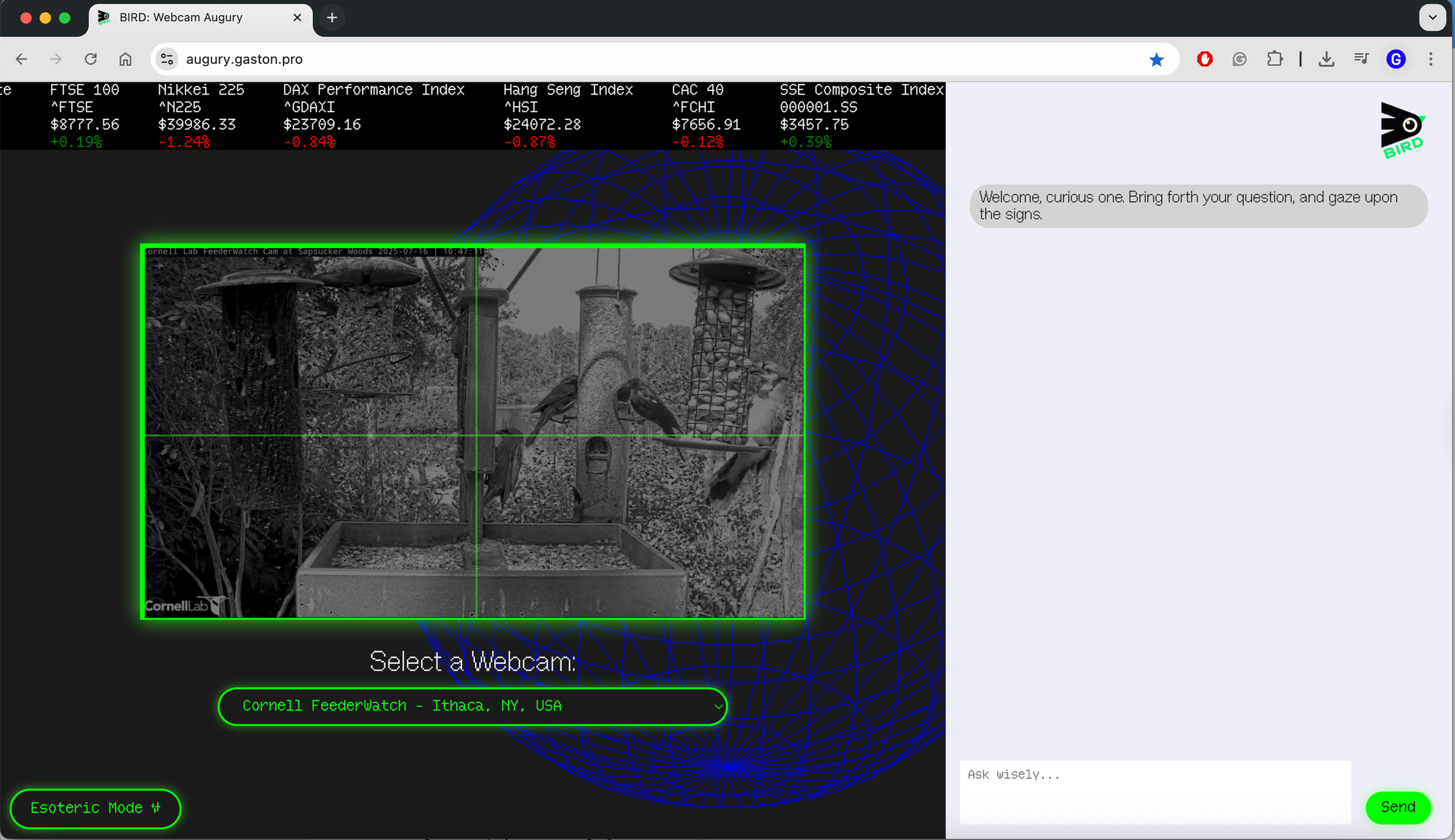
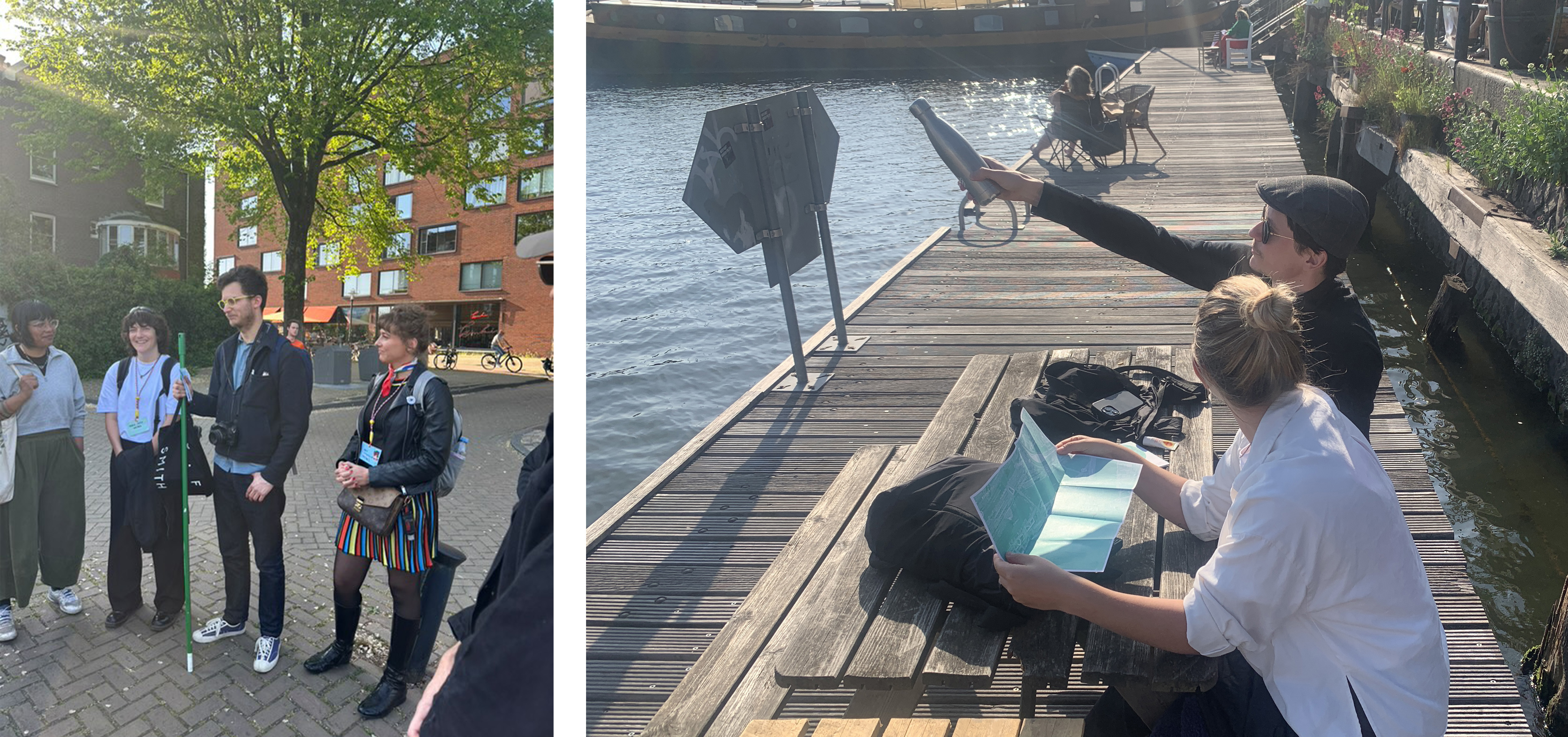
Two developed works from my practice provide the anchor cases for this approach (with two further planned for completion of the doctorate). The first is BIRD, Bird-Informed Remote Divination, a webcam-based augury website (https://augury.gaston.pro/) in which the participant formulates a question, observes birds through a live webcam, describes the signs they see, and receives a reading from a chat-based augur. Inspired by Roman augury, the work structures the encounter through a guided choreography of questioning, discussion, observation, and co-negotiated interpretation. It later extended into participatory augury walks and performances (see Figure 2), where participants adopted roles and enacted the procedural logic of augury in public. BIRD is the ritual-focused vignette: it refuses the conversational directness of contemporary chat interfaces. The participant must formulate a question, wait, observe, describe, negotiate, and only then receive a reading. A particularly useful friction occurred when the automated machine-vision pipeline I initially planned failed: asking participants to describe the birds themselves introduced a methodologically valuable seam. Participants became the Machine-Vision system for the AI. The work attempts to question conversational authority through a ritual procedure which aims to slow exchange and question the production of meaning.
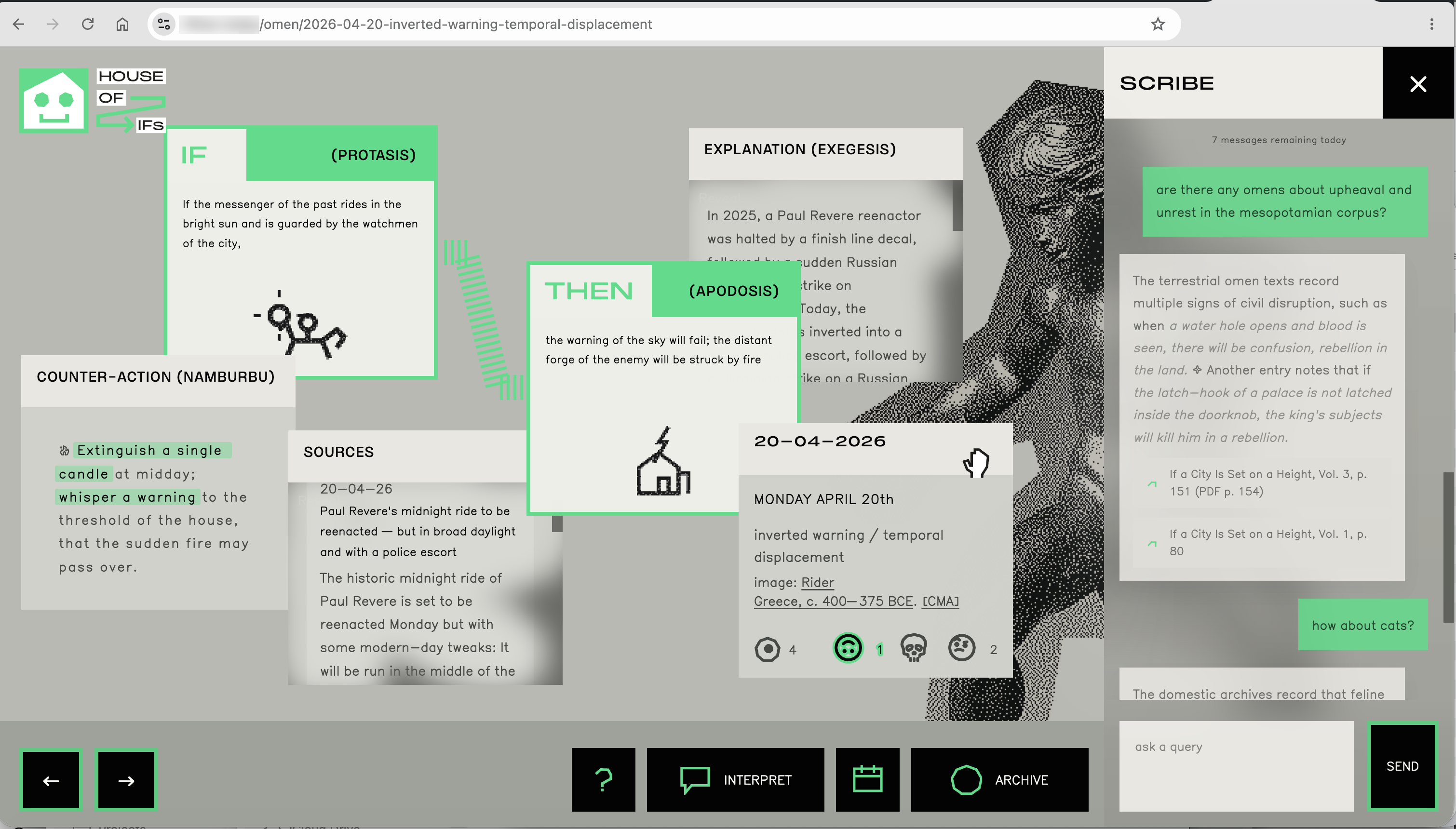
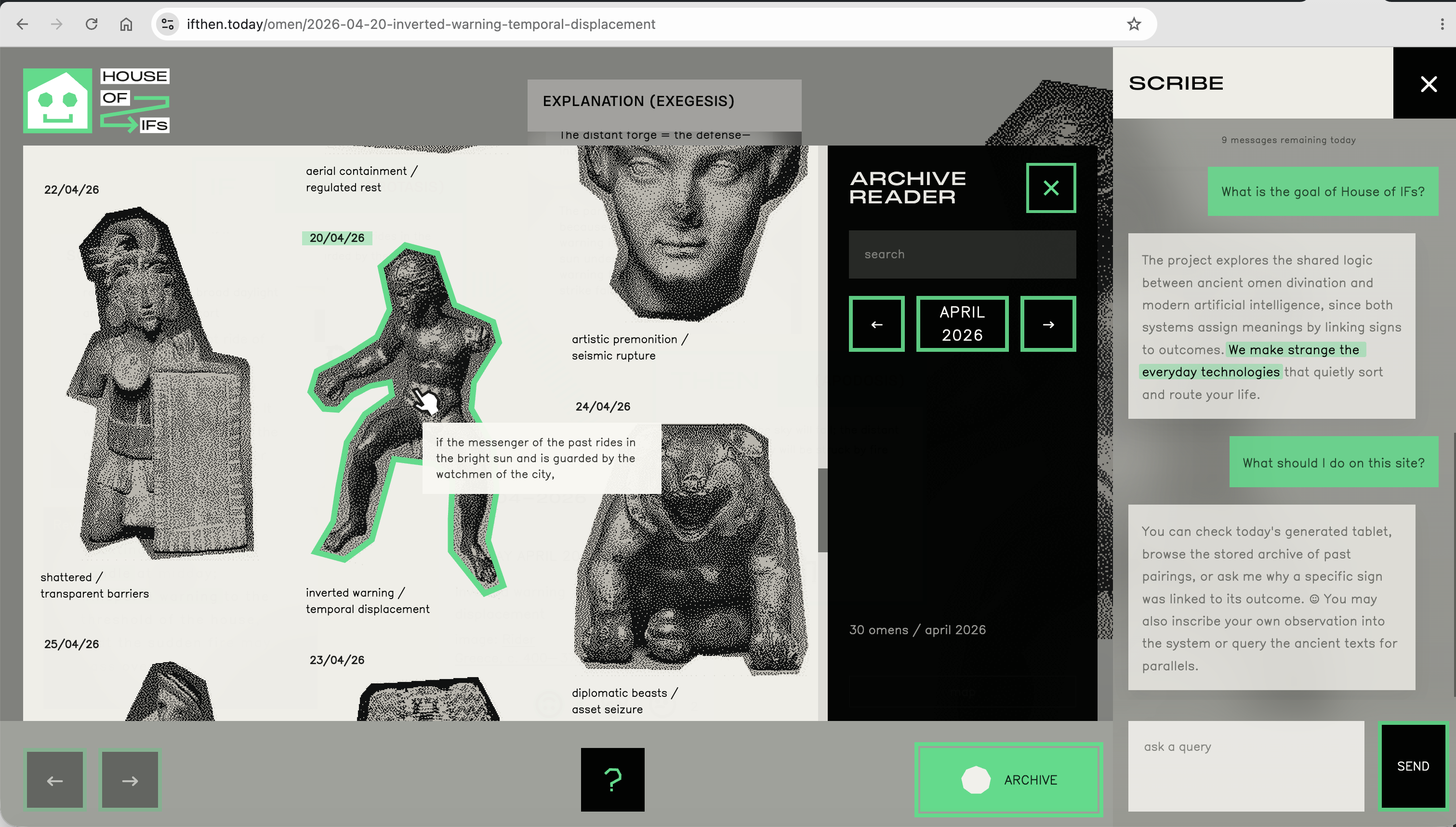
The second anchor case is House of IFs (https://ifthen.today/), a daily omen generator and archive centred on interpretation. Each day, the system links two sets of paired events: a sign and outcome for today, and a past occurrence of the same kind of sign leading to the same kind of outcome. The piece generates omens from contemporary news using the Mesopotamian protasis/apodosis (If/Then) structure and presents it through a six-panel interface with museum imagery, commentary, a chat “Scribe”, and namburbȗ-inspired counter-actions (counter-omen spells). Participatory affordances include participant readings left as traces on the omens. House of IFs produces friction in correlative reading and intepretation.
Its central operation is intentionally a little absurd: it links a present-day oddity (or faits-divers) with a major event, and a further event pair through an agentic system of correlation in a 2:2 structure. Omen texts can be understood as structured inferential systems organised through conditional reasoning, possibility, and conceivability (Rochberg 2009, 5, 13-15). House of IFs relies on and makes the correlation an object of interpretation. It plays with the authority effects of pattern-making. A scribe figure (LLM chatbot) functions here as a mediator of the site’s system, a way for the visitor through the archive and its logic. The counter-actions (namburbȗ) give the viewer a sense of agency on the events shown; the namburbȗ’s purpose is “to ‘undo’ or ‘avert’ portended evil” (Caplice 1974, 7) correlating with and responding to the observed events “taken by the Mesopotamians to be signs and portents with significance for the future” (Caplice 1974, 7). This is the magical affordance of agency, enactment on the world.
The Oracular Interfaces produce an emergent design space and insights in the relation between these vignettes and the wider workbook they begin to define. The ongoing contribution is the construction of a workbook-based design method for introducing playful friction into AI interaction, grounded in four conceptual threads, developed through practice-based vignettes that remain materially grounded and conceptually open. BIRD and House of IFs demonstrate how two different emphases, Ritual and Interpretation, can produce distinct ways of interrupting AI’s claims to fluency, neutrality, inevitability and conversational authority. The larger aim is to ask what AI could be if its seams were kept visible (or if concealment was made explicit) through metaphor as a method for inquiry. In that sense, the workbook creates conditions in which the values embedded in current AI interfaces can be made available, in oblique ways, for critical thought.
Image Credits
Fig. 1. Interface for BIRD (Bird-Informed Remote Divination)
Fig. 2. The BIRD augury walk at the May 2025 Slow AI festival in Amsterdam
(photo credit - left: Dominika Čupková; right: Gaston Welisch)
Fig. 3. Interface for House of IFs
Keywords
critical design; friction; divination; interface; metaphor
References
Bell, Genevieve, Mark Blythe, and Phoebe Sengers. 2005. ‘Making by Making Strange: Defamiliarization and the Design of Domestic Technologies’. ACM Transactions on Computer-Human Interaction 12 (2): 149–73. https://doi.org/10.1145/1067860.1067862.
Caplice, Richard I. 1974. The Akkadian Namburbi Texts: An Introduction. Vol. 1. Sources from the Ancient Near East 1. Undena Publications.
Chalmers, M., Ian MacColl, and Marek Bell. 2003. ‘Seamful Design: Showing the Seams in Wearable Computing’. October, 11–16. https://doi.org/10.1049/ic:20030140.
Cox, Anna L., Sandy J. J. Gould, Marta E. Cecchinato, Ioanna Iacovides, and Ian Renfree. 2016. ‘Design Frictions for Mindful Interactions: The Case for Microboundaries’. Proceedings of the 2016 CHI Conference Extended Abstracts on Human Factors in Computing Systems, May 7, 1389–97. https://doi.org/10.1145/2851581.2892410.
Coyne, Richard, Martin Parker, and Pedro Rebelo. 2004. ‘Resisting the Seamless Interface’. International Journal of Architectural Computing 2 (4): 429–42. https://doi.org/10.1260/1478077042906203.
Gaver, Bill, and Heather Martin. 2000. ‘Alternatives: Exploring Information Appliances through Conceptual Design Proposals’. Proceedings of the SIGCHI Conference on Human Factors in Computing Systems, April, 209–16. https://doi.org/10.1145/332040.332433.
Gaver, William. 2011. ‘Making Spaces: How Design Workbooks Work’. Proceedings of the SIGCHI Conference on Human Factors in Computing Systems, May 7, 1551–60. https://doi.org/10.1145/1978942.1979169.
Gell, Alfred. 1992. ‘The Technology of Enchantment and the Enchantment of Technology’. Anthropology, Art and Aesthetics 1992: 40–63.
Gould, Sandy J. J., Lewis L. Chuang, Ioanna Iacovides, et al. 2021. ‘A Special Interest Group on Designed and Engineered Friction in Interaction’. Extended Abstracts of the 2021 CHI Conference on Human Factors in Computing Systems, May 8, 1–4. https://doi.org/10.1145/3411763.3450404.
Kemper, Jakko. 2025. ‘Generative AI, Everyday Aesthetic Production, and the Imperial Mode of Living’. Critical AI 3 (1). https://doi.org/10.1215/2834703X-11700246.
Rochberg, Francesca. 2009. ‘Conditionals, Inference, and Possibility in Ancient Mesopotamian Science’. Science in Context 22 (1): 5–25. https://doi.org/10.1017/S0269889708002056.
Sørensen, Jesper, and Anders Klostergaard Petersen. 2021. Theoretical and Empirical Investigations of Divination and Magic: Manipulating the Divine. Numen Book Series 171. Brill.
Tilley, Christopher Y. 1999. Metaphor and Material Culture. Repr. Social Archaeology. Blackwell.
Welisch, Gaston. 2025. ‘Data Poets: Co-Interpreting Urban Ecologies with Generative AI Prototypes in Psychogeographic Walks’. Environment and Planning F, September 23, 26349825251365641. https://doi.org/10.1177/26349825251365641.
Gaston Welisch is an interdisciplinary artist, designer and researcher who explores parallels between Artificial Intelligence, Magic and Divination. His practice, which he terms 'Epistemic Mischief,' uses playful provocations to question technologies through web-based interactions, critical making projects and artefacts. He is currently undertaking his PhD, “Oracular Interfaces: (De)mystifying AI systems through the Metaphorical Framework of Divination and Magic”.
Situating AI procedures alongside ritual practices (like Roman augury), allows Gaston to critically contextualise AI's claims to knowledge, neutrality and inevitability. He is particularly interested in the way emerging technologies shape our interactions with the world, and in finding alternative approaches to hegemonic ontologies.
BY GASTON WELISCH
Centre for Sociodigital Futures, University of Bristol, United Kingdom
Oracular interfaces: Epistemic Mischief as a method for playful friction to subvert AI systems through divination and magic metaphors
Summary: “Oracular Interfaces” are interactive works which call into question the conversational authority of AI systems. This paper presents two case studies: BIRD, a webcam augury platform, and House of IFs, an agentic omen system based on daily news. These works introduce playful friction to make ubiquitous AI systems "strange". What they are positioned against is Generative AI's "frictionless fluency", its eloquence which leaves little space, or creative friction, for working out interpreted meaning. The wider design workbook they form creates conditions in which the values embedded in current AI interfaces can be made available, in oblique ways, for critical thought.
Generative AI services promise a “frictionless pathway from impulse to materialization” and present aesthetic production as “frictionlessly fluid and affectively immediate” (Kemper 2025, 2). What is being marketed is speed alongside the apparent dissolution of process, with effort framed as an obstacle to be optimised away. Friction is removed in the name of usability and engagement, yet this can also lead to “mindless forms of interaction” (Cox et al. 2016, 1389) and encourage “automatic and thoughtless behaviour”. Frictions, then, can respond to this “over-optimisation and over-proceduralisation” (Gould et al. 2021, 1). In my past practice-as-research project, the Data Poets, the move from GPT-2 in the 2019 prototype to GPT-4o and GPT-Vision in 2024 made the outputs more fluent, but also less open. The designed objects turned sensorial data capture into “poems”. The older system’s awkwardness, nonsense, and unevenness often invited participants to work out meaning; the newer models’ descriptive competence and polished tone narrowed that interpretive space. There arose a problem of frictionless fluency; the newer models’ eloquence left little space, or creative friction, for working out interpreted meaning (Welisch 2025, 12).
For Alfred Gell, the magic standard is the ideal against which all technologies are compared: effortless, costless production (1992, 12). But this magic standard conceals the “minimization of costs to the corporation by the maximization of social costs,” alongside “unemployment, depletion of unrenewable resources, degradation of the environment, etc.” Paradoxically, the “technology of enchantment is founded on the enchantment of technology” (Gell 1992, 44); the force of the enchanted object stems from the technical and material processes it embodies. Technical processes of making “are construed magically so that, by enchanting us, they make the products ... seem enchanted vessels of magical power” (46). Generative AI services are often marketed as though they dissolved the need for practice, skill, and labour, whereas anthropological accounts of magic and the material infrastructures of AI suggest a different picture: labour is redistributed, concealed, ritualised, or made meaningful in new ways. Frictionlessness is an ideological framing which conceals extractive foundations and expands the norms of immediacy (Kemper 2025, 3-5).
My wider doctoral project, from which this paper emerges, uses metaphors of Magic and Divination methodologically to question how we interface with AI. Metaphor is understood here as a tension that produces semantic innovations by which “new information about the world is created” (Tilley 1999, 14-15), a generative framework for producing emergent insights into our interactions with AI. If “metaphors provide a basis by means of which communities create and understand their collective experience” (10), then the work of building and testing metaphors for emerging experiences like AI deserves sustained experimentation. The project is built upon the distinct yet complementary practices of magic and divination. Magic is understood as exerting control over the unknown; it enacts change in the world, it performs and intervenes. Divination is a method of accessing that which is uncertain or concealed, without necessarily influencing it (Sørensen and Petersen 2021). Divinatory practices are “means to acquire information” while magical practices are “modes of interfering,” through which agents gain “some degree of control” (10-11). I use these two modalities to articulate a dual orientation towards the future: divination as epistemic access, an inquiry into the unknown through the ritual interpretation of signs; and magic as ontological enactment, a structured intervention intended to shape the world and produce effects. Together, they form a dual lens of knowing and doing that structure the theoretical arguments and practical outputs of this research.
Epistemic Mischief is the approach I use to explore this opportunity space. I describe it as a sincere, playful, and intentful misuse of AI, a design practice that inhabits the logic of the system to reveal its assumptions. The term, like Divination and Magic, is concerned with knowledge and with action. This stance is useful for critically probing poorly designed, or exploitative and harmful uses of AI. It allows a piece to remain earnest enough to work while still introducing enough awkwardness for its assumptions, its seams, to become visible. Metaphor in interaction is inherently mismatched and tension-filled: “Metaphors are not smooth” (Coyne, Parker, and Rebelo 2004, 435). But I aim for Epistemic Mischief to be “a deliberate policy to reveal and use seams” (Chalmers, MacColl, and Bell 2003, 11). Magic and divination operate here as ways of working on the seam, to expose staging through incongruity and challenge claims to authority that seamless interfaces otherwise make “normal”. The aim is to make AI “weird”, or to render “strange the familiar” (Bell et al. 2005, 170), to reopen the interpretive labour that fluency forecloses, and open imagination to alternative ways of interacting with AI.
Through this approach, I am building “Oracular Interfaces”, interactive works which call into question the discursive authority of AI systems. The term draws on the Latin etymology of orare, to speak or pray. The adjective oracular is productively polysemic: the oracle can be the future-oriented pronouncement and its source, and the role of the oracle may fall either on the interface or on the one wielding it. The specific format I propose for developing these works is for them to form a workbook. Design workbooks are “collections of design proposals and other materials drawn together during projects to investigate options for design” (Gaver 2011, 1551). What they share is “not just the description of a design space but its creation” (1551), with ideas emerging over time from multiple concrete proposals. Conceptual design proposals are research through design that balances concreteness with openness and uses multiplicity to allow a design space to emerge (Gaver & Martin 2000, 209). The proposals need to be specific enough to evoke intuitive reactions and open enough to invite imaginative extension (209-11). I am building a workbook of multiple proposals, organised around four conceptual dimensions: Interface, Ritual, Interpretation, and Imaginaries. Each proposal foregrounds one dimension, and the comparison across vignettes allows the design space to emerge.
Two developed works from my practice provide the anchor cases for this approach (with two further planned for completion of the doctorate). The first is BIRD, Bird-Informed Remote Divination, a webcam-based augury website (https://augury.gaston.pro/) in which the participant formulates a question, observes birds through a live webcam, describes the signs they see, and receives a reading from a chat-based augur. Inspired by Roman augury, the work structures the encounter through a guided choreography of questioning, discussion, observation, and co-negotiated interpretation. It later extended into participatory augury walks and performances (see Figure 2), where participants adopted roles and enacted the procedural logic of augury in public. BIRD is the ritual-focused vignette: it refuses the conversational directness of contemporary chat interfaces. The participant must formulate a question, wait, observe, describe, negotiate, and only then receive a reading. A particularly useful friction occurred when the automated machine-vision pipeline I initially planned failed: asking participants to describe the birds themselves introduced a methodologically valuable seam. Participants became the Machine-Vision system for the AI. The work attempts to question conversational authority through a ritual procedure which aims to slow exchange and question the production of meaning.
The second anchor case is House of IFs (https://ifthen.today/), a daily omen generator and archive centred on interpretation. Each day, the system links two sets of paired events: a sign and outcome for today, and a past occurrence of the same kind of sign leading to the same kind of outcome. The piece generates omens from contemporary news using the Mesopotamian protasis/apodosis (If/Then) structure and presents it through a six-panel interface with museum imagery, commentary, a chat “Scribe”, and namburbȗ-inspired counter-actions (counter-omen spells). Participatory affordances include participant readings left as traces on the omens. House of IFs produces friction in correlative reading and intepretation.
Its central operation is intentionally a little absurd: it links a present-day oddity (or faits-divers) with a major event, and a further event pair through an agentic system of correlation in a 2:2 structure. Omen texts can be understood as structured inferential systems organised through conditional reasoning, possibility, and conceivability (Rochberg 2009, 5, 13-15). House of IFs relies on and makes the correlation an object of interpretation. It plays with the authority effects of pattern-making. A scribe figure (LLM chatbot) functions here as a mediator of the site’s system, a way for the visitor through the archive and its logic. The counter-actions (namburbȗ) give the viewer a sense of agency on the events shown; the namburbȗ’s purpose is “to ‘undo’ or ‘avert’ portended evil” (Caplice 1974, 7) correlating with and responding to the observed events “taken by the Mesopotamians to be signs and portents with significance for the future” (Caplice 1974, 7). This is the magical affordance of agency, enactment on the world.
The Oracular Interfaces produce an emergent design space and insights in the relation between these vignettes and the wider workbook they begin to define. The ongoing contribution is the construction of a workbook-based design method for introducing playful friction into AI interaction, grounded in four conceptual threads, developed through practice-based vignettes that remain materially grounded and conceptually open. BIRD and House of IFs demonstrate how two different emphases, Ritual and Interpretation, can produce distinct ways of interrupting AI’s claims to fluency, neutrality, inevitability and conversational authority. The larger aim is to ask what AI could be if its seams were kept visible (or if concealment was made explicit) through metaphor as a method for inquiry. In that sense, the workbook creates conditions in which the values embedded in current AI interfaces can be made available, in oblique ways, for critical thought.
Image Credits
Fig. 1. Interface for BIRD (Bird-Informed Remote Divination)
Fig. 2. The BIRD augury walk at the May 2025 Slow AI festival in Amsterdam
(photo credit - left: Dominika Čupková; right: Gaston Welisch)
Fig. 3. Interface for House of IFs
Keywords
critical design; friction; divination; interface; metaphor
References
Bell, Genevieve, Mark Blythe, and Phoebe Sengers. 2005. ‘Making by Making Strange: Defamiliarization and the Design of Domestic Technologies’. ACM Transactions on Computer-Human Interaction 12 (2): 149–73. https://doi.org/10.1145/1067860.1067862.
Caplice, Richard I. 1974. The Akkadian Namburbi Texts: An Introduction. Vol. 1. Sources from the Ancient Near East 1. Undena Publications.
Chalmers, M., Ian MacColl, and Marek Bell. 2003. ‘Seamful Design: Showing the Seams in Wearable Computing’. October, 11–16. https://doi.org/10.1049/ic:20030140.
Cox, Anna L., Sandy J. J. Gould, Marta E. Cecchinato, Ioanna Iacovides, and Ian Renfree. 2016. ‘Design Frictions for Mindful Interactions: The Case for Microboundaries’. Proceedings of the 2016 CHI Conference Extended Abstracts on Human Factors in Computing Systems, May 7, 1389–97. https://doi.org/10.1145/2851581.2892410.
Coyne, Richard, Martin Parker, and Pedro Rebelo. 2004. ‘Resisting the Seamless Interface’. International Journal of Architectural Computing 2 (4): 429–42. https://doi.org/10.1260/1478077042906203.
Gaver, Bill, and Heather Martin. 2000. ‘Alternatives: Exploring Information Appliances through Conceptual Design Proposals’. Proceedings of the SIGCHI Conference on Human Factors in Computing Systems, April, 209–16. https://doi.org/10.1145/332040.332433.
Gaver, William. 2011. ‘Making Spaces: How Design Workbooks Work’. Proceedings of the SIGCHI Conference on Human Factors in Computing Systems, May 7, 1551–60. https://doi.org/10.1145/1978942.1979169.
Gell, Alfred. 1992. ‘The Technology of Enchantment and the Enchantment of Technology’. Anthropology, Art and Aesthetics 1992: 40–63.
Gould, Sandy J. J., Lewis L. Chuang, Ioanna Iacovides, et al. 2021. ‘A Special Interest Group on Designed and Engineered Friction in Interaction’. Extended Abstracts of the 2021 CHI Conference on Human Factors in Computing Systems, May 8, 1–4. https://doi.org/10.1145/3411763.3450404.
Kemper, Jakko. 2025. ‘Generative AI, Everyday Aesthetic Production, and the Imperial Mode of Living’. Critical AI 3 (1). https://doi.org/10.1215/2834703X-11700246.
Rochberg, Francesca. 2009. ‘Conditionals, Inference, and Possibility in Ancient Mesopotamian Science’. Science in Context 22 (1): 5–25. https://doi.org/10.1017/S0269889708002056.
Sørensen, Jesper, and Anders Klostergaard Petersen. 2021. Theoretical and Empirical Investigations of Divination and Magic: Manipulating the Divine. Numen Book Series 171. Brill.
Tilley, Christopher Y. 1999. Metaphor and Material Culture. Repr. Social Archaeology. Blackwell.
Welisch, Gaston. 2025. ‘Data Poets: Co-Interpreting Urban Ecologies with Generative AI Prototypes in Psychogeographic Walks’. Environment and Planning F, September 23, 26349825251365641. https://doi.org/10.1177/26349825251365641.
Oracular interfaces: Epistemic Mischief as a method for playful friction to subvert AI systems through divination and magic metaphors
Summary: “Oracular Interfaces” are interactive works which call into question the conversational authority of AI systems. This paper presents two case studies: BIRD, a webcam augury platform, and House of IFs, an agentic omen system based on daily news. These works introduce playful friction to make ubiquitous AI systems "strange". What they are positioned against is Generative AI's "frictionless fluency", its eloquence which leaves little space, or creative friction, for working out interpreted meaning. The wider design workbook they form creates conditions in which the values embedded in current AI interfaces can be made available, in oblique ways, for critical thought.
Generative AI services promise a “frictionless pathway from impulse to materialization” and present aesthetic production as “frictionlessly fluid and affectively immediate” (Kemper 2025, 2). What is being marketed is speed alongside the apparent dissolution of process, with effort framed as an obstacle to be optimised away. Friction is removed in the name of usability and engagement, yet this can also lead to “mindless forms of interaction” (Cox et al. 2016, 1389) and encourage “automatic and thoughtless behaviour”. Frictions, then, can respond to this “over-optimisation and over-proceduralisation” (Gould et al. 2021, 1). In my past practice-as-research project, the Data Poets, the move from GPT-2 in the 2019 prototype to GPT-4o and GPT-Vision in 2024 made the outputs more fluent, but also less open. The designed objects turned sensorial data capture into “poems”. The older system’s awkwardness, nonsense, and unevenness often invited participants to work out meaning; the newer models’ descriptive competence and polished tone narrowed that interpretive space. There arose a problem of frictionless fluency; the newer models’ eloquence left little space, or creative friction, for working out interpreted meaning (Welisch 2025, 12).
For Alfred Gell, the magic standard is the ideal against which all technologies are compared: effortless, costless production (1992, 12). But this magic standard conceals the “minimization of costs to the corporation by the maximization of social costs,” alongside “unemployment, depletion of unrenewable resources, degradation of the environment, etc.” Paradoxically, the “technology of enchantment is founded on the enchantment of technology” (Gell 1992, 44); the force of the enchanted object stems from the technical and material processes it embodies. Technical processes of making “are construed magically so that, by enchanting us, they make the products ... seem enchanted vessels of magical power” (46). Generative AI services are often marketed as though they dissolved the need for practice, skill, and labour, whereas anthropological accounts of magic and the material infrastructures of AI suggest a different picture: labour is redistributed, concealed, ritualised, or made meaningful in new ways. Frictionlessness is an ideological framing which conceals extractive foundations and expands the norms of immediacy (Kemper 2025, 3-5).
My wider doctoral project, from which this paper emerges, uses metaphors of Magic and Divination methodologically to question how we interface with AI. Metaphor is understood here as a tension that produces semantic innovations by which “new information about the world is created” (Tilley 1999, 14-15), a generative framework for producing emergent insights into our interactions with AI. If “metaphors provide a basis by means of which communities create and understand their collective experience” (10), then the work of building and testing metaphors for emerging experiences like AI deserves sustained experimentation. The project is built upon the distinct yet complementary practices of magic and divination. Magic is understood as exerting control over the unknown; it enacts change in the world, it performs and intervenes. Divination is a method of accessing that which is uncertain or concealed, without necessarily influencing it (Sørensen and Petersen 2021). Divinatory practices are “means to acquire information” while magical practices are “modes of interfering,” through which agents gain “some degree of control” (10-11). I use these two modalities to articulate a dual orientation towards the future: divination as epistemic access, an inquiry into the unknown through the ritual interpretation of signs; and magic as ontological enactment, a structured intervention intended to shape the world and produce effects. Together, they form a dual lens of knowing and doing that structure the theoretical arguments and practical outputs of this research.
Epistemic Mischief is the approach I use to explore this opportunity space. I describe it as a sincere, playful, and intentful misuse of AI, a design practice that inhabits the logic of the system to reveal its assumptions. The term, like Divination and Magic, is concerned with knowledge and with action. This stance is useful for critically probing poorly designed, or exploitative and harmful uses of AI. It allows a piece to remain earnest enough to work while still introducing enough awkwardness for its assumptions, its seams, to become visible. Metaphor in interaction is inherently mismatched and tension-filled: “Metaphors are not smooth” (Coyne, Parker, and Rebelo 2004, 435). But I aim for Epistemic Mischief to be “a deliberate policy to reveal and use seams” (Chalmers, MacColl, and Bell 2003, 11). Magic and divination operate here as ways of working on the seam, to expose staging through incongruity and challenge claims to authority that seamless interfaces otherwise make “normal”. The aim is to make AI “weird”, or to render “strange the familiar” (Bell et al. 2005, 170), to reopen the interpretive labour that fluency forecloses, and open imagination to alternative ways of interacting with AI.
Through this approach, I am building “Oracular Interfaces”, interactive works which call into question the discursive authority of AI systems. The term draws on the Latin etymology of orare, to speak or pray. The adjective oracular is productively polysemic: the oracle can be the future-oriented pronouncement and its source, and the role of the oracle may fall either on the interface or on the one wielding it. The specific format I propose for developing these works is for them to form a workbook. Design workbooks are “collections of design proposals and other materials drawn together during projects to investigate options for design” (Gaver 2011, 1551). What they share is “not just the description of a design space but its creation” (1551), with ideas emerging over time from multiple concrete proposals. Conceptual design proposals are research through design that balances concreteness with openness and uses multiplicity to allow a design space to emerge (Gaver & Martin 2000, 209). The proposals need to be specific enough to evoke intuitive reactions and open enough to invite imaginative extension (209-11). I am building a workbook of multiple proposals, organised around four conceptual dimensions: Interface, Ritual, Interpretation, and Imaginaries. Each proposal foregrounds one dimension, and the comparison across vignettes allows the design space to emerge.
Two developed works from my practice provide the anchor cases for this approach (with two further planned for completion of the doctorate). The first is BIRD, Bird-Informed Remote Divination, a webcam-based augury website (https://augury.gaston.pro/) in which the participant formulates a question, observes birds through a live webcam, describes the signs they see, and receives a reading from a chat-based augur. Inspired by Roman augury, the work structures the encounter through a guided choreography of questioning, discussion, observation, and co-negotiated interpretation. It later extended into participatory augury walks and performances (see Figure 2), where participants adopted roles and enacted the procedural logic of augury in public. BIRD is the ritual-focused vignette: it refuses the conversational directness of contemporary chat interfaces. The participant must formulate a question, wait, observe, describe, negotiate, and only then receive a reading. A particularly useful friction occurred when the automated machine-vision pipeline I initially planned failed: asking participants to describe the birds themselves introduced a methodologically valuable seam. Participants became the Machine-Vision system for the AI. The work attempts to question conversational authority through a ritual procedure which aims to slow exchange and question the production of meaning.
The second anchor case is House of IFs (https://ifthen.today/), a daily omen generator and archive centred on interpretation. Each day, the system links two sets of paired events: a sign and outcome for today, and a past occurrence of the same kind of sign leading to the same kind of outcome. The piece generates omens from contemporary news using the Mesopotamian protasis/apodosis (If/Then) structure and presents it through a six-panel interface with museum imagery, commentary, a chat “Scribe”, and namburbȗ-inspired counter-actions (counter-omen spells). Participatory affordances include participant readings left as traces on the omens. House of IFs produces friction in correlative reading and intepretation.
Its central operation is intentionally a little absurd: it links a present-day oddity (or faits-divers) with a major event, and a further event pair through an agentic system of correlation in a 2:2 structure. Omen texts can be understood as structured inferential systems organised through conditional reasoning, possibility, and conceivability (Rochberg 2009, 5, 13-15). House of IFs relies on and makes the correlation an object of interpretation. It plays with the authority effects of pattern-making. A scribe figure (LLM chatbot) functions here as a mediator of the site’s system, a way for the visitor through the archive and its logic. The counter-actions (namburbȗ) give the viewer a sense of agency on the events shown; the namburbȗ’s purpose is “to ‘undo’ or ‘avert’ portended evil” (Caplice 1974, 7) correlating with and responding to the observed events “taken by the Mesopotamians to be signs and portents with significance for the future” (Caplice 1974, 7). This is the magical affordance of agency, enactment on the world.
The Oracular Interfaces produce an emergent design space and insights in the relation between these vignettes and the wider workbook they begin to define. The ongoing contribution is the construction of a workbook-based design method for introducing playful friction into AI interaction, grounded in four conceptual threads, developed through practice-based vignettes that remain materially grounded and conceptually open. BIRD and House of IFs demonstrate how two different emphases, Ritual and Interpretation, can produce distinct ways of interrupting AI’s claims to fluency, neutrality, inevitability and conversational authority. The larger aim is to ask what AI could be if its seams were kept visible (or if concealment was made explicit) through metaphor as a method for inquiry. In that sense, the workbook creates conditions in which the values embedded in current AI interfaces can be made available, in oblique ways, for critical thought.
Image Credits
Fig. 1. Interface for BIRD (Bird-Informed Remote Divination)
Fig. 2. The BIRD augury walk at the May 2025 Slow AI festival in Amsterdam
(photo credit - left: Dominika Čupková; right: Gaston Welisch)
Fig. 3. Interface for House of IFs
Keywords
critical design; friction; divination; interface; metaphor
References
Bell, Genevieve, Mark Blythe, and Phoebe Sengers. 2005. ‘Making by Making Strange: Defamiliarization and the Design of Domestic Technologies’. ACM Transactions on Computer-Human Interaction 12 (2): 149–73. https://doi.org/10.1145/1067860.1067862.
Caplice, Richard I. 1974. The Akkadian Namburbi Texts: An Introduction. Vol. 1. Sources from the Ancient Near East 1. Undena Publications.
Chalmers, M., Ian MacColl, and Marek Bell. 2003. ‘Seamful Design: Showing the Seams in Wearable Computing’. October, 11–16. https://doi.org/10.1049/ic:20030140.
Cox, Anna L., Sandy J. J. Gould, Marta E. Cecchinato, Ioanna Iacovides, and Ian Renfree. 2016. ‘Design Frictions for Mindful Interactions: The Case for Microboundaries’. Proceedings of the 2016 CHI Conference Extended Abstracts on Human Factors in Computing Systems, May 7, 1389–97. https://doi.org/10.1145/2851581.2892410.
Coyne, Richard, Martin Parker, and Pedro Rebelo. 2004. ‘Resisting the Seamless Interface’. International Journal of Architectural Computing 2 (4): 429–42. https://doi.org/10.1260/1478077042906203.
Gaver, Bill, and Heather Martin. 2000. ‘Alternatives: Exploring Information Appliances through Conceptual Design Proposals’. Proceedings of the SIGCHI Conference on Human Factors in Computing Systems, April, 209–16. https://doi.org/10.1145/332040.332433.
Gaver, William. 2011. ‘Making Spaces: How Design Workbooks Work’. Proceedings of the SIGCHI Conference on Human Factors in Computing Systems, May 7, 1551–60. https://doi.org/10.1145/1978942.1979169.
Gell, Alfred. 1992. ‘The Technology of Enchantment and the Enchantment of Technology’. Anthropology, Art and Aesthetics 1992: 40–63.
Gould, Sandy J. J., Lewis L. Chuang, Ioanna Iacovides, et al. 2021. ‘A Special Interest Group on Designed and Engineered Friction in Interaction’. Extended Abstracts of the 2021 CHI Conference on Human Factors in Computing Systems, May 8, 1–4. https://doi.org/10.1145/3411763.3450404.
Kemper, Jakko. 2025. ‘Generative AI, Everyday Aesthetic Production, and the Imperial Mode of Living’. Critical AI 3 (1). https://doi.org/10.1215/2834703X-11700246.
Rochberg, Francesca. 2009. ‘Conditionals, Inference, and Possibility in Ancient Mesopotamian Science’. Science in Context 22 (1): 5–25. https://doi.org/10.1017/S0269889708002056.
Sørensen, Jesper, and Anders Klostergaard Petersen. 2021. Theoretical and Empirical Investigations of Divination and Magic: Manipulating the Divine. Numen Book Series 171. Brill.
Tilley, Christopher Y. 1999. Metaphor and Material Culture. Repr. Social Archaeology. Blackwell.
Welisch, Gaston. 2025. ‘Data Poets: Co-Interpreting Urban Ecologies with Generative AI Prototypes in Psychogeographic Walks’. Environment and Planning F, September 23, 26349825251365641. https://doi.org/10.1177/26349825251365641.
Gaston Welisch is an interdisciplinary artist, designer and researcher who explores parallels between Artificial Intelligence, Magic and Divination. His practice, which he terms 'Epistemic Mischief,' uses playful provocations to question technologies through web-based interactions, critical making projects and artefacts. He is currently undertaking his PhD, “Oracular Interfaces: (De)mystifying AI systems through the Metaphorical Framework of Divination and Magic”.
Situating AI procedures alongside ritual practices (like Roman augury), allows Gaston to critically contextualise AI's claims to knowledge, neutrality and inevitability. He is particularly interested in the way emerging technologies shape our interactions with the world, and in finding alternative approaches to hegemonic ontologies.