BY GIULIA CASALINI
Eco-poetic storytelling practice via drawing-sensing-listening
at Hermitage Sykaminea, Lesbos, May 2026
This eco-poetic exercise comes from days of observing and staying with the land of Lesbos, and the non-human presences that inhabit it. During the two weeks of the residency in the north-east part of the island, facing Turkey, I have been walking up and down the mountainous paths to reach the sea and the above village whilst observing attentively what was happening around me – greeting plants and insects whilst collecting herbs or flower petals for myself and the other residents, for food and for dyeing textiles. On the last day of my residency, I walked those paths again – this time stopping at three specific spots I felt were charged with storytelling – and started sketching the ‘scene’ by focusing only on a few elements (or ‘protagonists’). After my quick sketch, I walked whilst free-talking into my voice recorder, expressing what emerged from my encounter with the ‘scene’. The morning after, I edited the transcripts. The result is the following poetic, eco-intimate and kinky micro-stories.
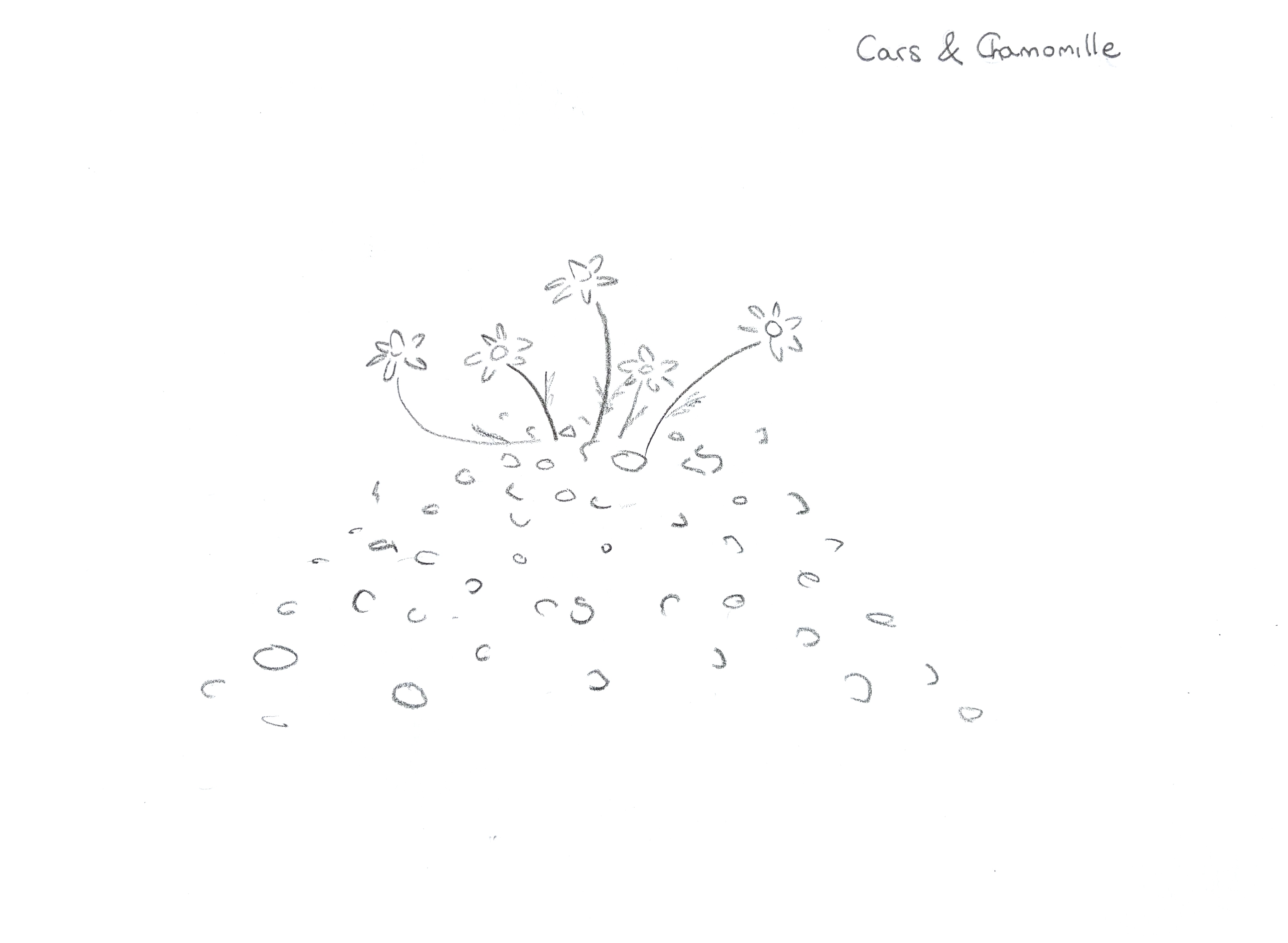
Cars and chamomile
These little white flowers like it rough.
They emerge from uneven soil - from the middle and the sides of the tracks where wheels run.
Does chamomile have a sympathy for its own destruction? To be crushed, squeezed and smelled of sweetness?
Maybe chamomile likes its own taste. Or just to be submissive.
Maybe chamomile is tired of being pretty every day, so she doesn't mind knowing that it's time for her to go, and to become something else.
And as chamomile goes towards its own death, it emanates the sweetest smell. A smell that makes you sleep as much as it awakens you.
Is chamomile the flavour of death?
I want my death to taste like her.
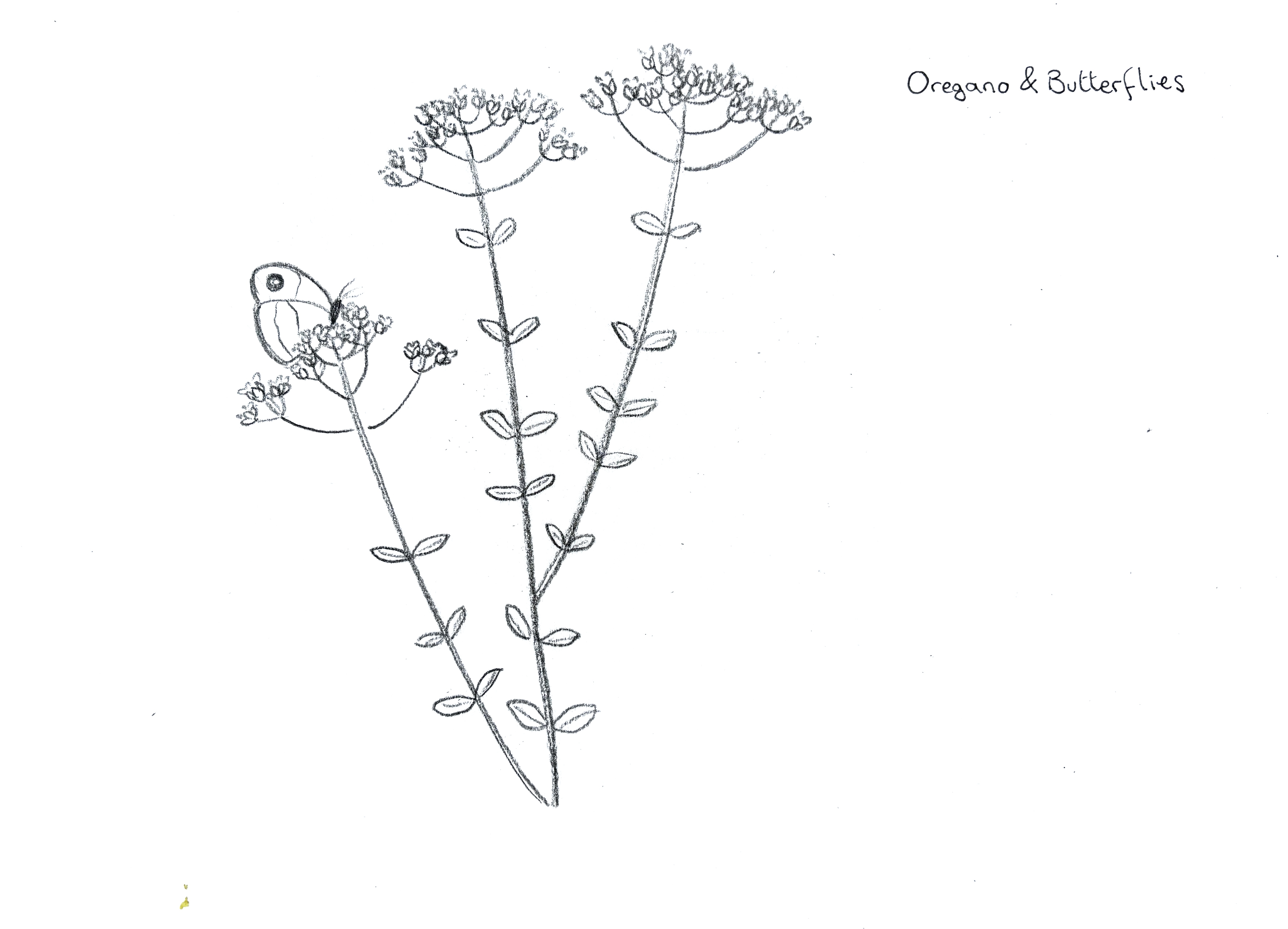
Oregano and butterflies
Oregano's essential oils intensify as the weather gets drier and warmer.
Two by two, its leaves climb up the stem, ending up in geometrical bouquets of tiny white juicy flowers that attract all sorts of insects, especially butterflies - the ones with brown wings and a dark circle on top.
Their attraction makes them spin around the clusters of oregano, creating a vortex of juicy desires.
They are sucking so hard I can almost hear them sipping. Flower by flower.
Hungry butterflies - they would only stop when it's time for the sun to set.
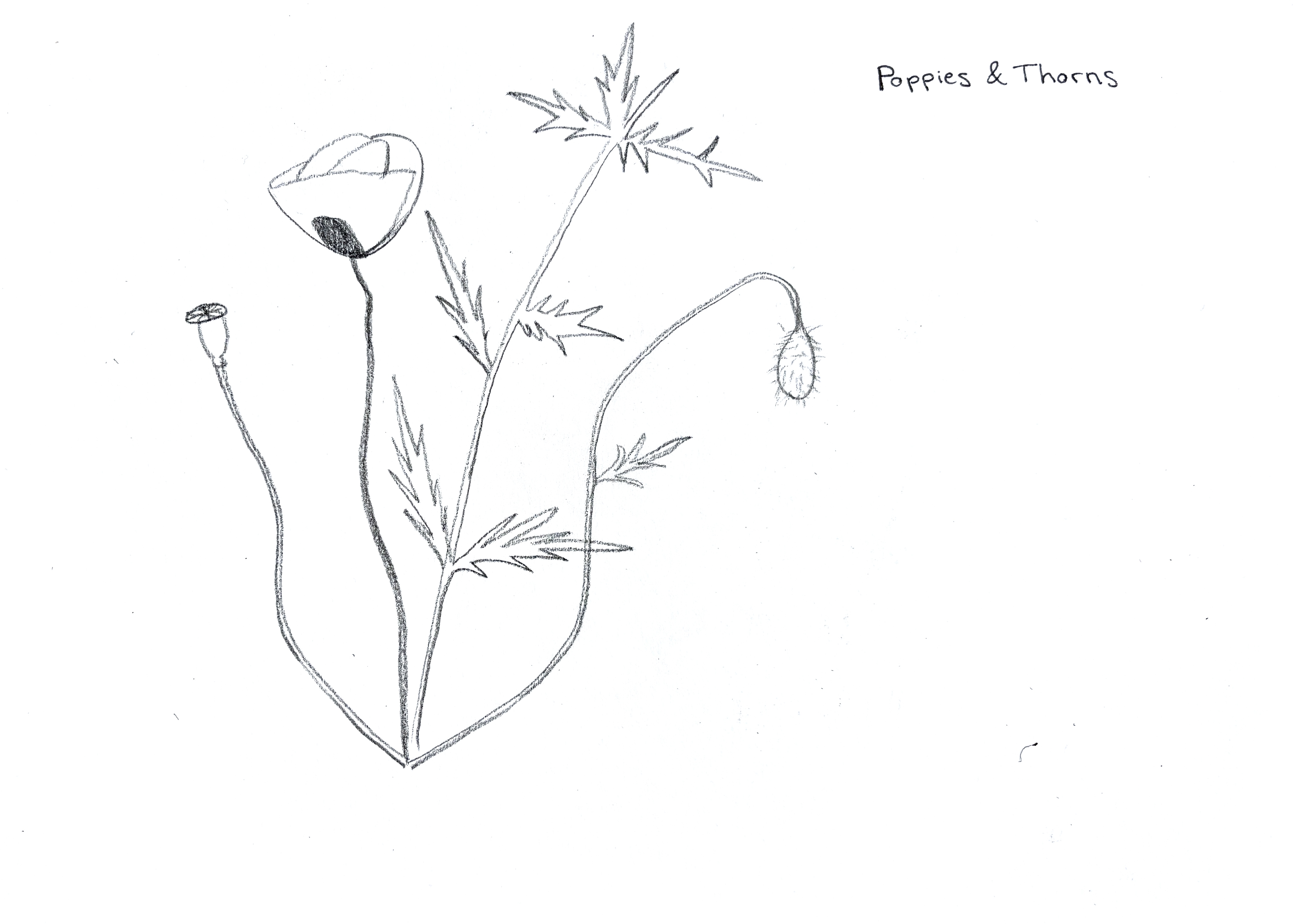
Poppies and thorns
The red of poppies is a signal.
Near fences, they attract my attention and the one of many other beings. They like to be protected, but they also like to trick.
I pick their bright red leaves by gently stroking them - if it is the petals' desire to fall into my hand, I would grab them.
But one needs to be very careful when caressing poppies as they like to surround themselves with thorny plant friends.
And inside, in their small but soft chambers, they harbour nesting insect partners - or lovers. They might be resting. They might be fucking. Or both. Sleepy, long, insect fucks.
How close can you get to poppies?
Eco-poetic storytelling practice via drawing-sensing-listening
at Hermitage Sykaminea, Lesbos, May 2026
This eco-poetic exercise comes from days of observing and staying with the land of Lesbos, and the non-human presences that inhabit it. During the two weeks of the residency in the north-east part of the island, facing Turkey, I have been walking up and down the mountainous paths to reach the sea and the above village whilst observing attentively what was happening around me – greeting plants and insects whilst collecting herbs or flower petals for myself and the other residents, for food and for dyeing textiles. On the last day of my residency, I walked those paths again – this time stopping at three specific spots I felt were charged with storytelling – and started sketching the ‘scene’ by focusing only on a few elements (or ‘protagonists’). After my quick sketch, I walked whilst free-talking into my voice recorder, expressing what emerged from my encounter with the ‘scene’. The morning after, I edited the transcripts. The result is the following poetic, eco-intimate and kinky micro-stories.
Cars and chamomile
These little white flowers like it rough.
They emerge from uneven soil - from the middle and the sides of the tracks where wheels run.
Does chamomile have a sympathy for its own destruction? To be crushed, squeezed and smelled of sweetness?
Maybe chamomile likes its own taste. Or just to be submissive.
Maybe chamomile is tired of being pretty every day, so she doesn't mind knowing that it's time for her to go, and to become something else.
And as chamomile goes towards its own death, it emanates the sweetest smell. A smell that makes you sleep as much as it awakens you.
Is chamomile the flavour of death?
I want my death to taste like her.
Oregano and butterflies
Oregano's essential oils intensify as the weather gets drier and warmer.
Two by two, its leaves climb up the stem, ending up in geometrical bouquets of tiny white juicy flowers that attract all sorts of insects, especially butterflies - the ones with brown wings and a dark circle on top.
Their attraction makes them spin around the clusters of oregano, creating a vortex of juicy desires.
They are sucking so hard I can almost hear them sipping. Flower by flower.
Hungry butterflies - they would only stop when it's time for the sun to set.
Poppies and thorns
The red of poppies is a signal.
Near fences, they attract my attention and the one of many other beings. They like to be protected, but they also like to trick.
I pick their bright red leaves by gently stroking them - if it is the petals' desire to fall into my hand, I would grab them.
But one needs to be very careful when caressing poppies as they like to surround themselves with thorny plant friends.
And inside, in their small but soft chambers, they harbour nesting insect partners - or lovers. They might be resting. They might be fucking. Or both. Sleepy, long, insect fucks.
How close can you get to poppies?
Giulia Casalini (they/she) is a freelance curator-artist-researcher based in London and with over 15 years of experience working alongside queer, trans, and gender-expansive artists worldwide. Going to the root of curating as a practice of ‘healing’ (from the Latin ‘curare’), their curatorial practice is understood as a path of healing relationships – human, non-human, and planetary – and of unlearning colonial patterns in knowledge-making, work praxis, social relationality, and institutional logic. Their writing and art practice is based on embodied responses to environments, the artists’ works and other invisible forces, using a ‘deep sensing’ method and energy work to understand beyond the spoken word.
They hold a PhD in transnational queer-trans-feminist live art, in which they discussed the works of artists from Ghana, the Philippines, Brazil, and Spain to decentre the Euro-Anglo-American aesthetic canons and discourses. They have been a co-founder of the non-profit organisation Arts Feminism Queer (Cuntemporary, 2012-21) and Archivio Queer Italia (2014-2017). Selected curatorial projects: Burned House Horizon (exhibition, Mimosa House and QUEERCIRCLE, funded by Arts Council England, London, 2025); Va-Bene Elikem Fiatsi: Performance as Life (documentary, 2024); Diwata (artist moving image, funded by British Council, Philippines, 2024); #WIP (Queer Art Projects, online, 2020); EcoFutures (multi-venue festival, London, 2019); Still Burning (exhibition, Konsthalle, Varberg, 2019); Transitional States (touring exhibition at Peltz Gallery, London and CCCB, Barcelona, 2017-18); Transformer (Richard Saltoun, London, 2014).
BY GIULIA CASALINI
Eco-poetic storytelling practice via drawing-sensing-listening
at Hermitage Sykaminea, Lesbos, May 2026
This eco-poetic exercise comes from days of observing and staying with the land of Lesbos, and the non-human presences that inhabit it. During the two weeks of the residency in the north-east part of the island, facing Turkey, I have been walking up and down the mountainous paths to reach the sea and the above village whilst observing attentively what was happening around me – greeting plants and insects whilst collecting herbs or flower petals for myself and the other residents, for food and for dyeing textiles. On the last day of my residency, I walked those paths again – this time stopping at three specific spots I felt were charged with storytelling – and started sketching the ‘scene’ by focusing only on a few elements (or ‘protagonists’). After my quick sketch, I walked whilst free-talking into my voice recorder, expressing what emerged from my encounter with the ‘scene’. The morning after, I edited the transcripts. The result is the following poetic, eco-intimate and kinky micro-stories.
Cars and chamomile
These little white flowers like it rough.
They emerge from uneven soil - from the middle and the sides of the tracks where wheels run.
Does chamomile have a sympathy for its own destruction? To be crushed, squeezed and smelled of sweetness?
Maybe chamomile likes its own taste. Or just to be submissive.
Maybe chamomile is tired of being pretty every day, so she doesn't mind knowing that it's time for her to go, and to become something else.
And as chamomile goes towards its own death, it emanates the sweetest smell. A smell that makes you sleep as much as it awakens you.
Is chamomile the flavour of death?
I want my death to taste like her.
Oregano and butterflies
Oregano's essential oils intensify as the weather gets drier and warmer.
Two by two, its leaves climb up the stem, ending up in geometrical bouquets of tiny white juicy flowers that attract all sorts of insects, especially butterflies - the ones with brown wings and a dark circle on top.
Their attraction makes them spin around the clusters of oregano, creating a vortex of juicy desires.
They are sucking so hard I can almost hear them sipping. Flower by flower.
Hungry butterflies - they would only stop when it's time for the sun to set.
Poppies and thorns
The red of poppies is a signal.
Near fences, they attract my attention and the one of many other beings. They like to be protected, but they also like to trick.
I pick their bright red leaves by gently stroking them - if it is the petals' desire to fall into my hand, I would grab them.
But one needs to be very careful when caressing poppies as they like to surround themselves with thorny plant friends.
And inside, in their small but soft chambers, they harbour nesting insect partners - or lovers. They might be resting. They might be fucking. Or both. Sleepy, long, insect fucks.
How close can you get to poppies?
Eco-poetic storytelling practice via drawing-sensing-listening
at Hermitage Sykaminea, Lesbos, May 2026
This eco-poetic exercise comes from days of observing and staying with the land of Lesbos, and the non-human presences that inhabit it. During the two weeks of the residency in the north-east part of the island, facing Turkey, I have been walking up and down the mountainous paths to reach the sea and the above village whilst observing attentively what was happening around me – greeting plants and insects whilst collecting herbs or flower petals for myself and the other residents, for food and for dyeing textiles. On the last day of my residency, I walked those paths again – this time stopping at three specific spots I felt were charged with storytelling – and started sketching the ‘scene’ by focusing only on a few elements (or ‘protagonists’). After my quick sketch, I walked whilst free-talking into my voice recorder, expressing what emerged from my encounter with the ‘scene’. The morning after, I edited the transcripts. The result is the following poetic, eco-intimate and kinky micro-stories.
Cars and chamomile
These little white flowers like it rough.
They emerge from uneven soil - from the middle and the sides of the tracks where wheels run.
Does chamomile have a sympathy for its own destruction? To be crushed, squeezed and smelled of sweetness?
Maybe chamomile likes its own taste. Or just to be submissive.
Maybe chamomile is tired of being pretty every day, so she doesn't mind knowing that it's time for her to go, and to become something else.
And as chamomile goes towards its own death, it emanates the sweetest smell. A smell that makes you sleep as much as it awakens you.
Is chamomile the flavour of death?
I want my death to taste like her.
Oregano and butterflies
Oregano's essential oils intensify as the weather gets drier and warmer.
Two by two, its leaves climb up the stem, ending up in geometrical bouquets of tiny white juicy flowers that attract all sorts of insects, especially butterflies - the ones with brown wings and a dark circle on top.
Their attraction makes them spin around the clusters of oregano, creating a vortex of juicy desires.
They are sucking so hard I can almost hear them sipping. Flower by flower.
Hungry butterflies - they would only stop when it's time for the sun to set.
Poppies and thorns
The red of poppies is a signal.
Near fences, they attract my attention and the one of many other beings. They like to be protected, but they also like to trick.
I pick their bright red leaves by gently stroking them - if it is the petals' desire to fall into my hand, I would grab them.
But one needs to be very careful when caressing poppies as they like to surround themselves with thorny plant friends.
And inside, in their small but soft chambers, they harbour nesting insect partners - or lovers. They might be resting. They might be fucking. Or both. Sleepy, long, insect fucks.
How close can you get to poppies?
Giulia Casalini (they/she) is a freelance curator-artist-researcher based in London and with over 15 years of experience working alongside queer, trans, and gender-expansive artists worldwide. Going to the root of curating as a practice of ‘healing’ (from the Latin ‘curare’), their curatorial practice is understood as a path of healing relationships – human, non-human, and planetary – and of unlearning colonial patterns in knowledge-making, work praxis, social relationality, and institutional logic. Their writing and art practice is based on embodied responses to environments, the artists’ works and other invisible forces, using a ‘deep sensing’ method and energy work to understand beyond the spoken word.
They hold a PhD in transnational queer-trans-feminist live art, in which they discussed the works of artists from Ghana, the Philippines, Brazil, and Spain to decentre the Euro-Anglo-American aesthetic canons and discourses. They have been a co-founder of the non-profit organisation Arts Feminism Queer (Cuntemporary, 2012-21) and Archivio Queer Italia (2014-2017). Selected curatorial projects: Burned House Horizon (exhibition, Mimosa House and QUEERCIRCLE, funded by Arts Council England, London, 2025); Va-Bene Elikem Fiatsi: Performance as Life (documentary, 2024); Diwata (artist moving image, funded by British Council, Philippines, 2024); #WIP (Queer Art Projects, online, 2020); EcoFutures (multi-venue festival, London, 2019); Still Burning (exhibition, Konsthalle, Varberg, 2019); Transitional States (touring exhibition at Peltz Gallery, London and CCCB, Barcelona, 2017-18); Transformer (Richard Saltoun, London, 2014).
BY GIULIA CASALINI
Eco-poetic storytelling practice via drawing-sensing-listening
at Hermitage Sykaminea, Lesbos, May 2026
This eco-poetic exercise comes from days of observing and staying with the land of Lesbos, and the non-human presences that inhabit it. During the two weeks of the residency in the north-east part of the island, facing Turkey, I have been walking up and down the mountainous paths to reach the sea and the above village whilst observing attentively what was happening around me – greeting plants and insects whilst collecting herbs or flower petals for myself and the other residents, for food and for dyeing textiles. On the last day of my residency, I walked those paths again – this time stopping at three specific spots I felt were charged with storytelling – and started sketching the ‘scene’ by focusing only on a few elements (or ‘protagonists’). After my quick sketch, I walked whilst free-talking into my voice recorder, expressing what emerged from my encounter with the ‘scene’. The morning after, I edited the transcripts. The result is the following poetic, eco-intimate and kinky micro-stories.
Cars and chamomile
These little white flowers like it rough.
They emerge from uneven soil - from the middle and the sides of the tracks where wheels run.
Does chamomile have a sympathy for its own destruction? To be crushed, squeezed and smelled of sweetness?
Maybe chamomile likes its own taste. Or just to be submissive.
Maybe chamomile is tired of being pretty every day, so she doesn't mind knowing that it's time for her to go, and to become something else.
And as chamomile goes towards its own death, it emanates the sweetest smell. A smell that makes you sleep as much as it awakens you.
Is chamomile the flavour of death?
I want my death to taste like her.
Oregano and butterflies
Oregano's essential oils intensify as the weather gets drier and warmer.
Two by two, its leaves climb up the stem, ending up in geometrical bouquets of tiny white juicy flowers that attract all sorts of insects, especially butterflies - the ones with brown wings and a dark circle on top.
Their attraction makes them spin around the clusters of oregano, creating a vortex of juicy desires.
They are sucking so hard I can almost hear them sipping. Flower by flower.
Hungry butterflies - they would only stop when it's time for the sun to set.
Poppies and thorns
The red of poppies is a signal.
Near fences, they attract my attention and the one of many other beings. They like to be protected, but they also like to trick.
I pick their bright red leaves by gently stroking them - if it is the petals' desire to fall into my hand, I would grab them.
But one needs to be very careful when caressing poppies as they like to surround themselves with thorny plant friends.
And inside, in their small but soft chambers, they harbour nesting insect partners - or lovers. They might be resting. They might be fucking. Or both. Sleepy, long, insect fucks.
How close can you get to poppies?
Eco-poetic storytelling practice via drawing-sensing-listening
at Hermitage Sykaminea, Lesbos, May 2026
This eco-poetic exercise comes from days of observing and staying with the land of Lesbos, and the non-human presences that inhabit it. During the two weeks of the residency in the north-east part of the island, facing Turkey, I have been walking up and down the mountainous paths to reach the sea and the above village whilst observing attentively what was happening around me – greeting plants and insects whilst collecting herbs or flower petals for myself and the other residents, for food and for dyeing textiles. On the last day of my residency, I walked those paths again – this time stopping at three specific spots I felt were charged with storytelling – and started sketching the ‘scene’ by focusing only on a few elements (or ‘protagonists’). After my quick sketch, I walked whilst free-talking into my voice recorder, expressing what emerged from my encounter with the ‘scene’. The morning after, I edited the transcripts. The result is the following poetic, eco-intimate and kinky micro-stories.
Cars and chamomile
These little white flowers like it rough.
They emerge from uneven soil - from the middle and the sides of the tracks where wheels run.
Does chamomile have a sympathy for its own destruction? To be crushed, squeezed and smelled of sweetness?
Maybe chamomile likes its own taste. Or just to be submissive.
Maybe chamomile is tired of being pretty every day, so she doesn't mind knowing that it's time for her to go, and to become something else.
And as chamomile goes towards its own death, it emanates the sweetest smell. A smell that makes you sleep as much as it awakens you.
Is chamomile the flavour of death?
I want my death to taste like her.
Oregano and butterflies
Oregano's essential oils intensify as the weather gets drier and warmer.
Two by two, its leaves climb up the stem, ending up in geometrical bouquets of tiny white juicy flowers that attract all sorts of insects, especially butterflies - the ones with brown wings and a dark circle on top.
Their attraction makes them spin around the clusters of oregano, creating a vortex of juicy desires.
They are sucking so hard I can almost hear them sipping. Flower by flower.
Hungry butterflies - they would only stop when it's time for the sun to set.
Poppies and thorns
The red of poppies is a signal.
Near fences, they attract my attention and the one of many other beings. They like to be protected, but they also like to trick.
I pick their bright red leaves by gently stroking them - if it is the petals' desire to fall into my hand, I would grab them.
But one needs to be very careful when caressing poppies as they like to surround themselves with thorny plant friends.
And inside, in their small but soft chambers, they harbour nesting insect partners - or lovers. They might be resting. They might be fucking. Or both. Sleepy, long, insect fucks.
How close can you get to poppies?
Giulia Casalini (they/she) is a freelance curator-artist-researcher based in London and with over 15 years of experience working alongside queer, trans, and gender-expansive artists worldwide. Going to the root of curating as a practice of ‘healing’ (from the Latin ‘curare’), their curatorial practice is understood as a path of healing relationships – human, non-human, and planetary – and of unlearning colonial patterns in knowledge-making, work praxis, social relationality, and institutional logic. Their writing and art practice is based on embodied responses to environments, the artists’ works and other invisible forces, using a ‘deep sensing’ method and energy work to understand beyond the spoken word.
They hold a PhD in transnational queer-trans-feminist live art, in which they discussed the works of artists from Ghana, the Philippines, Brazil, and Spain to decentre the Euro-Anglo-American aesthetic canons and discourses. They have been a co-founder of the non-profit organisation Arts Feminism Queer (Cuntemporary, 2012-21) and Archivio Queer Italia (2014-2017). Selected curatorial projects: Burned House Horizon (exhibition, Mimosa House and QUEERCIRCLE, funded by Arts Council England, London, 2025); Va-Bene Elikem Fiatsi: Performance as Life (documentary, 2024); Diwata (artist moving image, funded by British Council, Philippines, 2024); #WIP (Queer Art Projects, online, 2020); EcoFutures (multi-venue festival, London, 2019); Still Burning (exhibition, Konsthalle, Varberg, 2019); Transitional States (touring exhibition at Peltz Gallery, London and CCCB, Barcelona, 2017-18); Transformer (Richard Saltoun, London, 2014).
BY GIULIA CASALINI
Eco-poetic storytelling practice via drawing-sensing-listening
at Hermitage Sykaminea, Lesbos, May 2026
This eco-poetic exercise comes from days of observing and staying with the land of Lesbos, and the non-human presences that inhabit it. During the two weeks of the residency in the north-east part of the island, facing Turkey, I have been walking up and down the mountainous paths to reach the sea and the above village whilst observing attentively what was happening around me – greeting plants and insects whilst collecting herbs or flower petals for myself and the other residents, for food and for dyeing textiles. On the last day of my residency, I walked those paths again – this time stopping at three specific spots I felt were charged with storytelling – and started sketching the ‘scene’ by focusing only on a few elements (or ‘protagonists’). After my quick sketch, I walked whilst free-talking into my voice recorder, expressing what emerged from my encounter with the ‘scene’. The morning after, I edited the transcripts. The result is the following poetic, eco-intimate and kinky micro-stories.
Cars and chamomile
These little white flowers like it rough.
They emerge from uneven soil - from the middle and the sides of the tracks where wheels run.
Does chamomile have a sympathy for its own destruction? To be crushed, squeezed and smelled of sweetness?
Maybe chamomile likes its own taste. Or just to be submissive.
Maybe chamomile is tired of being pretty every day, so she doesn't mind knowing that it's time for her to go, and to become something else.
And as chamomile goes towards its own death, it emanates the sweetest smell. A smell that makes you sleep as much as it awakens you.
Is chamomile the flavour of death?
I want my death to taste like her.
Oregano and butterflies
Oregano's essential oils intensify as the weather gets drier and warmer.
Two by two, its leaves climb up the stem, ending up in geometrical bouquets of tiny white juicy flowers that attract all sorts of insects, especially butterflies - the ones with brown wings and a dark circle on top.
Their attraction makes them spin around the clusters of oregano, creating a vortex of juicy desires.
They are sucking so hard I can almost hear them sipping. Flower by flower.
Hungry butterflies - they would only stop when it's time for the sun to set.
Poppies and thorns
The red of poppies is a signal.
Near fences, they attract my attention and the one of many other beings. They like to be protected, but they also like to trick.
I pick their bright red leaves by gently stroking them - if it is the petals' desire to fall into my hand, I would grab them.
But one needs to be very careful when caressing poppies as they like to surround themselves with thorny plant friends.
And inside, in their small but soft chambers, they harbour nesting insect partners - or lovers. They might be resting. They might be fucking. Or both. Sleepy, long, insect fucks.
How close can you get to poppies?
Eco-poetic storytelling practice via drawing-sensing-listening
at Hermitage Sykaminea, Lesbos, May 2026
This eco-poetic exercise comes from days of observing and staying with the land of Lesbos, and the non-human presences that inhabit it. During the two weeks of the residency in the north-east part of the island, facing Turkey, I have been walking up and down the mountainous paths to reach the sea and the above village whilst observing attentively what was happening around me – greeting plants and insects whilst collecting herbs or flower petals for myself and the other residents, for food and for dyeing textiles. On the last day of my residency, I walked those paths again – this time stopping at three specific spots I felt were charged with storytelling – and started sketching the ‘scene’ by focusing only on a few elements (or ‘protagonists’). After my quick sketch, I walked whilst free-talking into my voice recorder, expressing what emerged from my encounter with the ‘scene’. The morning after, I edited the transcripts. The result is the following poetic, eco-intimate and kinky micro-stories.
Cars and chamomile
These little white flowers like it rough.
They emerge from uneven soil - from the middle and the sides of the tracks where wheels run.
Does chamomile have a sympathy for its own destruction? To be crushed, squeezed and smelled of sweetness?
Maybe chamomile likes its own taste. Or just to be submissive.
Maybe chamomile is tired of being pretty every day, so she doesn't mind knowing that it's time for her to go, and to become something else.
And as chamomile goes towards its own death, it emanates the sweetest smell. A smell that makes you sleep as much as it awakens you.
Is chamomile the flavour of death?
I want my death to taste like her.
Oregano and butterflies
Oregano's essential oils intensify as the weather gets drier and warmer.
Two by two, its leaves climb up the stem, ending up in geometrical bouquets of tiny white juicy flowers that attract all sorts of insects, especially butterflies - the ones with brown wings and a dark circle on top.
Their attraction makes them spin around the clusters of oregano, creating a vortex of juicy desires.
They are sucking so hard I can almost hear them sipping. Flower by flower.
Hungry butterflies - they would only stop when it's time for the sun to set.
Poppies and thorns
The red of poppies is a signal.
Near fences, they attract my attention and the one of many other beings. They like to be protected, but they also like to trick.
I pick their bright red leaves by gently stroking them - if it is the petals' desire to fall into my hand, I would grab them.
But one needs to be very careful when caressing poppies as they like to surround themselves with thorny plant friends.
And inside, in their small but soft chambers, they harbour nesting insect partners - or lovers. They might be resting. They might be fucking. Or both. Sleepy, long, insect fucks.
How close can you get to poppies?
Giulia Casalini (they/she) is a freelance curator-artist-researcher based in London and with over 15 years of experience working alongside queer, trans, and gender-expansive artists worldwide. Going to the root of curating as a practice of ‘healing’ (from the Latin ‘curare’), their curatorial practice is understood as a path of healing relationships – human, non-human, and planetary – and of unlearning colonial patterns in knowledge-making, work praxis, social relationality, and institutional logic. Their writing and art practice is based on embodied responses to environments, the artists’ works and other invisible forces, using a ‘deep sensing’ method and energy work to understand beyond the spoken word.
They hold a PhD in transnational queer-trans-feminist live art, in which they discussed the works of artists from Ghana, the Philippines, Brazil, and Spain to decentre the Euro-Anglo-American aesthetic canons and discourses. They have been a co-founder of the non-profit organisation Arts Feminism Queer (Cuntemporary, 2012-21) and Archivio Queer Italia (2014-2017). Selected curatorial projects: Burned House Horizon (exhibition, Mimosa House and QUEERCIRCLE, funded by Arts Council England, London, 2025); Va-Bene Elikem Fiatsi: Performance as Life (documentary, 2024); Diwata (artist moving image, funded by British Council, Philippines, 2024); #WIP (Queer Art Projects, online, 2020); EcoFutures (multi-venue festival, London, 2019); Still Burning (exhibition, Konsthalle, Varberg, 2019); Transitional States (touring exhibition at Peltz Gallery, London and CCCB, Barcelona, 2017-18); Transformer (Richard Saltoun, London, 2014).