
BY ANDRES ROBERTS
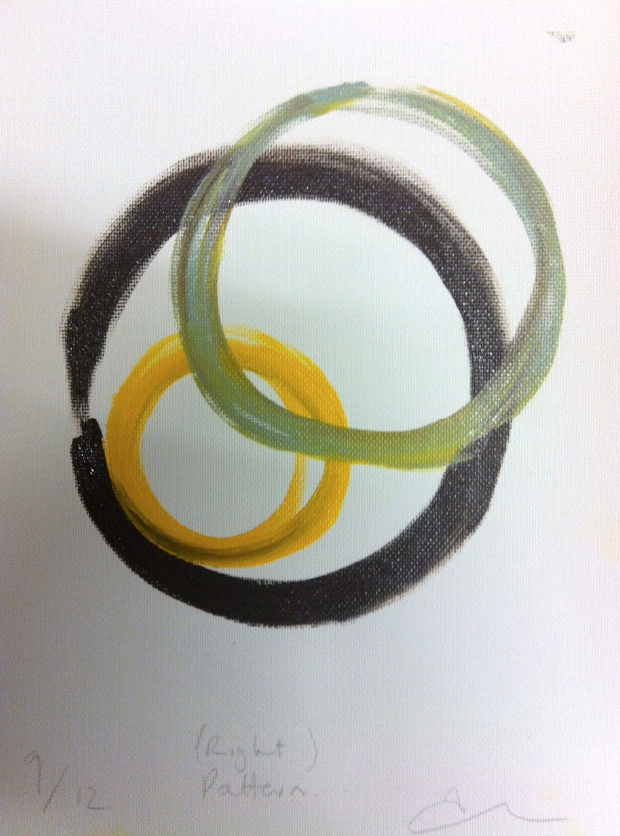
Circles
How do we connect, enchant and take care?
(An inquiry into ecological crisis, systems, worldviews and love)
Extract from thesis paper 2012
...The life of a man is a circle from childhood to childhood, and so it is in everything
where power moves...
As spoken by Black Elk, Black Elk Speaks
Nobody has written a book about the wisdom of medical science, because this is precisely the thing which it lacks. Wisdom I take to be the knowledge of the interactive system – that system which, if disturbed, is likely to generate exponential curves of change.
Gregory Bateson, Steps to an Ecology of Mind
Everything can be taken from a man but one thing: the last of the human freedoms—to choose one’s attitude in any given set of circumstances, to choose one's way.
Viktor E. Frankl, Man's Search for Meaning
Turning and turning in the widening gyre
The falcon cannot hear the falconer;
Things fall apart; the centre cannot hold;
Mere anarchy is loosed upon the world,
The blood-dimmed tide is loosed, and everywhere
The ceremony of innocence is drowned;
The best lack all conviction, while the worst
Are full of passionate intensity.
WB Yeats, The Second Coming
Thinking about Circles
There is a premise at the heart of my paper:
We must start thinking and acting less in straight lines, and more in circles.
I believe life works in cycles. Fritjof Capra (The Web of Life, 1997) tells us that systems that survive – those that we find in nature, operate in mutually supportive cycles. He draws on features like cooperation, partnership and diversity in describing what is necessary for sustainability. Similarly, Gregory Bateson (Steps to an Ecology of the Mind, 1972) tells us that life works in a process of optimisation rather than maximisation. Where a system tries to maximise any one particular aspect, it leads to destruction of other aspects of the system. Only a mutually supportive process of optimisation can maintain an ecosystem alive. This of course contrasts sharply with the method and attitude that has developed through the Industrial Growth Paradigm; on the one side an intention to maximise against one dimension (such as growth or profit); on the other hand to close oneself off from nurturing the whole.
We might also look at the symbolism of circles to interpret a deeper, ancient feeling of unity or connection. Morris Berman (The enchantment of the World, 1981) writes of the Ourobouros, the symbol of a snake coiled to hold its tail with its mouth (below). The Ourobouros is linked closely to ancient alchemy; a worldview of connection, holism, and eternal return. We see that the Ourobouros appears in Egyptian history, in Ancient Greece, in the Middle Ages and Jung explores it in looking at Alchemy as more than charlatan make-believe, but a deeply holistic worldview. Eastern philosophies also use the circle as a symbol of wholeness and wisdom. Mandalas are used as forms through which to reach deeper levels of consciousness – doorways to insight and enlightenment. And in Japanese calligraphy, ensō – the symbol of a circle - symbolises absolute enlightenment, strength, elegance, the universe, and the void.
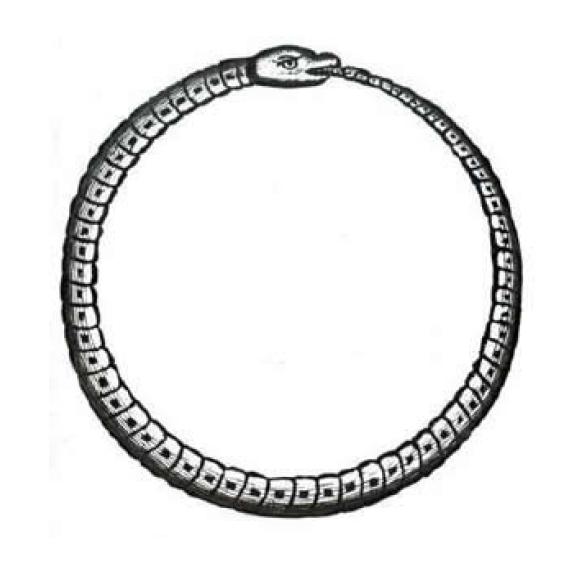
When you look and experience a circle, there is a balance. No one point stands out more than another. There is a notion of continuity – no particular part greater than the rest. I also believe that a circle can only be made and held through a moving, even, constant flow.
In the context of organisations, business and society, I think we have reached a point where thinking in straight lines gets us into trouble. There is no such thing as limitless growth. There are finite boundaries to the resources of the world. So I propose we must think in circles; looping back resource, ingredients, processes, energy into continuous and sustainable wholes.
I think we know this too, of relationships ourselves. We know that there is a constant motion of giving and taking. This is what Black Elk saw in all of the patterns of humanity. I share his quote in full:
…Everything the Power of the World does is done in a circle. The sky is
round, and I have heard the earth is round like a ball, and so are all the stars.
The wind, in its greatest power, whirls. Birds make their nests in circles, for theirs
is the same religion as ours. The sun comes forth and goes down again in a
circle. The moon does the same, and both are round. Even the seasons form a
great circle in their changing and always come back to where they where. The
life of a man is a circle from childhood to childhood, and so it is in everything
where power moves….
As spoken by Black Elk Speaks
So, I have come to feel that circles are about more than structural dynamics, but of the patterns of relationship and energy – and we are part of this.
Can we stand back to understand the connections we are part of?
Can we say whether these ‘circles’ nourish life, energy, feeling, in a positive way, or whether we stop this collective flourishing?
Can we choose to take responsibility for these invisible factors?
These questions form an essence to this work.
IDEAS
The world is in serious ecological crisis
The essential idea that frames all of this work is the notion that the world is in serious ecological crisis. It seems distant and cold to me to present this as an abstract idea now. I have spent so much time looking at it and believe it to be so true that I have become passionate and committed to make this situation better. Yet, this is not the case for many people. Am I wrong? It seems important to step back and explore the facts. What do I really know about this? Why do I believe it?
Understanding Gaia
James Lovelock (Revenge of Gaia, 1936) has helped me to grasp the science and the severity of the situation. Lovelock describes how the Earth self-regulates through a series of interrelated chemical, biological and physical processes. These processes ensure that Earth, through what you might even call some other-than-human form of sensing, can adapt and shape itself to keep steady the conditions required by life to survive. Lovelock calls this theory Gaia (1), and Gaia is at risk of overheating, and causing systems within her to spiral dangerously or break down.
Hardin Tibbs shows the condition of these systems as a whole (see chart below, from Nature), indicating that many systems, including the carbon cycle, nitrogen cycle, phosphorus cycle, climate systems, food systems and biodiversity levels (and more) are at risk of imbalance and breakdown.
Looking to evaluate these positions, I have looked at wider sources including work by Oxfam, Forum for the Future, the WorldWatch Institute and more (not leas constant flow of articles and news items through Alumni from this programme). I get an urgent sense that these sources are offering a very realistic perspective – increasingly outbalancing scepticism. Added to this, something I believe adds weight is that the tide is swinging towards the picture of crisis. According to the International Panel on Climate Change, most scientists looking at climate change to believe it is happening. Reading Lovelock, while most people were highly sceptical of Gaia at first, the consensus thirty years later is that there is a need for an Earths System understanding (if not a sense that she is a way of knowing animatedly, as Lovelock and Harding would put it).

Perhaps the most striking source of information for me was a meeting with some of the Kogi People from the mountains of Northern Colombia. The Kogi are carefully protected, isolated from the world, and they have a deep connection and understanding of their ecosystem. They also describe themselves as the ‘elder brother’, seeing Western civilization as the ‘younger brother’; immature, selfish and destructive. Today, the Kogi believe their environment is failing. They believe the younger brother must change, for life itself is at risk.
This all becomes more severe with a deeper understanding that these systems are interrelated, so that a movement in one area affects another. It is likely then, that change will come like a falling house of cards; one part more than tipping, but bringing down other areas and the whole. (I share more on systems thinking in the next section.)
We are also accelerating towards these critical points. The possible metaphor being that of the pond in which lilies double in numbers per unit of time. Unaware, the pond goes from half empty to overrun in a single unit of time.
Looking forward
Cynics might say – so what? For them, Earth is a constant and immovable object. An attitude might be: “Even if we all die out as people, life will go on.” The risk is that this is not the case. Firstly, we know (again from Lovelock and Harding) that the world is warmer than it has been through most other points of history (see the table below. The ‘hockey stick’ graph has been hotly debated, but consensus now seems that the world is heating). The last time the Earth was this hot it took 200,000 years to cool. The thing is, it might not cool again. On the one side, the sun is actually hotter now. On the other, there may be an accelerated heating factors such as man made agriculture, the destruction of rainforests, melting ice caps and a current artificial cooling factor from CFC’s in the atmosphere. Overheating may not be something we, or many other forms of life, recover from.

Finally in this section I point to simple human nature – and hubris. In Collapse (2006), Jared Diamond tells the story of many communities that reached points of civilisation only to crumble. These include the Aztecs, Easter Islanders and more, each perhaps carrying a feeling of invulnerability, short sightedness, even stupidity. How did the Easter Islanders come to chop down their last tree? Lest we find a different form of consciousness, we are likely to meet equally catastrophic ends.
This leads me to the next section of ideas; that of understanding the world as systems, before getting into matters of consciousness.
The world as circles – systems (of which we are part)
If looking at systemic problems, we should explore what we mean by systems. I start to define what we mean by a system in cause-and-effect terms, but build towards in notion that a system must be looked at as more than cause and effect, and even that systems have properties that appear magical! I put it that to work well with systems, we need to understand these forces and find a new kind of consciousness. I also expand here on a notion that our minds are part of the systems we create.
The basics
A system might be defined as flow of relationships; of causes and effects in a space. It might be seen that a system is continuously sending information and meaning along a circle to create flows of influence and action. Within this, we might observe positive and negative feedback within a circuit. A positive feedback loop will accelerate the direction or motion of a system until it reaches a form of constraint or limiting factor. A negative feedback loop will have the opposite effect.
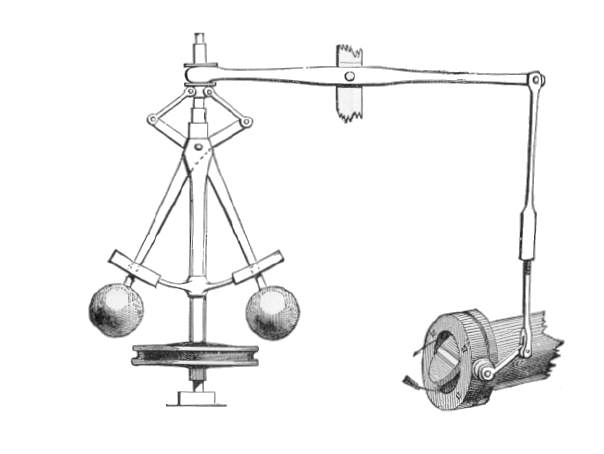
The governor in a steam engine is commonly used as an example of such a system. This system is a circuit consisting of:
1. Heat creating steam
2. Steam driving pistons
3. Pistons turning a wheel
4. A wheel driving an engine
So here, if we add more heat, we increase the steam, quicken the pistons and accelerate motion. This is a positive feedback loop - a constant build up –positive progression. A corrective in this system would somehow reduce or limit this movement, and this is the role that a governor plays. Here, as the wheel turns, it also creates centrifugal force (pushing out the weighted balls, as in the illustration below), which raises an escape valve, taking out excess steam. The result is an even amount of steam over time, and constant speed – a form of homeostasis. This is a wonderful logical model. But only a starting point, because while this explains a complicated system (that is, measurable and understandable), many systems are far more complex.
Complex systems
The above thinking cannot really be used to fully explain the movement or activity in a complex system such as biological communities, neighbourhoods, or Gaia. Certainly I understand that some rules of thinking can be applied, and that there are very advanced mathematical models which support systems modelling (Fritjof Capra provides an amazing overview of the development of systems thinking). But there is something more to complex systems, based on a number of features.
A characteristic of complexity is that it is not possible to see the system, so we must work with aspects of principles and different kinds of riles. Then a system has properties of emergence; that is, the system is more than the sum of all of its parts. So we begin to work with something which has a different kind of energy – not measurable in rational means. Plus in a complex system, often what Capra relates to as a self-organising system, there is a fascinating relationship between the part and the whole. Both seem to need each other in a system – the part contains the whole, and then the whole is shaped by the part. To me, this is magic stuff – at least, unexplainable in conventional scientific form. While we don’t have space to describe all these aspects now, it is evident – they are areas which need to be approached with something different than linear thinking.
More matters of mind
We should then consider a place that Fritjof points us to – through the work of Varela and Maturana (cited in The Web of Life); and that is, that our own mind and level of thinking are part of the systems we see in the world – what Capra relates to as Mind. This comes back to how our minds shape the world based on an interpretation of the world. So a mechanical world creates mechanical minds which make more mechanical things in the world. Iain McGilchrist (The Master and his Emissary, 2009), points to similar matters, also discussing ‘attention’. For him, the attention we place out in the world (for example whether we see a mountain as a place for leisure, for gathering resources or for artistic inspiration) begins to shape this world; and then whatever we create affects how we think. This notion of Mind – the interconnected nature of how we think and the world we act in, is central to this matter of connection and enchantment. Awareness of how we come to see the world becomes critical to being able to step outside of habit and exploring different kinds of consciousness and action. I want to look more into this, but first I want to say more about invisible forces in society and culture.
Bateson’s Invisible forces
It is interesting now to look at Bateson’s concept of schismogenesis, which I understand to be the mutual and reciprocal influence of two movements in a social system. So - one part may do one thing, influencing a second part to respond. Part two’s response will then mutually influence part one. Bateson described were two kinds of schismogenesis – symmetrical and complementary (very bluntly, in symmetrical schismogenesis the dynamic is one of matching behaviour – e.g. assertive meets assertive. In complementary, the behaviour moves mutually but in a different nature of behaviour, e.g. assertive meets submissive.). So here again we have a system with positively reinforcing impact loops. Two things then become important; the first is to note that progression occurs– that is, there is an of amplifying effect on the system in different directions. The second is that the system needs ways to stop this progression –to break out of habits, routines, customs or patterns that reinforce the schismogenesis. (In his work with the Naven custom of a tribe from New Guinea, Bateson showed how a schismogenesis emerging from gender roles was broken by a crossdressing dance.) For me, this is fascinating stuff of human systems. It makes me ask: what are the invisible forces - of culture and energy - that propel us through the world?
Forces in worldviews?
I look now at the world of Klaas Van Egmond, who points to something similar to schismogenesis
but looking at worldviews over time. Van Egmond presents his ideas through a model of two axes
describing value orientation (below). The horizontal axis presents a spectrum from individualism to
uniformity. The vertical axis runs from materialism to idealism.
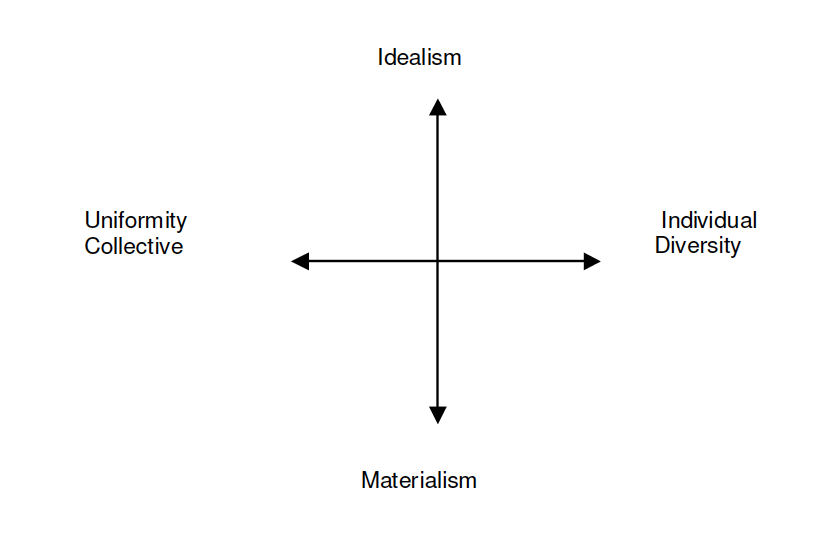
Van Egmond then maps out worldviews against this model. Early Christianity for example falls into the top right quadrant of the model; a place where people took held high regard for spirituality, but in many different forms. Christianity, with a single unifying god, falls on the left side of the model. What becomes really interesting about Van Egmond’s work for me, is his proposition that there are centrifugal forces that push values out to extremes. For example Darwinism, which falls in the bottom left hand corner, ultimately gets forced out to become Nazism. Similarly, today the emphasis on materialistic individualism leads to an ecological crisis. The point being – we seem to be pushed or pulled in extreme directions as whole societies. I wonder whether this is a form of schismogenesis… indeed whether it is a form of cyclical progression, a feedback loop of the Mind. The implication of this for me is pretty grave. A conversation about the basics of systems takes us to mind, and to minds which may create these pulls towards extreme forms. I have only really started to grasp what this might mean through this paper – the interrelation and pattern between mind and outer world systems, but from the above, I am certain there are patterns. This all calls for a different level of consciousness. And here I turn to our inner world – but it’s not happy reading.
Desperate disenchantment
..the ordinary person is a shrivelled, desiccated fragment of what a person can be…What we call normal is a product of repressions, denial, splitting, projection, introjection and other forms of destructive action on experience… It is radically estranged from the structure of being.
R.D Laing , 1967 in Reason and Bradbury, 2006
In this section I question:
How are we in the world, and how do we see it?
A narrative of changing worldviews
Let me say first that I define a worldview as the frame through which we view the world; of values, beliefs, intentions, attentions and within these the knowledge that we have about the world. A first question in exploring the current worldview is – how have worldviews changed? I have referred to a number of writers in exploring this –Morris Berman, Iain McGilchrist, Stephan Harding, Van Egmond (as above) and Gregory Bateson. The difficulty here of course is that this is a vast subject.. What I try do here is share some of the key insights and patterns linked to notions of connection to the whole.
I start off with two propositions from Berman and McGilchrist. The first is from Berman, which is the proposition that primary consciousness is holistic. That is, before the ego is fully developed, the basic nature of a human being is that of unity; of mind and body connected, and potentially the whole of the being connected to the world. Berman also notes to work of William Reich in understanding the whole being; proposing as much that even the nature of the ego has evolved in the past 500 years, suggesting the ego is now a more manipulative, powerful agent in the mind contrasted to how humans were half a millennium ago. Berman also provides a compelling argument by looking at Alchemy – and the idea that before the scientific revolution, humanity had a stronger sense of the interrelated and magical nature of the earth.
McGilchrist touches on something related, from a neurological perspective. In The Master and the Emissary, he draws a distinction between the two hemispheres of the brain. He describes the fact that both sides of the brain are actually involved in most activities, but it is how the two hemispheres work that is different. The right side is more about the ‘how’ of the world (holistic, connected, intuitive), the left-side is more about the ‘what’ (linear, abstractive, manipulative). The key thing for McGilchrist is that the right side of the brain is the natural ‘Master’; and as the mind has evolved in the modern world, the left side – the Emissary - has usurped the Master.
I find myself attracted to this notion of a holistic, connected state. But I struggle with the idea that this pre-modern state is what we should e striving for in the world. After all, the world was full of suffering murder, war, short-sightedness, famine, death through all these times. Rather, my belief is that these natural states are naive – to borrow the word from Berman. I also like Aldous Huxley’sframe here (cited in Bateson)– of ‘Grace’ – a form of connection as being part of nature which man has lost. I see it as an unconscious enchantment; natural balance; an unintentional floating in the world. But there is a problem – that we cannot experience this state, simply because we are conscious. Here we get into what Bateson calls conscious purpose; the intention to act in the world with a certain belief towards our gain. I share more on this shortly.
Coming back to how worldviews have changed first, we must look at a critical turning point – the enlightenment. Driven by the thinking of Newton, Galileo, Descartes and Bacon – here is where humanity began to separate itself in mind from nature. The world became something to measure, manipulate, master. Reductionism took hold; breaking down everything into separate components (far away from the sense of magical emergence I described in the systems section above). Here we find the separation of subject from object; value from fact; Eros from Logos (as Berman puts it)
From here, a number of aspects came together to catalyse the mechanistic, reductionist worldview. Capitalism was beginning to take hold; and means of measuring and counting in structures became important. Discoveries were being made all over. The world must have really felt like something humanity was conquering.
We know that the romanticist movement was a reflexive cry out for reconnection. It is here that I believe the modern mind seeks to find a more of a conscious form of enchantment, where we might say man is truly trying to find love again with the Earth; where he is sad to lose a lover or a friend when it is hurt. But the wheels of machinery and left-brain thinking crunched on – and here we find ourselves in a globalised, mechanical world. And it appears as desperate inside as it does outside, as I share below.
The modern environment and modern worldview
Martin Seligman (Authentic Happiness, 2003) and Richard Layard (Happiness: Lessons from a new science, 2005) provide worrying evidence of a world at unease with itself. They both point to statistics around increased mental illness, drug abuse, alcoholism and crime over the past half century. Added to this, work satisfaction has decreased. Iain McGilchrist adds: ‘Over the years, urbanisation, globalisation and the destruction of global cultures has led the prevalence of mental illness in the developed world’. In short: Money has not made us happier.
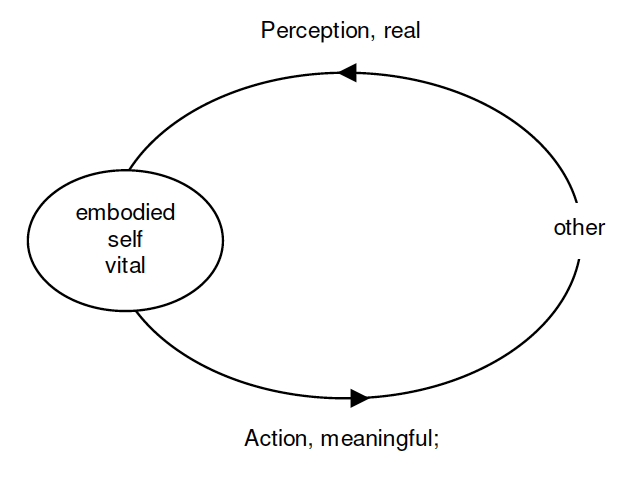
I then look to R.D Laing’s model of the ‘Divided Self’ to understand this inner state better (cited through Berman). Laing shares ideas that to be ‘vital’, the self should flow authentically with an outer world that feels authentic. Where this doesn’t happen, the self ‘splits’ out (the bubble on the left hand side becomes many small false bubbles) - different false selves are embodied, perception becomes unreal, actions futile, and an aspect of ‘deadness’ emerges. The world becomes tedious and we ourselves meaningless. Consumption is a form of substitute for this wholeness; and something that ultimately does not satisfy.
The Reenchantment of the World
Carl Jung in The Undiscovered Self (1957) leads to similar things - man seeking satisfaction from
an outer world, continuously putting himself through revolutions, never seeking to work with his
own mind. Always feeling let down only to move on to the next outer world revolt.
It seems Black Elk, the Sioux holy man, saw this coming long ago, through the lens of his ‘ancient’ worldview. These are his words on arrival to New York in the late 1800s. I cannot imagine what he would think of the world today:
After a while I got used to being there and I was like a man who had never had a vision. I felt dead and my people seemed lost and I thought I might never find them again. I did not see anything to help my people. I could see the Waichus (2) did not care for each other… They would take everything from each other… so there were some who had more of everything than they could use, while crowds of people had nothing at all and maybe were starving. They had forgotten that the earth was their mother….
Where do we go from here?
Matters of mind, consciousness and love
Darling, I am know you are there, and I’m so happy
Thich Nhat Hanh, one of four mantras in a meditation
Here try to bring together the threads of ideas we have explored so far – relating mind to system. I draw a distinction between the unconscious, which seeks to be holistic and ‘graceful’; and then the conscious which I believe is naturally not seeking connection. I use Bateson’s framing of conscious purpose to explain why. We then look at what ‘correctives’ in this destructive form of acting might be – in essence, how we can enchant ourselves with the world.
About conscious purpose
Conscious purpose as I understand it is the intention we are aware of carrying out our actions in this world. The problem with this, according to Bateson, is that consciousness is only part of an arc of a system. It is only a bit of the full picture, not the whole. And in fact, according to Bateson, consciousness is unable to have a full picture, because (imagining consciousness like the screen of a TV), in order for it to have a full picture of how things are, it would need enough circuitry to show all of the parts of the TV, and all of the circuitry. We don’t have this, so we operate in an ‘unwise’ way.
This unwise conscious purpose leads us to see that a place in A can influence D. That is, we shift A and A moves B which moves C which moves D. Except, the world is not like this. A whole system of changes takes place which we do not consciously understand. So our conscious purpose has a na.ve and potentially destructive impact on the world. Perhaps this explains all of the narratives in Jared Diamond’s Collapse.
Bateson also describes a difficulty in working with conscious purpose – that essentially we are trying to match two different systems to each other, and the systems don’t know how to communicate. He relates to the metaphor of Alice trying to play croquet with a flamingo. The different systems don’t know each others’ rules. The result is chaos.
Bateson then brings in three ideas which make this even scarier. Firstly he talks of the fact that the normal pattern of man is that he tries to change environment rather than himself. Secondly, he shares an idea that the very organisations that we have created act in such a way as to narrow our conscious purpose even further. That is; they create conditions where we shut our wider thinking even further from the whole. A company is dedicated to maximising profit, so we allow ourselves to step in to a way of thinking that amplifies this purpose – doing so in essentially an inhuman mode of operation. Thirdly, conscious purpose is accelerated by technology – so we are moving quicker in unwise ways.
This all again relates to McGilchrist’s notions of attention being in a cycle in shaping the world. The risk is that a reductionist mind – one where the emissary has usurped the master – reinforces a mechanical, compartmentalised and bureaucratic world.
Writing this makes me want to stop and feel my fingertips and stop thinking. It makes me want to feel all around me and feel whole. Not only of the mind.
‘Correctives’ + LOVE
So, we find ourselves in a place where we might work with two realms across our unconscious knowing and our conscious purpose. I see that unconscious knowing relates to much of the ‘under the surface’ dynamics and personality splits that R.D. Laing points to. Our conscious purpose is what we know, without really getting the whole picture. McGilchrist might also put this as the difference between the left side of brain – very abstract and manipulative, and the right – holistic and intuitive.
So how do make things right?!
Beautifully, Bateson explains that we must seek to find ‘correctives’ to help the adaptation of the human mind into the wider system. That is; let us shift back from the Emissary’s way of thinking to the Masters, and in Berman’s words, enchant ourselves.
How might we do this?
The thinking is that there are four areas to work with to do this:
• Firstly through reconnection with animals (which I interpret more broadly as nature.)
• Secondly through religion (which I interpret as spirituality and mindfulness in a
contemporary and from my agnostic sense).
• Thirdly through art.
• Fourthly through love.
Here we begin to feel our way in the world from the heart and from the will. This is a space which Berman begins to describe as a new worldview, combining an understanding of science and quantity with a feeling for energy and human quality. I see it as a space where we might evolve to understand deeper connection from the heart and from the will. It links together unconscious knowing with an endeavour to practice with a wiser conscious purpose.
Circles
How do we connect, enchant and take care?
(An inquiry into ecological crisis, systems, worldviews and love)
Extract from thesis paper 2012
...The life of a man is a circle from childhood to childhood, and so it is in everything
where power moves...
As spoken by Black Elk, Black Elk Speaks
Nobody has written a book about the wisdom of medical science, because this is precisely the thing which it lacks. Wisdom I take to be the knowledge of the interactive system – that system which, if disturbed, is likely to generate exponential curves of change.
Gregory Bateson, Steps to an Ecology of Mind
Everything can be taken from a man but one thing: the last of the human freedoms—to choose one’s attitude in any given set of circumstances, to choose one's way.
Viktor E. Frankl, Man's Search for Meaning
Turning and turning in the widening gyre
The falcon cannot hear the falconer;
Things fall apart; the centre cannot hold;
Mere anarchy is loosed upon the world,
The blood-dimmed tide is loosed, and everywhere
The ceremony of innocence is drowned;
The best lack all conviction, while the worst
Are full of passionate intensity.
WB Yeats, The Second Coming
Thinking about Circles
There is a premise at the heart of my paper:
We must start thinking and acting less in straight lines, and more in circles.
I believe life works in cycles. Fritjof Capra (The Web of Life, 1997) tells us that systems that survive – those that we find in nature, operate in mutually supportive cycles. He draws on features like cooperation, partnership and diversity in describing what is necessary for sustainability. Similarly, Gregory Bateson (Steps to an Ecology of the Mind, 1972) tells us that life works in a process of optimisation rather than maximisation. Where a system tries to maximise any one particular aspect, it leads to destruction of other aspects of the system. Only a mutually supportive process of optimisation can maintain an ecosystem alive. This of course contrasts sharply with the method and attitude that has developed through the Industrial Growth Paradigm; on the one side an intention to maximise against one dimension (such as growth or profit); on the other hand to close oneself off from nurturing the whole.
We might also look at the symbolism of circles to interpret a deeper, ancient feeling of unity or connection. Morris Berman (The enchantment of the World, 1981) writes of the Ourobouros, the symbol of a snake coiled to hold its tail with its mouth (below). The Ourobouros is linked closely to ancient alchemy; a worldview of connection, holism, and eternal return. We see that the Ourobouros appears in Egyptian history, in Ancient Greece, in the Middle Ages and Jung explores it in looking at Alchemy as more than charlatan make-believe, but a deeply holistic worldview. Eastern philosophies also use the circle as a symbol of wholeness and wisdom. Mandalas are used as forms through which to reach deeper levels of consciousness – doorways to insight and enlightenment. And in Japanese calligraphy, ensō – the symbol of a circle - symbolises absolute enlightenment, strength, elegance, the universe, and the void.
When you look and experience a circle, there is a balance. No one point stands out more than another. There is a notion of continuity – no particular part greater than the rest. I also believe that a circle can only be made and held through a moving, even, constant flow.
In the context of organisations, business and society, I think we have reached a point where thinking in straight lines gets us into trouble. There is no such thing as limitless growth. There are finite boundaries to the resources of the world. So I propose we must think in circles; looping back resource, ingredients, processes, energy into continuous and sustainable wholes.
I think we know this too, of relationships ourselves. We know that there is a constant motion of giving and taking. This is what Black Elk saw in all of the patterns of humanity. I share his quote in full:
…Everything the Power of the World does is done in a circle. The sky is
round, and I have heard the earth is round like a ball, and so are all the stars.
The wind, in its greatest power, whirls. Birds make their nests in circles, for theirs
is the same religion as ours. The sun comes forth and goes down again in a
circle. The moon does the same, and both are round. Even the seasons form a
great circle in their changing and always come back to where they where. The
life of a man is a circle from childhood to childhood, and so it is in everything
where power moves….
As spoken by Black Elk Speaks
So, I have come to feel that circles are about more than structural dynamics, but of the patterns of relationship and energy – and we are part of this.
Can we stand back to understand the connections we are part of?
Can we say whether these ‘circles’ nourish life, energy, feeling, in a positive way, or whether we stop this collective flourishing?
Can we choose to take responsibility for these invisible factors?
These questions form an essence to this work.
IDEAS
The world is in serious ecological crisis
The essential idea that frames all of this work is the notion that the world is in serious ecological crisis. It seems distant and cold to me to present this as an abstract idea now. I have spent so much time looking at it and believe it to be so true that I have become passionate and committed to make this situation better. Yet, this is not the case for many people. Am I wrong? It seems important to step back and explore the facts. What do I really know about this? Why do I believe it?
Understanding Gaia
James Lovelock (Revenge of Gaia, 1936) has helped me to grasp the science and the severity of the situation. Lovelock describes how the Earth self-regulates through a series of interrelated chemical, biological and physical processes. These processes ensure that Earth, through what you might even call some other-than-human form of sensing, can adapt and shape itself to keep steady the conditions required by life to survive. Lovelock calls this theory Gaia (1), and Gaia is at risk of overheating, and causing systems within her to spiral dangerously or break down.
Hardin Tibbs shows the condition of these systems as a whole (see chart below, from Nature), indicating that many systems, including the carbon cycle, nitrogen cycle, phosphorus cycle, climate systems, food systems and biodiversity levels (and more) are at risk of imbalance and breakdown.
Looking to evaluate these positions, I have looked at wider sources including work by Oxfam, Forum for the Future, the WorldWatch Institute and more (not leas constant flow of articles and news items through Alumni from this programme). I get an urgent sense that these sources are offering a very realistic perspective – increasingly outbalancing scepticism. Added to this, something I believe adds weight is that the tide is swinging towards the picture of crisis. According to the International Panel on Climate Change, most scientists looking at climate change to believe it is happening. Reading Lovelock, while most people were highly sceptical of Gaia at first, the consensus thirty years later is that there is a need for an Earths System understanding (if not a sense that she is a way of knowing animatedly, as Lovelock and Harding would put it).
Perhaps the most striking source of information for me was a meeting with some of the Kogi People from the mountains of Northern Colombia. The Kogi are carefully protected, isolated from the world, and they have a deep connection and understanding of their ecosystem. They also describe themselves as the ‘elder brother’, seeing Western civilization as the ‘younger brother’; immature, selfish and destructive. Today, the Kogi believe their environment is failing. They believe the younger brother must change, for life itself is at risk.
This all becomes more severe with a deeper understanding that these systems are interrelated, so that a movement in one area affects another. It is likely then, that change will come like a falling house of cards; one part more than tipping, but bringing down other areas and the whole. (I share more on systems thinking in the next section.)
We are also accelerating towards these critical points. The possible metaphor being that of the pond in which lilies double in numbers per unit of time. Unaware, the pond goes from half empty to overrun in a single unit of time.
Looking forward
Cynics might say – so what? For them, Earth is a constant and immovable object. An attitude might be: “Even if we all die out as people, life will go on.” The risk is that this is not the case. Firstly, we know (again from Lovelock and Harding) that the world is warmer than it has been through most other points of history (see the table below. The ‘hockey stick’ graph has been hotly debated, but consensus now seems that the world is heating). The last time the Earth was this hot it took 200,000 years to cool. The thing is, it might not cool again. On the one side, the sun is actually hotter now. On the other, there may be an accelerated heating factors such as man made agriculture, the destruction of rainforests, melting ice caps and a current artificial cooling factor from CFC’s in the atmosphere. Overheating may not be something we, or many other forms of life, recover from.
Finally in this section I point to simple human nature – and hubris. In Collapse (2006), Jared Diamond tells the story of many communities that reached points of civilisation only to crumble. These include the Aztecs, Easter Islanders and more, each perhaps carrying a feeling of invulnerability, short sightedness, even stupidity. How did the Easter Islanders come to chop down their last tree? Lest we find a different form of consciousness, we are likely to meet equally catastrophic ends.
This leads me to the next section of ideas; that of understanding the world as systems, before getting into matters of consciousness.
The world as circles – systems (of which we are part)
If looking at systemic problems, we should explore what we mean by systems. I start to define what we mean by a system in cause-and-effect terms, but build towards in notion that a system must be looked at as more than cause and effect, and even that systems have properties that appear magical! I put it that to work well with systems, we need to understand these forces and find a new kind of consciousness. I also expand here on a notion that our minds are part of the systems we create.
The basics
A system might be defined as flow of relationships; of causes and effects in a space. It might be seen that a system is continuously sending information and meaning along a circle to create flows of influence and action. Within this, we might observe positive and negative feedback within a circuit. A positive feedback loop will accelerate the direction or motion of a system until it reaches a form of constraint or limiting factor. A negative feedback loop will have the opposite effect.
The governor in a steam engine is commonly used as an example of such a system. This system is a circuit consisting of:
1. Heat creating steam
2. Steam driving pistons
3. Pistons turning a wheel
4. A wheel driving an engine
So here, if we add more heat, we increase the steam, quicken the pistons and accelerate motion. This is a positive feedback loop - a constant build up –positive progression. A corrective in this system would somehow reduce or limit this movement, and this is the role that a governor plays. Here, as the wheel turns, it also creates centrifugal force (pushing out the weighted balls, as in the illustration below), which raises an escape valve, taking out excess steam. The result is an even amount of steam over time, and constant speed – a form of homeostasis. This is a wonderful logical model. But only a starting point, because while this explains a complicated system (that is, measurable and understandable), many systems are far more complex.
Complex systems
The above thinking cannot really be used to fully explain the movement or activity in a complex system such as biological communities, neighbourhoods, or Gaia. Certainly I understand that some rules of thinking can be applied, and that there are very advanced mathematical models which support systems modelling (Fritjof Capra provides an amazing overview of the development of systems thinking). But there is something more to complex systems, based on a number of features.
A characteristic of complexity is that it is not possible to see the system, so we must work with aspects of principles and different kinds of riles. Then a system has properties of emergence; that is, the system is more than the sum of all of its parts. So we begin to work with something which has a different kind of energy – not measurable in rational means. Plus in a complex system, often what Capra relates to as a self-organising system, there is a fascinating relationship between the part and the whole. Both seem to need each other in a system – the part contains the whole, and then the whole is shaped by the part. To me, this is magic stuff – at least, unexplainable in conventional scientific form. While we don’t have space to describe all these aspects now, it is evident – they are areas which need to be approached with something different than linear thinking.
More matters of mind
We should then consider a place that Fritjof points us to – through the work of Varela and Maturana (cited in The Web of Life); and that is, that our own mind and level of thinking are part of the systems we see in the world – what Capra relates to as Mind. This comes back to how our minds shape the world based on an interpretation of the world. So a mechanical world creates mechanical minds which make more mechanical things in the world. Iain McGilchrist (The Master and his Emissary, 2009), points to similar matters, also discussing ‘attention’. For him, the attention we place out in the world (for example whether we see a mountain as a place for leisure, for gathering resources or for artistic inspiration) begins to shape this world; and then whatever we create affects how we think. This notion of Mind – the interconnected nature of how we think and the world we act in, is central to this matter of connection and enchantment. Awareness of how we come to see the world becomes critical to being able to step outside of habit and exploring different kinds of consciousness and action. I want to look more into this, but first I want to say more about invisible forces in society and culture.
Bateson’s Invisible forces
It is interesting now to look at Bateson’s concept of schismogenesis, which I understand to be the mutual and reciprocal influence of two movements in a social system. So - one part may do one thing, influencing a second part to respond. Part two’s response will then mutually influence part one. Bateson described were two kinds of schismogenesis – symmetrical and complementary (very bluntly, in symmetrical schismogenesis the dynamic is one of matching behaviour – e.g. assertive meets assertive. In complementary, the behaviour moves mutually but in a different nature of behaviour, e.g. assertive meets submissive.). So here again we have a system with positively reinforcing impact loops. Two things then become important; the first is to note that progression occurs– that is, there is an of amplifying effect on the system in different directions. The second is that the system needs ways to stop this progression –to break out of habits, routines, customs or patterns that reinforce the schismogenesis. (In his work with the Naven custom of a tribe from New Guinea, Bateson showed how a schismogenesis emerging from gender roles was broken by a crossdressing dance.) For me, this is fascinating stuff of human systems. It makes me ask: what are the invisible forces - of culture and energy - that propel us through the world?
Forces in worldviews?
I look now at the world of Klaas Van Egmond, who points to something similar to schismogenesis
but looking at worldviews over time. Van Egmond presents his ideas through a model of two axes
describing value orientation (below). The horizontal axis presents a spectrum from individualism to
uniformity. The vertical axis runs from materialism to idealism.
Van Egmond then maps out worldviews against this model. Early Christianity for example falls into the top right quadrant of the model; a place where people took held high regard for spirituality, but in many different forms. Christianity, with a single unifying god, falls on the left side of the model. What becomes really interesting about Van Egmond’s work for me, is his proposition that there are centrifugal forces that push values out to extremes. For example Darwinism, which falls in the bottom left hand corner, ultimately gets forced out to become Nazism. Similarly, today the emphasis on materialistic individualism leads to an ecological crisis. The point being – we seem to be pushed or pulled in extreme directions as whole societies. I wonder whether this is a form of schismogenesis… indeed whether it is a form of cyclical progression, a feedback loop of the Mind. The implication of this for me is pretty grave. A conversation about the basics of systems takes us to mind, and to minds which may create these pulls towards extreme forms. I have only really started to grasp what this might mean through this paper – the interrelation and pattern between mind and outer world systems, but from the above, I am certain there are patterns. This all calls for a different level of consciousness. And here I turn to our inner world – but it’s not happy reading.
Desperate disenchantment
..the ordinary person is a shrivelled, desiccated fragment of what a person can be…What we call normal is a product of repressions, denial, splitting, projection, introjection and other forms of destructive action on experience… It is radically estranged from the structure of being.
R.D Laing , 1967 in Reason and Bradbury, 2006
In this section I question:
How are we in the world, and how do we see it?
A narrative of changing worldviews
Let me say first that I define a worldview as the frame through which we view the world; of values, beliefs, intentions, attentions and within these the knowledge that we have about the world. A first question in exploring the current worldview is – how have worldviews changed? I have referred to a number of writers in exploring this –Morris Berman, Iain McGilchrist, Stephan Harding, Van Egmond (as above) and Gregory Bateson. The difficulty here of course is that this is a vast subject.. What I try do here is share some of the key insights and patterns linked to notions of connection to the whole.
I start off with two propositions from Berman and McGilchrist. The first is from Berman, which is the proposition that primary consciousness is holistic. That is, before the ego is fully developed, the basic nature of a human being is that of unity; of mind and body connected, and potentially the whole of the being connected to the world. Berman also notes to work of William Reich in understanding the whole being; proposing as much that even the nature of the ego has evolved in the past 500 years, suggesting the ego is now a more manipulative, powerful agent in the mind contrasted to how humans were half a millennium ago. Berman also provides a compelling argument by looking at Alchemy – and the idea that before the scientific revolution, humanity had a stronger sense of the interrelated and magical nature of the earth.
McGilchrist touches on something related, from a neurological perspective. In The Master and the Emissary, he draws a distinction between the two hemispheres of the brain. He describes the fact that both sides of the brain are actually involved in most activities, but it is how the two hemispheres work that is different. The right side is more about the ‘how’ of the world (holistic, connected, intuitive), the left-side is more about the ‘what’ (linear, abstractive, manipulative). The key thing for McGilchrist is that the right side of the brain is the natural ‘Master’; and as the mind has evolved in the modern world, the left side – the Emissary - has usurped the Master.
I find myself attracted to this notion of a holistic, connected state. But I struggle with the idea that this pre-modern state is what we should e striving for in the world. After all, the world was full of suffering murder, war, short-sightedness, famine, death through all these times. Rather, my belief is that these natural states are naive – to borrow the word from Berman. I also like Aldous Huxley’sframe here (cited in Bateson)– of ‘Grace’ – a form of connection as being part of nature which man has lost. I see it as an unconscious enchantment; natural balance; an unintentional floating in the world. But there is a problem – that we cannot experience this state, simply because we are conscious. Here we get into what Bateson calls conscious purpose; the intention to act in the world with a certain belief towards our gain. I share more on this shortly.
Coming back to how worldviews have changed first, we must look at a critical turning point – the enlightenment. Driven by the thinking of Newton, Galileo, Descartes and Bacon – here is where humanity began to separate itself in mind from nature. The world became something to measure, manipulate, master. Reductionism took hold; breaking down everything into separate components (far away from the sense of magical emergence I described in the systems section above). Here we find the separation of subject from object; value from fact; Eros from Logos (as Berman puts it)
From here, a number of aspects came together to catalyse the mechanistic, reductionist worldview. Capitalism was beginning to take hold; and means of measuring and counting in structures became important. Discoveries were being made all over. The world must have really felt like something humanity was conquering.
We know that the romanticist movement was a reflexive cry out for reconnection. It is here that I believe the modern mind seeks to find a more of a conscious form of enchantment, where we might say man is truly trying to find love again with the Earth; where he is sad to lose a lover or a friend when it is hurt. But the wheels of machinery and left-brain thinking crunched on – and here we find ourselves in a globalised, mechanical world. And it appears as desperate inside as it does outside, as I share below.
The modern environment and modern worldview
Martin Seligman (Authentic Happiness, 2003) and Richard Layard (Happiness: Lessons from a new science, 2005) provide worrying evidence of a world at unease with itself. They both point to statistics around increased mental illness, drug abuse, alcoholism and crime over the past half century. Added to this, work satisfaction has decreased. Iain McGilchrist adds: ‘Over the years, urbanisation, globalisation and the destruction of global cultures has led the prevalence of mental illness in the developed world’. In short: Money has not made us happier.
I then look to R.D Laing’s model of the ‘Divided Self’ to understand this inner state better (cited through Berman). Laing shares ideas that to be ‘vital’, the self should flow authentically with an outer world that feels authentic. Where this doesn’t happen, the self ‘splits’ out (the bubble on the left hand side becomes many small false bubbles) - different false selves are embodied, perception becomes unreal, actions futile, and an aspect of ‘deadness’ emerges. The world becomes tedious and we ourselves meaningless. Consumption is a form of substitute for this wholeness; and something that ultimately does not satisfy.
The Reenchantment of the World
Carl Jung in The Undiscovered Self (1957) leads to similar things - man seeking satisfaction from
an outer world, continuously putting himself through revolutions, never seeking to work with his
own mind. Always feeling let down only to move on to the next outer world revolt.
It seems Black Elk, the Sioux holy man, saw this coming long ago, through the lens of his ‘ancient’ worldview. These are his words on arrival to New York in the late 1800s. I cannot imagine what he would think of the world today:
After a while I got used to being there and I was like a man who had never had a vision. I felt dead and my people seemed lost and I thought I might never find them again. I did not see anything to help my people. I could see the Waichus (2) did not care for each other… They would take everything from each other… so there were some who had more of everything than they could use, while crowds of people had nothing at all and maybe were starving. They had forgotten that the earth was their mother….
Where do we go from here?
Matters of mind, consciousness and love
Darling, I am know you are there, and I’m so happy
Thich Nhat Hanh, one of four mantras in a meditation
Here try to bring together the threads of ideas we have explored so far – relating mind to system. I draw a distinction between the unconscious, which seeks to be holistic and ‘graceful’; and then the conscious which I believe is naturally not seeking connection. I use Bateson’s framing of conscious purpose to explain why. We then look at what ‘correctives’ in this destructive form of acting might be – in essence, how we can enchant ourselves with the world.
About conscious purpose
Conscious purpose as I understand it is the intention we are aware of carrying out our actions in this world. The problem with this, according to Bateson, is that consciousness is only part of an arc of a system. It is only a bit of the full picture, not the whole. And in fact, according to Bateson, consciousness is unable to have a full picture, because (imagining consciousness like the screen of a TV), in order for it to have a full picture of how things are, it would need enough circuitry to show all of the parts of the TV, and all of the circuitry. We don’t have this, so we operate in an ‘unwise’ way.
This unwise conscious purpose leads us to see that a place in A can influence D. That is, we shift A and A moves B which moves C which moves D. Except, the world is not like this. A whole system of changes takes place which we do not consciously understand. So our conscious purpose has a na.ve and potentially destructive impact on the world. Perhaps this explains all of the narratives in Jared Diamond’s Collapse.
Bateson also describes a difficulty in working with conscious purpose – that essentially we are trying to match two different systems to each other, and the systems don’t know how to communicate. He relates to the metaphor of Alice trying to play croquet with a flamingo. The different systems don’t know each others’ rules. The result is chaos.
Bateson then brings in three ideas which make this even scarier. Firstly he talks of the fact that the normal pattern of man is that he tries to change environment rather than himself. Secondly, he shares an idea that the very organisations that we have created act in such a way as to narrow our conscious purpose even further. That is; they create conditions where we shut our wider thinking even further from the whole. A company is dedicated to maximising profit, so we allow ourselves to step in to a way of thinking that amplifies this purpose – doing so in essentially an inhuman mode of operation. Thirdly, conscious purpose is accelerated by technology – so we are moving quicker in unwise ways.
This all again relates to McGilchrist’s notions of attention being in a cycle in shaping the world. The risk is that a reductionist mind – one where the emissary has usurped the master – reinforces a mechanical, compartmentalised and bureaucratic world.
Writing this makes me want to stop and feel my fingertips and stop thinking. It makes me want to feel all around me and feel whole. Not only of the mind.
‘Correctives’ + LOVE
So, we find ourselves in a place where we might work with two realms across our unconscious knowing and our conscious purpose. I see that unconscious knowing relates to much of the ‘under the surface’ dynamics and personality splits that R.D. Laing points to. Our conscious purpose is what we know, without really getting the whole picture. McGilchrist might also put this as the difference between the left side of brain – very abstract and manipulative, and the right – holistic and intuitive.
So how do make things right?!
Beautifully, Bateson explains that we must seek to find ‘correctives’ to help the adaptation of the human mind into the wider system. That is; let us shift back from the Emissary’s way of thinking to the Masters, and in Berman’s words, enchant ourselves.
How might we do this?
The thinking is that there are four areas to work with to do this:
• Firstly through reconnection with animals (which I interpret more broadly as nature.)
• Secondly through religion (which I interpret as spirituality and mindfulness in a
contemporary and from my agnostic sense).
• Thirdly through art.
• Fourthly through love.
Here we begin to feel our way in the world from the heart and from the will. This is a space which Berman begins to describe as a new worldview, combining an understanding of science and quantity with a feeling for energy and human quality. I see it as a space where we might evolve to understand deeper connection from the heart and from the will. It links together unconscious knowing with an endeavour to practice with a wiser conscious purpose.
Andres Roberts has worked for 20 years with themes of wholeness, systems-change, responsibility and connection across many areas of life and work. He leads work with organisations such as Patagonia, Natura & Co, Aviva Investors and more. He was a catalyst and is now a project lead for the Earth Funding Lab - an initiative helping funders collaborate towards ‘Economies in Service to Life’. He has helped initiate programmes such as ‘OD For Life,’ helping consultants act to care for the planet. Most deeply, he is a Nature Quest guide - helping people reconnect and transform through profound immersions in nature.

BY ANDRES ROBERTS
Circles
How do we connect, enchant and take care?
(An inquiry into ecological crisis, systems, worldviews and love)
Extract from thesis paper 2012
...The life of a man is a circle from childhood to childhood, and so it is in everything
where power moves...
As spoken by Black Elk, Black Elk Speaks
Nobody has written a book about the wisdom of medical science, because this is precisely the thing which it lacks. Wisdom I take to be the knowledge of the interactive system – that system which, if disturbed, is likely to generate exponential curves of change.
Gregory Bateson, Steps to an Ecology of Mind
Everything can be taken from a man but one thing: the last of the human freedoms—to choose one’s attitude in any given set of circumstances, to choose one's way.
Viktor E. Frankl, Man's Search for Meaning
Turning and turning in the widening gyre
The falcon cannot hear the falconer;
Things fall apart; the centre cannot hold;
Mere anarchy is loosed upon the world,
The blood-dimmed tide is loosed, and everywhere
The ceremony of innocence is drowned;
The best lack all conviction, while the worst
Are full of passionate intensity.
WB Yeats, The Second Coming
Thinking about Circles
There is a premise at the heart of my paper:
We must start thinking and acting less in straight lines, and more in circles.
I believe life works in cycles. Fritjof Capra (The Web of Life, 1997) tells us that systems that survive – those that we find in nature, operate in mutually supportive cycles. He draws on features like cooperation, partnership and diversity in describing what is necessary for sustainability. Similarly, Gregory Bateson (Steps to an Ecology of the Mind, 1972) tells us that life works in a process of optimisation rather than maximisation. Where a system tries to maximise any one particular aspect, it leads to destruction of other aspects of the system. Only a mutually supportive process of optimisation can maintain an ecosystem alive. This of course contrasts sharply with the method and attitude that has developed through the Industrial Growth Paradigm; on the one side an intention to maximise against one dimension (such as growth or profit); on the other hand to close oneself off from nurturing the whole.
We might also look at the symbolism of circles to interpret a deeper, ancient feeling of unity or connection. Morris Berman (The enchantment of the World, 1981) writes of the Ourobouros, the symbol of a snake coiled to hold its tail with its mouth (below). The Ourobouros is linked closely to ancient alchemy; a worldview of connection, holism, and eternal return. We see that the Ourobouros appears in Egyptian history, in Ancient Greece, in the Middle Ages and Jung explores it in looking at Alchemy as more than charlatan make-believe, but a deeply holistic worldview. Eastern philosophies also use the circle as a symbol of wholeness and wisdom. Mandalas are used as forms through which to reach deeper levels of consciousness – doorways to insight and enlightenment. And in Japanese calligraphy, ensō – the symbol of a circle - symbolises absolute enlightenment, strength, elegance, the universe, and the void.
When you look and experience a circle, there is a balance. No one point stands out more than another. There is a notion of continuity – no particular part greater than the rest. I also believe that a circle can only be made and held through a moving, even, constant flow.
In the context of organisations, business and society, I think we have reached a point where thinking in straight lines gets us into trouble. There is no such thing as limitless growth. There are finite boundaries to the resources of the world. So I propose we must think in circles; looping back resource, ingredients, processes, energy into continuous and sustainable wholes.
I think we know this too, of relationships ourselves. We know that there is a constant motion of giving and taking. This is what Black Elk saw in all of the patterns of humanity. I share his quote in full:
…Everything the Power of the World does is done in a circle. The sky is
round, and I have heard the earth is round like a ball, and so are all the stars.
The wind, in its greatest power, whirls. Birds make their nests in circles, for theirs
is the same religion as ours. The sun comes forth and goes down again in a
circle. The moon does the same, and both are round. Even the seasons form a
great circle in their changing and always come back to where they where. The
life of a man is a circle from childhood to childhood, and so it is in everything
where power moves….
As spoken by Black Elk Speaks
So, I have come to feel that circles are about more than structural dynamics, but of the patterns of relationship and energy – and we are part of this.
Can we stand back to understand the connections we are part of?
Can we say whether these ‘circles’ nourish life, energy, feeling, in a positive way, or whether we stop this collective flourishing?
Can we choose to take responsibility for these invisible factors?
These questions form an essence to this work.
IDEAS
The world is in serious ecological crisis
The essential idea that frames all of this work is the notion that the world is in serious ecological crisis. It seems distant and cold to me to present this as an abstract idea now. I have spent so much time looking at it and believe it to be so true that I have become passionate and committed to make this situation better. Yet, this is not the case for many people. Am I wrong? It seems important to step back and explore the facts. What do I really know about this? Why do I believe it?
Understanding Gaia
James Lovelock (Revenge of Gaia, 1936) has helped me to grasp the science and the severity of the situation. Lovelock describes how the Earth self-regulates through a series of interrelated chemical, biological and physical processes. These processes ensure that Earth, through what you might even call some other-than-human form of sensing, can adapt and shape itself to keep steady the conditions required by life to survive. Lovelock calls this theory Gaia (1), and Gaia is at risk of overheating, and causing systems within her to spiral dangerously or break down.
Hardin Tibbs shows the condition of these systems as a whole (see chart below, from Nature), indicating that many systems, including the carbon cycle, nitrogen cycle, phosphorus cycle, climate systems, food systems and biodiversity levels (and more) are at risk of imbalance and breakdown.
Looking to evaluate these positions, I have looked at wider sources including work by Oxfam, Forum for the Future, the WorldWatch Institute and more (not leas constant flow of articles and news items through Alumni from this programme). I get an urgent sense that these sources are offering a very realistic perspective – increasingly outbalancing scepticism. Added to this, something I believe adds weight is that the tide is swinging towards the picture of crisis. According to the International Panel on Climate Change, most scientists looking at climate change to believe it is happening. Reading Lovelock, while most people were highly sceptical of Gaia at first, the consensus thirty years later is that there is a need for an Earths System understanding (if not a sense that she is a way of knowing animatedly, as Lovelock and Harding would put it).
Perhaps the most striking source of information for me was a meeting with some of the Kogi People from the mountains of Northern Colombia. The Kogi are carefully protected, isolated from the world, and they have a deep connection and understanding of their ecosystem. They also describe themselves as the ‘elder brother’, seeing Western civilization as the ‘younger brother’; immature, selfish and destructive. Today, the Kogi believe their environment is failing. They believe the younger brother must change, for life itself is at risk.
This all becomes more severe with a deeper understanding that these systems are interrelated, so that a movement in one area affects another. It is likely then, that change will come like a falling house of cards; one part more than tipping, but bringing down other areas and the whole. (I share more on systems thinking in the next section.)
We are also accelerating towards these critical points. The possible metaphor being that of the pond in which lilies double in numbers per unit of time. Unaware, the pond goes from half empty to overrun in a single unit of time.
Looking forward
Cynics might say – so what? For them, Earth is a constant and immovable object. An attitude might be: “Even if we all die out as people, life will go on.” The risk is that this is not the case. Firstly, we know (again from Lovelock and Harding) that the world is warmer than it has been through most other points of history (see the table below. The ‘hockey stick’ graph has been hotly debated, but consensus now seems that the world is heating). The last time the Earth was this hot it took 200,000 years to cool. The thing is, it might not cool again. On the one side, the sun is actually hotter now. On the other, there may be an accelerated heating factors such as man made agriculture, the destruction of rainforests, melting ice caps and a current artificial cooling factor from CFC’s in the atmosphere. Overheating may not be something we, or many other forms of life, recover from.
Finally in this section I point to simple human nature – and hubris. In Collapse (2006), Jared Diamond tells the story of many communities that reached points of civilisation only to crumble. These include the Aztecs, Easter Islanders and more, each perhaps carrying a feeling of invulnerability, short sightedness, even stupidity. How did the Easter Islanders come to chop down their last tree? Lest we find a different form of consciousness, we are likely to meet equally catastrophic ends.
This leads me to the next section of ideas; that of understanding the world as systems, before getting into matters of consciousness.
The world as circles – systems (of which we are part)
If looking at systemic problems, we should explore what we mean by systems. I start to define what we mean by a system in cause-and-effect terms, but build towards in notion that a system must be looked at as more than cause and effect, and even that systems have properties that appear magical! I put it that to work well with systems, we need to understand these forces and find a new kind of consciousness. I also expand here on a notion that our minds are part of the systems we create.
The basics
A system might be defined as flow of relationships; of causes and effects in a space. It might be seen that a system is continuously sending information and meaning along a circle to create flows of influence and action. Within this, we might observe positive and negative feedback within a circuit. A positive feedback loop will accelerate the direction or motion of a system until it reaches a form of constraint or limiting factor. A negative feedback loop will have the opposite effect.
The governor in a steam engine is commonly used as an example of such a system. This system is a circuit consisting of:
1. Heat creating steam
2. Steam driving pistons
3. Pistons turning a wheel
4. A wheel driving an engine
So here, if we add more heat, we increase the steam, quicken the pistons and accelerate motion. This is a positive feedback loop - a constant build up –positive progression. A corrective in this system would somehow reduce or limit this movement, and this is the role that a governor plays. Here, as the wheel turns, it also creates centrifugal force (pushing out the weighted balls, as in the illustration below), which raises an escape valve, taking out excess steam. The result is an even amount of steam over time, and constant speed – a form of homeostasis. This is a wonderful logical model. But only a starting point, because while this explains a complicated system (that is, measurable and understandable), many systems are far more complex.
Complex systems
The above thinking cannot really be used to fully explain the movement or activity in a complex system such as biological communities, neighbourhoods, or Gaia. Certainly I understand that some rules of thinking can be applied, and that there are very advanced mathematical models which support systems modelling (Fritjof Capra provides an amazing overview of the development of systems thinking). But there is something more to complex systems, based on a number of features.
A characteristic of complexity is that it is not possible to see the system, so we must work with aspects of principles and different kinds of riles. Then a system has properties of emergence; that is, the system is more than the sum of all of its parts. So we begin to work with something which has a different kind of energy – not measurable in rational means. Plus in a complex system, often what Capra relates to as a self-organising system, there is a fascinating relationship between the part and the whole. Both seem to need each other in a system – the part contains the whole, and then the whole is shaped by the part. To me, this is magic stuff – at least, unexplainable in conventional scientific form. While we don’t have space to describe all these aspects now, it is evident – they are areas which need to be approached with something different than linear thinking.
More matters of mind
We should then consider a place that Fritjof points us to – through the work of Varela and Maturana (cited in The Web of Life); and that is, that our own mind and level of thinking are part of the systems we see in the world – what Capra relates to as Mind. This comes back to how our minds shape the world based on an interpretation of the world. So a mechanical world creates mechanical minds which make more mechanical things in the world. Iain McGilchrist (The Master and his Emissary, 2009), points to similar matters, also discussing ‘attention’. For him, the attention we place out in the world (for example whether we see a mountain as a place for leisure, for gathering resources or for artistic inspiration) begins to shape this world; and then whatever we create affects how we think. This notion of Mind – the interconnected nature of how we think and the world we act in, is central to this matter of connection and enchantment. Awareness of how we come to see the world becomes critical to being able to step outside of habit and exploring different kinds of consciousness and action. I want to look more into this, but first I want to say more about invisible forces in society and culture.
Bateson’s Invisible forces
It is interesting now to look at Bateson’s concept of schismogenesis, which I understand to be the mutual and reciprocal influence of two movements in a social system. So - one part may do one thing, influencing a second part to respond. Part two’s response will then mutually influence part one. Bateson described were two kinds of schismogenesis – symmetrical and complementary (very bluntly, in symmetrical schismogenesis the dynamic is one of matching behaviour – e.g. assertive meets assertive. In complementary, the behaviour moves mutually but in a different nature of behaviour, e.g. assertive meets submissive.). So here again we have a system with positively reinforcing impact loops. Two things then become important; the first is to note that progression occurs– that is, there is an of amplifying effect on the system in different directions. The second is that the system needs ways to stop this progression –to break out of habits, routines, customs or patterns that reinforce the schismogenesis. (In his work with the Naven custom of a tribe from New Guinea, Bateson showed how a schismogenesis emerging from gender roles was broken by a crossdressing dance.) For me, this is fascinating stuff of human systems. It makes me ask: what are the invisible forces - of culture and energy - that propel us through the world?
Forces in worldviews?
I look now at the world of Klaas Van Egmond, who points to something similar to schismogenesis
but looking at worldviews over time. Van Egmond presents his ideas through a model of two axes
describing value orientation (below). The horizontal axis presents a spectrum from individualism to
uniformity. The vertical axis runs from materialism to idealism.
Van Egmond then maps out worldviews against this model. Early Christianity for example falls into the top right quadrant of the model; a place where people took held high regard for spirituality, but in many different forms. Christianity, with a single unifying god, falls on the left side of the model. What becomes really interesting about Van Egmond’s work for me, is his proposition that there are centrifugal forces that push values out to extremes. For example Darwinism, which falls in the bottom left hand corner, ultimately gets forced out to become Nazism. Similarly, today the emphasis on materialistic individualism leads to an ecological crisis. The point being – we seem to be pushed or pulled in extreme directions as whole societies. I wonder whether this is a form of schismogenesis… indeed whether it is a form of cyclical progression, a feedback loop of the Mind. The implication of this for me is pretty grave. A conversation about the basics of systems takes us to mind, and to minds which may create these pulls towards extreme forms. I have only really started to grasp what this might mean through this paper – the interrelation and pattern between mind and outer world systems, but from the above, I am certain there are patterns. This all calls for a different level of consciousness. And here I turn to our inner world – but it’s not happy reading.
Desperate disenchantment
..the ordinary person is a shrivelled, desiccated fragment of what a person can be…What we call normal is a product of repressions, denial, splitting, projection, introjection and other forms of destructive action on experience… It is radically estranged from the structure of being.
R.D Laing , 1967 in Reason and Bradbury, 2006
In this section I question:
How are we in the world, and how do we see it?
A narrative of changing worldviews
Let me say first that I define a worldview as the frame through which we view the world; of values, beliefs, intentions, attentions and within these the knowledge that we have about the world. A first question in exploring the current worldview is – how have worldviews changed? I have referred to a number of writers in exploring this –Morris Berman, Iain McGilchrist, Stephan Harding, Van Egmond (as above) and Gregory Bateson. The difficulty here of course is that this is a vast subject.. What I try do here is share some of the key insights and patterns linked to notions of connection to the whole.
I start off with two propositions from Berman and McGilchrist. The first is from Berman, which is the proposition that primary consciousness is holistic. That is, before the ego is fully developed, the basic nature of a human being is that of unity; of mind and body connected, and potentially the whole of the being connected to the world. Berman also notes to work of William Reich in understanding the whole being; proposing as much that even the nature of the ego has evolved in the past 500 years, suggesting the ego is now a more manipulative, powerful agent in the mind contrasted to how humans were half a millennium ago. Berman also provides a compelling argument by looking at Alchemy – and the idea that before the scientific revolution, humanity had a stronger sense of the interrelated and magical nature of the earth.
McGilchrist touches on something related, from a neurological perspective. In The Master and the Emissary, he draws a distinction between the two hemispheres of the brain. He describes the fact that both sides of the brain are actually involved in most activities, but it is how the two hemispheres work that is different. The right side is more about the ‘how’ of the world (holistic, connected, intuitive), the left-side is more about the ‘what’ (linear, abstractive, manipulative). The key thing for McGilchrist is that the right side of the brain is the natural ‘Master’; and as the mind has evolved in the modern world, the left side – the Emissary - has usurped the Master.
I find myself attracted to this notion of a holistic, connected state. But I struggle with the idea that this pre-modern state is what we should e striving for in the world. After all, the world was full of suffering murder, war, short-sightedness, famine, death through all these times. Rather, my belief is that these natural states are naive – to borrow the word from Berman. I also like Aldous Huxley’sframe here (cited in Bateson)– of ‘Grace’ – a form of connection as being part of nature which man has lost. I see it as an unconscious enchantment; natural balance; an unintentional floating in the world. But there is a problem – that we cannot experience this state, simply because we are conscious. Here we get into what Bateson calls conscious purpose; the intention to act in the world with a certain belief towards our gain. I share more on this shortly.
Coming back to how worldviews have changed first, we must look at a critical turning point – the enlightenment. Driven by the thinking of Newton, Galileo, Descartes and Bacon – here is where humanity began to separate itself in mind from nature. The world became something to measure, manipulate, master. Reductionism took hold; breaking down everything into separate components (far away from the sense of magical emergence I described in the systems section above). Here we find the separation of subject from object; value from fact; Eros from Logos (as Berman puts it)
From here, a number of aspects came together to catalyse the mechanistic, reductionist worldview. Capitalism was beginning to take hold; and means of measuring and counting in structures became important. Discoveries were being made all over. The world must have really felt like something humanity was conquering.
We know that the romanticist movement was a reflexive cry out for reconnection. It is here that I believe the modern mind seeks to find a more of a conscious form of enchantment, where we might say man is truly trying to find love again with the Earth; where he is sad to lose a lover or a friend when it is hurt. But the wheels of machinery and left-brain thinking crunched on – and here we find ourselves in a globalised, mechanical world. And it appears as desperate inside as it does outside, as I share below.
The modern environment and modern worldview
Martin Seligman (Authentic Happiness, 2003) and Richard Layard (Happiness: Lessons from a new science, 2005) provide worrying evidence of a world at unease with itself. They both point to statistics around increased mental illness, drug abuse, alcoholism and crime over the past half century. Added to this, work satisfaction has decreased. Iain McGilchrist adds: ‘Over the years, urbanisation, globalisation and the destruction of global cultures has led the prevalence of mental illness in the developed world’. In short: Money has not made us happier.
I then look to R.D Laing’s model of the ‘Divided Self’ to understand this inner state better (cited through Berman). Laing shares ideas that to be ‘vital’, the self should flow authentically with an outer world that feels authentic. Where this doesn’t happen, the self ‘splits’ out (the bubble on the left hand side becomes many small false bubbles) - different false selves are embodied, perception becomes unreal, actions futile, and an aspect of ‘deadness’ emerges. The world becomes tedious and we ourselves meaningless. Consumption is a form of substitute for this wholeness; and something that ultimately does not satisfy.
The Reenchantment of the World
Carl Jung in The Undiscovered Self (1957) leads to similar things - man seeking satisfaction from
an outer world, continuously putting himself through revolutions, never seeking to work with his
own mind. Always feeling let down only to move on to the next outer world revolt.
It seems Black Elk, the Sioux holy man, saw this coming long ago, through the lens of his ‘ancient’ worldview. These are his words on arrival to New York in the late 1800s. I cannot imagine what he would think of the world today:
After a while I got used to being there and I was like a man who had never had a vision. I felt dead and my people seemed lost and I thought I might never find them again. I did not see anything to help my people. I could see the Waichus (2) did not care for each other… They would take everything from each other… so there were some who had more of everything than they could use, while crowds of people had nothing at all and maybe were starving. They had forgotten that the earth was their mother….
Where do we go from here?
Matters of mind, consciousness and love
Darling, I am know you are there, and I’m so happy
Thich Nhat Hanh, one of four mantras in a meditation
Here try to bring together the threads of ideas we have explored so far – relating mind to system. I draw a distinction between the unconscious, which seeks to be holistic and ‘graceful’; and then the conscious which I believe is naturally not seeking connection. I use Bateson’s framing of conscious purpose to explain why. We then look at what ‘correctives’ in this destructive form of acting might be – in essence, how we can enchant ourselves with the world.
About conscious purpose
Conscious purpose as I understand it is the intention we are aware of carrying out our actions in this world. The problem with this, according to Bateson, is that consciousness is only part of an arc of a system. It is only a bit of the full picture, not the whole. And in fact, according to Bateson, consciousness is unable to have a full picture, because (imagining consciousness like the screen of a TV), in order for it to have a full picture of how things are, it would need enough circuitry to show all of the parts of the TV, and all of the circuitry. We don’t have this, so we operate in an ‘unwise’ way.
This unwise conscious purpose leads us to see that a place in A can influence D. That is, we shift A and A moves B which moves C which moves D. Except, the world is not like this. A whole system of changes takes place which we do not consciously understand. So our conscious purpose has a na.ve and potentially destructive impact on the world. Perhaps this explains all of the narratives in Jared Diamond’s Collapse.
Bateson also describes a difficulty in working with conscious purpose – that essentially we are trying to match two different systems to each other, and the systems don’t know how to communicate. He relates to the metaphor of Alice trying to play croquet with a flamingo. The different systems don’t know each others’ rules. The result is chaos.
Bateson then brings in three ideas which make this even scarier. Firstly he talks of the fact that the normal pattern of man is that he tries to change environment rather than himself. Secondly, he shares an idea that the very organisations that we have created act in such a way as to narrow our conscious purpose even further. That is; they create conditions where we shut our wider thinking even further from the whole. A company is dedicated to maximising profit, so we allow ourselves to step in to a way of thinking that amplifies this purpose – doing so in essentially an inhuman mode of operation. Thirdly, conscious purpose is accelerated by technology – so we are moving quicker in unwise ways.
This all again relates to McGilchrist’s notions of attention being in a cycle in shaping the world. The risk is that a reductionist mind – one where the emissary has usurped the master – reinforces a mechanical, compartmentalised and bureaucratic world.
Writing this makes me want to stop and feel my fingertips and stop thinking. It makes me want to feel all around me and feel whole. Not only of the mind.
‘Correctives’ + LOVE
So, we find ourselves in a place where we might work with two realms across our unconscious knowing and our conscious purpose. I see that unconscious knowing relates to much of the ‘under the surface’ dynamics and personality splits that R.D. Laing points to. Our conscious purpose is what we know, without really getting the whole picture. McGilchrist might also put this as the difference between the left side of brain – very abstract and manipulative, and the right – holistic and intuitive.
So how do make things right?!
Beautifully, Bateson explains that we must seek to find ‘correctives’ to help the adaptation of the human mind into the wider system. That is; let us shift back from the Emissary’s way of thinking to the Masters, and in Berman’s words, enchant ourselves.
How might we do this?
The thinking is that there are four areas to work with to do this:
• Firstly through reconnection with animals (which I interpret more broadly as nature.)
• Secondly through religion (which I interpret as spirituality and mindfulness in a
contemporary and from my agnostic sense).
• Thirdly through art.
• Fourthly through love.
Here we begin to feel our way in the world from the heart and from the will. This is a space which Berman begins to describe as a new worldview, combining an understanding of science and quantity with a feeling for energy and human quality. I see it as a space where we might evolve to understand deeper connection from the heart and from the will. It links together unconscious knowing with an endeavour to practice with a wiser conscious purpose.
Circles
How do we connect, enchant and take care?
(An inquiry into ecological crisis, systems, worldviews and love)
Extract from thesis paper 2012
...The life of a man is a circle from childhood to childhood, and so it is in everything
where power moves...
As spoken by Black Elk, Black Elk Speaks
Nobody has written a book about the wisdom of medical science, because this is precisely the thing which it lacks. Wisdom I take to be the knowledge of the interactive system – that system which, if disturbed, is likely to generate exponential curves of change.
Gregory Bateson, Steps to an Ecology of Mind
Everything can be taken from a man but one thing: the last of the human freedoms—to choose one’s attitude in any given set of circumstances, to choose one's way.
Viktor E. Frankl, Man's Search for Meaning
Turning and turning in the widening gyre
The falcon cannot hear the falconer;
Things fall apart; the centre cannot hold;
Mere anarchy is loosed upon the world,
The blood-dimmed tide is loosed, and everywhere
The ceremony of innocence is drowned;
The best lack all conviction, while the worst
Are full of passionate intensity.
WB Yeats, The Second Coming
Thinking about Circles
There is a premise at the heart of my paper:
We must start thinking and acting less in straight lines, and more in circles.
I believe life works in cycles. Fritjof Capra (The Web of Life, 1997) tells us that systems that survive – those that we find in nature, operate in mutually supportive cycles. He draws on features like cooperation, partnership and diversity in describing what is necessary for sustainability. Similarly, Gregory Bateson (Steps to an Ecology of the Mind, 1972) tells us that life works in a process of optimisation rather than maximisation. Where a system tries to maximise any one particular aspect, it leads to destruction of other aspects of the system. Only a mutually supportive process of optimisation can maintain an ecosystem alive. This of course contrasts sharply with the method and attitude that has developed through the Industrial Growth Paradigm; on the one side an intention to maximise against one dimension (such as growth or profit); on the other hand to close oneself off from nurturing the whole.
We might also look at the symbolism of circles to interpret a deeper, ancient feeling of unity or connection. Morris Berman (The enchantment of the World, 1981) writes of the Ourobouros, the symbol of a snake coiled to hold its tail with its mouth (below). The Ourobouros is linked closely to ancient alchemy; a worldview of connection, holism, and eternal return. We see that the Ourobouros appears in Egyptian history, in Ancient Greece, in the Middle Ages and Jung explores it in looking at Alchemy as more than charlatan make-believe, but a deeply holistic worldview. Eastern philosophies also use the circle as a symbol of wholeness and wisdom. Mandalas are used as forms through which to reach deeper levels of consciousness – doorways to insight and enlightenment. And in Japanese calligraphy, ensō – the symbol of a circle - symbolises absolute enlightenment, strength, elegance, the universe, and the void.
When you look and experience a circle, there is a balance. No one point stands out more than another. There is a notion of continuity – no particular part greater than the rest. I also believe that a circle can only be made and held through a moving, even, constant flow.
In the context of organisations, business and society, I think we have reached a point where thinking in straight lines gets us into trouble. There is no such thing as limitless growth. There are finite boundaries to the resources of the world. So I propose we must think in circles; looping back resource, ingredients, processes, energy into continuous and sustainable wholes.
I think we know this too, of relationships ourselves. We know that there is a constant motion of giving and taking. This is what Black Elk saw in all of the patterns of humanity. I share his quote in full:
…Everything the Power of the World does is done in a circle. The sky is
round, and I have heard the earth is round like a ball, and so are all the stars.
The wind, in its greatest power, whirls. Birds make their nests in circles, for theirs
is the same religion as ours. The sun comes forth and goes down again in a
circle. The moon does the same, and both are round. Even the seasons form a
great circle in their changing and always come back to where they where. The
life of a man is a circle from childhood to childhood, and so it is in everything
where power moves….
As spoken by Black Elk Speaks
So, I have come to feel that circles are about more than structural dynamics, but of the patterns of relationship and energy – and we are part of this.
Can we stand back to understand the connections we are part of?
Can we say whether these ‘circles’ nourish life, energy, feeling, in a positive way, or whether we stop this collective flourishing?
Can we choose to take responsibility for these invisible factors?
These questions form an essence to this work.
IDEAS
The world is in serious ecological crisis
The essential idea that frames all of this work is the notion that the world is in serious ecological crisis. It seems distant and cold to me to present this as an abstract idea now. I have spent so much time looking at it and believe it to be so true that I have become passionate and committed to make this situation better. Yet, this is not the case for many people. Am I wrong? It seems important to step back and explore the facts. What do I really know about this? Why do I believe it?
Understanding Gaia
James Lovelock (Revenge of Gaia, 1936) has helped me to grasp the science and the severity of the situation. Lovelock describes how the Earth self-regulates through a series of interrelated chemical, biological and physical processes. These processes ensure that Earth, through what you might even call some other-than-human form of sensing, can adapt and shape itself to keep steady the conditions required by life to survive. Lovelock calls this theory Gaia (1), and Gaia is at risk of overheating, and causing systems within her to spiral dangerously or break down.
Hardin Tibbs shows the condition of these systems as a whole (see chart below, from Nature), indicating that many systems, including the carbon cycle, nitrogen cycle, phosphorus cycle, climate systems, food systems and biodiversity levels (and more) are at risk of imbalance and breakdown.
Looking to evaluate these positions, I have looked at wider sources including work by Oxfam, Forum for the Future, the WorldWatch Institute and more (not leas constant flow of articles and news items through Alumni from this programme). I get an urgent sense that these sources are offering a very realistic perspective – increasingly outbalancing scepticism. Added to this, something I believe adds weight is that the tide is swinging towards the picture of crisis. According to the International Panel on Climate Change, most scientists looking at climate change to believe it is happening. Reading Lovelock, while most people were highly sceptical of Gaia at first, the consensus thirty years later is that there is a need for an Earths System understanding (if not a sense that she is a way of knowing animatedly, as Lovelock and Harding would put it).
Perhaps the most striking source of information for me was a meeting with some of the Kogi People from the mountains of Northern Colombia. The Kogi are carefully protected, isolated from the world, and they have a deep connection and understanding of their ecosystem. They also describe themselves as the ‘elder brother’, seeing Western civilization as the ‘younger brother’; immature, selfish and destructive. Today, the Kogi believe their environment is failing. They believe the younger brother must change, for life itself is at risk.
This all becomes more severe with a deeper understanding that these systems are interrelated, so that a movement in one area affects another. It is likely then, that change will come like a falling house of cards; one part more than tipping, but bringing down other areas and the whole. (I share more on systems thinking in the next section.)
We are also accelerating towards these critical points. The possible metaphor being that of the pond in which lilies double in numbers per unit of time. Unaware, the pond goes from half empty to overrun in a single unit of time.
Looking forward
Cynics might say – so what? For them, Earth is a constant and immovable object. An attitude might be: “Even if we all die out as people, life will go on.” The risk is that this is not the case. Firstly, we know (again from Lovelock and Harding) that the world is warmer than it has been through most other points of history (see the table below. The ‘hockey stick’ graph has been hotly debated, but consensus now seems that the world is heating). The last time the Earth was this hot it took 200,000 years to cool. The thing is, it might not cool again. On the one side, the sun is actually hotter now. On the other, there may be an accelerated heating factors such as man made agriculture, the destruction of rainforests, melting ice caps and a current artificial cooling factor from CFC’s in the atmosphere. Overheating may not be something we, or many other forms of life, recover from.
Finally in this section I point to simple human nature – and hubris. In Collapse (2006), Jared Diamond tells the story of many communities that reached points of civilisation only to crumble. These include the Aztecs, Easter Islanders and more, each perhaps carrying a feeling of invulnerability, short sightedness, even stupidity. How did the Easter Islanders come to chop down their last tree? Lest we find a different form of consciousness, we are likely to meet equally catastrophic ends.
This leads me to the next section of ideas; that of understanding the world as systems, before getting into matters of consciousness.
The world as circles – systems (of which we are part)
If looking at systemic problems, we should explore what we mean by systems. I start to define what we mean by a system in cause-and-effect terms, but build towards in notion that a system must be looked at as more than cause and effect, and even that systems have properties that appear magical! I put it that to work well with systems, we need to understand these forces and find a new kind of consciousness. I also expand here on a notion that our minds are part of the systems we create.
The basics
A system might be defined as flow of relationships; of causes and effects in a space. It might be seen that a system is continuously sending information and meaning along a circle to create flows of influence and action. Within this, we might observe positive and negative feedback within a circuit. A positive feedback loop will accelerate the direction or motion of a system until it reaches a form of constraint or limiting factor. A negative feedback loop will have the opposite effect.
The governor in a steam engine is commonly used as an example of such a system. This system is a circuit consisting of:
1. Heat creating steam
2. Steam driving pistons
3. Pistons turning a wheel
4. A wheel driving an engine
So here, if we add more heat, we increase the steam, quicken the pistons and accelerate motion. This is a positive feedback loop - a constant build up –positive progression. A corrective in this system would somehow reduce or limit this movement, and this is the role that a governor plays. Here, as the wheel turns, it also creates centrifugal force (pushing out the weighted balls, as in the illustration below), which raises an escape valve, taking out excess steam. The result is an even amount of steam over time, and constant speed – a form of homeostasis. This is a wonderful logical model. But only a starting point, because while this explains a complicated system (that is, measurable and understandable), many systems are far more complex.
Complex systems
The above thinking cannot really be used to fully explain the movement or activity in a complex system such as biological communities, neighbourhoods, or Gaia. Certainly I understand that some rules of thinking can be applied, and that there are very advanced mathematical models which support systems modelling (Fritjof Capra provides an amazing overview of the development of systems thinking). But there is something more to complex systems, based on a number of features.
A characteristic of complexity is that it is not possible to see the system, so we must work with aspects of principles and different kinds of riles. Then a system has properties of emergence; that is, the system is more than the sum of all of its parts. So we begin to work with something which has a different kind of energy – not measurable in rational means. Plus in a complex system, often what Capra relates to as a self-organising system, there is a fascinating relationship between the part and the whole. Both seem to need each other in a system – the part contains the whole, and then the whole is shaped by the part. To me, this is magic stuff – at least, unexplainable in conventional scientific form. While we don’t have space to describe all these aspects now, it is evident – they are areas which need to be approached with something different than linear thinking.
More matters of mind
We should then consider a place that Fritjof points us to – through the work of Varela and Maturana (cited in The Web of Life); and that is, that our own mind and level of thinking are part of the systems we see in the world – what Capra relates to as Mind. This comes back to how our minds shape the world based on an interpretation of the world. So a mechanical world creates mechanical minds which make more mechanical things in the world. Iain McGilchrist (The Master and his Emissary, 2009), points to similar matters, also discussing ‘attention’. For him, the attention we place out in the world (for example whether we see a mountain as a place for leisure, for gathering resources or for artistic inspiration) begins to shape this world; and then whatever we create affects how we think. This notion of Mind – the interconnected nature of how we think and the world we act in, is central to this matter of connection and enchantment. Awareness of how we come to see the world becomes critical to being able to step outside of habit and exploring different kinds of consciousness and action. I want to look more into this, but first I want to say more about invisible forces in society and culture.
Bateson’s Invisible forces
It is interesting now to look at Bateson’s concept of schismogenesis, which I understand to be the mutual and reciprocal influence of two movements in a social system. So - one part may do one thing, influencing a second part to respond. Part two’s response will then mutually influence part one. Bateson described were two kinds of schismogenesis – symmetrical and complementary (very bluntly, in symmetrical schismogenesis the dynamic is one of matching behaviour – e.g. assertive meets assertive. In complementary, the behaviour moves mutually but in a different nature of behaviour, e.g. assertive meets submissive.). So here again we have a system with positively reinforcing impact loops. Two things then become important; the first is to note that progression occurs– that is, there is an of amplifying effect on the system in different directions. The second is that the system needs ways to stop this progression –to break out of habits, routines, customs or patterns that reinforce the schismogenesis. (In his work with the Naven custom of a tribe from New Guinea, Bateson showed how a schismogenesis emerging from gender roles was broken by a crossdressing dance.) For me, this is fascinating stuff of human systems. It makes me ask: what are the invisible forces - of culture and energy - that propel us through the world?
Forces in worldviews?
I look now at the world of Klaas Van Egmond, who points to something similar to schismogenesis
but looking at worldviews over time. Van Egmond presents his ideas through a model of two axes
describing value orientation (below). The horizontal axis presents a spectrum from individualism to
uniformity. The vertical axis runs from materialism to idealism.
Van Egmond then maps out worldviews against this model. Early Christianity for example falls into the top right quadrant of the model; a place where people took held high regard for spirituality, but in many different forms. Christianity, with a single unifying god, falls on the left side of the model. What becomes really interesting about Van Egmond’s work for me, is his proposition that there are centrifugal forces that push values out to extremes. For example Darwinism, which falls in the bottom left hand corner, ultimately gets forced out to become Nazism. Similarly, today the emphasis on materialistic individualism leads to an ecological crisis. The point being – we seem to be pushed or pulled in extreme directions as whole societies. I wonder whether this is a form of schismogenesis… indeed whether it is a form of cyclical progression, a feedback loop of the Mind. The implication of this for me is pretty grave. A conversation about the basics of systems takes us to mind, and to minds which may create these pulls towards extreme forms. I have only really started to grasp what this might mean through this paper – the interrelation and pattern between mind and outer world systems, but from the above, I am certain there are patterns. This all calls for a different level of consciousness. And here I turn to our inner world – but it’s not happy reading.
Desperate disenchantment
..the ordinary person is a shrivelled, desiccated fragment of what a person can be…What we call normal is a product of repressions, denial, splitting, projection, introjection and other forms of destructive action on experience… It is radically estranged from the structure of being.
R.D Laing , 1967 in Reason and Bradbury, 2006
In this section I question:
How are we in the world, and how do we see it?
A narrative of changing worldviews
Let me say first that I define a worldview as the frame through which we view the world; of values, beliefs, intentions, attentions and within these the knowledge that we have about the world. A first question in exploring the current worldview is – how have worldviews changed? I have referred to a number of writers in exploring this –Morris Berman, Iain McGilchrist, Stephan Harding, Van Egmond (as above) and Gregory Bateson. The difficulty here of course is that this is a vast subject.. What I try do here is share some of the key insights and patterns linked to notions of connection to the whole.
I start off with two propositions from Berman and McGilchrist. The first is from Berman, which is the proposition that primary consciousness is holistic. That is, before the ego is fully developed, the basic nature of a human being is that of unity; of mind and body connected, and potentially the whole of the being connected to the world. Berman also notes to work of William Reich in understanding the whole being; proposing as much that even the nature of the ego has evolved in the past 500 years, suggesting the ego is now a more manipulative, powerful agent in the mind contrasted to how humans were half a millennium ago. Berman also provides a compelling argument by looking at Alchemy – and the idea that before the scientific revolution, humanity had a stronger sense of the interrelated and magical nature of the earth.
McGilchrist touches on something related, from a neurological perspective. In The Master and the Emissary, he draws a distinction between the two hemispheres of the brain. He describes the fact that both sides of the brain are actually involved in most activities, but it is how the two hemispheres work that is different. The right side is more about the ‘how’ of the world (holistic, connected, intuitive), the left-side is more about the ‘what’ (linear, abstractive, manipulative). The key thing for McGilchrist is that the right side of the brain is the natural ‘Master’; and as the mind has evolved in the modern world, the left side – the Emissary - has usurped the Master.
I find myself attracted to this notion of a holistic, connected state. But I struggle with the idea that this pre-modern state is what we should e striving for in the world. After all, the world was full of suffering murder, war, short-sightedness, famine, death through all these times. Rather, my belief is that these natural states are naive – to borrow the word from Berman. I also like Aldous Huxley’sframe here (cited in Bateson)– of ‘Grace’ – a form of connection as being part of nature which man has lost. I see it as an unconscious enchantment; natural balance; an unintentional floating in the world. But there is a problem – that we cannot experience this state, simply because we are conscious. Here we get into what Bateson calls conscious purpose; the intention to act in the world with a certain belief towards our gain. I share more on this shortly.
Coming back to how worldviews have changed first, we must look at a critical turning point – the enlightenment. Driven by the thinking of Newton, Galileo, Descartes and Bacon – here is where humanity began to separate itself in mind from nature. The world became something to measure, manipulate, master. Reductionism took hold; breaking down everything into separate components (far away from the sense of magical emergence I described in the systems section above). Here we find the separation of subject from object; value from fact; Eros from Logos (as Berman puts it)
From here, a number of aspects came together to catalyse the mechanistic, reductionist worldview. Capitalism was beginning to take hold; and means of measuring and counting in structures became important. Discoveries were being made all over. The world must have really felt like something humanity was conquering.
We know that the romanticist movement was a reflexive cry out for reconnection. It is here that I believe the modern mind seeks to find a more of a conscious form of enchantment, where we might say man is truly trying to find love again with the Earth; where he is sad to lose a lover or a friend when it is hurt. But the wheels of machinery and left-brain thinking crunched on – and here we find ourselves in a globalised, mechanical world. And it appears as desperate inside as it does outside, as I share below.
The modern environment and modern worldview
Martin Seligman (Authentic Happiness, 2003) and Richard Layard (Happiness: Lessons from a new science, 2005) provide worrying evidence of a world at unease with itself. They both point to statistics around increased mental illness, drug abuse, alcoholism and crime over the past half century. Added to this, work satisfaction has decreased. Iain McGilchrist adds: ‘Over the years, urbanisation, globalisation and the destruction of global cultures has led the prevalence of mental illness in the developed world’. In short: Money has not made us happier.
I then look to R.D Laing’s model of the ‘Divided Self’ to understand this inner state better (cited through Berman). Laing shares ideas that to be ‘vital’, the self should flow authentically with an outer world that feels authentic. Where this doesn’t happen, the self ‘splits’ out (the bubble on the left hand side becomes many small false bubbles) - different false selves are embodied, perception becomes unreal, actions futile, and an aspect of ‘deadness’ emerges. The world becomes tedious and we ourselves meaningless. Consumption is a form of substitute for this wholeness; and something that ultimately does not satisfy.
The Reenchantment of the World
Carl Jung in The Undiscovered Self (1957) leads to similar things - man seeking satisfaction from
an outer world, continuously putting himself through revolutions, never seeking to work with his
own mind. Always feeling let down only to move on to the next outer world revolt.
It seems Black Elk, the Sioux holy man, saw this coming long ago, through the lens of his ‘ancient’ worldview. These are his words on arrival to New York in the late 1800s. I cannot imagine what he would think of the world today:
After a while I got used to being there and I was like a man who had never had a vision. I felt dead and my people seemed lost and I thought I might never find them again. I did not see anything to help my people. I could see the Waichus (2) did not care for each other… They would take everything from each other… so there were some who had more of everything than they could use, while crowds of people had nothing at all and maybe were starving. They had forgotten that the earth was their mother….
Where do we go from here?
Matters of mind, consciousness and love
Darling, I am know you are there, and I’m so happy
Thich Nhat Hanh, one of four mantras in a meditation
Here try to bring together the threads of ideas we have explored so far – relating mind to system. I draw a distinction between the unconscious, which seeks to be holistic and ‘graceful’; and then the conscious which I believe is naturally not seeking connection. I use Bateson’s framing of conscious purpose to explain why. We then look at what ‘correctives’ in this destructive form of acting might be – in essence, how we can enchant ourselves with the world.
About conscious purpose
Conscious purpose as I understand it is the intention we are aware of carrying out our actions in this world. The problem with this, according to Bateson, is that consciousness is only part of an arc of a system. It is only a bit of the full picture, not the whole. And in fact, according to Bateson, consciousness is unable to have a full picture, because (imagining consciousness like the screen of a TV), in order for it to have a full picture of how things are, it would need enough circuitry to show all of the parts of the TV, and all of the circuitry. We don’t have this, so we operate in an ‘unwise’ way.
This unwise conscious purpose leads us to see that a place in A can influence D. That is, we shift A and A moves B which moves C which moves D. Except, the world is not like this. A whole system of changes takes place which we do not consciously understand. So our conscious purpose has a na.ve and potentially destructive impact on the world. Perhaps this explains all of the narratives in Jared Diamond’s Collapse.
Bateson also describes a difficulty in working with conscious purpose – that essentially we are trying to match two different systems to each other, and the systems don’t know how to communicate. He relates to the metaphor of Alice trying to play croquet with a flamingo. The different systems don’t know each others’ rules. The result is chaos.
Bateson then brings in three ideas which make this even scarier. Firstly he talks of the fact that the normal pattern of man is that he tries to change environment rather than himself. Secondly, he shares an idea that the very organisations that we have created act in such a way as to narrow our conscious purpose even further. That is; they create conditions where we shut our wider thinking even further from the whole. A company is dedicated to maximising profit, so we allow ourselves to step in to a way of thinking that amplifies this purpose – doing so in essentially an inhuman mode of operation. Thirdly, conscious purpose is accelerated by technology – so we are moving quicker in unwise ways.
This all again relates to McGilchrist’s notions of attention being in a cycle in shaping the world. The risk is that a reductionist mind – one where the emissary has usurped the master – reinforces a mechanical, compartmentalised and bureaucratic world.
Writing this makes me want to stop and feel my fingertips and stop thinking. It makes me want to feel all around me and feel whole. Not only of the mind.
‘Correctives’ + LOVE
So, we find ourselves in a place where we might work with two realms across our unconscious knowing and our conscious purpose. I see that unconscious knowing relates to much of the ‘under the surface’ dynamics and personality splits that R.D. Laing points to. Our conscious purpose is what we know, without really getting the whole picture. McGilchrist might also put this as the difference between the left side of brain – very abstract and manipulative, and the right – holistic and intuitive.
So how do make things right?!
Beautifully, Bateson explains that we must seek to find ‘correctives’ to help the adaptation of the human mind into the wider system. That is; let us shift back from the Emissary’s way of thinking to the Masters, and in Berman’s words, enchant ourselves.
How might we do this?
The thinking is that there are four areas to work with to do this:
• Firstly through reconnection with animals (which I interpret more broadly as nature.)
• Secondly through religion (which I interpret as spirituality and mindfulness in a
contemporary and from my agnostic sense).
• Thirdly through art.
• Fourthly through love.
Here we begin to feel our way in the world from the heart and from the will. This is a space which Berman begins to describe as a new worldview, combining an understanding of science and quantity with a feeling for energy and human quality. I see it as a space where we might evolve to understand deeper connection from the heart and from the will. It links together unconscious knowing with an endeavour to practice with a wiser conscious purpose.
Andres Roberts has worked for 20 years with themes of wholeness, systems-change, responsibility and connection across many areas of life and work. He leads work with organisations such as Patagonia, Natura & Co, Aviva Investors and more. He was a catalyst and is now a project lead for the Earth Funding Lab - an initiative helping funders collaborate towards ‘Economies in Service to Life’. He has helped initiate programmes such as ‘OD For Life,’ helping consultants act to care for the planet. Most deeply, he is a Nature Quest guide - helping people reconnect and transform through profound immersions in nature.
BY ANDRES ROBERTS
Circles
How do we connect, enchant and take care?
(An inquiry into ecological crisis, systems, worldviews and love)
Extract from thesis paper 2012
...The life of a man is a circle from childhood to childhood, and so it is in everything
where power moves...
As spoken by Black Elk, Black Elk Speaks
Nobody has written a book about the wisdom of medical science, because this is precisely the thing which it lacks. Wisdom I take to be the knowledge of the interactive system – that system which, if disturbed, is likely to generate exponential curves of change.
Gregory Bateson, Steps to an Ecology of Mind
Everything can be taken from a man but one thing: the last of the human freedoms—to choose one’s attitude in any given set of circumstances, to choose one's way.
Viktor E. Frankl, Man's Search for Meaning
Turning and turning in the widening gyre
The falcon cannot hear the falconer;
Things fall apart; the centre cannot hold;
Mere anarchy is loosed upon the world,
The blood-dimmed tide is loosed, and everywhere
The ceremony of innocence is drowned;
The best lack all conviction, while the worst
Are full of passionate intensity.
WB Yeats, The Second Coming
Thinking about Circles
There is a premise at the heart of my paper:
We must start thinking and acting less in straight lines, and more in circles.
I believe life works in cycles. Fritjof Capra (The Web of Life, 1997) tells us that systems that survive – those that we find in nature, operate in mutually supportive cycles. He draws on features like cooperation, partnership and diversity in describing what is necessary for sustainability. Similarly, Gregory Bateson (Steps to an Ecology of the Mind, 1972) tells us that life works in a process of optimisation rather than maximisation. Where a system tries to maximise any one particular aspect, it leads to destruction of other aspects of the system. Only a mutually supportive process of optimisation can maintain an ecosystem alive. This of course contrasts sharply with the method and attitude that has developed through the Industrial Growth Paradigm; on the one side an intention to maximise against one dimension (such as growth or profit); on the other hand to close oneself off from nurturing the whole.
We might also look at the symbolism of circles to interpret a deeper, ancient feeling of unity or connection. Morris Berman (The enchantment of the World, 1981) writes of the Ourobouros, the symbol of a snake coiled to hold its tail with its mouth (below). The Ourobouros is linked closely to ancient alchemy; a worldview of connection, holism, and eternal return. We see that the Ourobouros appears in Egyptian history, in Ancient Greece, in the Middle Ages and Jung explores it in looking at Alchemy as more than charlatan make-believe, but a deeply holistic worldview. Eastern philosophies also use the circle as a symbol of wholeness and wisdom. Mandalas are used as forms through which to reach deeper levels of consciousness – doorways to insight and enlightenment. And in Japanese calligraphy, ensō – the symbol of a circle - symbolises absolute enlightenment, strength, elegance, the universe, and the void.
When you look and experience a circle, there is a balance. No one point stands out more than another. There is a notion of continuity – no particular part greater than the rest. I also believe that a circle can only be made and held through a moving, even, constant flow.
In the context of organisations, business and society, I think we have reached a point where thinking in straight lines gets us into trouble. There is no such thing as limitless growth. There are finite boundaries to the resources of the world. So I propose we must think in circles; looping back resource, ingredients, processes, energy into continuous and sustainable wholes.
I think we know this too, of relationships ourselves. We know that there is a constant motion of giving and taking. This is what Black Elk saw in all of the patterns of humanity. I share his quote in full:
…Everything the Power of the World does is done in a circle. The sky is
round, and I have heard the earth is round like a ball, and so are all the stars.
The wind, in its greatest power, whirls. Birds make their nests in circles, for theirs
is the same religion as ours. The sun comes forth and goes down again in a
circle. The moon does the same, and both are round. Even the seasons form a
great circle in their changing and always come back to where they where. The
life of a man is a circle from childhood to childhood, and so it is in everything
where power moves….
As spoken by Black Elk Speaks
So, I have come to feel that circles are about more than structural dynamics, but of the patterns of relationship and energy – and we are part of this.
Can we stand back to understand the connections we are part of?
Can we say whether these ‘circles’ nourish life, energy, feeling, in a positive way, or whether we stop this collective flourishing?
Can we choose to take responsibility for these invisible factors?
These questions form an essence to this work.
IDEAS
The world is in serious ecological crisis
The essential idea that frames all of this work is the notion that the world is in serious ecological crisis. It seems distant and cold to me to present this as an abstract idea now. I have spent so much time looking at it and believe it to be so true that I have become passionate and committed to make this situation better. Yet, this is not the case for many people. Am I wrong? It seems important to step back and explore the facts. What do I really know about this? Why do I believe it?
Understanding Gaia
James Lovelock (Revenge of Gaia, 1936) has helped me to grasp the science and the severity of the situation. Lovelock describes how the Earth self-regulates through a series of interrelated chemical, biological and physical processes. These processes ensure that Earth, through what you might even call some other-than-human form of sensing, can adapt and shape itself to keep steady the conditions required by life to survive. Lovelock calls this theory Gaia (1), and Gaia is at risk of overheating, and causing systems within her to spiral dangerously or break down.
Hardin Tibbs shows the condition of these systems as a whole (see chart below, from Nature), indicating that many systems, including the carbon cycle, nitrogen cycle, phosphorus cycle, climate systems, food systems and biodiversity levels (and more) are at risk of imbalance and breakdown.
Looking to evaluate these positions, I have looked at wider sources including work by Oxfam, Forum for the Future, the WorldWatch Institute and more (not leas constant flow of articles and news items through Alumni from this programme). I get an urgent sense that these sources are offering a very realistic perspective – increasingly outbalancing scepticism. Added to this, something I believe adds weight is that the tide is swinging towards the picture of crisis. According to the International Panel on Climate Change, most scientists looking at climate change to believe it is happening. Reading Lovelock, while most people were highly sceptical of Gaia at first, the consensus thirty years later is that there is a need for an Earths System understanding (if not a sense that she is a way of knowing animatedly, as Lovelock and Harding would put it).
Perhaps the most striking source of information for me was a meeting with some of the Kogi People from the mountains of Northern Colombia. The Kogi are carefully protected, isolated from the world, and they have a deep connection and understanding of their ecosystem. They also describe themselves as the ‘elder brother’, seeing Western civilization as the ‘younger brother’; immature, selfish and destructive. Today, the Kogi believe their environment is failing. They believe the younger brother must change, for life itself is at risk.
This all becomes more severe with a deeper understanding that these systems are interrelated, so that a movement in one area affects another. It is likely then, that change will come like a falling house of cards; one part more than tipping, but bringing down other areas and the whole. (I share more on systems thinking in the next section.)
We are also accelerating towards these critical points. The possible metaphor being that of the pond in which lilies double in numbers per unit of time. Unaware, the pond goes from half empty to overrun in a single unit of time.
Looking forward
Cynics might say – so what? For them, Earth is a constant and immovable object. An attitude might be: “Even if we all die out as people, life will go on.” The risk is that this is not the case. Firstly, we know (again from Lovelock and Harding) that the world is warmer than it has been through most other points of history (see the table below. The ‘hockey stick’ graph has been hotly debated, but consensus now seems that the world is heating). The last time the Earth was this hot it took 200,000 years to cool. The thing is, it might not cool again. On the one side, the sun is actually hotter now. On the other, there may be an accelerated heating factors such as man made agriculture, the destruction of rainforests, melting ice caps and a current artificial cooling factor from CFC’s in the atmosphere. Overheating may not be something we, or many other forms of life, recover from.
Finally in this section I point to simple human nature – and hubris. In Collapse (2006), Jared Diamond tells the story of many communities that reached points of civilisation only to crumble. These include the Aztecs, Easter Islanders and more, each perhaps carrying a feeling of invulnerability, short sightedness, even stupidity. How did the Easter Islanders come to chop down their last tree? Lest we find a different form of consciousness, we are likely to meet equally catastrophic ends.
This leads me to the next section of ideas; that of understanding the world as systems, before getting into matters of consciousness.
The world as circles – systems (of which we are part)
If looking at systemic problems, we should explore what we mean by systems. I start to define what we mean by a system in cause-and-effect terms, but build towards in notion that a system must be looked at as more than cause and effect, and even that systems have properties that appear magical! I put it that to work well with systems, we need to understand these forces and find a new kind of consciousness. I also expand here on a notion that our minds are part of the systems we create.
The basics
A system might be defined as flow of relationships; of causes and effects in a space. It might be seen that a system is continuously sending information and meaning along a circle to create flows of influence and action. Within this, we might observe positive and negative feedback within a circuit. A positive feedback loop will accelerate the direction or motion of a system until it reaches a form of constraint or limiting factor. A negative feedback loop will have the opposite effect.
The governor in a steam engine is commonly used as an example of such a system. This system is a circuit consisting of:
1. Heat creating steam
2. Steam driving pistons
3. Pistons turning a wheel
4. A wheel driving an engine
So here, if we add more heat, we increase the steam, quicken the pistons and accelerate motion. This is a positive feedback loop - a constant build up –positive progression. A corrective in this system would somehow reduce or limit this movement, and this is the role that a governor plays. Here, as the wheel turns, it also creates centrifugal force (pushing out the weighted balls, as in the illustration below), which raises an escape valve, taking out excess steam. The result is an even amount of steam over time, and constant speed – a form of homeostasis. This is a wonderful logical model. But only a starting point, because while this explains a complicated system (that is, measurable and understandable), many systems are far more complex.
Complex systems
The above thinking cannot really be used to fully explain the movement or activity in a complex system such as biological communities, neighbourhoods, or Gaia. Certainly I understand that some rules of thinking can be applied, and that there are very advanced mathematical models which support systems modelling (Fritjof Capra provides an amazing overview of the development of systems thinking). But there is something more to complex systems, based on a number of features.
A characteristic of complexity is that it is not possible to see the system, so we must work with aspects of principles and different kinds of riles. Then a system has properties of emergence; that is, the system is more than the sum of all of its parts. So we begin to work with something which has a different kind of energy – not measurable in rational means. Plus in a complex system, often what Capra relates to as a self-organising system, there is a fascinating relationship between the part and the whole. Both seem to need each other in a system – the part contains the whole, and then the whole is shaped by the part. To me, this is magic stuff – at least, unexplainable in conventional scientific form. While we don’t have space to describe all these aspects now, it is evident – they are areas which need to be approached with something different than linear thinking.
More matters of mind
We should then consider a place that Fritjof points us to – through the work of Varela and Maturana (cited in The Web of Life); and that is, that our own mind and level of thinking are part of the systems we see in the world – what Capra relates to as Mind. This comes back to how our minds shape the world based on an interpretation of the world. So a mechanical world creates mechanical minds which make more mechanical things in the world. Iain McGilchrist (The Master and his Emissary, 2009), points to similar matters, also discussing ‘attention’. For him, the attention we place out in the world (for example whether we see a mountain as a place for leisure, for gathering resources or for artistic inspiration) begins to shape this world; and then whatever we create affects how we think. This notion of Mind – the interconnected nature of how we think and the world we act in, is central to this matter of connection and enchantment. Awareness of how we come to see the world becomes critical to being able to step outside of habit and exploring different kinds of consciousness and action. I want to look more into this, but first I want to say more about invisible forces in society and culture.
Bateson’s Invisible forces
It is interesting now to look at Bateson’s concept of schismogenesis, which I understand to be the mutual and reciprocal influence of two movements in a social system. So - one part may do one thing, influencing a second part to respond. Part two’s response will then mutually influence part one. Bateson described were two kinds of schismogenesis – symmetrical and complementary (very bluntly, in symmetrical schismogenesis the dynamic is one of matching behaviour – e.g. assertive meets assertive. In complementary, the behaviour moves mutually but in a different nature of behaviour, e.g. assertive meets submissive.). So here again we have a system with positively reinforcing impact loops. Two things then become important; the first is to note that progression occurs– that is, there is an of amplifying effect on the system in different directions. The second is that the system needs ways to stop this progression –to break out of habits, routines, customs or patterns that reinforce the schismogenesis. (In his work with the Naven custom of a tribe from New Guinea, Bateson showed how a schismogenesis emerging from gender roles was broken by a crossdressing dance.) For me, this is fascinating stuff of human systems. It makes me ask: what are the invisible forces - of culture and energy - that propel us through the world?
Forces in worldviews?
I look now at the world of Klaas Van Egmond, who points to something similar to schismogenesis
but looking at worldviews over time. Van Egmond presents his ideas through a model of two axes
describing value orientation (below). The horizontal axis presents a spectrum from individualism to
uniformity. The vertical axis runs from materialism to idealism.
Van Egmond then maps out worldviews against this model. Early Christianity for example falls into the top right quadrant of the model; a place where people took held high regard for spirituality, but in many different forms. Christianity, with a single unifying god, falls on the left side of the model. What becomes really interesting about Van Egmond’s work for me, is his proposition that there are centrifugal forces that push values out to extremes. For example Darwinism, which falls in the bottom left hand corner, ultimately gets forced out to become Nazism. Similarly, today the emphasis on materialistic individualism leads to an ecological crisis. The point being – we seem to be pushed or pulled in extreme directions as whole societies. I wonder whether this is a form of schismogenesis… indeed whether it is a form of cyclical progression, a feedback loop of the Mind. The implication of this for me is pretty grave. A conversation about the basics of systems takes us to mind, and to minds which may create these pulls towards extreme forms. I have only really started to grasp what this might mean through this paper – the interrelation and pattern between mind and outer world systems, but from the above, I am certain there are patterns. This all calls for a different level of consciousness. And here I turn to our inner world – but it’s not happy reading.
Desperate disenchantment
..the ordinary person is a shrivelled, desiccated fragment of what a person can be…What we call normal is a product of repressions, denial, splitting, projection, introjection and other forms of destructive action on experience… It is radically estranged from the structure of being.
R.D Laing , 1967 in Reason and Bradbury, 2006
In this section I question:
How are we in the world, and how do we see it?
A narrative of changing worldviews
Let me say first that I define a worldview as the frame through which we view the world; of values, beliefs, intentions, attentions and within these the knowledge that we have about the world. A first question in exploring the current worldview is – how have worldviews changed? I have referred to a number of writers in exploring this –Morris Berman, Iain McGilchrist, Stephan Harding, Van Egmond (as above) and Gregory Bateson. The difficulty here of course is that this is a vast subject.. What I try do here is share some of the key insights and patterns linked to notions of connection to the whole.
I start off with two propositions from Berman and McGilchrist. The first is from Berman, which is the proposition that primary consciousness is holistic. That is, before the ego is fully developed, the basic nature of a human being is that of unity; of mind and body connected, and potentially the whole of the being connected to the world. Berman also notes to work of William Reich in understanding the whole being; proposing as much that even the nature of the ego has evolved in the past 500 years, suggesting the ego is now a more manipulative, powerful agent in the mind contrasted to how humans were half a millennium ago. Berman also provides a compelling argument by looking at Alchemy – and the idea that before the scientific revolution, humanity had a stronger sense of the interrelated and magical nature of the earth.
McGilchrist touches on something related, from a neurological perspective. In The Master and the Emissary, he draws a distinction between the two hemispheres of the brain. He describes the fact that both sides of the brain are actually involved in most activities, but it is how the two hemispheres work that is different. The right side is more about the ‘how’ of the world (holistic, connected, intuitive), the left-side is more about the ‘what’ (linear, abstractive, manipulative). The key thing for McGilchrist is that the right side of the brain is the natural ‘Master’; and as the mind has evolved in the modern world, the left side – the Emissary - has usurped the Master.
I find myself attracted to this notion of a holistic, connected state. But I struggle with the idea that this pre-modern state is what we should e striving for in the world. After all, the world was full of suffering murder, war, short-sightedness, famine, death through all these times. Rather, my belief is that these natural states are naive – to borrow the word from Berman. I also like Aldous Huxley’sframe here (cited in Bateson)– of ‘Grace’ – a form of connection as being part of nature which man has lost. I see it as an unconscious enchantment; natural balance; an unintentional floating in the world. But there is a problem – that we cannot experience this state, simply because we are conscious. Here we get into what Bateson calls conscious purpose; the intention to act in the world with a certain belief towards our gain. I share more on this shortly.
Coming back to how worldviews have changed first, we must look at a critical turning point – the enlightenment. Driven by the thinking of Newton, Galileo, Descartes and Bacon – here is where humanity began to separate itself in mind from nature. The world became something to measure, manipulate, master. Reductionism took hold; breaking down everything into separate components (far away from the sense of magical emergence I described in the systems section above). Here we find the separation of subject from object; value from fact; Eros from Logos (as Berman puts it)
From here, a number of aspects came together to catalyse the mechanistic, reductionist worldview. Capitalism was beginning to take hold; and means of measuring and counting in structures became important. Discoveries were being made all over. The world must have really felt like something humanity was conquering.
We know that the romanticist movement was a reflexive cry out for reconnection. It is here that I believe the modern mind seeks to find a more of a conscious form of enchantment, where we might say man is truly trying to find love again with the Earth; where he is sad to lose a lover or a friend when it is hurt. But the wheels of machinery and left-brain thinking crunched on – and here we find ourselves in a globalised, mechanical world. And it appears as desperate inside as it does outside, as I share below.
The modern environment and modern worldview
Martin Seligman (Authentic Happiness, 2003) and Richard Layard (Happiness: Lessons from a new science, 2005) provide worrying evidence of a world at unease with itself. They both point to statistics around increased mental illness, drug abuse, alcoholism and crime over the past half century. Added to this, work satisfaction has decreased. Iain McGilchrist adds: ‘Over the years, urbanisation, globalisation and the destruction of global cultures has led the prevalence of mental illness in the developed world’. In short: Money has not made us happier.
I then look to R.D Laing’s model of the ‘Divided Self’ to understand this inner state better (cited through Berman). Laing shares ideas that to be ‘vital’, the self should flow authentically with an outer world that feels authentic. Where this doesn’t happen, the self ‘splits’ out (the bubble on the left hand side becomes many small false bubbles) - different false selves are embodied, perception becomes unreal, actions futile, and an aspect of ‘deadness’ emerges. The world becomes tedious and we ourselves meaningless. Consumption is a form of substitute for this wholeness; and something that ultimately does not satisfy.
The Reenchantment of the World
Carl Jung in The Undiscovered Self (1957) leads to similar things - man seeking satisfaction from
an outer world, continuously putting himself through revolutions, never seeking to work with his
own mind. Always feeling let down only to move on to the next outer world revolt.
It seems Black Elk, the Sioux holy man, saw this coming long ago, through the lens of his ‘ancient’ worldview. These are his words on arrival to New York in the late 1800s. I cannot imagine what he would think of the world today:
After a while I got used to being there and I was like a man who had never had a vision. I felt dead and my people seemed lost and I thought I might never find them again. I did not see anything to help my people. I could see the Waichus (2) did not care for each other… They would take everything from each other… so there were some who had more of everything than they could use, while crowds of people had nothing at all and maybe were starving. They had forgotten that the earth was their mother….
Where do we go from here?
Matters of mind, consciousness and love
Darling, I am know you are there, and I’m so happy
Thich Nhat Hanh, one of four mantras in a meditation
Here try to bring together the threads of ideas we have explored so far – relating mind to system. I draw a distinction between the unconscious, which seeks to be holistic and ‘graceful’; and then the conscious which I believe is naturally not seeking connection. I use Bateson’s framing of conscious purpose to explain why. We then look at what ‘correctives’ in this destructive form of acting might be – in essence, how we can enchant ourselves with the world.
About conscious purpose
Conscious purpose as I understand it is the intention we are aware of carrying out our actions in this world. The problem with this, according to Bateson, is that consciousness is only part of an arc of a system. It is only a bit of the full picture, not the whole. And in fact, according to Bateson, consciousness is unable to have a full picture, because (imagining consciousness like the screen of a TV), in order for it to have a full picture of how things are, it would need enough circuitry to show all of the parts of the TV, and all of the circuitry. We don’t have this, so we operate in an ‘unwise’ way.
This unwise conscious purpose leads us to see that a place in A can influence D. That is, we shift A and A moves B which moves C which moves D. Except, the world is not like this. A whole system of changes takes place which we do not consciously understand. So our conscious purpose has a na.ve and potentially destructive impact on the world. Perhaps this explains all of the narratives in Jared Diamond’s Collapse.
Bateson also describes a difficulty in working with conscious purpose – that essentially we are trying to match two different systems to each other, and the systems don’t know how to communicate. He relates to the metaphor of Alice trying to play croquet with a flamingo. The different systems don’t know each others’ rules. The result is chaos.
Bateson then brings in three ideas which make this even scarier. Firstly he talks of the fact that the normal pattern of man is that he tries to change environment rather than himself. Secondly, he shares an idea that the very organisations that we have created act in such a way as to narrow our conscious purpose even further. That is; they create conditions where we shut our wider thinking even further from the whole. A company is dedicated to maximising profit, so we allow ourselves to step in to a way of thinking that amplifies this purpose – doing so in essentially an inhuman mode of operation. Thirdly, conscious purpose is accelerated by technology – so we are moving quicker in unwise ways.
This all again relates to McGilchrist’s notions of attention being in a cycle in shaping the world. The risk is that a reductionist mind – one where the emissary has usurped the master – reinforces a mechanical, compartmentalised and bureaucratic world.
Writing this makes me want to stop and feel my fingertips and stop thinking. It makes me want to feel all around me and feel whole. Not only of the mind.
‘Correctives’ + LOVE
So, we find ourselves in a place where we might work with two realms across our unconscious knowing and our conscious purpose. I see that unconscious knowing relates to much of the ‘under the surface’ dynamics and personality splits that R.D. Laing points to. Our conscious purpose is what we know, without really getting the whole picture. McGilchrist might also put this as the difference between the left side of brain – very abstract and manipulative, and the right – holistic and intuitive.
So how do make things right?!
Beautifully, Bateson explains that we must seek to find ‘correctives’ to help the adaptation of the human mind into the wider system. That is; let us shift back from the Emissary’s way of thinking to the Masters, and in Berman’s words, enchant ourselves.
How might we do this?
The thinking is that there are four areas to work with to do this:
• Firstly through reconnection with animals (which I interpret more broadly as nature.)
• Secondly through religion (which I interpret as spirituality and mindfulness in a
contemporary and from my agnostic sense).
• Thirdly through art.
• Fourthly through love.
Here we begin to feel our way in the world from the heart and from the will. This is a space which Berman begins to describe as a new worldview, combining an understanding of science and quantity with a feeling for energy and human quality. I see it as a space where we might evolve to understand deeper connection from the heart and from the will. It links together unconscious knowing with an endeavour to practice with a wiser conscious purpose.
Circles
How do we connect, enchant and take care?
(An inquiry into ecological crisis, systems, worldviews and love)
Extract from thesis paper 2012
...The life of a man is a circle from childhood to childhood, and so it is in everything
where power moves...
As spoken by Black Elk, Black Elk Speaks
Nobody has written a book about the wisdom of medical science, because this is precisely the thing which it lacks. Wisdom I take to be the knowledge of the interactive system – that system which, if disturbed, is likely to generate exponential curves of change.
Gregory Bateson, Steps to an Ecology of Mind
Everything can be taken from a man but one thing: the last of the human freedoms—to choose one’s attitude in any given set of circumstances, to choose one's way.
Viktor E. Frankl, Man's Search for Meaning
Turning and turning in the widening gyre
The falcon cannot hear the falconer;
Things fall apart; the centre cannot hold;
Mere anarchy is loosed upon the world,
The blood-dimmed tide is loosed, and everywhere
The ceremony of innocence is drowned;
The best lack all conviction, while the worst
Are full of passionate intensity.
WB Yeats, The Second Coming
Thinking about Circles
There is a premise at the heart of my paper:
We must start thinking and acting less in straight lines, and more in circles.
I believe life works in cycles. Fritjof Capra (The Web of Life, 1997) tells us that systems that survive – those that we find in nature, operate in mutually supportive cycles. He draws on features like cooperation, partnership and diversity in describing what is necessary for sustainability. Similarly, Gregory Bateson (Steps to an Ecology of the Mind, 1972) tells us that life works in a process of optimisation rather than maximisation. Where a system tries to maximise any one particular aspect, it leads to destruction of other aspects of the system. Only a mutually supportive process of optimisation can maintain an ecosystem alive. This of course contrasts sharply with the method and attitude that has developed through the Industrial Growth Paradigm; on the one side an intention to maximise against one dimension (such as growth or profit); on the other hand to close oneself off from nurturing the whole.
We might also look at the symbolism of circles to interpret a deeper, ancient feeling of unity or connection. Morris Berman (The enchantment of the World, 1981) writes of the Ourobouros, the symbol of a snake coiled to hold its tail with its mouth (below). The Ourobouros is linked closely to ancient alchemy; a worldview of connection, holism, and eternal return. We see that the Ourobouros appears in Egyptian history, in Ancient Greece, in the Middle Ages and Jung explores it in looking at Alchemy as more than charlatan make-believe, but a deeply holistic worldview. Eastern philosophies also use the circle as a symbol of wholeness and wisdom. Mandalas are used as forms through which to reach deeper levels of consciousness – doorways to insight and enlightenment. And in Japanese calligraphy, ensō – the symbol of a circle - symbolises absolute enlightenment, strength, elegance, the universe, and the void.
When you look and experience a circle, there is a balance. No one point stands out more than another. There is a notion of continuity – no particular part greater than the rest. I also believe that a circle can only be made and held through a moving, even, constant flow.
In the context of organisations, business and society, I think we have reached a point where thinking in straight lines gets us into trouble. There is no such thing as limitless growth. There are finite boundaries to the resources of the world. So I propose we must think in circles; looping back resource, ingredients, processes, energy into continuous and sustainable wholes.
I think we know this too, of relationships ourselves. We know that there is a constant motion of giving and taking. This is what Black Elk saw in all of the patterns of humanity. I share his quote in full:
…Everything the Power of the World does is done in a circle. The sky is
round, and I have heard the earth is round like a ball, and so are all the stars.
The wind, in its greatest power, whirls. Birds make their nests in circles, for theirs
is the same religion as ours. The sun comes forth and goes down again in a
circle. The moon does the same, and both are round. Even the seasons form a
great circle in their changing and always come back to where they where. The
life of a man is a circle from childhood to childhood, and so it is in everything
where power moves….
As spoken by Black Elk Speaks
So, I have come to feel that circles are about more than structural dynamics, but of the patterns of relationship and energy – and we are part of this.
Can we stand back to understand the connections we are part of?
Can we say whether these ‘circles’ nourish life, energy, feeling, in a positive way, or whether we stop this collective flourishing?
Can we choose to take responsibility for these invisible factors?
These questions form an essence to this work.
IDEAS
The world is in serious ecological crisis
The essential idea that frames all of this work is the notion that the world is in serious ecological crisis. It seems distant and cold to me to present this as an abstract idea now. I have spent so much time looking at it and believe it to be so true that I have become passionate and committed to make this situation better. Yet, this is not the case for many people. Am I wrong? It seems important to step back and explore the facts. What do I really know about this? Why do I believe it?
Understanding Gaia
James Lovelock (Revenge of Gaia, 1936) has helped me to grasp the science and the severity of the situation. Lovelock describes how the Earth self-regulates through a series of interrelated chemical, biological and physical processes. These processes ensure that Earth, through what you might even call some other-than-human form of sensing, can adapt and shape itself to keep steady the conditions required by life to survive. Lovelock calls this theory Gaia (1), and Gaia is at risk of overheating, and causing systems within her to spiral dangerously or break down.
Hardin Tibbs shows the condition of these systems as a whole (see chart below, from Nature), indicating that many systems, including the carbon cycle, nitrogen cycle, phosphorus cycle, climate systems, food systems and biodiversity levels (and more) are at risk of imbalance and breakdown.
Looking to evaluate these positions, I have looked at wider sources including work by Oxfam, Forum for the Future, the WorldWatch Institute and more (not leas constant flow of articles and news items through Alumni from this programme). I get an urgent sense that these sources are offering a very realistic perspective – increasingly outbalancing scepticism. Added to this, something I believe adds weight is that the tide is swinging towards the picture of crisis. According to the International Panel on Climate Change, most scientists looking at climate change to believe it is happening. Reading Lovelock, while most people were highly sceptical of Gaia at first, the consensus thirty years later is that there is a need for an Earths System understanding (if not a sense that she is a way of knowing animatedly, as Lovelock and Harding would put it).
Perhaps the most striking source of information for me was a meeting with some of the Kogi People from the mountains of Northern Colombia. The Kogi are carefully protected, isolated from the world, and they have a deep connection and understanding of their ecosystem. They also describe themselves as the ‘elder brother’, seeing Western civilization as the ‘younger brother’; immature, selfish and destructive. Today, the Kogi believe their environment is failing. They believe the younger brother must change, for life itself is at risk.
This all becomes more severe with a deeper understanding that these systems are interrelated, so that a movement in one area affects another. It is likely then, that change will come like a falling house of cards; one part more than tipping, but bringing down other areas and the whole. (I share more on systems thinking in the next section.)
We are also accelerating towards these critical points. The possible metaphor being that of the pond in which lilies double in numbers per unit of time. Unaware, the pond goes from half empty to overrun in a single unit of time.
Looking forward
Cynics might say – so what? For them, Earth is a constant and immovable object. An attitude might be: “Even if we all die out as people, life will go on.” The risk is that this is not the case. Firstly, we know (again from Lovelock and Harding) that the world is warmer than it has been through most other points of history (see the table below. The ‘hockey stick’ graph has been hotly debated, but consensus now seems that the world is heating). The last time the Earth was this hot it took 200,000 years to cool. The thing is, it might not cool again. On the one side, the sun is actually hotter now. On the other, there may be an accelerated heating factors such as man made agriculture, the destruction of rainforests, melting ice caps and a current artificial cooling factor from CFC’s in the atmosphere. Overheating may not be something we, or many other forms of life, recover from.
Finally in this section I point to simple human nature – and hubris. In Collapse (2006), Jared Diamond tells the story of many communities that reached points of civilisation only to crumble. These include the Aztecs, Easter Islanders and more, each perhaps carrying a feeling of invulnerability, short sightedness, even stupidity. How did the Easter Islanders come to chop down their last tree? Lest we find a different form of consciousness, we are likely to meet equally catastrophic ends.
This leads me to the next section of ideas; that of understanding the world as systems, before getting into matters of consciousness.
The world as circles – systems (of which we are part)
If looking at systemic problems, we should explore what we mean by systems. I start to define what we mean by a system in cause-and-effect terms, but build towards in notion that a system must be looked at as more than cause and effect, and even that systems have properties that appear magical! I put it that to work well with systems, we need to understand these forces and find a new kind of consciousness. I also expand here on a notion that our minds are part of the systems we create.
The basics
A system might be defined as flow of relationships; of causes and effects in a space. It might be seen that a system is continuously sending information and meaning along a circle to create flows of influence and action. Within this, we might observe positive and negative feedback within a circuit. A positive feedback loop will accelerate the direction or motion of a system until it reaches a form of constraint or limiting factor. A negative feedback loop will have the opposite effect.
The governor in a steam engine is commonly used as an example of such a system. This system is a circuit consisting of:
1. Heat creating steam
2. Steam driving pistons
3. Pistons turning a wheel
4. A wheel driving an engine
So here, if we add more heat, we increase the steam, quicken the pistons and accelerate motion. This is a positive feedback loop - a constant build up –positive progression. A corrective in this system would somehow reduce or limit this movement, and this is the role that a governor plays. Here, as the wheel turns, it also creates centrifugal force (pushing out the weighted balls, as in the illustration below), which raises an escape valve, taking out excess steam. The result is an even amount of steam over time, and constant speed – a form of homeostasis. This is a wonderful logical model. But only a starting point, because while this explains a complicated system (that is, measurable and understandable), many systems are far more complex.
Complex systems
The above thinking cannot really be used to fully explain the movement or activity in a complex system such as biological communities, neighbourhoods, or Gaia. Certainly I understand that some rules of thinking can be applied, and that there are very advanced mathematical models which support systems modelling (Fritjof Capra provides an amazing overview of the development of systems thinking). But there is something more to complex systems, based on a number of features.
A characteristic of complexity is that it is not possible to see the system, so we must work with aspects of principles and different kinds of riles. Then a system has properties of emergence; that is, the system is more than the sum of all of its parts. So we begin to work with something which has a different kind of energy – not measurable in rational means. Plus in a complex system, often what Capra relates to as a self-organising system, there is a fascinating relationship between the part and the whole. Both seem to need each other in a system – the part contains the whole, and then the whole is shaped by the part. To me, this is magic stuff – at least, unexplainable in conventional scientific form. While we don’t have space to describe all these aspects now, it is evident – they are areas which need to be approached with something different than linear thinking.
More matters of mind
We should then consider a place that Fritjof points us to – through the work of Varela and Maturana (cited in The Web of Life); and that is, that our own mind and level of thinking are part of the systems we see in the world – what Capra relates to as Mind. This comes back to how our minds shape the world based on an interpretation of the world. So a mechanical world creates mechanical minds which make more mechanical things in the world. Iain McGilchrist (The Master and his Emissary, 2009), points to similar matters, also discussing ‘attention’. For him, the attention we place out in the world (for example whether we see a mountain as a place for leisure, for gathering resources or for artistic inspiration) begins to shape this world; and then whatever we create affects how we think. This notion of Mind – the interconnected nature of how we think and the world we act in, is central to this matter of connection and enchantment. Awareness of how we come to see the world becomes critical to being able to step outside of habit and exploring different kinds of consciousness and action. I want to look more into this, but first I want to say more about invisible forces in society and culture.
Bateson’s Invisible forces
It is interesting now to look at Bateson’s concept of schismogenesis, which I understand to be the mutual and reciprocal influence of two movements in a social system. So - one part may do one thing, influencing a second part to respond. Part two’s response will then mutually influence part one. Bateson described were two kinds of schismogenesis – symmetrical and complementary (very bluntly, in symmetrical schismogenesis the dynamic is one of matching behaviour – e.g. assertive meets assertive. In complementary, the behaviour moves mutually but in a different nature of behaviour, e.g. assertive meets submissive.). So here again we have a system with positively reinforcing impact loops. Two things then become important; the first is to note that progression occurs– that is, there is an of amplifying effect on the system in different directions. The second is that the system needs ways to stop this progression –to break out of habits, routines, customs or patterns that reinforce the schismogenesis. (In his work with the Naven custom of a tribe from New Guinea, Bateson showed how a schismogenesis emerging from gender roles was broken by a crossdressing dance.) For me, this is fascinating stuff of human systems. It makes me ask: what are the invisible forces - of culture and energy - that propel us through the world?
Forces in worldviews?
I look now at the world of Klaas Van Egmond, who points to something similar to schismogenesis
but looking at worldviews over time. Van Egmond presents his ideas through a model of two axes
describing value orientation (below). The horizontal axis presents a spectrum from individualism to
uniformity. The vertical axis runs from materialism to idealism.
Van Egmond then maps out worldviews against this model. Early Christianity for example falls into the top right quadrant of the model; a place where people took held high regard for spirituality, but in many different forms. Christianity, with a single unifying god, falls on the left side of the model. What becomes really interesting about Van Egmond’s work for me, is his proposition that there are centrifugal forces that push values out to extremes. For example Darwinism, which falls in the bottom left hand corner, ultimately gets forced out to become Nazism. Similarly, today the emphasis on materialistic individualism leads to an ecological crisis. The point being – we seem to be pushed or pulled in extreme directions as whole societies. I wonder whether this is a form of schismogenesis… indeed whether it is a form of cyclical progression, a feedback loop of the Mind. The implication of this for me is pretty grave. A conversation about the basics of systems takes us to mind, and to minds which may create these pulls towards extreme forms. I have only really started to grasp what this might mean through this paper – the interrelation and pattern between mind and outer world systems, but from the above, I am certain there are patterns. This all calls for a different level of consciousness. And here I turn to our inner world – but it’s not happy reading.
Desperate disenchantment
..the ordinary person is a shrivelled, desiccated fragment of what a person can be…What we call normal is a product of repressions, denial, splitting, projection, introjection and other forms of destructive action on experience… It is radically estranged from the structure of being.
R.D Laing , 1967 in Reason and Bradbury, 2006
In this section I question:
How are we in the world, and how do we see it?
A narrative of changing worldviews
Let me say first that I define a worldview as the frame through which we view the world; of values, beliefs, intentions, attentions and within these the knowledge that we have about the world. A first question in exploring the current worldview is – how have worldviews changed? I have referred to a number of writers in exploring this –Morris Berman, Iain McGilchrist, Stephan Harding, Van Egmond (as above) and Gregory Bateson. The difficulty here of course is that this is a vast subject.. What I try do here is share some of the key insights and patterns linked to notions of connection to the whole.
I start off with two propositions from Berman and McGilchrist. The first is from Berman, which is the proposition that primary consciousness is holistic. That is, before the ego is fully developed, the basic nature of a human being is that of unity; of mind and body connected, and potentially the whole of the being connected to the world. Berman also notes to work of William Reich in understanding the whole being; proposing as much that even the nature of the ego has evolved in the past 500 years, suggesting the ego is now a more manipulative, powerful agent in the mind contrasted to how humans were half a millennium ago. Berman also provides a compelling argument by looking at Alchemy – and the idea that before the scientific revolution, humanity had a stronger sense of the interrelated and magical nature of the earth.
McGilchrist touches on something related, from a neurological perspective. In The Master and the Emissary, he draws a distinction between the two hemispheres of the brain. He describes the fact that both sides of the brain are actually involved in most activities, but it is how the two hemispheres work that is different. The right side is more about the ‘how’ of the world (holistic, connected, intuitive), the left-side is more about the ‘what’ (linear, abstractive, manipulative). The key thing for McGilchrist is that the right side of the brain is the natural ‘Master’; and as the mind has evolved in the modern world, the left side – the Emissary - has usurped the Master.
I find myself attracted to this notion of a holistic, connected state. But I struggle with the idea that this pre-modern state is what we should e striving for in the world. After all, the world was full of suffering murder, war, short-sightedness, famine, death through all these times. Rather, my belief is that these natural states are naive – to borrow the word from Berman. I also like Aldous Huxley’sframe here (cited in Bateson)– of ‘Grace’ – a form of connection as being part of nature which man has lost. I see it as an unconscious enchantment; natural balance; an unintentional floating in the world. But there is a problem – that we cannot experience this state, simply because we are conscious. Here we get into what Bateson calls conscious purpose; the intention to act in the world with a certain belief towards our gain. I share more on this shortly.
Coming back to how worldviews have changed first, we must look at a critical turning point – the enlightenment. Driven by the thinking of Newton, Galileo, Descartes and Bacon – here is where humanity began to separate itself in mind from nature. The world became something to measure, manipulate, master. Reductionism took hold; breaking down everything into separate components (far away from the sense of magical emergence I described in the systems section above). Here we find the separation of subject from object; value from fact; Eros from Logos (as Berman puts it)
From here, a number of aspects came together to catalyse the mechanistic, reductionist worldview. Capitalism was beginning to take hold; and means of measuring and counting in structures became important. Discoveries were being made all over. The world must have really felt like something humanity was conquering.
We know that the romanticist movement was a reflexive cry out for reconnection. It is here that I believe the modern mind seeks to find a more of a conscious form of enchantment, where we might say man is truly trying to find love again with the Earth; where he is sad to lose a lover or a friend when it is hurt. But the wheels of machinery and left-brain thinking crunched on – and here we find ourselves in a globalised, mechanical world. And it appears as desperate inside as it does outside, as I share below.
The modern environment and modern worldview
Martin Seligman (Authentic Happiness, 2003) and Richard Layard (Happiness: Lessons from a new science, 2005) provide worrying evidence of a world at unease with itself. They both point to statistics around increased mental illness, drug abuse, alcoholism and crime over the past half century. Added to this, work satisfaction has decreased. Iain McGilchrist adds: ‘Over the years, urbanisation, globalisation and the destruction of global cultures has led the prevalence of mental illness in the developed world’. In short: Money has not made us happier.
I then look to R.D Laing’s model of the ‘Divided Self’ to understand this inner state better (cited through Berman). Laing shares ideas that to be ‘vital’, the self should flow authentically with an outer world that feels authentic. Where this doesn’t happen, the self ‘splits’ out (the bubble on the left hand side becomes many small false bubbles) - different false selves are embodied, perception becomes unreal, actions futile, and an aspect of ‘deadness’ emerges. The world becomes tedious and we ourselves meaningless. Consumption is a form of substitute for this wholeness; and something that ultimately does not satisfy.
The Reenchantment of the World
Carl Jung in The Undiscovered Self (1957) leads to similar things - man seeking satisfaction from
an outer world, continuously putting himself through revolutions, never seeking to work with his
own mind. Always feeling let down only to move on to the next outer world revolt.
It seems Black Elk, the Sioux holy man, saw this coming long ago, through the lens of his ‘ancient’ worldview. These are his words on arrival to New York in the late 1800s. I cannot imagine what he would think of the world today:
After a while I got used to being there and I was like a man who had never had a vision. I felt dead and my people seemed lost and I thought I might never find them again. I did not see anything to help my people. I could see the Waichus (2) did not care for each other… They would take everything from each other… so there were some who had more of everything than they could use, while crowds of people had nothing at all and maybe were starving. They had forgotten that the earth was their mother….
Where do we go from here?
Matters of mind, consciousness and love
Darling, I am know you are there, and I’m so happy
Thich Nhat Hanh, one of four mantras in a meditation
Here try to bring together the threads of ideas we have explored so far – relating mind to system. I draw a distinction between the unconscious, which seeks to be holistic and ‘graceful’; and then the conscious which I believe is naturally not seeking connection. I use Bateson’s framing of conscious purpose to explain why. We then look at what ‘correctives’ in this destructive form of acting might be – in essence, how we can enchant ourselves with the world.
About conscious purpose
Conscious purpose as I understand it is the intention we are aware of carrying out our actions in this world. The problem with this, according to Bateson, is that consciousness is only part of an arc of a system. It is only a bit of the full picture, not the whole. And in fact, according to Bateson, consciousness is unable to have a full picture, because (imagining consciousness like the screen of a TV), in order for it to have a full picture of how things are, it would need enough circuitry to show all of the parts of the TV, and all of the circuitry. We don’t have this, so we operate in an ‘unwise’ way.
This unwise conscious purpose leads us to see that a place in A can influence D. That is, we shift A and A moves B which moves C which moves D. Except, the world is not like this. A whole system of changes takes place which we do not consciously understand. So our conscious purpose has a na.ve and potentially destructive impact on the world. Perhaps this explains all of the narratives in Jared Diamond’s Collapse.
Bateson also describes a difficulty in working with conscious purpose – that essentially we are trying to match two different systems to each other, and the systems don’t know how to communicate. He relates to the metaphor of Alice trying to play croquet with a flamingo. The different systems don’t know each others’ rules. The result is chaos.
Bateson then brings in three ideas which make this even scarier. Firstly he talks of the fact that the normal pattern of man is that he tries to change environment rather than himself. Secondly, he shares an idea that the very organisations that we have created act in such a way as to narrow our conscious purpose even further. That is; they create conditions where we shut our wider thinking even further from the whole. A company is dedicated to maximising profit, so we allow ourselves to step in to a way of thinking that amplifies this purpose – doing so in essentially an inhuman mode of operation. Thirdly, conscious purpose is accelerated by technology – so we are moving quicker in unwise ways.
This all again relates to McGilchrist’s notions of attention being in a cycle in shaping the world. The risk is that a reductionist mind – one where the emissary has usurped the master – reinforces a mechanical, compartmentalised and bureaucratic world.
Writing this makes me want to stop and feel my fingertips and stop thinking. It makes me want to feel all around me and feel whole. Not only of the mind.
‘Correctives’ + LOVE
So, we find ourselves in a place where we might work with two realms across our unconscious knowing and our conscious purpose. I see that unconscious knowing relates to much of the ‘under the surface’ dynamics and personality splits that R.D. Laing points to. Our conscious purpose is what we know, without really getting the whole picture. McGilchrist might also put this as the difference between the left side of brain – very abstract and manipulative, and the right – holistic and intuitive.
So how do make things right?!
Beautifully, Bateson explains that we must seek to find ‘correctives’ to help the adaptation of the human mind into the wider system. That is; let us shift back from the Emissary’s way of thinking to the Masters, and in Berman’s words, enchant ourselves.
How might we do this?
The thinking is that there are four areas to work with to do this:
• Firstly through reconnection with animals (which I interpret more broadly as nature.)
• Secondly through religion (which I interpret as spirituality and mindfulness in a
contemporary and from my agnostic sense).
• Thirdly through art.
• Fourthly through love.
Here we begin to feel our way in the world from the heart and from the will. This is a space which Berman begins to describe as a new worldview, combining an understanding of science and quantity with a feeling for energy and human quality. I see it as a space where we might evolve to understand deeper connection from the heart and from the will. It links together unconscious knowing with an endeavour to practice with a wiser conscious purpose.
Andres Roberts has worked for 20 years with themes of wholeness, systems-change, responsibility and connection across many areas of life and work. He leads work with organisations such as Patagonia, Natura & Co, Aviva Investors and more. He was a catalyst and is now a project lead for the Earth Funding Lab - an initiative helping funders collaborate towards ‘Economies in Service to Life’. He has helped initiate programmes such as ‘OD For Life,’ helping consultants act to care for the planet. Most deeply, he is a Nature Quest guide - helping people reconnect and transform through profound immersions in nature.
BY ANDRES ROBERTS
Circles
How do we connect, enchant and take care?
(An inquiry into ecological crisis, systems, worldviews and love)
Extract from thesis paper 2012
...The life of a man is a circle from childhood to childhood, and so it is in everything
where power moves...
As spoken by Black Elk, Black Elk Speaks
Nobody has written a book about the wisdom of medical science, because this is precisely the thing which it lacks. Wisdom I take to be the knowledge of the interactive system – that system which, if disturbed, is likely to generate exponential curves of change.
Gregory Bateson, Steps to an Ecology of Mind
Everything can be taken from a man but one thing: the last of the human freedoms—to choose one’s attitude in any given set of circumstances, to choose one's way.
Viktor E. Frankl, Man's Search for Meaning
Turning and turning in the widening gyre
The falcon cannot hear the falconer;
Things fall apart; the centre cannot hold;
Mere anarchy is loosed upon the world,
The blood-dimmed tide is loosed, and everywhere
The ceremony of innocence is drowned;
The best lack all conviction, while the worst
Are full of passionate intensity.
WB Yeats, The Second Coming
Thinking about Circles
There is a premise at the heart of my paper:
We must start thinking and acting less in straight lines, and more in circles.
I believe life works in cycles. Fritjof Capra (The Web of Life, 1997) tells us that systems that survive – those that we find in nature, operate in mutually supportive cycles. He draws on features like cooperation, partnership and diversity in describing what is necessary for sustainability. Similarly, Gregory Bateson (Steps to an Ecology of the Mind, 1972) tells us that life works in a process of optimisation rather than maximisation. Where a system tries to maximise any one particular aspect, it leads to destruction of other aspects of the system. Only a mutually supportive process of optimisation can maintain an ecosystem alive. This of course contrasts sharply with the method and attitude that has developed through the Industrial Growth Paradigm; on the one side an intention to maximise against one dimension (such as growth or profit); on the other hand to close oneself off from nurturing the whole.
We might also look at the symbolism of circles to interpret a deeper, ancient feeling of unity or connection. Morris Berman (The enchantment of the World, 1981) writes of the Ourobouros, the symbol of a snake coiled to hold its tail with its mouth (below). The Ourobouros is linked closely to ancient alchemy; a worldview of connection, holism, and eternal return. We see that the Ourobouros appears in Egyptian history, in Ancient Greece, in the Middle Ages and Jung explores it in looking at Alchemy as more than charlatan make-believe, but a deeply holistic worldview. Eastern philosophies also use the circle as a symbol of wholeness and wisdom. Mandalas are used as forms through which to reach deeper levels of consciousness – doorways to insight and enlightenment. And in Japanese calligraphy, ensō – the symbol of a circle - symbolises absolute enlightenment, strength, elegance, the universe, and the void.
When you look and experience a circle, there is a balance. No one point stands out more than another. There is a notion of continuity – no particular part greater than the rest. I also believe that a circle can only be made and held through a moving, even, constant flow.
In the context of organisations, business and society, I think we have reached a point where thinking in straight lines gets us into trouble. There is no such thing as limitless growth. There are finite boundaries to the resources of the world. So I propose we must think in circles; looping back resource, ingredients, processes, energy into continuous and sustainable wholes.
I think we know this too, of relationships ourselves. We know that there is a constant motion of giving and taking. This is what Black Elk saw in all of the patterns of humanity. I share his quote in full:
…Everything the Power of the World does is done in a circle. The sky is
round, and I have heard the earth is round like a ball, and so are all the stars.
The wind, in its greatest power, whirls. Birds make their nests in circles, for theirs
is the same religion as ours. The sun comes forth and goes down again in a
circle. The moon does the same, and both are round. Even the seasons form a
great circle in their changing and always come back to where they where. The
life of a man is a circle from childhood to childhood, and so it is in everything
where power moves….
As spoken by Black Elk Speaks
So, I have come to feel that circles are about more than structural dynamics, but of the patterns of relationship and energy – and we are part of this.
Can we stand back to understand the connections we are part of?
Can we say whether these ‘circles’ nourish life, energy, feeling, in a positive way, or whether we stop this collective flourishing?
Can we choose to take responsibility for these invisible factors?
These questions form an essence to this work.
IDEAS
The world is in serious ecological crisis
The essential idea that frames all of this work is the notion that the world is in serious ecological crisis. It seems distant and cold to me to present this as an abstract idea now. I have spent so much time looking at it and believe it to be so true that I have become passionate and committed to make this situation better. Yet, this is not the case for many people. Am I wrong? It seems important to step back and explore the facts. What do I really know about this? Why do I believe it?
Understanding Gaia
James Lovelock (Revenge of Gaia, 1936) has helped me to grasp the science and the severity of the situation. Lovelock describes how the Earth self-regulates through a series of interrelated chemical, biological and physical processes. These processes ensure that Earth, through what you might even call some other-than-human form of sensing, can adapt and shape itself to keep steady the conditions required by life to survive. Lovelock calls this theory Gaia (1), and Gaia is at risk of overheating, and causing systems within her to spiral dangerously or break down.
Hardin Tibbs shows the condition of these systems as a whole (see chart below, from Nature), indicating that many systems, including the carbon cycle, nitrogen cycle, phosphorus cycle, climate systems, food systems and biodiversity levels (and more) are at risk of imbalance and breakdown.
Looking to evaluate these positions, I have looked at wider sources including work by Oxfam, Forum for the Future, the WorldWatch Institute and more (not leas constant flow of articles and news items through Alumni from this programme). I get an urgent sense that these sources are offering a very realistic perspective – increasingly outbalancing scepticism. Added to this, something I believe adds weight is that the tide is swinging towards the picture of crisis. According to the International Panel on Climate Change, most scientists looking at climate change to believe it is happening. Reading Lovelock, while most people were highly sceptical of Gaia at first, the consensus thirty years later is that there is a need for an Earths System understanding (if not a sense that she is a way of knowing animatedly, as Lovelock and Harding would put it).
Perhaps the most striking source of information for me was a meeting with some of the Kogi People from the mountains of Northern Colombia. The Kogi are carefully protected, isolated from the world, and they have a deep connection and understanding of their ecosystem. They also describe themselves as the ‘elder brother’, seeing Western civilization as the ‘younger brother’; immature, selfish and destructive. Today, the Kogi believe their environment is failing. They believe the younger brother must change, for life itself is at risk.
This all becomes more severe with a deeper understanding that these systems are interrelated, so that a movement in one area affects another. It is likely then, that change will come like a falling house of cards; one part more than tipping, but bringing down other areas and the whole. (I share more on systems thinking in the next section.)
We are also accelerating towards these critical points. The possible metaphor being that of the pond in which lilies double in numbers per unit of time. Unaware, the pond goes from half empty to overrun in a single unit of time.
Looking forward
Cynics might say – so what? For them, Earth is a constant and immovable object. An attitude might be: “Even if we all die out as people, life will go on.” The risk is that this is not the case. Firstly, we know (again from Lovelock and Harding) that the world is warmer than it has been through most other points of history (see the table below. The ‘hockey stick’ graph has been hotly debated, but consensus now seems that the world is heating). The last time the Earth was this hot it took 200,000 years to cool. The thing is, it might not cool again. On the one side, the sun is actually hotter now. On the other, there may be an accelerated heating factors such as man made agriculture, the destruction of rainforests, melting ice caps and a current artificial cooling factor from CFC’s in the atmosphere. Overheating may not be something we, or many other forms of life, recover from.
Finally in this section I point to simple human nature – and hubris. In Collapse (2006), Jared Diamond tells the story of many communities that reached points of civilisation only to crumble. These include the Aztecs, Easter Islanders and more, each perhaps carrying a feeling of invulnerability, short sightedness, even stupidity. How did the Easter Islanders come to chop down their last tree? Lest we find a different form of consciousness, we are likely to meet equally catastrophic ends.
This leads me to the next section of ideas; that of understanding the world as systems, before getting into matters of consciousness.
The world as circles – systems (of which we are part)
If looking at systemic problems, we should explore what we mean by systems. I start to define what we mean by a system in cause-and-effect terms, but build towards in notion that a system must be looked at as more than cause and effect, and even that systems have properties that appear magical! I put it that to work well with systems, we need to understand these forces and find a new kind of consciousness. I also expand here on a notion that our minds are part of the systems we create.
The basics
A system might be defined as flow of relationships; of causes and effects in a space. It might be seen that a system is continuously sending information and meaning along a circle to create flows of influence and action. Within this, we might observe positive and negative feedback within a circuit. A positive feedback loop will accelerate the direction or motion of a system until it reaches a form of constraint or limiting factor. A negative feedback loop will have the opposite effect.
The governor in a steam engine is commonly used as an example of such a system. This system is a circuit consisting of:
1. Heat creating steam
2. Steam driving pistons
3. Pistons turning a wheel
4. A wheel driving an engine
So here, if we add more heat, we increase the steam, quicken the pistons and accelerate motion. This is a positive feedback loop - a constant build up –positive progression. A corrective in this system would somehow reduce or limit this movement, and this is the role that a governor plays. Here, as the wheel turns, it also creates centrifugal force (pushing out the weighted balls, as in the illustration below), which raises an escape valve, taking out excess steam. The result is an even amount of steam over time, and constant speed – a form of homeostasis. This is a wonderful logical model. But only a starting point, because while this explains a complicated system (that is, measurable and understandable), many systems are far more complex.
Complex systems
The above thinking cannot really be used to fully explain the movement or activity in a complex system such as biological communities, neighbourhoods, or Gaia. Certainly I understand that some rules of thinking can be applied, and that there are very advanced mathematical models which support systems modelling (Fritjof Capra provides an amazing overview of the development of systems thinking). But there is something more to complex systems, based on a number of features.
A characteristic of complexity is that it is not possible to see the system, so we must work with aspects of principles and different kinds of riles. Then a system has properties of emergence; that is, the system is more than the sum of all of its parts. So we begin to work with something which has a different kind of energy – not measurable in rational means. Plus in a complex system, often what Capra relates to as a self-organising system, there is a fascinating relationship between the part and the whole. Both seem to need each other in a system – the part contains the whole, and then the whole is shaped by the part. To me, this is magic stuff – at least, unexplainable in conventional scientific form. While we don’t have space to describe all these aspects now, it is evident – they are areas which need to be approached with something different than linear thinking.
More matters of mind
We should then consider a place that Fritjof points us to – through the work of Varela and Maturana (cited in The Web of Life); and that is, that our own mind and level of thinking are part of the systems we see in the world – what Capra relates to as Mind. This comes back to how our minds shape the world based on an interpretation of the world. So a mechanical world creates mechanical minds which make more mechanical things in the world. Iain McGilchrist (The Master and his Emissary, 2009), points to similar matters, also discussing ‘attention’. For him, the attention we place out in the world (for example whether we see a mountain as a place for leisure, for gathering resources or for artistic inspiration) begins to shape this world; and then whatever we create affects how we think. This notion of Mind – the interconnected nature of how we think and the world we act in, is central to this matter of connection and enchantment. Awareness of how we come to see the world becomes critical to being able to step outside of habit and exploring different kinds of consciousness and action. I want to look more into this, but first I want to say more about invisible forces in society and culture.
Bateson’s Invisible forces
It is interesting now to look at Bateson’s concept of schismogenesis, which I understand to be the mutual and reciprocal influence of two movements in a social system. So - one part may do one thing, influencing a second part to respond. Part two’s response will then mutually influence part one. Bateson described were two kinds of schismogenesis – symmetrical and complementary (very bluntly, in symmetrical schismogenesis the dynamic is one of matching behaviour – e.g. assertive meets assertive. In complementary, the behaviour moves mutually but in a different nature of behaviour, e.g. assertive meets submissive.). So here again we have a system with positively reinforcing impact loops. Two things then become important; the first is to note that progression occurs– that is, there is an of amplifying effect on the system in different directions. The second is that the system needs ways to stop this progression –to break out of habits, routines, customs or patterns that reinforce the schismogenesis. (In his work with the Naven custom of a tribe from New Guinea, Bateson showed how a schismogenesis emerging from gender roles was broken by a crossdressing dance.) For me, this is fascinating stuff of human systems. It makes me ask: what are the invisible forces - of culture and energy - that propel us through the world?
Forces in worldviews?
I look now at the world of Klaas Van Egmond, who points to something similar to schismogenesis
but looking at worldviews over time. Van Egmond presents his ideas through a model of two axes
describing value orientation (below). The horizontal axis presents a spectrum from individualism to
uniformity. The vertical axis runs from materialism to idealism.
Van Egmond then maps out worldviews against this model. Early Christianity for example falls into the top right quadrant of the model; a place where people took held high regard for spirituality, but in many different forms. Christianity, with a single unifying god, falls on the left side of the model. What becomes really interesting about Van Egmond’s work for me, is his proposition that there are centrifugal forces that push values out to extremes. For example Darwinism, which falls in the bottom left hand corner, ultimately gets forced out to become Nazism. Similarly, today the emphasis on materialistic individualism leads to an ecological crisis. The point being – we seem to be pushed or pulled in extreme directions as whole societies. I wonder whether this is a form of schismogenesis… indeed whether it is a form of cyclical progression, a feedback loop of the Mind. The implication of this for me is pretty grave. A conversation about the basics of systems takes us to mind, and to minds which may create these pulls towards extreme forms. I have only really started to grasp what this might mean through this paper – the interrelation and pattern between mind and outer world systems, but from the above, I am certain there are patterns. This all calls for a different level of consciousness. And here I turn to our inner world – but it’s not happy reading.
Desperate disenchantment
..the ordinary person is a shrivelled, desiccated fragment of what a person can be…What we call normal is a product of repressions, denial, splitting, projection, introjection and other forms of destructive action on experience… It is radically estranged from the structure of being.
R.D Laing , 1967 in Reason and Bradbury, 2006
In this section I question:
How are we in the world, and how do we see it?
A narrative of changing worldviews
Let me say first that I define a worldview as the frame through which we view the world; of values, beliefs, intentions, attentions and within these the knowledge that we have about the world. A first question in exploring the current worldview is – how have worldviews changed? I have referred to a number of writers in exploring this –Morris Berman, Iain McGilchrist, Stephan Harding, Van Egmond (as above) and Gregory Bateson. The difficulty here of course is that this is a vast subject.. What I try do here is share some of the key insights and patterns linked to notions of connection to the whole.
I start off with two propositions from Berman and McGilchrist. The first is from Berman, which is the proposition that primary consciousness is holistic. That is, before the ego is fully developed, the basic nature of a human being is that of unity; of mind and body connected, and potentially the whole of the being connected to the world. Berman also notes to work of William Reich in understanding the whole being; proposing as much that even the nature of the ego has evolved in the past 500 years, suggesting the ego is now a more manipulative, powerful agent in the mind contrasted to how humans were half a millennium ago. Berman also provides a compelling argument by looking at Alchemy – and the idea that before the scientific revolution, humanity had a stronger sense of the interrelated and magical nature of the earth.
McGilchrist touches on something related, from a neurological perspective. In The Master and the Emissary, he draws a distinction between the two hemispheres of the brain. He describes the fact that both sides of the brain are actually involved in most activities, but it is how the two hemispheres work that is different. The right side is more about the ‘how’ of the world (holistic, connected, intuitive), the left-side is more about the ‘what’ (linear, abstractive, manipulative). The key thing for McGilchrist is that the right side of the brain is the natural ‘Master’; and as the mind has evolved in the modern world, the left side – the Emissary - has usurped the Master.
I find myself attracted to this notion of a holistic, connected state. But I struggle with the idea that this pre-modern state is what we should e striving for in the world. After all, the world was full of suffering murder, war, short-sightedness, famine, death through all these times. Rather, my belief is that these natural states are naive – to borrow the word from Berman. I also like Aldous Huxley’sframe here (cited in Bateson)– of ‘Grace’ – a form of connection as being part of nature which man has lost. I see it as an unconscious enchantment; natural balance; an unintentional floating in the world. But there is a problem – that we cannot experience this state, simply because we are conscious. Here we get into what Bateson calls conscious purpose; the intention to act in the world with a certain belief towards our gain. I share more on this shortly.
Coming back to how worldviews have changed first, we must look at a critical turning point – the enlightenment. Driven by the thinking of Newton, Galileo, Descartes and Bacon – here is where humanity began to separate itself in mind from nature. The world became something to measure, manipulate, master. Reductionism took hold; breaking down everything into separate components (far away from the sense of magical emergence I described in the systems section above). Here we find the separation of subject from object; value from fact; Eros from Logos (as Berman puts it)
From here, a number of aspects came together to catalyse the mechanistic, reductionist worldview. Capitalism was beginning to take hold; and means of measuring and counting in structures became important. Discoveries were being made all over. The world must have really felt like something humanity was conquering.
We know that the romanticist movement was a reflexive cry out for reconnection. It is here that I believe the modern mind seeks to find a more of a conscious form of enchantment, where we might say man is truly trying to find love again with the Earth; where he is sad to lose a lover or a friend when it is hurt. But the wheels of machinery and left-brain thinking crunched on – and here we find ourselves in a globalised, mechanical world. And it appears as desperate inside as it does outside, as I share below.
The modern environment and modern worldview
Martin Seligman (Authentic Happiness, 2003) and Richard Layard (Happiness: Lessons from a new science, 2005) provide worrying evidence of a world at unease with itself. They both point to statistics around increased mental illness, drug abuse, alcoholism and crime over the past half century. Added to this, work satisfaction has decreased. Iain McGilchrist adds: ‘Over the years, urbanisation, globalisation and the destruction of global cultures has led the prevalence of mental illness in the developed world’. In short: Money has not made us happier.
I then look to R.D Laing’s model of the ‘Divided Self’ to understand this inner state better (cited through Berman). Laing shares ideas that to be ‘vital’, the self should flow authentically with an outer world that feels authentic. Where this doesn’t happen, the self ‘splits’ out (the bubble on the left hand side becomes many small false bubbles) - different false selves are embodied, perception becomes unreal, actions futile, and an aspect of ‘deadness’ emerges. The world becomes tedious and we ourselves meaningless. Consumption is a form of substitute for this wholeness; and something that ultimately does not satisfy.
The Reenchantment of the World
Carl Jung in The Undiscovered Self (1957) leads to similar things - man seeking satisfaction from
an outer world, continuously putting himself through revolutions, never seeking to work with his
own mind. Always feeling let down only to move on to the next outer world revolt.
It seems Black Elk, the Sioux holy man, saw this coming long ago, through the lens of his ‘ancient’ worldview. These are his words on arrival to New York in the late 1800s. I cannot imagine what he would think of the world today:
After a while I got used to being there and I was like a man who had never had a vision. I felt dead and my people seemed lost and I thought I might never find them again. I did not see anything to help my people. I could see the Waichus (2) did not care for each other… They would take everything from each other… so there were some who had more of everything than they could use, while crowds of people had nothing at all and maybe were starving. They had forgotten that the earth was their mother….
Where do we go from here?
Matters of mind, consciousness and love
Darling, I am know you are there, and I’m so happy
Thich Nhat Hanh, one of four mantras in a meditation
Here try to bring together the threads of ideas we have explored so far – relating mind to system. I draw a distinction between the unconscious, which seeks to be holistic and ‘graceful’; and then the conscious which I believe is naturally not seeking connection. I use Bateson’s framing of conscious purpose to explain why. We then look at what ‘correctives’ in this destructive form of acting might be – in essence, how we can enchant ourselves with the world.
About conscious purpose
Conscious purpose as I understand it is the intention we are aware of carrying out our actions in this world. The problem with this, according to Bateson, is that consciousness is only part of an arc of a system. It is only a bit of the full picture, not the whole. And in fact, according to Bateson, consciousness is unable to have a full picture, because (imagining consciousness like the screen of a TV), in order for it to have a full picture of how things are, it would need enough circuitry to show all of the parts of the TV, and all of the circuitry. We don’t have this, so we operate in an ‘unwise’ way.
This unwise conscious purpose leads us to see that a place in A can influence D. That is, we shift A and A moves B which moves C which moves D. Except, the world is not like this. A whole system of changes takes place which we do not consciously understand. So our conscious purpose has a na.ve and potentially destructive impact on the world. Perhaps this explains all of the narratives in Jared Diamond’s Collapse.
Bateson also describes a difficulty in working with conscious purpose – that essentially we are trying to match two different systems to each other, and the systems don’t know how to communicate. He relates to the metaphor of Alice trying to play croquet with a flamingo. The different systems don’t know each others’ rules. The result is chaos.
Bateson then brings in three ideas which make this even scarier. Firstly he talks of the fact that the normal pattern of man is that he tries to change environment rather than himself. Secondly, he shares an idea that the very organisations that we have created act in such a way as to narrow our conscious purpose even further. That is; they create conditions where we shut our wider thinking even further from the whole. A company is dedicated to maximising profit, so we allow ourselves to step in to a way of thinking that amplifies this purpose – doing so in essentially an inhuman mode of operation. Thirdly, conscious purpose is accelerated by technology – so we are moving quicker in unwise ways.
This all again relates to McGilchrist’s notions of attention being in a cycle in shaping the world. The risk is that a reductionist mind – one where the emissary has usurped the master – reinforces a mechanical, compartmentalised and bureaucratic world.
Writing this makes me want to stop and feel my fingertips and stop thinking. It makes me want to feel all around me and feel whole. Not only of the mind.
‘Correctives’ + LOVE
So, we find ourselves in a place where we might work with two realms across our unconscious knowing and our conscious purpose. I see that unconscious knowing relates to much of the ‘under the surface’ dynamics and personality splits that R.D. Laing points to. Our conscious purpose is what we know, without really getting the whole picture. McGilchrist might also put this as the difference between the left side of brain – very abstract and manipulative, and the right – holistic and intuitive.
So how do make things right?!
Beautifully, Bateson explains that we must seek to find ‘correctives’ to help the adaptation of the human mind into the wider system. That is; let us shift back from the Emissary’s way of thinking to the Masters, and in Berman’s words, enchant ourselves.
How might we do this?
The thinking is that there are four areas to work with to do this:
• Firstly through reconnection with animals (which I interpret more broadly as nature.)
• Secondly through religion (which I interpret as spirituality and mindfulness in a
contemporary and from my agnostic sense).
• Thirdly through art.
• Fourthly through love.
Here we begin to feel our way in the world from the heart and from the will. This is a space which Berman begins to describe as a new worldview, combining an understanding of science and quantity with a feeling for energy and human quality. I see it as a space where we might evolve to understand deeper connection from the heart and from the will. It links together unconscious knowing with an endeavour to practice with a wiser conscious purpose.
Circles
How do we connect, enchant and take care?
(An inquiry into ecological crisis, systems, worldviews and love)
Extract from thesis paper 2012
...The life of a man is a circle from childhood to childhood, and so it is in everything
where power moves...
As spoken by Black Elk, Black Elk Speaks
Nobody has written a book about the wisdom of medical science, because this is precisely the thing which it lacks. Wisdom I take to be the knowledge of the interactive system – that system which, if disturbed, is likely to generate exponential curves of change.
Gregory Bateson, Steps to an Ecology of Mind
Everything can be taken from a man but one thing: the last of the human freedoms—to choose one’s attitude in any given set of circumstances, to choose one's way.
Viktor E. Frankl, Man's Search for Meaning
Turning and turning in the widening gyre
The falcon cannot hear the falconer;
Things fall apart; the centre cannot hold;
Mere anarchy is loosed upon the world,
The blood-dimmed tide is loosed, and everywhere
The ceremony of innocence is drowned;
The best lack all conviction, while the worst
Are full of passionate intensity.
WB Yeats, The Second Coming
Thinking about Circles
There is a premise at the heart of my paper:
We must start thinking and acting less in straight lines, and more in circles.
I believe life works in cycles. Fritjof Capra (The Web of Life, 1997) tells us that systems that survive – those that we find in nature, operate in mutually supportive cycles. He draws on features like cooperation, partnership and diversity in describing what is necessary for sustainability. Similarly, Gregory Bateson (Steps to an Ecology of the Mind, 1972) tells us that life works in a process of optimisation rather than maximisation. Where a system tries to maximise any one particular aspect, it leads to destruction of other aspects of the system. Only a mutually supportive process of optimisation can maintain an ecosystem alive. This of course contrasts sharply with the method and attitude that has developed through the Industrial Growth Paradigm; on the one side an intention to maximise against one dimension (such as growth or profit); on the other hand to close oneself off from nurturing the whole.
We might also look at the symbolism of circles to interpret a deeper, ancient feeling of unity or connection. Morris Berman (The enchantment of the World, 1981) writes of the Ourobouros, the symbol of a snake coiled to hold its tail with its mouth (below). The Ourobouros is linked closely to ancient alchemy; a worldview of connection, holism, and eternal return. We see that the Ourobouros appears in Egyptian history, in Ancient Greece, in the Middle Ages and Jung explores it in looking at Alchemy as more than charlatan make-believe, but a deeply holistic worldview. Eastern philosophies also use the circle as a symbol of wholeness and wisdom. Mandalas are used as forms through which to reach deeper levels of consciousness – doorways to insight and enlightenment. And in Japanese calligraphy, ensō – the symbol of a circle - symbolises absolute enlightenment, strength, elegance, the universe, and the void.
When you look and experience a circle, there is a balance. No one point stands out more than another. There is a notion of continuity – no particular part greater than the rest. I also believe that a circle can only be made and held through a moving, even, constant flow.
In the context of organisations, business and society, I think we have reached a point where thinking in straight lines gets us into trouble. There is no such thing as limitless growth. There are finite boundaries to the resources of the world. So I propose we must think in circles; looping back resource, ingredients, processes, energy into continuous and sustainable wholes.
I think we know this too, of relationships ourselves. We know that there is a constant motion of giving and taking. This is what Black Elk saw in all of the patterns of humanity. I share his quote in full:
…Everything the Power of the World does is done in a circle. The sky is
round, and I have heard the earth is round like a ball, and so are all the stars.
The wind, in its greatest power, whirls. Birds make their nests in circles, for theirs
is the same religion as ours. The sun comes forth and goes down again in a
circle. The moon does the same, and both are round. Even the seasons form a
great circle in their changing and always come back to where they where. The
life of a man is a circle from childhood to childhood, and so it is in everything
where power moves….
As spoken by Black Elk Speaks
So, I have come to feel that circles are about more than structural dynamics, but of the patterns of relationship and energy – and we are part of this.
Can we stand back to understand the connections we are part of?
Can we say whether these ‘circles’ nourish life, energy, feeling, in a positive way, or whether we stop this collective flourishing?
Can we choose to take responsibility for these invisible factors?
These questions form an essence to this work.
IDEAS
The world is in serious ecological crisis
The essential idea that frames all of this work is the notion that the world is in serious ecological crisis. It seems distant and cold to me to present this as an abstract idea now. I have spent so much time looking at it and believe it to be so true that I have become passionate and committed to make this situation better. Yet, this is not the case for many people. Am I wrong? It seems important to step back and explore the facts. What do I really know about this? Why do I believe it?
Understanding Gaia
James Lovelock (Revenge of Gaia, 1936) has helped me to grasp the science and the severity of the situation. Lovelock describes how the Earth self-regulates through a series of interrelated chemical, biological and physical processes. These processes ensure that Earth, through what you might even call some other-than-human form of sensing, can adapt and shape itself to keep steady the conditions required by life to survive. Lovelock calls this theory Gaia (1), and Gaia is at risk of overheating, and causing systems within her to spiral dangerously or break down.
Hardin Tibbs shows the condition of these systems as a whole (see chart below, from Nature), indicating that many systems, including the carbon cycle, nitrogen cycle, phosphorus cycle, climate systems, food systems and biodiversity levels (and more) are at risk of imbalance and breakdown.
Looking to evaluate these positions, I have looked at wider sources including work by Oxfam, Forum for the Future, the WorldWatch Institute and more (not leas constant flow of articles and news items through Alumni from this programme). I get an urgent sense that these sources are offering a very realistic perspective – increasingly outbalancing scepticism. Added to this, something I believe adds weight is that the tide is swinging towards the picture of crisis. According to the International Panel on Climate Change, most scientists looking at climate change to believe it is happening. Reading Lovelock, while most people were highly sceptical of Gaia at first, the consensus thirty years later is that there is a need for an Earths System understanding (if not a sense that she is a way of knowing animatedly, as Lovelock and Harding would put it).
Perhaps the most striking source of information for me was a meeting with some of the Kogi People from the mountains of Northern Colombia. The Kogi are carefully protected, isolated from the world, and they have a deep connection and understanding of their ecosystem. They also describe themselves as the ‘elder brother’, seeing Western civilization as the ‘younger brother’; immature, selfish and destructive. Today, the Kogi believe their environment is failing. They believe the younger brother must change, for life itself is at risk.
This all becomes more severe with a deeper understanding that these systems are interrelated, so that a movement in one area affects another. It is likely then, that change will come like a falling house of cards; one part more than tipping, but bringing down other areas and the whole. (I share more on systems thinking in the next section.)
We are also accelerating towards these critical points. The possible metaphor being that of the pond in which lilies double in numbers per unit of time. Unaware, the pond goes from half empty to overrun in a single unit of time.
Looking forward
Cynics might say – so what? For them, Earth is a constant and immovable object. An attitude might be: “Even if we all die out as people, life will go on.” The risk is that this is not the case. Firstly, we know (again from Lovelock and Harding) that the world is warmer than it has been through most other points of history (see the table below. The ‘hockey stick’ graph has been hotly debated, but consensus now seems that the world is heating). The last time the Earth was this hot it took 200,000 years to cool. The thing is, it might not cool again. On the one side, the sun is actually hotter now. On the other, there may be an accelerated heating factors such as man made agriculture, the destruction of rainforests, melting ice caps and a current artificial cooling factor from CFC’s in the atmosphere. Overheating may not be something we, or many other forms of life, recover from.
Finally in this section I point to simple human nature – and hubris. In Collapse (2006), Jared Diamond tells the story of many communities that reached points of civilisation only to crumble. These include the Aztecs, Easter Islanders and more, each perhaps carrying a feeling of invulnerability, short sightedness, even stupidity. How did the Easter Islanders come to chop down their last tree? Lest we find a different form of consciousness, we are likely to meet equally catastrophic ends.
This leads me to the next section of ideas; that of understanding the world as systems, before getting into matters of consciousness.
The world as circles – systems (of which we are part)
If looking at systemic problems, we should explore what we mean by systems. I start to define what we mean by a system in cause-and-effect terms, but build towards in notion that a system must be looked at as more than cause and effect, and even that systems have properties that appear magical! I put it that to work well with systems, we need to understand these forces and find a new kind of consciousness. I also expand here on a notion that our minds are part of the systems we create.
The basics
A system might be defined as flow of relationships; of causes and effects in a space. It might be seen that a system is continuously sending information and meaning along a circle to create flows of influence and action. Within this, we might observe positive and negative feedback within a circuit. A positive feedback loop will accelerate the direction or motion of a system until it reaches a form of constraint or limiting factor. A negative feedback loop will have the opposite effect.
The governor in a steam engine is commonly used as an example of such a system. This system is a circuit consisting of:
1. Heat creating steam
2. Steam driving pistons
3. Pistons turning a wheel
4. A wheel driving an engine
So here, if we add more heat, we increase the steam, quicken the pistons and accelerate motion. This is a positive feedback loop - a constant build up –positive progression. A corrective in this system would somehow reduce or limit this movement, and this is the role that a governor plays. Here, as the wheel turns, it also creates centrifugal force (pushing out the weighted balls, as in the illustration below), which raises an escape valve, taking out excess steam. The result is an even amount of steam over time, and constant speed – a form of homeostasis. This is a wonderful logical model. But only a starting point, because while this explains a complicated system (that is, measurable and understandable), many systems are far more complex.
Complex systems
The above thinking cannot really be used to fully explain the movement or activity in a complex system such as biological communities, neighbourhoods, or Gaia. Certainly I understand that some rules of thinking can be applied, and that there are very advanced mathematical models which support systems modelling (Fritjof Capra provides an amazing overview of the development of systems thinking). But there is something more to complex systems, based on a number of features.
A characteristic of complexity is that it is not possible to see the system, so we must work with aspects of principles and different kinds of riles. Then a system has properties of emergence; that is, the system is more than the sum of all of its parts. So we begin to work with something which has a different kind of energy – not measurable in rational means. Plus in a complex system, often what Capra relates to as a self-organising system, there is a fascinating relationship between the part and the whole. Both seem to need each other in a system – the part contains the whole, and then the whole is shaped by the part. To me, this is magic stuff – at least, unexplainable in conventional scientific form. While we don’t have space to describe all these aspects now, it is evident – they are areas which need to be approached with something different than linear thinking.
More matters of mind
We should then consider a place that Fritjof points us to – through the work of Varela and Maturana (cited in The Web of Life); and that is, that our own mind and level of thinking are part of the systems we see in the world – what Capra relates to as Mind. This comes back to how our minds shape the world based on an interpretation of the world. So a mechanical world creates mechanical minds which make more mechanical things in the world. Iain McGilchrist (The Master and his Emissary, 2009), points to similar matters, also discussing ‘attention’. For him, the attention we place out in the world (for example whether we see a mountain as a place for leisure, for gathering resources or for artistic inspiration) begins to shape this world; and then whatever we create affects how we think. This notion of Mind – the interconnected nature of how we think and the world we act in, is central to this matter of connection and enchantment. Awareness of how we come to see the world becomes critical to being able to step outside of habit and exploring different kinds of consciousness and action. I want to look more into this, but first I want to say more about invisible forces in society and culture.
Bateson’s Invisible forces
It is interesting now to look at Bateson’s concept of schismogenesis, which I understand to be the mutual and reciprocal influence of two movements in a social system. So - one part may do one thing, influencing a second part to respond. Part two’s response will then mutually influence part one. Bateson described were two kinds of schismogenesis – symmetrical and complementary (very bluntly, in symmetrical schismogenesis the dynamic is one of matching behaviour – e.g. assertive meets assertive. In complementary, the behaviour moves mutually but in a different nature of behaviour, e.g. assertive meets submissive.). So here again we have a system with positively reinforcing impact loops. Two things then become important; the first is to note that progression occurs– that is, there is an of amplifying effect on the system in different directions. The second is that the system needs ways to stop this progression –to break out of habits, routines, customs or patterns that reinforce the schismogenesis. (In his work with the Naven custom of a tribe from New Guinea, Bateson showed how a schismogenesis emerging from gender roles was broken by a crossdressing dance.) For me, this is fascinating stuff of human systems. It makes me ask: what are the invisible forces - of culture and energy - that propel us through the world?
Forces in worldviews?
I look now at the world of Klaas Van Egmond, who points to something similar to schismogenesis
but looking at worldviews over time. Van Egmond presents his ideas through a model of two axes
describing value orientation (below). The horizontal axis presents a spectrum from individualism to
uniformity. The vertical axis runs from materialism to idealism.
Van Egmond then maps out worldviews against this model. Early Christianity for example falls into the top right quadrant of the model; a place where people took held high regard for spirituality, but in many different forms. Christianity, with a single unifying god, falls on the left side of the model. What becomes really interesting about Van Egmond’s work for me, is his proposition that there are centrifugal forces that push values out to extremes. For example Darwinism, which falls in the bottom left hand corner, ultimately gets forced out to become Nazism. Similarly, today the emphasis on materialistic individualism leads to an ecological crisis. The point being – we seem to be pushed or pulled in extreme directions as whole societies. I wonder whether this is a form of schismogenesis… indeed whether it is a form of cyclical progression, a feedback loop of the Mind. The implication of this for me is pretty grave. A conversation about the basics of systems takes us to mind, and to minds which may create these pulls towards extreme forms. I have only really started to grasp what this might mean through this paper – the interrelation and pattern between mind and outer world systems, but from the above, I am certain there are patterns. This all calls for a different level of consciousness. And here I turn to our inner world – but it’s not happy reading.
Desperate disenchantment
..the ordinary person is a shrivelled, desiccated fragment of what a person can be…What we call normal is a product of repressions, denial, splitting, projection, introjection and other forms of destructive action on experience… It is radically estranged from the structure of being.
R.D Laing , 1967 in Reason and Bradbury, 2006
In this section I question:
How are we in the world, and how do we see it?
A narrative of changing worldviews
Let me say first that I define a worldview as the frame through which we view the world; of values, beliefs, intentions, attentions and within these the knowledge that we have about the world. A first question in exploring the current worldview is – how have worldviews changed? I have referred to a number of writers in exploring this –Morris Berman, Iain McGilchrist, Stephan Harding, Van Egmond (as above) and Gregory Bateson. The difficulty here of course is that this is a vast subject.. What I try do here is share some of the key insights and patterns linked to notions of connection to the whole.
I start off with two propositions from Berman and McGilchrist. The first is from Berman, which is the proposition that primary consciousness is holistic. That is, before the ego is fully developed, the basic nature of a human being is that of unity; of mind and body connected, and potentially the whole of the being connected to the world. Berman also notes to work of William Reich in understanding the whole being; proposing as much that even the nature of the ego has evolved in the past 500 years, suggesting the ego is now a more manipulative, powerful agent in the mind contrasted to how humans were half a millennium ago. Berman also provides a compelling argument by looking at Alchemy – and the idea that before the scientific revolution, humanity had a stronger sense of the interrelated and magical nature of the earth.
McGilchrist touches on something related, from a neurological perspective. In The Master and the Emissary, he draws a distinction between the two hemispheres of the brain. He describes the fact that both sides of the brain are actually involved in most activities, but it is how the two hemispheres work that is different. The right side is more about the ‘how’ of the world (holistic, connected, intuitive), the left-side is more about the ‘what’ (linear, abstractive, manipulative). The key thing for McGilchrist is that the right side of the brain is the natural ‘Master’; and as the mind has evolved in the modern world, the left side – the Emissary - has usurped the Master.
I find myself attracted to this notion of a holistic, connected state. But I struggle with the idea that this pre-modern state is what we should e striving for in the world. After all, the world was full of suffering murder, war, short-sightedness, famine, death through all these times. Rather, my belief is that these natural states are naive – to borrow the word from Berman. I also like Aldous Huxley’sframe here (cited in Bateson)– of ‘Grace’ – a form of connection as being part of nature which man has lost. I see it as an unconscious enchantment; natural balance; an unintentional floating in the world. But there is a problem – that we cannot experience this state, simply because we are conscious. Here we get into what Bateson calls conscious purpose; the intention to act in the world with a certain belief towards our gain. I share more on this shortly.
Coming back to how worldviews have changed first, we must look at a critical turning point – the enlightenment. Driven by the thinking of Newton, Galileo, Descartes and Bacon – here is where humanity began to separate itself in mind from nature. The world became something to measure, manipulate, master. Reductionism took hold; breaking down everything into separate components (far away from the sense of magical emergence I described in the systems section above). Here we find the separation of subject from object; value from fact; Eros from Logos (as Berman puts it)
From here, a number of aspects came together to catalyse the mechanistic, reductionist worldview. Capitalism was beginning to take hold; and means of measuring and counting in structures became important. Discoveries were being made all over. The world must have really felt like something humanity was conquering.
We know that the romanticist movement was a reflexive cry out for reconnection. It is here that I believe the modern mind seeks to find a more of a conscious form of enchantment, where we might say man is truly trying to find love again with the Earth; where he is sad to lose a lover or a friend when it is hurt. But the wheels of machinery and left-brain thinking crunched on – and here we find ourselves in a globalised, mechanical world. And it appears as desperate inside as it does outside, as I share below.
The modern environment and modern worldview
Martin Seligman (Authentic Happiness, 2003) and Richard Layard (Happiness: Lessons from a new science, 2005) provide worrying evidence of a world at unease with itself. They both point to statistics around increased mental illness, drug abuse, alcoholism and crime over the past half century. Added to this, work satisfaction has decreased. Iain McGilchrist adds: ‘Over the years, urbanisation, globalisation and the destruction of global cultures has led the prevalence of mental illness in the developed world’. In short: Money has not made us happier.
I then look to R.D Laing’s model of the ‘Divided Self’ to understand this inner state better (cited through Berman). Laing shares ideas that to be ‘vital’, the self should flow authentically with an outer world that feels authentic. Where this doesn’t happen, the self ‘splits’ out (the bubble on the left hand side becomes many small false bubbles) - different false selves are embodied, perception becomes unreal, actions futile, and an aspect of ‘deadness’ emerges. The world becomes tedious and we ourselves meaningless. Consumption is a form of substitute for this wholeness; and something that ultimately does not satisfy.
The Reenchantment of the World
Carl Jung in The Undiscovered Self (1957) leads to similar things - man seeking satisfaction from
an outer world, continuously putting himself through revolutions, never seeking to work with his
own mind. Always feeling let down only to move on to the next outer world revolt.
It seems Black Elk, the Sioux holy man, saw this coming long ago, through the lens of his ‘ancient’ worldview. These are his words on arrival to New York in the late 1800s. I cannot imagine what he would think of the world today:
After a while I got used to being there and I was like a man who had never had a vision. I felt dead and my people seemed lost and I thought I might never find them again. I did not see anything to help my people. I could see the Waichus (2) did not care for each other… They would take everything from each other… so there were some who had more of everything than they could use, while crowds of people had nothing at all and maybe were starving. They had forgotten that the earth was their mother….
Where do we go from here?
Matters of mind, consciousness and love
Darling, I am know you are there, and I’m so happy
Thich Nhat Hanh, one of four mantras in a meditation
Here try to bring together the threads of ideas we have explored so far – relating mind to system. I draw a distinction between the unconscious, which seeks to be holistic and ‘graceful’; and then the conscious which I believe is naturally not seeking connection. I use Bateson’s framing of conscious purpose to explain why. We then look at what ‘correctives’ in this destructive form of acting might be – in essence, how we can enchant ourselves with the world.
About conscious purpose
Conscious purpose as I understand it is the intention we are aware of carrying out our actions in this world. The problem with this, according to Bateson, is that consciousness is only part of an arc of a system. It is only a bit of the full picture, not the whole. And in fact, according to Bateson, consciousness is unable to have a full picture, because (imagining consciousness like the screen of a TV), in order for it to have a full picture of how things are, it would need enough circuitry to show all of the parts of the TV, and all of the circuitry. We don’t have this, so we operate in an ‘unwise’ way.
This unwise conscious purpose leads us to see that a place in A can influence D. That is, we shift A and A moves B which moves C which moves D. Except, the world is not like this. A whole system of changes takes place which we do not consciously understand. So our conscious purpose has a na.ve and potentially destructive impact on the world. Perhaps this explains all of the narratives in Jared Diamond’s Collapse.
Bateson also describes a difficulty in working with conscious purpose – that essentially we are trying to match two different systems to each other, and the systems don’t know how to communicate. He relates to the metaphor of Alice trying to play croquet with a flamingo. The different systems don’t know each others’ rules. The result is chaos.
Bateson then brings in three ideas which make this even scarier. Firstly he talks of the fact that the normal pattern of man is that he tries to change environment rather than himself. Secondly, he shares an idea that the very organisations that we have created act in such a way as to narrow our conscious purpose even further. That is; they create conditions where we shut our wider thinking even further from the whole. A company is dedicated to maximising profit, so we allow ourselves to step in to a way of thinking that amplifies this purpose – doing so in essentially an inhuman mode of operation. Thirdly, conscious purpose is accelerated by technology – so we are moving quicker in unwise ways.
This all again relates to McGilchrist’s notions of attention being in a cycle in shaping the world. The risk is that a reductionist mind – one where the emissary has usurped the master – reinforces a mechanical, compartmentalised and bureaucratic world.
Writing this makes me want to stop and feel my fingertips and stop thinking. It makes me want to feel all around me and feel whole. Not only of the mind.
‘Correctives’ + LOVE
So, we find ourselves in a place where we might work with two realms across our unconscious knowing and our conscious purpose. I see that unconscious knowing relates to much of the ‘under the surface’ dynamics and personality splits that R.D. Laing points to. Our conscious purpose is what we know, without really getting the whole picture. McGilchrist might also put this as the difference between the left side of brain – very abstract and manipulative, and the right – holistic and intuitive.
So how do make things right?!
Beautifully, Bateson explains that we must seek to find ‘correctives’ to help the adaptation of the human mind into the wider system. That is; let us shift back from the Emissary’s way of thinking to the Masters, and in Berman’s words, enchant ourselves.
How might we do this?
The thinking is that there are four areas to work with to do this:
• Firstly through reconnection with animals (which I interpret more broadly as nature.)
• Secondly through religion (which I interpret as spirituality and mindfulness in a
contemporary and from my agnostic sense).
• Thirdly through art.
• Fourthly through love.
Here we begin to feel our way in the world from the heart and from the will. This is a space which Berman begins to describe as a new worldview, combining an understanding of science and quantity with a feeling for energy and human quality. I see it as a space where we might evolve to understand deeper connection from the heart and from the will. It links together unconscious knowing with an endeavour to practice with a wiser conscious purpose.
Andres Roberts has worked for 20 years with themes of wholeness, systems-change, responsibility and connection across many areas of life and work. He leads work with organisations such as Patagonia, Natura & Co, Aviva Investors and more. He was a catalyst and is now a project lead for the Earth Funding Lab - an initiative helping funders collaborate towards ‘Economies in Service to Life’. He has helped initiate programmes such as ‘OD For Life,’ helping consultants act to care for the planet. Most deeply, he is a Nature Quest guide - helping people reconnect and transform through profound immersions in nature.