BY KYRIAKI GONI
Telling the Bees, a solo exhibition by Kyriaki Goni, that brings together a major multimedia installation and the presentation of the Beeseeker’s Character Inventory part of Telling the Bees (The Game), a speculative video game developed as part of the same evolving artistic universe. Rooted in field research, rural traditions, and feminist critical theory, such as Donna Haraways’ speculative fabulation, the exhibition unfolds as an immersive environment that moves between naturalistic precision and poetic worldbuilding, foregrounding questions of ecological collapse, interspecies communication, and collective care.
Telling the Bees is a multifaceted installation composed of video works, sculptural objects, drawings, notes, textiles, sound, and ritual artifacts. Time within the installation unfolds as non-linear, layering historical reference, lived experiences and imagined futures in a way that is reminiscent of spoken tradition. The viewer encounters a constellation of materials: offerings, tools, talismans and archival research which hold memories and echo the artist’s labor and creative process, suggesting an unfolding narrative rather than a fixed conclusion.
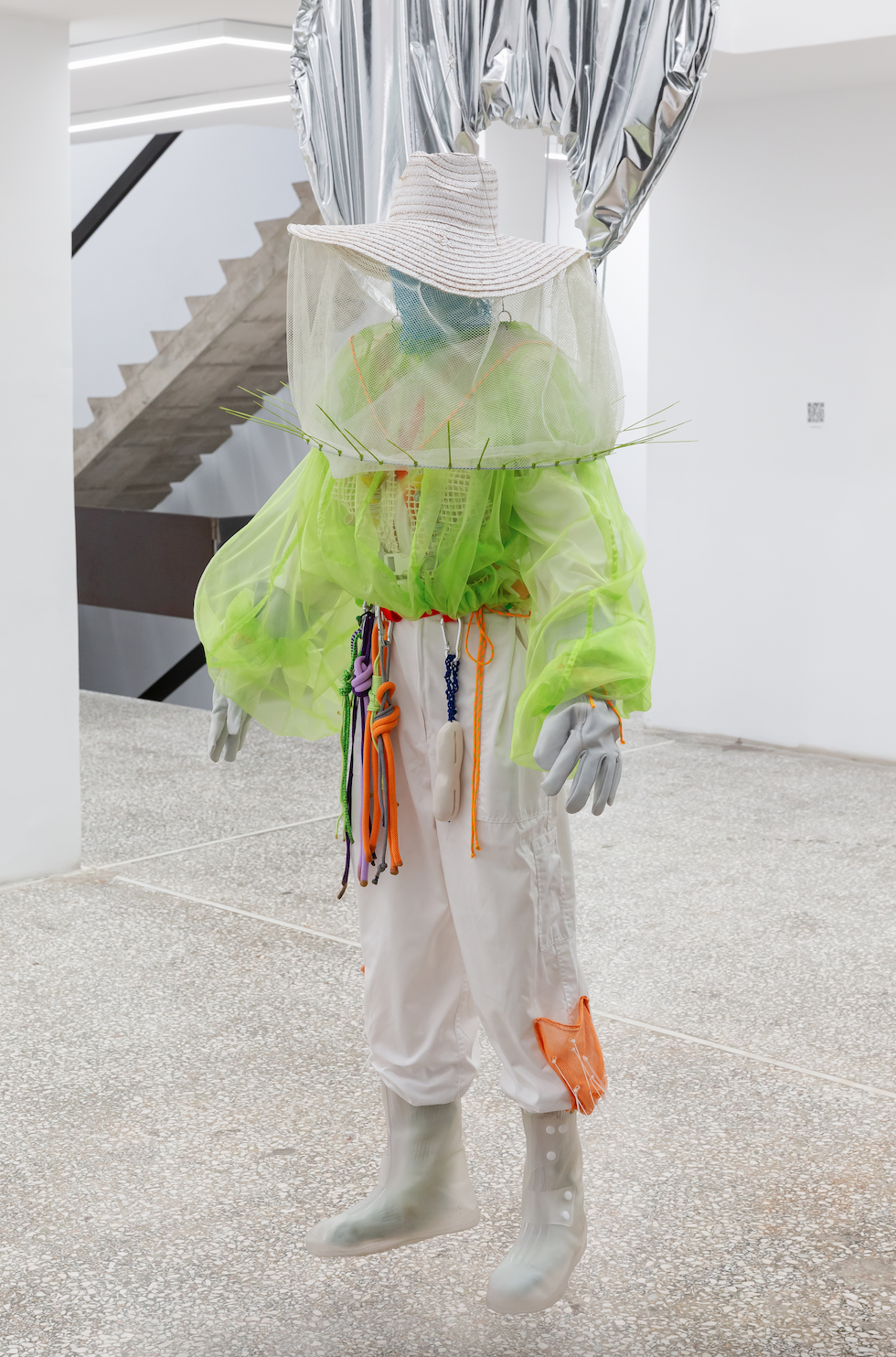
Central to this narrative is the figure of the Beeseeker, a protagonist dressed in a retro-futuristic,handcrafted shell suit, navigating an Aegean landscape depleted by mass tourism, drought, heat and environmental degradation. Drawing equally from science fiction aesthetics and rural ingenuity, the Beeseeker’s attire evokes both survival gear and ceremonial costume. Questions of orientation and relation whether socially, ethically or spatially, reoccur throughout the work, informed by the ways bees navigate through space, communicate within the swarm, and sustain collective life.
Bees are not treated solely as symbols, but as co-agents and knowledge-bearers. Goni’s work draws attention to the hive as a dynamic social formation, one in which innate systems of communication, movement, and collaboration exceed narrow ideas of efficiency and productivity also contributing to the collective emotional wellbeing of all members of the hive. These qualities surface across the installation, from embroidered banners tracing the geometry of bee dances to videos combining found headlines, artificial intelligence generated imagery, and field recordings of bee sounds. A portable shrine dedicated to the mythical bee goddess gathers materials such as beeswax, seeds, soil, and tools, activating the exhibition space through scent, sound, and ritual presence.
The title Telling the Bees refers to an old rural custom found in multiple cultures, in which people would inform bees of significant events like births, deaths and departures, believing that failure to do so could lead the bees to abandon their hive. In Goni’s work, this ritual becomes both a conceptual framework and an ethical proposition: an invitation to include nonhuman life within systems of meaning, mourning, and continuity. A woven basket known as a smarologos, gifted to the artist years ago on the island of Ikaria, functions as a core object within the installation. The smarologos acts as a carrier, vessel, and container of relations and recalls Ursula K. Le Guin’s Carrier Bag Theory of Fiction, proposing an alternative to heroic narratives in favor of stories structured around holding, gathering, and sustaining.
Telling the Bees (The Game), is a speculative, experimental video game currently in development by Goni as an evolving component of the project. Shaped by climate care and hope, it blends storytelling with ethnographic research and rural traditions. Set in a fictional archipelago marked by ecological collapse and overtourism, the game follows the Beeseeker as she searches for the last swarm of wild bees, believed to have vanished. The Beeseeker functions as the player’s guide and avatar, while her inventory becomes a key storytelling device. Through this inventory, we explore her equipment, talismans, and offerings, objects embedded with lore, actions, and emotional resonance. These include wildflower seeds intended for planting, ceramic vessels with water to hydrate bees, protective tools, and gestures such as buzzing or performing the bee waggle dance as a means of communication with nonhuman life. In this way, interaction unfolds through observation, attention, and care rather than progression or conquest.
Rejecting dominant gaming logics of extraction, competition, and violence, Telling the Bees (The Game) proposes an alternative understanding of play. As Goni notes, gameplay is built around acts of tenderness, reciprocity, and joy, reframing “winning” as the cultivation of multispecies flourishing. Its feminist orientation challenges normative assumptions within video game culture and positions the game as an open-ended, living system, one that privileges listening, kinship, and interdependence over resolution or mastery.
Across both installation and game, Telling the Bees speaks to the urgency of ecological collapse while resisting narratives of despair. Drawing on local knowledge from the Eastern Mediterranean and informed by broader scientific and cultural research, the exhibition proposes theorised futures grounded in care, ritual, and collective resilience. Rather than offering solutions, it creates a space for attunement, between humans and nonhumans, technology and tradition, loss and possibility.
Images courtesy of the artist and The Breeder Gallery, Athens.
Telling the Bees, a solo exhibition by Kyriaki Goni, that brings together a major multimedia installation and the presentation of the Beeseeker’s Character Inventory part of Telling the Bees (The Game), a speculative video game developed as part of the same evolving artistic universe. Rooted in field research, rural traditions, and feminist critical theory, such as Donna Haraways’ speculative fabulation, the exhibition unfolds as an immersive environment that moves between naturalistic precision and poetic worldbuilding, foregrounding questions of ecological collapse, interspecies communication, and collective care.
Telling the Bees is a multifaceted installation composed of video works, sculptural objects, drawings, notes, textiles, sound, and ritual artifacts. Time within the installation unfolds as non-linear, layering historical reference, lived experiences and imagined futures in a way that is reminiscent of spoken tradition. The viewer encounters a constellation of materials: offerings, tools, talismans and archival research which hold memories and echo the artist’s labor and creative process, suggesting an unfolding narrative rather than a fixed conclusion.
Central to this narrative is the figure of the Beeseeker, a protagonist dressed in a retro-futuristic,handcrafted shell suit, navigating an Aegean landscape depleted by mass tourism, drought, heat and environmental degradation. Drawing equally from science fiction aesthetics and rural ingenuity, the Beeseeker’s attire evokes both survival gear and ceremonial costume. Questions of orientation and relation whether socially, ethically or spatially, reoccur throughout the work, informed by the ways bees navigate through space, communicate within the swarm, and sustain collective life.
Bees are not treated solely as symbols, but as co-agents and knowledge-bearers. Goni’s work draws attention to the hive as a dynamic social formation, one in which innate systems of communication, movement, and collaboration exceed narrow ideas of efficiency and productivity also contributing to the collective emotional wellbeing of all members of the hive. These qualities surface across the installation, from embroidered banners tracing the geometry of bee dances to videos combining found headlines, artificial intelligence generated imagery, and field recordings of bee sounds. A portable shrine dedicated to the mythical bee goddess gathers materials such as beeswax, seeds, soil, and tools, activating the exhibition space through scent, sound, and ritual presence.
The title Telling the Bees refers to an old rural custom found in multiple cultures, in which people would inform bees of significant events like births, deaths and departures, believing that failure to do so could lead the bees to abandon their hive. In Goni’s work, this ritual becomes both a conceptual framework and an ethical proposition: an invitation to include nonhuman life within systems of meaning, mourning, and continuity. A woven basket known as a smarologos, gifted to the artist years ago on the island of Ikaria, functions as a core object within the installation. The smarologos acts as a carrier, vessel, and container of relations and recalls Ursula K. Le Guin’s Carrier Bag Theory of Fiction, proposing an alternative to heroic narratives in favor of stories structured around holding, gathering, and sustaining.
Telling the Bees (The Game), is a speculative, experimental video game currently in development by Goni as an evolving component of the project. Shaped by climate care and hope, it blends storytelling with ethnographic research and rural traditions. Set in a fictional archipelago marked by ecological collapse and overtourism, the game follows the Beeseeker as she searches for the last swarm of wild bees, believed to have vanished. The Beeseeker functions as the player’s guide and avatar, while her inventory becomes a key storytelling device. Through this inventory, we explore her equipment, talismans, and offerings, objects embedded with lore, actions, and emotional resonance. These include wildflower seeds intended for planting, ceramic vessels with water to hydrate bees, protective tools, and gestures such as buzzing or performing the bee waggle dance as a means of communication with nonhuman life. In this way, interaction unfolds through observation, attention, and care rather than progression or conquest.
Rejecting dominant gaming logics of extraction, competition, and violence, Telling the Bees (The Game) proposes an alternative understanding of play. As Goni notes, gameplay is built around acts of tenderness, reciprocity, and joy, reframing “winning” as the cultivation of multispecies flourishing. Its feminist orientation challenges normative assumptions within video game culture and positions the game as an open-ended, living system, one that privileges listening, kinship, and interdependence over resolution or mastery.
Across both installation and game, Telling the Bees speaks to the urgency of ecological collapse while resisting narratives of despair. Drawing on local knowledge from the Eastern Mediterranean and informed by broader scientific and cultural research, the exhibition proposes theorised futures grounded in care, ritual, and collective resilience. Rather than offering solutions, it creates a space for attunement, between humans and nonhumans, technology and tradition, loss and possibility.
Images courtesy of the artist and The Breeder Gallery, Athens.
Kyriaki Goni is an artist, who for ten years now engages with diverse media to explore the political, affective, and environmental dimensions of big tech. Her focus encompasses extractivism, surveillance, human and non-human relations, as well as alternative networks and infrastructures related to care and community. Employing websites, textiles, ceramics, drawings, videos, sound, and text, Goni's installations construct alternative ecosystems and shared experiences by bridging the local with the planetary and intertwining the fictional with the scientific.
Telling the Bees as a physical installation was initiated with a commission by curator Iliana Fokianaki for the exhibition “The One Straw Revolution” (Framer Framed, Amsterdam, 2024) and continued with a commission by curator Nadja Argyropoulou for the exhibition "the collective purr" (Nobel building, Athens, 2024). The concept of Telling the Bees (The Game) was developed within the framework of Onassis AiR and ONX Residency in 2024. A teaser of Telling the Bees (The Game) was presented at ONX winter exhibition in February 2025 in New York.
Telling the Bees solo exhibition at the Breeder in Athens took place January 22, 2026–February 21, 2026
.jpg)

.jpg)
.jpg)
.jpg)
.jpg)
.jpg)
.jpg)
BY KYRIAKI GONI
Telling the Bees, a solo exhibition by Kyriaki Goni, that brings together a major multimedia installation and the presentation of the Beeseeker’s Character Inventory part of Telling the Bees (The Game), a speculative video game developed as part of the same evolving artistic universe. Rooted in field research, rural traditions, and feminist critical theory, such as Donna Haraways’ speculative fabulation, the exhibition unfolds as an immersive environment that moves between naturalistic precision and poetic worldbuilding, foregrounding questions of ecological collapse, interspecies communication, and collective care.
Telling the Bees is a multifaceted installation composed of video works, sculptural objects, drawings, notes, textiles, sound, and ritual artifacts. Time within the installation unfolds as non-linear, layering historical reference, lived experiences and imagined futures in a way that is reminiscent of spoken tradition. The viewer encounters a constellation of materials: offerings, tools, talismans and archival research which hold memories and echo the artist’s labor and creative process, suggesting an unfolding narrative rather than a fixed conclusion.
Central to this narrative is the figure of the Beeseeker, a protagonist dressed in a retro-futuristic,handcrafted shell suit, navigating an Aegean landscape depleted by mass tourism, drought, heat and environmental degradation. Drawing equally from science fiction aesthetics and rural ingenuity, the Beeseeker’s attire evokes both survival gear and ceremonial costume. Questions of orientation and relation whether socially, ethically or spatially, reoccur throughout the work, informed by the ways bees navigate through space, communicate within the swarm, and sustain collective life.
Bees are not treated solely as symbols, but as co-agents and knowledge-bearers. Goni’s work draws attention to the hive as a dynamic social formation, one in which innate systems of communication, movement, and collaboration exceed narrow ideas of efficiency and productivity also contributing to the collective emotional wellbeing of all members of the hive. These qualities surface across the installation, from embroidered banners tracing the geometry of bee dances to videos combining found headlines, artificial intelligence generated imagery, and field recordings of bee sounds. A portable shrine dedicated to the mythical bee goddess gathers materials such as beeswax, seeds, soil, and tools, activating the exhibition space through scent, sound, and ritual presence.
The title Telling the Bees refers to an old rural custom found in multiple cultures, in which people would inform bees of significant events like births, deaths and departures, believing that failure to do so could lead the bees to abandon their hive. In Goni’s work, this ritual becomes both a conceptual framework and an ethical proposition: an invitation to include nonhuman life within systems of meaning, mourning, and continuity. A woven basket known as a smarologos, gifted to the artist years ago on the island of Ikaria, functions as a core object within the installation. The smarologos acts as a carrier, vessel, and container of relations and recalls Ursula K. Le Guin’s Carrier Bag Theory of Fiction, proposing an alternative to heroic narratives in favor of stories structured around holding, gathering, and sustaining.
Telling the Bees (The Game), is a speculative, experimental video game currently in development by Goni as an evolving component of the project. Shaped by climate care and hope, it blends storytelling with ethnographic research and rural traditions. Set in a fictional archipelago marked by ecological collapse and overtourism, the game follows the Beeseeker as she searches for the last swarm of wild bees, believed to have vanished. The Beeseeker functions as the player’s guide and avatar, while her inventory becomes a key storytelling device. Through this inventory, we explore her equipment, talismans, and offerings, objects embedded with lore, actions, and emotional resonance. These include wildflower seeds intended for planting, ceramic vessels with water to hydrate bees, protective tools, and gestures such as buzzing or performing the bee waggle dance as a means of communication with nonhuman life. In this way, interaction unfolds through observation, attention, and care rather than progression or conquest.
Rejecting dominant gaming logics of extraction, competition, and violence, Telling the Bees (The Game) proposes an alternative understanding of play. As Goni notes, gameplay is built around acts of tenderness, reciprocity, and joy, reframing “winning” as the cultivation of multispecies flourishing. Its feminist orientation challenges normative assumptions within video game culture and positions the game as an open-ended, living system, one that privileges listening, kinship, and interdependence over resolution or mastery.
Across both installation and game, Telling the Bees speaks to the urgency of ecological collapse while resisting narratives of despair. Drawing on local knowledge from the Eastern Mediterranean and informed by broader scientific and cultural research, the exhibition proposes theorised futures grounded in care, ritual, and collective resilience. Rather than offering solutions, it creates a space for attunement, between humans and nonhumans, technology and tradition, loss and possibility.
Images courtesy of the artist and The Breeder Gallery, Athens.
Telling the Bees, a solo exhibition by Kyriaki Goni, that brings together a major multimedia installation and the presentation of the Beeseeker’s Character Inventory part of Telling the Bees (The Game), a speculative video game developed as part of the same evolving artistic universe. Rooted in field research, rural traditions, and feminist critical theory, such as Donna Haraways’ speculative fabulation, the exhibition unfolds as an immersive environment that moves between naturalistic precision and poetic worldbuilding, foregrounding questions of ecological collapse, interspecies communication, and collective care.
Telling the Bees is a multifaceted installation composed of video works, sculptural objects, drawings, notes, textiles, sound, and ritual artifacts. Time within the installation unfolds as non-linear, layering historical reference, lived experiences and imagined futures in a way that is reminiscent of spoken tradition. The viewer encounters a constellation of materials: offerings, tools, talismans and archival research which hold memories and echo the artist’s labor and creative process, suggesting an unfolding narrative rather than a fixed conclusion.
Central to this narrative is the figure of the Beeseeker, a protagonist dressed in a retro-futuristic,handcrafted shell suit, navigating an Aegean landscape depleted by mass tourism, drought, heat and environmental degradation. Drawing equally from science fiction aesthetics and rural ingenuity, the Beeseeker’s attire evokes both survival gear and ceremonial costume. Questions of orientation and relation whether socially, ethically or spatially, reoccur throughout the work, informed by the ways bees navigate through space, communicate within the swarm, and sustain collective life.
Bees are not treated solely as symbols, but as co-agents and knowledge-bearers. Goni’s work draws attention to the hive as a dynamic social formation, one in which innate systems of communication, movement, and collaboration exceed narrow ideas of efficiency and productivity also contributing to the collective emotional wellbeing of all members of the hive. These qualities surface across the installation, from embroidered banners tracing the geometry of bee dances to videos combining found headlines, artificial intelligence generated imagery, and field recordings of bee sounds. A portable shrine dedicated to the mythical bee goddess gathers materials such as beeswax, seeds, soil, and tools, activating the exhibition space through scent, sound, and ritual presence.
The title Telling the Bees refers to an old rural custom found in multiple cultures, in which people would inform bees of significant events like births, deaths and departures, believing that failure to do so could lead the bees to abandon their hive. In Goni’s work, this ritual becomes both a conceptual framework and an ethical proposition: an invitation to include nonhuman life within systems of meaning, mourning, and continuity. A woven basket known as a smarologos, gifted to the artist years ago on the island of Ikaria, functions as a core object within the installation. The smarologos acts as a carrier, vessel, and container of relations and recalls Ursula K. Le Guin’s Carrier Bag Theory of Fiction, proposing an alternative to heroic narratives in favor of stories structured around holding, gathering, and sustaining.
Telling the Bees (The Game), is a speculative, experimental video game currently in development by Goni as an evolving component of the project. Shaped by climate care and hope, it blends storytelling with ethnographic research and rural traditions. Set in a fictional archipelago marked by ecological collapse and overtourism, the game follows the Beeseeker as she searches for the last swarm of wild bees, believed to have vanished. The Beeseeker functions as the player’s guide and avatar, while her inventory becomes a key storytelling device. Through this inventory, we explore her equipment, talismans, and offerings, objects embedded with lore, actions, and emotional resonance. These include wildflower seeds intended for planting, ceramic vessels with water to hydrate bees, protective tools, and gestures such as buzzing or performing the bee waggle dance as a means of communication with nonhuman life. In this way, interaction unfolds through observation, attention, and care rather than progression or conquest.
Rejecting dominant gaming logics of extraction, competition, and violence, Telling the Bees (The Game) proposes an alternative understanding of play. As Goni notes, gameplay is built around acts of tenderness, reciprocity, and joy, reframing “winning” as the cultivation of multispecies flourishing. Its feminist orientation challenges normative assumptions within video game culture and positions the game as an open-ended, living system, one that privileges listening, kinship, and interdependence over resolution or mastery.
Across both installation and game, Telling the Bees speaks to the urgency of ecological collapse while resisting narratives of despair. Drawing on local knowledge from the Eastern Mediterranean and informed by broader scientific and cultural research, the exhibition proposes theorised futures grounded in care, ritual, and collective resilience. Rather than offering solutions, it creates a space for attunement, between humans and nonhumans, technology and tradition, loss and possibility.
Images courtesy of the artist and The Breeder Gallery, Athens.
Kyriaki Goni is an artist, who for ten years now engages with diverse media to explore the political, affective, and environmental dimensions of big tech. Her focus encompasses extractivism, surveillance, human and non-human relations, as well as alternative networks and infrastructures related to care and community. Employing websites, textiles, ceramics, drawings, videos, sound, and text, Goni's installations construct alternative ecosystems and shared experiences by bridging the local with the planetary and intertwining the fictional with the scientific.
Telling the Bees as a physical installation was initiated with a commission by curator Iliana Fokianaki for the exhibition “The One Straw Revolution” (Framer Framed, Amsterdam, 2024) and continued with a commission by curator Nadja Argyropoulou for the exhibition "the collective purr" (Nobel building, Athens, 2024). The concept of Telling the Bees (The Game) was developed within the framework of Onassis AiR and ONX Residency in 2024. A teaser of Telling the Bees (The Game) was presented at ONX winter exhibition in February 2025 in New York.
Telling the Bees solo exhibition at the Breeder in Athens took place January 22, 2026–February 21, 2026
BY KYRIAKI GONI
Telling the Bees, a solo exhibition by Kyriaki Goni, that brings together a major multimedia installation and the presentation of the Beeseeker’s Character Inventory part of Telling the Bees (The Game), a speculative video game developed as part of the same evolving artistic universe. Rooted in field research, rural traditions, and feminist critical theory, such as Donna Haraways’ speculative fabulation, the exhibition unfolds as an immersive environment that moves between naturalistic precision and poetic worldbuilding, foregrounding questions of ecological collapse, interspecies communication, and collective care.
Telling the Bees is a multifaceted installation composed of video works, sculptural objects, drawings, notes, textiles, sound, and ritual artifacts. Time within the installation unfolds as non-linear, layering historical reference, lived experiences and imagined futures in a way that is reminiscent of spoken tradition. The viewer encounters a constellation of materials: offerings, tools, talismans and archival research which hold memories and echo the artist’s labor and creative process, suggesting an unfolding narrative rather than a fixed conclusion.
Central to this narrative is the figure of the Beeseeker, a protagonist dressed in a retro-futuristic,handcrafted shell suit, navigating an Aegean landscape depleted by mass tourism, drought, heat and environmental degradation. Drawing equally from science fiction aesthetics and rural ingenuity, the Beeseeker’s attire evokes both survival gear and ceremonial costume. Questions of orientation and relation whether socially, ethically or spatially, reoccur throughout the work, informed by the ways bees navigate through space, communicate within the swarm, and sustain collective life.
Bees are not treated solely as symbols, but as co-agents and knowledge-bearers. Goni’s work draws attention to the hive as a dynamic social formation, one in which innate systems of communication, movement, and collaboration exceed narrow ideas of efficiency and productivity also contributing to the collective emotional wellbeing of all members of the hive. These qualities surface across the installation, from embroidered banners tracing the geometry of bee dances to videos combining found headlines, artificial intelligence generated imagery, and field recordings of bee sounds. A portable shrine dedicated to the mythical bee goddess gathers materials such as beeswax, seeds, soil, and tools, activating the exhibition space through scent, sound, and ritual presence.
The title Telling the Bees refers to an old rural custom found in multiple cultures, in which people would inform bees of significant events like births, deaths and departures, believing that failure to do so could lead the bees to abandon their hive. In Goni’s work, this ritual becomes both a conceptual framework and an ethical proposition: an invitation to include nonhuman life within systems of meaning, mourning, and continuity. A woven basket known as a smarologos, gifted to the artist years ago on the island of Ikaria, functions as a core object within the installation. The smarologos acts as a carrier, vessel, and container of relations and recalls Ursula K. Le Guin’s Carrier Bag Theory of Fiction, proposing an alternative to heroic narratives in favor of stories structured around holding, gathering, and sustaining.
Telling the Bees (The Game), is a speculative, experimental video game currently in development by Goni as an evolving component of the project. Shaped by climate care and hope, it blends storytelling with ethnographic research and rural traditions. Set in a fictional archipelago marked by ecological collapse and overtourism, the game follows the Beeseeker as she searches for the last swarm of wild bees, believed to have vanished. The Beeseeker functions as the player’s guide and avatar, while her inventory becomes a key storytelling device. Through this inventory, we explore her equipment, talismans, and offerings, objects embedded with lore, actions, and emotional resonance. These include wildflower seeds intended for planting, ceramic vessels with water to hydrate bees, protective tools, and gestures such as buzzing or performing the bee waggle dance as a means of communication with nonhuman life. In this way, interaction unfolds through observation, attention, and care rather than progression or conquest.
Rejecting dominant gaming logics of extraction, competition, and violence, Telling the Bees (The Game) proposes an alternative understanding of play. As Goni notes, gameplay is built around acts of tenderness, reciprocity, and joy, reframing “winning” as the cultivation of multispecies flourishing. Its feminist orientation challenges normative assumptions within video game culture and positions the game as an open-ended, living system, one that privileges listening, kinship, and interdependence over resolution or mastery.
Across both installation and game, Telling the Bees speaks to the urgency of ecological collapse while resisting narratives of despair. Drawing on local knowledge from the Eastern Mediterranean and informed by broader scientific and cultural research, the exhibition proposes theorised futures grounded in care, ritual, and collective resilience. Rather than offering solutions, it creates a space for attunement, between humans and nonhumans, technology and tradition, loss and possibility.
Images courtesy of the artist and The Breeder Gallery, Athens.
Telling the Bees, a solo exhibition by Kyriaki Goni, that brings together a major multimedia installation and the presentation of the Beeseeker’s Character Inventory part of Telling the Bees (The Game), a speculative video game developed as part of the same evolving artistic universe. Rooted in field research, rural traditions, and feminist critical theory, such as Donna Haraways’ speculative fabulation, the exhibition unfolds as an immersive environment that moves between naturalistic precision and poetic worldbuilding, foregrounding questions of ecological collapse, interspecies communication, and collective care.
Telling the Bees is a multifaceted installation composed of video works, sculptural objects, drawings, notes, textiles, sound, and ritual artifacts. Time within the installation unfolds as non-linear, layering historical reference, lived experiences and imagined futures in a way that is reminiscent of spoken tradition. The viewer encounters a constellation of materials: offerings, tools, talismans and archival research which hold memories and echo the artist’s labor and creative process, suggesting an unfolding narrative rather than a fixed conclusion.
Central to this narrative is the figure of the Beeseeker, a protagonist dressed in a retro-futuristic,handcrafted shell suit, navigating an Aegean landscape depleted by mass tourism, drought, heat and environmental degradation. Drawing equally from science fiction aesthetics and rural ingenuity, the Beeseeker’s attire evokes both survival gear and ceremonial costume. Questions of orientation and relation whether socially, ethically or spatially, reoccur throughout the work, informed by the ways bees navigate through space, communicate within the swarm, and sustain collective life.
Bees are not treated solely as symbols, but as co-agents and knowledge-bearers. Goni’s work draws attention to the hive as a dynamic social formation, one in which innate systems of communication, movement, and collaboration exceed narrow ideas of efficiency and productivity also contributing to the collective emotional wellbeing of all members of the hive. These qualities surface across the installation, from embroidered banners tracing the geometry of bee dances to videos combining found headlines, artificial intelligence generated imagery, and field recordings of bee sounds. A portable shrine dedicated to the mythical bee goddess gathers materials such as beeswax, seeds, soil, and tools, activating the exhibition space through scent, sound, and ritual presence.
The title Telling the Bees refers to an old rural custom found in multiple cultures, in which people would inform bees of significant events like births, deaths and departures, believing that failure to do so could lead the bees to abandon their hive. In Goni’s work, this ritual becomes both a conceptual framework and an ethical proposition: an invitation to include nonhuman life within systems of meaning, mourning, and continuity. A woven basket known as a smarologos, gifted to the artist years ago on the island of Ikaria, functions as a core object within the installation. The smarologos acts as a carrier, vessel, and container of relations and recalls Ursula K. Le Guin’s Carrier Bag Theory of Fiction, proposing an alternative to heroic narratives in favor of stories structured around holding, gathering, and sustaining.
Telling the Bees (The Game), is a speculative, experimental video game currently in development by Goni as an evolving component of the project. Shaped by climate care and hope, it blends storytelling with ethnographic research and rural traditions. Set in a fictional archipelago marked by ecological collapse and overtourism, the game follows the Beeseeker as she searches for the last swarm of wild bees, believed to have vanished. The Beeseeker functions as the player’s guide and avatar, while her inventory becomes a key storytelling device. Through this inventory, we explore her equipment, talismans, and offerings, objects embedded with lore, actions, and emotional resonance. These include wildflower seeds intended for planting, ceramic vessels with water to hydrate bees, protective tools, and gestures such as buzzing or performing the bee waggle dance as a means of communication with nonhuman life. In this way, interaction unfolds through observation, attention, and care rather than progression or conquest.
Rejecting dominant gaming logics of extraction, competition, and violence, Telling the Bees (The Game) proposes an alternative understanding of play. As Goni notes, gameplay is built around acts of tenderness, reciprocity, and joy, reframing “winning” as the cultivation of multispecies flourishing. Its feminist orientation challenges normative assumptions within video game culture and positions the game as an open-ended, living system, one that privileges listening, kinship, and interdependence over resolution or mastery.
Across both installation and game, Telling the Bees speaks to the urgency of ecological collapse while resisting narratives of despair. Drawing on local knowledge from the Eastern Mediterranean and informed by broader scientific and cultural research, the exhibition proposes theorised futures grounded in care, ritual, and collective resilience. Rather than offering solutions, it creates a space for attunement, between humans and nonhumans, technology and tradition, loss and possibility.
Images courtesy of the artist and The Breeder Gallery, Athens.
Kyriaki Goni is an artist, who for ten years now engages with diverse media to explore the political, affective, and environmental dimensions of big tech. Her focus encompasses extractivism, surveillance, human and non-human relations, as well as alternative networks and infrastructures related to care and community. Employing websites, textiles, ceramics, drawings, videos, sound, and text, Goni's installations construct alternative ecosystems and shared experiences by bridging the local with the planetary and intertwining the fictional with the scientific.
Telling the Bees as a physical installation was initiated with a commission by curator Iliana Fokianaki for the exhibition “The One Straw Revolution” (Framer Framed, Amsterdam, 2024) and continued with a commission by curator Nadja Argyropoulou for the exhibition "the collective purr" (Nobel building, Athens, 2024). The concept of Telling the Bees (The Game) was developed within the framework of Onassis AiR and ONX Residency in 2024. A teaser of Telling the Bees (The Game) was presented at ONX winter exhibition in February 2025 in New York.
Telling the Bees solo exhibition at the Breeder in Athens took place January 22, 2026–February 21, 2026
BY KYRIAKI GONI
Telling the Bees, a solo exhibition by Kyriaki Goni, that brings together a major multimedia installation and the presentation of the Beeseeker’s Character Inventory part of Telling the Bees (The Game), a speculative video game developed as part of the same evolving artistic universe. Rooted in field research, rural traditions, and feminist critical theory, such as Donna Haraways’ speculative fabulation, the exhibition unfolds as an immersive environment that moves between naturalistic precision and poetic worldbuilding, foregrounding questions of ecological collapse, interspecies communication, and collective care.
Telling the Bees is a multifaceted installation composed of video works, sculptural objects, drawings, notes, textiles, sound, and ritual artifacts. Time within the installation unfolds as non-linear, layering historical reference, lived experiences and imagined futures in a way that is reminiscent of spoken tradition. The viewer encounters a constellation of materials: offerings, tools, talismans and archival research which hold memories and echo the artist’s labor and creative process, suggesting an unfolding narrative rather than a fixed conclusion.
Central to this narrative is the figure of the Beeseeker, a protagonist dressed in a retro-futuristic,handcrafted shell suit, navigating an Aegean landscape depleted by mass tourism, drought, heat and environmental degradation. Drawing equally from science fiction aesthetics and rural ingenuity, the Beeseeker’s attire evokes both survival gear and ceremonial costume. Questions of orientation and relation whether socially, ethically or spatially, reoccur throughout the work, informed by the ways bees navigate through space, communicate within the swarm, and sustain collective life.
Bees are not treated solely as symbols, but as co-agents and knowledge-bearers. Goni’s work draws attention to the hive as a dynamic social formation, one in which innate systems of communication, movement, and collaboration exceed narrow ideas of efficiency and productivity also contributing to the collective emotional wellbeing of all members of the hive. These qualities surface across the installation, from embroidered banners tracing the geometry of bee dances to videos combining found headlines, artificial intelligence generated imagery, and field recordings of bee sounds. A portable shrine dedicated to the mythical bee goddess gathers materials such as beeswax, seeds, soil, and tools, activating the exhibition space through scent, sound, and ritual presence.
The title Telling the Bees refers to an old rural custom found in multiple cultures, in which people would inform bees of significant events like births, deaths and departures, believing that failure to do so could lead the bees to abandon their hive. In Goni’s work, this ritual becomes both a conceptual framework and an ethical proposition: an invitation to include nonhuman life within systems of meaning, mourning, and continuity. A woven basket known as a smarologos, gifted to the artist years ago on the island of Ikaria, functions as a core object within the installation. The smarologos acts as a carrier, vessel, and container of relations and recalls Ursula K. Le Guin’s Carrier Bag Theory of Fiction, proposing an alternative to heroic narratives in favor of stories structured around holding, gathering, and sustaining.
Telling the Bees (The Game), is a speculative, experimental video game currently in development by Goni as an evolving component of the project. Shaped by climate care and hope, it blends storytelling with ethnographic research and rural traditions. Set in a fictional archipelago marked by ecological collapse and overtourism, the game follows the Beeseeker as she searches for the last swarm of wild bees, believed to have vanished. The Beeseeker functions as the player’s guide and avatar, while her inventory becomes a key storytelling device. Through this inventory, we explore her equipment, talismans, and offerings, objects embedded with lore, actions, and emotional resonance. These include wildflower seeds intended for planting, ceramic vessels with water to hydrate bees, protective tools, and gestures such as buzzing or performing the bee waggle dance as a means of communication with nonhuman life. In this way, interaction unfolds through observation, attention, and care rather than progression or conquest.
Rejecting dominant gaming logics of extraction, competition, and violence, Telling the Bees (The Game) proposes an alternative understanding of play. As Goni notes, gameplay is built around acts of tenderness, reciprocity, and joy, reframing “winning” as the cultivation of multispecies flourishing. Its feminist orientation challenges normative assumptions within video game culture and positions the game as an open-ended, living system, one that privileges listening, kinship, and interdependence over resolution or mastery.
Across both installation and game, Telling the Bees speaks to the urgency of ecological collapse while resisting narratives of despair. Drawing on local knowledge from the Eastern Mediterranean and informed by broader scientific and cultural research, the exhibition proposes theorised futures grounded in care, ritual, and collective resilience. Rather than offering solutions, it creates a space for attunement, between humans and nonhumans, technology and tradition, loss and possibility.
Images courtesy of the artist and The Breeder Gallery, Athens.
Telling the Bees, a solo exhibition by Kyriaki Goni, that brings together a major multimedia installation and the presentation of the Beeseeker’s Character Inventory part of Telling the Bees (The Game), a speculative video game developed as part of the same evolving artistic universe. Rooted in field research, rural traditions, and feminist critical theory, such as Donna Haraways’ speculative fabulation, the exhibition unfolds as an immersive environment that moves between naturalistic precision and poetic worldbuilding, foregrounding questions of ecological collapse, interspecies communication, and collective care.
Telling the Bees is a multifaceted installation composed of video works, sculptural objects, drawings, notes, textiles, sound, and ritual artifacts. Time within the installation unfolds as non-linear, layering historical reference, lived experiences and imagined futures in a way that is reminiscent of spoken tradition. The viewer encounters a constellation of materials: offerings, tools, talismans and archival research which hold memories and echo the artist’s labor and creative process, suggesting an unfolding narrative rather than a fixed conclusion.
Central to this narrative is the figure of the Beeseeker, a protagonist dressed in a retro-futuristic,handcrafted shell suit, navigating an Aegean landscape depleted by mass tourism, drought, heat and environmental degradation. Drawing equally from science fiction aesthetics and rural ingenuity, the Beeseeker’s attire evokes both survival gear and ceremonial costume. Questions of orientation and relation whether socially, ethically or spatially, reoccur throughout the work, informed by the ways bees navigate through space, communicate within the swarm, and sustain collective life.
Bees are not treated solely as symbols, but as co-agents and knowledge-bearers. Goni’s work draws attention to the hive as a dynamic social formation, one in which innate systems of communication, movement, and collaboration exceed narrow ideas of efficiency and productivity also contributing to the collective emotional wellbeing of all members of the hive. These qualities surface across the installation, from embroidered banners tracing the geometry of bee dances to videos combining found headlines, artificial intelligence generated imagery, and field recordings of bee sounds. A portable shrine dedicated to the mythical bee goddess gathers materials such as beeswax, seeds, soil, and tools, activating the exhibition space through scent, sound, and ritual presence.
The title Telling the Bees refers to an old rural custom found in multiple cultures, in which people would inform bees of significant events like births, deaths and departures, believing that failure to do so could lead the bees to abandon their hive. In Goni’s work, this ritual becomes both a conceptual framework and an ethical proposition: an invitation to include nonhuman life within systems of meaning, mourning, and continuity. A woven basket known as a smarologos, gifted to the artist years ago on the island of Ikaria, functions as a core object within the installation. The smarologos acts as a carrier, vessel, and container of relations and recalls Ursula K. Le Guin’s Carrier Bag Theory of Fiction, proposing an alternative to heroic narratives in favor of stories structured around holding, gathering, and sustaining.
Telling the Bees (The Game), is a speculative, experimental video game currently in development by Goni as an evolving component of the project. Shaped by climate care and hope, it blends storytelling with ethnographic research and rural traditions. Set in a fictional archipelago marked by ecological collapse and overtourism, the game follows the Beeseeker as she searches for the last swarm of wild bees, believed to have vanished. The Beeseeker functions as the player’s guide and avatar, while her inventory becomes a key storytelling device. Through this inventory, we explore her equipment, talismans, and offerings, objects embedded with lore, actions, and emotional resonance. These include wildflower seeds intended for planting, ceramic vessels with water to hydrate bees, protective tools, and gestures such as buzzing or performing the bee waggle dance as a means of communication with nonhuman life. In this way, interaction unfolds through observation, attention, and care rather than progression or conquest.
Rejecting dominant gaming logics of extraction, competition, and violence, Telling the Bees (The Game) proposes an alternative understanding of play. As Goni notes, gameplay is built around acts of tenderness, reciprocity, and joy, reframing “winning” as the cultivation of multispecies flourishing. Its feminist orientation challenges normative assumptions within video game culture and positions the game as an open-ended, living system, one that privileges listening, kinship, and interdependence over resolution or mastery.
Across both installation and game, Telling the Bees speaks to the urgency of ecological collapse while resisting narratives of despair. Drawing on local knowledge from the Eastern Mediterranean and informed by broader scientific and cultural research, the exhibition proposes theorised futures grounded in care, ritual, and collective resilience. Rather than offering solutions, it creates a space for attunement, between humans and nonhumans, technology and tradition, loss and possibility.
Images courtesy of the artist and The Breeder Gallery, Athens.
Kyriaki Goni is an artist, who for ten years now engages with diverse media to explore the political, affective, and environmental dimensions of big tech. Her focus encompasses extractivism, surveillance, human and non-human relations, as well as alternative networks and infrastructures related to care and community. Employing websites, textiles, ceramics, drawings, videos, sound, and text, Goni's installations construct alternative ecosystems and shared experiences by bridging the local with the planetary and intertwining the fictional with the scientific.
Telling the Bees as a physical installation was initiated with a commission by curator Iliana Fokianaki for the exhibition “The One Straw Revolution” (Framer Framed, Amsterdam, 2024) and continued with a commission by curator Nadja Argyropoulou for the exhibition "the collective purr" (Nobel building, Athens, 2024). The concept of Telling the Bees (The Game) was developed within the framework of Onassis AiR and ONX Residency in 2024. A teaser of Telling the Bees (The Game) was presented at ONX winter exhibition in February 2025 in New York.
Telling the Bees solo exhibition at the Breeder in Athens took place January 22, 2026–February 21, 2026