BY CHANTAL POWELL
Fruits of My Woman is an exhibition inspired by the short story The Fruit of My Woman by Han Kang in which a woman gradually transitions into plant life. The story uses vegetal transformation as a potent metaphor for resistance and the longing to move beyond the confines of domesticity and social expectation.
Taking this literary starting point, the exhibition explores transformation as an inner necessity: a quiet rebellion, a rewilding of the self, and a gradual opening towards other ways of being.
Han Kang’s protagonist dreams of growing “as tall as a poplar”, of pushing through walls, of exceeding the limits of her given form. These desires form a conceptual thread through the exhibition, offering a way to think about metamorphosis as a radical psychic act: a turning away from systems that constrict, and towards elemental forces that nourish.
The exhibition brings together artworks that move across thresholds between self and environment, tracing liminal and transformative states. Across painting, sculpture, drawing, collage and film, the boundaries between human and vegetal life become porous. Bodies, vessels, plants and landscapes appear layered and in flux, suggesting ways of growing beyond inherited shapes and into other relations with the natural world. Some forms are assembled, spliced or recomposed. Change emerges not as a single image but as something slow, strange and unfolding.
Set within the landscape of Lower Hewood Farm, the exhibition is grounded in a place where land, care and ecology are already central. The farm’s slow cycles, its attention to plant life and its sense of retreat and recalibration all echo the themes of the exhibition. Here, vegetal transformation is not metaphor alone but something felt in the damp soil, the changing light and the sense that growth happens whether witnessed or not.
The artworks move from the intimate interior of the farmhouse to the darker, more elemental atmosphere of the barn, echoing the story’s shift from domestic constraint towards another mode of being. The surrounding landscape becomes a silent collaborator: a continual reminder of the quiet intelligence of plants, their resilience, and their capacity to grow in unexpected directions.
FEATURING:
SIMON BAYLISS
FRANCISCO BORES
JOHN CRAXTON
ADAM CVIJANOVIC
MARLENE DUMAS
NINA ROYLE
JANE HAYES GREENWOOD
HANNAH HUGHES
EVY JOKHOVA
GUNNER LA COUR
SHANA MOULTON
AIMÉE PARROTT
CHANTAL POWELL
LUCY STEIN
DAFNA TALMOR
MARIANNE WALKER
SHELAGH WAKELY
ON HAN KANG'S THE FRUIT OF MY WOMAN
“Mother, I keep having the same dream. I dream that I’m growing tall as a poplar.”
Han Kang’s short story The Fruit of My Woman (1997) begins within a constrained domestic world, where estrangement and the pressures of conventional life close in around a woman. Narrated at first through the husband’s impatient and emotionally limited perspective, the story opens into something strange and uncanny as he notices bruises appear and spread across her body. They darken, green, and gradually give way to a metamorphosis that is at once disturbing and strangely beautiful. Her transformation is a form of radical resistance and her vegetal becoming alters the possibilities of relation: as the woman changes, the husband begins belatedly to care for and tend to her in ways he had failed to before.
“I bent forwards into the embrace of those camellia-petal hands. ‘Are you okay?’ I asked. Her eyes, a pair of well-ripened grapes; glimmering on their lacquered surfaces, the ghost of a smile”
As winter approaches, her new plant form withers, and the story ends with her disgorging tiny, seed-like fruits which her husband both ingests and plants in a dozen round plant pots filled with fertile soil.
In the context of Lower Hewood Farm, that movement into relational connection and tending has a particular resonance. Here, the story’s imagery of growth and eventual fruiting is held close to the material presence of plant life, soil and seasonal change. The story suggests not only a breaking free from a constricted life, but also that plant life might offer another model of relation altogether: one grounded in care, permeability, interdependence and attention.
Written by the Korean author Han Kang, a translation of the story into English by Deborah Smith can be read here.
ABOUT THE CURATOR
Chantal Powell is an artist based in West Dorset whose practice brings together making, research and the exploration of symbolic material through talks and curatorial projects. Informed by Jungian psychology and alchemical symbolism, she has a particular interest in archetypal imagery and the unconscious. Her recent work has increasingly focused on what she describes as vegetal alchemy, using vegetal life as a way of thinking about embodied transformation.
Chantal is also the founder of Hogchester Arts, a contemporary arts residency programme, and host of The Red Book Club, an international online book club and speaker programme focused on depth psychology, art and the imagination.
Invited to respond to Lower Hewood Farm in the context of the Survival Library, Chantal saw an opportunity to bring together literature, symbolic inquiry and the vegetal life of the land.
Han Kang’s short story The Fruit of My Woman offered a starting point that connected her longstanding interest in transformation and psychic life with questions of embodiment, ecology and the imaginative force of books.
ABOUT LOWER HEWOOD FARM
Lower Hewood is a small organic farm on the Dorset, Devon and Somerset borders where food growing, ecological practice, cultural activity and community life come together. Alongside its farming and market garden work, it hosts workshops, events and artistic projects, creating a setting in which land-based knowledge, creativity and shared inquiry can meet.
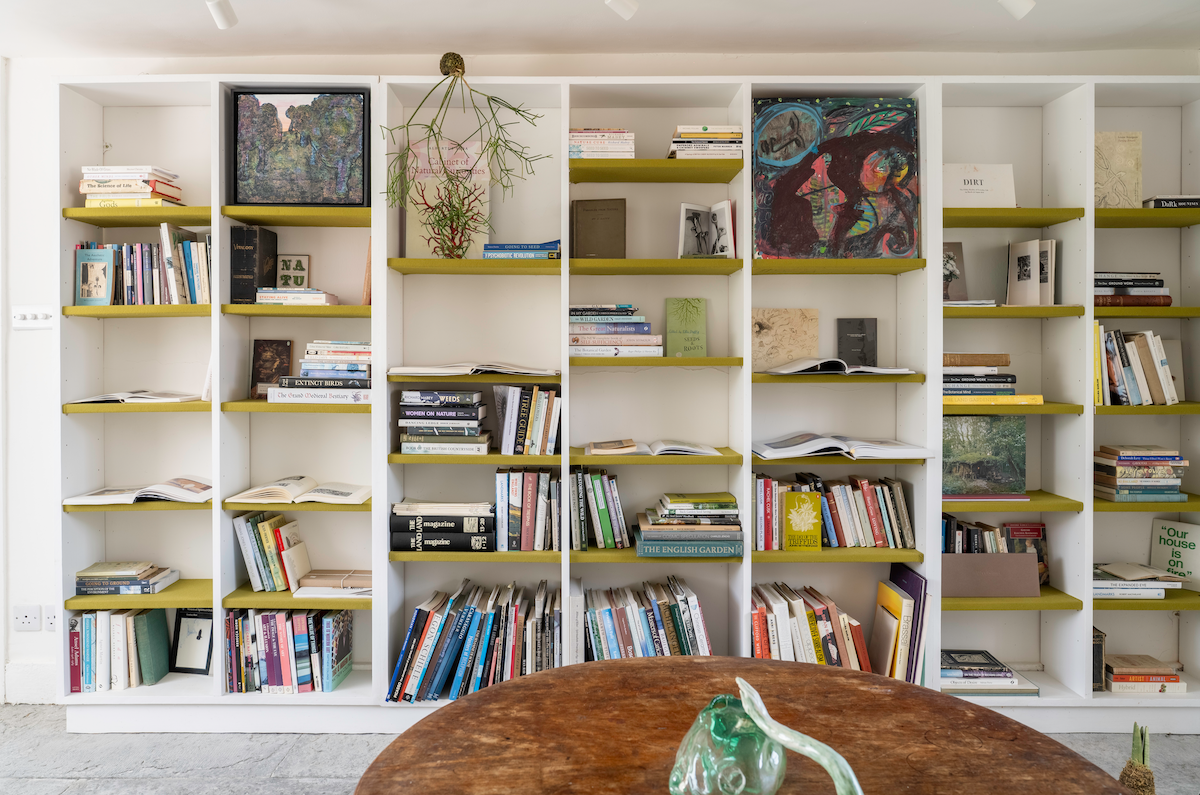
At the heart of the farm is the Survival Library, a reading room and research space developed around the relationship between creative practice and agroecology. Its collection includes artist books, exhibition catalogues, psychoanalytic texts, poetry, self-sufficiency manuals, environmental philosophy, local history publications and farming books, reflecting the farm’s commitment to interdisciplinary thinking.
Owned by Alexa de Ferranti, Lower Hewood Farm is currently stewarded by Tim Williams and Claire Hannington-Williams, who oversee its regenerative farming and growing activities. Tim’s work focuses on soil, plants and resilient farming systems, while Claire brings together growing, design and seasonal practice through an approach shaped by both ecology and aesthetics.
In response to the exhibition and the Korean origin of Han Kang's story Tim propagated indigenous micro-organisms based on natural farming methods from Korea mirroring the biological processes on the farm. Claire created the living plant elements in the library space using a technique inspired by kokedama in which plant roots are contained by hand-made balls of soil and moss.
Exhibition photographs by Rob Coombe.
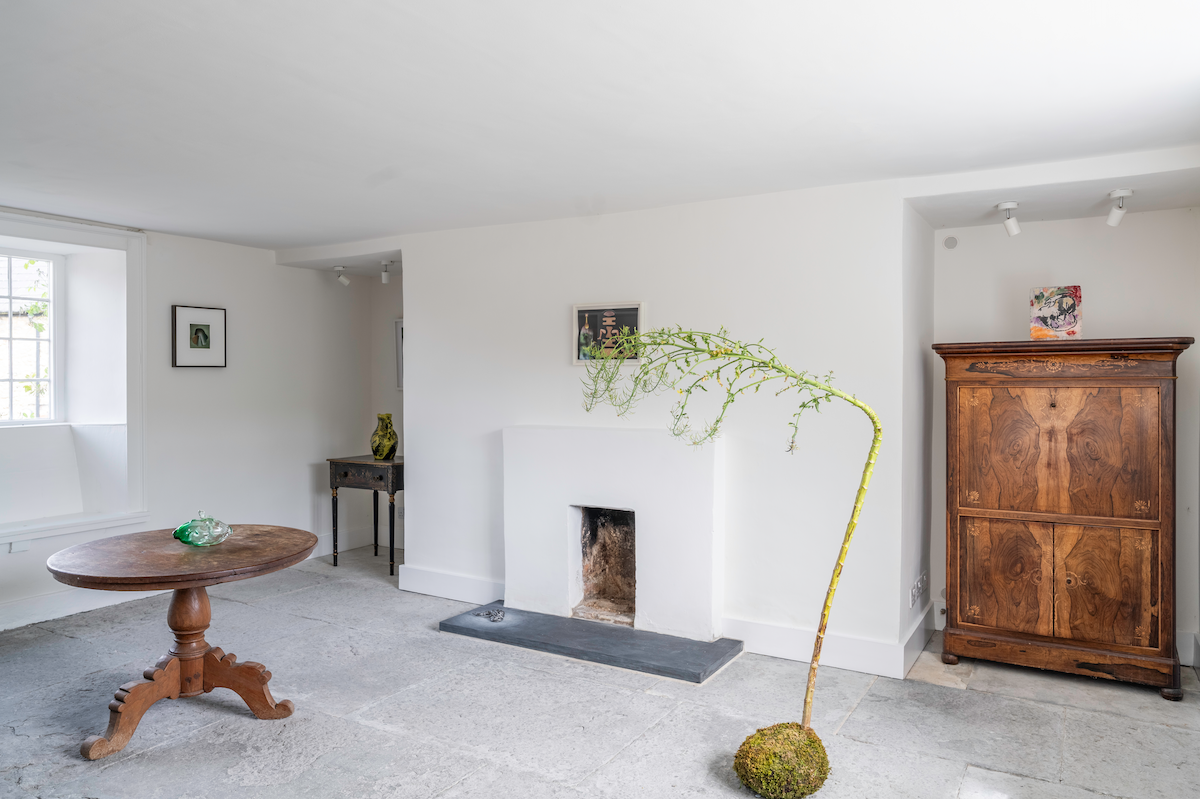
Image 1. L-R
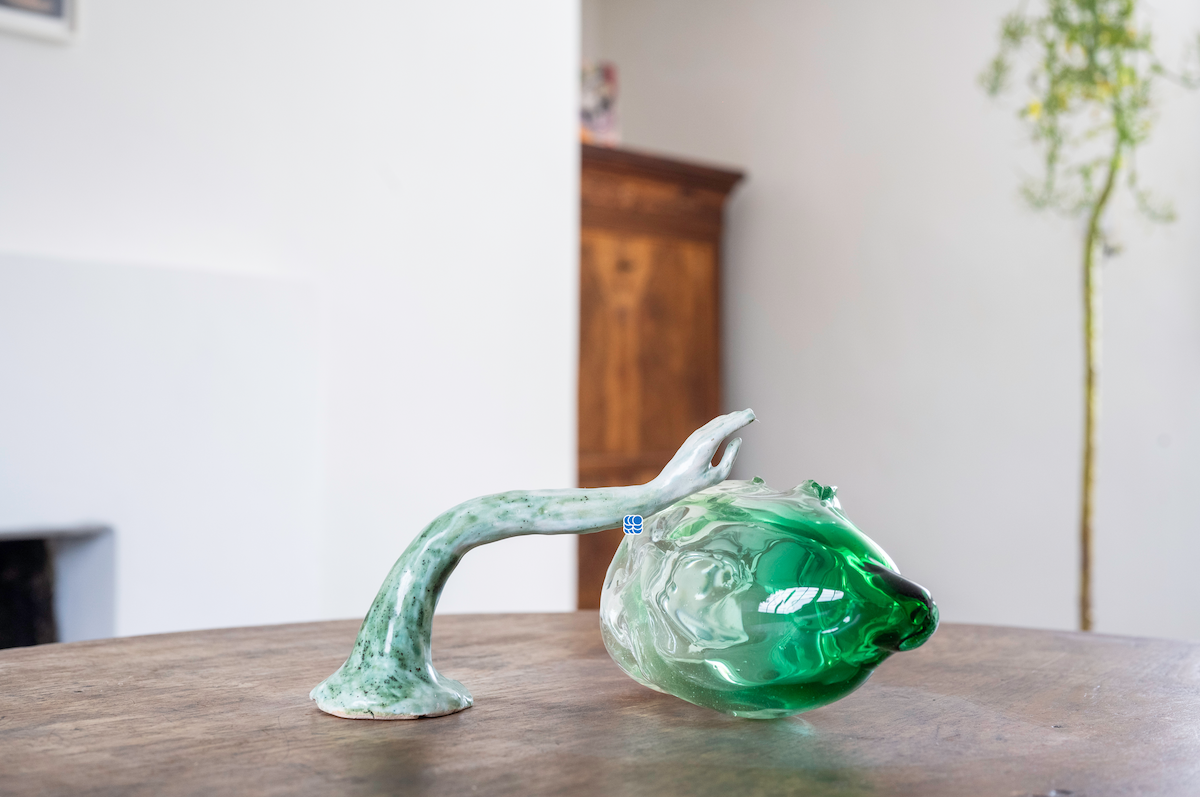
Chantal Powell, Divine Germ, 2024. Blown glass & glazed ceramic
Hannah Hughes, Pendulum, 2022. Unique collage, archival pigmented papers
Simon Bayliss, Jug(Transcendent Function), 2021. Single-fired terracotta, coloured slips, oxides, clear glaze
Marianne Walker, awrithe, 2021. Graphite on paper clay
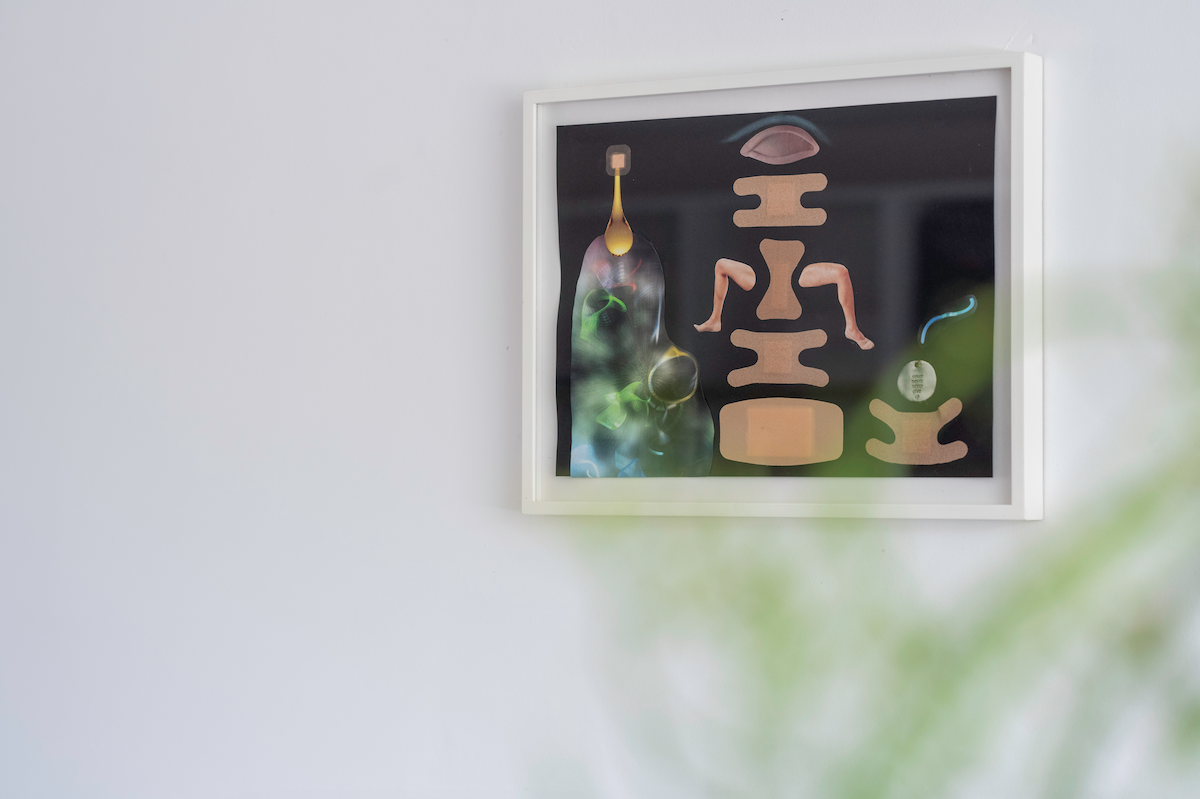
Shana Moulton, never never never give up, 2014. Collage on paper
Nina Royle, A Snake Birthing Permutations 2020,. Ink, watercolour and oil on a shaped wood and gesso panel
Image 2. L-R
Gunner la Cour, Dreams of Eskilstrup Orchard VI, 2006. Acrylic on board
Lucy Stein, Untitled, 2021. Oil on board
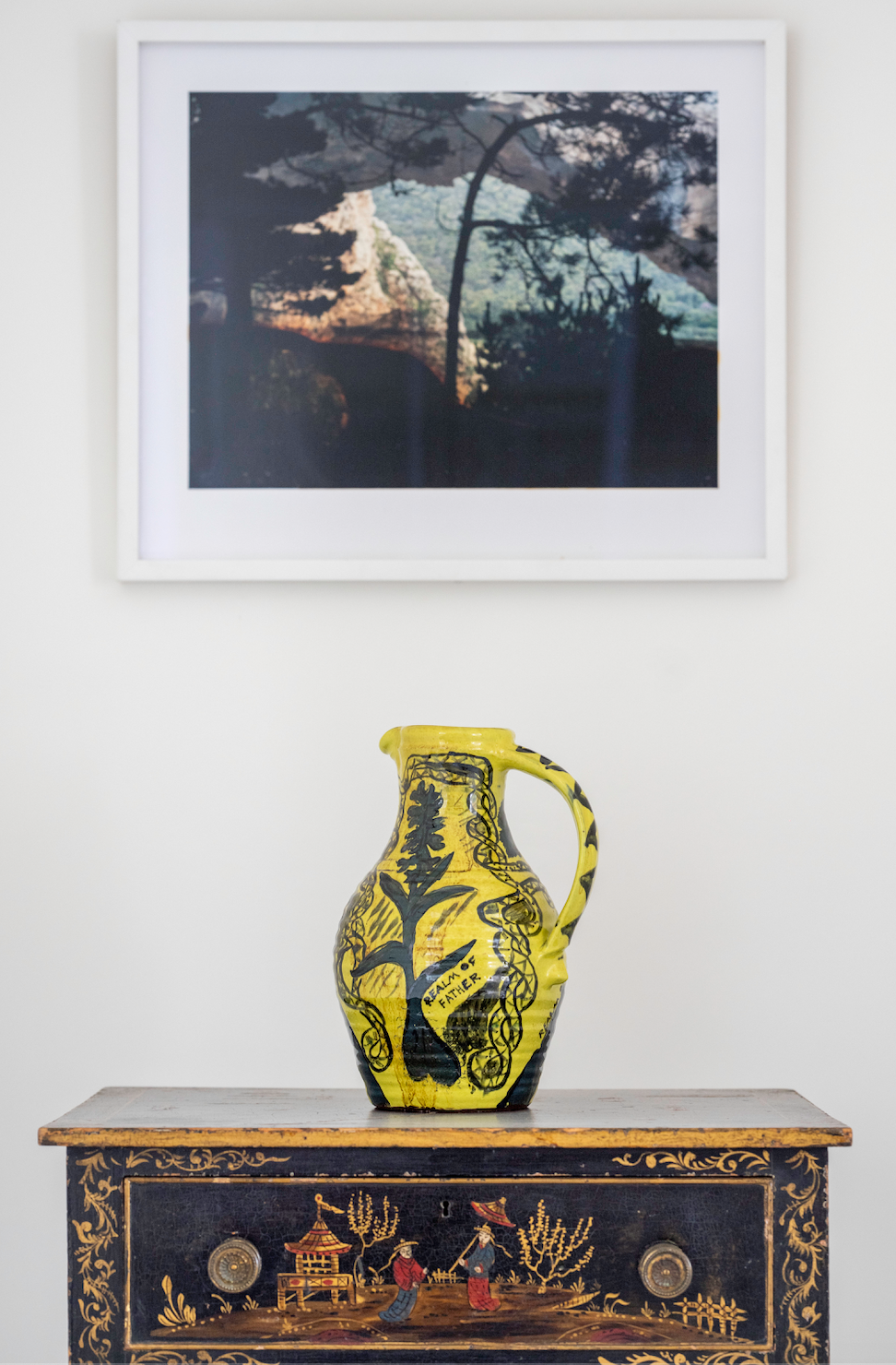
Image 2. Top-bottom
Dafna Talmor, Untitled (1212-2) fromthe ConstructedLandscapes (Vol. II) series, 2013.C-type handprint made from collaged and montaged colour negatives
Simon Bayliss, Jug(Transcendent Function), 2021. Single-fired terracotta, coloured slips, oxides, clear glaze
Image 3
Chantal Powell, Divine Germ, 2024. Blown glass & glazed ceramic
Image 4
Shana Moulton, never never never give up, 2014. Collage on paper
Image 4
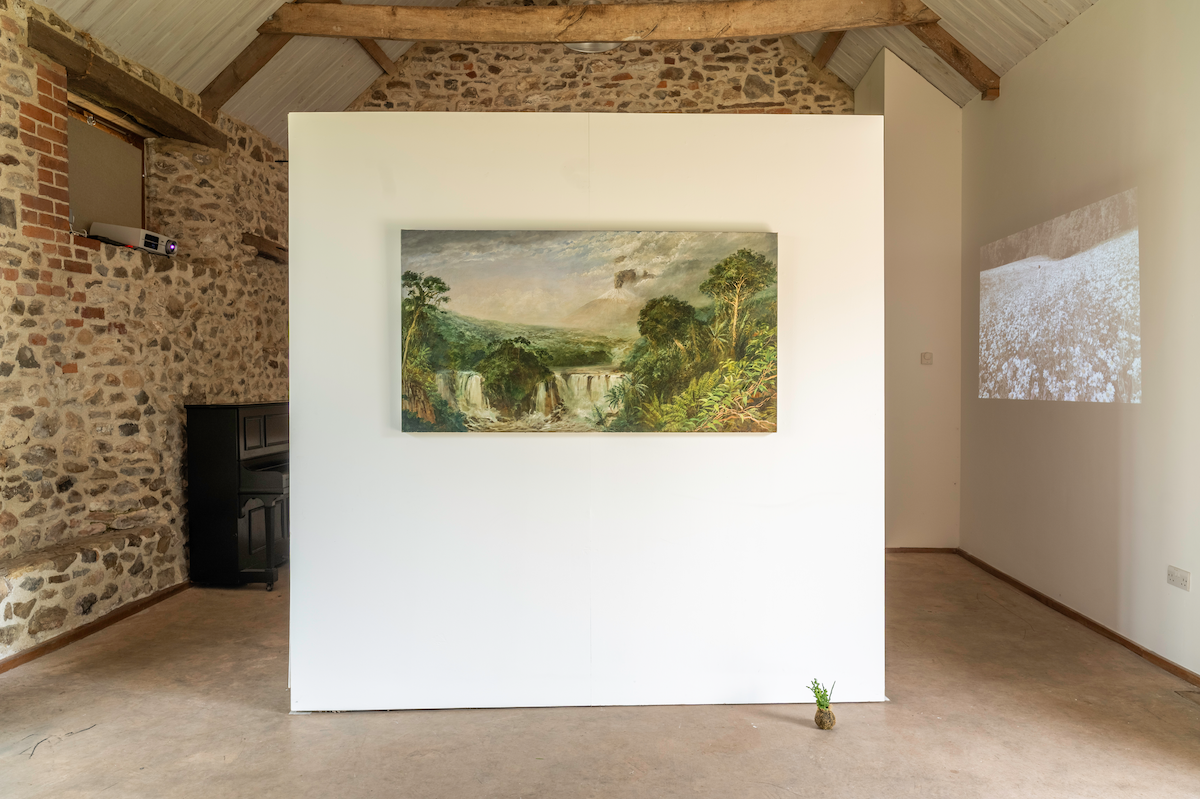
Adam Cvijanovic, Imaginary Landscape With Volcano and Waterfall, 1993. Oil on canvas
Image 5
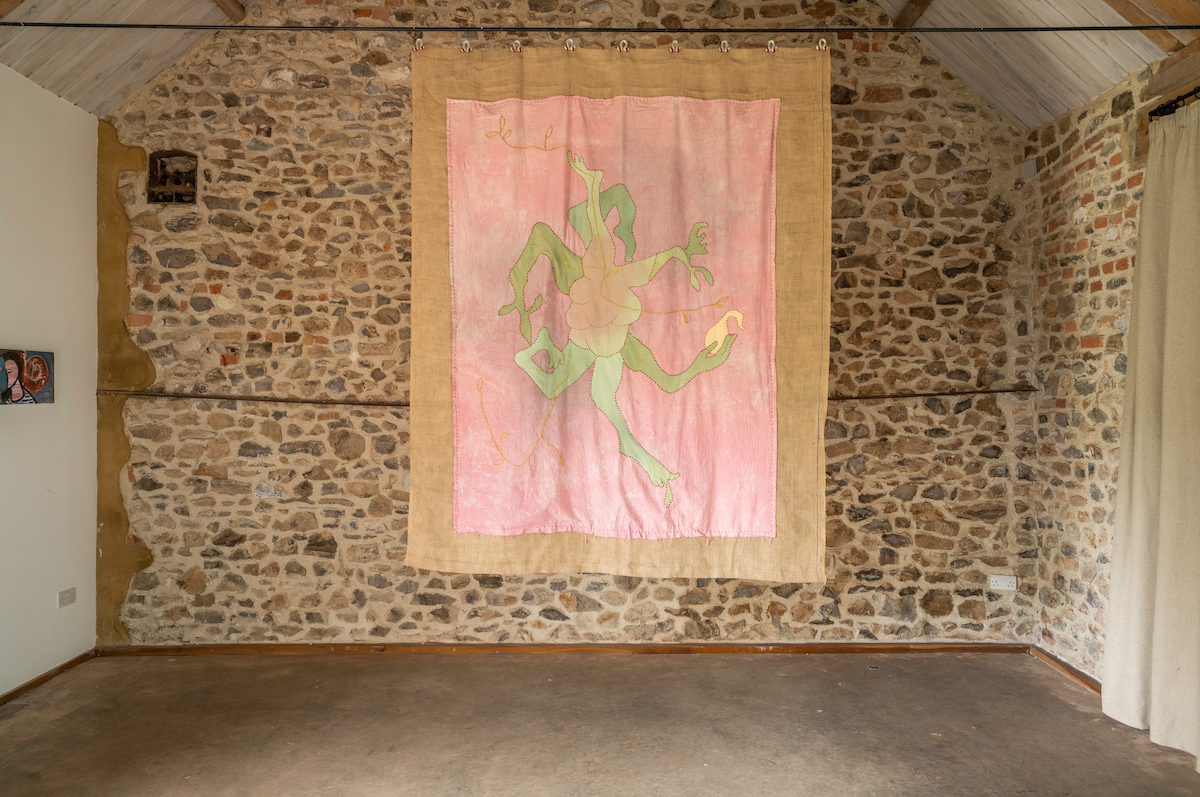
Chantal Powell, I Am Born For Love, 2024. Hand dyed calico, embroidery thread, hessian,sand cast tin
Fruits of My Woman is an exhibition inspired by the short story The Fruit of My Woman by Han Kang in which a woman gradually transitions into plant life. The story uses vegetal transformation as a potent metaphor for resistance and the longing to move beyond the confines of domesticity and social expectation.
Taking this literary starting point, the exhibition explores transformation as an inner necessity: a quiet rebellion, a rewilding of the self, and a gradual opening towards other ways of being.
Han Kang’s protagonist dreams of growing “as tall as a poplar”, of pushing through walls, of exceeding the limits of her given form. These desires form a conceptual thread through the exhibition, offering a way to think about metamorphosis as a radical psychic act: a turning away from systems that constrict, and towards elemental forces that nourish.
The exhibition brings together artworks that move across thresholds between self and environment, tracing liminal and transformative states. Across painting, sculpture, drawing, collage and film, the boundaries between human and vegetal life become porous. Bodies, vessels, plants and landscapes appear layered and in flux, suggesting ways of growing beyond inherited shapes and into other relations with the natural world. Some forms are assembled, spliced or recomposed. Change emerges not as a single image but as something slow, strange and unfolding.
Set within the landscape of Lower Hewood Farm, the exhibition is grounded in a place where land, care and ecology are already central. The farm’s slow cycles, its attention to plant life and its sense of retreat and recalibration all echo the themes of the exhibition. Here, vegetal transformation is not metaphor alone but something felt in the damp soil, the changing light and the sense that growth happens whether witnessed or not.
The artworks move from the intimate interior of the farmhouse to the darker, more elemental atmosphere of the barn, echoing the story’s shift from domestic constraint towards another mode of being. The surrounding landscape becomes a silent collaborator: a continual reminder of the quiet intelligence of plants, their resilience, and their capacity to grow in unexpected directions.
FEATURING:
SIMON BAYLISS
FRANCISCO BORES
JOHN CRAXTON
ADAM CVIJANOVIC
MARLENE DUMAS
NINA ROYLE
JANE HAYES GREENWOOD
HANNAH HUGHES
EVY JOKHOVA
GUNNER LA COUR
SHANA MOULTON
AIMÉE PARROTT
CHANTAL POWELL
LUCY STEIN
DAFNA TALMOR
MARIANNE WALKER
SHELAGH WAKELY
ON HAN KANG'S THE FRUIT OF MY WOMAN
“Mother, I keep having the same dream. I dream that I’m growing tall as a poplar.”
Han Kang’s short story The Fruit of My Woman (1997) begins within a constrained domestic world, where estrangement and the pressures of conventional life close in around a woman. Narrated at first through the husband’s impatient and emotionally limited perspective, the story opens into something strange and uncanny as he notices bruises appear and spread across her body. They darken, green, and gradually give way to a metamorphosis that is at once disturbing and strangely beautiful. Her transformation is a form of radical resistance and her vegetal becoming alters the possibilities of relation: as the woman changes, the husband begins belatedly to care for and tend to her in ways he had failed to before.
“I bent forwards into the embrace of those camellia-petal hands. ‘Are you okay?’ I asked. Her eyes, a pair of well-ripened grapes; glimmering on their lacquered surfaces, the ghost of a smile”
As winter approaches, her new plant form withers, and the story ends with her disgorging tiny, seed-like fruits which her husband both ingests and plants in a dozen round plant pots filled with fertile soil.
In the context of Lower Hewood Farm, that movement into relational connection and tending has a particular resonance. Here, the story’s imagery of growth and eventual fruiting is held close to the material presence of plant life, soil and seasonal change. The story suggests not only a breaking free from a constricted life, but also that plant life might offer another model of relation altogether: one grounded in care, permeability, interdependence and attention.
Written by the Korean author Han Kang, a translation of the story into English by Deborah Smith can be read here.
ABOUT THE CURATOR
Chantal Powell is an artist based in West Dorset whose practice brings together making, research and the exploration of symbolic material through talks and curatorial projects. Informed by Jungian psychology and alchemical symbolism, she has a particular interest in archetypal imagery and the unconscious. Her recent work has increasingly focused on what she describes as vegetal alchemy, using vegetal life as a way of thinking about embodied transformation.
Chantal is also the founder of Hogchester Arts, a contemporary arts residency programme, and host of The Red Book Club, an international online book club and speaker programme focused on depth psychology, art and the imagination.
Invited to respond to Lower Hewood Farm in the context of the Survival Library, Chantal saw an opportunity to bring together literature, symbolic inquiry and the vegetal life of the land.
Han Kang’s short story The Fruit of My Woman offered a starting point that connected her longstanding interest in transformation and psychic life with questions of embodiment, ecology and the imaginative force of books.
ABOUT LOWER HEWOOD FARM
Lower Hewood is a small organic farm on the Dorset, Devon and Somerset borders where food growing, ecological practice, cultural activity and community life come together. Alongside its farming and market garden work, it hosts workshops, events and artistic projects, creating a setting in which land-based knowledge, creativity and shared inquiry can meet.
At the heart of the farm is the Survival Library, a reading room and research space developed around the relationship between creative practice and agroecology. Its collection includes artist books, exhibition catalogues, psychoanalytic texts, poetry, self-sufficiency manuals, environmental philosophy, local history publications and farming books, reflecting the farm’s commitment to interdisciplinary thinking.
Owned by Alexa de Ferranti, Lower Hewood Farm is currently stewarded by Tim Williams and Claire Hannington-Williams, who oversee its regenerative farming and growing activities. Tim’s work focuses on soil, plants and resilient farming systems, while Claire brings together growing, design and seasonal practice through an approach shaped by both ecology and aesthetics.
In response to the exhibition and the Korean origin of Han Kang's story Tim propagated indigenous micro-organisms based on natural farming methods from Korea mirroring the biological processes on the farm. Claire created the living plant elements in the library space using a technique inspired by kokedama in which plant roots are contained by hand-made balls of soil and moss.
Exhibition photographs by Rob Coombe.
Image 1. L-R
Chantal Powell, Divine Germ, 2024. Blown glass & glazed ceramic
Hannah Hughes, Pendulum, 2022. Unique collage, archival pigmented papers
Simon Bayliss, Jug(Transcendent Function), 2021. Single-fired terracotta, coloured slips, oxides, clear glaze
Marianne Walker, awrithe, 2021. Graphite on paper clay
Shana Moulton, never never never give up, 2014. Collage on paper
Nina Royle, A Snake Birthing Permutations 2020,. Ink, watercolour and oil on a shaped wood and gesso panel
Image 2. L-R
Gunner la Cour, Dreams of Eskilstrup Orchard VI, 2006. Acrylic on board
Lucy Stein, Untitled, 2021. Oil on board
Image 2. Top-bottom
Dafna Talmor, Untitled (1212-2) fromthe ConstructedLandscapes (Vol. II) series, 2013.C-type handprint made from collaged and montaged colour negatives
Simon Bayliss, Jug(Transcendent Function), 2021. Single-fired terracotta, coloured slips, oxides, clear glaze
Image 3
Chantal Powell, Divine Germ, 2024. Blown glass & glazed ceramic
Image 4
Shana Moulton, never never never give up, 2014. Collage on paper
Image 4
Adam Cvijanovic, Imaginary Landscape With Volcano and Waterfall, 1993. Oil on canvas
Image 5
Chantal Powell, I Am Born For Love, 2024. Hand dyed calico, embroidery thread, hessian,sand cast tin
BY CHANTAL POWELL
Fruits of My Woman is an exhibition inspired by the short story The Fruit of My Woman by Han Kang in which a woman gradually transitions into plant life. The story uses vegetal transformation as a potent metaphor for resistance and the longing to move beyond the confines of domesticity and social expectation.
Taking this literary starting point, the exhibition explores transformation as an inner necessity: a quiet rebellion, a rewilding of the self, and a gradual opening towards other ways of being.
Han Kang’s protagonist dreams of growing “as tall as a poplar”, of pushing through walls, of exceeding the limits of her given form. These desires form a conceptual thread through the exhibition, offering a way to think about metamorphosis as a radical psychic act: a turning away from systems that constrict, and towards elemental forces that nourish.
The exhibition brings together artworks that move across thresholds between self and environment, tracing liminal and transformative states. Across painting, sculpture, drawing, collage and film, the boundaries between human and vegetal life become porous. Bodies, vessels, plants and landscapes appear layered and in flux, suggesting ways of growing beyond inherited shapes and into other relations with the natural world. Some forms are assembled, spliced or recomposed. Change emerges not as a single image but as something slow, strange and unfolding.
Set within the landscape of Lower Hewood Farm, the exhibition is grounded in a place where land, care and ecology are already central. The farm’s slow cycles, its attention to plant life and its sense of retreat and recalibration all echo the themes of the exhibition. Here, vegetal transformation is not metaphor alone but something felt in the damp soil, the changing light and the sense that growth happens whether witnessed or not.
The artworks move from the intimate interior of the farmhouse to the darker, more elemental atmosphere of the barn, echoing the story’s shift from domestic constraint towards another mode of being. The surrounding landscape becomes a silent collaborator: a continual reminder of the quiet intelligence of plants, their resilience, and their capacity to grow in unexpected directions.
FEATURING:
SIMON BAYLISS
FRANCISCO BORES
JOHN CRAXTON
ADAM CVIJANOVIC
MARLENE DUMAS
NINA ROYLE
JANE HAYES GREENWOOD
HANNAH HUGHES
EVY JOKHOVA
GUNNER LA COUR
SHANA MOULTON
AIMÉE PARROTT
CHANTAL POWELL
LUCY STEIN
DAFNA TALMOR
MARIANNE WALKER
SHELAGH WAKELY
ON HAN KANG'S THE FRUIT OF MY WOMAN
“Mother, I keep having the same dream. I dream that I’m growing tall as a poplar.”
Han Kang’s short story The Fruit of My Woman (1997) begins within a constrained domestic world, where estrangement and the pressures of conventional life close in around a woman. Narrated at first through the husband’s impatient and emotionally limited perspective, the story opens into something strange and uncanny as he notices bruises appear and spread across her body. They darken, green, and gradually give way to a metamorphosis that is at once disturbing and strangely beautiful. Her transformation is a form of radical resistance and her vegetal becoming alters the possibilities of relation: as the woman changes, the husband begins belatedly to care for and tend to her in ways he had failed to before.
“I bent forwards into the embrace of those camellia-petal hands. ‘Are you okay?’ I asked. Her eyes, a pair of well-ripened grapes; glimmering on their lacquered surfaces, the ghost of a smile”
As winter approaches, her new plant form withers, and the story ends with her disgorging tiny, seed-like fruits which her husband both ingests and plants in a dozen round plant pots filled with fertile soil.
In the context of Lower Hewood Farm, that movement into relational connection and tending has a particular resonance. Here, the story’s imagery of growth and eventual fruiting is held close to the material presence of plant life, soil and seasonal change. The story suggests not only a breaking free from a constricted life, but also that plant life might offer another model of relation altogether: one grounded in care, permeability, interdependence and attention.
Written by the Korean author Han Kang, a translation of the story into English by Deborah Smith can be read here.
ABOUT THE CURATOR
Chantal Powell is an artist based in West Dorset whose practice brings together making, research and the exploration of symbolic material through talks and curatorial projects. Informed by Jungian psychology and alchemical symbolism, she has a particular interest in archetypal imagery and the unconscious. Her recent work has increasingly focused on what she describes as vegetal alchemy, using vegetal life as a way of thinking about embodied transformation.
Chantal is also the founder of Hogchester Arts, a contemporary arts residency programme, and host of The Red Book Club, an international online book club and speaker programme focused on depth psychology, art and the imagination.
Invited to respond to Lower Hewood Farm in the context of the Survival Library, Chantal saw an opportunity to bring together literature, symbolic inquiry and the vegetal life of the land.
Han Kang’s short story The Fruit of My Woman offered a starting point that connected her longstanding interest in transformation and psychic life with questions of embodiment, ecology and the imaginative force of books.
ABOUT LOWER HEWOOD FARM
Lower Hewood is a small organic farm on the Dorset, Devon and Somerset borders where food growing, ecological practice, cultural activity and community life come together. Alongside its farming and market garden work, it hosts workshops, events and artistic projects, creating a setting in which land-based knowledge, creativity and shared inquiry can meet.
At the heart of the farm is the Survival Library, a reading room and research space developed around the relationship between creative practice and agroecology. Its collection includes artist books, exhibition catalogues, psychoanalytic texts, poetry, self-sufficiency manuals, environmental philosophy, local history publications and farming books, reflecting the farm’s commitment to interdisciplinary thinking.
Owned by Alexa de Ferranti, Lower Hewood Farm is currently stewarded by Tim Williams and Claire Hannington-Williams, who oversee its regenerative farming and growing activities. Tim’s work focuses on soil, plants and resilient farming systems, while Claire brings together growing, design and seasonal practice through an approach shaped by both ecology and aesthetics.
In response to the exhibition and the Korean origin of Han Kang's story Tim propagated indigenous micro-organisms based on natural farming methods from Korea mirroring the biological processes on the farm. Claire created the living plant elements in the library space using a technique inspired by kokedama in which plant roots are contained by hand-made balls of soil and moss.
Exhibition photographs by Rob Coombe.
Image 1. L-R
Chantal Powell, Divine Germ, 2024. Blown glass & glazed ceramic
Hannah Hughes, Pendulum, 2022. Unique collage, archival pigmented papers
Simon Bayliss, Jug(Transcendent Function), 2021. Single-fired terracotta, coloured slips, oxides, clear glaze
Marianne Walker, awrithe, 2021. Graphite on paper clay
Shana Moulton, never never never give up, 2014. Collage on paper
Nina Royle, A Snake Birthing Permutations 2020,. Ink, watercolour and oil on a shaped wood and gesso panel
Image 2. L-R
Gunner la Cour, Dreams of Eskilstrup Orchard VI, 2006. Acrylic on board
Lucy Stein, Untitled, 2021. Oil on board
Image 2. Top-bottom
Dafna Talmor, Untitled (1212-2) fromthe ConstructedLandscapes (Vol. II) series, 2013.C-type handprint made from collaged and montaged colour negatives
Simon Bayliss, Jug(Transcendent Function), 2021. Single-fired terracotta, coloured slips, oxides, clear glaze
Image 3
Chantal Powell, Divine Germ, 2024. Blown glass & glazed ceramic
Image 4
Shana Moulton, never never never give up, 2014. Collage on paper
Image 4
Adam Cvijanovic, Imaginary Landscape With Volcano and Waterfall, 1993. Oil on canvas
Image 5
Chantal Powell, I Am Born For Love, 2024. Hand dyed calico, embroidery thread, hessian,sand cast tin
Fruits of My Woman is an exhibition inspired by the short story The Fruit of My Woman by Han Kang in which a woman gradually transitions into plant life. The story uses vegetal transformation as a potent metaphor for resistance and the longing to move beyond the confines of domesticity and social expectation.
Taking this literary starting point, the exhibition explores transformation as an inner necessity: a quiet rebellion, a rewilding of the self, and a gradual opening towards other ways of being.
Han Kang’s protagonist dreams of growing “as tall as a poplar”, of pushing through walls, of exceeding the limits of her given form. These desires form a conceptual thread through the exhibition, offering a way to think about metamorphosis as a radical psychic act: a turning away from systems that constrict, and towards elemental forces that nourish.
The exhibition brings together artworks that move across thresholds between self and environment, tracing liminal and transformative states. Across painting, sculpture, drawing, collage and film, the boundaries between human and vegetal life become porous. Bodies, vessels, plants and landscapes appear layered and in flux, suggesting ways of growing beyond inherited shapes and into other relations with the natural world. Some forms are assembled, spliced or recomposed. Change emerges not as a single image but as something slow, strange and unfolding.
Set within the landscape of Lower Hewood Farm, the exhibition is grounded in a place where land, care and ecology are already central. The farm’s slow cycles, its attention to plant life and its sense of retreat and recalibration all echo the themes of the exhibition. Here, vegetal transformation is not metaphor alone but something felt in the damp soil, the changing light and the sense that growth happens whether witnessed or not.
The artworks move from the intimate interior of the farmhouse to the darker, more elemental atmosphere of the barn, echoing the story’s shift from domestic constraint towards another mode of being. The surrounding landscape becomes a silent collaborator: a continual reminder of the quiet intelligence of plants, their resilience, and their capacity to grow in unexpected directions.
FEATURING:
SIMON BAYLISS
FRANCISCO BORES
JOHN CRAXTON
ADAM CVIJANOVIC
MARLENE DUMAS
NINA ROYLE
JANE HAYES GREENWOOD
HANNAH HUGHES
EVY JOKHOVA
GUNNER LA COUR
SHANA MOULTON
AIMÉE PARROTT
CHANTAL POWELL
LUCY STEIN
DAFNA TALMOR
MARIANNE WALKER
SHELAGH WAKELY
ON HAN KANG'S THE FRUIT OF MY WOMAN
“Mother, I keep having the same dream. I dream that I’m growing tall as a poplar.”
Han Kang’s short story The Fruit of My Woman (1997) begins within a constrained domestic world, where estrangement and the pressures of conventional life close in around a woman. Narrated at first through the husband’s impatient and emotionally limited perspective, the story opens into something strange and uncanny as he notices bruises appear and spread across her body. They darken, green, and gradually give way to a metamorphosis that is at once disturbing and strangely beautiful. Her transformation is a form of radical resistance and her vegetal becoming alters the possibilities of relation: as the woman changes, the husband begins belatedly to care for and tend to her in ways he had failed to before.
“I bent forwards into the embrace of those camellia-petal hands. ‘Are you okay?’ I asked. Her eyes, a pair of well-ripened grapes; glimmering on their lacquered surfaces, the ghost of a smile”
As winter approaches, her new plant form withers, and the story ends with her disgorging tiny, seed-like fruits which her husband both ingests and plants in a dozen round plant pots filled with fertile soil.
In the context of Lower Hewood Farm, that movement into relational connection and tending has a particular resonance. Here, the story’s imagery of growth and eventual fruiting is held close to the material presence of plant life, soil and seasonal change. The story suggests not only a breaking free from a constricted life, but also that plant life might offer another model of relation altogether: one grounded in care, permeability, interdependence and attention.
Written by the Korean author Han Kang, a translation of the story into English by Deborah Smith can be read here.
ABOUT THE CURATOR
Chantal Powell is an artist based in West Dorset whose practice brings together making, research and the exploration of symbolic material through talks and curatorial projects. Informed by Jungian psychology and alchemical symbolism, she has a particular interest in archetypal imagery and the unconscious. Her recent work has increasingly focused on what she describes as vegetal alchemy, using vegetal life as a way of thinking about embodied transformation.
Chantal is also the founder of Hogchester Arts, a contemporary arts residency programme, and host of The Red Book Club, an international online book club and speaker programme focused on depth psychology, art and the imagination.
Invited to respond to Lower Hewood Farm in the context of the Survival Library, Chantal saw an opportunity to bring together literature, symbolic inquiry and the vegetal life of the land.
Han Kang’s short story The Fruit of My Woman offered a starting point that connected her longstanding interest in transformation and psychic life with questions of embodiment, ecology and the imaginative force of books.
ABOUT LOWER HEWOOD FARM
Lower Hewood is a small organic farm on the Dorset, Devon and Somerset borders where food growing, ecological practice, cultural activity and community life come together. Alongside its farming and market garden work, it hosts workshops, events and artistic projects, creating a setting in which land-based knowledge, creativity and shared inquiry can meet.
At the heart of the farm is the Survival Library, a reading room and research space developed around the relationship between creative practice and agroecology. Its collection includes artist books, exhibition catalogues, psychoanalytic texts, poetry, self-sufficiency manuals, environmental philosophy, local history publications and farming books, reflecting the farm’s commitment to interdisciplinary thinking.
Owned by Alexa de Ferranti, Lower Hewood Farm is currently stewarded by Tim Williams and Claire Hannington-Williams, who oversee its regenerative farming and growing activities. Tim’s work focuses on soil, plants and resilient farming systems, while Claire brings together growing, design and seasonal practice through an approach shaped by both ecology and aesthetics.
In response to the exhibition and the Korean origin of Han Kang's story Tim propagated indigenous micro-organisms based on natural farming methods from Korea mirroring the biological processes on the farm. Claire created the living plant elements in the library space using a technique inspired by kokedama in which plant roots are contained by hand-made balls of soil and moss.
Exhibition photographs by Rob Coombe.
Image 1. L-R
Chantal Powell, Divine Germ, 2024. Blown glass & glazed ceramic
Hannah Hughes, Pendulum, 2022. Unique collage, archival pigmented papers
Simon Bayliss, Jug(Transcendent Function), 2021. Single-fired terracotta, coloured slips, oxides, clear glaze
Marianne Walker, awrithe, 2021. Graphite on paper clay
Shana Moulton, never never never give up, 2014. Collage on paper
Nina Royle, A Snake Birthing Permutations 2020,. Ink, watercolour and oil on a shaped wood and gesso panel
Image 2. L-R
Gunner la Cour, Dreams of Eskilstrup Orchard VI, 2006. Acrylic on board
Lucy Stein, Untitled, 2021. Oil on board
Image 2. Top-bottom
Dafna Talmor, Untitled (1212-2) fromthe ConstructedLandscapes (Vol. II) series, 2013.C-type handprint made from collaged and montaged colour negatives
Simon Bayliss, Jug(Transcendent Function), 2021. Single-fired terracotta, coloured slips, oxides, clear glaze
Image 3
Chantal Powell, Divine Germ, 2024. Blown glass & glazed ceramic
Image 4
Shana Moulton, never never never give up, 2014. Collage on paper
Image 4
Adam Cvijanovic, Imaginary Landscape With Volcano and Waterfall, 1993. Oil on canvas
Image 5
Chantal Powell, I Am Born For Love, 2024. Hand dyed calico, embroidery thread, hessian,sand cast tin
BY CHANTAL POWELL
Fruits of My Woman is an exhibition inspired by the short story The Fruit of My Woman by Han Kang in which a woman gradually transitions into plant life. The story uses vegetal transformation as a potent metaphor for resistance and the longing to move beyond the confines of domesticity and social expectation.
Taking this literary starting point, the exhibition explores transformation as an inner necessity: a quiet rebellion, a rewilding of the self, and a gradual opening towards other ways of being.
Han Kang’s protagonist dreams of growing “as tall as a poplar”, of pushing through walls, of exceeding the limits of her given form. These desires form a conceptual thread through the exhibition, offering a way to think about metamorphosis as a radical psychic act: a turning away from systems that constrict, and towards elemental forces that nourish.
The exhibition brings together artworks that move across thresholds between self and environment, tracing liminal and transformative states. Across painting, sculpture, drawing, collage and film, the boundaries between human and vegetal life become porous. Bodies, vessels, plants and landscapes appear layered and in flux, suggesting ways of growing beyond inherited shapes and into other relations with the natural world. Some forms are assembled, spliced or recomposed. Change emerges not as a single image but as something slow, strange and unfolding.
Set within the landscape of Lower Hewood Farm, the exhibition is grounded in a place where land, care and ecology are already central. The farm’s slow cycles, its attention to plant life and its sense of retreat and recalibration all echo the themes of the exhibition. Here, vegetal transformation is not metaphor alone but something felt in the damp soil, the changing light and the sense that growth happens whether witnessed or not.
The artworks move from the intimate interior of the farmhouse to the darker, more elemental atmosphere of the barn, echoing the story’s shift from domestic constraint towards another mode of being. The surrounding landscape becomes a silent collaborator: a continual reminder of the quiet intelligence of plants, their resilience, and their capacity to grow in unexpected directions.
FEATURING:
SIMON BAYLISS
FRANCISCO BORES
JOHN CRAXTON
ADAM CVIJANOVIC
MARLENE DUMAS
NINA ROYLE
JANE HAYES GREENWOOD
HANNAH HUGHES
EVY JOKHOVA
GUNNER LA COUR
SHANA MOULTON
AIMÉE PARROTT
CHANTAL POWELL
LUCY STEIN
DAFNA TALMOR
MARIANNE WALKER
SHELAGH WAKELY
ON HAN KANG'S THE FRUIT OF MY WOMAN
“Mother, I keep having the same dream. I dream that I’m growing tall as a poplar.”
Han Kang’s short story The Fruit of My Woman (1997) begins within a constrained domestic world, where estrangement and the pressures of conventional life close in around a woman. Narrated at first through the husband’s impatient and emotionally limited perspective, the story opens into something strange and uncanny as he notices bruises appear and spread across her body. They darken, green, and gradually give way to a metamorphosis that is at once disturbing and strangely beautiful. Her transformation is a form of radical resistance and her vegetal becoming alters the possibilities of relation: as the woman changes, the husband begins belatedly to care for and tend to her in ways he had failed to before.
“I bent forwards into the embrace of those camellia-petal hands. ‘Are you okay?’ I asked. Her eyes, a pair of well-ripened grapes; glimmering on their lacquered surfaces, the ghost of a smile”
As winter approaches, her new plant form withers, and the story ends with her disgorging tiny, seed-like fruits which her husband both ingests and plants in a dozen round plant pots filled with fertile soil.
In the context of Lower Hewood Farm, that movement into relational connection and tending has a particular resonance. Here, the story’s imagery of growth and eventual fruiting is held close to the material presence of plant life, soil and seasonal change. The story suggests not only a breaking free from a constricted life, but also that plant life might offer another model of relation altogether: one grounded in care, permeability, interdependence and attention.
Written by the Korean author Han Kang, a translation of the story into English by Deborah Smith can be read here.
ABOUT THE CURATOR
Chantal Powell is an artist based in West Dorset whose practice brings together making, research and the exploration of symbolic material through talks and curatorial projects. Informed by Jungian psychology and alchemical symbolism, she has a particular interest in archetypal imagery and the unconscious. Her recent work has increasingly focused on what she describes as vegetal alchemy, using vegetal life as a way of thinking about embodied transformation.
Chantal is also the founder of Hogchester Arts, a contemporary arts residency programme, and host of The Red Book Club, an international online book club and speaker programme focused on depth psychology, art and the imagination.
Invited to respond to Lower Hewood Farm in the context of the Survival Library, Chantal saw an opportunity to bring together literature, symbolic inquiry and the vegetal life of the land.
Han Kang’s short story The Fruit of My Woman offered a starting point that connected her longstanding interest in transformation and psychic life with questions of embodiment, ecology and the imaginative force of books.
ABOUT LOWER HEWOOD FARM
Lower Hewood is a small organic farm on the Dorset, Devon and Somerset borders where food growing, ecological practice, cultural activity and community life come together. Alongside its farming and market garden work, it hosts workshops, events and artistic projects, creating a setting in which land-based knowledge, creativity and shared inquiry can meet.
At the heart of the farm is the Survival Library, a reading room and research space developed around the relationship between creative practice and agroecology. Its collection includes artist books, exhibition catalogues, psychoanalytic texts, poetry, self-sufficiency manuals, environmental philosophy, local history publications and farming books, reflecting the farm’s commitment to interdisciplinary thinking.
Owned by Alexa de Ferranti, Lower Hewood Farm is currently stewarded by Tim Williams and Claire Hannington-Williams, who oversee its regenerative farming and growing activities. Tim’s work focuses on soil, plants and resilient farming systems, while Claire brings together growing, design and seasonal practice through an approach shaped by both ecology and aesthetics.
In response to the exhibition and the Korean origin of Han Kang's story Tim propagated indigenous micro-organisms based on natural farming methods from Korea mirroring the biological processes on the farm. Claire created the living plant elements in the library space using a technique inspired by kokedama in which plant roots are contained by hand-made balls of soil and moss.
Exhibition photographs by Rob Coombe.
Image 1. L-R
Chantal Powell, Divine Germ, 2024. Blown glass & glazed ceramic
Hannah Hughes, Pendulum, 2022. Unique collage, archival pigmented papers
Simon Bayliss, Jug(Transcendent Function), 2021. Single-fired terracotta, coloured slips, oxides, clear glaze
Marianne Walker, awrithe, 2021. Graphite on paper clay
Shana Moulton, never never never give up, 2014. Collage on paper
Nina Royle, A Snake Birthing Permutations 2020,. Ink, watercolour and oil on a shaped wood and gesso panel
Image 2. L-R
Gunner la Cour, Dreams of Eskilstrup Orchard VI, 2006. Acrylic on board
Lucy Stein, Untitled, 2021. Oil on board
Image 2. Top-bottom
Dafna Talmor, Untitled (1212-2) fromthe ConstructedLandscapes (Vol. II) series, 2013.C-type handprint made from collaged and montaged colour negatives
Simon Bayliss, Jug(Transcendent Function), 2021. Single-fired terracotta, coloured slips, oxides, clear glaze
Image 3
Chantal Powell, Divine Germ, 2024. Blown glass & glazed ceramic
Image 4
Shana Moulton, never never never give up, 2014. Collage on paper
Image 4
Adam Cvijanovic, Imaginary Landscape With Volcano and Waterfall, 1993. Oil on canvas
Image 5
Chantal Powell, I Am Born For Love, 2024. Hand dyed calico, embroidery thread, hessian,sand cast tin
Fruits of My Woman is an exhibition inspired by the short story The Fruit of My Woman by Han Kang in which a woman gradually transitions into plant life. The story uses vegetal transformation as a potent metaphor for resistance and the longing to move beyond the confines of domesticity and social expectation.
Taking this literary starting point, the exhibition explores transformation as an inner necessity: a quiet rebellion, a rewilding of the self, and a gradual opening towards other ways of being.
Han Kang’s protagonist dreams of growing “as tall as a poplar”, of pushing through walls, of exceeding the limits of her given form. These desires form a conceptual thread through the exhibition, offering a way to think about metamorphosis as a radical psychic act: a turning away from systems that constrict, and towards elemental forces that nourish.
The exhibition brings together artworks that move across thresholds between self and environment, tracing liminal and transformative states. Across painting, sculpture, drawing, collage and film, the boundaries between human and vegetal life become porous. Bodies, vessels, plants and landscapes appear layered and in flux, suggesting ways of growing beyond inherited shapes and into other relations with the natural world. Some forms are assembled, spliced or recomposed. Change emerges not as a single image but as something slow, strange and unfolding.
Set within the landscape of Lower Hewood Farm, the exhibition is grounded in a place where land, care and ecology are already central. The farm’s slow cycles, its attention to plant life and its sense of retreat and recalibration all echo the themes of the exhibition. Here, vegetal transformation is not metaphor alone but something felt in the damp soil, the changing light and the sense that growth happens whether witnessed or not.
The artworks move from the intimate interior of the farmhouse to the darker, more elemental atmosphere of the barn, echoing the story’s shift from domestic constraint towards another mode of being. The surrounding landscape becomes a silent collaborator: a continual reminder of the quiet intelligence of plants, their resilience, and their capacity to grow in unexpected directions.
FEATURING:
SIMON BAYLISS
FRANCISCO BORES
JOHN CRAXTON
ADAM CVIJANOVIC
MARLENE DUMAS
NINA ROYLE
JANE HAYES GREENWOOD
HANNAH HUGHES
EVY JOKHOVA
GUNNER LA COUR
SHANA MOULTON
AIMÉE PARROTT
CHANTAL POWELL
LUCY STEIN
DAFNA TALMOR
MARIANNE WALKER
SHELAGH WAKELY
ON HAN KANG'S THE FRUIT OF MY WOMAN
“Mother, I keep having the same dream. I dream that I’m growing tall as a poplar.”
Han Kang’s short story The Fruit of My Woman (1997) begins within a constrained domestic world, where estrangement and the pressures of conventional life close in around a woman. Narrated at first through the husband’s impatient and emotionally limited perspective, the story opens into something strange and uncanny as he notices bruises appear and spread across her body. They darken, green, and gradually give way to a metamorphosis that is at once disturbing and strangely beautiful. Her transformation is a form of radical resistance and her vegetal becoming alters the possibilities of relation: as the woman changes, the husband begins belatedly to care for and tend to her in ways he had failed to before.
“I bent forwards into the embrace of those camellia-petal hands. ‘Are you okay?’ I asked. Her eyes, a pair of well-ripened grapes; glimmering on their lacquered surfaces, the ghost of a smile”
As winter approaches, her new plant form withers, and the story ends with her disgorging tiny, seed-like fruits which her husband both ingests and plants in a dozen round plant pots filled with fertile soil.
In the context of Lower Hewood Farm, that movement into relational connection and tending has a particular resonance. Here, the story’s imagery of growth and eventual fruiting is held close to the material presence of plant life, soil and seasonal change. The story suggests not only a breaking free from a constricted life, but also that plant life might offer another model of relation altogether: one grounded in care, permeability, interdependence and attention.
Written by the Korean author Han Kang, a translation of the story into English by Deborah Smith can be read here.
ABOUT THE CURATOR
Chantal Powell is an artist based in West Dorset whose practice brings together making, research and the exploration of symbolic material through talks and curatorial projects. Informed by Jungian psychology and alchemical symbolism, she has a particular interest in archetypal imagery and the unconscious. Her recent work has increasingly focused on what she describes as vegetal alchemy, using vegetal life as a way of thinking about embodied transformation.
Chantal is also the founder of Hogchester Arts, a contemporary arts residency programme, and host of The Red Book Club, an international online book club and speaker programme focused on depth psychology, art and the imagination.
Invited to respond to Lower Hewood Farm in the context of the Survival Library, Chantal saw an opportunity to bring together literature, symbolic inquiry and the vegetal life of the land.
Han Kang’s short story The Fruit of My Woman offered a starting point that connected her longstanding interest in transformation and psychic life with questions of embodiment, ecology and the imaginative force of books.
ABOUT LOWER HEWOOD FARM
Lower Hewood is a small organic farm on the Dorset, Devon and Somerset borders where food growing, ecological practice, cultural activity and community life come together. Alongside its farming and market garden work, it hosts workshops, events and artistic projects, creating a setting in which land-based knowledge, creativity and shared inquiry can meet.
At the heart of the farm is the Survival Library, a reading room and research space developed around the relationship between creative practice and agroecology. Its collection includes artist books, exhibition catalogues, psychoanalytic texts, poetry, self-sufficiency manuals, environmental philosophy, local history publications and farming books, reflecting the farm’s commitment to interdisciplinary thinking.
Owned by Alexa de Ferranti, Lower Hewood Farm is currently stewarded by Tim Williams and Claire Hannington-Williams, who oversee its regenerative farming and growing activities. Tim’s work focuses on soil, plants and resilient farming systems, while Claire brings together growing, design and seasonal practice through an approach shaped by both ecology and aesthetics.
In response to the exhibition and the Korean origin of Han Kang's story Tim propagated indigenous micro-organisms based on natural farming methods from Korea mirroring the biological processes on the farm. Claire created the living plant elements in the library space using a technique inspired by kokedama in which plant roots are contained by hand-made balls of soil and moss.
Exhibition photographs by Rob Coombe.
Image 1. L-R
Chantal Powell, Divine Germ, 2024. Blown glass & glazed ceramic
Hannah Hughes, Pendulum, 2022. Unique collage, archival pigmented papers
Simon Bayliss, Jug(Transcendent Function), 2021. Single-fired terracotta, coloured slips, oxides, clear glaze
Marianne Walker, awrithe, 2021. Graphite on paper clay
Shana Moulton, never never never give up, 2014. Collage on paper
Nina Royle, A Snake Birthing Permutations 2020,. Ink, watercolour and oil on a shaped wood and gesso panel
Image 2. L-R
Gunner la Cour, Dreams of Eskilstrup Orchard VI, 2006. Acrylic on board
Lucy Stein, Untitled, 2021. Oil on board
Image 2. Top-bottom
Dafna Talmor, Untitled (1212-2) fromthe ConstructedLandscapes (Vol. II) series, 2013.C-type handprint made from collaged and montaged colour negatives
Simon Bayliss, Jug(Transcendent Function), 2021. Single-fired terracotta, coloured slips, oxides, clear glaze
Image 3
Chantal Powell, Divine Germ, 2024. Blown glass & glazed ceramic
Image 4
Shana Moulton, never never never give up, 2014. Collage on paper
Image 4
Adam Cvijanovic, Imaginary Landscape With Volcano and Waterfall, 1993. Oil on canvas
Image 5
Chantal Powell, I Am Born For Love, 2024. Hand dyed calico, embroidery thread, hessian,sand cast tin
BY CHANTAL POWELL
Fruits of My Woman is an exhibition inspired by the short story The Fruit of My Woman by Han Kang in which a woman gradually transitions into plant life. The story uses vegetal transformation as a potent metaphor for resistance and the longing to move beyond the confines of domesticity and social expectation.
Taking this literary starting point, the exhibition explores transformation as an inner necessity: a quiet rebellion, a rewilding of the self, and a gradual opening towards other ways of being.
Han Kang’s protagonist dreams of growing “as tall as a poplar”, of pushing through walls, of exceeding the limits of her given form. These desires form a conceptual thread through the exhibition, offering a way to think about metamorphosis as a radical psychic act: a turning away from systems that constrict, and towards elemental forces that nourish.
The exhibition brings together artworks that move across thresholds between self and environment, tracing liminal and transformative states. Across painting, sculpture, drawing, collage and film, the boundaries between human and vegetal life become porous. Bodies, vessels, plants and landscapes appear layered and in flux, suggesting ways of growing beyond inherited shapes and into other relations with the natural world. Some forms are assembled, spliced or recomposed. Change emerges not as a single image but as something slow, strange and unfolding.
Set within the landscape of Lower Hewood Farm, the exhibition is grounded in a place where land, care and ecology are already central. The farm’s slow cycles, its attention to plant life and its sense of retreat and recalibration all echo the themes of the exhibition. Here, vegetal transformation is not metaphor alone but something felt in the damp soil, the changing light and the sense that growth happens whether witnessed or not.
The artworks move from the intimate interior of the farmhouse to the darker, more elemental atmosphere of the barn, echoing the story’s shift from domestic constraint towards another mode of being. The surrounding landscape becomes a silent collaborator: a continual reminder of the quiet intelligence of plants, their resilience, and their capacity to grow in unexpected directions.
FEATURING:
SIMON BAYLISS
FRANCISCO BORES
JOHN CRAXTON
ADAM CVIJANOVIC
MARLENE DUMAS
NINA ROYLE
JANE HAYES GREENWOOD
HANNAH HUGHES
EVY JOKHOVA
GUNNER LA COUR
SHANA MOULTON
AIMÉE PARROTT
CHANTAL POWELL
LUCY STEIN
DAFNA TALMOR
MARIANNE WALKER
SHELAGH WAKELY
ON HAN KANG'S THE FRUIT OF MY WOMAN
“Mother, I keep having the same dream. I dream that I’m growing tall as a poplar.”
Han Kang’s short story The Fruit of My Woman (1997) begins within a constrained domestic world, where estrangement and the pressures of conventional life close in around a woman. Narrated at first through the husband’s impatient and emotionally limited perspective, the story opens into something strange and uncanny as he notices bruises appear and spread across her body. They darken, green, and gradually give way to a metamorphosis that is at once disturbing and strangely beautiful. Her transformation is a form of radical resistance and her vegetal becoming alters the possibilities of relation: as the woman changes, the husband begins belatedly to care for and tend to her in ways he had failed to before.
“I bent forwards into the embrace of those camellia-petal hands. ‘Are you okay?’ I asked. Her eyes, a pair of well-ripened grapes; glimmering on their lacquered surfaces, the ghost of a smile”
As winter approaches, her new plant form withers, and the story ends with her disgorging tiny, seed-like fruits which her husband both ingests and plants in a dozen round plant pots filled with fertile soil.
In the context of Lower Hewood Farm, that movement into relational connection and tending has a particular resonance. Here, the story’s imagery of growth and eventual fruiting is held close to the material presence of plant life, soil and seasonal change. The story suggests not only a breaking free from a constricted life, but also that plant life might offer another model of relation altogether: one grounded in care, permeability, interdependence and attention.
Written by the Korean author Han Kang, a translation of the story into English by Deborah Smith can be read here.
ABOUT THE CURATOR
Chantal Powell is an artist based in West Dorset whose practice brings together making, research and the exploration of symbolic material through talks and curatorial projects. Informed by Jungian psychology and alchemical symbolism, she has a particular interest in archetypal imagery and the unconscious. Her recent work has increasingly focused on what she describes as vegetal alchemy, using vegetal life as a way of thinking about embodied transformation.
Chantal is also the founder of Hogchester Arts, a contemporary arts residency programme, and host of The Red Book Club, an international online book club and speaker programme focused on depth psychology, art and the imagination.
Invited to respond to Lower Hewood Farm in the context of the Survival Library, Chantal saw an opportunity to bring together literature, symbolic inquiry and the vegetal life of the land.
Han Kang’s short story The Fruit of My Woman offered a starting point that connected her longstanding interest in transformation and psychic life with questions of embodiment, ecology and the imaginative force of books.
ABOUT LOWER HEWOOD FARM
Lower Hewood is a small organic farm on the Dorset, Devon and Somerset borders where food growing, ecological practice, cultural activity and community life come together. Alongside its farming and market garden work, it hosts workshops, events and artistic projects, creating a setting in which land-based knowledge, creativity and shared inquiry can meet.
At the heart of the farm is the Survival Library, a reading room and research space developed around the relationship between creative practice and agroecology. Its collection includes artist books, exhibition catalogues, psychoanalytic texts, poetry, self-sufficiency manuals, environmental philosophy, local history publications and farming books, reflecting the farm’s commitment to interdisciplinary thinking.
Owned by Alexa de Ferranti, Lower Hewood Farm is currently stewarded by Tim Williams and Claire Hannington-Williams, who oversee its regenerative farming and growing activities. Tim’s work focuses on soil, plants and resilient farming systems, while Claire brings together growing, design and seasonal practice through an approach shaped by both ecology and aesthetics.
In response to the exhibition and the Korean origin of Han Kang's story Tim propagated indigenous micro-organisms based on natural farming methods from Korea mirroring the biological processes on the farm. Claire created the living plant elements in the library space using a technique inspired by kokedama in which plant roots are contained by hand-made balls of soil and moss.
Exhibition photographs by Rob Coombe.
Image 1. L-R
Chantal Powell, Divine Germ, 2024. Blown glass & glazed ceramic
Hannah Hughes, Pendulum, 2022. Unique collage, archival pigmented papers
Simon Bayliss, Jug(Transcendent Function), 2021. Single-fired terracotta, coloured slips, oxides, clear glaze
Marianne Walker, awrithe, 2021. Graphite on paper clay
Shana Moulton, never never never give up, 2014. Collage on paper
Nina Royle, A Snake Birthing Permutations 2020,. Ink, watercolour and oil on a shaped wood and gesso panel
Image 2. L-R
Gunner la Cour, Dreams of Eskilstrup Orchard VI, 2006. Acrylic on board
Lucy Stein, Untitled, 2021. Oil on board
Image 2. Top-bottom
Dafna Talmor, Untitled (1212-2) fromthe ConstructedLandscapes (Vol. II) series, 2013.C-type handprint made from collaged and montaged colour negatives
Simon Bayliss, Jug(Transcendent Function), 2021. Single-fired terracotta, coloured slips, oxides, clear glaze
Image 3
Chantal Powell, Divine Germ, 2024. Blown glass & glazed ceramic
Image 4
Shana Moulton, never never never give up, 2014. Collage on paper
Image 4
Adam Cvijanovic, Imaginary Landscape With Volcano and Waterfall, 1993. Oil on canvas
Image 5
Chantal Powell, I Am Born For Love, 2024. Hand dyed calico, embroidery thread, hessian,sand cast tin
Fruits of My Woman is an exhibition inspired by the short story The Fruit of My Woman by Han Kang in which a woman gradually transitions into plant life. The story uses vegetal transformation as a potent metaphor for resistance and the longing to move beyond the confines of domesticity and social expectation.
Taking this literary starting point, the exhibition explores transformation as an inner necessity: a quiet rebellion, a rewilding of the self, and a gradual opening towards other ways of being.
Han Kang’s protagonist dreams of growing “as tall as a poplar”, of pushing through walls, of exceeding the limits of her given form. These desires form a conceptual thread through the exhibition, offering a way to think about metamorphosis as a radical psychic act: a turning away from systems that constrict, and towards elemental forces that nourish.
The exhibition brings together artworks that move across thresholds between self and environment, tracing liminal and transformative states. Across painting, sculpture, drawing, collage and film, the boundaries between human and vegetal life become porous. Bodies, vessels, plants and landscapes appear layered and in flux, suggesting ways of growing beyond inherited shapes and into other relations with the natural world. Some forms are assembled, spliced or recomposed. Change emerges not as a single image but as something slow, strange and unfolding.
Set within the landscape of Lower Hewood Farm, the exhibition is grounded in a place where land, care and ecology are already central. The farm’s slow cycles, its attention to plant life and its sense of retreat and recalibration all echo the themes of the exhibition. Here, vegetal transformation is not metaphor alone but something felt in the damp soil, the changing light and the sense that growth happens whether witnessed or not.
The artworks move from the intimate interior of the farmhouse to the darker, more elemental atmosphere of the barn, echoing the story’s shift from domestic constraint towards another mode of being. The surrounding landscape becomes a silent collaborator: a continual reminder of the quiet intelligence of plants, their resilience, and their capacity to grow in unexpected directions.
FEATURING:
SIMON BAYLISS
FRANCISCO BORES
JOHN CRAXTON
ADAM CVIJANOVIC
MARLENE DUMAS
NINA ROYLE
JANE HAYES GREENWOOD
HANNAH HUGHES
EVY JOKHOVA
GUNNER LA COUR
SHANA MOULTON
AIMÉE PARROTT
CHANTAL POWELL
LUCY STEIN
DAFNA TALMOR
MARIANNE WALKER
SHELAGH WAKELY
ON HAN KANG'S THE FRUIT OF MY WOMAN
“Mother, I keep having the same dream. I dream that I’m growing tall as a poplar.”
Han Kang’s short story The Fruit of My Woman (1997) begins within a constrained domestic world, where estrangement and the pressures of conventional life close in around a woman. Narrated at first through the husband’s impatient and emotionally limited perspective, the story opens into something strange and uncanny as he notices bruises appear and spread across her body. They darken, green, and gradually give way to a metamorphosis that is at once disturbing and strangely beautiful. Her transformation is a form of radical resistance and her vegetal becoming alters the possibilities of relation: as the woman changes, the husband begins belatedly to care for and tend to her in ways he had failed to before.
“I bent forwards into the embrace of those camellia-petal hands. ‘Are you okay?’ I asked. Her eyes, a pair of well-ripened grapes; glimmering on their lacquered surfaces, the ghost of a smile”
As winter approaches, her new plant form withers, and the story ends with her disgorging tiny, seed-like fruits which her husband both ingests and plants in a dozen round plant pots filled with fertile soil.
In the context of Lower Hewood Farm, that movement into relational connection and tending has a particular resonance. Here, the story’s imagery of growth and eventual fruiting is held close to the material presence of plant life, soil and seasonal change. The story suggests not only a breaking free from a constricted life, but also that plant life might offer another model of relation altogether: one grounded in care, permeability, interdependence and attention.
Written by the Korean author Han Kang, a translation of the story into English by Deborah Smith can be read here.
ABOUT THE CURATOR
Chantal Powell is an artist based in West Dorset whose practice brings together making, research and the exploration of symbolic material through talks and curatorial projects. Informed by Jungian psychology and alchemical symbolism, she has a particular interest in archetypal imagery and the unconscious. Her recent work has increasingly focused on what she describes as vegetal alchemy, using vegetal life as a way of thinking about embodied transformation.
Chantal is also the founder of Hogchester Arts, a contemporary arts residency programme, and host of The Red Book Club, an international online book club and speaker programme focused on depth psychology, art and the imagination.
Invited to respond to Lower Hewood Farm in the context of the Survival Library, Chantal saw an opportunity to bring together literature, symbolic inquiry and the vegetal life of the land.
Han Kang’s short story The Fruit of My Woman offered a starting point that connected her longstanding interest in transformation and psychic life with questions of embodiment, ecology and the imaginative force of books.
ABOUT LOWER HEWOOD FARM
Lower Hewood is a small organic farm on the Dorset, Devon and Somerset borders where food growing, ecological practice, cultural activity and community life come together. Alongside its farming and market garden work, it hosts workshops, events and artistic projects, creating a setting in which land-based knowledge, creativity and shared inquiry can meet.
At the heart of the farm is the Survival Library, a reading room and research space developed around the relationship between creative practice and agroecology. Its collection includes artist books, exhibition catalogues, psychoanalytic texts, poetry, self-sufficiency manuals, environmental philosophy, local history publications and farming books, reflecting the farm’s commitment to interdisciplinary thinking.
Owned by Alexa de Ferranti, Lower Hewood Farm is currently stewarded by Tim Williams and Claire Hannington-Williams, who oversee its regenerative farming and growing activities. Tim’s work focuses on soil, plants and resilient farming systems, while Claire brings together growing, design and seasonal practice through an approach shaped by both ecology and aesthetics.
In response to the exhibition and the Korean origin of Han Kang's story Tim propagated indigenous micro-organisms based on natural farming methods from Korea mirroring the biological processes on the farm. Claire created the living plant elements in the library space using a technique inspired by kokedama in which plant roots are contained by hand-made balls of soil and moss.
Exhibition photographs by Rob Coombe.
Image 1. L-R
Chantal Powell, Divine Germ, 2024. Blown glass & glazed ceramic
Hannah Hughes, Pendulum, 2022. Unique collage, archival pigmented papers
Simon Bayliss, Jug(Transcendent Function), 2021. Single-fired terracotta, coloured slips, oxides, clear glaze
Marianne Walker, awrithe, 2021. Graphite on paper clay
Shana Moulton, never never never give up, 2014. Collage on paper
Nina Royle, A Snake Birthing Permutations 2020,. Ink, watercolour and oil on a shaped wood and gesso panel
Image 2. L-R
Gunner la Cour, Dreams of Eskilstrup Orchard VI, 2006. Acrylic on board
Lucy Stein, Untitled, 2021. Oil on board
Image 2. Top-bottom
Dafna Talmor, Untitled (1212-2) fromthe ConstructedLandscapes (Vol. II) series, 2013.C-type handprint made from collaged and montaged colour negatives
Simon Bayliss, Jug(Transcendent Function), 2021. Single-fired terracotta, coloured slips, oxides, clear glaze
Image 3
Chantal Powell, Divine Germ, 2024. Blown glass & glazed ceramic
Image 4
Shana Moulton, never never never give up, 2014. Collage on paper
Image 4
Adam Cvijanovic, Imaginary Landscape With Volcano and Waterfall, 1993. Oil on canvas
Image 5
Chantal Powell, I Am Born For Love, 2024. Hand dyed calico, embroidery thread, hessian,sand cast tin