INTERVIEW WITH AMY HALE
JF- Everything She Touches Changes Remix references the neo-pagan chant “She changes everything she touches and everything she touches changes,” which testifies to the Goddess, and ultimately Gaia, in flux as an omnipresent catalyst for transformation. Octavia Butler’s line from Parable of the Sower, “All that you touch, you Change. All that you Change, Changes you,” similarly articulates an entangled cosmology of reciprocity, where in the Earthseed philosophy, active participation and adaptation become magical acts of resilience and survival. Within the contemporary magical practices you trace, particularly in plural cosmologies such as The Empathics by Saya Woolfalk or the branching futures staged in The Martian Word for World is Mother by Alice Bucknell, does this point to a broader shift away from vertical spiritual models toward horizontal, ecological, and pluriversal ways of organising meaning and initiating change?
AH - Absolutely I think it does. Many of these artists are very consciously engaging with models of reality that suggest that we are all deeply entangled, and that there is no one action that does not impact the entire ecosystem, however, small that action is. I think embedded in these models is a critique of Neoplatonism, and hierarchies, a model that is so foundational to what we call Western esotericism or the occult, suggesting some sort of descent from a One. The idea that all beings in the material and immaterial worlds possess a form of agency asks us to start thinking of everything we do in terms of relationality, suggesting that we need an ethical basis around those relationships. These models are also critiquing ideas around essentialism that are so foundational to a lot of Western magic. At the end of the day when you get down to our subatomic foundations, it's hard to distinguish one thing from another.
JF - You describe the work of these artists as “a magical spell designed with the intention of producing empathy and novel ways of approaching our collective and entangled futures.” In practices where magic operates explicitly as a tactic of hope and agency, such as Parasites of Pangu by Bones Tan Jones, which reimagines post-apocalyptic survival through queer, non-gendered caretakers of the planet, what distinguishes a spell that remains speculative from one capable of contributing to material or systemic transformation? At what point does empathy metabolise as action? While these artists might reject universal truth or initiatory revelation, there remains a shared desire for repair, reconciliation and a wider shift in consciousness. How do these practices imagine shared reorientation while resisting hierarchy, authority, or a singular moral framework?
AH - This is a great question. To answer the first part, let's consider the paradigm that I was looking at in my first response. I think a lot of these artists are very specific in their contention that a change in consciousness is already a material change. Now, that material change, however small, may not constitute a revolution, yet it should not be dismissed as wholly insufficient. If we can experience empathy in our bodies in a way that is deeply profound, it will almost certainly impact our orientations toward care and community. Simply put, empathy just might very well cause us to be kinder to each other and better inhabitants of the planet. We might make different choices informed by these experiences and those can add up quickly.
I think the second part of your question about resisting a single moral authority and resisting hierarchies may prove to be a little bit more difficult in practice. I definitely feel that many of these artists are deeply idealistic, and I am certainly willing to share and promote that idealism because I feel it is so sorely needed right now. However, what models would emerge in terms of actual societal organizing are not clear. This is why I really enjoy the work of Tai Shani, who is trying to get us to an imaginal space where we can dream of new societal models. Her hypothesis is that we can't imagine a new world while we are still operating within frameworks of oppression.
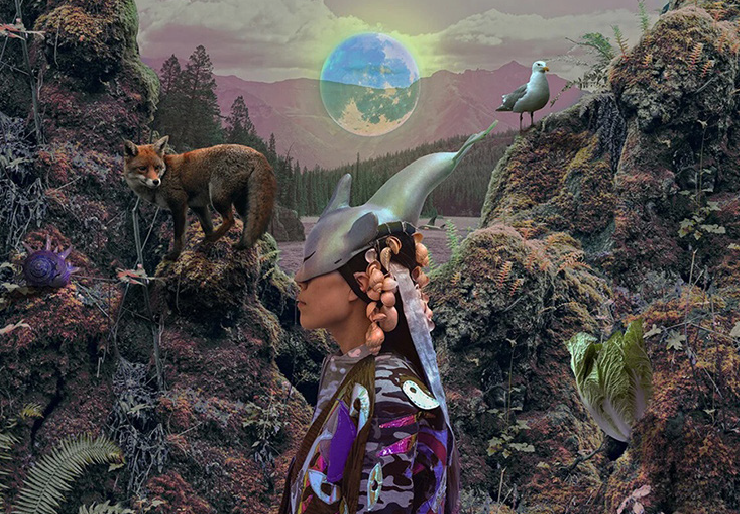
JF - What changes when humans are no longer the primary agents within the system? How does this shape the magical approaches you trace, particularly in Moon Poetics 4 Courageous Earth Critters and Dangerous Day Dreamers by Zadie Xa, where meaning unfolds through interspecies interlocutors and the boundaries between human and more-than-human worlds are deliberately dissolved?
AH - Again this is a great question, and I think at the end of the day we have to recognize that approaches that cultivate empathy for the other than human are still doing it through a very human lens, and through the mechanisms of human narrative. As much as I want to know what my cats are thinking and feeling, while I do believe we can communicate, I can't ever fully know their experience. I think it's also useful to recognize that while the trees in my woods are certainly impacted by the human populations which surround them, that they are still occupying their own reality, and it's a reality that I can't ever fully approach. To some degree, humans are only the center of the story because that's where we place ourselves . There are far more bugs and trees in this world than there are humans , and I certainly hope that they outlive human folly. That doesn't mean that what these artists are trying to accomplish isn't meaningful or useful because it is. The exercise of getting people to shift their perspective and to interpret that shift in their bodies as data that they can act on, is still exceptionally useful, even if it doesn't accurately show me what it is like to look through the eyes of a cabbage, assuming of course that cabbages have eyes. I think the magic of this art is to reorient us toward possibility and inclusivity.
JF -Feminist new materialist thought, particularly Karen Barad’s agential realism, reframes agency as distributed across matter, living systems, technologies, and observers themselves, insisting that no action leaves the world unchanged. In immersive spell-like environments such as Vessel or Hechizo Tuutú (Flower Spell) by Edgar Fabián Frías, which combine indigenous cosmologies, ritual, AI, and queer futurism, do you see artists increasingly working with materials, data, ancestors, and technologies as active participants rather than instruments? How are viewers positioned as ethical agents within these more-than-human ecologies?
AH - These artists are working with these entities in a way that honours their distinct agency and I know that many of them consider these entities to be collaborative co-creators in their works. This position asks us to approach these artistic creations with respect and awareness and also to explicitly acknowledge the sentience and agency of everything in our world. For many of us, this is a worldview we already hold, but for others, it can be a world expanding idea.
JF -Set against climate crisis, extinction, and social instability, many of the works you discuss seem to hold space for grief as much as for possibility. In pieces like Tai Shani’s The Spell or the Dream, how does grief, ecological, ancestral and planetary, operate as a generative force rather than a paralysing one? Can speculative fabulation and long-form world-building function as communal sanctuaries where loss and potential are held together? As traditional patriarchal infrastructures continue to erode, do you see these magical practices emerging as provisional infrastructures in their own right, places for communal tending and collective becoming?
AH -I've had to think about this issue quite a bit, especially in relation to Tai's work. Many of the artists who I wrote about in that piece balance moments of wonder and awe with the channeling of a deep grief and sense of loss, also explicitly with trauma. The acknowledgment of the grief and the trauma is important, because it is those experiences which bring us to the present moment. However, particularly in Shani’s work and that of Bones Tan Jones, I feel that the grief is also a signpost. Both artists present figures in their work that can act as guides and catalysts between states and into worlds of potential and also regeneration. But the fact that we must rely on each other both now and in any future state is an overarching theme among all of these artists. I think in terms of magical culture and what is perceived of as the Western magical tradition, a collaborative ethos is a critical shift. We're moving away from the idea of the powerful individuated will-driven magus to a collective model. I don't believe these new models abandon the ideas of individualism and freedom, but I feel they are explicitly balanced with responsibility and care for others, which are values that aren't always present in Western magical cultures. What this infrastructure in a new world looks like is hard to say, but perhaps these can be the values that drive it.
JF - Across your discussion of immersive and technologically mediated practices, affective and embodied experience repeatedly emerge as central to how magic operates. In works ranging from Bucknell’s interactive world-building to Tan Jones’s use of biodegradable materials, living moss and fungi, herbs, and sound frequencies, or Frías’s portal-like ritual installations, these artists cultivate forms of magical knowing rooted in feeling, sensation, and empathy. How are these artists reshaping not only how magic is understood conceptually, but how it is experienced in the body? What kinds of embodied wisdom become possible when immersion replaces initiation as the engine of transformation?
AH - I think the experience of magic always and universally has an embodied element to it, and these artists are working in a long line of magically inclined artists who are directing their attention to that aspect of the magical experience. A lot of contemporary occultists in particular tend to focus more on reading and transmission of tradition rather than the things that happen in your body when you perform a good ritual or a good spell. I think in any magical experience there's always that moment where something wild and numinous occurs that you can't put your finger on, but it's weird and electric. This generation of artists is focusing on inspiring and cultivating those electric experiences rather than transmitting initiated wisdom through symbols that need to be decoded. I feel this is even true of the contemporary artists of an alchemical and Hermetic persuasion who I work with as well. Even with artists who are more explicitly focused on tradition and symbolism, there is still an aspect of their work that engages the senses and speaks to different modes of consciousness. My friend, the Australian artist Barry William Hale does so many interesting things with technology working in a primarily Thelemic context, but he sees technological applications such as virtual reality as extremely traditional from the perspective of magical history. He recognizes that both performers and magicians have always used technologies and immersion to heighten the sensory, full body experience of magic, which is really where it all happens. There's really nothing new about that.
Image credit: Zadie Xa and Benito Mayor Vallejo, Moon Poetics 4 Courageous Earth Critters and Dangerous Day Dreamers, 2020. Digital collage. Image source: www.zadiexa.com, all rights reserved.
JF- Everything She Touches Changes Remix references the neo-pagan chant “She changes everything she touches and everything she touches changes,” which testifies to the Goddess, and ultimately Gaia, in flux as an omnipresent catalyst for transformation. Octavia Butler’s line from Parable of the Sower, “All that you touch, you Change. All that you Change, Changes you,” similarly articulates an entangled cosmology of reciprocity, where in the Earthseed philosophy, active participation and adaptation become magical acts of resilience and survival. Within the contemporary magical practices you trace, particularly in plural cosmologies such as The Empathics by Saya Woolfalk or the branching futures staged in The Martian Word for World is Mother by Alice Bucknell, does this point to a broader shift away from vertical spiritual models toward horizontal, ecological, and pluriversal ways of organising meaning and initiating change?
AH - Absolutely I think it does. Many of these artists are very consciously engaging with models of reality that suggest that we are all deeply entangled, and that there is no one action that does not impact the entire ecosystem, however, small that action is. I think embedded in these models is a critique of Neoplatonism, and hierarchies, a model that is so foundational to what we call Western esotericism or the occult, suggesting some sort of descent from a One. The idea that all beings in the material and immaterial worlds possess a form of agency asks us to start thinking of everything we do in terms of relationality, suggesting that we need an ethical basis around those relationships. These models are also critiquing ideas around essentialism that are so foundational to a lot of Western magic. At the end of the day when you get down to our subatomic foundations, it's hard to distinguish one thing from another.
JF - You describe the work of these artists as “a magical spell designed with the intention of producing empathy and novel ways of approaching our collective and entangled futures.” In practices where magic operates explicitly as a tactic of hope and agency, such as Parasites of Pangu by Bones Tan Jones, which reimagines post-apocalyptic survival through queer, non-gendered caretakers of the planet, what distinguishes a spell that remains speculative from one capable of contributing to material or systemic transformation? At what point does empathy metabolise as action? While these artists might reject universal truth or initiatory revelation, there remains a shared desire for repair, reconciliation and a wider shift in consciousness. How do these practices imagine shared reorientation while resisting hierarchy, authority, or a singular moral framework?
AH - This is a great question. To answer the first part, let's consider the paradigm that I was looking at in my first response. I think a lot of these artists are very specific in their contention that a change in consciousness is already a material change. Now, that material change, however small, may not constitute a revolution, yet it should not be dismissed as wholly insufficient. If we can experience empathy in our bodies in a way that is deeply profound, it will almost certainly impact our orientations toward care and community. Simply put, empathy just might very well cause us to be kinder to each other and better inhabitants of the planet. We might make different choices informed by these experiences and those can add up quickly.
I think the second part of your question about resisting a single moral authority and resisting hierarchies may prove to be a little bit more difficult in practice. I definitely feel that many of these artists are deeply idealistic, and I am certainly willing to share and promote that idealism because I feel it is so sorely needed right now. However, what models would emerge in terms of actual societal organizing are not clear. This is why I really enjoy the work of Tai Shani, who is trying to get us to an imaginal space where we can dream of new societal models. Her hypothesis is that we can't imagine a new world while we are still operating within frameworks of oppression.
JF - What changes when humans are no longer the primary agents within the system? How does this shape the magical approaches you trace, particularly in Moon Poetics 4 Courageous Earth Critters and Dangerous Day Dreamers by Zadie Xa, where meaning unfolds through interspecies interlocutors and the boundaries between human and more-than-human worlds are deliberately dissolved?
AH - Again this is a great question, and I think at the end of the day we have to recognize that approaches that cultivate empathy for the other than human are still doing it through a very human lens, and through the mechanisms of human narrative. As much as I want to know what my cats are thinking and feeling, while I do believe we can communicate, I can't ever fully know their experience. I think it's also useful to recognize that while the trees in my woods are certainly impacted by the human populations which surround them, that they are still occupying their own reality, and it's a reality that I can't ever fully approach. To some degree, humans are only the center of the story because that's where we place ourselves . There are far more bugs and trees in this world than there are humans , and I certainly hope that they outlive human folly. That doesn't mean that what these artists are trying to accomplish isn't meaningful or useful because it is. The exercise of getting people to shift their perspective and to interpret that shift in their bodies as data that they can act on, is still exceptionally useful, even if it doesn't accurately show me what it is like to look through the eyes of a cabbage, assuming of course that cabbages have eyes. I think the magic of this art is to reorient us toward possibility and inclusivity.
JF -Feminist new materialist thought, particularly Karen Barad’s agential realism, reframes agency as distributed across matter, living systems, technologies, and observers themselves, insisting that no action leaves the world unchanged. In immersive spell-like environments such as Vessel or Hechizo Tuutú (Flower Spell) by Edgar Fabián Frías, which combine indigenous cosmologies, ritual, AI, and queer futurism, do you see artists increasingly working with materials, data, ancestors, and technologies as active participants rather than instruments? How are viewers positioned as ethical agents within these more-than-human ecologies?
AH - These artists are working with these entities in a way that honours their distinct agency and I know that many of them consider these entities to be collaborative co-creators in their works. This position asks us to approach these artistic creations with respect and awareness and also to explicitly acknowledge the sentience and agency of everything in our world. For many of us, this is a worldview we already hold, but for others, it can be a world expanding idea.
JF -Set against climate crisis, extinction, and social instability, many of the works you discuss seem to hold space for grief as much as for possibility. In pieces like Tai Shani’s The Spell or the Dream, how does grief, ecological, ancestral and planetary, operate as a generative force rather than a paralysing one? Can speculative fabulation and long-form world-building function as communal sanctuaries where loss and potential are held together? As traditional patriarchal infrastructures continue to erode, do you see these magical practices emerging as provisional infrastructures in their own right, places for communal tending and collective becoming?
AH -I've had to think about this issue quite a bit, especially in relation to Tai's work. Many of the artists who I wrote about in that piece balance moments of wonder and awe with the channeling of a deep grief and sense of loss, also explicitly with trauma. The acknowledgment of the grief and the trauma is important, because it is those experiences which bring us to the present moment. However, particularly in Shani’s work and that of Bones Tan Jones, I feel that the grief is also a signpost. Both artists present figures in their work that can act as guides and catalysts between states and into worlds of potential and also regeneration. But the fact that we must rely on each other both now and in any future state is an overarching theme among all of these artists. I think in terms of magical culture and what is perceived of as the Western magical tradition, a collaborative ethos is a critical shift. We're moving away from the idea of the powerful individuated will-driven magus to a collective model. I don't believe these new models abandon the ideas of individualism and freedom, but I feel they are explicitly balanced with responsibility and care for others, which are values that aren't always present in Western magical cultures. What this infrastructure in a new world looks like is hard to say, but perhaps these can be the values that drive it.
JF - Across your discussion of immersive and technologically mediated practices, affective and embodied experience repeatedly emerge as central to how magic operates. In works ranging from Bucknell’s interactive world-building to Tan Jones’s use of biodegradable materials, living moss and fungi, herbs, and sound frequencies, or Frías’s portal-like ritual installations, these artists cultivate forms of magical knowing rooted in feeling, sensation, and empathy. How are these artists reshaping not only how magic is understood conceptually, but how it is experienced in the body? What kinds of embodied wisdom become possible when immersion replaces initiation as the engine of transformation?
AH - I think the experience of magic always and universally has an embodied element to it, and these artists are working in a long line of magically inclined artists who are directing their attention to that aspect of the magical experience. A lot of contemporary occultists in particular tend to focus more on reading and transmission of tradition rather than the things that happen in your body when you perform a good ritual or a good spell. I think in any magical experience there's always that moment where something wild and numinous occurs that you can't put your finger on, but it's weird and electric. This generation of artists is focusing on inspiring and cultivating those electric experiences rather than transmitting initiated wisdom through symbols that need to be decoded. I feel this is even true of the contemporary artists of an alchemical and Hermetic persuasion who I work with as well. Even with artists who are more explicitly focused on tradition and symbolism, there is still an aspect of their work that engages the senses and speaks to different modes of consciousness. My friend, the Australian artist Barry William Hale does so many interesting things with technology working in a primarily Thelemic context, but he sees technological applications such as virtual reality as extremely traditional from the perspective of magical history. He recognizes that both performers and magicians have always used technologies and immersion to heighten the sensory, full body experience of magic, which is really where it all happens. There's really nothing new about that.
Image credit: Zadie Xa and Benito Mayor Vallejo, Moon Poetics 4 Courageous Earth Critters and Dangerous Day Dreamers, 2020. Digital collage. Image source: www.zadiexa.com, all rights reserved.
Dr. Amy Hale (PhD Folklore UCLA) is an Atlanta based writer, curator, and critic, ethnographer and folklorist, speaking and writing about magic, art, culture, women and Cornwall in various combinations.
Jemma Foster is the founder and director of Wild Alchemy Lab.
INTERVIEW WITH AMY HALE
JF- Everything She Touches Changes Remix references the neo-pagan chant “She changes everything she touches and everything she touches changes,” which testifies to the Goddess, and ultimately Gaia, in flux as an omnipresent catalyst for transformation. Octavia Butler’s line from Parable of the Sower, “All that you touch, you Change. All that you Change, Changes you,” similarly articulates an entangled cosmology of reciprocity, where in the Earthseed philosophy, active participation and adaptation become magical acts of resilience and survival. Within the contemporary magical practices you trace, particularly in plural cosmologies such as The Empathics by Saya Woolfalk or the branching futures staged in The Martian Word for World is Mother by Alice Bucknell, does this point to a broader shift away from vertical spiritual models toward horizontal, ecological, and pluriversal ways of organising meaning and initiating change?
AH - Absolutely I think it does. Many of these artists are very consciously engaging with models of reality that suggest that we are all deeply entangled, and that there is no one action that does not impact the entire ecosystem, however, small that action is. I think embedded in these models is a critique of Neoplatonism, and hierarchies, a model that is so foundational to what we call Western esotericism or the occult, suggesting some sort of descent from a One. The idea that all beings in the material and immaterial worlds possess a form of agency asks us to start thinking of everything we do in terms of relationality, suggesting that we need an ethical basis around those relationships. These models are also critiquing ideas around essentialism that are so foundational to a lot of Western magic. At the end of the day when you get down to our subatomic foundations, it's hard to distinguish one thing from another.
JF - You describe the work of these artists as “a magical spell designed with the intention of producing empathy and novel ways of approaching our collective and entangled futures.” In practices where magic operates explicitly as a tactic of hope and agency, such as Parasites of Pangu by Bones Tan Jones, which reimagines post-apocalyptic survival through queer, non-gendered caretakers of the planet, what distinguishes a spell that remains speculative from one capable of contributing to material or systemic transformation? At what point does empathy metabolise as action? While these artists might reject universal truth or initiatory revelation, there remains a shared desire for repair, reconciliation and a wider shift in consciousness. How do these practices imagine shared reorientation while resisting hierarchy, authority, or a singular moral framework?
AH - This is a great question. To answer the first part, let's consider the paradigm that I was looking at in my first response. I think a lot of these artists are very specific in their contention that a change in consciousness is already a material change. Now, that material change, however small, may not constitute a revolution, yet it should not be dismissed as wholly insufficient. If we can experience empathy in our bodies in a way that is deeply profound, it will almost certainly impact our orientations toward care and community. Simply put, empathy just might very well cause us to be kinder to each other and better inhabitants of the planet. We might make different choices informed by these experiences and those can add up quickly.
I think the second part of your question about resisting a single moral authority and resisting hierarchies may prove to be a little bit more difficult in practice. I definitely feel that many of these artists are deeply idealistic, and I am certainly willing to share and promote that idealism because I feel it is so sorely needed right now. However, what models would emerge in terms of actual societal organizing are not clear. This is why I really enjoy the work of Tai Shani, who is trying to get us to an imaginal space where we can dream of new societal models. Her hypothesis is that we can't imagine a new world while we are still operating within frameworks of oppression.
JF - What changes when humans are no longer the primary agents within the system? How does this shape the magical approaches you trace, particularly in Moon Poetics 4 Courageous Earth Critters and Dangerous Day Dreamers by Zadie Xa, where meaning unfolds through interspecies interlocutors and the boundaries between human and more-than-human worlds are deliberately dissolved?
AH - Again this is a great question, and I think at the end of the day we have to recognize that approaches that cultivate empathy for the other than human are still doing it through a very human lens, and through the mechanisms of human narrative. As much as I want to know what my cats are thinking and feeling, while I do believe we can communicate, I can't ever fully know their experience. I think it's also useful to recognize that while the trees in my woods are certainly impacted by the human populations which surround them, that they are still occupying their own reality, and it's a reality that I can't ever fully approach. To some degree, humans are only the center of the story because that's where we place ourselves . There are far more bugs and trees in this world than there are humans , and I certainly hope that they outlive human folly. That doesn't mean that what these artists are trying to accomplish isn't meaningful or useful because it is. The exercise of getting people to shift their perspective and to interpret that shift in their bodies as data that they can act on, is still exceptionally useful, even if it doesn't accurately show me what it is like to look through the eyes of a cabbage, assuming of course that cabbages have eyes. I think the magic of this art is to reorient us toward possibility and inclusivity.
JF -Feminist new materialist thought, particularly Karen Barad’s agential realism, reframes agency as distributed across matter, living systems, technologies, and observers themselves, insisting that no action leaves the world unchanged. In immersive spell-like environments such as Vessel or Hechizo Tuutú (Flower Spell) by Edgar Fabián Frías, which combine indigenous cosmologies, ritual, AI, and queer futurism, do you see artists increasingly working with materials, data, ancestors, and technologies as active participants rather than instruments? How are viewers positioned as ethical agents within these more-than-human ecologies?
AH - These artists are working with these entities in a way that honours their distinct agency and I know that many of them consider these entities to be collaborative co-creators in their works. This position asks us to approach these artistic creations with respect and awareness and also to explicitly acknowledge the sentience and agency of everything in our world. For many of us, this is a worldview we already hold, but for others, it can be a world expanding idea.
JF -Set against climate crisis, extinction, and social instability, many of the works you discuss seem to hold space for grief as much as for possibility. In pieces like Tai Shani’s The Spell or the Dream, how does grief, ecological, ancestral and planetary, operate as a generative force rather than a paralysing one? Can speculative fabulation and long-form world-building function as communal sanctuaries where loss and potential are held together? As traditional patriarchal infrastructures continue to erode, do you see these magical practices emerging as provisional infrastructures in their own right, places for communal tending and collective becoming?
AH -I've had to think about this issue quite a bit, especially in relation to Tai's work. Many of the artists who I wrote about in that piece balance moments of wonder and awe with the channeling of a deep grief and sense of loss, also explicitly with trauma. The acknowledgment of the grief and the trauma is important, because it is those experiences which bring us to the present moment. However, particularly in Shani’s work and that of Bones Tan Jones, I feel that the grief is also a signpost. Both artists present figures in their work that can act as guides and catalysts between states and into worlds of potential and also regeneration. But the fact that we must rely on each other both now and in any future state is an overarching theme among all of these artists. I think in terms of magical culture and what is perceived of as the Western magical tradition, a collaborative ethos is a critical shift. We're moving away from the idea of the powerful individuated will-driven magus to a collective model. I don't believe these new models abandon the ideas of individualism and freedom, but I feel they are explicitly balanced with responsibility and care for others, which are values that aren't always present in Western magical cultures. What this infrastructure in a new world looks like is hard to say, but perhaps these can be the values that drive it.
JF - Across your discussion of immersive and technologically mediated practices, affective and embodied experience repeatedly emerge as central to how magic operates. In works ranging from Bucknell’s interactive world-building to Tan Jones’s use of biodegradable materials, living moss and fungi, herbs, and sound frequencies, or Frías’s portal-like ritual installations, these artists cultivate forms of magical knowing rooted in feeling, sensation, and empathy. How are these artists reshaping not only how magic is understood conceptually, but how it is experienced in the body? What kinds of embodied wisdom become possible when immersion replaces initiation as the engine of transformation?
AH - I think the experience of magic always and universally has an embodied element to it, and these artists are working in a long line of magically inclined artists who are directing their attention to that aspect of the magical experience. A lot of contemporary occultists in particular tend to focus more on reading and transmission of tradition rather than the things that happen in your body when you perform a good ritual or a good spell. I think in any magical experience there's always that moment where something wild and numinous occurs that you can't put your finger on, but it's weird and electric. This generation of artists is focusing on inspiring and cultivating those electric experiences rather than transmitting initiated wisdom through symbols that need to be decoded. I feel this is even true of the contemporary artists of an alchemical and Hermetic persuasion who I work with as well. Even with artists who are more explicitly focused on tradition and symbolism, there is still an aspect of their work that engages the senses and speaks to different modes of consciousness. My friend, the Australian artist Barry William Hale does so many interesting things with technology working in a primarily Thelemic context, but he sees technological applications such as virtual reality as extremely traditional from the perspective of magical history. He recognizes that both performers and magicians have always used technologies and immersion to heighten the sensory, full body experience of magic, which is really where it all happens. There's really nothing new about that.
Image credit: Zadie Xa and Benito Mayor Vallejo, Moon Poetics 4 Courageous Earth Critters and Dangerous Day Dreamers, 2020. Digital collage. Image source: www.zadiexa.com, all rights reserved.
JF- Everything She Touches Changes Remix references the neo-pagan chant “She changes everything she touches and everything she touches changes,” which testifies to the Goddess, and ultimately Gaia, in flux as an omnipresent catalyst for transformation. Octavia Butler’s line from Parable of the Sower, “All that you touch, you Change. All that you Change, Changes you,” similarly articulates an entangled cosmology of reciprocity, where in the Earthseed philosophy, active participation and adaptation become magical acts of resilience and survival. Within the contemporary magical practices you trace, particularly in plural cosmologies such as The Empathics by Saya Woolfalk or the branching futures staged in The Martian Word for World is Mother by Alice Bucknell, does this point to a broader shift away from vertical spiritual models toward horizontal, ecological, and pluriversal ways of organising meaning and initiating change?
AH - Absolutely I think it does. Many of these artists are very consciously engaging with models of reality that suggest that we are all deeply entangled, and that there is no one action that does not impact the entire ecosystem, however, small that action is. I think embedded in these models is a critique of Neoplatonism, and hierarchies, a model that is so foundational to what we call Western esotericism or the occult, suggesting some sort of descent from a One. The idea that all beings in the material and immaterial worlds possess a form of agency asks us to start thinking of everything we do in terms of relationality, suggesting that we need an ethical basis around those relationships. These models are also critiquing ideas around essentialism that are so foundational to a lot of Western magic. At the end of the day when you get down to our subatomic foundations, it's hard to distinguish one thing from another.
JF - You describe the work of these artists as “a magical spell designed with the intention of producing empathy and novel ways of approaching our collective and entangled futures.” In practices where magic operates explicitly as a tactic of hope and agency, such as Parasites of Pangu by Bones Tan Jones, which reimagines post-apocalyptic survival through queer, non-gendered caretakers of the planet, what distinguishes a spell that remains speculative from one capable of contributing to material or systemic transformation? At what point does empathy metabolise as action? While these artists might reject universal truth or initiatory revelation, there remains a shared desire for repair, reconciliation and a wider shift in consciousness. How do these practices imagine shared reorientation while resisting hierarchy, authority, or a singular moral framework?
AH - This is a great question. To answer the first part, let's consider the paradigm that I was looking at in my first response. I think a lot of these artists are very specific in their contention that a change in consciousness is already a material change. Now, that material change, however small, may not constitute a revolution, yet it should not be dismissed as wholly insufficient. If we can experience empathy in our bodies in a way that is deeply profound, it will almost certainly impact our orientations toward care and community. Simply put, empathy just might very well cause us to be kinder to each other and better inhabitants of the planet. We might make different choices informed by these experiences and those can add up quickly.
I think the second part of your question about resisting a single moral authority and resisting hierarchies may prove to be a little bit more difficult in practice. I definitely feel that many of these artists are deeply idealistic, and I am certainly willing to share and promote that idealism because I feel it is so sorely needed right now. However, what models would emerge in terms of actual societal organizing are not clear. This is why I really enjoy the work of Tai Shani, who is trying to get us to an imaginal space where we can dream of new societal models. Her hypothesis is that we can't imagine a new world while we are still operating within frameworks of oppression.
JF - What changes when humans are no longer the primary agents within the system? How does this shape the magical approaches you trace, particularly in Moon Poetics 4 Courageous Earth Critters and Dangerous Day Dreamers by Zadie Xa, where meaning unfolds through interspecies interlocutors and the boundaries between human and more-than-human worlds are deliberately dissolved?
AH - Again this is a great question, and I think at the end of the day we have to recognize that approaches that cultivate empathy for the other than human are still doing it through a very human lens, and through the mechanisms of human narrative. As much as I want to know what my cats are thinking and feeling, while I do believe we can communicate, I can't ever fully know their experience. I think it's also useful to recognize that while the trees in my woods are certainly impacted by the human populations which surround them, that they are still occupying their own reality, and it's a reality that I can't ever fully approach. To some degree, humans are only the center of the story because that's where we place ourselves . There are far more bugs and trees in this world than there are humans , and I certainly hope that they outlive human folly. That doesn't mean that what these artists are trying to accomplish isn't meaningful or useful because it is. The exercise of getting people to shift their perspective and to interpret that shift in their bodies as data that they can act on, is still exceptionally useful, even if it doesn't accurately show me what it is like to look through the eyes of a cabbage, assuming of course that cabbages have eyes. I think the magic of this art is to reorient us toward possibility and inclusivity.
JF -Feminist new materialist thought, particularly Karen Barad’s agential realism, reframes agency as distributed across matter, living systems, technologies, and observers themselves, insisting that no action leaves the world unchanged. In immersive spell-like environments such as Vessel or Hechizo Tuutú (Flower Spell) by Edgar Fabián Frías, which combine indigenous cosmologies, ritual, AI, and queer futurism, do you see artists increasingly working with materials, data, ancestors, and technologies as active participants rather than instruments? How are viewers positioned as ethical agents within these more-than-human ecologies?
AH - These artists are working with these entities in a way that honours their distinct agency and I know that many of them consider these entities to be collaborative co-creators in their works. This position asks us to approach these artistic creations with respect and awareness and also to explicitly acknowledge the sentience and agency of everything in our world. For many of us, this is a worldview we already hold, but for others, it can be a world expanding idea.
JF -Set against climate crisis, extinction, and social instability, many of the works you discuss seem to hold space for grief as much as for possibility. In pieces like Tai Shani’s The Spell or the Dream, how does grief, ecological, ancestral and planetary, operate as a generative force rather than a paralysing one? Can speculative fabulation and long-form world-building function as communal sanctuaries where loss and potential are held together? As traditional patriarchal infrastructures continue to erode, do you see these magical practices emerging as provisional infrastructures in their own right, places for communal tending and collective becoming?
AH -I've had to think about this issue quite a bit, especially in relation to Tai's work. Many of the artists who I wrote about in that piece balance moments of wonder and awe with the channeling of a deep grief and sense of loss, also explicitly with trauma. The acknowledgment of the grief and the trauma is important, because it is those experiences which bring us to the present moment. However, particularly in Shani’s work and that of Bones Tan Jones, I feel that the grief is also a signpost. Both artists present figures in their work that can act as guides and catalysts between states and into worlds of potential and also regeneration. But the fact that we must rely on each other both now and in any future state is an overarching theme among all of these artists. I think in terms of magical culture and what is perceived of as the Western magical tradition, a collaborative ethos is a critical shift. We're moving away from the idea of the powerful individuated will-driven magus to a collective model. I don't believe these new models abandon the ideas of individualism and freedom, but I feel they are explicitly balanced with responsibility and care for others, which are values that aren't always present in Western magical cultures. What this infrastructure in a new world looks like is hard to say, but perhaps these can be the values that drive it.
JF - Across your discussion of immersive and technologically mediated practices, affective and embodied experience repeatedly emerge as central to how magic operates. In works ranging from Bucknell’s interactive world-building to Tan Jones’s use of biodegradable materials, living moss and fungi, herbs, and sound frequencies, or Frías’s portal-like ritual installations, these artists cultivate forms of magical knowing rooted in feeling, sensation, and empathy. How are these artists reshaping not only how magic is understood conceptually, but how it is experienced in the body? What kinds of embodied wisdom become possible when immersion replaces initiation as the engine of transformation?
AH - I think the experience of magic always and universally has an embodied element to it, and these artists are working in a long line of magically inclined artists who are directing their attention to that aspect of the magical experience. A lot of contemporary occultists in particular tend to focus more on reading and transmission of tradition rather than the things that happen in your body when you perform a good ritual or a good spell. I think in any magical experience there's always that moment where something wild and numinous occurs that you can't put your finger on, but it's weird and electric. This generation of artists is focusing on inspiring and cultivating those electric experiences rather than transmitting initiated wisdom through symbols that need to be decoded. I feel this is even true of the contemporary artists of an alchemical and Hermetic persuasion who I work with as well. Even with artists who are more explicitly focused on tradition and symbolism, there is still an aspect of their work that engages the senses and speaks to different modes of consciousness. My friend, the Australian artist Barry William Hale does so many interesting things with technology working in a primarily Thelemic context, but he sees technological applications such as virtual reality as extremely traditional from the perspective of magical history. He recognizes that both performers and magicians have always used technologies and immersion to heighten the sensory, full body experience of magic, which is really where it all happens. There's really nothing new about that.
Image credit: Zadie Xa and Benito Mayor Vallejo, Moon Poetics 4 Courageous Earth Critters and Dangerous Day Dreamers, 2020. Digital collage. Image source: www.zadiexa.com, all rights reserved.
Dr. Amy Hale (PhD Folklore UCLA) is an Atlanta based writer, curator, and critic, ethnographer and folklorist, speaking and writing about magic, art, culture, women and Cornwall in various combinations.
Jemma Foster is the founder and director of Wild Alchemy Lab.
INTERVIEW WITH AMY HALE
JF- Everything She Touches Changes Remix references the neo-pagan chant “She changes everything she touches and everything she touches changes,” which testifies to the Goddess, and ultimately Gaia, in flux as an omnipresent catalyst for transformation. Octavia Butler’s line from Parable of the Sower, “All that you touch, you Change. All that you Change, Changes you,” similarly articulates an entangled cosmology of reciprocity, where in the Earthseed philosophy, active participation and adaptation become magical acts of resilience and survival. Within the contemporary magical practices you trace, particularly in plural cosmologies such as The Empathics by Saya Woolfalk or the branching futures staged in The Martian Word for World is Mother by Alice Bucknell, does this point to a broader shift away from vertical spiritual models toward horizontal, ecological, and pluriversal ways of organising meaning and initiating change?
AH - Absolutely I think it does. Many of these artists are very consciously engaging with models of reality that suggest that we are all deeply entangled, and that there is no one action that does not impact the entire ecosystem, however, small that action is. I think embedded in these models is a critique of Neoplatonism, and hierarchies, a model that is so foundational to what we call Western esotericism or the occult, suggesting some sort of descent from a One. The idea that all beings in the material and immaterial worlds possess a form of agency asks us to start thinking of everything we do in terms of relationality, suggesting that we need an ethical basis around those relationships. These models are also critiquing ideas around essentialism that are so foundational to a lot of Western magic. At the end of the day when you get down to our subatomic foundations, it's hard to distinguish one thing from another.
JF - You describe the work of these artists as “a magical spell designed with the intention of producing empathy and novel ways of approaching our collective and entangled futures.” In practices where magic operates explicitly as a tactic of hope and agency, such as Parasites of Pangu by Bones Tan Jones, which reimagines post-apocalyptic survival through queer, non-gendered caretakers of the planet, what distinguishes a spell that remains speculative from one capable of contributing to material or systemic transformation? At what point does empathy metabolise as action? While these artists might reject universal truth or initiatory revelation, there remains a shared desire for repair, reconciliation and a wider shift in consciousness. How do these practices imagine shared reorientation while resisting hierarchy, authority, or a singular moral framework?
AH - This is a great question. To answer the first part, let's consider the paradigm that I was looking at in my first response. I think a lot of these artists are very specific in their contention that a change in consciousness is already a material change. Now, that material change, however small, may not constitute a revolution, yet it should not be dismissed as wholly insufficient. If we can experience empathy in our bodies in a way that is deeply profound, it will almost certainly impact our orientations toward care and community. Simply put, empathy just might very well cause us to be kinder to each other and better inhabitants of the planet. We might make different choices informed by these experiences and those can add up quickly.
I think the second part of your question about resisting a single moral authority and resisting hierarchies may prove to be a little bit more difficult in practice. I definitely feel that many of these artists are deeply idealistic, and I am certainly willing to share and promote that idealism because I feel it is so sorely needed right now. However, what models would emerge in terms of actual societal organizing are not clear. This is why I really enjoy the work of Tai Shani, who is trying to get us to an imaginal space where we can dream of new societal models. Her hypothesis is that we can't imagine a new world while we are still operating within frameworks of oppression.
JF - What changes when humans are no longer the primary agents within the system? How does this shape the magical approaches you trace, particularly in Moon Poetics 4 Courageous Earth Critters and Dangerous Day Dreamers by Zadie Xa, where meaning unfolds through interspecies interlocutors and the boundaries between human and more-than-human worlds are deliberately dissolved?
AH - Again this is a great question, and I think at the end of the day we have to recognize that approaches that cultivate empathy for the other than human are still doing it through a very human lens, and through the mechanisms of human narrative. As much as I want to know what my cats are thinking and feeling, while I do believe we can communicate, I can't ever fully know their experience. I think it's also useful to recognize that while the trees in my woods are certainly impacted by the human populations which surround them, that they are still occupying their own reality, and it's a reality that I can't ever fully approach. To some degree, humans are only the center of the story because that's where we place ourselves . There are far more bugs and trees in this world than there are humans , and I certainly hope that they outlive human folly. That doesn't mean that what these artists are trying to accomplish isn't meaningful or useful because it is. The exercise of getting people to shift their perspective and to interpret that shift in their bodies as data that they can act on, is still exceptionally useful, even if it doesn't accurately show me what it is like to look through the eyes of a cabbage, assuming of course that cabbages have eyes. I think the magic of this art is to reorient us toward possibility and inclusivity.
JF -Feminist new materialist thought, particularly Karen Barad’s agential realism, reframes agency as distributed across matter, living systems, technologies, and observers themselves, insisting that no action leaves the world unchanged. In immersive spell-like environments such as Vessel or Hechizo Tuutú (Flower Spell) by Edgar Fabián Frías, which combine indigenous cosmologies, ritual, AI, and queer futurism, do you see artists increasingly working with materials, data, ancestors, and technologies as active participants rather than instruments? How are viewers positioned as ethical agents within these more-than-human ecologies?
AH - These artists are working with these entities in a way that honours their distinct agency and I know that many of them consider these entities to be collaborative co-creators in their works. This position asks us to approach these artistic creations with respect and awareness and also to explicitly acknowledge the sentience and agency of everything in our world. For many of us, this is a worldview we already hold, but for others, it can be a world expanding idea.
JF -Set against climate crisis, extinction, and social instability, many of the works you discuss seem to hold space for grief as much as for possibility. In pieces like Tai Shani’s The Spell or the Dream, how does grief, ecological, ancestral and planetary, operate as a generative force rather than a paralysing one? Can speculative fabulation and long-form world-building function as communal sanctuaries where loss and potential are held together? As traditional patriarchal infrastructures continue to erode, do you see these magical practices emerging as provisional infrastructures in their own right, places for communal tending and collective becoming?
AH -I've had to think about this issue quite a bit, especially in relation to Tai's work. Many of the artists who I wrote about in that piece balance moments of wonder and awe with the channeling of a deep grief and sense of loss, also explicitly with trauma. The acknowledgment of the grief and the trauma is important, because it is those experiences which bring us to the present moment. However, particularly in Shani’s work and that of Bones Tan Jones, I feel that the grief is also a signpost. Both artists present figures in their work that can act as guides and catalysts between states and into worlds of potential and also regeneration. But the fact that we must rely on each other both now and in any future state is an overarching theme among all of these artists. I think in terms of magical culture and what is perceived of as the Western magical tradition, a collaborative ethos is a critical shift. We're moving away from the idea of the powerful individuated will-driven magus to a collective model. I don't believe these new models abandon the ideas of individualism and freedom, but I feel they are explicitly balanced with responsibility and care for others, which are values that aren't always present in Western magical cultures. What this infrastructure in a new world looks like is hard to say, but perhaps these can be the values that drive it.
JF - Across your discussion of immersive and technologically mediated practices, affective and embodied experience repeatedly emerge as central to how magic operates. In works ranging from Bucknell’s interactive world-building to Tan Jones’s use of biodegradable materials, living moss and fungi, herbs, and sound frequencies, or Frías’s portal-like ritual installations, these artists cultivate forms of magical knowing rooted in feeling, sensation, and empathy. How are these artists reshaping not only how magic is understood conceptually, but how it is experienced in the body? What kinds of embodied wisdom become possible when immersion replaces initiation as the engine of transformation?
AH - I think the experience of magic always and universally has an embodied element to it, and these artists are working in a long line of magically inclined artists who are directing their attention to that aspect of the magical experience. A lot of contemporary occultists in particular tend to focus more on reading and transmission of tradition rather than the things that happen in your body when you perform a good ritual or a good spell. I think in any magical experience there's always that moment where something wild and numinous occurs that you can't put your finger on, but it's weird and electric. This generation of artists is focusing on inspiring and cultivating those electric experiences rather than transmitting initiated wisdom through symbols that need to be decoded. I feel this is even true of the contemporary artists of an alchemical and Hermetic persuasion who I work with as well. Even with artists who are more explicitly focused on tradition and symbolism, there is still an aspect of their work that engages the senses and speaks to different modes of consciousness. My friend, the Australian artist Barry William Hale does so many interesting things with technology working in a primarily Thelemic context, but he sees technological applications such as virtual reality as extremely traditional from the perspective of magical history. He recognizes that both performers and magicians have always used technologies and immersion to heighten the sensory, full body experience of magic, which is really where it all happens. There's really nothing new about that.
Image credit: Zadie Xa and Benito Mayor Vallejo, Moon Poetics 4 Courageous Earth Critters and Dangerous Day Dreamers, 2020. Digital collage. Image source: www.zadiexa.com, all rights reserved.
JF- Everything She Touches Changes Remix references the neo-pagan chant “She changes everything she touches and everything she touches changes,” which testifies to the Goddess, and ultimately Gaia, in flux as an omnipresent catalyst for transformation. Octavia Butler’s line from Parable of the Sower, “All that you touch, you Change. All that you Change, Changes you,” similarly articulates an entangled cosmology of reciprocity, where in the Earthseed philosophy, active participation and adaptation become magical acts of resilience and survival. Within the contemporary magical practices you trace, particularly in plural cosmologies such as The Empathics by Saya Woolfalk or the branching futures staged in The Martian Word for World is Mother by Alice Bucknell, does this point to a broader shift away from vertical spiritual models toward horizontal, ecological, and pluriversal ways of organising meaning and initiating change?
AH - Absolutely I think it does. Many of these artists are very consciously engaging with models of reality that suggest that we are all deeply entangled, and that there is no one action that does not impact the entire ecosystem, however, small that action is. I think embedded in these models is a critique of Neoplatonism, and hierarchies, a model that is so foundational to what we call Western esotericism or the occult, suggesting some sort of descent from a One. The idea that all beings in the material and immaterial worlds possess a form of agency asks us to start thinking of everything we do in terms of relationality, suggesting that we need an ethical basis around those relationships. These models are also critiquing ideas around essentialism that are so foundational to a lot of Western magic. At the end of the day when you get down to our subatomic foundations, it's hard to distinguish one thing from another.
JF - You describe the work of these artists as “a magical spell designed with the intention of producing empathy and novel ways of approaching our collective and entangled futures.” In practices where magic operates explicitly as a tactic of hope and agency, such as Parasites of Pangu by Bones Tan Jones, which reimagines post-apocalyptic survival through queer, non-gendered caretakers of the planet, what distinguishes a spell that remains speculative from one capable of contributing to material or systemic transformation? At what point does empathy metabolise as action? While these artists might reject universal truth or initiatory revelation, there remains a shared desire for repair, reconciliation and a wider shift in consciousness. How do these practices imagine shared reorientation while resisting hierarchy, authority, or a singular moral framework?
AH - This is a great question. To answer the first part, let's consider the paradigm that I was looking at in my first response. I think a lot of these artists are very specific in their contention that a change in consciousness is already a material change. Now, that material change, however small, may not constitute a revolution, yet it should not be dismissed as wholly insufficient. If we can experience empathy in our bodies in a way that is deeply profound, it will almost certainly impact our orientations toward care and community. Simply put, empathy just might very well cause us to be kinder to each other and better inhabitants of the planet. We might make different choices informed by these experiences and those can add up quickly.
I think the second part of your question about resisting a single moral authority and resisting hierarchies may prove to be a little bit more difficult in practice. I definitely feel that many of these artists are deeply idealistic, and I am certainly willing to share and promote that idealism because I feel it is so sorely needed right now. However, what models would emerge in terms of actual societal organizing are not clear. This is why I really enjoy the work of Tai Shani, who is trying to get us to an imaginal space where we can dream of new societal models. Her hypothesis is that we can't imagine a new world while we are still operating within frameworks of oppression.
JF - What changes when humans are no longer the primary agents within the system? How does this shape the magical approaches you trace, particularly in Moon Poetics 4 Courageous Earth Critters and Dangerous Day Dreamers by Zadie Xa, where meaning unfolds through interspecies interlocutors and the boundaries between human and more-than-human worlds are deliberately dissolved?
AH - Again this is a great question, and I think at the end of the day we have to recognize that approaches that cultivate empathy for the other than human are still doing it through a very human lens, and through the mechanisms of human narrative. As much as I want to know what my cats are thinking and feeling, while I do believe we can communicate, I can't ever fully know their experience. I think it's also useful to recognize that while the trees in my woods are certainly impacted by the human populations which surround them, that they are still occupying their own reality, and it's a reality that I can't ever fully approach. To some degree, humans are only the center of the story because that's where we place ourselves . There are far more bugs and trees in this world than there are humans , and I certainly hope that they outlive human folly. That doesn't mean that what these artists are trying to accomplish isn't meaningful or useful because it is. The exercise of getting people to shift their perspective and to interpret that shift in their bodies as data that they can act on, is still exceptionally useful, even if it doesn't accurately show me what it is like to look through the eyes of a cabbage, assuming of course that cabbages have eyes. I think the magic of this art is to reorient us toward possibility and inclusivity.
JF -Feminist new materialist thought, particularly Karen Barad’s agential realism, reframes agency as distributed across matter, living systems, technologies, and observers themselves, insisting that no action leaves the world unchanged. In immersive spell-like environments such as Vessel or Hechizo Tuutú (Flower Spell) by Edgar Fabián Frías, which combine indigenous cosmologies, ritual, AI, and queer futurism, do you see artists increasingly working with materials, data, ancestors, and technologies as active participants rather than instruments? How are viewers positioned as ethical agents within these more-than-human ecologies?
AH - These artists are working with these entities in a way that honours their distinct agency and I know that many of them consider these entities to be collaborative co-creators in their works. This position asks us to approach these artistic creations with respect and awareness and also to explicitly acknowledge the sentience and agency of everything in our world. For many of us, this is a worldview we already hold, but for others, it can be a world expanding idea.
JF -Set against climate crisis, extinction, and social instability, many of the works you discuss seem to hold space for grief as much as for possibility. In pieces like Tai Shani’s The Spell or the Dream, how does grief, ecological, ancestral and planetary, operate as a generative force rather than a paralysing one? Can speculative fabulation and long-form world-building function as communal sanctuaries where loss and potential are held together? As traditional patriarchal infrastructures continue to erode, do you see these magical practices emerging as provisional infrastructures in their own right, places for communal tending and collective becoming?
AH -I've had to think about this issue quite a bit, especially in relation to Tai's work. Many of the artists who I wrote about in that piece balance moments of wonder and awe with the channeling of a deep grief and sense of loss, also explicitly with trauma. The acknowledgment of the grief and the trauma is important, because it is those experiences which bring us to the present moment. However, particularly in Shani’s work and that of Bones Tan Jones, I feel that the grief is also a signpost. Both artists present figures in their work that can act as guides and catalysts between states and into worlds of potential and also regeneration. But the fact that we must rely on each other both now and in any future state is an overarching theme among all of these artists. I think in terms of magical culture and what is perceived of as the Western magical tradition, a collaborative ethos is a critical shift. We're moving away from the idea of the powerful individuated will-driven magus to a collective model. I don't believe these new models abandon the ideas of individualism and freedom, but I feel they are explicitly balanced with responsibility and care for others, which are values that aren't always present in Western magical cultures. What this infrastructure in a new world looks like is hard to say, but perhaps these can be the values that drive it.
JF - Across your discussion of immersive and technologically mediated practices, affective and embodied experience repeatedly emerge as central to how magic operates. In works ranging from Bucknell’s interactive world-building to Tan Jones’s use of biodegradable materials, living moss and fungi, herbs, and sound frequencies, or Frías’s portal-like ritual installations, these artists cultivate forms of magical knowing rooted in feeling, sensation, and empathy. How are these artists reshaping not only how magic is understood conceptually, but how it is experienced in the body? What kinds of embodied wisdom become possible when immersion replaces initiation as the engine of transformation?
AH - I think the experience of magic always and universally has an embodied element to it, and these artists are working in a long line of magically inclined artists who are directing their attention to that aspect of the magical experience. A lot of contemporary occultists in particular tend to focus more on reading and transmission of tradition rather than the things that happen in your body when you perform a good ritual or a good spell. I think in any magical experience there's always that moment where something wild and numinous occurs that you can't put your finger on, but it's weird and electric. This generation of artists is focusing on inspiring and cultivating those electric experiences rather than transmitting initiated wisdom through symbols that need to be decoded. I feel this is even true of the contemporary artists of an alchemical and Hermetic persuasion who I work with as well. Even with artists who are more explicitly focused on tradition and symbolism, there is still an aspect of their work that engages the senses and speaks to different modes of consciousness. My friend, the Australian artist Barry William Hale does so many interesting things with technology working in a primarily Thelemic context, but he sees technological applications such as virtual reality as extremely traditional from the perspective of magical history. He recognizes that both performers and magicians have always used technologies and immersion to heighten the sensory, full body experience of magic, which is really where it all happens. There's really nothing new about that.
Image credit: Zadie Xa and Benito Mayor Vallejo, Moon Poetics 4 Courageous Earth Critters and Dangerous Day Dreamers, 2020. Digital collage. Image source: www.zadiexa.com, all rights reserved.
Dr. Amy Hale (PhD Folklore UCLA) is an Atlanta based writer, curator, and critic, ethnographer and folklorist, speaking and writing about magic, art, culture, women and Cornwall in various combinations.
Jemma Foster is the founder and director of Wild Alchemy Lab.
INTERVIEW WITH AMY HALE
JF- Everything She Touches Changes Remix references the neo-pagan chant “She changes everything she touches and everything she touches changes,” which testifies to the Goddess, and ultimately Gaia, in flux as an omnipresent catalyst for transformation. Octavia Butler’s line from Parable of the Sower, “All that you touch, you Change. All that you Change, Changes you,” similarly articulates an entangled cosmology of reciprocity, where in the Earthseed philosophy, active participation and adaptation become magical acts of resilience and survival. Within the contemporary magical practices you trace, particularly in plural cosmologies such as The Empathics by Saya Woolfalk or the branching futures staged in The Martian Word for World is Mother by Alice Bucknell, does this point to a broader shift away from vertical spiritual models toward horizontal, ecological, and pluriversal ways of organising meaning and initiating change?
AH - Absolutely I think it does. Many of these artists are very consciously engaging with models of reality that suggest that we are all deeply entangled, and that there is no one action that does not impact the entire ecosystem, however, small that action is. I think embedded in these models is a critique of Neoplatonism, and hierarchies, a model that is so foundational to what we call Western esotericism or the occult, suggesting some sort of descent from a One. The idea that all beings in the material and immaterial worlds possess a form of agency asks us to start thinking of everything we do in terms of relationality, suggesting that we need an ethical basis around those relationships. These models are also critiquing ideas around essentialism that are so foundational to a lot of Western magic. At the end of the day when you get down to our subatomic foundations, it's hard to distinguish one thing from another.
JF - You describe the work of these artists as “a magical spell designed with the intention of producing empathy and novel ways of approaching our collective and entangled futures.” In practices where magic operates explicitly as a tactic of hope and agency, such as Parasites of Pangu by Bones Tan Jones, which reimagines post-apocalyptic survival through queer, non-gendered caretakers of the planet, what distinguishes a spell that remains speculative from one capable of contributing to material or systemic transformation? At what point does empathy metabolise as action? While these artists might reject universal truth or initiatory revelation, there remains a shared desire for repair, reconciliation and a wider shift in consciousness. How do these practices imagine shared reorientation while resisting hierarchy, authority, or a singular moral framework?
AH - This is a great question. To answer the first part, let's consider the paradigm that I was looking at in my first response. I think a lot of these artists are very specific in their contention that a change in consciousness is already a material change. Now, that material change, however small, may not constitute a revolution, yet it should not be dismissed as wholly insufficient. If we can experience empathy in our bodies in a way that is deeply profound, it will almost certainly impact our orientations toward care and community. Simply put, empathy just might very well cause us to be kinder to each other and better inhabitants of the planet. We might make different choices informed by these experiences and those can add up quickly.
I think the second part of your question about resisting a single moral authority and resisting hierarchies may prove to be a little bit more difficult in practice. I definitely feel that many of these artists are deeply idealistic, and I am certainly willing to share and promote that idealism because I feel it is so sorely needed right now. However, what models would emerge in terms of actual societal organizing are not clear. This is why I really enjoy the work of Tai Shani, who is trying to get us to an imaginal space where we can dream of new societal models. Her hypothesis is that we can't imagine a new world while we are still operating within frameworks of oppression.
JF - What changes when humans are no longer the primary agents within the system? How does this shape the magical approaches you trace, particularly in Moon Poetics 4 Courageous Earth Critters and Dangerous Day Dreamers by Zadie Xa, where meaning unfolds through interspecies interlocutors and the boundaries between human and more-than-human worlds are deliberately dissolved?
AH - Again this is a great question, and I think at the end of the day we have to recognize that approaches that cultivate empathy for the other than human are still doing it through a very human lens, and through the mechanisms of human narrative. As much as I want to know what my cats are thinking and feeling, while I do believe we can communicate, I can't ever fully know their experience. I think it's also useful to recognize that while the trees in my woods are certainly impacted by the human populations which surround them, that they are still occupying their own reality, and it's a reality that I can't ever fully approach. To some degree, humans are only the center of the story because that's where we place ourselves . There are far more bugs and trees in this world than there are humans , and I certainly hope that they outlive human folly. That doesn't mean that what these artists are trying to accomplish isn't meaningful or useful because it is. The exercise of getting people to shift their perspective and to interpret that shift in their bodies as data that they can act on, is still exceptionally useful, even if it doesn't accurately show me what it is like to look through the eyes of a cabbage, assuming of course that cabbages have eyes. I think the magic of this art is to reorient us toward possibility and inclusivity.
JF -Feminist new materialist thought, particularly Karen Barad’s agential realism, reframes agency as distributed across matter, living systems, technologies, and observers themselves, insisting that no action leaves the world unchanged. In immersive spell-like environments such as Vessel or Hechizo Tuutú (Flower Spell) by Edgar Fabián Frías, which combine indigenous cosmologies, ritual, AI, and queer futurism, do you see artists increasingly working with materials, data, ancestors, and technologies as active participants rather than instruments? How are viewers positioned as ethical agents within these more-than-human ecologies?
AH - These artists are working with these entities in a way that honours their distinct agency and I know that many of them consider these entities to be collaborative co-creators in their works. This position asks us to approach these artistic creations with respect and awareness and also to explicitly acknowledge the sentience and agency of everything in our world. For many of us, this is a worldview we already hold, but for others, it can be a world expanding idea.
JF -Set against climate crisis, extinction, and social instability, many of the works you discuss seem to hold space for grief as much as for possibility. In pieces like Tai Shani’s The Spell or the Dream, how does grief, ecological, ancestral and planetary, operate as a generative force rather than a paralysing one? Can speculative fabulation and long-form world-building function as communal sanctuaries where loss and potential are held together? As traditional patriarchal infrastructures continue to erode, do you see these magical practices emerging as provisional infrastructures in their own right, places for communal tending and collective becoming?
AH -I've had to think about this issue quite a bit, especially in relation to Tai's work. Many of the artists who I wrote about in that piece balance moments of wonder and awe with the channeling of a deep grief and sense of loss, also explicitly with trauma. The acknowledgment of the grief and the trauma is important, because it is those experiences which bring us to the present moment. However, particularly in Shani’s work and that of Bones Tan Jones, I feel that the grief is also a signpost. Both artists present figures in their work that can act as guides and catalysts between states and into worlds of potential and also regeneration. But the fact that we must rely on each other both now and in any future state is an overarching theme among all of these artists. I think in terms of magical culture and what is perceived of as the Western magical tradition, a collaborative ethos is a critical shift. We're moving away from the idea of the powerful individuated will-driven magus to a collective model. I don't believe these new models abandon the ideas of individualism and freedom, but I feel they are explicitly balanced with responsibility and care for others, which are values that aren't always present in Western magical cultures. What this infrastructure in a new world looks like is hard to say, but perhaps these can be the values that drive it.
JF - Across your discussion of immersive and technologically mediated practices, affective and embodied experience repeatedly emerge as central to how magic operates. In works ranging from Bucknell’s interactive world-building to Tan Jones’s use of biodegradable materials, living moss and fungi, herbs, and sound frequencies, or Frías’s portal-like ritual installations, these artists cultivate forms of magical knowing rooted in feeling, sensation, and empathy. How are these artists reshaping not only how magic is understood conceptually, but how it is experienced in the body? What kinds of embodied wisdom become possible when immersion replaces initiation as the engine of transformation?
AH - I think the experience of magic always and universally has an embodied element to it, and these artists are working in a long line of magically inclined artists who are directing their attention to that aspect of the magical experience. A lot of contemporary occultists in particular tend to focus more on reading and transmission of tradition rather than the things that happen in your body when you perform a good ritual or a good spell. I think in any magical experience there's always that moment where something wild and numinous occurs that you can't put your finger on, but it's weird and electric. This generation of artists is focusing on inspiring and cultivating those electric experiences rather than transmitting initiated wisdom through symbols that need to be decoded. I feel this is even true of the contemporary artists of an alchemical and Hermetic persuasion who I work with as well. Even with artists who are more explicitly focused on tradition and symbolism, there is still an aspect of their work that engages the senses and speaks to different modes of consciousness. My friend, the Australian artist Barry William Hale does so many interesting things with technology working in a primarily Thelemic context, but he sees technological applications such as virtual reality as extremely traditional from the perspective of magical history. He recognizes that both performers and magicians have always used technologies and immersion to heighten the sensory, full body experience of magic, which is really where it all happens. There's really nothing new about that.
Image credit: Zadie Xa and Benito Mayor Vallejo, Moon Poetics 4 Courageous Earth Critters and Dangerous Day Dreamers, 2020. Digital collage. Image source: www.zadiexa.com, all rights reserved.
JF- Everything She Touches Changes Remix references the neo-pagan chant “She changes everything she touches and everything she touches changes,” which testifies to the Goddess, and ultimately Gaia, in flux as an omnipresent catalyst for transformation. Octavia Butler’s line from Parable of the Sower, “All that you touch, you Change. All that you Change, Changes you,” similarly articulates an entangled cosmology of reciprocity, where in the Earthseed philosophy, active participation and adaptation become magical acts of resilience and survival. Within the contemporary magical practices you trace, particularly in plural cosmologies such as The Empathics by Saya Woolfalk or the branching futures staged in The Martian Word for World is Mother by Alice Bucknell, does this point to a broader shift away from vertical spiritual models toward horizontal, ecological, and pluriversal ways of organising meaning and initiating change?
AH - Absolutely I think it does. Many of these artists are very consciously engaging with models of reality that suggest that we are all deeply entangled, and that there is no one action that does not impact the entire ecosystem, however, small that action is. I think embedded in these models is a critique of Neoplatonism, and hierarchies, a model that is so foundational to what we call Western esotericism or the occult, suggesting some sort of descent from a One. The idea that all beings in the material and immaterial worlds possess a form of agency asks us to start thinking of everything we do in terms of relationality, suggesting that we need an ethical basis around those relationships. These models are also critiquing ideas around essentialism that are so foundational to a lot of Western magic. At the end of the day when you get down to our subatomic foundations, it's hard to distinguish one thing from another.
JF - You describe the work of these artists as “a magical spell designed with the intention of producing empathy and novel ways of approaching our collective and entangled futures.” In practices where magic operates explicitly as a tactic of hope and agency, such as Parasites of Pangu by Bones Tan Jones, which reimagines post-apocalyptic survival through queer, non-gendered caretakers of the planet, what distinguishes a spell that remains speculative from one capable of contributing to material or systemic transformation? At what point does empathy metabolise as action? While these artists might reject universal truth or initiatory revelation, there remains a shared desire for repair, reconciliation and a wider shift in consciousness. How do these practices imagine shared reorientation while resisting hierarchy, authority, or a singular moral framework?
AH - This is a great question. To answer the first part, let's consider the paradigm that I was looking at in my first response. I think a lot of these artists are very specific in their contention that a change in consciousness is already a material change. Now, that material change, however small, may not constitute a revolution, yet it should not be dismissed as wholly insufficient. If we can experience empathy in our bodies in a way that is deeply profound, it will almost certainly impact our orientations toward care and community. Simply put, empathy just might very well cause us to be kinder to each other and better inhabitants of the planet. We might make different choices informed by these experiences and those can add up quickly.
I think the second part of your question about resisting a single moral authority and resisting hierarchies may prove to be a little bit more difficult in practice. I definitely feel that many of these artists are deeply idealistic, and I am certainly willing to share and promote that idealism because I feel it is so sorely needed right now. However, what models would emerge in terms of actual societal organizing are not clear. This is why I really enjoy the work of Tai Shani, who is trying to get us to an imaginal space where we can dream of new societal models. Her hypothesis is that we can't imagine a new world while we are still operating within frameworks of oppression.
JF - What changes when humans are no longer the primary agents within the system? How does this shape the magical approaches you trace, particularly in Moon Poetics 4 Courageous Earth Critters and Dangerous Day Dreamers by Zadie Xa, where meaning unfolds through interspecies interlocutors and the boundaries between human and more-than-human worlds are deliberately dissolved?
AH - Again this is a great question, and I think at the end of the day we have to recognize that approaches that cultivate empathy for the other than human are still doing it through a very human lens, and through the mechanisms of human narrative. As much as I want to know what my cats are thinking and feeling, while I do believe we can communicate, I can't ever fully know their experience. I think it's also useful to recognize that while the trees in my woods are certainly impacted by the human populations which surround them, that they are still occupying their own reality, and it's a reality that I can't ever fully approach. To some degree, humans are only the center of the story because that's where we place ourselves . There are far more bugs and trees in this world than there are humans , and I certainly hope that they outlive human folly. That doesn't mean that what these artists are trying to accomplish isn't meaningful or useful because it is. The exercise of getting people to shift their perspective and to interpret that shift in their bodies as data that they can act on, is still exceptionally useful, even if it doesn't accurately show me what it is like to look through the eyes of a cabbage, assuming of course that cabbages have eyes. I think the magic of this art is to reorient us toward possibility and inclusivity.
JF -Feminist new materialist thought, particularly Karen Barad’s agential realism, reframes agency as distributed across matter, living systems, technologies, and observers themselves, insisting that no action leaves the world unchanged. In immersive spell-like environments such as Vessel or Hechizo Tuutú (Flower Spell) by Edgar Fabián Frías, which combine indigenous cosmologies, ritual, AI, and queer futurism, do you see artists increasingly working with materials, data, ancestors, and technologies as active participants rather than instruments? How are viewers positioned as ethical agents within these more-than-human ecologies?
AH - These artists are working with these entities in a way that honours their distinct agency and I know that many of them consider these entities to be collaborative co-creators in their works. This position asks us to approach these artistic creations with respect and awareness and also to explicitly acknowledge the sentience and agency of everything in our world. For many of us, this is a worldview we already hold, but for others, it can be a world expanding idea.
JF -Set against climate crisis, extinction, and social instability, many of the works you discuss seem to hold space for grief as much as for possibility. In pieces like Tai Shani’s The Spell or the Dream, how does grief, ecological, ancestral and planetary, operate as a generative force rather than a paralysing one? Can speculative fabulation and long-form world-building function as communal sanctuaries where loss and potential are held together? As traditional patriarchal infrastructures continue to erode, do you see these magical practices emerging as provisional infrastructures in their own right, places for communal tending and collective becoming?
AH -I've had to think about this issue quite a bit, especially in relation to Tai's work. Many of the artists who I wrote about in that piece balance moments of wonder and awe with the channeling of a deep grief and sense of loss, also explicitly with trauma. The acknowledgment of the grief and the trauma is important, because it is those experiences which bring us to the present moment. However, particularly in Shani’s work and that of Bones Tan Jones, I feel that the grief is also a signpost. Both artists present figures in their work that can act as guides and catalysts between states and into worlds of potential and also regeneration. But the fact that we must rely on each other both now and in any future state is an overarching theme among all of these artists. I think in terms of magical culture and what is perceived of as the Western magical tradition, a collaborative ethos is a critical shift. We're moving away from the idea of the powerful individuated will-driven magus to a collective model. I don't believe these new models abandon the ideas of individualism and freedom, but I feel they are explicitly balanced with responsibility and care for others, which are values that aren't always present in Western magical cultures. What this infrastructure in a new world looks like is hard to say, but perhaps these can be the values that drive it.
JF - Across your discussion of immersive and technologically mediated practices, affective and embodied experience repeatedly emerge as central to how magic operates. In works ranging from Bucknell’s interactive world-building to Tan Jones’s use of biodegradable materials, living moss and fungi, herbs, and sound frequencies, or Frías’s portal-like ritual installations, these artists cultivate forms of magical knowing rooted in feeling, sensation, and empathy. How are these artists reshaping not only how magic is understood conceptually, but how it is experienced in the body? What kinds of embodied wisdom become possible when immersion replaces initiation as the engine of transformation?
AH - I think the experience of magic always and universally has an embodied element to it, and these artists are working in a long line of magically inclined artists who are directing their attention to that aspect of the magical experience. A lot of contemporary occultists in particular tend to focus more on reading and transmission of tradition rather than the things that happen in your body when you perform a good ritual or a good spell. I think in any magical experience there's always that moment where something wild and numinous occurs that you can't put your finger on, but it's weird and electric. This generation of artists is focusing on inspiring and cultivating those electric experiences rather than transmitting initiated wisdom through symbols that need to be decoded. I feel this is even true of the contemporary artists of an alchemical and Hermetic persuasion who I work with as well. Even with artists who are more explicitly focused on tradition and symbolism, there is still an aspect of their work that engages the senses and speaks to different modes of consciousness. My friend, the Australian artist Barry William Hale does so many interesting things with technology working in a primarily Thelemic context, but he sees technological applications such as virtual reality as extremely traditional from the perspective of magical history. He recognizes that both performers and magicians have always used technologies and immersion to heighten the sensory, full body experience of magic, which is really where it all happens. There's really nothing new about that.
Image credit: Zadie Xa and Benito Mayor Vallejo, Moon Poetics 4 Courageous Earth Critters and Dangerous Day Dreamers, 2020. Digital collage. Image source: www.zadiexa.com, all rights reserved.
Dr. Amy Hale (PhD Folklore UCLA) is an Atlanta based writer, curator, and critic, ethnographer and folklorist, speaking and writing about magic, art, culture, women and Cornwall in various combinations.
Jemma Foster is the founder and director of Wild Alchemy Lab.