
BY DIRK VIS
The vertiginous mass and madness of the world of artificially generated imagery can resemble the wildest ceremonial moments. Synthetic computer visuals can have an inherently graphic, stylised tex- ture that eerily matches the visual effects of psychedelic journeys. Neural networks are said to ‘dream’ or ‘hallucinate’ some of their outputs. While it is true that these systems can generate unexpected, weird results – mysterious maps of the processes and data involved in their training – we can only call this ‘hallucinating’ as long as we accept the equally generalising statement that a computer has such a thing as a mind to hallucinate with in the first place. Dreaming and hallucinating are processes that we understand poorly, just as there is no consensus on mind and intelligence: even single-celled organisms qualify, under particular definitions.
When photography was first invented, it changed how reality was perceived. Many of its early users thought this medium able to show things previously invisible, such as ghosts. The consequent emergence of spirit photography gave rise to the production of fascinating, beautiful fakes. Synthetic computer imagery isn’t any better or worse at showing spirits than photography once was. Computers are excellent at overwhelming their user with incredible, quickly produced, seductive images. Taking in a hero dose of synthetic computer imagery will put you in a trance state, granted: though maybe here, you’re actually letting the machine do the tripping for you.
Glitchy blurriness that still feels eerily hi-res; grainy colourful patterns that appear brushed with immaterial hairs; ever-morphing creatures that are half animal, half air. You can suddenly imagine the powerful forces they really represent. The vitally shimmering, tingling sensation of being touched by something uncanny. Meeting the spirit of a hybrid, general, artificial bio-intelligence, its modular limbs made of screens, branches, kitchen appliances and slime.
Have you ever experienced the synthetic images of a culture entirely different from yours? They can appear so unfamiliar, speaking such a different visual vocabulary, that suddenly the demons and deities that show up make new, beautiful, ‘fakes’ again – in the sense of mediated representations – of the very real energies running through those cultures and places.
Artists working with synthetic imagery demonstrate that they can dream with machines by producing, encountering, and then transforming, that which computers are capable of generating.We only ever come close to an experience of co-creation in relation with another consciousness. Whether artificial intelligence is an instantiation or simply an illusion of this, collaborations with computational intelligence have sometimes blossomed into genuinely innovative and unexpected aesthetics.
The fact remains that, as an embodied experience, the outwardly induced trance of synthetic imagery doesn’t easily come close to the presences conjured through breathwork, psychedelic substances, or sheer, concentrated sitting still. In other words, you might prefer to do your study trips yourself.
I’ve always believed that whoever finds it easier to imagine a robot with sentience than a plant, demonstrates that their alienation from the natural world is near-complete. Nevertheless, there are many cultures for whom the idea of other intelligences is so inherent and diverse, that computational functions are merely a software-based version of what has long been present in both hardware and wetware. In this worldview, alternative intelligences exist across different forms of being, whether natural or technological. Some not-quite alive as we know it, yet not inert either. They are ambiguously, weirdly, profoundly, other.
There is otherworldliness in the entire range of alternative intelligences that surrounds us. Advanced, artistic synthetic work, co-created by artists, and even with other life-forms, can put you face-to-face with other intelligences, other centres of experience. It can help shift perceptions. Psychedelic study does something similar: it allows you to re-train your capabilities of perception, so you may experience everything around you as expressive, meaning-making, experiencing subjects.
IMAGE CREDITS
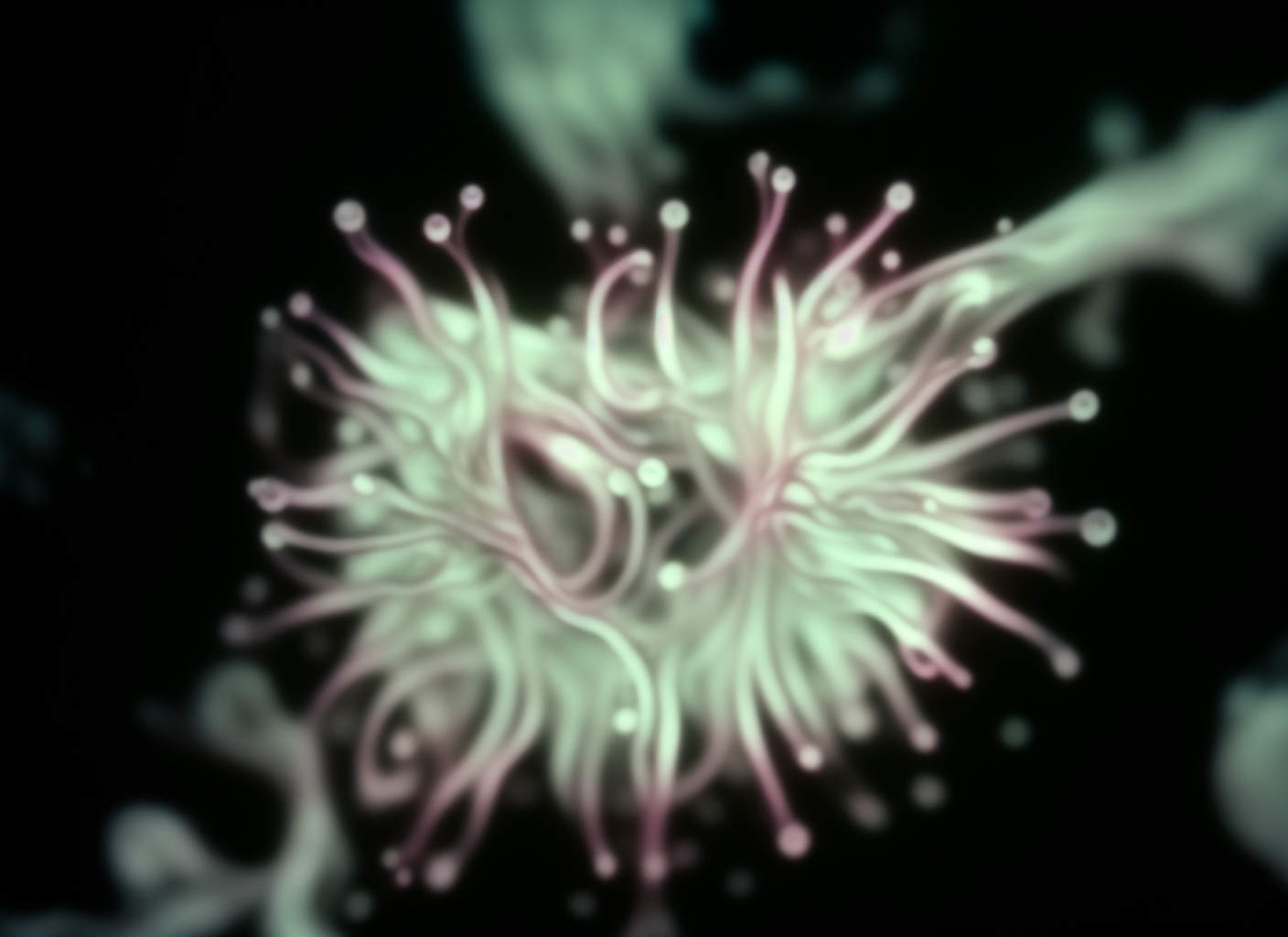
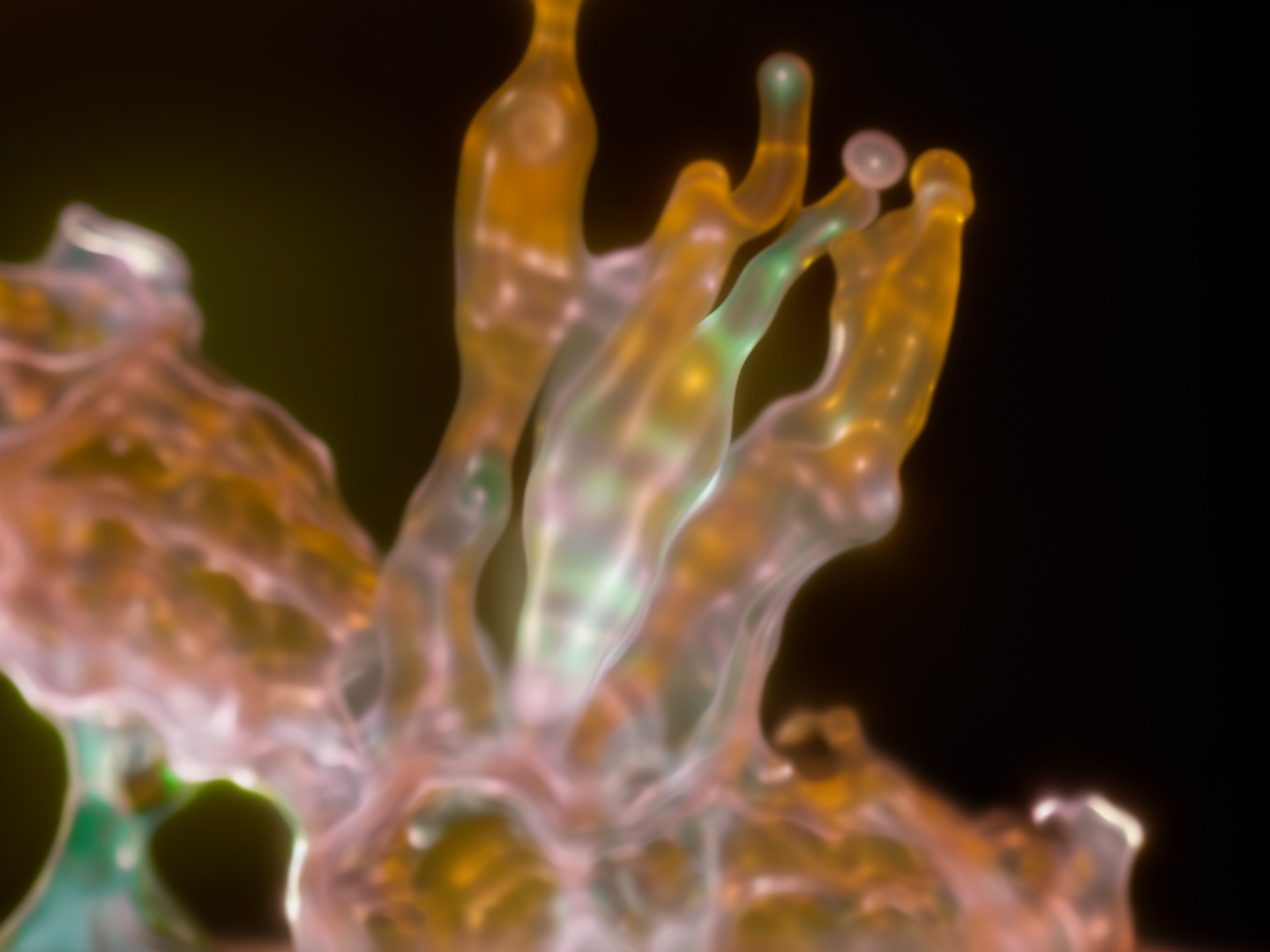
Agnieszka Polska, The Book of Flowers, 2023 (stills). HD video, 9’30”. Courtesy of the artist and Union Pacific, London.
The vertiginous mass and madness of the world of artificially generated imagery can resemble the wildest ceremonial moments. Synthetic computer visuals can have an inherently graphic, stylised tex- ture that eerily matches the visual effects of psychedelic journeys. Neural networks are said to ‘dream’ or ‘hallucinate’ some of their outputs. While it is true that these systems can generate unexpected, weird results – mysterious maps of the processes and data involved in their training – we can only call this ‘hallucinating’ as long as we accept the equally generalising statement that a computer has such a thing as a mind to hallucinate with in the first place. Dreaming and hallucinating are processes that we understand poorly, just as there is no consensus on mind and intelligence: even single-celled organisms qualify, under particular definitions.
When photography was first invented, it changed how reality was perceived. Many of its early users thought this medium able to show things previously invisible, such as ghosts. The consequent emergence of spirit photography gave rise to the production of fascinating, beautiful fakes. Synthetic computer imagery isn’t any better or worse at showing spirits than photography once was. Computers are excellent at overwhelming their user with incredible, quickly produced, seductive images. Taking in a hero dose of synthetic computer imagery will put you in a trance state, granted: though maybe here, you’re actually letting the machine do the tripping for you.
Glitchy blurriness that still feels eerily hi-res; grainy colourful patterns that appear brushed with immaterial hairs; ever-morphing creatures that are half animal, half air. You can suddenly imagine the powerful forces they really represent. The vitally shimmering, tingling sensation of being touched by something uncanny. Meeting the spirit of a hybrid, general, artificial bio-intelligence, its modular limbs made of screens, branches, kitchen appliances and slime.
Have you ever experienced the synthetic images of a culture entirely different from yours? They can appear so unfamiliar, speaking such a different visual vocabulary, that suddenly the demons and deities that show up make new, beautiful, ‘fakes’ again – in the sense of mediated representations – of the very real energies running through those cultures and places.
Artists working with synthetic imagery demonstrate that they can dream with machines by producing, encountering, and then transforming, that which computers are capable of generating.We only ever come close to an experience of co-creation in relation with another consciousness. Whether artificial intelligence is an instantiation or simply an illusion of this, collaborations with computational intelligence have sometimes blossomed into genuinely innovative and unexpected aesthetics.
The fact remains that, as an embodied experience, the outwardly induced trance of synthetic imagery doesn’t easily come close to the presences conjured through breathwork, psychedelic substances, or sheer, concentrated sitting still. In other words, you might prefer to do your study trips yourself.
I’ve always believed that whoever finds it easier to imagine a robot with sentience than a plant, demonstrates that their alienation from the natural world is near-complete. Nevertheless, there are many cultures for whom the idea of other intelligences is so inherent and diverse, that computational functions are merely a software-based version of what has long been present in both hardware and wetware. In this worldview, alternative intelligences exist across different forms of being, whether natural or technological. Some not-quite alive as we know it, yet not inert either. They are ambiguously, weirdly, profoundly, other.
There is otherworldliness in the entire range of alternative intelligences that surrounds us. Advanced, artistic synthetic work, co-created by artists, and even with other life-forms, can put you face-to-face with other intelligences, other centres of experience. It can help shift perceptions. Psychedelic study does something similar: it allows you to re-train your capabilities of perception, so you may experience everything around you as expressive, meaning-making, experiencing subjects.
IMAGE CREDITS
Agnieszka Polska, The Book of Flowers, 2023 (stills). HD video, 9’30”. Courtesy of the artist and Union Pacific, London.
Dirk Vis (1981) is a Dutch author of poetry, (science-)fiction, non-fiction and essays. Vis also published the ‘anti-manual’ Research For People Who (Think They) Would Rather Create. His book Study Trip is a guide to psychedelics for research and art. A ‘study trip’ is a psychedelic journey embarked upon to learn about the world. The book offers a lucid guide through artistic, scientific, social, material and spiritual issues around psychedelics, with the goal of helping you find your own deeper questions.
Agnieszka Polska is a Polish artist and filmmaker. The Book of Flowers is a short science-fiction film that combines artificial Intelligence-powered animation with 16mm film pre-production, presenting an alternative history of the human-plant ecology, where floral species and humans for millennia existed in close symbiosis.


BY DIRK VIS
The vertiginous mass and madness of the world of artificially generated imagery can resemble the wildest ceremonial moments. Synthetic computer visuals can have an inherently graphic, stylised tex- ture that eerily matches the visual effects of psychedelic journeys. Neural networks are said to ‘dream’ or ‘hallucinate’ some of their outputs. While it is true that these systems can generate unexpected, weird results – mysterious maps of the processes and data involved in their training – we can only call this ‘hallucinating’ as long as we accept the equally generalising statement that a computer has such a thing as a mind to hallucinate with in the first place. Dreaming and hallucinating are processes that we understand poorly, just as there is no consensus on mind and intelligence: even single-celled organisms qualify, under particular definitions.
When photography was first invented, it changed how reality was perceived. Many of its early users thought this medium able to show things previously invisible, such as ghosts. The consequent emergence of spirit photography gave rise to the production of fascinating, beautiful fakes. Synthetic computer imagery isn’t any better or worse at showing spirits than photography once was. Computers are excellent at overwhelming their user with incredible, quickly produced, seductive images. Taking in a hero dose of synthetic computer imagery will put you in a trance state, granted: though maybe here, you’re actually letting the machine do the tripping for you.
Glitchy blurriness that still feels eerily hi-res; grainy colourful patterns that appear brushed with immaterial hairs; ever-morphing creatures that are half animal, half air. You can suddenly imagine the powerful forces they really represent. The vitally shimmering, tingling sensation of being touched by something uncanny. Meeting the spirit of a hybrid, general, artificial bio-intelligence, its modular limbs made of screens, branches, kitchen appliances and slime.
Have you ever experienced the synthetic images of a culture entirely different from yours? They can appear so unfamiliar, speaking such a different visual vocabulary, that suddenly the demons and deities that show up make new, beautiful, ‘fakes’ again – in the sense of mediated representations – of the very real energies running through those cultures and places.
Artists working with synthetic imagery demonstrate that they can dream with machines by producing, encountering, and then transforming, that which computers are capable of generating.We only ever come close to an experience of co-creation in relation with another consciousness. Whether artificial intelligence is an instantiation or simply an illusion of this, collaborations with computational intelligence have sometimes blossomed into genuinely innovative and unexpected aesthetics.
The fact remains that, as an embodied experience, the outwardly induced trance of synthetic imagery doesn’t easily come close to the presences conjured through breathwork, psychedelic substances, or sheer, concentrated sitting still. In other words, you might prefer to do your study trips yourself.
I’ve always believed that whoever finds it easier to imagine a robot with sentience than a plant, demonstrates that their alienation from the natural world is near-complete. Nevertheless, there are many cultures for whom the idea of other intelligences is so inherent and diverse, that computational functions are merely a software-based version of what has long been present in both hardware and wetware. In this worldview, alternative intelligences exist across different forms of being, whether natural or technological. Some not-quite alive as we know it, yet not inert either. They are ambiguously, weirdly, profoundly, other.
There is otherworldliness in the entire range of alternative intelligences that surrounds us. Advanced, artistic synthetic work, co-created by artists, and even with other life-forms, can put you face-to-face with other intelligences, other centres of experience. It can help shift perceptions. Psychedelic study does something similar: it allows you to re-train your capabilities of perception, so you may experience everything around you as expressive, meaning-making, experiencing subjects.
IMAGE CREDITS
Agnieszka Polska, The Book of Flowers, 2023 (stills). HD video, 9’30”. Courtesy of the artist and Union Pacific, London.
The vertiginous mass and madness of the world of artificially generated imagery can resemble the wildest ceremonial moments. Synthetic computer visuals can have an inherently graphic, stylised tex- ture that eerily matches the visual effects of psychedelic journeys. Neural networks are said to ‘dream’ or ‘hallucinate’ some of their outputs. While it is true that these systems can generate unexpected, weird results – mysterious maps of the processes and data involved in their training – we can only call this ‘hallucinating’ as long as we accept the equally generalising statement that a computer has such a thing as a mind to hallucinate with in the first place. Dreaming and hallucinating are processes that we understand poorly, just as there is no consensus on mind and intelligence: even single-celled organisms qualify, under particular definitions.
When photography was first invented, it changed how reality was perceived. Many of its early users thought this medium able to show things previously invisible, such as ghosts. The consequent emergence of spirit photography gave rise to the production of fascinating, beautiful fakes. Synthetic computer imagery isn’t any better or worse at showing spirits than photography once was. Computers are excellent at overwhelming their user with incredible, quickly produced, seductive images. Taking in a hero dose of synthetic computer imagery will put you in a trance state, granted: though maybe here, you’re actually letting the machine do the tripping for you.
Glitchy blurriness that still feels eerily hi-res; grainy colourful patterns that appear brushed with immaterial hairs; ever-morphing creatures that are half animal, half air. You can suddenly imagine the powerful forces they really represent. The vitally shimmering, tingling sensation of being touched by something uncanny. Meeting the spirit of a hybrid, general, artificial bio-intelligence, its modular limbs made of screens, branches, kitchen appliances and slime.
Have you ever experienced the synthetic images of a culture entirely different from yours? They can appear so unfamiliar, speaking such a different visual vocabulary, that suddenly the demons and deities that show up make new, beautiful, ‘fakes’ again – in the sense of mediated representations – of the very real energies running through those cultures and places.
Artists working with synthetic imagery demonstrate that they can dream with machines by producing, encountering, and then transforming, that which computers are capable of generating.We only ever come close to an experience of co-creation in relation with another consciousness. Whether artificial intelligence is an instantiation or simply an illusion of this, collaborations with computational intelligence have sometimes blossomed into genuinely innovative and unexpected aesthetics.
The fact remains that, as an embodied experience, the outwardly induced trance of synthetic imagery doesn’t easily come close to the presences conjured through breathwork, psychedelic substances, or sheer, concentrated sitting still. In other words, you might prefer to do your study trips yourself.
I’ve always believed that whoever finds it easier to imagine a robot with sentience than a plant, demonstrates that their alienation from the natural world is near-complete. Nevertheless, there are many cultures for whom the idea of other intelligences is so inherent and diverse, that computational functions are merely a software-based version of what has long been present in both hardware and wetware. In this worldview, alternative intelligences exist across different forms of being, whether natural or technological. Some not-quite alive as we know it, yet not inert either. They are ambiguously, weirdly, profoundly, other.
There is otherworldliness in the entire range of alternative intelligences that surrounds us. Advanced, artistic synthetic work, co-created by artists, and even with other life-forms, can put you face-to-face with other intelligences, other centres of experience. It can help shift perceptions. Psychedelic study does something similar: it allows you to re-train your capabilities of perception, so you may experience everything around you as expressive, meaning-making, experiencing subjects.
IMAGE CREDITS
Agnieszka Polska, The Book of Flowers, 2023 (stills). HD video, 9’30”. Courtesy of the artist and Union Pacific, London.
Dirk Vis (1981) is a Dutch author of poetry, (science-)fiction, non-fiction and essays. Vis also published the ‘anti-manual’ Research For People Who (Think They) Would Rather Create. His book Study Trip is a guide to psychedelics for research and art. A ‘study trip’ is a psychedelic journey embarked upon to learn about the world. The book offers a lucid guide through artistic, scientific, social, material and spiritual issues around psychedelics, with the goal of helping you find your own deeper questions.
Agnieszka Polska is a Polish artist and filmmaker. The Book of Flowers is a short science-fiction film that combines artificial Intelligence-powered animation with 16mm film pre-production, presenting an alternative history of the human-plant ecology, where floral species and humans for millennia existed in close symbiosis.
BY DIRK VIS
The vertiginous mass and madness of the world of artificially generated imagery can resemble the wildest ceremonial moments. Synthetic computer visuals can have an inherently graphic, stylised tex- ture that eerily matches the visual effects of psychedelic journeys. Neural networks are said to ‘dream’ or ‘hallucinate’ some of their outputs. While it is true that these systems can generate unexpected, weird results – mysterious maps of the processes and data involved in their training – we can only call this ‘hallucinating’ as long as we accept the equally generalising statement that a computer has such a thing as a mind to hallucinate with in the first place. Dreaming and hallucinating are processes that we understand poorly, just as there is no consensus on mind and intelligence: even single-celled organisms qualify, under particular definitions.
When photography was first invented, it changed how reality was perceived. Many of its early users thought this medium able to show things previously invisible, such as ghosts. The consequent emergence of spirit photography gave rise to the production of fascinating, beautiful fakes. Synthetic computer imagery isn’t any better or worse at showing spirits than photography once was. Computers are excellent at overwhelming their user with incredible, quickly produced, seductive images. Taking in a hero dose of synthetic computer imagery will put you in a trance state, granted: though maybe here, you’re actually letting the machine do the tripping for you.
Glitchy blurriness that still feels eerily hi-res; grainy colourful patterns that appear brushed with immaterial hairs; ever-morphing creatures that are half animal, half air. You can suddenly imagine the powerful forces they really represent. The vitally shimmering, tingling sensation of being touched by something uncanny. Meeting the spirit of a hybrid, general, artificial bio-intelligence, its modular limbs made of screens, branches, kitchen appliances and slime.
Have you ever experienced the synthetic images of a culture entirely different from yours? They can appear so unfamiliar, speaking such a different visual vocabulary, that suddenly the demons and deities that show up make new, beautiful, ‘fakes’ again – in the sense of mediated representations – of the very real energies running through those cultures and places.
Artists working with synthetic imagery demonstrate that they can dream with machines by producing, encountering, and then transforming, that which computers are capable of generating.We only ever come close to an experience of co-creation in relation with another consciousness. Whether artificial intelligence is an instantiation or simply an illusion of this, collaborations with computational intelligence have sometimes blossomed into genuinely innovative and unexpected aesthetics.
The fact remains that, as an embodied experience, the outwardly induced trance of synthetic imagery doesn’t easily come close to the presences conjured through breathwork, psychedelic substances, or sheer, concentrated sitting still. In other words, you might prefer to do your study trips yourself.
I’ve always believed that whoever finds it easier to imagine a robot with sentience than a plant, demonstrates that their alienation from the natural world is near-complete. Nevertheless, there are many cultures for whom the idea of other intelligences is so inherent and diverse, that computational functions are merely a software-based version of what has long been present in both hardware and wetware. In this worldview, alternative intelligences exist across different forms of being, whether natural or technological. Some not-quite alive as we know it, yet not inert either. They are ambiguously, weirdly, profoundly, other.
There is otherworldliness in the entire range of alternative intelligences that surrounds us. Advanced, artistic synthetic work, co-created by artists, and even with other life-forms, can put you face-to-face with other intelligences, other centres of experience. It can help shift perceptions. Psychedelic study does something similar: it allows you to re-train your capabilities of perception, so you may experience everything around you as expressive, meaning-making, experiencing subjects.
IMAGE CREDITS
Agnieszka Polska, The Book of Flowers, 2023 (stills). HD video, 9’30”. Courtesy of the artist and Union Pacific, London.
The vertiginous mass and madness of the world of artificially generated imagery can resemble the wildest ceremonial moments. Synthetic computer visuals can have an inherently graphic, stylised tex- ture that eerily matches the visual effects of psychedelic journeys. Neural networks are said to ‘dream’ or ‘hallucinate’ some of their outputs. While it is true that these systems can generate unexpected, weird results – mysterious maps of the processes and data involved in their training – we can only call this ‘hallucinating’ as long as we accept the equally generalising statement that a computer has such a thing as a mind to hallucinate with in the first place. Dreaming and hallucinating are processes that we understand poorly, just as there is no consensus on mind and intelligence: even single-celled organisms qualify, under particular definitions.
When photography was first invented, it changed how reality was perceived. Many of its early users thought this medium able to show things previously invisible, such as ghosts. The consequent emergence of spirit photography gave rise to the production of fascinating, beautiful fakes. Synthetic computer imagery isn’t any better or worse at showing spirits than photography once was. Computers are excellent at overwhelming their user with incredible, quickly produced, seductive images. Taking in a hero dose of synthetic computer imagery will put you in a trance state, granted: though maybe here, you’re actually letting the machine do the tripping for you.
Glitchy blurriness that still feels eerily hi-res; grainy colourful patterns that appear brushed with immaterial hairs; ever-morphing creatures that are half animal, half air. You can suddenly imagine the powerful forces they really represent. The vitally shimmering, tingling sensation of being touched by something uncanny. Meeting the spirit of a hybrid, general, artificial bio-intelligence, its modular limbs made of screens, branches, kitchen appliances and slime.
Have you ever experienced the synthetic images of a culture entirely different from yours? They can appear so unfamiliar, speaking such a different visual vocabulary, that suddenly the demons and deities that show up make new, beautiful, ‘fakes’ again – in the sense of mediated representations – of the very real energies running through those cultures and places.
Artists working with synthetic imagery demonstrate that they can dream with machines by producing, encountering, and then transforming, that which computers are capable of generating.We only ever come close to an experience of co-creation in relation with another consciousness. Whether artificial intelligence is an instantiation or simply an illusion of this, collaborations with computational intelligence have sometimes blossomed into genuinely innovative and unexpected aesthetics.
The fact remains that, as an embodied experience, the outwardly induced trance of synthetic imagery doesn’t easily come close to the presences conjured through breathwork, psychedelic substances, or sheer, concentrated sitting still. In other words, you might prefer to do your study trips yourself.
I’ve always believed that whoever finds it easier to imagine a robot with sentience than a plant, demonstrates that their alienation from the natural world is near-complete. Nevertheless, there are many cultures for whom the idea of other intelligences is so inherent and diverse, that computational functions are merely a software-based version of what has long been present in both hardware and wetware. In this worldview, alternative intelligences exist across different forms of being, whether natural or technological. Some not-quite alive as we know it, yet not inert either. They are ambiguously, weirdly, profoundly, other.
There is otherworldliness in the entire range of alternative intelligences that surrounds us. Advanced, artistic synthetic work, co-created by artists, and even with other life-forms, can put you face-to-face with other intelligences, other centres of experience. It can help shift perceptions. Psychedelic study does something similar: it allows you to re-train your capabilities of perception, so you may experience everything around you as expressive, meaning-making, experiencing subjects.
IMAGE CREDITS
Agnieszka Polska, The Book of Flowers, 2023 (stills). HD video, 9’30”. Courtesy of the artist and Union Pacific, London.
Dirk Vis (1981) is a Dutch author of poetry, (science-)fiction, non-fiction and essays. Vis also published the ‘anti-manual’ Research For People Who (Think They) Would Rather Create. His book Study Trip is a guide to psychedelics for research and art. A ‘study trip’ is a psychedelic journey embarked upon to learn about the world. The book offers a lucid guide through artistic, scientific, social, material and spiritual issues around psychedelics, with the goal of helping you find your own deeper questions.
Agnieszka Polska is a Polish artist and filmmaker. The Book of Flowers is a short science-fiction film that combines artificial Intelligence-powered animation with 16mm film pre-production, presenting an alternative history of the human-plant ecology, where floral species and humans for millennia existed in close symbiosis.
BY DIRK VIS
The vertiginous mass and madness of the world of artificially generated imagery can resemble the wildest ceremonial moments. Synthetic computer visuals can have an inherently graphic, stylised tex- ture that eerily matches the visual effects of psychedelic journeys. Neural networks are said to ‘dream’ or ‘hallucinate’ some of their outputs. While it is true that these systems can generate unexpected, weird results – mysterious maps of the processes and data involved in their training – we can only call this ‘hallucinating’ as long as we accept the equally generalising statement that a computer has such a thing as a mind to hallucinate with in the first place. Dreaming and hallucinating are processes that we understand poorly, just as there is no consensus on mind and intelligence: even single-celled organisms qualify, under particular definitions.
When photography was first invented, it changed how reality was perceived. Many of its early users thought this medium able to show things previously invisible, such as ghosts. The consequent emergence of spirit photography gave rise to the production of fascinating, beautiful fakes. Synthetic computer imagery isn’t any better or worse at showing spirits than photography once was. Computers are excellent at overwhelming their user with incredible, quickly produced, seductive images. Taking in a hero dose of synthetic computer imagery will put you in a trance state, granted: though maybe here, you’re actually letting the machine do the tripping for you.
Glitchy blurriness that still feels eerily hi-res; grainy colourful patterns that appear brushed with immaterial hairs; ever-morphing creatures that are half animal, half air. You can suddenly imagine the powerful forces they really represent. The vitally shimmering, tingling sensation of being touched by something uncanny. Meeting the spirit of a hybrid, general, artificial bio-intelligence, its modular limbs made of screens, branches, kitchen appliances and slime.
Have you ever experienced the synthetic images of a culture entirely different from yours? They can appear so unfamiliar, speaking such a different visual vocabulary, that suddenly the demons and deities that show up make new, beautiful, ‘fakes’ again – in the sense of mediated representations – of the very real energies running through those cultures and places.
Artists working with synthetic imagery demonstrate that they can dream with machines by producing, encountering, and then transforming, that which computers are capable of generating.We only ever come close to an experience of co-creation in relation with another consciousness. Whether artificial intelligence is an instantiation or simply an illusion of this, collaborations with computational intelligence have sometimes blossomed into genuinely innovative and unexpected aesthetics.
The fact remains that, as an embodied experience, the outwardly induced trance of synthetic imagery doesn’t easily come close to the presences conjured through breathwork, psychedelic substances, or sheer, concentrated sitting still. In other words, you might prefer to do your study trips yourself.
I’ve always believed that whoever finds it easier to imagine a robot with sentience than a plant, demonstrates that their alienation from the natural world is near-complete. Nevertheless, there are many cultures for whom the idea of other intelligences is so inherent and diverse, that computational functions are merely a software-based version of what has long been present in both hardware and wetware. In this worldview, alternative intelligences exist across different forms of being, whether natural or technological. Some not-quite alive as we know it, yet not inert either. They are ambiguously, weirdly, profoundly, other.
There is otherworldliness in the entire range of alternative intelligences that surrounds us. Advanced, artistic synthetic work, co-created by artists, and even with other life-forms, can put you face-to-face with other intelligences, other centres of experience. It can help shift perceptions. Psychedelic study does something similar: it allows you to re-train your capabilities of perception, so you may experience everything around you as expressive, meaning-making, experiencing subjects.
IMAGE CREDITS
Agnieszka Polska, The Book of Flowers, 2023 (stills). HD video, 9’30”. Courtesy of the artist and Union Pacific, London.
The vertiginous mass and madness of the world of artificially generated imagery can resemble the wildest ceremonial moments. Synthetic computer visuals can have an inherently graphic, stylised tex- ture that eerily matches the visual effects of psychedelic journeys. Neural networks are said to ‘dream’ or ‘hallucinate’ some of their outputs. While it is true that these systems can generate unexpected, weird results – mysterious maps of the processes and data involved in their training – we can only call this ‘hallucinating’ as long as we accept the equally generalising statement that a computer has such a thing as a mind to hallucinate with in the first place. Dreaming and hallucinating are processes that we understand poorly, just as there is no consensus on mind and intelligence: even single-celled organisms qualify, under particular definitions.
When photography was first invented, it changed how reality was perceived. Many of its early users thought this medium able to show things previously invisible, such as ghosts. The consequent emergence of spirit photography gave rise to the production of fascinating, beautiful fakes. Synthetic computer imagery isn’t any better or worse at showing spirits than photography once was. Computers are excellent at overwhelming their user with incredible, quickly produced, seductive images. Taking in a hero dose of synthetic computer imagery will put you in a trance state, granted: though maybe here, you’re actually letting the machine do the tripping for you.
Glitchy blurriness that still feels eerily hi-res; grainy colourful patterns that appear brushed with immaterial hairs; ever-morphing creatures that are half animal, half air. You can suddenly imagine the powerful forces they really represent. The vitally shimmering, tingling sensation of being touched by something uncanny. Meeting the spirit of a hybrid, general, artificial bio-intelligence, its modular limbs made of screens, branches, kitchen appliances and slime.
Have you ever experienced the synthetic images of a culture entirely different from yours? They can appear so unfamiliar, speaking such a different visual vocabulary, that suddenly the demons and deities that show up make new, beautiful, ‘fakes’ again – in the sense of mediated representations – of the very real energies running through those cultures and places.
Artists working with synthetic imagery demonstrate that they can dream with machines by producing, encountering, and then transforming, that which computers are capable of generating.We only ever come close to an experience of co-creation in relation with another consciousness. Whether artificial intelligence is an instantiation or simply an illusion of this, collaborations with computational intelligence have sometimes blossomed into genuinely innovative and unexpected aesthetics.
The fact remains that, as an embodied experience, the outwardly induced trance of synthetic imagery doesn’t easily come close to the presences conjured through breathwork, psychedelic substances, or sheer, concentrated sitting still. In other words, you might prefer to do your study trips yourself.
I’ve always believed that whoever finds it easier to imagine a robot with sentience than a plant, demonstrates that their alienation from the natural world is near-complete. Nevertheless, there are many cultures for whom the idea of other intelligences is so inherent and diverse, that computational functions are merely a software-based version of what has long been present in both hardware and wetware. In this worldview, alternative intelligences exist across different forms of being, whether natural or technological. Some not-quite alive as we know it, yet not inert either. They are ambiguously, weirdly, profoundly, other.
There is otherworldliness in the entire range of alternative intelligences that surrounds us. Advanced, artistic synthetic work, co-created by artists, and even with other life-forms, can put you face-to-face with other intelligences, other centres of experience. It can help shift perceptions. Psychedelic study does something similar: it allows you to re-train your capabilities of perception, so you may experience everything around you as expressive, meaning-making, experiencing subjects.
IMAGE CREDITS
Agnieszka Polska, The Book of Flowers, 2023 (stills). HD video, 9’30”. Courtesy of the artist and Union Pacific, London.
Dirk Vis (1981) is a Dutch author of poetry, (science-)fiction, non-fiction and essays. Vis also published the ‘anti-manual’ Research For People Who (Think They) Would Rather Create. His book Study Trip is a guide to psychedelics for research and art. A ‘study trip’ is a psychedelic journey embarked upon to learn about the world. The book offers a lucid guide through artistic, scientific, social, material and spiritual issues around psychedelics, with the goal of helping you find your own deeper questions.
Agnieszka Polska is a Polish artist and filmmaker. The Book of Flowers is a short science-fiction film that combines artificial Intelligence-powered animation with 16mm film pre-production, presenting an alternative history of the human-plant ecology, where floral species and humans for millennia existed in close symbiosis.